




Two friends, Aarav and Rohan, start investing ₹10,000 a month in the Indian stock market on the same day. Aarav spends his mornings reading market news, sells his shares whenever the Nifty drops out of fear, and waits on the sidelines for a safer entry point. Rohan buys shares in quality businesses every month and leaves his portfolio untouched through market rallies and crashes alike. Ten years later, Rohan’s wealth has multiplied several times over, while Aarav has barely beaten a basic savings account.
Long-term wealth from investing in stock markets rarely comes from catching a sudden multibagger or predicting tomorrow's index level. Real results depend on how long you stay invested, how you spread your money across different sectors, and how calmly you react when prices fall.
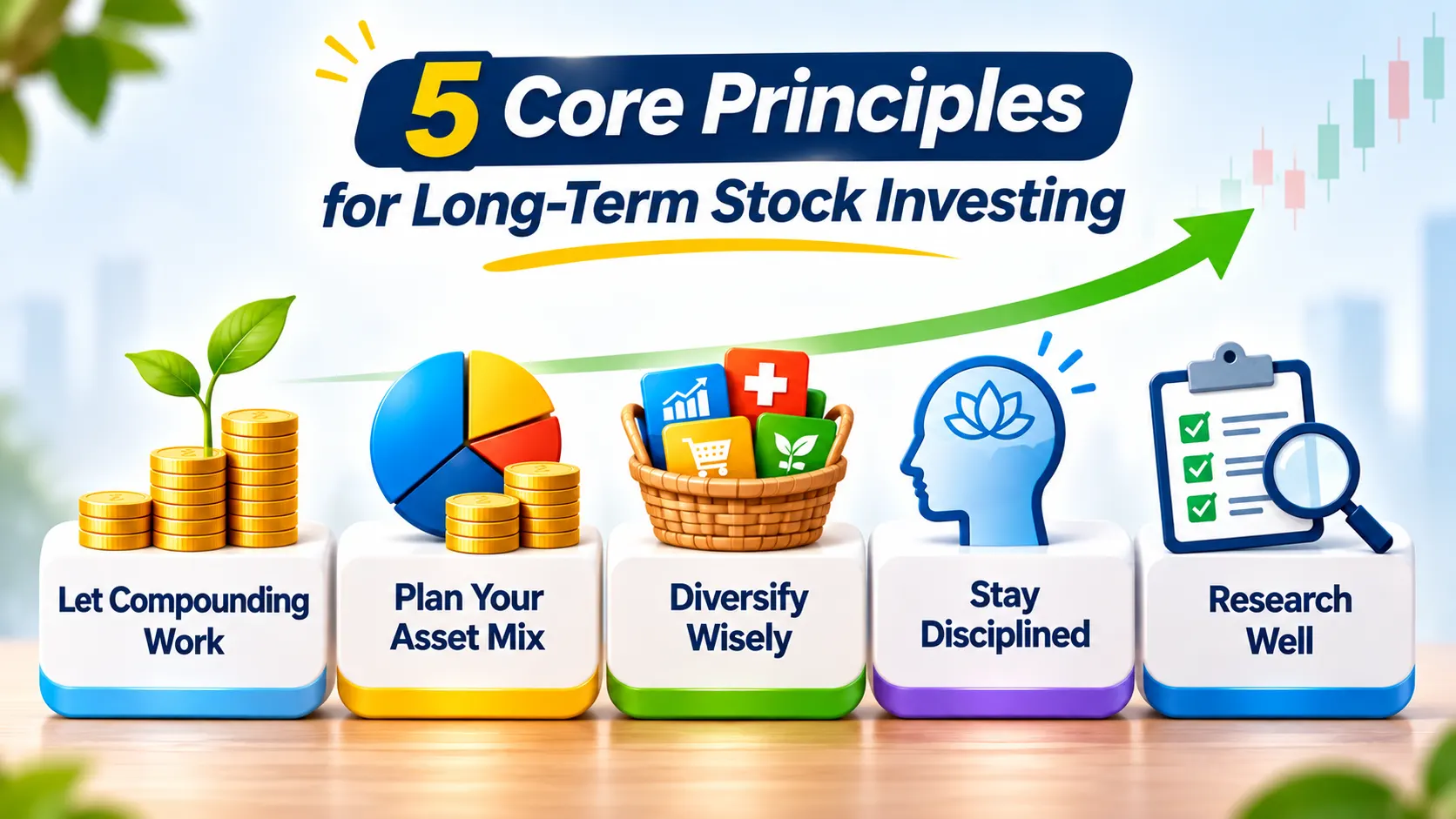
You do not need complicated formulas to build a strong portfolio over the next ten or twenty years. Five foundational principles will keep your decisions disciplined and help your money grow steadily over time.
1. Time in the Market Beats Timing the Market
One of the most important principles of investing in stocks is to stay invested for the long term rather than trying to predict the perfect time to enter or exit the market.
Stock prices move up and down regularly. Even experienced investors find it difficult to identify the exact market bottom or the best time to sell. Trying to time every market movement can also make you miss important recovery periods.
The Nifty 50 provides an interesting example. Missing just the 10 best trading days over 20 years can reduce annualised returns by approximately 3% to 4% per year. These strong trading days often occur around market corrections. Investors who panic and exit during downturns may miss these recovery opportunities.
This is where the power of compounding becomes important. When you stay invested, your returns can generate further returns over time. Starting early gives your investments more time to benefit from this process.
Ideally, investors should approach equity investments with a holding period of at least 2–3 years, while 4–5 years or longer can provide a more suitable horizon for long-term wealth creation.
Systematic Investment Plans (SIPs) can also help maintain investment discipline. They allow investors to invest regularly through different market conditions instead of waiting for the perfect entry point.
Practical takeaway: Focus on staying invested rather than predicting every market movement. Give your investments enough time to grow and avoid making decisions based on short-term market fluctuations.


2. Focus on Asset Allocation Before Selecting Stocks
Before deciding which stocks or mutual funds to invest in, decide how much money you should allocate to different asset classes. This process is called asset allocation, and it plays an important role in determining your portfolio's long-term performance.
Your asset allocation should depend on three factors: financial goals, risk tolerance, and investment horizon.
For example, someone investing for a goal several years away may be comfortable with a higher equity allocation. However, someone who needs the money soon may benefit from keeping a larger portion in debt or other lower-risk options.
Another important step is to build an emergency fund before taking significant equity exposure. Ideally, this fund should cover at least six months of essential expenses and remain in safe, easily accessible instruments.
Similarly, money required within roughly three years should generally be kept in low-risk options. This reduces the chances of being forced to sell stocks during a market downturn to meet an immediate financial need.
You should also rebalance your portfolio periodically. Rebalancing means bringing your investments back to their planned allocation. If a market rally increases your equity exposure beyond the target, you may need to reduce it. If a market decline lowers your equity allocation, you may consider adding to it.
So, build your investment allocation around your financial goals and ability to handle risk before choosing individual stocks or funds.
3. Choose Meaningful Diversification Over Too Many Investments
Portfolio diversification means spreading your investments across different assets, industries, and market capitalisations to reduce concentration risk. Simply holding more stocks or mutual funds does not automatically make your portfolio diversified.
For example, investing in several funds that hold almost the same top stocks may look diversified without providing much additional protection.
A well-diversified equity portfolio should have exposure to different market capitalisations, including large-cap, mid-cap, and small-cap stocks. It should also cover different industry sectors so your entire portfolio doesn't depend on one industry's performance.
You should also understand the difference between asset allocation and diversification. Asset allocation divides your money across asset classes such as equity, debt, gold, and real estate. Diversification spreads investments within those asset classes.
Another common mistake is holding too many mutual funds. Owning 15 different equity funds does not necessarily improve diversification. Many of them may hold similar companies, while each fund adds another expense ratio to your overall costs.
For many investors, 5–7 carefully selected funds across different categories can provide meaningful diversification without making portfolio management unnecessarily complicated.
Avoid putting too much money into a single popular sector or investment theme. For example, allocating 80% of your portfolio to one sector can expose you to significant losses if that industry's conditions deteriorate.
So, focus on what your investments actually hold rather than how many stocks or funds appear in your portfolio. Choose investments across different categories and avoid excessive concentration.
4. Control Your Emotions and Understand Investment Risk
Your investment decisions should be based on research and financial goals, not fear, excitement, or social media trends. Emotional reactions are among the common reasons investors make poor decisions in the stock market.
Some investors buy stocks when everyone is excited about a particular company or sector. Others panic and sell their investments when the market starts falling. Following unverified stock tips and speculative trends can create similar problems.
To invest with discipline, it is important to understand the difference between volatility and actual investment risk.
Volatility refers to the regular up-and-down movement in stock prices. These movements are a normal part of equity investing. True risk is the possibility of permanently losing your capital or failing to achieve your long-term financial goals.
Equity markets can experience declines of 20% to 40%. Your investment allocation should be planned around your ability to handle such declines without facing genuine financial hardship or feeling forced to sell your investments.
Another important point is to avoid treating short-term trading and derivatives as long-term investing strategies. Frequent trading can increase losses through poor timing, taxes, and high transaction activity. SEBI analyses also show that the vast majority of retail derivatives traders lose money.
Practical takeaway: Do not make investment decisions based on market excitement or panic. Understand the risks before investing and choose an equity allocation that you can comfortably maintain during market downturns.
5. Research Businesses and Keep Investment Costs Under Control
Long-term stock market investing requires proper research and attention to costs. Before investing in a company, understand its business, competition, growth prospects, and the quality of its earnings rather than relying on unverified tips or revenue growth alone.
A company may report strong revenue growth, but investors should also examine whether that growth is translating into healthy bottom-line earnings. Understanding its entry barriers and competitive position can also help you evaluate its business prospects.
Investment costs deserve equal attention because even a small additional expense can reduce your wealth significantly over a long period.
Consider a portfolio worth ₹50 lakh growing at an assumed annual rate of 13% over 20 years. An additional annual expense ratio of 1% can reduce the final portfolio value by approximately ₹50–₹60 lakh.
This shows why controlling investment costs matters. Here are a few practical steps.
- Prefer direct mutual fund plans: Direct plans can help save approximately 0.5% to 1.0% annually in expense ratios compared with regular plans.
- Keep your portfolio manageable: Limit your holdings to 5–7 well-selected funds where appropriate.
- Avoid frequent switching: Unnecessary buying and selling can increase capital gains taxes and reduce net returns.
- Review your investments regularly: Check your portfolio quarterly or annually to review financial statements, institutional activity, and alignment with your financial goals.
- Maintain an investment audit trail: Record your investment decisions so you can understand past mistakes and improve your future decisions.
So, research the business before investing and pay attention to the costs involved. Small differences in annual expenses can have a significant impact on long-term wealth.
Frequently Asked Questions
1. What is the best way to invest in stocks for the long term?
The best approach is to invest according to your financial goals, diversify your portfolio, research businesses, and stay invested for the long term. Avoid making decisions based on short-term market movements.
2. How much time should you stay invested in stocks?
Equity investments should ideally have a holding period of at least 2–3 years. A horizon of 4–5 years or longer can provide more time for businesses and investments to grow.
3. How can beginners start investing in the stock market?
Beginners should first understand their financial goals, risk tolerance, and investment horizon. Building an emergency fund, learning about asset allocation, and researching investments can help them develop a disciplined approach.
4. Why is diversification important in stock market investing?
Diversification helps reduce concentration risk by spreading investments across different companies, sectors, and market capitalisations. It reduces dependence on the performance of a single stock or industry.
5. Is investing in more stocks always better?
No. Holding more stocks does not automatically improve diversification. The quality and variety of investments matter more than the number of holdings.
Conclusion
Building long-term wealth through investing in stocks requires more than finding promising companies. It requires patience, proper asset allocation, meaningful diversification, emotional discipline, and regular research.
These five principles can help investors make informed decisions and avoid common mistakes. Rather than chasing quick returns, focus on building a portfolio that matches your financial goals and risk tolerance.
Looking to make smarter investment decisions? Connect with Swastika Investmart to review your portfolio, explore investment opportunities and take a more informed approach to your stock market journey.