


5 Different Types of Investments in the Share Market Based on Your Capital and Risk Appetite


Two friends sit down to invest ₹50,000 each in the stock market. One needs that money back in two years for a wedding and wants safe, steady growth. The other is saving for retirement twenty years away and does not mind sharp price ups and downs along the way.
So, investing in one stock will never work for both of them. Every person has a different budget, timeline, and comfort level when share prices fall. The choices you make in the market should match your own goals rather than copying someone else.
You can invest in the share market through five main options: large-cap stocks, mid-cap stocks, small-cap stocks, direct shares, and equity mutual funds. Each option offers a different mix of safety and profit potential, and knowing how they work makes it easy to pick the right one for your money.
Try Sarthi -Your AI Stock Assistant
5 Different Types of Investments in the Share Market
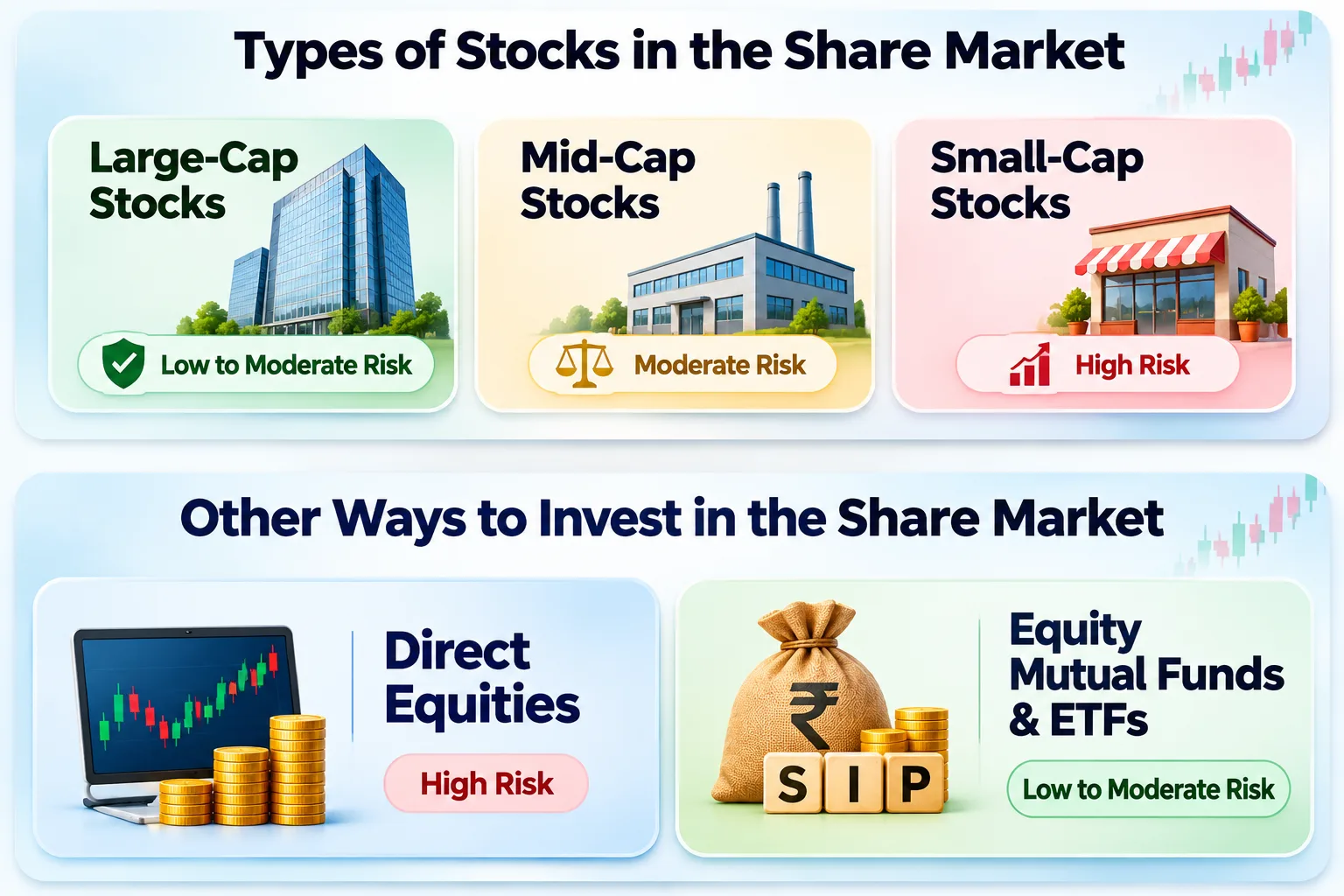
1. Large-Cap Stocks and Funds (Low-to-Moderate Risk)
Large-cap stocks are shares of the top 100 publicly listed companies ranked by market capitalisation. These companies are generally well-established businesses with strong balance sheets, steady earnings, and a history of regular dividend payouts. Examples include Reliance, HDFC Bank, and TCS.
Large-cap investments are generally considered suitable for investors who prioritise stability over rapid growth. Established companies tend to experience smaller price declines during market downturns compared to smaller businesses, although they are not completely protected from market risks.
The capital requirement for large-cap investments is moderate to high, making them more suitable for investors who have sufficient funds and prefer relatively stable businesses. They can be considered by conservative investors, retirees, and people with shorter investment horizons who prioritise capital preservation.
So, investors who prefer established businesses and are comfortable with moderate growth potential rather than taking higher risks for faster growth.


2. Mid-Cap Stocks and Funds (Moderate Risk)
Mid-cap stocks represent companies ranked between 101 and 250 by market capitalisation. These businesses are generally established but are still expanding their operations and working towards becoming larger companies.
Mid-cap investments offer a balance between stability and growth potential. They can provide higher growth opportunities than large-cap companies, but their share prices can also experience greater fluctuations. Investors should be prepared for market declines and temporary losses.
The capital requirement is flexible and moderate. These investments are generally suitable for people with a medium to long investment horizon, particularly those who can remain invested for 5–10 years and tolerate drawdowns of 15–25%.
Who should consider them? Investors with a moderate to moderately aggressive risk appetite who want a balance between business stability and long-term capital growth.
3. Small-Cap Stocks and Funds (High Risk)
Small-cap stocks represent companies ranked 251 and beyond by market capitalisation. These businesses are generally smaller and may still be expanding their operations. They offer higher growth potential, but they also carry greater investment risks.
Small-cap companies can experience significant share price fluctuations, particularly during market downturns. Their prices may fall sharply, making them less suitable for investors who cannot tolerate short-term losses.
The capital requirement is flexible, which means investors can start with smaller amounts and invest over a longer period. However, the higher risk makes investment duration especially important. These investments are generally more suitable for aggressive investors with a 10+ year horizon who can remain invested through market fluctuations.
Who should consider them? Younger working professionals and experienced investors with a high risk appetite who are comfortable with short-term volatility and have a long-term investment approach.
4. Direct Equities and Targeted Growth or Value Stocks (High Risk)
Direct equity investment means buying shares of individual companies instead of investing through a pooled investment fund. It gives investors direct ownership in the selected companies and allows them to benefit from potential capital appreciation and dividend income.
However, direct equity investing requires investors to research and evaluate individual businesses. Unlike diversified funds, an investment in a single company carries greater exposure to company-specific risks. Poor business performance can directly affect the value of an investor's holdings.
Investors can follow different approaches when selecting individual stocks. Two common strategies are growth investing and value investing.
Growth investing focuses on companies expected to grow faster than the average market. Investors look for businesses with strong growth opportunities and the potential to increase their earnings over time.
Value investing involves identifying stocks that appear undervalued compared to their financial performance and business fundamentals. Investors may use financial measures such as the Price-to-Earnings (P/E) ratio, Price-to-Book (P/B) ratio, and Earnings Per Share (EPS) to evaluate these opportunities.
Direct equity investing requires high capital flexibility or a separate tactical allocation. It is generally more suitable for active investors who understand financial statements, can evaluate business performance, and have a high risk tolerance.
Who should consider Direct Equities and Targeted Growth or Value Stocks?
Investors with market knowledge who are willing to research individual companies and manage the risks associated with direct stock ownership.
5. Equity Mutual Funds and ETFs Through SIP (Low-to-Moderate Risk)
Equity mutual funds and Exchange-Traded Funds (ETFs) allow investors to participate in the share market without selecting every individual stock themselves. Mutual funds are managed by professional fund managers, while index-tracking ETFs aim to follow the performance of a particular market index.
One of their main advantages is diversification. Instead of investing all your money in one company, these investment options spread your money across multiple companies and sectors, such as technology, healthcare, and banking. This helps reduce the risk associated with depending on a single stock.
Investors can also use a Systematic Investment Plan (SIP) calculator to calculate the possible return by investing a fixed amount regularly. This approach allows them to start with low initial capital and build an investment habit over time without trying to predict market movements.
Equity mutual funds and ETFs can be suitable for beginners, busy professionals, and investors who want exposure to the share market without actively researching individual stocks. However, diversification does not eliminate market risk, and equity investments can still experience losses.
Who should consider Equity Mutual Funds and ETFs Through SIP?
Investors who prefer a structured investment approach, want diversified stock market exposure, and have limited time or experience to select individual shares.
How to Choose the Right Share Market Investment Based on Your Risk Appetite
The right investment depends on your available capital, ability to handle losses, financial goals, and investment duration. Before investing, understand how much risk you are comfortable taking.
Conservative investors can consider large-cap stocks and diversified equity funds. These options focus on established businesses or spread investments across multiple companies.
Moderate investors can explore mid-cap stocks and funds. They offer a balance between stability and growth potential, although investors should be prepared for greater price fluctuations.
Aggressive investors can consider small-cap stocks and direct equities. These options offer higher growth potential but also carry greater risks. A longer investment horizon can help aggressive investors stay invested through short-term market fluctuations.
Your investment decision should not depend on risk appetite alone. Consider how much capital you can invest and when you may need the money. Avoid investing money that you may need in the short term in highly volatile stocks.
Comparison of 5 Share Market Investment Options
Frequently Asked Questions
1. How to invest in the share market as a beginner?
Beginners can consider equity mutual funds or ETFs through SIPs. These options provide diversified market exposure and allow investors to start with smaller amounts. Understanding investment risks and financial goals is important before investing.
2. Which share market investment is suitable for low capital?
Equity mutual funds and ETFs through SIPs can be suitable for investors with low initial capital. They allow regular investments without requiring investors to purchase individual shares of multiple companies.
3. Which type of share market investment carries the highest risk?
Small-cap stocks and direct equities generally carry high risks. Small-cap companies can experience significant price fluctuations, while direct equity investors face risks associated with individual businesses.
4. Are mutual funds safer than direct stocks?
Mutual funds and ETFs offer diversification across multiple companies, which helps reduce individual stock risk. However, they are still exposed to market movements and can experience losses.
Conclusion
Choosing the right investment in the share market starts with knowing your budget, risk comfort, and financial goals. Large-cap stocks suit investors who want steady growth, while mid-cap and small-cap stocks offer higher return potential along with sharper price swings. Direct equities give you full control over what you own, whereas mutual funds and ETFs spread your money across many companies automatically. The best path matches your timeline and lets you sleep peacefully at night; you can take that first step now by opening a Demat and trading account with Swastika Investmart to access research-backed stock ideas, reliable trading tools, and dedicated support for your wealth journey.