

How to Pick the Best Discount Broker in India Without Losing Quality


Opening your first Demat account today feels a bit like walking into a massive, noisy bazaar. Everyone is waving a bigger discount in your face with "Zero brokerage!" "Free account opening!" "Flat ₹20 on everything!"
A few years ago, picking a broker meant calling up a local relationship manager, filling out stacks of paperwork, and paying a hefty percentage on every single trade. Discount brokers completely flipped that script, stripping away pricey branch networks and advisory teams to make investing affordable for everyday Indians.
That democratisation is great, until you realise that flashy banners rarely tell the whole story. Once the excitement of "zero fees" wears off, the real cost of a mediocre broker starts showing up in sneaky ways, such as a sudden glitch on expiry day, an unexpected AMC deduction, or a support ticket that sits unanswered for three days while your funds are stuck in limbo. So, finding the right platform isn't a race to the bottom on fees, it’s about finding a partner that won't let you down when real money is on the line.
Before you sign up for the first app with a slick ad, walk through these four practical steps to pick the best discount broker that delivers on both price and reliability.


1. Check the Broker's SEBI Registration and Regulatory Credentials
Before comparing brokerage charges or trading features, verify whether the broker is properly registered with the relevant regulatory authorities. Regulatory registration helps establish that the broker operates within the applicable market framework.
Start by checking the broker's SEBI registration number and active exchange memberships. A broker offering stock trading services should clearly disclose its registration details and relevant memberships, such as NSE, BSE, or MCX. You should also check where your demat account is maintained. India has two official depositories, CDSL and NSDL. Your broker should act as a registered Depository Participant (DP) to provide demat services.
Another useful step is reviewing monthly investor complaint disclosures published by NSE and BSE. These disclosures show the number of complaints received relative to the broker's active client count. A broker with transparent regulatory information and accessible complaint disclosures gives you a better starting point for evaluating its reliability. Do not open an account without completing these basic checks.
2. Compare Total Trading Costs Instead of Brokerage Alone
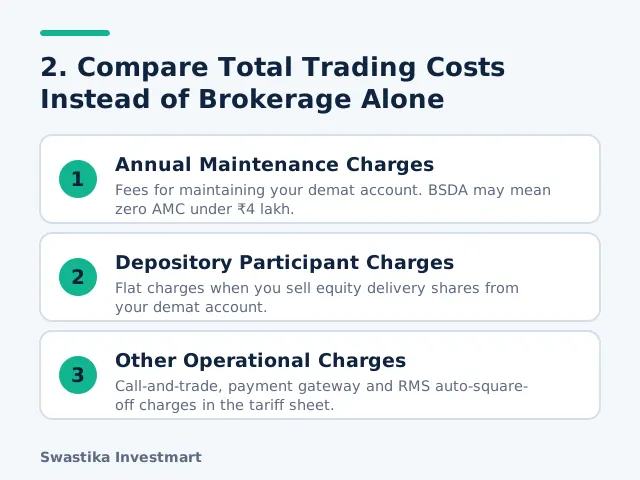
A low brokerage charge does not always mean a low-cost trading experience. You should calculate the total cost of maintaining and operating your trading and demat accounts. Although statutory charges such as STT, GST, stamp duty, and exchange transaction fees apply across brokers, other operational charges can differ. Here are the important charges to check before selecting a broker.
Annual Maintenance Charges
Annual Maintenance Charges (AMC) are fees charged for maintaining your demat account. Some brokers offer free account maintenance, while others charge an annual fee. If your holdings are under ₹4 lakh, check whether you qualify for a Basic Services Demat Account (BSDA). Under the applicable BSDA rules, eligible investors can receive zero AMC.
Depository Participant Charges
DP charges apply when you sell equity delivery shares from your demat account. These are generally flat charges for each applicable transaction. For example, a long-term investor who frequently sells shares should compare DP charges carefully. Even if the broker offers low delivery brokerage, higher DP charges can increase the overall cost.
Other Operational Charges
Check the broker's tariff sheet for additional fees, including call-and-trade charges, payment gateway charges, and Risk Management System (RMS) auto-square-off penalties. These charges can affect your trading expenses, especially if you regularly trade intraday or use different order types. The best approach is to compare the complete tariff sheet instead of making a decision based on advertised brokerage rates.
3. Evaluate App Stability and Order Execution Quality
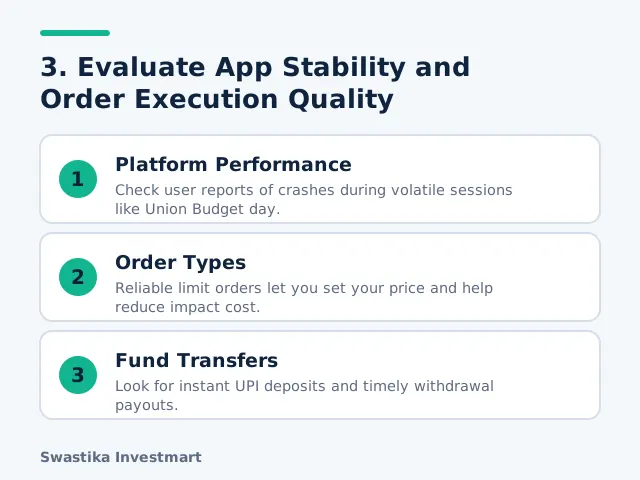
A trading platform should work smoothly when you need it most. An inexpensive broker may become a costly choice if its application freezes during market volatility or delays order execution. Technology quality is particularly important for active traders who depend on timely order placement and execution. Before selecting a broker, check its platform performance during high-volatility sessions. You can search for user reports about app crashes and technical issues during events such as Union Budget announcements or major market corrections.
You should also examine the available order types. Reliable limit order functionality is important because it allows you to specify the price at which you want to buy or sell a security. It can help reduce impact cost, which refers to the additional cost of executing a trade by crossing the bid-ask spread. Fund transfer facilities also deserve attention. Check whether the broker supports instant UPI deposits and timely withdrawal payouts. A good trading application should combine stable performance, useful charting tools, reliable order placement, and smooth fund transfers.
4. Test the Broker Before Transferring Large Capital
Opening an account does not mean you should immediately move all your trading capital to the platform. A practical way to evaluate a discount broker is to test its services over 30 days. Start by completing the digital Aadhaar eKYC process. Before signing the account-opening documents, review the official tariff sheet to understand all applicable charges.
Once the account is active, place small trial trades over the next month. Use this period to evaluate the platform's stability, charting features, order execution, customer support, and withdrawal process. After trading, review your contract notes to check whether the charges match the broker's published rate card. These documents help you understand the actual fees deducted from your transactions.
You should also add a nominee to your demat account during setup. Avoid keeping large idle funds in your trading ledger when they are not required for trading. This testing process helps you understand how the broker performs in actual market conditions rather than relying only on its website or promotional claims.
Frequently Asked Questions
1. What is the typical brokerage charged by discount brokers in India?
Discount brokers typically charge ₹0–₹20 per order. The actual brokerage depends on the broker's pricing structure and the type of transaction.
2. Is the cheapest discount broker always the best choice?
No. Brokerage charges are only one part of the overall cost. App stability, order execution, customer support, DP charges, and account maintenance fees also matter.
3. How can I check whether a discount broker is SEBI registered?
Check the broker's SEBI registration number and exchange membership details against the official SEBI or exchange portals. You should also review its regulatory disclosures.
4. What are DP charges in a demat account?
Depository Participant charges are fees applicable when selling equity delivery shares from your demat account. These charges should be considered while comparing brokers.
5. Why should I test a trading application before investing large amounts?
Testing helps you evaluate app stability, order execution, customer support, charting tools, and fund withdrawal speed. It also helps you identify unexpected charges before committing larger capital.
Conclusion
Picking the best discount broker in India requires balancing affordability with service quality. Low brokerage charges can reduce trading expenses, but they should not come at the cost of platform stability, transparent pricing, or reliable support. Check regulatory credentials, calculate total trading costs, evaluate technology, and test the platform for 30 days before moving larger capital. These steps can help you select a broker that meets your trading needs without compromising on quality. So, if you are looking for a reliable way to participate in the stock market, explore the trading and investment services offered by Swastika Investmart and evaluate the available options based on your financial needs.