



You finally set aside your first ₹10,000 to invest, open a stock market app, and immediately hit a wall. Between unfamiliar terms like Demat accounts, brokerages, and order types, plus constant news about market ups and downs, it is easy to close the app and leave your money sitting in a savings account.
Most beginners face this exact hurdle. Buying shares in Indian companies is a practical way to grow your wealth over time, yet taking that first step often feels risky when you are worried about losing your hard-earned savings to a rookie mistake.
Getting started safely does not require predicting market trends or tracking charts all day. You simply need to set up the right accounts with a SEBI-registered broker, understand the charges involved, check basic company details before buying, and follow a few ground rules to limit your risk.
Here is a simple, step-by-step guide to help you set up your accounts and place your first trade in India with confidence.


How to Start Investing in the Stock Market?
You can start investing in the Indian stock market by opening the required accounts with a registered stockbroker. These accounts allow you to transfer money, place buy and sell orders, and hold your investments electronically.
Types of Accounts You Need to Start Investing?
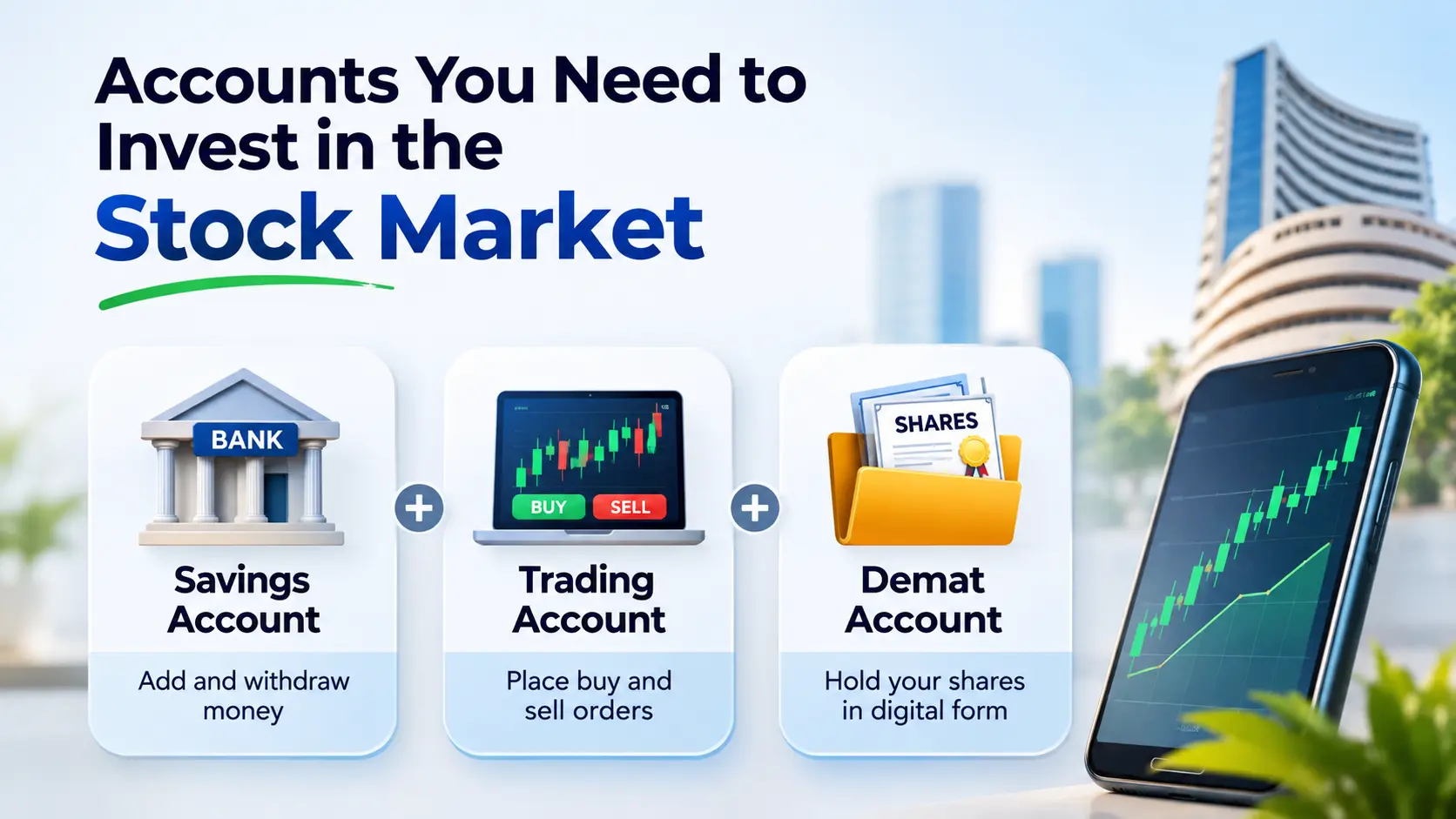
You need three accounts to invest in Indian equities. Each account serves a different purpose and works together to complete your investment transactions.
1. Savings Account
A savings account is used to transfer money to and from your trading account. You can add funds before purchasing shares and transfer available money back to your bank account when required.
2. Trading Account
A trading account is maintained with a SEBI-registered stockbroker. It allows you to place buy and sell orders on stock exchanges such as the National Stock Exchange (NSE) and Bombay Stock Exchange (BSE). For example, if you want to purchase shares of a listed company, you can place a buy order through your broker's trading platform.
3. Demat Account
A demat account holds your shares, ETFs, and mutual funds in digital form. It is maintained through a Depository Participant (DP) registered with either the National Securities Depository Limited (NSDL) or Central Depository Services Limited (CDSL). When you purchase shares for delivery, they are credited to your Demat account. You can view and track your holdings electronically.
How to Open a Demat and Trading Account Online?
You can open a Demat and trading account online through the e-KYC process offered by a SEBI-registered stockbroker. The process involves identity verification, document submission, and video-based verification. Follow these steps to complete your account opening.
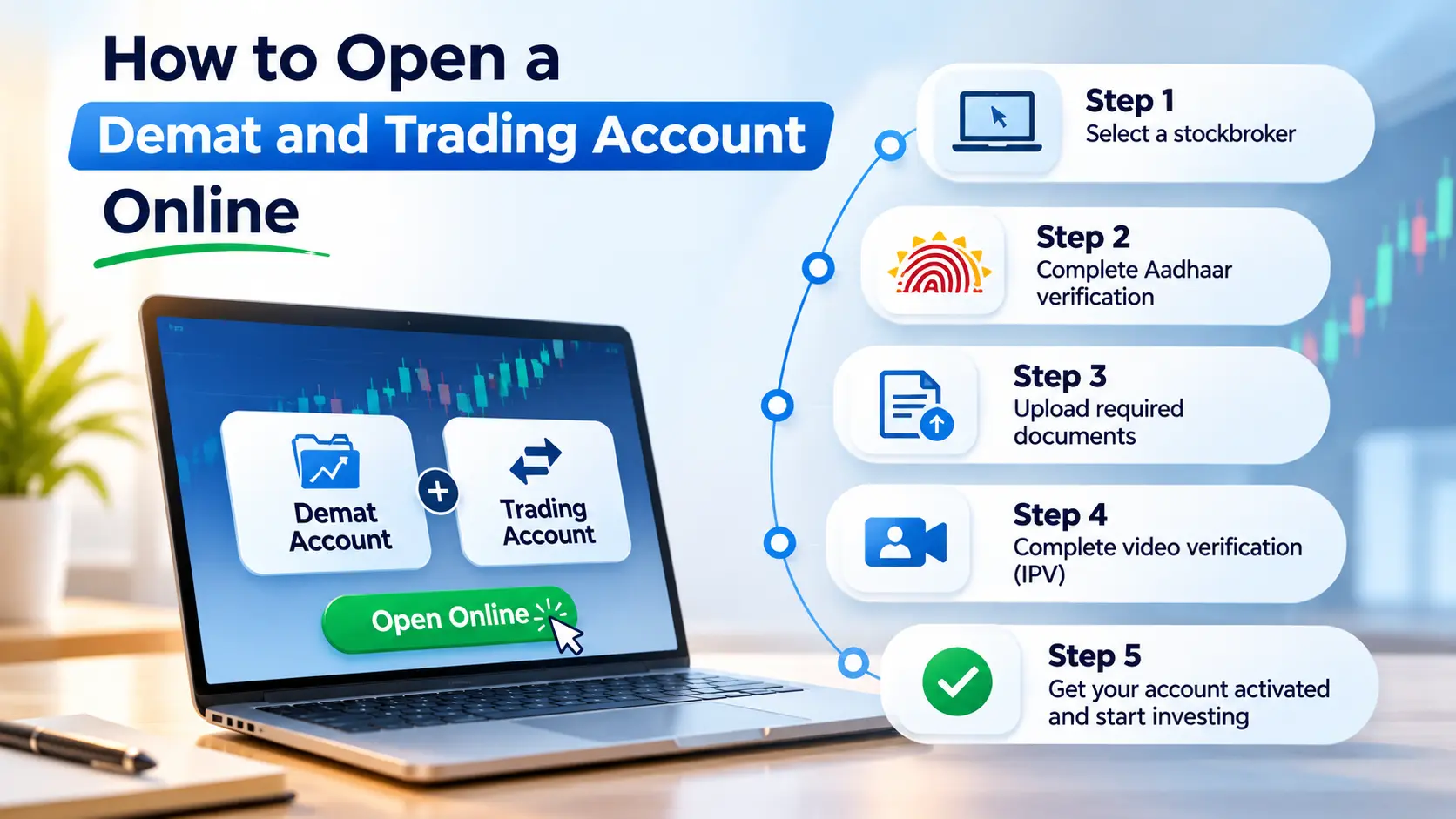
Step 1. Select a Stockbroker
Visit the official website or mobile application of your selected SEBI-registered stockbroker and start the account-opening process.
Step 2. Complete Aadhaar Verification
Enter your Aadhaar number to begin the e-KYC process. An OTP will be sent to your Aadhaar-linked mobile number for verification.
Step 3. Submit the Required Documents
Upload your PAN Card, address proof, and bank proof, such as a cancelled cheque or bank statement. You also need to submit a photograph of your signature on white paper.
Step 4. Complete In-Person Verification (IPV)
Complete a short video-based verification by showing your original physical documents on camera.
Step 5. Get Your Account Activated
Once the broker verifies your application and documents, your account can be activated. You can then access the trading platform and start investing.
What is a Basic Services Demat Account (BSDA)?
A Basic Services Demat Account (BSDA) is designed to reduce account maintenance costs for eligible retail individual investors. SEBI mandates the option of a BSDA, which offers nil or low Annual Maintenance Charges (AMC) and free periodic holding statements.
This option can help beginners reduce the cost of maintaining a Demat account. You can check the applicable eligibility conditions and charges with your Depository Participant before selecting this facility.
How to Choose the Right Stockbroker in India?
A stockbroker acts as an intermediary between you and the stock exchange. You need a broker to place buy and sell orders in the stock market. The right broker should offer a reliable trading platform, transparent charges, and services that match your investment needs. You should also verify the broker's SEBI registration and exchange membership before opening an account.
Full-Service vs Discount Brokers
Stockbrokers generally fall into two categories. Full-service brokers and discount brokers offer different services and charge different brokerage fees.
Full-Service Brokers
Full-service brokers offer services such as research advisory, fundamental reports, and personalised assistance. They generally charge higher percentage-based commissions for their services.
Discount Brokers
Discount brokers focus on digital trading platforms and order execution. They generally charge flat per-trade brokerage fees, regardless of the trade value. Your choice should depend on the services you need and the overall cost of trading.
What Charges should You Consider before Investing?
Brokerage is not the only expense involved in stock market transactions. Several additional charges can increase your total trading cost. Use an online brokerage cost calculator to estimate the total expenses before placing a trade. The total trading cost generally includes:
- Brokerage
- Securities Transaction Tax (STT)
- Goods and Services Tax (GST)
- SEBI Turnover Fees
- State Stamp Duty
- Depository Participant (DP) Charges
For example, a broker may advertise a low brokerage fee, but your actual transaction cost will also include applicable taxes and other charges.
Therefore, compare the total trading cost rather than choosing a broker based only on its advertised brokerage rate.
How does Stock Market Trading Work?
Stock market trading involves buying and selling shares through a stock exchange. Before placing an order, beginners should understand the different order types and the time period for which they want to hold a stock.
What is the Difference between Delivery and Intraday Trading?
Stockbrokers generally offer two common options for equity trading.
Delivery trading (CNC) allows you to buy shares and hold them for as long as you want. You pay the full trade value, and the shares are transferred electronically to your demat account. This option is suitable for investors who want to hold stocks for the long term.
Intraday trading (MIS) involves buying and selling shares on the same trading day. You must close your positions before the market closes. If you do not close them yourself, the broker may automatically square them off.
The main difference is the holding period. Delivery trading allows you to hold shares beyond the trading day, while intraday trading requires you to close your position on the same day.
What are Market and Limit Orders?
A market order is an instruction to buy or sell a stock at the best available market price. It usually gets executed quickly. However, the final execution price may differ from the price you saw when placing the order, especially during periods of high market volatility. This difference is known as slippage.
A limit order lets you set the maximum price you are willing to pay when buying a stock or the minimum price you want when selling it. The order will execute only if the market reaches your specified price. However, execution is not guaranteed.
For example, suppose a stock is trading at ₹500. You can place a limit buy order at ₹490. Your order will execute only if the stock becomes available at ₹490 or lower.
How do Stop-Loss and Trailing Stop Orders help Manage Risk?
A stop-loss order helps manage potential losses by triggering an exit when a stock reaches a specified price. It can help traders follow a planned exit strategy instead of making emotional decisions during a market fall.
A trailing stop adjusts the stop price upward as the stock price rises. This can help traders protect some of their gains while allowing a position to benefit from further price increases. It is particularly useful in trending markets, although it does not guarantee a profit or prevent every loss.
Some brokers also offer advanced order types such as Bracket Orders (BO) and Cover Orders (CO). These orders require traders to define their entry, target profit and mandatory stop-loss when placing the trade.
Beginners should understand how these orders work before using them. A clear entry and exit plan can help reduce impulsive trading decisions.
What are the Safe Options to Invest in the Stock Market?
There is no stock market investment that is completely risk-free. However, beginners can manage their exposure by researching companies, diversifying their investments and keeping enough money aside for emergencies.
How should You Research a Stock before Investing?
A company's share price alone does not tell you whether it is a good investment. You should understand the business and review its financial performance before buying its shares.
You can use a company's annual reports or platforms such as Screener.in to study important details, including:
- Revenue growth: Check whether the company has been able to grow its sales consistently.
- Profitability: Review whether the company is generating profits and how its profitability has changed over time.
- Debt-to-equity ratio: Understand how much debt the company carries compared with its shareholders' equity.
- Promoter shareholding: Track changes in the promoters' ownership over time.
Consider a stock trading at ₹5. A low share price does not automatically mean the stock is cheap. Its actual value depends on factors such as the company's earnings, financial position and business quality.
You should consider these factors together rather than relying on a single financial ratio or the stock's market price.
Why should Beginners Diversify their Investments?
Diversification means spreading your money across different companies, sectors and asset classes instead of putting everything into one investment.
For example, you can consider companies from sectors such as technology, finance and healthcare. This reduces your dependence on the performance of a single sector.
You can also spread your investments across different asset classes, such as equity, debt, fixed deposits and gold. The right mix depends on your age, financial goals and investment time horizon.
A diversified portfolio can help manage concentration risk, although it cannot eliminate market risk or guarantee that your investments will not lose value.
Why should You Keep an Emergency Fund before Investing?
Before putting money into equities, keep an emergency fund equal to at least six months of expenses in liquid bank deposits.
This money can help you manage unexpected expenses without having to sell your investments during a market correction. Without an emergency fund, a sudden financial need may force you to exit your stock market positions at an unfavourable time.
Your emergency savings and stock market investments should serve different purposes. Keep your emergency money accessible and invest in equities according to your financial goals and ability to handle risk.
How can Beginners Protect their Stock Market Investments?
Beginners can protect their investments by following basic safety practices, avoiding common trading mistakes, and using official channels to resolve complaints. A disciplined approach can help reduce unnecessary risks while investing in the stock market.
Avoid Common Stock Market Mistakes
Many beginners lose money not only because of market movements but also because of avoidable mistakes. Here are some practices to watch out for.
Avoid overtrading: Frequent buying and selling can increase your trading costs. Brokerage, Securities Transaction Tax (STT), and short-term capital gains tax can reduce your net returns. Trade only when you have a clear reason to enter or exit a position.
Do not borrow money to trade: Stock prices can move against your expectations. Borrowing to invest or trade can increase your financial pressure, especially when you face losses.
Do not invest only because a stock has a low price: A ₹5 share is not automatically a good investment. Check the company's financial performance, debt and business quality before making a decision.
Avoid putting all your money into one stock or sector: A single company or sector may face unexpected problems. Diversification across companies, sectors and asset classes can help manage this risk.
Do not invest your emergency savings in equities: Keep an emergency fund equal to at least six months of expenses in liquid bank deposits. This can reduce the need to sell shares when you need money urgently.
6 Practices to Keep Your Trading Account Safe
A few basic precautions can help protect your money and trading account.
- Use SEBI-registered intermediaries. Check the registration details of your broker before opening an account.
- Use formal banking channels. Transfer funds through official banking methods rather than informal arrangements.
- Check your contract notes. Your broker should provide a valid contract note within 24 hours of trade execution. Review it to confirm the transaction details and charges.
- Update your nomination. Keep your Demat account nomination details updated.
- Protect your account credentials. Never share your trading password or OTP with anyone.
- Avoid blank Delivery Instruction Slips. Never sign or hand over blank slips that can be used to transfer securities from your Demat account.
You should also stay away from illegal Dabba Trading. It involves off-exchange cash betting on stock market prices instead of placing trades through recognised exchanges. Such activity does not provide the protections available through the formal exchange-based trading system.
If Required, File a Complaint Against a Stockbroker
If you face an issue with your stockbroker or a listed company, first submit a written complaint to the concerned broker or company. Keep a copy of the complaint and any response you receive.
If the issue remains unresolved, you can use SEBI's SCORES platform to register your complaint. You can access it through the official website at scores.gov.in or the SCORES Mobile App. The platform provides a unique tracking ID that helps you follow the status of your complaint.
You can also approach the relevant stock exchange through its Investor Service Centres (ISCs). Other available resolution routes include the Investor Grievance Redressal Process (IGRP) and arbitration. For assistance, investors can contact the investor helpline at 1800 266 7575 or 1800 22 7575. The helpline provides support in eight Indian languages.
Frequently Asked Questions
1. How much money do I need to start investing in the stock market?
There is no fixed amount required to start investing in the stock market. The amount depends on the share price, your financial goals and how much money you can afford to invest. Beginners should start with an amount that does not affect their essential expenses or emergency savings.
2. Is the stock market safe for beginners?
The stock market carries risks, and share prices can rise or fall. Beginners can manage some of these risks by researching companies, diversifying their investments, avoiding borrowed money and following a long-term investment plan. No approach can eliminate market risk.
3. What is the safest way to invest in the stock market?
No stock market investment is completely safe. A careful approach includes studying a company's financial performance, investing across different sectors, maintaining an emergency fund and avoiding decisions based only on short-term price movements.
4. Do I need a Demat account to invest in stocks?
Yes. You need a Demat account to hold shares in electronic form. You also need a trading account with a stockbroker to place buy and sell orders on the stock exchange.
5. How can I avoid losses in the stock market?
You cannot completely avoid losses when investing in equities. However, you can manage risk by researching companies, diversifying your portfolio, avoiding overtrading, setting suitable exit levels and investing according to your financial goals and risk tolerance.
Conclusion
Learning how to invest in the stock market is not just about opening a Demat account and buying shares. It also requires an understanding of trading costs, order types, company financials and investment risks.
Beginners should start with the basics, choose a SEBI-registered stockbroker, maintain an emergency fund and research every company before investing. A diversified portfolio and regular reviews can also help you stay aligned with your financial goals.
If you are looking for guidance to begin your stock market journey, Swastika Investmart can help you understand the investment process and explore the services available to investors. Make informed decisions and choose investments based on your financial needs and risk tolerance.