
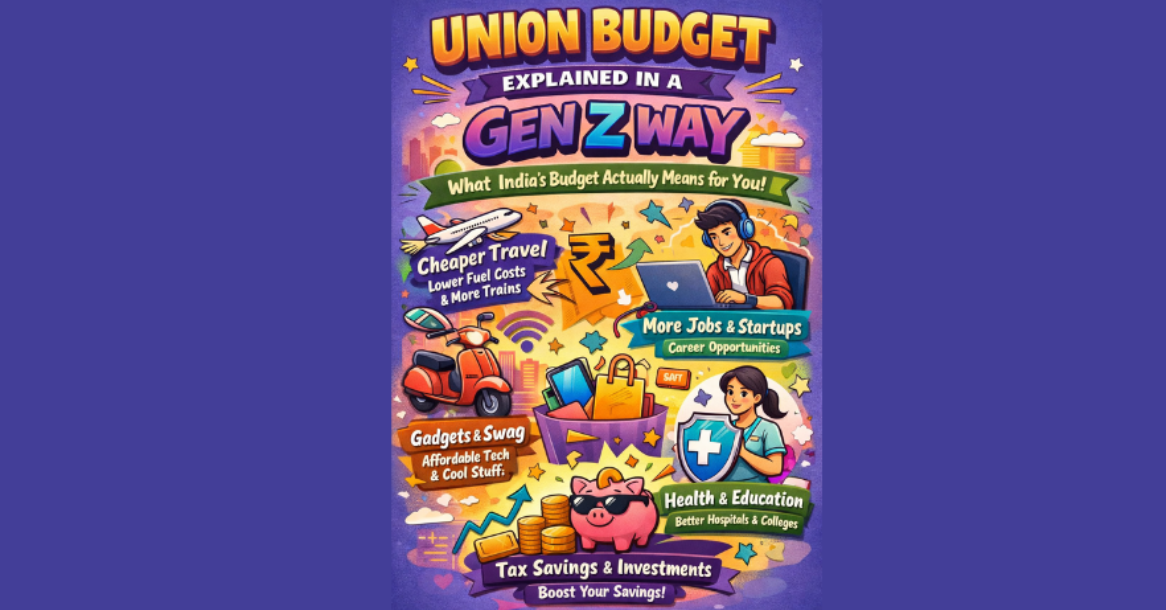
Union Budget 2026 Explained in a Gen Z Way: What India’s Budget Actually Means for You
Every year, the Union Budget 2026 dominates headlines, trends across social media, and sparks sharp moves in Indian stock markets. Yet for many Gen Z Indians, it still feels distant, complicated, or meant only for policymakers and economists.
In reality, the Union Budget 2026 quietly shapes your salary, side hustle income, career opportunities, cost of living, and even how your investments perform. Whether you are a student, a young professional, a freelancer, or a first-time investor, this Budget has real implications for your financial future.
Let’s break down the Union Budget 2026 in a way that actually makes sense.
What the Union Budget 2026 Really Is
The Union Budget 2026 is the Indian government’s annual financial blueprint for the upcoming financial year. It outlines how the government plans to earn revenue and where it intends to spend that money.
Revenue mainly comes from income tax, GST, corporate tax, and customs duties. Spending is directed toward education, infrastructure, healthcare, defence, digital development, and welfare schemes.
For Gen Z, the Union Budget 2026 determines how affordable daily life becomes, how many jobs are created, how startups are supported, and how stable financial markets remain.
Why the Union Budget 2026 Matters to Gen Z Indians
Your Salary, Taxes, and Take-Home Pay
If you are entering the workforce or earning through freelancing or gig work, the Union Budget 2026 directly affects how much money stays in your bank account. Any changes in income tax slabs, rebates, or standard deductions influence your take-home pay.
Recent Budgets have focused on simplifying the new tax regime, and the Union Budget 2026 continues this trend by prioritising clarity and ease of compliance. This benefits Gen Z professionals who prefer straightforward, digital-first money management.
Jobs, Skills, and Career Opportunities
With one of the youngest populations in the world, employment generation remains a key focus area in the Union Budget 2026. Higher spending on infrastructure, manufacturing, renewable energy, and digital services often translates into increased hiring.
Allocations toward skilling programs, digital education, and emerging technologies such as artificial intelligence, fintech, and data analytics support long-term career growth for Gen Z. Budget priorities often signal where future job demand is likely to emerge.
Startup Culture and Side Hustles
Gen Z is driving India’s startup culture, side hustles, and creator economy. The Union Budget 2026 plays a crucial role in shaping this ecosystem through measures related to MSMEs, startups, and digital businesses.
Initiatives like credit guarantees, easier compliance, and incentives for innovation help young entrepreneurs scale their ideas. Freelancers and gig workers also benefit from clearer taxation norms and improved digital infrastructure announced in the Union Budget 2026.
Union Budget 2026 Impact on Stock Markets
Why Markets React on Budget Day
On the day of the Union Budget 2026, Indian stock markets often witness sharp intraday volatility. Indices such as the Nifty and Sensex respond quickly to announcements related to taxation, government spending, and sector-specific incentives.
A higher push toward infrastructure can benefit capital goods and cement stocks, while focus on digital finance and manufacturing may support banking and industrial stocks. Traders closely analyse Budget cues to identify opportunities.
What It Means for Young Traders and Investors
For traders and investors, the Union Budget 2026 significantly influences market sentiment. Any changes in capital gains tax, securities transaction tax, or regulatory clarity can affect trading strategies and portfolio allocation.
This is where a reliable brokerage matters. Swastika Investmart, a SEBI-registered broker, offers research-backed insights, real-time market analysis, and dedicated customer support to help investors navigate Budget-driven volatility with confidence.
Union Budget 2026 and the Cost of Living
Inflation and Everyday Expenses
Government spending and borrowing decisions under the Union Budget 2026 influence inflation trends. Controlled inflation helps keep essentials like food, fuel, rent, and EMIs affordable.
Budget measures aimed at strengthening agriculture, logistics, and supply chains help manage price pressures over the long term. While these effects may not be immediate, they shape affordability for Gen Z households.
How Union Budget 2026 Shapes India’s Financial Future
Regulatory Stability and Market Confidence
India’s financial markets operate under regulators such as SEBI and RBI. The Union Budget 2026 often reinforces regulatory stability, which builds trust among investors.
A predictable policy environment attracts both domestic and global capital, supporting long-term market growth. This benefits Gen Z investors participating in equities, mutual funds, and derivatives.
Digital India and Financial Inclusion
As a digitally native generation, Gen Z benefits directly from the Union Budget 2026 focus on digital payments, fintech innovation, and online compliance. This has made investing and trading more accessible and transparent.
Tech-enabled platforms offered by Swastika Investmart align well with this digital push, providing seamless access, strong research tools, and continuous investor education.