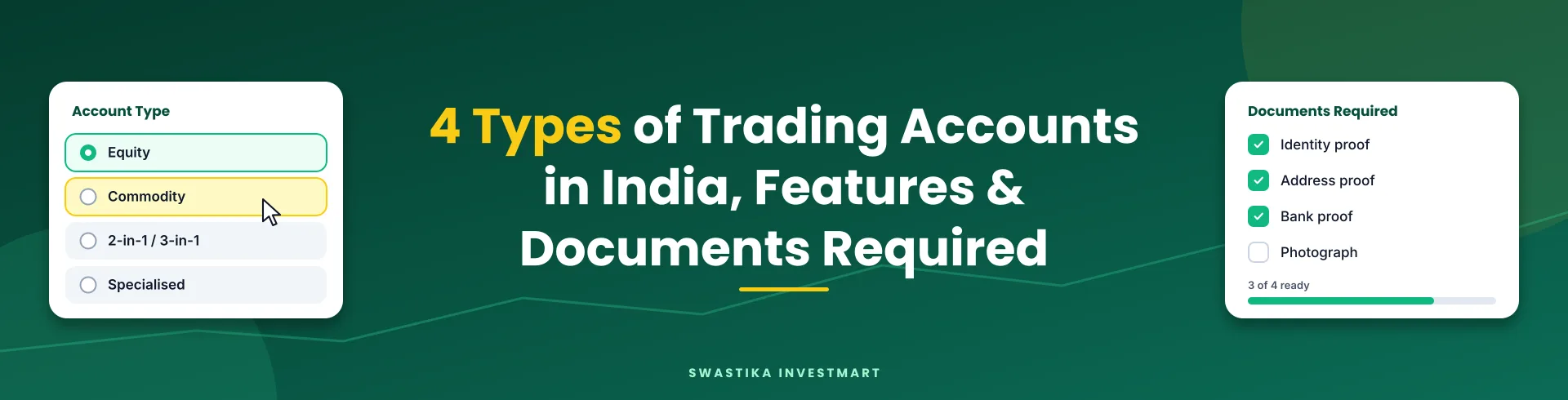

4 Types of Trading Accounts in India, Features & Documents Required


A trading account allows investors to buy and sell securities in the stock market. It acts as a bridge between your bank account, demat account, and stock exchanges, making it possible to execute trading orders. In India, investors can open trading accounts through SEBI-registered stockbrokers or trading members.
There are different types of trading accounts based on the securities you want to trade, the services you need, and your eligibility. These include equity trading accounts, commodity trading accounts, integrated 2-in-1 and 3-in-1 accounts, and specialised trading arrangements such as Margin Trading Facility (MTF) and NRI accounts.
Understanding their features, charges, and documentation requirements can help you choose an account that matches your trading needs.
1. Equity Trading Account
An equity trading account allows investors to buy and sell shares listed on stock exchanges such as the National Stock Exchange (NSE) and Bombay Stock Exchange (BSE).
It is suitable for investors who want to participate in the equity market through delivery-based or intraday trading. The account provides access to stock prices, real-time market updates, technical charts, and research tools.
For cash equity delivery trades, investors generally need to maintain 100% of the transaction value upfront unless they use a Margin Trading Facility (MTF). Investors can open an equity trading account through a SEBI-registered stockbroker by completing the required KYC formalities.
2. Commodity Trading Account
A commodity trading account allows investors to trade commodities such as gold, silver, crude oil, and agricultural products. Unlike regular equity trading, commodity trading mainly involves futures contracts. These contracts allow traders to take positions based on the expected price movements of commodities.
Commodity trading generally requires an initial margin of 10% to 25% of the total contract value. Traders must also maintain the required margin as prices change. Daily mark-to-market adjustments can result in additional margin requirements.
Commodity contracts have fixed expiry dates and may involve physical settlement, depending on the contract. Investors must activate the commodity segment separately. Brokers also require proof of financial standing, such as bank statements, Income Tax Return (ITR) acknowledgements, or net-worth certificates.
3. 2-in-1 and 3-in-1 Integrated Trading Accounts
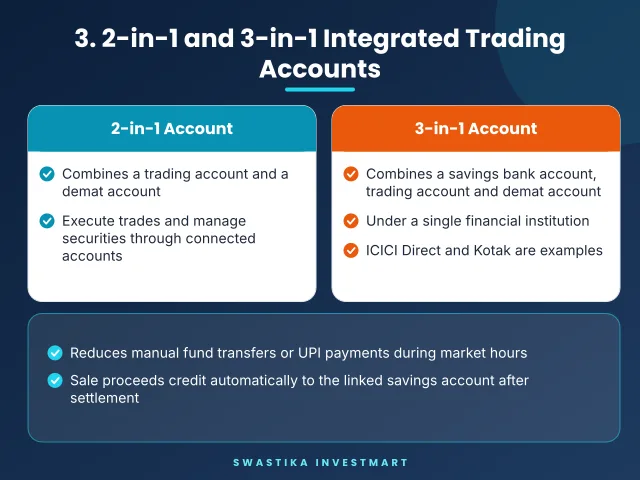
Integrated trading accounts connect multiple financial accounts under one platform. They make it easier to transfer funds and securities while managing investments. There are two common types.
2-in-1 Account
A 2-in-1 account combines a trading account and a demat account. It allows investors to execute trades and manage their securities through connected accounts.
3-in-1 Account
A 3-in-1 account combines a savings bank account, trading account, and demat account under a single financial institution. ICICI Direct and Kotak are examples of institutions offering such integrated arrangements.
These accounts reduce the need for manual fund transfers or UPI payments during market hours. They also allow the automatic credit of sale proceeds to the linked savings account after settlement. Integrated accounts can be useful for investors who prefer managing their banking, trading, and investments through a single financial institution.
4. Specialised Trading Accounts and Facilities
Apart from regular equity and commodity accounts, investors can access different trading arrangements based on their financial needs and eligibility.
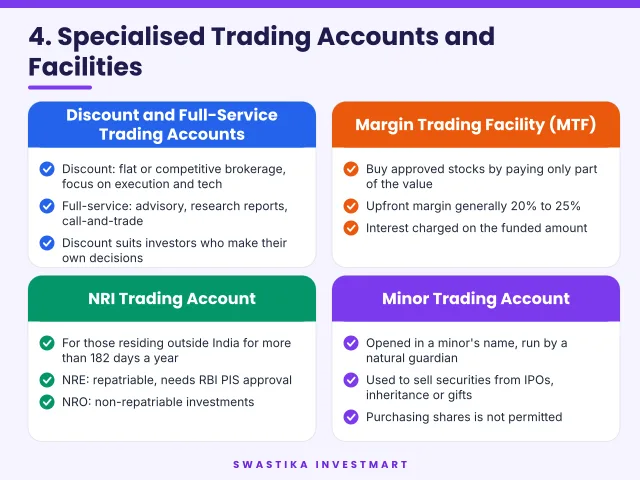
Discount and Full-Service Trading Accounts
Discount brokers offer trading platforms with flat or competitive brokerage charges. Their services mainly focus on order execution and technology tools. These accounts are generally suitable for investors who prefer making their own trading decisions. Full-service brokers offer additional services such as dedicated advisory, research reports, call-and-trade facilities, and portfolio management.
Margin Trading Facility (MTF)
MTF allows traders to purchase approved stocks by paying only a part of the total transaction value. The upfront margin generally ranges from 20% to 25%, while the broker funds the remaining amount. The broker charges interest on the funded amount for the period the position remains open. The purchased shares remain pledged with the depository until the funded amount is cleared.
NRI Trading Account
Non-Resident Indians (NRIs), Overseas Citizens of India (OCIs), and Persons of Indian Origin (PIOs) residing outside India for more than 182 days in a financial year can open NRI trading accounts. These accounts generally operate through two categories.
- NRE Account is used for investments on a repatriable basis, allowing eligible funds to be transferred abroad. It requires Portfolio Investment Scheme (PIS) approval from the RBI.
- NRO Account is used for non-repatriable investments.
NRI trading accounts have specific restrictions. Equity trading is restricted to delivery-based transactions under the applicable rules. Equity derivatives can be traded only through an NRO account. Commodity and currency derivative trading is prohibited for NRIs.
Minor Trading Account
A minor trading account is opened in the name of a minor and operated by a natural guardian. It is mainly used to sell securities received through IPOs, inheritance, corporate actions, or gifts and family transfers.
Purchasing shares through a minor's trading account is not permitted. The guardian operates the account until the minor reaches majority, after which the required KYC and account confirmation formalities must be completed.
Documents Required to Open a Trading Account in India
Investors must complete KYC formalities before opening a trading account. The documents generally depend on their residency status and the trading segments they want to activate. For resident individual investors, the following documents are required.
Additional Documents for F&O and Commodity Trading
Investors activating Futures and Options (F&O) or commodity segments must provide proof of financial standing. Accepted documents include recent six-month bank statements, ITR acknowledgement receipts, or a net-worth certificate issued by a Chartered Accountant.
Additional Documents for NRI Trading Accounts
NRIs must submit a passport copy with a valid visa, work permit, or OCI/PIO card. They must also provide overseas address proof, Indian address proof, and a cancelled cheque from their NRE/NRO bank account.
An RBI PIS approval letter is required for NRE accounts. Documents must be attested by the Indian Embassy or Consulate, an overseas Notary Public, a Court Magistrate, or authorised officials of overseas branches of Indian banks.
Important Rules to Know Before Opening a Trading Account
SEBI has established several rules to improve transparency and protect investors. A Unique Client Code (UCC) identifies an investor accessing equity cash, equity derivatives, and commodity derivatives through a broker.
Single-holder demat and trading accounts can register up to three nominees with specified percentage allocations. Investors can also submit a formal opt-out declaration. A Power of Attorney (PoA) is optional and limited to settlement obligations. SEBI introduced the Demat Debit and Pledge Instruction (DDPI) as an alternative for authorising the debit of securities for exchange settlements and pledging securities for margin requirements.
Investors must also receive important account-opening documents, including the Rights and Obligations document, Risk Disclosure Document (RDD), Exchange Do's and Don'ts, broker policies and procedures, and tariff sheet.
Conclusion
Choosing the right trading account depends on your investment requirements, preferred market segment, and the services you need. An equity trading account suits stock market participants, while a commodity account provides access to commodity contracts. Integrated accounts simplify banking and trading, whereas specialised arrangements address requirements such as margin funding and NRI investments.
Before opening an account, compare brokerage charges, available services, documentation requirements, and applicable trading restrictions. Swastika Investmart provides trading and investment services to help investors access financial markets. Understanding your requirements before opening an account can help you make a more informed choice.