

Adani Goes All-In on AI: What the $100 Billion Data Center Push Means


Adani Goes All In on AI: What the $100 Billion Data Center Push Means


TLDR Summary
- The $100 billion investment signals India’s largest private AI infrastructure bet.
- Data centers could become a new growth engine for the conglomerate.
- The move aligns with India’s digital economy and AI policy push.
- Investors should watch execution risk, debt levels, and partnerships.
The Big Announcement and Why It Matters
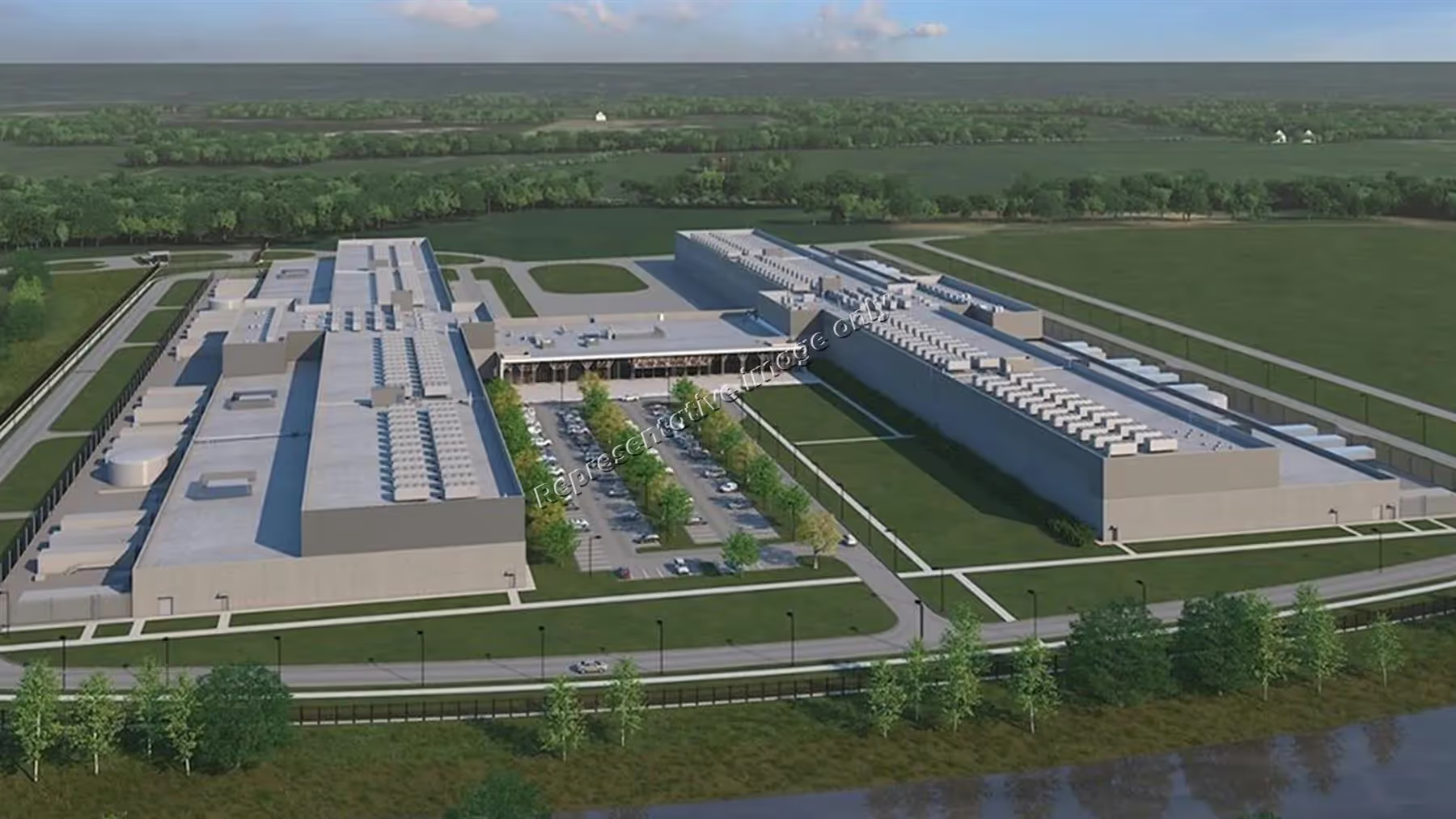
The ambitious expansion by Adani Group into artificial intelligence infrastructure marks one of the boldest strategic shifts by any Indian conglomerate in recent years. The plan to deploy up to $100 billion toward hyperscale data centers and AI ecosystems is not just a business expansion. It is a signal that India’s corporate giants are preparing for a future where computing power becomes as valuable as energy or ports.
Chairman Gautam Adani has repeatedly emphasized infrastructure-led growth. Until now, that meant roads, ports, airports, and power. With this move, digital infrastructure joins that list.
The timing is strategic. Global demand for AI compute capacity is rising sharply due to generative AI adoption, enterprise automation, and cloud migration. Countries that control computing infrastructure will shape the next digital decade.
Why Data Centers Are the New Oil Fields
Exploding Demand for Compute Power
AI models need massive processing capacity. Training advanced models requires thousands of GPUs running nonstop. This has created a supply shortage in global data center capacity.
India currently accounts for a small share of global hyperscale infrastructure compared to the US and China. That gap creates an opportunity for domestic players to scale quickly.
India’s Structural Advantage
India offers three key advantages for AI infrastructure expansion:
- Low construction costs compared to Western markets
- Large engineering talent pool
- Rapidly growing digital economy
Government initiatives supporting data localization and digital public infrastructure also encourage companies to build local facilities.
Strategic Fit With Adani’s Existing Businesses
This expansion is not random diversification. It fits neatly into the group’s existing strengths.
Power and Energy Integration
Data centers require huge electricity supply. The group already operates large renewable and thermal power assets. This allows it to provide captive energy to its own facilities, lowering operating costs.
Land and Infrastructure Access
Owning ports, logistics networks, and industrial land banks makes large scale construction faster. Competitors often struggle with approvals and land acquisition. That bottleneck is less severe for infrastructure focused conglomerates.
Long Term Revenue Visibility
Unlike cyclical businesses, data centers operate on long contracts. Clients sign multi year agreements for server space and cloud capacity. This creates stable cash flow, which investors often reward with premium valuations.
Impact on Indian Markets and Investors
The announcement has several implications for equity markets and sector valuations.
1. Infrastructure and Capital Goods Boost
Companies involved in electrical equipment, cooling systems, fiber networks, and construction could benefit from large order inflows.
2. Tech Sector Re Rating
Domestic technology firms that provide AI services or cloud solutions may see improved sentiment as India builds its own computing backbone.
3. Debt and Execution Risk
Large capital expenditure projects always carry financial risk. Investors should track funding mix, project timelines, and return ratios. If execution is delayed, markets may react negatively.
Global Context: The AI Infrastructure Race
The world is currently witnessing a technology arms race. The United States, China, and Middle Eastern sovereign funds are investing heavily in compute infrastructure. Global tech firms are signing power purchase agreements just to secure electricity for data centers.
If India wants to compete in advanced AI development, domestic infrastructure is essential. Without local computing capacity, companies rely on foreign cloud providers. That can increase costs and create strategic dependence.
Large scale investments from private players can accelerate India’s push to become an AI hub.
Real World Scenario: Why This Matters to Businesses
Imagine an Indian startup building a generative AI platform. Today it might rely on overseas servers. That leads to higher latency, regulatory hurdles, and foreign currency costs.
If hyperscale facilities expand domestically, startups can deploy models locally. This reduces costs and improves performance. It also helps sectors like fintech, health tech, and logistics adopt AI faster.
Regulatory and Policy Angle
India’s regulatory environment is gradually evolving to support digital infrastructure. Data protection rules, localization policies, and incentives for electronics manufacturing all indirectly support data center growth.
Authorities have also signaled interest in building national AI compute capacity. Large private investments align well with that goal. Policymakers typically welcome such projects because they generate jobs, improve technology access, and attract global clients.
Key Risks Investors Should Monitor
Even strong long term themes carry risks. Investors should evaluate:
- Capital intensity and funding structure
- Partner ecosystem and technology sourcing
- Utilization rates once centers go live
- Competition from global cloud providers
Execution quality will determine whether the investment becomes a value creator or a balance sheet burden.
What This Means for Long Term Investors
The data center and AI infrastructure space is still in its early innings in India. Early movers could capture significant market share. However, valuations may fluctuate as projects scale.
Investors with a long horizon often benefit from tracking infrastructure themes early. The key is to combine thematic conviction with careful stock selection and risk management.
Platforms like Swastika Investmart help investors analyze such large corporate strategies through advanced research tools, reliable support, and SEBI registered advisory frameworks. Access to structured insights can make a big difference when evaluating complex capital intensive sectors.
FAQs
1. Why is the Adani AI investment significant?
It is among the largest private investments in digital infrastructure globally and signals India’s entry into the AI compute race.
2. Will this affect Adani stocks immediately?
Short term price movement depends on market sentiment. Long term performance depends on project execution and returns.
3. Which sectors benefit from data center growth?
Power equipment, cables, cooling systems, cloud services, and semiconductor supply chains.
4. Is AI infrastructure a good investment theme?
It can be promising, but investors should diversify and assess financial strength, not just growth stories.
5. Does India have enough demand for such capacity?
Yes. Rapid digital adoption, startups, fintech growth, and enterprise AI adoption are driving demand.
Conclusion
The $100 billion push into AI infrastructure reflects a major shift in India’s corporate strategy landscape. It shows that future growth may be driven not only by physical assets but also by digital backbone capacity. For investors, this development highlights a powerful emerging theme that blends technology, infrastructure, and policy support. If you want to track such transformational opportunities with professional research support, consider