


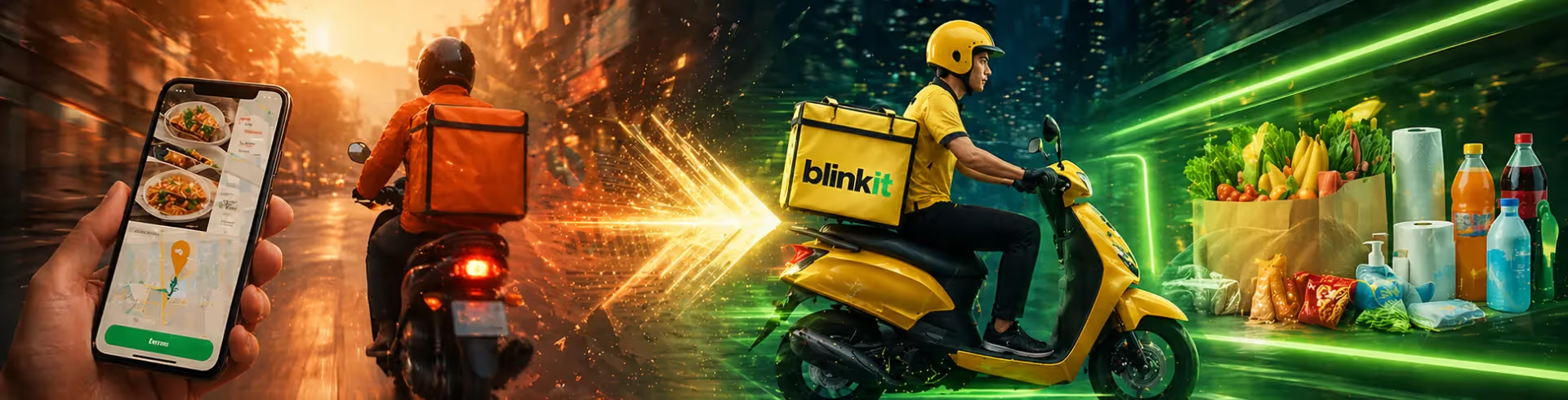

How Eternal Limited Is Transforming from Food Delivery to Quick Commerce — Why Blinkit Is Now the Real Growth Engine


Key Takeaways
• Eternal Limited reported strong quarterly growth, but the bigger story is the rise of quick commerce.
• Blinkit has become EBITDA positive and is scaling rapidly.
• Food delivery remains stable, but quick commerce is driving future expansion.
• Competition in quick commerce is intensifying, making scale and efficiency critical.
• Investors should watch this business model shift closely as it may reshape India’s consumption story.
The Quarter Looked Strong, But the Real Story Is Deeper
At first glance, Eternal Limited delivered an impressive quarter.
Net profit jumped 346 percent year-on-year to ₹174 crore.
Revenue surged 196 percent to ₹17,292 crore.
These numbers are enough to grab attention.
But profits are not the most important takeaway.
The bigger shift is strategic.
Eternal is moving from being a food delivery-focused company into a quick commerce-led platform.
And at the center of this transformation is Blinkit.
This is not just another quarter of growth.
It could be the beginning of a new business identity.
Blinkit Is No Longer a Side Business
For years, food delivery was the main engine.
That is changing.
Blinkit’s Net Order Value rose 95 percent to ₹14,386 crore.
It also turned EBITDA positive at ₹37 crore.
This matters because profitability in quick commerce has been the biggest question mark.
Now that Blinkit has crossed that line, the market has a new narrative.
Growth with improving unit economics.
That combination changes investor perception.
Why This Shift Matters
Quick commerce is about speed, convenience, and frequency.
Unlike food delivery, which often depends on meal timing, quick commerce creates multiple daily buying opportunities.
Think about this.
A customer may order lunch once a day.
But groceries, snacks, medicines, and essentials can be ordered multiple times a week.
That increases engagement and transaction frequency.
For a platform business, frequency is power.
Scale Is Changing the Economics
One of the biggest reasons Blinkit has moved toward profitability is scale.
The company processed nearly 274 million orders in the quarter.
That is massive.
When order density improves across the same dark store network, delivery costs per order fall.
This is where operating leverage starts working.
More orders.
Same infrastructure.
Better margins.
This model is similar to how Amazon.com, Inc. scaled logistics globally.
In India, quick commerce is following a similar playbook, adapted for dense urban markets.
Management expects this business to grow over four times in the next three years.
That shows confidence.
And markets pay attention to confidence backed by execution.
Food Delivery Is Becoming the Foundation
While Blinkit grabs the spotlight, the food delivery business remains important.
Food delivery revenue grew 33 percent to ₹2,737 crore.
That is still solid.
But compared to Blinkit’s pace, it looks mature.
This does not mean weakness.
It means evolution.
Food delivery is becoming the stable base.
Quick commerce is becoming the growth layer.
A Smart Strategic Shift
Instead of pushing larger basket sizes, the company is focusing on order frequency.
Lower minimum order values attract more users.
At first, this may seem like weaker monetization.
But it expands the customer base.
More customers ordering more often creates long-term value.
This is a classic scale strategy.
The Competitive Battle Is Getting Intense
Quick commerce is not an empty field.
Major players are spending aggressively.
Swiggy Limited through Instamart, Zepto Marketplace Private Limited, and Reliance Retail Limited through JioMart are all scaling fast.
This creates pressure.
Heavy investments in:
- Dark stores
- Logistics
- Discounts
- Customer acquisition
are becoming normal.
The challenge is simple.
Can companies grow fast enough while staying profitable?
This is now a scale game.
And scale usually creates winners and losers quickly.
What This Means for Indian Markets
The rise of quick commerce is changing the consumer internet story in India.
Investors earlier valued food delivery based on market share and margins.
Now the valuation framework is expanding.
Quick commerce introduces:
- Higher frequency transactions
- Larger addressable market
- Faster consumption cycles
- Better cross-selling opportunities
For Indian equity markets, this means internet businesses may start being evaluated differently.
If Blinkit continues to grow profitably, it could influence how analysts value the broader digital consumption sector.
That includes players in retail tech, grocery delivery, and hyperlocal commerce.
The Regulatory Side Investors Should Know
Companies like Eternal operate under the oversight of Securities and Exchange Board of India for disclosures and corporate governance.
Investors should always review:
- Quarterly filings
- Management commentary
- Business segment performance
- Risk disclosures
These are available on National Stock Exchange of India and BSE Limited.
In fast-growing sectors, transparent disclosures matter more than headlines.
What Investors Should Watch Next
Profitability Trend in Blinkit
One profitable quarter is important.
Consistency matters more.
Expansion of Dark Stores
Store density directly affects delivery efficiency.
Competition Intensity
Discount wars can hurt margins.
Consumer Retention
Quick commerce depends heavily on repeat behavior.
How Swastika Investmart Can Help Investors Track These Shifts
Business transformations like this can create major investment opportunities.
But they require research.
Swastika Investmart Limited helps investors understand these structural shifts with:
Research-Driven Insights
Detailed analysis beyond headlines.
Technology-Enabled Trading
Smooth execution during volatile market phases.
Investor Education
Helping investors understand business model transitions.
Dedicated Support
Guidance when market narratives change quickly.
As a SEBI-registered broker, Swastika Investmart combines compliance with market expertise.
That becomes valuable when sectors evolve fast.
Final Thoughts
The biggest story in Eternal’s quarter is not the 346 percent jump in profits.
It is the changing shape of the business.
Food delivery is becoming the foundation.
Quick commerce is becoming the future.
And Blinkit is at the center of that future.
If execution remains strong and profitability scales, this transformation could redefine not just Eternal’s growth story, but India’s quick commerce landscape itself.
For investors, these are the shifts worth tracking early.
To stay ahead with research-backed market insights and smarter investing tools, consider opening an account with Swastika Investmart Limited.
👉
Frequently Asked Questions
Why is Blinkit becoming important for Eternal?
Blinkit is driving faster growth, higher order frequency, and has now turned EBITDA positive, making it a major growth engine.
Is food delivery slowing down?
Food delivery is still growing, but at a slower pace compared to quick commerce.
What is quick commerce?
Quick commerce is ultra-fast delivery of essentials, groceries, and daily-use products, usually within minutes.
Who are Blinkit’s main competitors?
Its main competitors include Swiggy Instamart, Zepto, and JioMart.
Should investors track business model shifts?
Yes. Business model shifts often create long-term investment opportunities before the market fully prices them in.






