
No, It's Not Mexican Food - Why Wall Street Calls Trump 'TACO' & How Trump Earned the TACO Label


 Add Swastika as preferred source
No, It's Not Mexican Food — Why Wall Street Started Calling Trump "TACO" and Why It Matters for Your Portfolio
At a Glance
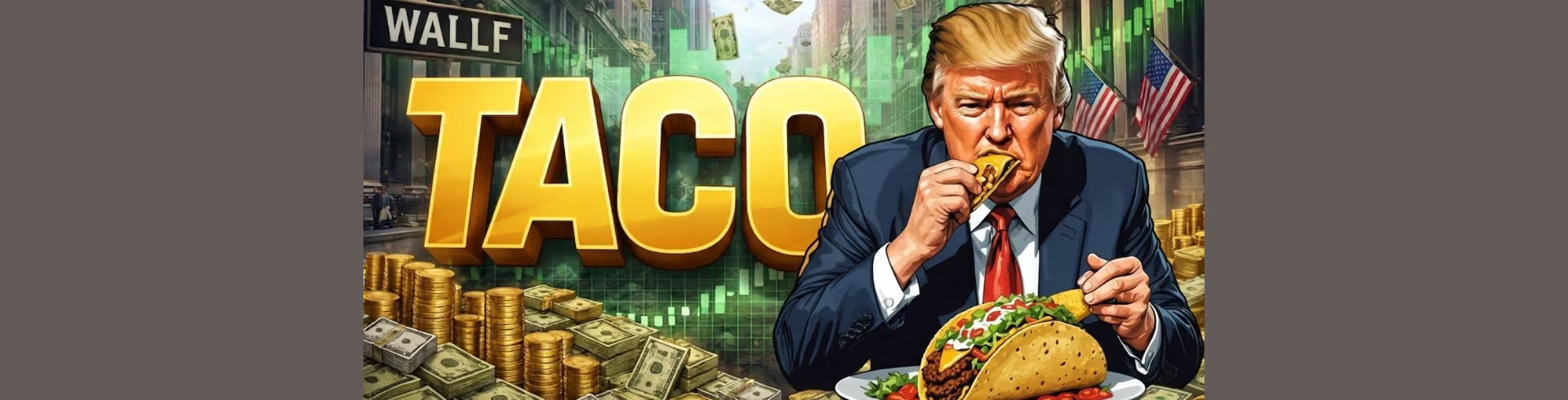
- TACO stands for "Trump Always Chickens Out" — a term coined by a Financial Times journalist in May 2025
- It describes Trump's pattern of making big threats on tariffs or policy, then quietly backing down
- Wall Street traders built a profitable strategy around this pattern — buy the dip, sell the bounce
- The TACO trade has now moved beyond tariffs and is influencing the US-Iran war narrative
- Indian markets — Sensex and Nifty — are directly feeling the heat every time Trump speaks
No, It's Not Mexican Food — Why Wall Street Started Calling Trump "TACO"
Picture this. It's May 2025. A journalist at the Financial Times is watching US markets go through yet another wild swing — crashing on a Trump tariff announcement, then roaring back two days later when Trump quietly walked it back. Frustrated and a little amused, the journalist coins a term that will echo across trading floors from New York to Mumbai.
He calls it the TACO trade.
And no — nobody is ordering guacamole.
TACO stands for Trump Always Chickens Out. Four words that managed to irritate the most powerful man in the world, make traders millions of dollars, and now — in 2026 — find themselves at the center of a live war situation in the Middle East.
Let's break it all down.
The Man, The Myth, The Pattern
When Donald Trump returned to the White House in January 2025, he came with a very specific economic vision — aggressive tariffs on imports to protect American manufacturing. He called it "Liberation Day" when he announced sweeping tariff rates against virtually every country on earth in April 2025.
Markets panicked. The S&P 500 tanked. Investors scrambled.
Then, exactly one week later, Trump paused most of those tariffs, dropping them to 10% for 90 days. Markets exploded upward in one of the biggest single-day rallies in history.
Traders who had bought the dip made a fortune.
This happened again. And again. China tariffs went to 145% — then got frozen. EU tariffs threatened at 50% — then delayed. Federal Reserve chair Jerome Powell threatened with removal — then Trump backed off.
Robert Armstrong of the Financial Times noticed the pattern and gave it a name: the TACO trade — Trump Always Chickens Out. The strategy was simple. When Trump makes a scary announcement and markets fall, buy. When he inevitably walks it back, sell. Profit.
When a reporter asked Trump about the term at a White House press conference, his reaction was telling. He called it a "nasty question" and said, "Don't ever say what you said." He insisted it was all just negotiation.
Wall Street disagreed — and kept buying the dips.
How TACO Works as a Trading Strategy
The mechanics are straightforward once you understand the pattern.
Trump announces something extreme. Tariffs, sanctions, threats — whatever it is, it sounds catastrophic. Markets sell off sharply because uncertainty is the enemy of equity prices. Volatility spikes. Fear dominates the headlines.
Then, within days or sometimes hours, Trump softens the stance. Maybe he says talks are going well. Maybe he announces a pause. Maybe he just posts something vague but hopeful on Truth Social. Markets interpret this as de-escalation and rally hard.
Traders who stayed calm and bought during the fear phase walked away with solid gains — repeatedly.
One Wall Street analyst described the approach simply: "He steers us toward disaster and then, at the last minute, steers us away from disaster and says, look, I saved us."
For most of 2025, this worked like clockwork. So well, in fact, that the term entered mainstream financial vocabulary and analysts began pricing TACO expectations directly into their models.
TACO Crosses Into Foreign Policy — And Hits a Wall
By early 2026, something shifted. The TACO trade moved beyond trade policy into actual military conflict.
On February 28, 2026, the US and Israel launched coordinated strikes on Iran — an operation called Epic Fury. Oil prices surged. The Strait of Hormuz, through which roughly one-fifth of the world's oil supply flows, came under Iranian pressure. Global markets went into shock.
And then the TACO pattern started repeating — except this time with much higher stakes.
In March 2026, Trump posted on Truth Social that the US and Iran were having "good and productive conversations" toward a complete resolution. GIFT Nifty surged over 700 points in a single evening. Brent crude fell from $113 to $98 per barrel almost instantly.
Hours later, Iran denied any such conversations were taking place.
Markets whipsawed violently. Traders who had bought the TACO bounce got burned.
Then on April 1, 2026, Trump again signalled the war might wrap up in two to three weeks, sending Sensex surging over 1,800 points in early trade. By evening, in a prime-time national address, he threatened to strike Iranian power plants simultaneously if no deal was reached and promised to bring Iran "back to the stone age."
Oil jumped back above $102 per barrel. Asian markets reversed.
The TACO pattern was trying to play out — but Iran was not cooperating the way the EU or China had during the tariff wars.
As one Fortune analysis put it sharply: tariffs are a toggle. You flip them on with a post, you flip them off with another. A war, once started, has its own momentum. It does not toggle.
Why India Cannot Ignore the TACO Trade
Indian investors might wonder what Trump's statements have to do with their portfolio. The answer is — quite a lot, actually.
India imports over 85% of its crude oil requirements. When Brent crude surges past $100 per barrel, the effects cascade through the entire economy. Petrol and diesel prices climb. Logistics costs go up. Inflation rises. The rupee weakens against the dollar. Corporate margins — especially in sectors like aviation, paints, chemicals, and FMCG — get squeezed.
Foreign institutional investors, who hold significant positions in Indian equities, also become risk-averse when global uncertainty rises, pulling money out of emerging markets including India. In March 2026 alone, FIIs sold shares worth over Rs 1.17 lakh crore in Indian markets.
Every TACO signal from Trump — every hint that the Iran conflict might wind down — triggers a brief FII reversal and a rally in Sensex and Nifty. Every escalation does the opposite.
This is why Indian retail investors need to understand the TACO trade. Not to blindly copy Wall Street's strategy, but to understand what is moving markets on any given morning and why your portfolio is behaving the way it is.
The Limits of TACO — When Chickening Out Is Not an Option
Here is where things get genuinely complicated in 2026.
The TACO trade worked brilliantly through 2025 because Trump's counterparties — the EU, China, Canada — were rational economic actors who wanted stability. They were willing to take a face-saving deal and move on. The back-and-forth was uncomfortable, but ultimately everyone wanted off the roller coaster.
Iran in 2026 is a fundamentally different situation. Its supreme leader is dead. Its military infrastructure has absorbed significant damage. And yet it has not behaved like a party looking for an exit. It has continued pressuring the Strait of Hormuz, denied negotiations that Trump claims are happening, and shown no clear signal of wanting the same kind of off-ramp that China eventually took.
JPMorgan's former chief quant Marko Kolanovic said it plainly: Trump can fix very little in this scenario. You cannot undo physical damage to oil infrastructure with a Truth Social post. You cannot reopen a maritime chokepoint by announcing a pause.
The TACO trade has a hidden assumption — that both sides want out. When only one side does, the strategy becomes far more dangerous.
What Should Indian Investors Actually Do?
This is not a moment for panic, but it is absolutely a moment for clarity.
If you are a short-term trader, understanding the TACO pattern gives you a framework for reading market moves. A Trump de-escalation signal will likely produce a short rally. An escalation statement will likely trigger a selloff. But the reversals are becoming faster and more unpredictable.
If you are a long-term investor, the underlying message is simpler. Geopolitical events — even severe ones — tend to be temporary market movers. India's domestic growth story, its consumption-led economy, and the steady support from domestic institutional investors have provided a cushion even through March 2026's steep fall.
What matters most right now is having a well-diversified portfolio, avoiding panic selling on Trump tweets, and staying informed about how global events translate into market movements.
Working with a SEBI-registered investment platform gives you access to structured research, real-time market tools, and guidance from professionals who track these global developments closely so you are not making decisions based on morning headlines alone.
Frequently Asked Questions
What exactly is the TACO trade?
TACO stands for Trump Always Chickens Out. It is a term coined by Financial Times journalist Robert Armstrong in May 2025 to describe how Trump repeatedly makes aggressive policy announcements and then walks them back, causing markets to first fall and then rally sharply.
How does the TACO trade affect Indian markets?
Indian markets are sensitive to global sentiment, crude oil prices, and FII flows — all of which react to Trump's statements. A TACO signal, meaning a de-escalation hint, tends to push Nifty and Sensex higher temporarily. An escalation does the opposite.
Does the TACO trade still work during the US-Iran war?
It is far less reliable. Unlike tariff disputes, military conflicts cannot be easily reversed with a statement. Iran has not responded to de-escalation signals the way trade partners like China or the EU did in 2025, making the TACO pattern less predictable.
Should I buy the dip every time Trump makes a scary announcement?
Not blindly. The TACO trade carried clear risk even during the tariff era. In a military conflict scenario, the downside if escalation continues is significantly larger. Always assess your risk tolerance and time horizon before acting on short-term geopolitical moves.
What does the Strait of Hormuz have to do with my Indian portfolio?
India imports over 85% of its crude oil. The Strait of Hormuz carries a significant portion of global oil supply. Any disruption there pushes oil prices higher, which raises inflation, weakens the rupee, hurts corporate margins, and makes FIIs more likely to sell Indian equities.
The Bottom Line
The TACO trade is one of the most fascinating phenomena in modern financial markets — a nickname born out of frustration with political unpredictability that accidentally became a profitable strategy for millions of traders.
But as 2026 has shown, even the most reliable patterns have limits. When the stakes move from tariffs to bombs, chickening out is not always an option. And when it is not, markets do not bounce back as predictably.
For Indian investors, the takeaway is this: understand the forces moving your market, stay informed, keep a long-term perspective, and make sure you have the right tools and guidance to navigate volatility without making emotional decisions.
If you are looking to invest smarter through all this noise, Swastika Investmart offers SEBI-registered advisory, powerful research tools, and a platform built for investors who want clarity in uncertain times.