


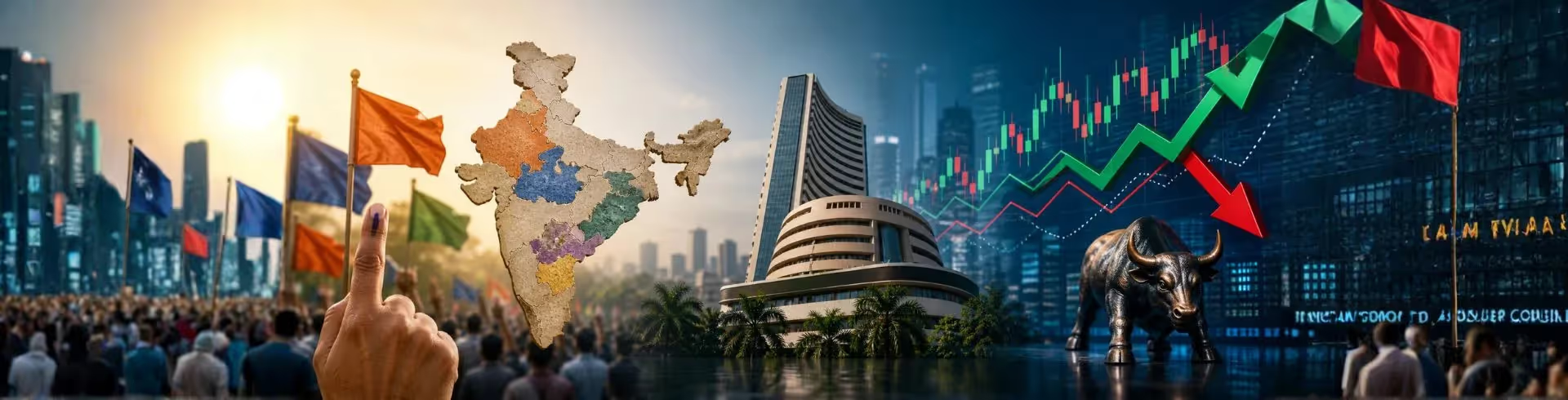

State Elections 2026 & Dalal Street: How Political Results Move the Markets


At a Glance
- Indian stock markets are highly sensitive to state election outcomes, especially when results affect political stability or policy continuity.
- The May 2026 state election results — particularly West Bengal — triggered intraday volatility before markets closed higher.
- Sensex gained 355 points and Nifty closed above 24,100 on election results day, driven by a BJP win in West Bengal.
- Sectors like infrastructure, banking, and consumption tend to react sharply to political outcomes.
- Smart investors treat election periods as opportunities, not threats — if they understand the playbook.
Elections and the Stock Market — A Relationship India Knows Too Well
Ask any seasoned investor on Dalal Street and they will tell you — election season is not just a political event. It is a market event. From the euphoric 2014 Modi wave that sent Sensex soaring over 1,400 points in a single session, to the nervous consolidation before the 2024 general elections, Indian markets have consistently shown that political outcomes move money.
But what about state elections? Are they really that important for a ₹400 lakh crore market? The answer, as May 2026 just demonstrated, is a firm yes.
What Happened in May 2026 — The Market Story
On May 4, 2026, India woke up to election results from key states including West Bengal, Tamil Nadu, and Assam. Markets opened cautiously, waiting for clarity. As results started trickling in and BJP surged ahead in West Bengal — a state long dominated by the Trinamool Congress — Dalal Street responded.
By close of trade, the Sensex had gained 355.90 points to settle at 77,269.40. Nifty added 121.75 points, closing at 24,119.30. The banking sector led the charge. The broader market mood, which had been weighed down by crude oil fears and FII outflows, found a domestic anchor in the election outcome.
This was not a coincidence. It was the market doing exactly what it always does — pricing in political signals.
Why State Elections Matter More Than You Think
Many retail investors assume state elections are a local affair with limited national impact. That thinking can be costly. Here is why state outcomes carry real weight for your portfolio.
Policy Continuity and Capital Allocation
State governments control massive infrastructure budgets, land acquisition decisions, and industrial policy. A business-friendly government in a large state like West Bengal, Tamil Nadu, or Maharashtra directly impacts sectors like real estate, cement, power, and logistics.
When a state pivots to a pro-growth administration, companies with exposure to that geography — construction firms, NBFC lenders, consumer goods companies — tend to rerate upward over the following months.
Coalition Arithmetic at the Centre
In a coalition-era India, state results shape the arithmetic of power at the Centre too. A weakened opposition or a stronger NDA alliance at the state level generally reassures markets about policy continuity at the national level. This reduces what analysts call "political risk premium" — the extra uncertainty investors bake into valuations during unstable political periods.
Sentiment as a Trigger
Even when the fundamental impact of a state result is modest, sentiment alone can move markets. Retail participation in Indian equity markets has grown dramatically since 2020. Crores of new investors react to headlines — and election headlines are among the loudest.
Sectors That React the Most
Not every sector responds equally to election results. Here is a quick map of what typically moves and why.
Infrastructure and Capital Goods — Government capex decisions, highway tenders, and power projects are all state-influenced. A decisive mandate usually means faster project clearances. Stocks like BHEL, L&T, and Power Grid tend to move on political stability signals. In fact, BHEL hit a 52-week high on May 4, surging over 7% on strong earnings — aligned with a positive political backdrop.
Banking and NBFCs — Financial inclusion schemes, state-sponsored credit programs, and agricultural loan waivers are all state-driven. A fiscally responsible government at the state level is good news for public sector banks and retail lenders.
Consumer Staples and FMCG — State election campaigns often come with rural welfare announcements. Post-election, rural consumption tends to pick up in winning party states, benefiting companies like HUL, Dabur, and ITC.
Real Estate — Land reform policies, RERA implementation speed, and urban development priorities all sit with state governments. Election clarity removes a key overhang for real estate stocks.
The Volatility Window — Risk and Opportunity Together
The week before and the week after a major election result is historically one of the most volatile periods for Indian indices. Nifty typically swings in a 1 to 1.5 percent band on results day itself. For short-term traders, this is noise. For long-term investors, it is often a buying window.
Consider this pattern: markets tend to sell the rumour and buy the news. In the days leading up to results, uncertainty causes cautious investors to pare positions. Once results are out — regardless of who wins — markets often rally simply because the uncertainty is resolved.
Experienced investors use this predictable behaviour to accumulate quality stocks in fundamentally strong sectors during the pre-result nervousness.
What Should Investors Do During Election Season?
The worst thing you can do during an election period is make impulsive decisions based on exit polls or early trends. Exit polls have a mixed record in India. Markets have been caught off guard multiple times when actual results diverged sharply from predictions.
A more measured approach involves three steps.
First, review your sector exposure before results. If you are heavily concentrated in state-sensitive sectors like infrastructure or real estate, consider whether your portfolio can handle a 3 to 5 percent drawdown if results disappoint.
Second, avoid leveraged positions around results day. The intraday swings can trigger stop losses on perfectly good trades simply due to short-term volatility.
Third, look at the medium-term picture. State elections create noise, but corporate earnings, interest rate cycles, and global flows drive markets over 12 to 18 months. Do not let a single day's political event derail a sound investment thesis.
The Bigger Picture — India's Political Economy and Long-Term Markets
Zoom out and the picture is encouraging. India is in a sustained capex supercycle. Whether at the Centre or in the states, infrastructure spending continues to be a political priority across party lines. Digital India, PM Awas Yojana, and highway expansion programs survive changes in state government because they are popular with voters everywhere.
This means the long-term investor in Indian equities has a structural tailwind that transcends election cycles. Short-term volatility around results is real — but it has consistently proven to be a buying opportunity for those with patience.
Frequently Asked Questions
Do state election results have a lasting impact on the stock market?Usually not beyond a few sessions unless the result significantly changes policy expectations for a large state. The initial reaction fades within a week and markets return to tracking earnings, flows, and global cues.
Which sectors are most affected by state election outcomes?Infrastructure, banking, real estate, consumer goods, and power sectors are most directly influenced by state government policies and spending decisions.
Should I sell my stocks before election results?Generally no. Unless you have very concentrated exposure to state-sensitive sectors, selling ahead of results means locking in uncertainty. History shows markets often recover quickly even when results are mixed.
How did markets react to the 2026 state election results?Sensex gained 355 points and Nifty rose 121 points on May 4, 2026, supported by BJP's win in West Bengal and continued buying in banking and financial stocks.
What is the best strategy during election-related market volatility?Stay invested in quality stocks, avoid leveraged bets around results day, and look for dips in fundamentally strong sectors as entry opportunities.
Conclusion — Politics Creates Noise, Strategy Creates Wealth
State elections will always create short-term turbulence on Dalal Street. But turbulence is not the same as danger — not if you understand what is driving it and have a plan.
The investors who consistently build wealth through Indian market cycles are not the ones who predict election results correctly. They are the ones who stay disciplined, diversified, and research-driven regardless of who wins or loses.
At Swastika Investmart, our research team tracks political, macroeconomic, and sectoral developments continuously to help you make informed, confident investment decisions. With SEBI-registered advisory services, robust research tools, and a dedicated support team, we are built for investors who want to go beyond the headlines.
Ready to invest with clarity and confidence?






