



Starting your journey in stocks and investing does not require a huge amount of money. Even ₹50,000 can be a good starting point if you have a clear investment plan and understand how to manage risk.
The biggest mistake beginners make is putting all their money into a few popular stocks without understanding their financial position or investment goals. A better approach is to divide your money across different asset classes, including equities, debt, gold, and cash.
In this guide, we will explain how to build your first ₹50,000 investment portfolio, where to invest, how much to allocate to different assets, and what to check before buying individual stocks.


What should You do Before Investing Your First ₹50,000?

Before investing in stocks or mutual funds, make sure your basic financial needs are covered. Your investment plan should not put your everyday expenses or financial security at risk.
Here are three things to take care of before entering the stock market.
1. Build an Emergency Fund
An emergency fund is money kept aside for unexpected expenses, such as medical bills, job loss, or urgent household repairs.
Ideally, you should maintain an emergency fund equal to 3 to 6 months of your living expenses. Your research also suggests keeping approximately ₹1.5–2 lakh in a liquid mutual fund or high-yield savings account.
Having this money available can prevent you from selling your investments during a market downturn just to manage an emergency.
2. Get Adequate Insurance Protection
Health and term life insurance are important parts of financial planning.
Health insurance can help cover medical expenses, while term life insurance provides financial protection to your dependants in case of your death.
Without adequate insurance, an unexpected event could force you to use the money you have invested.
3. Clear High-Interest Debt
If you have outstanding credit card bills or personal loans carrying interest rates above 12–15%, consider clearing them before investing.
High-interest debt can put pressure on your monthly budget. Managing these obligations first can give you more financial freedom to invest regularly.
How to Divide Your First ₹50,000 Investment?

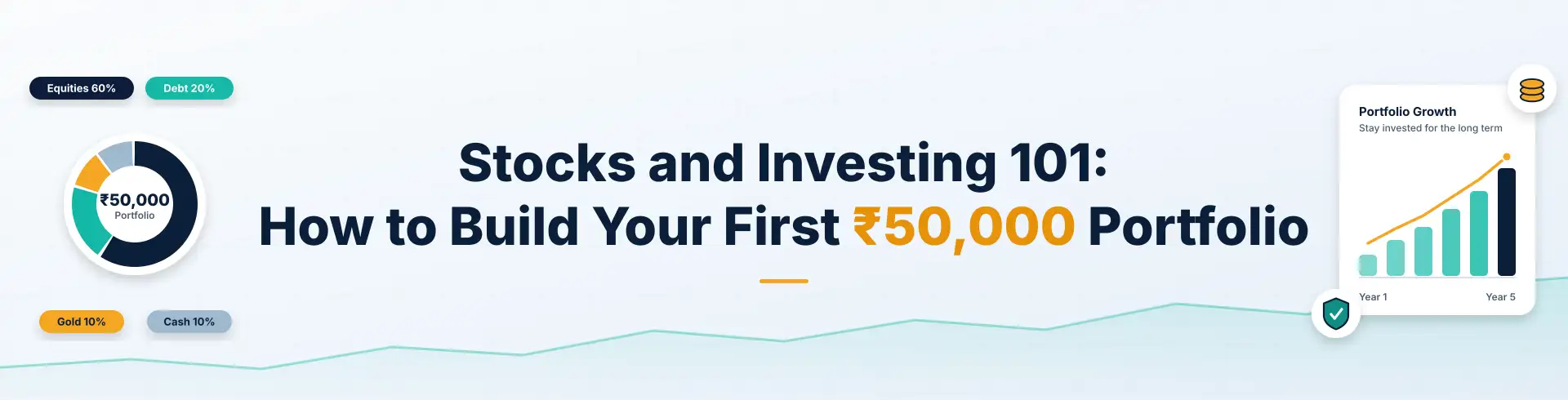
A beginner should focus on diversification instead of putting the entire ₹50,000 into individual stocks. One suggested approach is to divide your money across four asset classes. This allocation gives you exposure to equity investments while keeping some money in relatively stable assets.
Here is a sample portfolio.
Let's understand why each category has a place in this portfolio.
1. Equities – ₹30,000
Equities can be the primary growth component of a long-term investment portfolio. However, stock prices can fluctuate, and individual companies carry their own business risks. If you are a beginner, you do not necessarily need to start by selecting individual stocks. You can consider two types of mutual funds.
Index Funds: These funds track a market index, such as the Nifty 50 or Sensex. Instead of investing in one company, you get exposure to several companies included in that index.
Flexi-Cap Funds: These mutual funds can invest across companies of different market capitalisations. This gives the fund manager flexibility to choose investments based on the fund's strategy.
Both options can help beginners access a diversified basket of stocks without having to analyse every company individually. With ₹30,000 allocated to equities, you can use these funds as the core of your portfolio.
2. Debt and Fixed Income – ₹10,000
Debt investments can provide stability to your portfolio when equity markets experience volatility. You can consider options such as:
- Bank Fixed Deposits (FDs)
- Recurring Deposits (RDs)
- Liquid Mutual Funds
These instruments have different features, liquidity conditions, and risk levels. Choose an option after understanding its terms and suitability. For beginners, having a debt allocation can help balance the overall portfolio instead of depending entirely on stock market movements.
3. Gold – ₹5,000
Gold can act as a defensive asset during periods of economic uncertainty. Instead of purchasing physical gold, you can consider Gold ETFs or digital gold. Gold ETFs allow investors to gain exposure to gold through the stock exchange without having to store physical gold themselves. A 10% allocation means you would invest ₹5,000 in this category.
4. Cash Buffer – ₹5,000
You do not always need to invest every rupee immediately. Keeping ₹5,000 aside as a cash buffer gives you flexibility when new investment opportunities appear or market prices decline. It also prevents you from having to sell existing investments whenever you need some money for a new opportunity.
Should You Invest ₹50,000 through SIP or Lump Sum?
Both SIP and lump sum investing are ways to put money into mutual funds. The main difference is how and when you invest your money.
Lump Sum Investment: You invest a larger amount at once.
Systematic Investment Plan (SIP): You invest a fixed amount at regular intervals, usually every month.
For example, if you have ₹50,000 available, you can invest it across your chosen asset allocation in one go. Alternatively, you can spread your equity investment over several months through SIPs.
SIPs can start with amounts as low as ₹500 to ₹1,000 per month, depending on the mutual fund. A SIP helps you develop a regular investment habit and spread your investment across different market levels. A lump sum approach allows you to deploy available money immediately. The right choice depends on your financial position, investment horizon, and comfort with market fluctuations.
How should you Manage your Monthly Salary While Investing?
Building a portfolio is not just about investing your initial ₹50,000. Your monthly income also plays an important role in maintaining your investment habit. Let's take an example of someone earning ₹50,000 per month. Here is one suggested way to divide the monthly salary.
Essential Expenses: This category covers rent, groceries, electricity bills, utilities, and EMIs.
Protection: Keep money aside for health and term insurance premiums and emergency savings.
Wealth Creation: This is the amount you can allocate towards building your investment portfolio. You can divide it between index funds, flexi-cap funds, ELSS funds under Section 80C with a 3-year lock-in, and mandatory EPF deductions.
Discretionary Spending: This money can be used for shopping, entertainment, eating out, and personal expenses.
These are suggested allocation ranges rather than fixed amounts. Your actual spending should depend on your household expenses and financial responsibilities.
How can you Start Investing in Stocks and Mutual Funds?
Once your financial basics are in place, the next step is to set up the accounts required to invest. Here is a simple process.
Step 1. Open a Demat and Trading Account
To buy and hold shares electronically, you need a demat account and a trading account. You can open these accounts with a SEBI-registered broker or depository participant associated with CDSL or NSDL. Compare the available account features, charges, and services before choosing a provider.
Step 2. Complete Your KYC
KYC stands for Know Your Customer. It is the identity verification process required to open an investment account. Digital KYC usually takes 24–48 hours, as mentioned in the supplied research. You will need to complete the required verification before you can start trading.
Step 3. Add Money to Your Account
After your account is activated, transfer money using available payment methods such as:
- UPI
- NEFT
- RTGS
Once the money is credited, you can use it to purchase eligible investments through your account.
Step 4. Start with Diversified Investments
If you are new to the stock market, consider starting with index funds or flexi-cap funds instead of immediately purchasing several individual stocks. This approach can help you understand how equity investments work while reducing your dependence on the performance of a single company.
What should Beginners Check before Buying Individual Stocks?
Once you understand mutual funds and basic investing, you may want to explore individual stocks. However, buying a stock simply because its price is rising or someone has recommended it is not a sound investment approach. You should understand the company's financial position before investing. Here are three basic factors to examine.
1. Check Revenue and Earnings Growth
Revenue represents the money a company generates from selling its products or services. A company showing consistent revenue and earnings growth over 3–5 years may indicate that its business is expanding. However, one or two good financial years are not enough to understand a company's long-term performance. Look at its financial statements and examine how the business has performed over multiple years.
2. Understand the Debt-to-Equity Ratio
The debt-to-equity ratio helps investors understand how much debt a company uses compared with its shareholders' equity. A lower ratio can indicate that a company depends less on borrowed money.
Your supplied research suggests checking companies with a debt-to-equity ratio below 1.0. However, this should not be treated as a universal rule for every industry. You should also examine the company's business model and overall financial health.
3. Consider Your Investment Horizon
Stock market investments require patience.
If you are investing in individual stocks, consider whether you can keep the money invested for at least 3 to 5 years. Money required for immediate expenses should not be exposed to stock market fluctuations. Your investment horizon should match your financial goals and ability to handle risk.
5 Rules to Follow when Building a Long-Term Investment Portfolio
Starting your portfolio is only the first step. Maintaining it with discipline is equally important. Here are five practical rules to follow.
1. Keep Your Portfolio Simple
You do not need to purchase dozens of mutual funds or stocks to build a diversified portfolio. Holding too many investments can make it difficult to track their performance and understand where your money is allocated. Start with a manageable number of investments that you understand.
2. Avoid Very Small Stock Allocations
If you decide to invest in individual stocks, avoid spreading your money across too many companies with negligible allocations. Your research suggests keeping individual positions meaningful, preferably 5% or more of the portfolio. However, position size should also depend on the company's risk and your overall investment strategy.
3. Increase Your SIP Amount Regularly
As your income increases, try to increase your monthly investment amount as well. The step-up principle suggests increasing your SIP allocation by 10–20% annually. For example, if you currently invest ₹5,000 per month, you can consider increasing that amount as your income and financial capacity improve.
Regular contributions can help build a larger investment corpus over a 15- to 20-year horizon.
4. Diversify Across Asset Classes
Do not depend entirely on stocks or equity mutual funds. Your portfolio can include equity, debt, gold, and cash, depending on your financial goals and risk tolerance. Different asset classes serve different purposes. Diversification can help reduce dependence on one investment category.
5. Review Your Portfolio Quarterly
Checking stock prices every day can create unnecessary stress, especially for beginners. Instead, review your portfolio quarterly.
Check whether your investments are aligned with your financial goals, whether the companies you own remain financially sound, and whether your asset allocation needs adjustment. Avoid making frequent changes based only on short-term market movements.
Frequently Asked Questions about Stocks and Investing
1. Is ₹50,000 enough to start investing in the stock market?
Yes. ₹50,000 can be a starting amount for building a diversified investment portfolio. You can divide it across equities, debt, gold, and cash based on your financial goals and risk tolerance.
2. Should beginners invest in stocks or mutual funds first?
Beginners can consider starting with index funds or flexi-cap mutual funds. These options provide exposure to multiple companies without requiring investors to select and analyse individual stocks.
3. Can I invest ₹50,000 in mutual funds at once?
Yes. You can invest a lump sum of ₹50,000 in mutual funds. However, consider your financial position, investment horizon, and comfort with market fluctuations before choosing this approach.
4. How many stocks should a beginner hold?
There is no fixed number that works for every investor. Beginners should focus on understanding their investments rather than purchasing too many stocks. The amount allocated to each company should also reflect its risk.
5. How long should I stay invested in the stock market?
For individual stock investments, the suggested investment horizon in this guide is at least 3 to 5 years. Your actual holding period should depend on your financial goals and the company's fundamentals.
6. Should I invest my entire salary surplus in stocks?
No. You should first account for essential expenses, emergency savings, insurance, and existing debt obligations. The remaining amount can be divided across suitable investment categories.
Conclusion
Building your first ₹50,000 portfolio is an opportunity to develop good financial habits. You do not need to identify the next big stock or invest all your money in one place. Start by securing your financial basics, divide your investment across suitable asset classes, and consider diversified mutual funds if you are new to the market. As your knowledge and income grow, you can gradually explore individual stocks and increase your monthly investments. The most important thing is to have a clear plan, understand the risks, and stay disciplined throughout your investment journey. For more guidance and expert analysis, visit Swastika Investmart.