.avif)



The Jio IPO is likely to attract significant investor attention, but a strong brand and market position should not be the only things investors consider before applying.
The Draft Red Herring Prospectus (DRHP) highlights several risks that could affect the company's operations, profitability, cash flows and, ultimately, the performance of its equity shares after listing.
For an investor, the important question is not simply "Is Jio a strong business?" It is also "What could go wrong, and how much of that risk is already reflected in the IPO valuation?" Here are the 10 major Jio IPO risks that deserve closer attention before making an investment decision.
TRY SARTHI - YOUR AI STOCK ASSISTANT
Dependence on Telecom Licences and Spectrum
This is arguably one of the most fundamental risks for any telecom business.
Jio's operations depend heavily on maintaining the necessary telecommunications licences, regulatory approvals and spectrum. The company also needs access to suitable spectrum to support its network and future expansion. Spectrum is not an unlimited resource. Its availability, pricing, allocation and renewal are influenced by government policy and regulatory decisions.
From an investor's perspective, this means Jio's growth is not determined entirely by its own business strategy. Changes in spectrum pricing, auction conditions, licence requirements or renewal terms could increase costs or affect the company's ability to expand its services.
The investor takeaway: Jio's ability to grow depends partly on access to the right spectrum at an economically viable cost. Any difficulty in renewing licences or acquiring additional spectrum could affect both its expansion plans and future capital requirements.
Read More About JIO IPO: Jio IPO: Date, Valuation, Review and Complete Investor Guide
Network Disruptions Could Affect Customers and Revenue
For a telecom company, the network is the product. A disruption involving Jio's network, passive infrastructure, technology systems, or other critical infrastructure could affect service availability. Even temporary disruptions can become significant if they affect a large customer base.
There is also a customer-retention angle here. Telecom users have relatively low tolerance for persistent network or service problems. If customers experience poor connectivity or repeated outages, they may consider switching to competing operators.
The risk therefore extends beyond the immediate cost of repairing infrastructure. A prolonged disruption could affect customer satisfaction, brand reputation, subscriber retention and revenue.
The investor takeaway: For a telecom operator, network availability directly affects customer experience. A prolonged disruption could therefore go beyond a temporary operational problem and translate into higher customer churn, additional costs and reputational damage.
Technology is Moving Fast: 4G, 5G and Beyond
One thing investors should remember about telecom is that today's competitive advantage can become tomorrow's outdated technology.
The industry is constantly evolving, and Jio needs to keep investing in network technology and infrastructure to respond to changing customer expectations. The transition from 4G to 5G is one example of how quickly technology can reshape the market.
If the company fails to adopt new technologies at the right pace, its services could become less competitive. On the other hand, aggressively investing in new technology creates another challenge, which is high capital expenditure.
So investors are essentially looking at two risks at the same time, which include the risk of technological obsolescence and the risk of spending heavily to avoid it.
The investor takeaway: Jio has to keep investing simply to remain technologically competitive. Investors therefore need to consider whether future network and technology investments can generate sufficient returns rather than looking at capex only as a growth expense.
Jio's Business Requires Enormous and Recurring Capital Investment
Telecom is not a business where a large initial investment is enough. Networks have to be continuously upgraded as technology and customer usage evolve. Jio spent ₹34,184.3 crore in cash capex in FY26. During the peak of the 5G rollout, cash capex reached an even higher ₹53,509.6 crore in FY24.
This creates an important investment consideration. Jio needs to keep spending heavily on network infrastructure, technology and related assets to remain competitive. The risk is that these investments may not always generate returns at the pace or scale expected.
Investor takeaway: Investors should look beyond revenue growth and ask whether Jio's future returns can justify the enormous capital required to sustain that growth.
Heavy Debt Could Limit Financial Flexibility
Jio operates in a capital-intensive industry where network expansion, spectrum and technology upgrades require substantial funding. As of March 31, 2026, the company's total fund-based outstanding borrowings stood at ₹71,529.2 crore, while non-fund-based borrowings were another ₹2,021.7 crore.
The pressure is also visible in finance costs. Jio's finance costs increased 76.42% to ₹8,653.4 crore in FY26, primarily due to interest associated with 5G-related assets and borrowings.
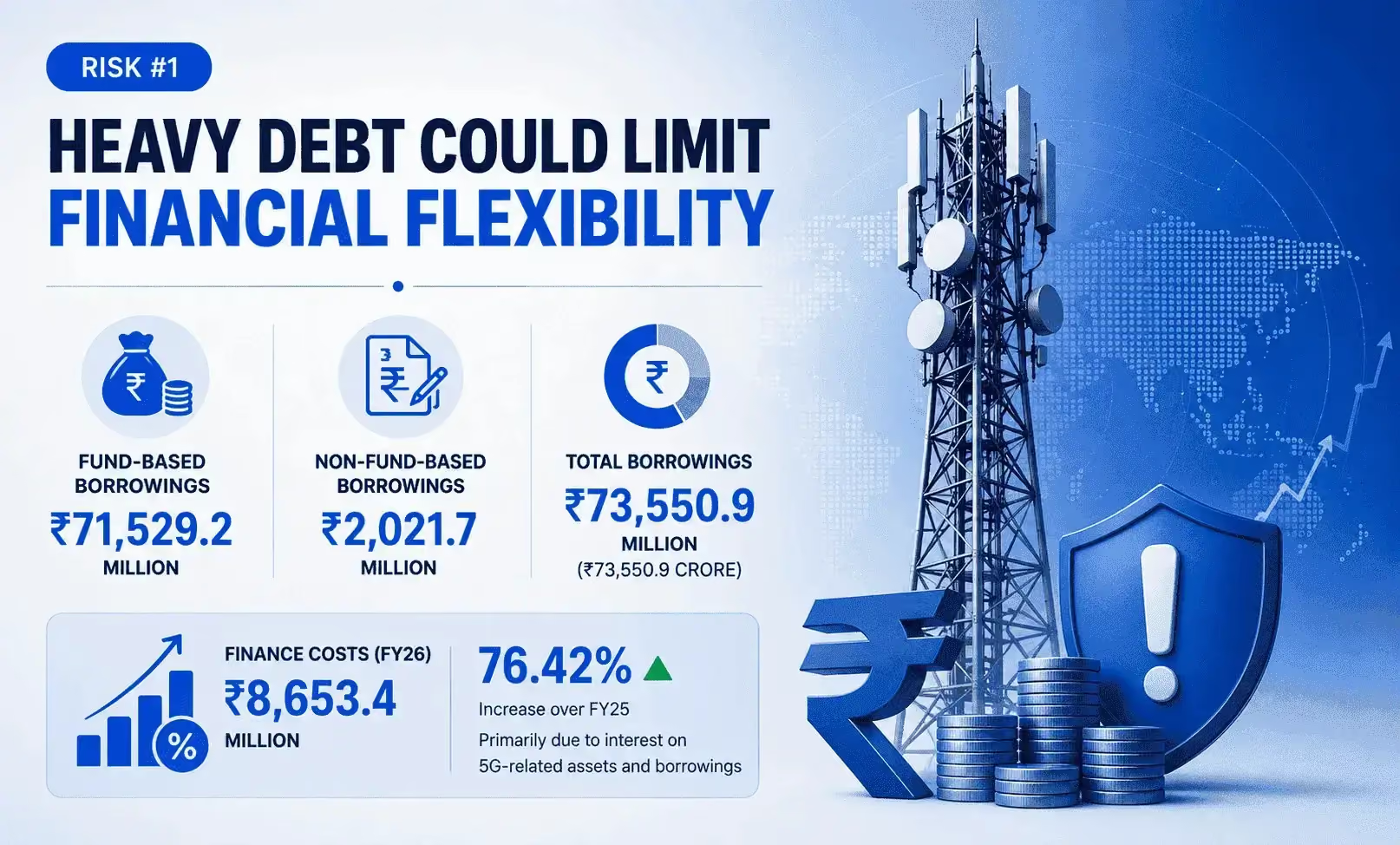
For investors, the concern is straightforward: a highly leveraged telecom business needs strong and consistent cash generation to service debt while continuing to invest in the network. If operating cash flows do not grow as expected, debt servicing can reduce the financial flexibility available for future expansion.
The investor takeaway: The key question for investors is whether Jio can comfortably service its debt while continuing to fund network expansion and technology upgrades. A rise in financing costs or weaker cash generation could narrow that flexibility.
Network Disruptions can Directly Affect Customer Experience
For a telecom company, network reliability is not simply an operational metric. It is central to customer retention.
The DRHP provides examples of service disruptions. In FY26, a server-related issue resulted in a two-hour disruption of 5G and JioAirFiber services in Gujarat. During FY25, multiple power-related outages lasted for as long as three hours. Such incidents may appear temporary, but repeated or prolonged disruptions can affect customer satisfaction, brand perception, and ultimately churn.
Jio's extensive network also means that maintaining reliability across a very large infrastructure footprint is a continuing operational challenge.
Investor takeaway: The larger the network becomes, the greater the importance of maintaining consistent service availability across geographies and technologies.
Customer Growth has Slowed After Tariff Increases
Jio had a massive customer base of 524.4 million subscribers as of March 31, 2026. However, the trajectory of customer additions deserves attention. Net customer additions fell from 42.5 million in FY24 to only 6.4 million in FY25, following industry-wide tariff increases. Jio's monthly churn rate stood at 1.67% in FY26.
The issue here isn't that Jio has a small customer base. It clearly doesn't. The question is how much further customer growth can contribute to the business and whether higher tariffs can translate into sustainable revenue and ARPU growth without increasing churn.
Investor takeaway: At Jio's current scale, monetising the existing customer base may become increasingly important alongside adding new subscribers.
Jio Remains Dependent on Group Companies and Related-Party Arrangements
Jio's association with the wider Reliance ecosystem can create strategic advantages, but it also creates operational and financial dependencies that investors need to understand.
In FY26, Jio paid ₹4,355.1 crore to Reliance Retail Limited for selling and distribution, representing 3.98% of total expenses. In addition, ₹3,904 crore of capex, or 11.42% of total cash capex, was directed to the Promoter (Parent) for property and equipment.
The company also has arrangements with other Reliance Group entities for various services and infrastructure. These relationships are not necessarily negative, but their scale makes them relevant when assessing the company's cost structure, operational independence and potential related-party risks.
Investor takeaway: Investors should evaluate not only Jio's standalone numbers but also how its relationships with the Reliance Group influence its operations and expenses.
Regulatory Dependence Can Translate Into Financial and Operational Risk
Telecom is one of India's most heavily regulated sectors. Jio's operations depend on licences, spectrum allocations and compliance with regulations administered by authorities including the Department of Telecommunications and TRAI.
The DRHP also provides evidence that regulatory compliance can have a financial impact. Between April 2020 and June 2024, TRAI issued 17 orders against the company, imposing aggregate financial disincentives of ₹27.1 crore for issues including failure to curb unsolicited communications and quality-of-service shortcomings.
Future regulatory changes could affect operating costs, service requirements, spectrum economics or the way telecom services can be monetised.
Investor takeaway: Investors should treat regulatory risk as an ongoing business variable rather than a one-time compliance issue.
The IPO Shares Themselves could be Volatile after Listing
Now comes the risk that directly affects the investor. Even if Jio performs well operationally, that does not guarantee that the stock will perform well after listing.
The DRHP highlights the possibility of market price volatility and the fact that there has been no prior formal public market for the company's equity shares.
After listing, the share price will be influenced not only by Jio's financial performance but also by market sentiment, valuation, investor expectations, sector trends and overall market conditions.
A highly anticipated IPO can also see significant movement as investors reassess the company's valuation once shares begin trading. So, investors should separate two questions: “Is Jio a good business?” and “Is the IPO price attractive enough to compensate for the risks?” Those are not necessarily the same question.
The investor takeaway: This is where the distinction between a good company and a good investment becomes important. Even strong operating performance may not translate into attractive shareholder returns if the IPO valuation leaves little room for disappointment.
Additional Factors Investors Should Keep in Mind
The 10 risks above are the ones I would put at the top of an investor's checklist. But they are not the only risks disclosed in the DRHP. Beyond these 10 major risks, several other points from the DRHP deserve consideration:
- Power and fuel costs: Jio incurred ₹10,932.8 crore in power and fuel costs in FY26, equivalent to 7.44% of revenue from operations.
- Insurance coverage: Insurance coverage of ₹1,37,398.6 crore represented only 43.57% of tangible gross block plus capital work-in-progress, excluding right-of-use assets.
- Employee attrition: Full-time employees declined from 35,757 in FY24 to 28,163 in FY26, while the latest reported attrition rate was 21.78%.
- Loss-making subsidiaries: 11 subsidiaries reported a combined loss after tax of ₹100.6 crore in FY26.
- Competition: Jio operates in a highly competitive telecom market where pricing, network quality, technology and customer retention can directly affect market share and profitability.
- Technology risk: The company must continue investing in newer technologies as customer requirements evolve, creating a recurring risk of technological obsolescence.
- Share-price risk: After listing, the market price may differ significantly from the IPO price, particularly because there is no established public trading history for the shares.
So, Should Investors Be Worried About the Jio IPO?
Not necessarily, and this is an important distinction. A risk factor does not mean that the risk will definitely materialise. Companies are required to disclose material risks so that investors can make informed decisions. The better approach is to understand which risks are structural and which can actually change the investment thesis.
For Jio, the major areas to monitor are its ability to maintain spectrum and network quality, manage capital expenditure and debt, grow ARPU, retain customers, remain competitive and navigate India's evolving telecom regulations. At the same time, investors should not overlook the valuation. A strong business can still be an unattractive investment if the IPO price leaves little room for potential risks or disappointing execution.
Over to You
The Jio IPO could offer investors exposure to a major telecom and digital business, but the investment case should not be based on the Jio brand alone. Spectrum dependency, technology spending, cybersecurity, debt, competition, regulation, customer monetisation and post-listing volatility are all important factors to evaluate.
Before applying, investors should read the DRHP carefully, assess the IPO valuation against the company's growth prospects and decide whether the potential return justifies the risks involved. For more IPO-specific updates, analysis and market insights, visit Swastika Investmart.