.webp)

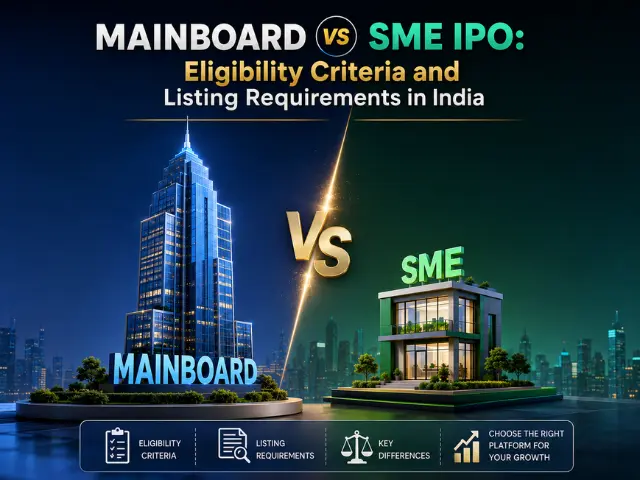
Mainboard vs SME IPO: Eligibility Criteria and Listing Requirements in India


In today's fast moving financial markets, an Initial Public Offering (IPO) serves as a vital tool for companies seeking to raise capital, strengthen their market presence, and accelerate business expansion.
An IPO (Initial Public Offering) is the process through which a private company offers its shares to the public for the first time and gets listed on a stock exchange.
Before launching an IPO, a company must fulfill the regulatory requirements established by government authorities, particularly the Securities and Exchange Board of India (SEBI), as well as comply with the listing criteria of stock exchanges such as the Bombay Stock Exchange(BSE) and the National Stock Exchange of India (NSE). Meeting these eligibility and approval requirements is mandatory for a company to become publicly listed in India.
Mainboard IPO
A Mainboard IPO is when a large, well-established company sells its shares to the public for the first time. These shares are listed and traded on major Indian stock exchanges like the BSE and NSE. The main purpose is to raise money could be to grow the business, repay debts, or fund new projects. Such companies usually have a strong financial track record and stable operations. Mainboard IPOs generally attract many investors, including both big institutions and retail investors and their shares are easier to buy and sell in the market.
1. Mainboard IPO Requirements
The applicant must have a minimum paid-up equity capital of ₹10 crore, and minimum market capitalization of ₹25 crores at the time of listing.
1.1 Profitability Route (Entry Norm I)
For companies that are already profitable and have a solid financial history. All conditions below must be met:
- The company needs net tangible assets worth a minimum of ₹3 crore in each of the three years immediately preceding the issue.
- For a fresh issue, no more than 50% ofthese assets may be held in cash or other monetary forms, unless that amount has been earmarked for use in the business.
- The company must show an average operating profit(calculated before accounting for depreciation and tax) of at least ₹15 crore,achieved in any three out of the previous five financial years.
- The minimum net worth for a company to qualify for a Mainboard IPO under SEBI ICDR Regulations is ₹1 crore in each of the three preceding financial years.
- If the company has changed its name within the past year, at least half of the revenue earned in that year must come from the business activity reflected by the new name.
- The size of the IPO must not be more thanfive times the company’s net worth calculated before the issue (pre‑issue).
1.2 QIB Route (Entry Norm II)
The QIB route is a separate path introduced by SEBI to give legitimate, credible, and well-run companies a way to go public if they can't meet the strict profit-based requirements. Companies opting for this route must ensure the following:
- The IPO must be conducted using the book-building process.
- At least 75% of the net offer must be reserved for Qualified Institutional Buyers (QIBs), while retail investors are limited to 10% to reduce their exposure to higher-risk IPOs.
- If the required QIB subscription is not achieved, the IPO cannot proceed, and all application funds must be refunded to investors.
SME IPO
An SME IPO refers to the process by which a small or medium enterprise offers its shares to the public for the first time.Unlike larger companies that list on the main stock exchange platforms, SMEs list on dedicated segments created specifically for smaller businesses such as NSE Emerge and BSE SME.
SME IPOs are subject to more relaxed eligibility norms than Mainboard IPOs. However, the company's post-issue paid-up capital must not exceed ₹25 crore.
The eligibility requirements for promoters/directors/investors remain the same as those for a Mainboard IPO- they must not be defaulters,fugitive economic offenders, or barred from accessing the capital markets.
BSE SME IPO Eligibility Criteria

Additional Eligibility Criteria for Broking Companies(BSE SME IPO)

Additional Eligibility Criteria for Micro Finance Companies

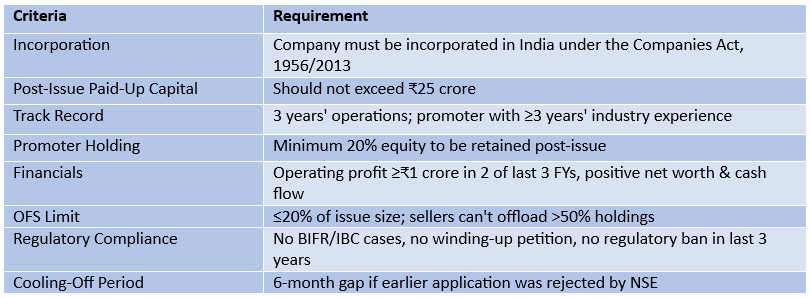
NSE SME (Emerge) IPO Eligibility Criteria