.avif)

NSE Dividend Story: Key Factors Investors Must Know Before Applying for NSE IPO


As the National Stock Exchange of India (NSE) prepares for its much-anticipated IPO, with its Draft Red Herring Prospectus filed in mid-June 2026, most eyes are on valuation multiples and grey-market premiums. But seasoned income investors are asking a different question entirely: what does NSE's dividend history tell us about the quality of this business? The answer, it turns out, reveals quite a lot about the structural character of this institution.
Dividends are not free money. They are a capital-allocation decision. For a market-infrastructure business like an exchange, typically asset-light, cash-generative, and structurally advantaged, dividend capacity can become a defining part of the long-term return equation. This article analyses NSE's revenue and dividend history to help investors make an informed decision ahead of the listing.
Key Highlights About NSE Dividend 2026

The NSE Dividend Story
As the National Stock Exchange prepares for its much-anticipated IPO with its Draft Red Herring Prospectus filed in mid-June 2026, most eyes are on valuation multiples and grey-market premiums. But seasoned income investors are asking a different question:
What does NSE's dividend history tell us about the quality of this business?
The answer reveals a lot. Let’s break down and understand NSE in more detail.
The Core Business Model of NSE
NSE's ability to sustain extraordinary dividend payouts year after year isn't luck, it's structural. The exchange earns the bulk of its revenues through transaction fees, dominated by India's derivatives segment. Unlike a bank or manufacturer, NSE doesn't need to reinvest billions into plants, equipment, or loan books to grow.
Three structural advantages underpin NSE's dividend firepower:
1. Zero Debt
Most large companies take on debt to fund expansion, acquisitions, or manage difficult periods. NSE has no debt. This is more than just a sign of good financial management, it highlights the strength of its business model. Unlike companies that need borrowed money to grow, an exchange grows naturally as market participation increases. With India's equity markets expanding steadily over the past two decades, NSE has been able to grow without relying on external funding.
2. Minimal Capex
Unlike capital-intensive businesses, NSE does not require heavy spending on factories, equipment, or physical expansion. Its technology-driven model allows it to grow with relatively lower capital requirements. This means a larger portion of its profits can be converted into actual cash and returned to shareholders. For dividend investors, this reflects strong earnings quality.
3. Treasury Strength
NSE’s strong cash reserves generate additional income through investments in safe financial instruments. This creates a second earnings stream beyond its core exchange business. Treasury income provides stability when market activity slows and supports consistent dividend payouts. For investors, it adds another layer of strength to NSE’s financial profile.
FY26 Payout of NSE
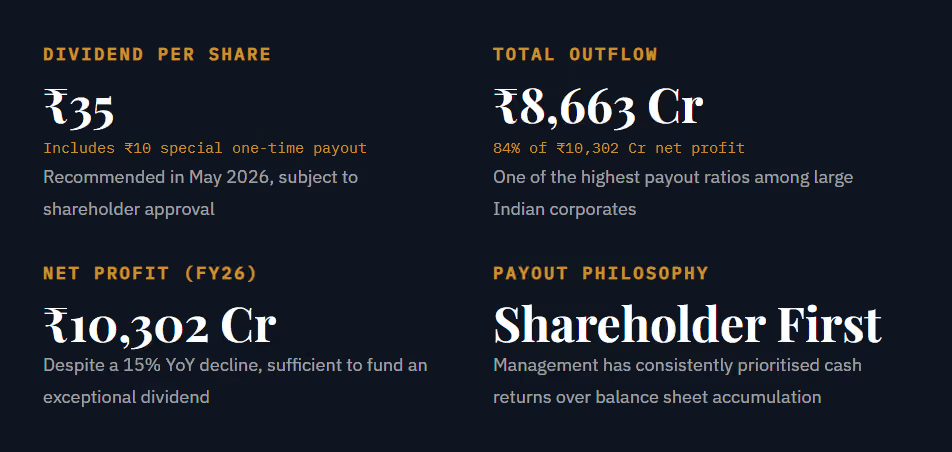
The remarkable aspect of NSE's FY26 dividend is that despite a 15% year-on-year decline in full-year profit, the exchange still recommended a payout that stands out among Indian blue-chip companies.
FY26 Dividend Details of NSE
Santosh Meena of Swastika Investmart has noted that the pure Offer for Sale structure of the IPO itself reflects the exchange's immense financial strength. He advises that investors should evaluate NSE differently from a traditional growth IPO, treating it instead as an acquisition of secondary shares in a proven, mature business with a well-established return profile.
Historical Track Record of NSE - Six Years of Dividend History
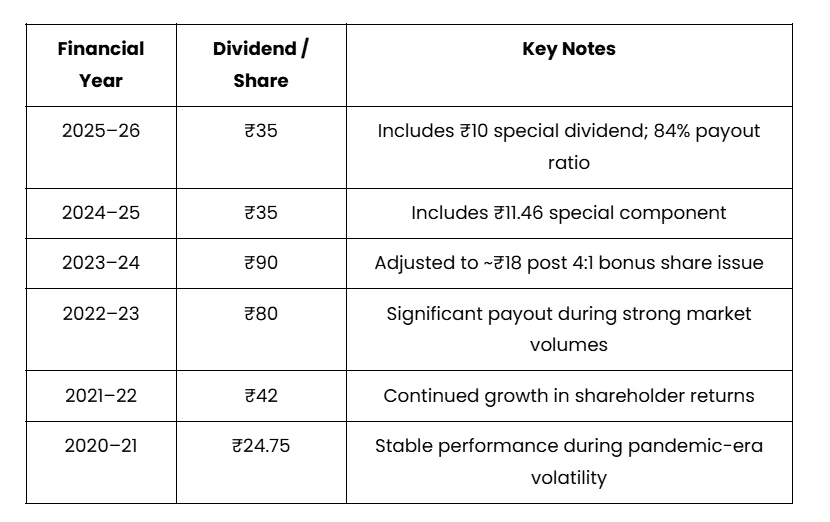
NSE's commitment to shareholders isn't a recent phenomenon. There is a consistent dividend track record of NSE with regular and special payouts.
Note: NSE typically declares final dividends around August each year, subject to shareholder approval at the AGM.
Understanding Dividend Yield: NSE vs Market
Dividend yield (annual dividend ÷ share price) is the key metric for income investors because it shows income generated per rupee invested.
Dividend Yield Comparison

The Nifty Dividend Opportunities 50 Index yields more than twice the Nifty 50. NSE's consistent payout history places it among premium high-yield companies, a factor investors may consider while evaluating the IPO.
Expert Vincent K.A. in The Economic Times said that the upcoming IPO is "better suited for investors seeking long-term participation in India's financialisation trend rather than a short-term trading opportunity". He also expects the relative market positioning between the NSE and BSE to "normalise over time" due to NSE’s market leadership and strong profitability.
The Verdict - Should You Invest? An Honest Assessment
NSE's dividend story is more than a number. A company paying out 84% of profits as dividends, even during a lower earnings year, signals management confidence and a shareholder-focused capital allocation strategy.
Reasons to Invest in NSE IPO
Predictable Income Stream
For retirees and income-focused investors, NSE's consistent multi-year dividend track record offers a reliable stream of passive income that few Indian equities can match. The exchange has paid dividends without interruption through bull markets, bear markets, and even pandemic-era volatility, making it one of the more dependable income instruments available in Indian equities.
Market Infrastructure Play
Owning NSE means owning the operational foundation on which Indian capital markets function. Every derivative contract traded, every equity settlement processed, and every index tracked flows through NSE's systems. This is not a bet on one company's products. It is a stake in the plumbing of an entire financial ecosystem.
IPO Value Proposition
The strong dividend history may support investor confidence and price stability in the post-listing period. Unlike speculative new-age listings where post-IPO price discovery can be volatile, NSE enters the public market with decades of earnings history and a clear shareholder return philosophy already in place.
Shareholder-First Culture
Management has demonstrated a sustained, multi-year commitment to returning cash to owners rather than accumulating it on the balance sheet. An 84% payout ratio in a year of declining profits is not a one-off gesture. It reflects a deeply embedded capital allocation philosophy that public market investors stand to benefit from directly.
Read More About NSE IPO and Timeline: NSE IPO Date and Timelines: When Will NSE Go Public?
Considerations Before Applying to the NSE IPO
Post-Listing Moderation
Future dividend payouts may moderate as NSE adapts to the expectations and obligations of being a publicly listed company. Growth investments, regulatory capital requirements, and the need to appeal to a broader investor base may collectively shift the payout ratio downward from its current exceptional levels.
Tax Impact
Dividends are taxed in the hands of the investor at their applicable income slab rate. Resident shareholders are subject to 10% TDS on dividends exceeding Rs. 10,000 in a financial year. For investors in the higher tax brackets, this can meaningfully reduce the effective yield received, and should be factored into any income-based return calculation.
Regulatory Risk
As a systemically important exchange, NSE operates under strict oversight from SEBI and other regulatory bodies. Changes in transaction tax structures, derivatives market regulations, or exchange governance norms could directly impact revenue and, consequently, dividend capacity. This is a risk specific to market-infrastructure businesses and deserves careful consideration.
Pure OFS Structure
Since the IPO is structured as a pure Offer for Sale, NSE itself will not receive any fresh capital from the listing. Proceeds flow entirely to existing selling shareholders rather than into the business. While this reflects confidence in the balance sheet, it also means the IPO does not unlock new growth capital or alter the company's financial position in any way.
The Bottom Line
NSE’s strong dividend history reflects the strength of its business model, supported by a debt-free balance sheet, consistent cash generation, and a leadership position in India’s financial markets. While dividends highlight shareholder returns, investors should also evaluate valuation, growth potential, and regulatory factors before investing in the IPO.
For detailed NSE IPO insights and expert market analysis, explore research-backed views from Swastika Investmart. Additionally, always consult a SEBI-registered financial advisor before making any investment decision.
—---------------------------------------------------------------------------------------------------------------------------------------------------------------------------------------------
Frequently Asked Questions About NSE Dividend and IPO
What dividend has NSE announced for FY26?
NSE has recommended Rs. 35 per share as its final dividend for FY26, which includes a special one-time component of Rs. 10 per share. The total payout amounts to approximately Rs. 8,663 crore, representing 84% of the exchange's net profit of Rs. 10,302 crore for the year. The dividend was recommended in May 2026 and is subject to shareholder approval at the AGM, with the actual payout typically processed around August.
How has NSE's dividend payout grown over the last six years?
NSE has maintained an uninterrupted dividend track record across varying market conditions. Payouts have grown from Rs. 24.75 per share in FY 2020-21 to Rs. 42 in FY 2021-22, Rs. 80 in FY 2022-23, and Rs. 90 in FY 2023-24, the highest nominal payout on record. Both FY 2024-25 and FY 2025-26 saw Rs. 35 per share, each including a special one-time component. The FY24 figure adjusts to approximately Rs. 18 per share on a post-bonus basis following the 4:1 bonus issue in 2024.
What was the NSE bonus share issue, and how did it affect shareholders?
In 2024, NSE issued bonus shares in a 4:1 ratio, meaning shareholders received four additional shares for every one share held. This quadrupled the total number of shares in circulation, improving liquidity and making the stock more accessible to retail investors. While the bonus issue did not change the overall value of a shareholder's holding on the day of issuance, it reduced the per-share price proportionally and adjusted historical dividend-per-share figures accordingly. NSE had also executed a similar equity action in 2016, combining a bonus allotment in November with a share split in December.
How are NSE dividends taxed, and what TDS applies?
NSE dividends are fully taxable in the hands of the investor and are added to total annual income, with tax applied at the investor's applicable income slab rate. There is no flat dividend tax rate. For resident individual shareholders, TDS at 10% is deducted at source when the total dividend received from NSE in a financial year exceeds Rs. 10,000, provided valid PAN details are registered with the company. Investors in higher tax brackets should factor this into their effective yield calculation, as the post-tax income received may differ meaningfully from the headline dividend figure.
When is the NSE IPO expected, and what is its size?
NSE filed its DRHP in mid-June 2026, with the IPO size estimated at ₹25,000–30,000 crore. The IPO is expected to be one of India’s largest listings due to NSE’s dominant market position.
Is the NSE IPO a fresh issue or an Offer for Sale, and why does it matter?
The NSE IPO is a pure Offer for Sale, which means existing shareholders are selling their stakes rather than the company issuing new shares to raise fresh capital. For investors, this distinction matters for two reasons.
First, NSE's balance sheet remains unchanged post-listing since no new capital enters the business. Second, Santosh Meena of Swastika Investmart notes that this structure itself signals immense financial strength, as the company does not need external funding. Investors should treat this as acquiring secondary shares in a proven, mature business rather than funding a growth-stage company.
What is the record date for NSE dividends?
Investors must hold NSE shares on the record date to become eligible for the dividend. The company uses this date to identify shareholders who qualify for the announced payout.
What are the major risks investors should consider before the NSE IPO?
Investors should evaluate valuation, regulatory changes, competition, and future dividend sustainability before investing. Despite NSE’s strong business model, market conditions and regulations can impact future performance.