

.webp)

National Stock Exchange of India Limited (NSE) is the country's largest stock exchange and the operator of the core market infrastructure through which the vast majority of India's equity, derivatives, currency, and debt trades are executed. Through its subsidiaries, NSE also runs India's largest clearing corporation, manages the Nifty family of indices, and provides market data, analytics, and investor education services, which makes it a near-complete ecosystem for India's capital markets rather than a single-product business.
With its proposed IPO, investors will get an opportunity to own a stake in one of India's most profitable financial infrastructure businesses. However, the key question is not only "Will the NSE IPO generate listing gains?" but also: "Does NSE justify its expected premium valuation for long-term investors?"
In this guide, we take a closer look at NSE to help investors understand its business, significance in India's capital markets, and key factors that help them in evaluating the IPO opportunity.
NSE IPO Details
The key metrics and structural details of this landmark public issue are outlined in the table below. This core data is sourced directly from the official SEBI Initial Filings.
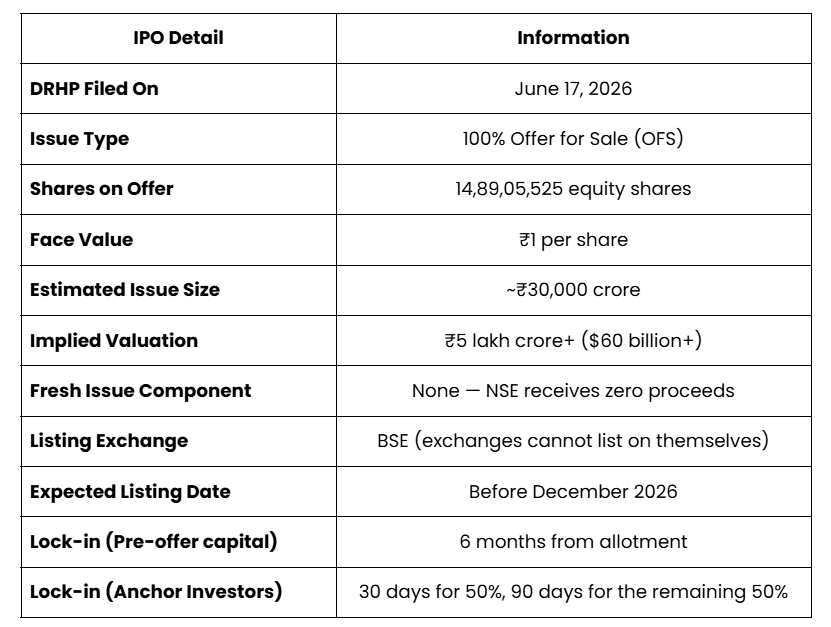
A quick explanation of two terms in this table that often confuse first-time investors. A DRHP, or Draft Red Herring Prospectus, is the detailed document a company files with SEBI before an IPO. It contains the company's financials, business details, and risks, and it is the starting point of the entire IPO process. An Offer for Sale, or OFS, simply means existing shareholders are selling their shares to the public, rather than the company printing brand new shares. NSE's entire IPO is structured this way.
The scale of this offer is why it is already being called the biggest IPO in Indian history. At an estimated ₹30,000 crore, it would be larger than Hyundai Motor India's 2024 IPO, which currently holds the record.
Structure of the IPO (Offer for Sale)
Because this is a pure Offer for Sale, the structure is simpler than most IPOs, there's no fundraising objective to evaluate:
- The entire issue consists of existing shareholders selling their shares to the public.
- NSE itself will not receive any proceeds from this offer.
- No portion of the issue will be used for capital expenditure, debt repayment, or working capital, since none is being raised by the company.
- The IPO's sole purpose is to provide an exit route for long-term institutional shareholders and to meet public shareholding norms for a Market Infrastructure Institution (MII).
Key Selling Shareholders of NSE Stocks
The breakdown below highlights the big institutional players selling their shares in this IPO, based on the latest data from Fortune India. The real story here isn’t just who is cashing out, but it’s about who is choosing to stay, which gives us a clear look at how much long-term confidence these massive investors have in NSE.
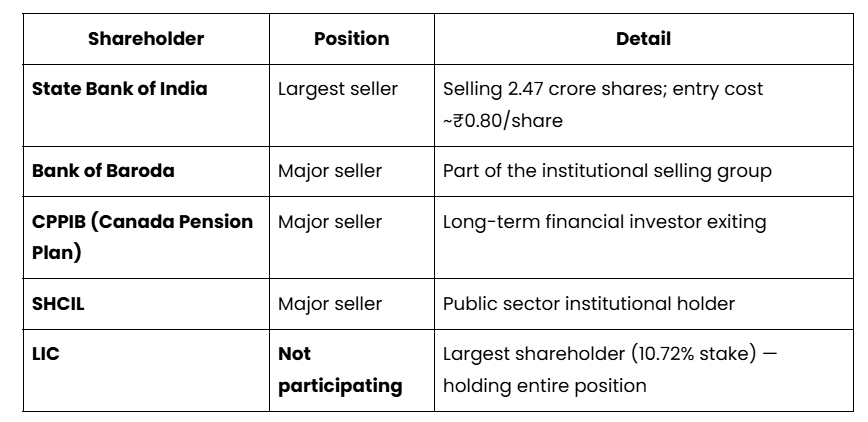
These names matter because of what their decisions reveal. SBI bought its NSE shares so long ago that it paid less than one rupee per share. If NSE lists anywhere close to the expected price of ₹2,000 per share, SBI's original investment could turn into a payout of nearly ₹5,000 crore. This single example shows how much value NSE has built up over the years for its earliest investors.
LIC's choice tells a different but equally important story. As the single biggest shareholder in NSE, LIC has decided not to sell even one share in this offer. When the investor who stands to gain the most from selling chooses to hold on instead, it is usually seen as a strong signal that they expect the company's value to keep growing well after listing.
NSE IPO - Company Profile
NSE operates as a parent to a wide financial ecosystem, not just a trading venue:
- NSE Clearing Ltd (NCL): India's largest clearing corporation, carrying a CARE AAA/Stable rating since 2008.
- NSE Indices Ltd: Manages the Nifty family of indices, tracked by 265 index funds and 230 ETFs as of March 2026.
- NSE Data & Analytics Ltd: Sells real-time and historical market data — a high-margin, recurring revenue stream.
- NAL Academy Ltd: Runs financial education and skill-development programs that help grow the long-term investor base.
- NSE Administration and Supervision Ltd (NASL): Supervises research analysts and investment advisers as part of NSE's regulatory mandate.
There is one more important thing to understand about NSE's structure. Under SEBI rules, NSE is officially recognised as a Market Infrastructure Institution, which means it is treated as a kind of first-level regulator for the market it runs. Because of this, at least half of its board members must be Public Interest Directors, people whose job is to protect investors rather than maximise profits for shareholders. This is unusual for a company that is also trying to be a profitable, publicly listed business.
NSE IPO - Market Position & Segment-wise Dominance
The breakdown below illustrates the National Stock Exchange’s massive market share and segment-wise dominance, according to official regulatory disclosures in the NSE DRHP. Rather than operating as a typical market participant, these figures reveal that NSE functions as the foundational backbone of India's financial infrastructure.
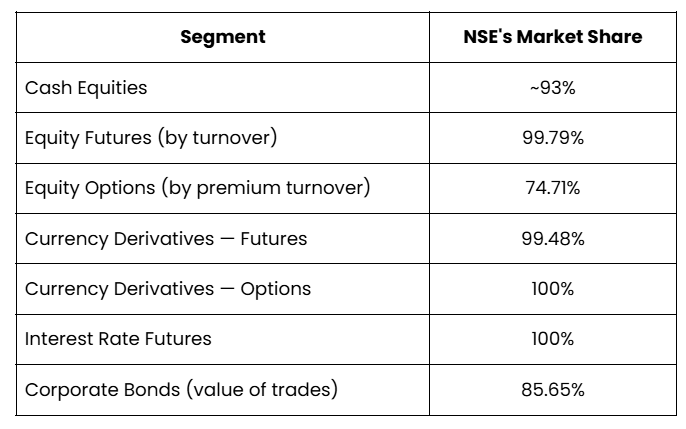
These numbers explain why investors often describe NSE as a near monopoly rather than just a market leader. In categories like currency options and interest rate futures, it effectively has no competition at all. This kind of dominance gives NSE strong pricing power and makes its income far more stable and predictable than most ordinary businesses, where competitors are constantly fighting for the same customers.
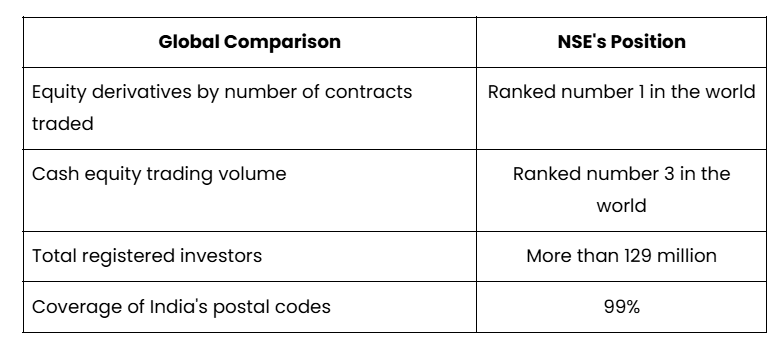
Additionally, NSE's size is not just an India story either. According to the World Federation of Exchanges, here is where it stands globally for the 2026 financial year.
NSE IPO - Competitive Strengths
Near Total Control Of The Market: As shown above, NSE dominates cash equities, derivatives, and currency trading, which makes its revenue unusually steady and predictable year after year.
A Business That Grows Without Growing Its Costs: Once NSE's trading systems are built, handling extra trades costs the company very little. This means that as trading activity increases, most of the additional money earned turns straight into profit instead of being spent on new expenses.
No Debt On The Books: NSE owes nothing to lenders and sits on a large amount of surplus cash, giving it the freedom to fund new projects on its own instead of borrowing money or asking shareholders for more capital.
Income From Many Different Sources: Beyond charging fees on trades, NSE earns money from clearing services, index licensing, data sales, and financial education, which means it does not depend too heavily on any single source of income.
A Customer Base That Is Hard To Copy: With a presence across 99% of India's postal codes and more than 129 million registered investors, NSE has built relationships and trust that would take a new competitor years, if not decades, to replicate.
A Quiet But Steady Income Stream: NSE earns interest by investing the security deposits that brokers are required to keep with it, along with its own cash reserves. This alone brought in ₹1,929 crore in the 2026 financial year, money that comes in even on days when very little trading happens.
NSE IPO - Key Concerns Investors Should Know Before Applying
Too Much Dependence On Options Trading: Around 60% of NSE's core income comes from fees on options trading alone. SEBI has already been tightening rules around retail trading in this segment to protect smaller investors from heavy losses. If these rules get stricter, it could directly hurt NSE's biggest source of income.
An Old Legal Issue Still Not Fully Resolved: Years ago, NSE faced allegations that some brokers were given unfair, faster access to its trading systems, an issue known as the co-location controversy. This is actually the reason NSE's IPO was delayed for nearly a decade. The company has filed for a settlement with SEBI and set aside a large provision for it, but the matter has not been fully closed yet.
A Conflict Built Into Its Own Structure: NSE is both a profit-seeking company and a market regulator at the same time. This means it sometimes has to choose between protecting fairness in the market and pushing for faster revenue growth, a balancing act that most ordinary listed companies never have to deal with.
Heavy Reliance On Technology Never Failing: NSE processes between 12 and 14 billion messages every single day, with peaks close to 22 billion. If its systems ever fail on a high-traffic day, it could lead to a trading halt, financial penalties from regulators, and a serious dent in investor trust.
Almost Entirely Dependent On India: Since NSE's business is tied almost completely to the Indian stock market, its fortunes rise and fall with India's economy and regulations, unlike global exchanges that spread their business across many countries.
According to Santosh Meena, Head of Research at Swastika Investmart, in an interview with Outlook Business, the National Stock Exchange's (NSE) IPO is structured entirely as a 100% Offer for Sale (OFS), meaning the exchange will receive zero proceeds as the funds go directly to selling shareholders like LIC and SBI. Meena noted that this structure reflects the exchange's immense financial strength, as it is already highly profitable and cash-rich, requiring no fresh capital for expansion. He advised investors to evaluate the company differently from a traditional growth IPO, treating it instead as an acquisition of secondary shares in a proven business, and cautioned them to carefully scrutinise its valuation, competitive moat, and long-term prospects.
NSE's Financial Performance (FY26)
The breakdown below highlights the National Stock Exchange’s core financial health and profitability metrics for the 2026 financial year, according to official disclosures in the NSE DRHP and a report by Outlook Business. Beyond the massive revenue numbers, these figures reveal an incredibly efficient business model that converts a remarkably high percentage of its income directly into pure profit.
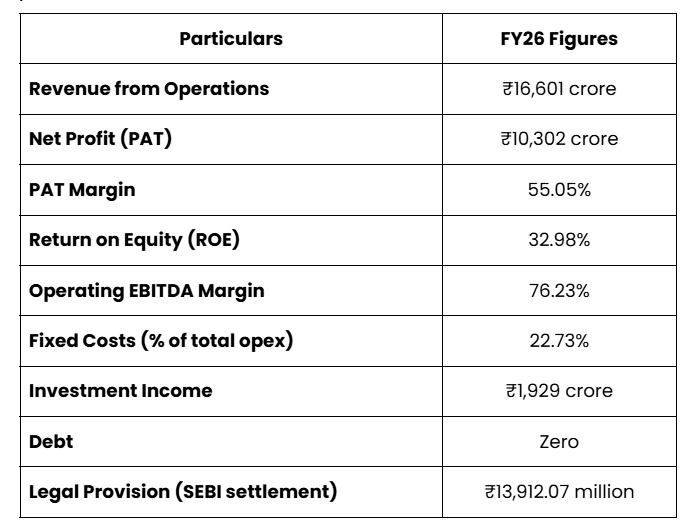
A couple of these figures deserve a closer look because the number alone does not tell the full story. The fact that only 22.73% of NSE's costs are fixed means most of its expenses do not rise much even when trading volumes go up sharply. This is exactly why the company is able to turn so much of its extra revenue into pure profit, which is reflected in that very high 76.23% operating margin. The ₹1,929 crore in interest income is also worth noting separately, since this money comes in from interest on cash and deposits, meaning NSE earns it even on slow trading days when fewer people are buying and selling shares.
Final Outlook - Is NSE Worth Considering?
NSE is the backbone of India's stock market, with industry-leading margins, zero debt, and near-total control over major trading segments. Its plans, spanning coal, gold, electricity, GIFT City, and index investing, add real growth potential on top of that. That said, the risks are still worth weighing. Around 60% of core income depends on options trading, a space regulators are watching closely, the old co-location legal matter isn't fully settled, and given the excitement around the ₹5 lakh crore valuation, the IPO may well be priced on the higher side, meaning much of the good news could already be baked into the price.
In short, NSE combines genuine strength with real risk. The sensible move is to wait for the final prospectus and price band before deciding, invest only as much as fits your own risk appetite, and make your investment decisions wisely, consulting your financial advisor where needed. For more IPO and market-related updates, visit Swastika Investmart.
-----------------------------------------------------------------------------------------------------------------------------------------------------------------------------
NSE IPO Information - A Quick Reference
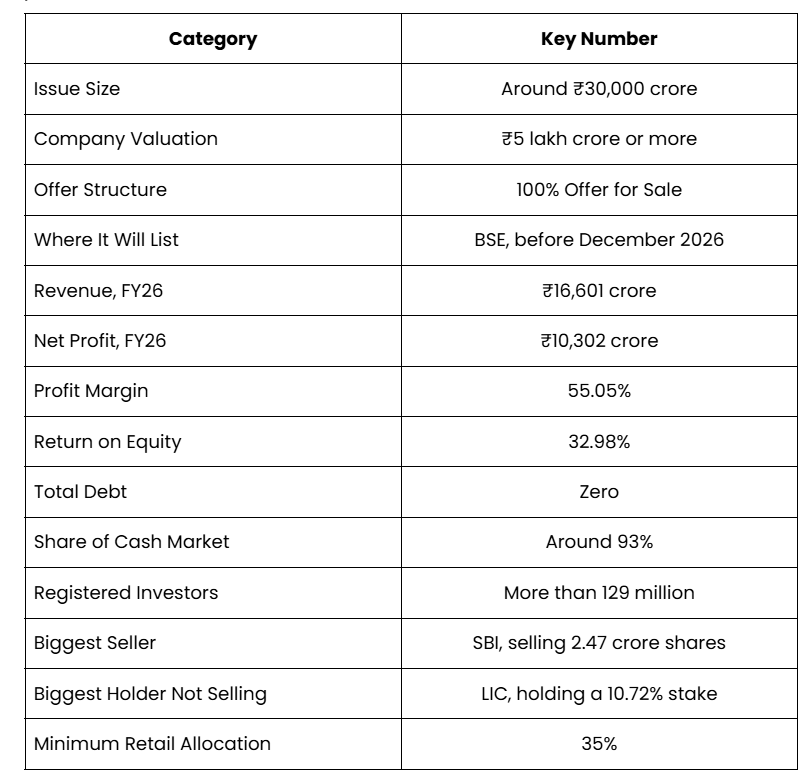
The breakdown below provides a quick reference to the National Stock Exchange's foundational data and key metrics for the 2026 financial year, sourced directly from the official NSE DRHP. Rather than just looking at isolated numbers, evaluating this comprehensive summary gives investors a clear view of the sheer scale, efficiency, and financial health behind this historic public offering.



.avif)
.avif)

.avif)