.avif)



India's largest asset management company is heading to the public markets. SBI Funds Management Limited, the AMC behind SBI Mutual Fund, filed its Draft Red Herring Prospectus with SEBI on March 19, 2026. With an expected fundraise of Rs. 13,000 to Rs. 13,500 crore and a potential market capitalisation approaching Rs. 1.75 to 1.80 lakh crore, this is one of the most significant listings in India's financial services sector this year.
This guide covers everything an investor needs to know before applying, from how the IPO is structured and what the financials look like, to the risks the company itself has disclosed and the factors that will determine whether this IPO makes sense at the offer price.
About SBI Funds Management Company, and Why is This IPO Seeking Investors’ Attention?
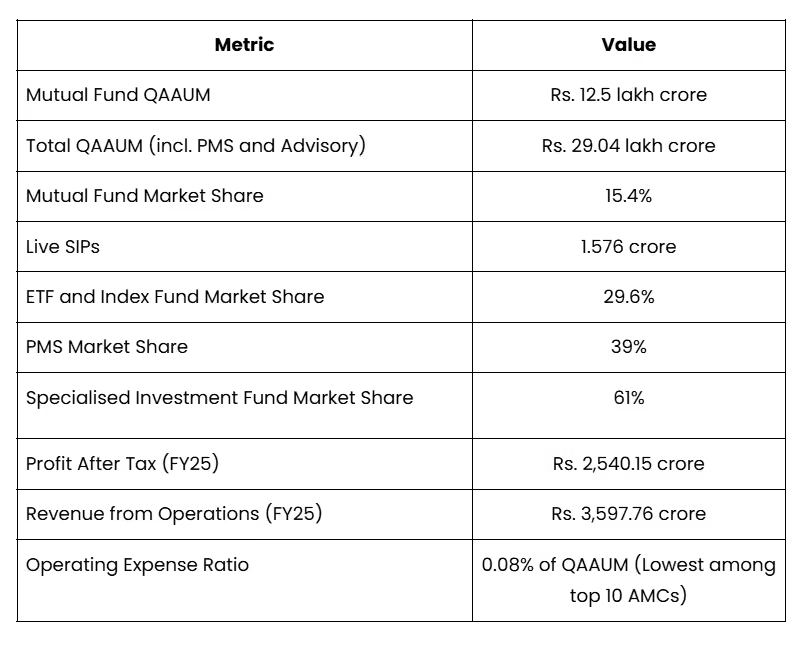
SBI Funds Management is India's largest asset management company, and it is not close. It manages a mutual fund quarterly average AUM of Rs. 12.5 lakh crore with a 15.4% market share as of December 31, 2025. When you include its institutional portfolio management and advisory books, total AUM reaches Rs. 29.04 lakh crore, making it one of the largest asset managers in Asia.
The company leads in two of India's fastest-growing investment categories simultaneously: actively managed mutual funds and passive products like ETFs and index funds. That dual dominance is rare, and it is a key reason this IPO is generating significant institutional and retail interest.
To understand the scale of what is being listed, here is a snapshot of where SBI Funds Management stands today across its key business metrics:
IPO Structure of SBI Funds Management: 100% Offer for Sale
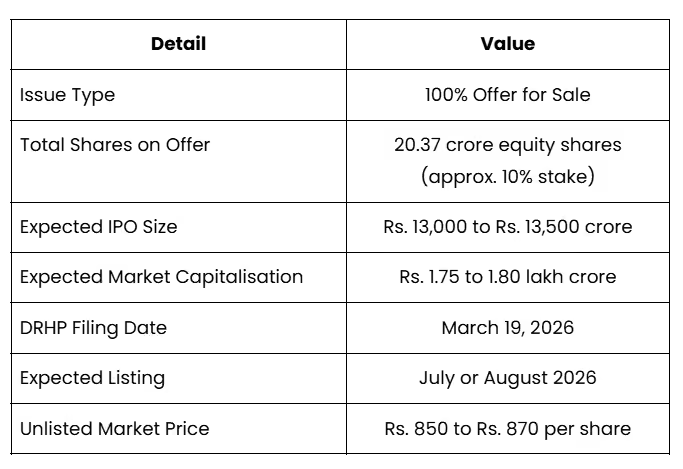
The SBI Funds Management IPO is a 100% Offer for Sale. This is the most important structural fact investors must understand before applying. No new shares are being issued, and SBI Funds Management itself will not receive a single rupee from the IPO proceeds. All the money raised goes directly to the two selling shareholders. Before you apply, here are the core IPO details you need to have in front of you:
Who is Selling and at What Profit?
Understanding who is selling, how much they paid for their shares, and how much they stand to gain puts the IPO in its proper context. The numbers below tell an important story about where the value creation has already happened.
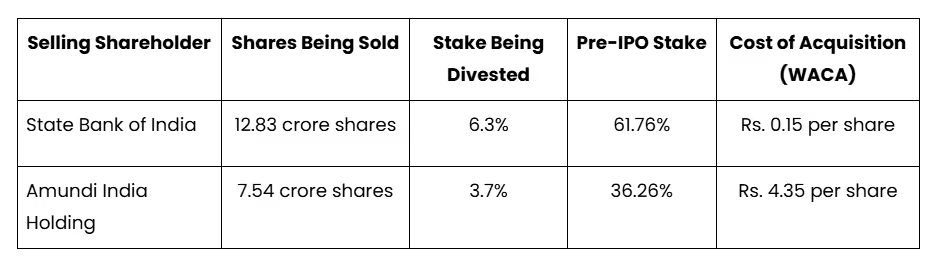
SBI acquired its stake at effectively Rs. 0.15 per share and Amundi at Rs. 4.35 per share. At an expected valuation of Rs. 1.75 to 1.80 lakh crore, both sellers are realising extraordinary returns on their original investments. IPO investors should assess honestly whether meaningful upside still remains after this re-rating has already occurred.
Revenue, Profit, and Dividends: How Has SBI Funds Management Performed Financially?
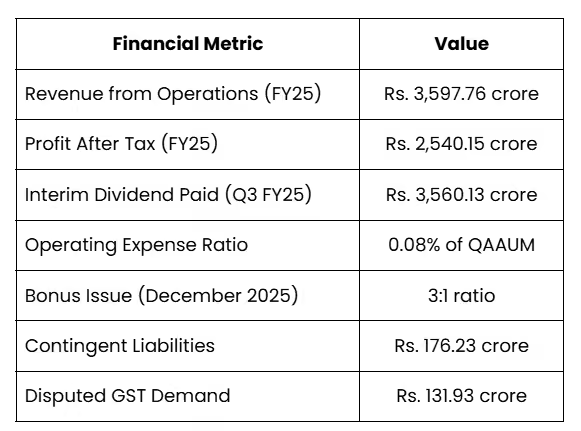
SBI Funds Management is a genuinely profitable and cash-rich business. It reported a profit after tax of Rs. 2,540.15 crore on revenue from operations of Rs. 3,597.76 crore for fiscal 2025. Its operating expense ratio of 0.08% of QAAUM is the lowest among India's top 10 AMCs, a direct result of the cost efficiency that comes with managing assets at this scale.
The dividend number is particularly telling. In just the third quarter of fiscal 2025, the company paid an interim dividend of Rs. 3,560.13 crore to its shareholders. A dividend larger than the full-year profit figure signals two things: the company carries significant retained earnings, and management is confident in the continuity of cash generation. In December 2025, the board also executed a 3:1 bonus share issue, tripling the share count, another signal of financial confidence.
The full financial picture, including contingent liabilities that investors should not overlook, is presented below:
According to CS Setty, Chairman of State Bank of India, speaking at the Citi India 2026 Conference, investors should stop watching daily market movements and start thinking about India as a long-term opportunity. He acknowledged that global geopolitical pressures have made markets choppy but urged investors not to lose sight of the bigger picture, describing India as one of the defining growth stories of this century that has moved well beyond the catch-up phase. 2.
What Makes SBI Funds Management Difficult to Compete With?
Distribution Through SBI Branches is an Unmatched Advantage
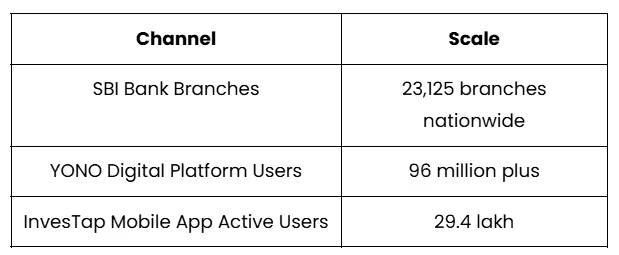
No AMC in India can replicate SBI Funds Management's distribution reach without the backing of a parent like State Bank of India. SBI operates 23,125 branches nationwide, covering urban centres, semi-urban towns, and rural areas that private sector banks and independent distributors rarely penetrate at comparable depth. Alongside this physical network, SBI's YONO digital platform serves over 96 million users, each of whom is a potential mutual fund investor already within the SBI ecosystem.
This is not a passive advantage. Every SBI account holder nudged toward an SIP through a branch visit, a teller recommendation, or a YONO notification adds to an AUM base that compounds over years. Building a comparable network from scratch would take decades and hundreds of thousands of crores. No private competitor can do it.
Amundi Provides the Investment Expertise Behind the Scenes
SBI brings distribution. Amundi brings investment depth. As Europe's largest asset manager, Amundi has embedded its risk management processes, investment frameworks, and product development capabilities into SBI Funds Management over a partnership spanning more than a decade. The stake now held by Amundi India Holding was originally held by Societe Generale S.A. before being transferred in June 2011, reflecting the long-standing and evolving nature of this international collaboration.
The SIP Book is One of the Stickiest in the Industry
SBI Funds Management runs 1.576 crore live SIPs. What makes this number particularly valuable is not its size but its staying power. The stickiness of this investor base is best captured by looking at how long those SIPs have remained active:
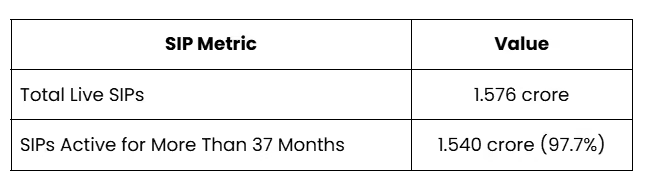
When 97.7% of SIP investors have stayed for more than three years without stopping their plan, it means they have already weathered market corrections and continued investing. For the AMC, this translates into a highly predictable monthly inflow of capital that grows AUM steadily regardless of short-term market sentiment. That predictability is itself a competitive advantage.
Leadership Across Multiple Business Segments
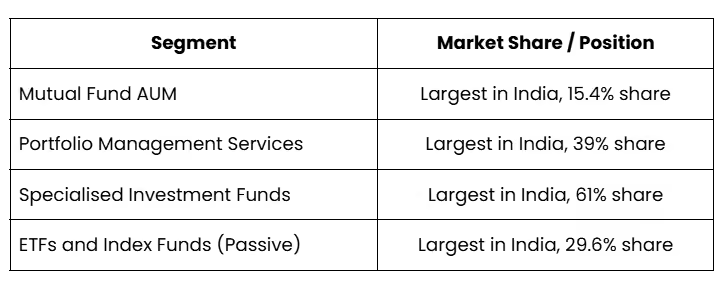
Most AMCs are dominant in one segment. SBI Funds Management holds the number one position across four separate business lines simultaneously. This breadth of leadership provides revenue diversification that most competitors simply do not have. The four segments and the company's standing in each are as follows:
A Research Engine That Supports Active Management
The company's investment decisions are supported by a research framework covering more than 400 listed companies and more than 200 fixed income issuers. This analytical infrastructure is a genuine entry barrier. Smaller AMCs operating at a fraction of SBIFM's scale simply cannot afford research teams of comparable depth, giving SBIFM a sustainable edge in active fund management quality.
Key Risks: What Has SBI Fund Management Disclosed in Its DRHP That Investors Must Read?
The DRHP for SBI Funds Management is candid about a substantial set of risks, and every investor should read them before applying. These are not hypothetical concerns invented by analysts. They are disclosures made by the company itself under regulatory obligation. Here is what the company has flagged and translated into what each risk actually means for you as a shareholder:
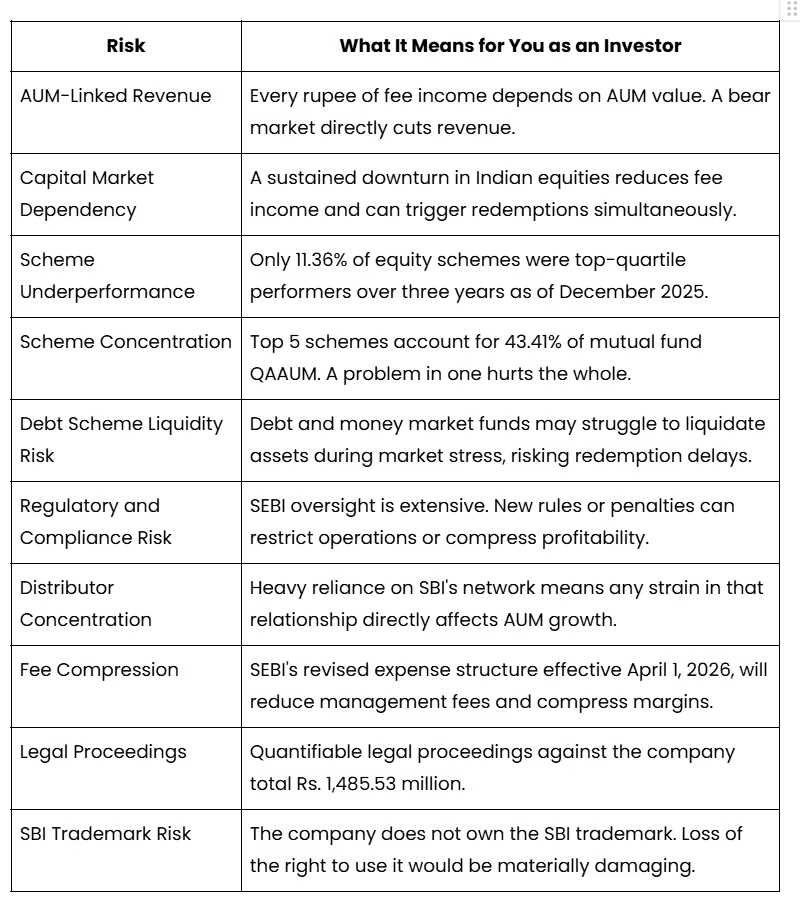
The trademark risk is worth pausing on because it has no easy fix. SBI Funds Management's brand identity, and a significant portion of its ability to attract and retain retail investors, is built around a name it does not legally own. The promoter relationship makes disruption unlikely, but the structural vulnerability is real and cannot be hedged away.
Peer Comparison: How Does SBIFM's Valuation Stack Up Against HDFC AMC and Nippon AMC?
Valuing the SBIFM IPO in isolation is difficult. The most practical approach is to benchmark it against its two closest listed peers, HDFC AMC and Nippon India AMC. This comparison reveals where SBIFM has a clear edge, where it falls short, and what those gaps mean for the multiple it should reasonably command.
The comparison below shows why SBIFM deserves a premium on AUM scale and cost efficiency, but why that premium may be partially offset by lower active equity performance and a compressed blended fee yield:
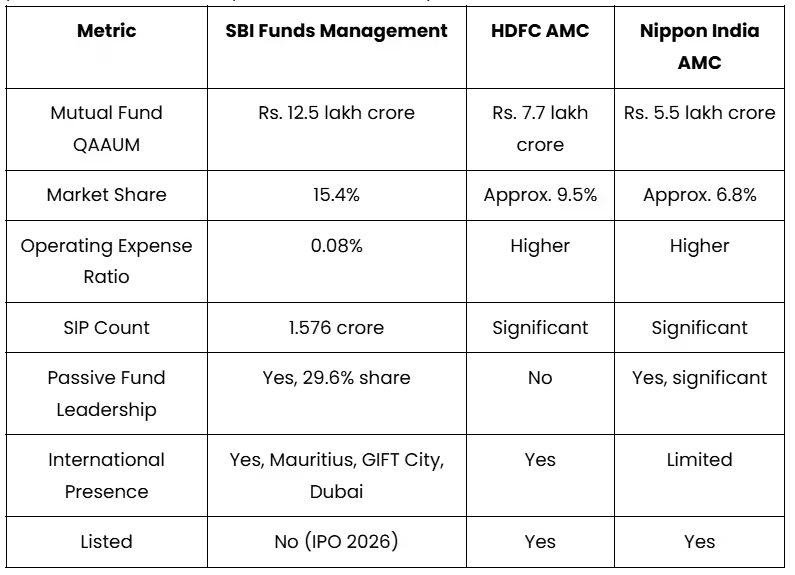
This comparison matters because HDFC AMC and Nippon India AMC are the reference points the market will use to price SBI Funds Management. SBI's AUM is significantly larger than both, and its cost efficiency is superior. However, its active equity performance metrics lag, and its blended fee yield is lower due to its heavy passive fund exposure. These factors will weigh on the valuation multiple relative to HDFC AMC's historical premium.
Pre-IPO Lock-In Rules: Can You Sell Your Unlisted Shares After Listing?
If you currently hold pre-IPO unlisted shares of SBI Funds Management, you cannot sell them immediately after the stock lists. SEBI's lock-in regulations determine when you are permitted to exit, and the rules differ depending on what category of investor you are and, in some cases, when you originally bought the shares.
The category-wise lock-in rules are straightforward, but the starting date of the lock-in period differs for institutional investors:
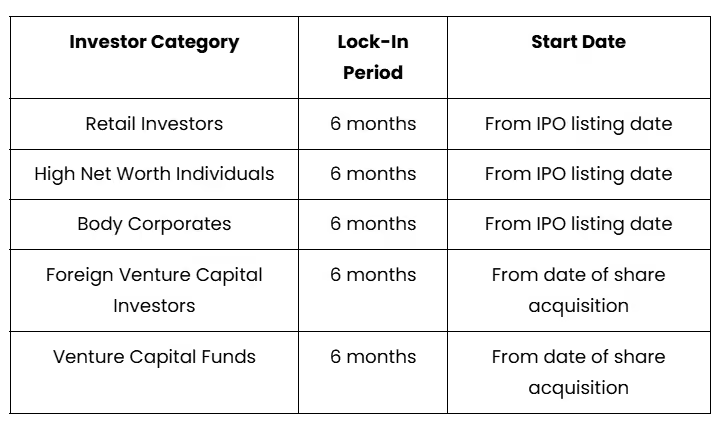
These rules follow SEBI's August 2021 regulatory amendments. With unlisted shares recently trading at Rs. 850 to Rs. 870 per share, investors holding pre-IPO stock should factor in this six-month restriction before making any assumptions about post-listing liquidity or exit timing.
Domestic and Global Reach: How Does SBI Fund Management Distribute and Serve Investors?
Domestic Investor Touchpoints
SBIFM's domestic distribution infrastructure combines physical branch access through SBI with a growing digital presence through its own platforms. The scale of this network is what gives SBIFM a sustainable AUM mobilisation advantage that no standalone private AMC can replicate:
International Investor Access
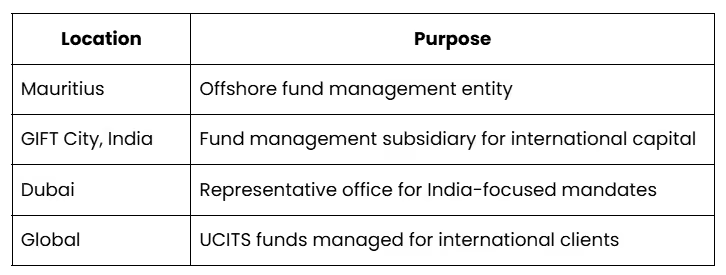
Beyond India, SBIFM has built a multi-entity international structure to capture demand from global investors seeking India-focused investment products. Each entity serves a specific regulatory or investor purpose in its respective jurisdiction:
Should You Apply for the SBIFM IPO? The Bull Case and the Bear Case
The Bull Case: Why SBIFM Is Worth Owning for the Long Term
SBI Funds Management holds a market position that is structurally protected in ways that most businesses are not. Its SBI branch distribution network is irreplaceable. Its SIP book, with 97.7% of plans active for more than 37 months, delivers a recurring, compounding inflow of capital that cushions revenue even in difficult markets. Its simultaneous leadership across mutual funds, PMS, specialised investment funds, and passive products provides genuine revenue diversification.
For investors who believe in India's long-term financialisation story, SBIFM is one of the most direct and defensible ways to participate. Every new SIP started, every mutual fund account opened, and every ETF unit purchased through its channels strengthens the AUM base that drives fee income. The tailwind is structural and multi-decade in nature.
The Bear Case: What Could Disappoint Investors Post-Listing
The active equity performance gap is the most immediate concern. With only 11.36% of equity schemes in the top performance quartile over three years, SBIFM is not consistently winning on the dimension that matters most to active fund investors. In a maturing market where investors increasingly compare performance data before choosing an AMC, this could pressure active equity AUM retention over time.
SEBI's fee compression effective April 2026 is already confirmed and will reduce management fees across the industry. Given SBIFM's already significant exposure to low-fee passive products, its blended fee yield will come under further pressure even as total AUM continues to grow. Revenue growth will lag AUM growth, and margin expansion will be harder to achieve than historical trends suggest.
Finally, the pure OFS structure means that at the IPO price of Rs. 850 to Rs. 870 in the unlisted market, you are buying at a valuation where both promoters, who acquired shares at Rs. 0.15 and Rs. 4.35 respectively, have already realised the bulk of the value creation. The upside from here depends entirely on future earnings growth and multiple expansion, not on any post-IPO transformation of the business.
Final Verdict: Is the SBIFM IPO a Buy, Hold Off, or Avoid?
SBI Funds Management is a rare business. It is profitable, cash-rich, debt-free, and sits at the centre of India's growing mutual fund industry. The fundamentals are hard to argue with. The only real debate is whether the IPO price leaves enough room for the next investor to make a meaningful return.
If the price band is set reasonably, this is a quality business worth holding for the long term. If it comes at a premium that already prices in years of future growth, patience may serve you better than enthusiasm on listing day.
Either way, this is not a straightforward IPO to evaluate on your own. The OFS structure, SEBI's new fee regulations, the trademark dependency, and the active fund performance gap all carry different implications depending on where you stand financially. What makes sense for one investor may not make sense for another.
That is exactly where a conversation with an expert helps. Swastika Investmart's research team has been closely following the SBI Fund Management IPO since its DRHP filing and can walk you through the valuation, the risks, and the right entry strategy based on your specific goals and portfolio.
Reach out to Swastika Investmart before the subscription window opens. A ten-minute conversation could make a meaningful difference to the decision you take.
Frequently Asked Questions About SBI Fund Management IPO
What is the SBI Funds Management IPO date?
The SBI Funds Management IPO is expected to open for subscription in July or August 2026. The DRHP was filed with SEBI on March 19, 2026, and the listing is targeted for the same calendar year.
What is the price band of the SBI Funds Management IPO?
The official price band for the SBI Funds Management IPO has not yet been announced. Based on unlisted market activity, shares have recently traded between Rs. 850 and Rs. 870, though the IPO price band may be set at a discount to these levels.
What is the GMP of the SBI Funds Management IPO?
Unlisted shares of SBI Funds Management have recently traded between Rs. 850 and Rs. 870 in the grey market, reflecting strong investor interest ahead of the official listing.
What is the issue size and valuation of the SBI Funds Management IPO?
The SBI Funds Management IPO is expected to raise between Rs. 13,000 and Rs. 13,500 crore through a 100% Offer for Sale of approximately 20.37 crore equity shares. The implied market capitalisation is estimated at Rs. 1.75 to 1.80 lakh crore based on current unlisted market prices.
Is the SBI Funds Management IPO a fresh issue or an OFS?
The SBI Funds Management IPO is a 100% Offer for Sale. No new shares are being created, and the company itself will not receive any proceeds from the listing. All funds raised go directly to the selling shareholders, State Bank of India and Amundi India Holding.
Should I invest in the SBI Funds Management IPO?
SBI Funds Management is a fundamentally strong business with consistent profitability, a debt-free balance sheet, and dominant market positions across mutual funds, PMS, and passive funds. Whether the IPO is right for you depends on the final price band, your investment horizon, and your personal financial goals. Consult a SEBI-registered financial advisor before applying.
What are the allotment and listing dates for the SBI Funds Management IPO?
The official allotment and listing dates have not yet been announced. The IPO is expected to list in July or August 2026. Check the Swastika Investmart website for updates as the listing timeline is confirmed.