

The Power of Compounding – Why Starting Early Matters




Introduction
Albert Einstein reportedly called compound interest the "eighth wonder of the world." Whether or not he actually said it, the math is undeniable. Compounding is the process where your investment returns begin earning their own returns — and over time, this snowball effect becomes truly extraordinary.
The catch? Compounding needs one essential ingredient: time.
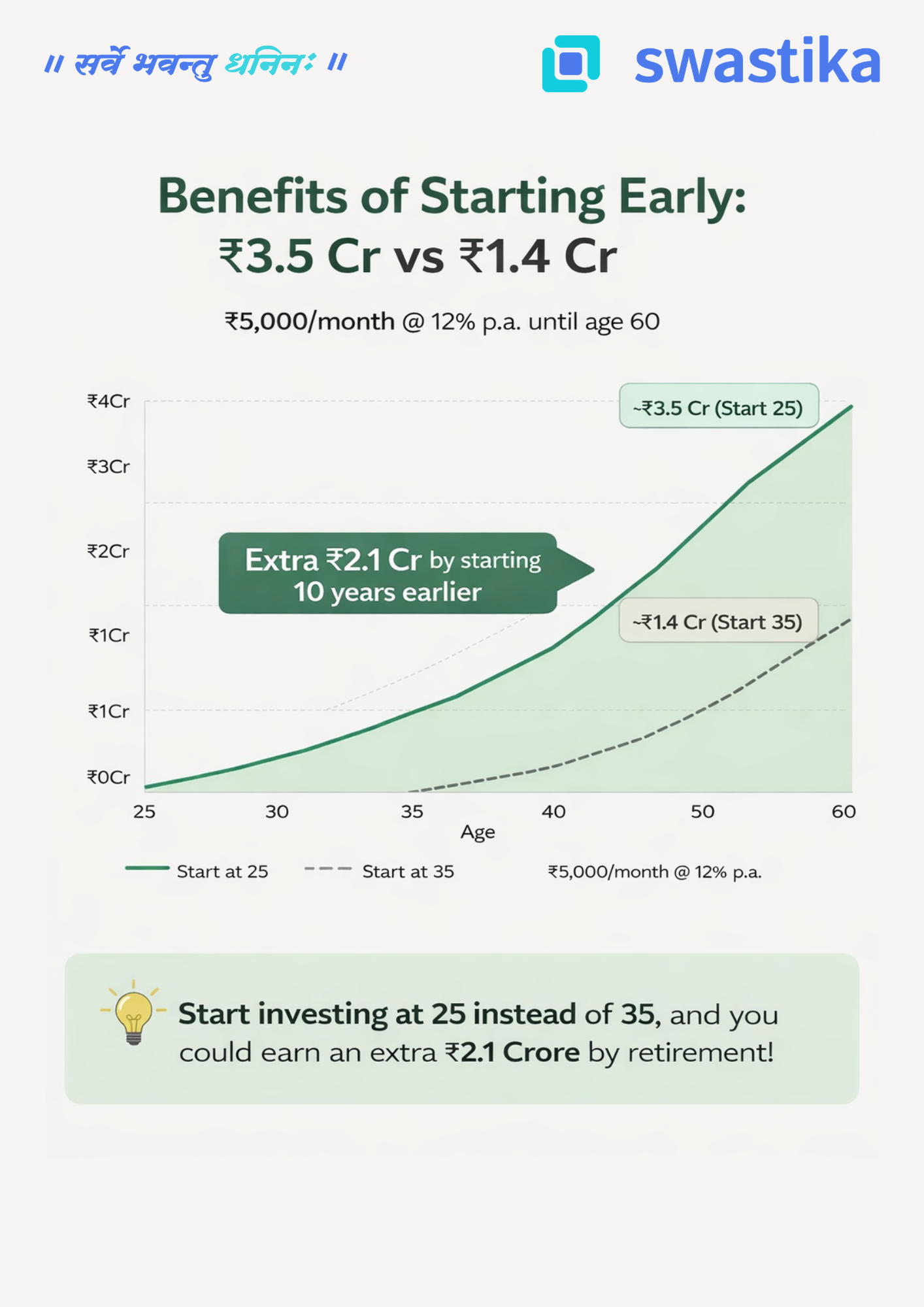
The more years you give your money to grow, the more dramatic — and life-changing — the results become. This is exactly why starting your investment journey early, even with a modest amount, can make a difference of crores by the time you retire.
A Tale of Two Investors: Arjun vs Priya
Let's bring this concept to life with a simple, real-world example.
Meet Arjun and Priya. Both are sensible, disciplined investors. Both invest ₹5,000 every month through a SIP (Systematic Investment Plan) in equity mutual funds, earning an average annual return of 12%. Both stop investing at age 60.
The only difference? Arjun starts at 25. Priya starts at 35.
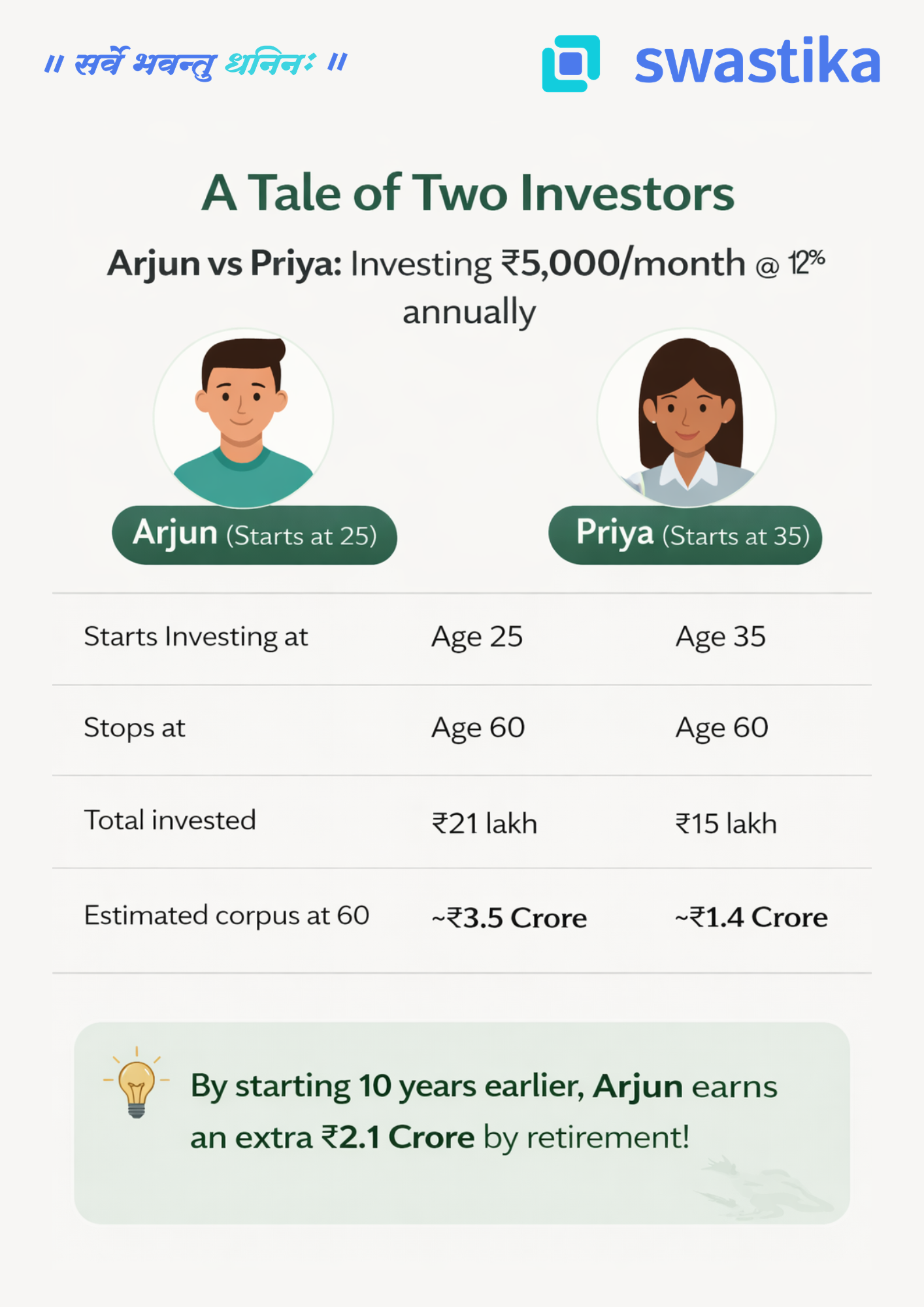
The numbers are striking. Arjun invests just ₹6 lakh more than Priya in absolute terms — yet walks away with ₹2.1 Crore more at retirement.
That extra ₹2.1 Crore didn't come from investing more aggressively or taking bigger risks. It came purely from starting 10 years earlier.
Why Does Time Make Such a Huge Difference?
This is where the magic of compounding reveals itself.
In the early years of investing, growth looks modest and almost unimpressive. But as the years pass, your corpus grows not just on your original investment, but on all the accumulated returns from previous years. The curve goes from almost flat to steeply exponential — and that steep climb happens in the later years.
When Arjun starts at 25, his money has 35 years to ride that exponential curve. Priya's money, starting at 35, only catches the last 25 years — and critically, it misses the steepest part of the climb in the final decade.
Think of it this way: the last 10 years of compounding are worth more than the first 20. That is the counterintuitive truth at the heart of long-term investing.
The Real Cost of Waiting
Many young earners tell themselves, "I'll start investing once I'm more settled — once the salary improves, once the EMI is paid off, once life is a bit easier."
But the numbers show that every year of delay is extraordinarily expensive — far more expensive than any EMI or lifestyle expense. Priya didn't invest carelessly. She invested faithfully for 25 years. Yet she ends up with less than half of what Arjun accumulated — not because she did anything wrong, but simply because she started a decade late.
The cost of waiting 10 years wasn't ₹6 lakh in additional contributions. The cost was ₹2.1 Crore in lost wealth.
Three Principles to Remember
1. Start now, not later.The best time to start investing was yesterday. The second best time is today. Even a SIP of ₹1,000–₹2,000 per month in your 20s is infinitely better than waiting for the "right time."
2. Consistency beats intensity.You don't need to invest large sums all at once. A small, steady, monthly commitment — maintained without interruption — is what unlocks the full power of compounding over decades.
3. Stay invested through market cycles.Compounding works only if you let it work. Exiting during market corrections or stopping your SIP in tough months breaks the chain. Time in the market, not timing the market, is what builds wealth.
The Bottom Line
If you are in your 20s or early 30s, you hold an asset that no amount of money can buy later: time. Use it. Start a SIP today — even a small one. Let compounding do its slow, steady, powerful work.
Because the difference between starting at 25 and starting at 35 is not just 10 years. As Arjun and Priya's story shows, that difference is ₹2.1 Crore.
Big Budget








.webp)
.webp)
.webp)
.webp)
.webp)















.webp)
.webp)
.webp)
.webp)
Latest Articles
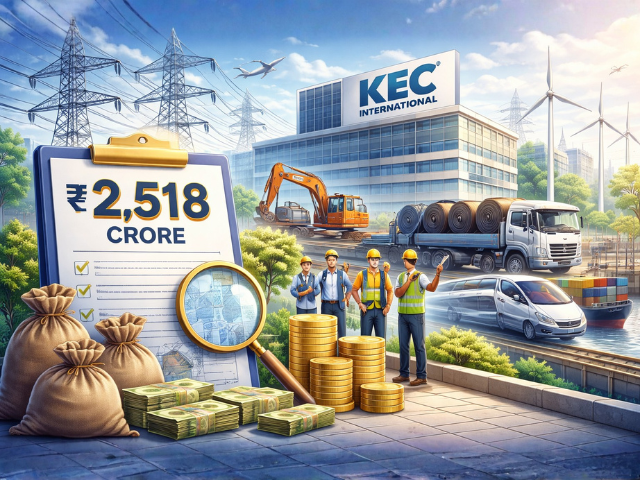
KEC International Wins ₹2,518 Crore Orders: Strong Order Book, Stronger Outlook?


Key Takeaways
- KEC International Ltd secures ₹2,518 crore worth of new orders
- Includes its largest commercial real estate project in the civil segment
- Participation in the Kavach railway safety programme adds diversification
- Strong order inflow supports revenue visibility
- Execution and margin sustainability remain key monitorables
Introduction
India’s infrastructure story continues to gain momentum, and companies in the EPC space are at the center of this growth. Recently, KEC International Ltd announced fresh orders worth ₹2,518 crore, attracting investor attention.
The development raises an important question. Does this order win strengthen KEC’s growth outlook, or are there underlying risks investors should consider?
Breaking Down the Order Win
The new orders include a mix of projects that highlight KEC’s diversified capabilities.
Key highlights
- Largest commercial real estate project in the civil segment
- Joint venture order under the Kavach train safety programme
- Continued presence across infrastructure verticals
This diversification is crucial as it reduces dependency on a single segment and provides stability during market cycles.
Why Order Book Matters in EPC Companies
For EPC companies, the order book acts as a forward indicator of future revenue.
What a strong order book means
- Better revenue visibility over the next few quarters
- Improved business confidence
- Potential for consistent cash flows
In KEC’s case, steady order inflows suggest that demand remains strong in infrastructure and construction sectors.
Sectoral Tailwinds Supporting Growth
India is currently witnessing a strong push in infrastructure development.
Key drivers
- Government spending on railways and urban infrastructure
- Focus on safety systems like Kavach
- Growth in commercial real estate
Projects like the Kavach system indicate increasing emphasis on railway safety, which could open new opportunities for EPC players.
Real-World Context: Infrastructure Push in India
The Indian government has been actively investing in large-scale infrastructure projects.
Examples include:
- Expansion of railway networks
- Smart city developments
- Industrial corridor projects
Companies like KEC International are well-positioned to benefit from this trend, given their diversified execution capabilities.
Market Impact and Investor Sentiment
Positive Factors
- Strong order inflow improves growth visibility
- Diversified project mix reduces risk
- Participation in government-backed initiatives
These factors often lead to improved investor sentiment, especially in a capital-intensive sector like infrastructure.
Risks to Watch
Despite the positive outlook, investors should remain cautious about certain factors.
- Execution delays can impact revenue recognition
- Rising input costs may pressure margins
- Working capital requirements can remain high
EPC companies typically operate on thin margins, making efficient execution critical.
Financial Perspective
Order wins are encouraging, but they need to translate into actual financial performance.
Key metrics to track
- Revenue growth
- EBITDA margins
- Order execution timeline
- Debt levels
Sustained improvement in these areas will determine long-term value creation.
Competitive Landscape
KEC operates in a competitive EPC market alongside several established players.
What sets KEC apart is:
- Strong execution track record
- Diversified presence across sectors
- Ability to secure large-scale projects
However, competition remains intense, and pricing pressures can affect profitability.
Regulatory and Policy Support
Infrastructure development in India is supported by policy initiatives and regulatory frameworks.
Organizations like the Securities and Exchange Board of India ensure transparency in disclosures, helping investors make informed decisions.
Government initiatives in railways, power, and urban infrastructure continue to create opportunities for EPC companies.
Investor Strategy: What Should You Do?
For investors, the key lies in balancing optimism with caution.
Short-Term View
- Stock may react positively to order inflow news
- Momentum-driven movement possible
Long-Term View
- Growth depends on execution and margin stability
- Consistent order inflows are a positive sign
Investors should focus on fundamentals rather than short-term news-driven moves.
FAQs
What orders has KEC International won?
KEC International has secured orders worth ₹2,518 crore across civil and railway segments.
Why is the Kavach project important?
The Kavach system is a railway safety initiative that improves train operations and reduces accidents, creating long-term opportunities.
How do order wins impact EPC companies?
Order wins improve revenue visibility and indicate strong business demand.
Are there risks associated with EPC companies?
Yes, risks include execution delays, margin pressure, and high working capital requirements.
Is KEC International a good long-term investment?
It depends on execution efficiency, financial performance, and overall infrastructure demand.
Conclusion
The ₹2,518 crore order win by KEC International reinforces its position in India’s growing infrastructure space. While the strong order book supports a positive outlook, investors must closely monitor execution and financial performance.
Infrastructure remains a long-term growth theme in India, but disciplined investing is essential to navigate sector-specific risks.
If you are looking to explore such opportunities with the right guidance, having a reliable investment platform is crucial. With SEBI registration, advanced research tools, strong customer support, and a focus on investor education, Swastika Investmart helps you make informed decisions.

Bosch Ltd’s Big Acquisition: Bullish Signal or Strategic Realignment?
Key Takeaways
- Bosch Ltd plans to acquire 100% stake in Bosch Chassis Systems India
- Deal size stands at ₹9,068 crore, indicating a major internal restructuring
- Move may improve operational efficiency and margin visibility
- Short-term valuation concerns remain, but long-term outlook looks stable
- Auto component sector may see increased consolidation trends
Introduction
In a significant corporate development, Bosch Ltd has approved the acquisition of a 100% stake in Bosch Chassis Systems India from its group entities. Valued at over ₹9,000 crore, this move is not just a routine transaction but a strategic shift that could reshape Bosch’s India operations.
For investors, the key question is simple. Is this acquisition a bullish signal indicating future growth, or is it merely a restructuring exercise with limited upside?
Understanding the Deal Structure
The acquisition involves Bosch consolidating its ownership in Bosch Chassis Systems India, effectively bringing a key subsidiary fully under its control.
Why this matters
- Simplifies corporate structure
- Improves operational integration
- Enhances control over core business segments
Such internal consolidations are common among global companies looking to streamline operations in high-growth markets like India.
Strategic Rationale Behind the Acquisition
Strengthening Core Capabilities
Bosch Chassis Systems plays a crucial role in automotive safety and control systems. By acquiring full ownership, Bosch can align its India operations more closely with global strategies.
Preparing for EV Transition
India’s auto industry is rapidly evolving towards electric vehicles. Bosch’s move may be aimed at:
- Enhancing R&D capabilities
- Improving product integration
- Positioning itself in next-generation mobility solutions
Operational Efficiency
Full ownership reduces inter-company complexities and allows faster decision-making. This can lead to:
- Better cost management
- Improved margins over time
Impact on Indian Stock Market
Positive Signals
For investors, this deal sends a few encouraging signals:
- Confidence in India growth story
- Long-term commitment by global parent
- Potential margin expansion through integration
Auto component companies often benefit from such structural improvements, especially in a competitive market.
Concerns to Watch
However, not everything is outright positive.
- Large cash outflow may impact short-term financials
- Valuation concerns if synergies take time to reflect
- Execution risk in integration
Markets usually take time to fully price in the benefits of such restructuring.
Sectoral Perspective: Auto Components in Focus
India’s auto component sector is undergoing rapid transformation. Factors driving this include:
- Shift towards electric vehicles
- Increasing localization
- Government initiatives like PLI schemes
Bosch’s move could trigger similar consolidation trends across the sector, as companies look to scale up and remain competitive.
Real-World Context
Globally, Bosch operates with a strong focus on integrated systems. Similar restructuring moves have been seen in other markets where the company aims to centralize control and improve efficiency.
In India, where growth potential remains high, such steps are often taken to align operations with future demand.
Investor Perspective: Bullish or Neutral?
Short-Term View
- Limited immediate upside
- Possible pressure on financial metrics
- Market may remain cautious
Long-Term View
- Stronger business structure
- Better growth alignment
- Improved operational efficiency
For long-term investors, the move appears more strategic than opportunistic.
Regulatory and Governance Angle
Transactions between group entities are closely monitored under Indian regulations. Frameworks by Securities and Exchange Board of India ensure transparency and fairness in such deals.
This adds a layer of confidence for investors evaluating the transaction.
What Should Investors Do?
Investors should avoid reacting purely to headlines and instead focus on:
- Integration progress over the next few quarters
- Margin trends post-acquisition
- Management commentary in earnings calls
Such factors will determine whether the acquisition delivers real value.
FAQs
What is Bosch Ltd acquiring?
Bosch Ltd is acquiring a 100% stake in Bosch Chassis Systems India from its group entities.
Why is this acquisition important?
It helps simplify operations, improve efficiency, and align the company with future growth trends like EVs.
Is this a positive signal for investors?
It is positive from a long-term perspective, but short-term impact may remain neutral due to valuation concerns.
Will this impact Bosch’s financials?
There may be short-term pressure due to the large deal size, but long-term benefits could offset this.
Should investors buy Bosch Ltd stock now?
Investors should evaluate valuation, long-term strategy, and execution before making a decision.
Conclusion
Bosch Ltd’s ₹9,068 crore acquisition is a classic example of strategic realignment rather than a quick growth trigger. While the deal strengthens the company’s long-term positioning, especially in a transforming auto sector, it may not immediately translate into stock price gains.
For investors, patience and a long-term perspective will be key. Tracking execution and financial performance post-acquisition will provide clearer signals.
If you are looking to invest with confidence in such evolving market opportunities, having the right platform makes all the difference. With SEBI registration, strong research capabilities, advanced technology, and investor-focused services, Swastika Investmart supports informed decision-making.

Tax Planning vs Tax Evasion: Understanding the Difference
Key Takeaways
- Tax planning is legal and helps reduce tax liability using government-approved provisions
- Tax evasion is illegal and can lead to penalties, prosecution, and scrutiny
- Understanding the difference is essential for financial safety and compliance
- Smart tax planning improves wealth creation and long-term investing
- Indian tax laws clearly distinguish between legal planning and illegal evasion
Why This Topic Matters for Every Taxpayer
When it comes to managing taxes, most individuals and investors aim to reduce their tax burden. However, there is a fine line between what is legally allowed and what can get you into serious trouble.
Understanding the difference between tax planning and tax evasion is not just important for compliance, but also for building long-term financial security.
In India, tax laws are governed by the Income Tax Department, and non-compliance can lead to strict penalties. Knowing where to draw the line can save both money and stress.
What is Tax Planning?
Tax planning refers to the legal use of tax provisions to minimize your tax liability.
It involves structuring your finances in a way that takes advantage of deductions, exemptions, and benefits provided under the Income Tax Act.
Common examples of tax planning:
- Investing under Section 80C (ELSS, PPF, LIC)
- Claiming deductions for health insurance under Section 80D
- Using HRA and standard deduction benefits
- Setting off capital losses against gains
These are all legitimate strategies encouraged by the government to promote savings and investments.
Real-world example:
A salaried individual invests ₹1.5 lakh in ELSS funds and reduces taxable income under Section 80C. This is completely legal and considered smart financial planning.
What is Tax Evasion?
Tax evasion, on the other hand, involves illegal methods to avoid paying taxes.
This includes hiding income, falsifying documents, or misreporting financial information.
Common examples of tax evasion:
- Not reporting cash income
- Claiming fake deductions
- Using benami transactions
- Not declaring capital gains from stock market trades
Tax evasion is a punishable offense and can lead to penalties, interest, and even prosecution under Indian laws.
Real-world example:
An individual earns income from trading but does not report it while filing returns. This is tax evasion and can attract scrutiny notices.
Key Differences Between Tax Planning and Tax Evasion
Legality
Tax planning is legal and compliant with the law.
Tax evasion is illegal and punishable.
Intent
Tax planning aims to optimize tax liability within the law.
Tax evasion aims to hide income and avoid taxes unlawfully.
Risk
Tax planning carries no legal risk.
Tax evasion can result in penalties, audits, and prosecution.
Transparency
Tax planning is fully disclosed in tax returns.
Tax evasion involves concealment or misrepresentation.
Indian Regulatory Framework and Penalties
The Income Tax Act clearly defines consequences for tax evasion.
Possible penalties include:
- Monetary penalties up to 200 percent of tax evaded
- Interest on unpaid taxes
- Legal prosecution in severe cases
With increasing digitization, the government now tracks financial transactions more closely. Systems like AIS and TIS help the tax department identify mismatches in reported income.
This means that tax evasion has become riskier than ever before.
Impact on Investors and Financial Markets
Tax compliance plays a crucial role in maintaining transparency in financial markets.
For example:
- Investors must report capital gains from stocks and mutual funds
- Traders need to disclose income from derivatives and intraday trading
- Dividend income is fully taxable under current laws
Non-compliance not only leads to penalties but also affects credibility, especially for active market participants.
In a growing economy like India, tax compliance strengthens the overall financial ecosystem and boosts investor confidence.
Smart Tax Planning Strategies for Investors
If you are investing in the stock market, there are several ways to optimize taxes legally.
1. Use Long-Term Capital Gains Benefits
Holding equities for more than one year qualifies for LTCG taxation, which is lower compared to short-term gains.
2. Tax-Loss Harvesting
Offsetting losses against gains can help reduce overall tax liability.
3. Diversified Investment Approach
Using a mix of equity, debt, and tax-saving instruments helps balance returns and tax efficiency.
4. Proper Documentation
Maintaining accurate records ensures smooth filing and avoids unnecessary notices.
Why Investors Should Avoid Shortcuts
In the short term, tax evasion may seem like a way to save money. But the long-term consequences can be severe.
With data integration across banks, exchanges, and financial institutions, authorities have access to detailed financial information.
Choosing legal tax planning over shortcuts ensures:
- Peace of mind
- Long-term wealth creation
- Better financial discipline
Role of Technology in Tax Compliance
Modern platforms and brokerage services are making it easier for investors to stay compliant.
Features like:
- Automated capital gains reports
- Transaction summaries
- Integrated tax statements
help investors file accurate returns without hassle.
This is especially important for traders and active investors who deal with multiple transactions.
FAQs
What is the main difference between tax planning and tax evasion?
Tax planning is legal and uses approved methods to reduce taxes, while tax evasion is illegal and involves hiding or misreporting income.
Is tax planning allowed in India?
Yes, tax planning is completely legal and encouraged under the Income Tax Act.
What are the penalties for tax evasion?
Penalties can include fines, interest, and even prosecution depending on the severity of the offense.
Can stock market income be taxed?
Yes, capital gains, dividends, and trading income are all taxable under Indian tax laws.
How can investors reduce taxes legally?
Investors can use strategies like long-term investing, tax-loss harvesting, and deductions under various sections of the Income Tax Act.
Conclusion
Understanding the difference between tax planning and tax evasion is essential for every taxpayer and investor. While both aim to reduce tax liability, only one is legal and sustainable.
In today’s transparent financial system, compliance is not just a requirement but a smart financial habit. By following the right strategies, investors can optimize taxes while staying on the right side of the law.
If you are actively investing or planning to enter the markets, having the right support system can make a big difference.
With SEBI-registered credibility, strong research tools, advanced technology, and a focus on investor education, Swastika Investmart helps you invest with confidence while staying compliant.

Poly Medicure Fundamental Analysis: A High-Growth Medtech Story?
Poly Medicure Fundamental Analysis: A High-Growth Medtech Story?
Meta Title: Poly Medicure Fundamental Analysis 2025
Meta Description: Explore Poly Medicure's (POLYMED) fundamentals: revenue growth, export strength, debt-free status & what it means for long-term investors in Indian medtech.
Quick Summary
- Poly Medicure posted revenue of ₹1,782 Cr in FY25 with a profit growth CAGR of 28.4% over the last 5 years, making it one of India's most consistent medtech compounders.
- Total assets surged from ₹767 Cr in March 2020 to ₹3,192 Cr in March 2025, and the company eliminated all long-term borrowings by FY25.
- Exports are a structural strength — Q4 FY25 export revenue grew 14% year-on-year, driven by continued strong performance in key international markets.
- India's medical devices industry is projected to reach USD 50.1 billion by 2030, registering a CAGR of 26.9% from USD 15.2 billion in 2025.
- Valuations remain stretched — the trailing P/E hovers between 36x and 50x depending on the period, so entry timing matters.
The Company Most Retail Investors Overlook
When people think of healthcare stocks in India, names like Sun Pharma or Dr. Reddy's usually come up first. Poly Medicure rarely makes those lists. Yet quietly, over the last decade, this Faridabad-based medical device maker has compounded wealth at a rate that would make most pharma investors envious.
Founded in 1995 by Himanshu Baid, Poly Medicure specialises in manufacturing medical devices in India. The Department of Pharmaceuticals, Ministry of Chemicals and Fertilisers recognised the company as the Medical Devices Company of the Year 2018, and it has been acknowledged as the Largest Exporter of Medical Devices from India for six consecutive years.
That's not a small achievement. India has hundreds of medical device manufacturers. Being the largest exporter, repeatedly, says something real about the quality of the business model and the trust that global buyers place in it.
What Does Poly Medicure Actually Make?
Before diving into the financials, it helps to understand what the company actually sells.
Poly Medicure operates a product portfolio of 200-plus SKUs across 12 clinical specialties, including infusion therapy, oncology, anesthesia and respiratory care, urology, gastroenterology, blood management, surgery and wound drainage, dialysis, central venous access catheters, and veterinary medical devices.
Think IV cannulas, infusion sets, catheters, safety needles, and ventilator circuit kits. These are consumables — products hospitals use and discard every single day. That recurring demand pattern is one of the most attractive features of this business. Hospitals don't stop buying IV lines the way consumers delay upgrading a phone.
Geographically, the company derives a majority of its revenue from exports, operating under a single reporting segment: medical devices. This focus keeps the business lean and the management bandwidth concentrated.
The Financial Picture: What the Numbers Actually Say
Revenue and Profit Growth
Operating profit (PBDIT) climbed from ₹147.72 Cr in March 2019 to ₹541.97 Cr in March 2025, while profit after tax rose from ₹64 Cr to ₹333.38 Cr over the same period. Earnings per share improved from ₹7.41 to ₹33.41.
That is a five-fold increase in absolute profit in six years, achieved without taking on significant debt to fund it. Not many Indian midcaps can say the same.
On a more recent quarterly basis, sales rose 16.37% year-on-year to ₹493.66 Cr in the quarter ended December 2025, though net profit dipped 16.78% compared to the same quarter of the prior year. That single-quarter profit compression is worth watching carefully. Margin pressure, whether from input costs, freight, or competitive pricing, is a real theme across the disposable medical devices space right now.
Balance Sheet Strength
This is where Poly Medicure truly distinguishes itself from most Indian midcaps.
Shareholder funds rose from ₹434.82 Cr to ₹2,765.66 Cr between FY20 and FY25. More strikingly, the company eliminated its long-term borrowings entirely, reaching a zero-debt position by March 2025.
A debt-free balance sheet in a capital-intensive manufacturing business is genuinely unusual. It signals that the company has funded its capacity expansion almost entirely through internal cash generation — which speaks volumes about the underlying profitability and working capital discipline.
Key Financial Metrics at a Glance
Revenue (FY25): ₹1,782 Cr
Net Profit (FY25): ₹348 Cr
5-Year Profit CAGR: 28.4%
Total Assets (Mar'25): ₹3,192 Cr
Long-Term Debt: Zero
Promoter Holding: 62.4%
Trailing P/E: ~36–50x
The Export Engine: Why It Matters More Than You Think
Most Indian medical device companies are domestically focused. Poly Medicure took the opposite path, and it has paid off.
Revenue from operations rose to ₹440.8 Cr in Q4 FY25, a 16.6% year-on-year increase, with export revenue for that quarter growing 14% year-on-year. Over the full FY25, exports contributed the majority of consolidated revenues.
Why does this export orientation matter so much? Two reasons stand out.
First, international markets, particularly in Europe, the Middle East, and parts of Asia, typically carry higher realisation per unit than domestic tender-based pricing. That protects overall margins even when domestic volumes are under pressure.
Second, it reduces dependence on government procurement cycles in India, which can be lumpy, delayed, and aggressively price-sensitive. A hospital in Germany paying market rates for an IV catheter operates on very different economics than a state government tender at L1 pricing.
The Industry Tailwind: Right Place, Right Time
A good business in a shrinking industry is still a problem. Poly Medicure has the good fortune of operating in one of India's fastest-expanding sectors.
India now ranks as the fourth-largest medical devices market in Asia, after Japan, China, and South Korea, and among the top 20 globally. The industry was valued at approximately USD 12 billion in FY24, growing at a CAGR of around 15%. Projections from multiple research bodies suggest the market could reach USD 50 billion by 2030.
Medical device exports have been a particular bright spot. Between FY19 and FY25, exports surged 88% to reach ₹31,120 Cr, supported by the government's ₹3,420 Cr Production Linked Incentive (PLI) scheme, which is specifically designed to drive manufacturing competitiveness and position India as a trusted global supplier.
For a company whose core strength already is exports, this is a policy tailwind that compounds on an existing advantage. The PLI scheme makes Indian manufacturing more cost-competitive globally — exactly what Poly Medicure needs to defend and grow its share in international markets.
Demographic Drivers Are Not Going Away
The longer-term demand story is equally compelling. Diabetes cases in India are projected to jump from 77 million in 2025 to over 134 million by 2045, magnifying demand for monitoring and management devices. An aging population, rising cardiovascular disease incidence, and expanding health insurance penetration are all extending the growth runway well beyond typical demand cycles.
These are not speculative tailwinds. They are demographic and epidemiological trends that play out over decades, and they directly benefit companies selling high-volume disposable medical devices.
Growth Levers: What Could Drive the Next Phase
Critical Care Expansion
The company has outlined plans to scale its critical care segment meaningfully, with an expected revenue contribution of ₹75 to ₹100 Cr from this division over the next three to four years. Critical care products carry better margins than standard infusion therapy products, so even moderate success here could have an outsized effect on profitability.
Cardiology and Dialysis Investments
Expansion into higher-complexity, higher-margin areas like cardiology and dialysis is being actively pursued. These segments demand more regulatory effort and capital, but they also carry significantly higher barriers to entry — which protects pricing once established.
Automation and Forward Integration
Capacity expansion through automation initiatives is expected to structurally improve cost control and operational resilience. Forward integration into higher-value segments reduces the risk of being squeezed purely on price in commoditised device categories.
Risks Worth Acknowledging
No fundamental analysis is complete without an honest look at what could go wrong.
Margin volatility: The December 2025 quarter showed a 16.78% net profit decline even as revenues grew 16.37%. That gap between revenue growth and profit growth points to cost pressures that management will need to address consistently.
Valuation premium: At a trailing P/E of 36x to 50x, the stock is priced for continued execution. Any stumble in growth, whether from a global demand slowdown, currency headwinds, or regulatory changes in key export markets, could lead to a meaningful re-rating downward.
Regulatory risk in export markets: A significant portion of revenue comes from regulated markets in Europe and the Middle East. Changes in device standards, CE marking requirements, or import restrictions in these geographies could materially impact revenues.
Post-PLI sustainability: The PLI scheme for medical devices concludes around FY 2026-27. Investors should assess whether cost structures and margins remain sustainable once the incentive window closes — a question that applies to the broader sector, not just Poly Medicure.
Raw material and forex exposure: As a major exporter, the company benefits from a weaker rupee but faces input cost volatility in polymers and other raw materials that are globally priced.
The Verdict: Strong Business, But Valuation Demands Patience
Poly Medicure ticks a lot of the boxes that long-term investors look for. A debt-free balance sheet, a recurring-revenue product mix, export diversification, a 28%-plus profit CAGR, high promoter holding, and a sector growing at double digits backed by government policy — these are not ordinary attributes.
The business model is resilient. Hospitals cannot function without the products Poly Medicure makes. That creates a baseline of demand that does not disappear in economic downturns the way discretionary spending does.
The concern, and it is a legitimate one, is valuation. At current price levels, a significant amount of future growth is already priced in. Investors who bought at steep premiums have seen the stock correct meaningfully over the past year, with the share price declining from a 52-week high of around ₹2,937 to roughly ₹1,241-1,956 depending on the date of assessment. That kind of drawdown matters.
The smart approach is not to dismiss the stock because it looks expensive at first glance, nor to chase it purely on the growth narrative. The right question is: at what price does the growth justify the risk?
Frequently Asked Questions
Is Poly Medicure a good long-term investment?
Poly Medicure has demonstrated consistent revenue and profit growth, a debt-free balance sheet, and strong export credentials. The business fundamentals are genuinely solid. However, the stock has historically traded at premium valuations, which means the entry price matters significantly. Long-term investors should evaluate whether current valuations offer an adequate margin of safety before committing capital.
What is the main revenue driver for Poly Medicure?
Exports form the backbone of Poly Medicure's revenue. The company derives a majority of its consolidated revenue from international markets, particularly in Europe and the Middle East. This export orientation provides better pricing power compared to domestic government procurement and reduces dependence on any single geography.
How does the PLI scheme benefit Poly Medicure?
The government's Production Linked Incentive scheme for medical devices is designed to improve cost competitiveness for Indian manufacturers in global markets. Since Poly Medicure is primarily an exporter, the scheme supports its ability to price competitively internationally while maintaining healthier domestic margins. The scheme runs through FY 2026-27.
What are the key risks in Poly Medicure's business?
The main risks include margin pressure from raw material cost volatility, currency fluctuations affecting export realisations, potential regulatory changes in key international markets, and the premium valuation the stock commands. The December 2025 quarter's profit decline despite strong sales growth also points to near-term margin management challenges.
How does Poly Medicure compare to other Indian medical device companies?
Poly Medicure stands out for its export focus and debt-free status. Most domestic peers are more dependent on Indian government procurement. Its recognition as India's largest medical device exporter for six consecutive years is a meaningful differentiator. That said, its market cap is significantly larger than most domestic peers, which reflects both the quality premium and the growth expectations already built into the price.
Conclusion
Poly Medicure is a genuinely rare business in the Indian listed space — a manufacturer of essential medical consumables, export-dominant, debt-free, with a three-decade track record of compounding. The sector it operates in is growing rapidly, supported by favourable demographics, government policy, and rising global demand for affordable, quality medical devices from India.
The stock is not cheap. It never really has been. But over meaningful holding periods, quality businesses in growing industries tend to reward patient investors even when purchased at a premium — provided the fundamentals hold up.
If you are building a long-term portfolio with exposure to India's healthcare sector, Poly Medicure deserves serious research attention. The question is not whether the business is good. It clearly is. The question is whether the price you pay today gives you enough runway to generate meaningful returns.
For investors who want to track, research, and invest in opportunities like Poly Medicure with the right tools and guidance, Swastika Investmart offers a SEBI-registered platform with robust research capabilities, in-depth stock analysis, and dedicated customer support designed for both new and experienced investors. Whether you are evaluating medtech stocks or building a diversified equity portfolio, having the right brokerage partner makes a measurable difference.

Kalyan Jewellers Shares Rise on 64% Q4 Revenue Growth, Strong Wedding Demand Boosts Outlook
Key Takeaways
- Kalyan Jewellers Ltd reported 64% revenue growth in Q4
- Same-store sales growth stood strong at 45%
- Wedding and festive demand remained resilient despite high gold prices
- Expansion continues with 500+ showrooms globally
- Digital platform Candere delivered exceptional growth
Strong Quarter Reflects Consumer Demand Strength
The latest business update from Kalyan Jewellers Ltd highlights a strong comeback in consumer demand, particularly in the jewellery segment. The company reported an impressive 64% year-on-year revenue growth in the March quarter, signaling a robust recovery and sustained momentum in discretionary spending.
This performance is notable because it comes at a time when gold prices have remained volatile. Typically, rising gold prices tend to dampen demand. However, in India, jewellery buying is deeply linked to cultural and emotional factors, especially weddings, which helped offset any pricing concerns.
What Drove the Growth?
Wedding Season Demand Remains Key
India’s wedding market continues to be one of the biggest drivers for jewellery sales. During the quarter, strong wedding demand played a central role in boosting sales.
Even in urban markets where consumer behavior is evolving, gold jewellery remains a preferred store of value. This trend was clearly visible in Kalyan Jewellers’ performance.
Same Store Sales Growth Stands Out
Same-store sales growth of 45% is a significant indicator. It shows that growth is not just coming from new store additions but also from higher productivity at existing outlets.
For investors, this is a positive signal as it reflects:
- Strong brand recall
- Improved customer footfall
- Better conversion rates
Expansion Strategy Driving Scale
Kalyan Jewellers continues to expand aggressively. As of March 2026, the company operates over 500 showrooms across India and international markets.
Geographic Presence
- India remains the core market
- Middle East contributes significantly to international revenue
- Presence in the US and UK adds global visibility
Retail expansion is a key pillar of the company’s strategy. More showrooms mean better reach, especially in Tier 2 and Tier 3 cities where jewellery demand is growing rapidly.
Candere: The Digital Growth Engine
One of the standout performers in the update is Candere, the company’s digital-first jewellery platform.
Candere reported:
- Over 360% revenue growth in Q4
- Around 160% growth for the full year
This reflects a broader trend where younger consumers are increasingly comfortable buying jewellery online. The combination of online discovery and offline purchase is strengthening the omnichannel model.
International Business Shows Resilience
The international segment also delivered solid performance with 45% growth in the quarter.
Despite geopolitical challenges in the Middle East, demand recovered strongly due to festive buying during Ramadan. This shows the company’s ability to navigate external challenges while maintaining growth momentum.
Impact on the Indian Stock Market
The strong update led to a positive reaction in the stock price of Kalyan Jewellers Ltd, with shares gaining following the announcement.
What This Means for Investors
- Consumption Story Still Strong
The performance reinforces that India’s consumption theme remains intact, especially in discretionary categories. - Jewellery Sector Momentum
Companies in the organised jewellery segment are gaining market share from unorganised players due to trust, branding, and transparency. - Positive Read Across Sector
Peers like Senco Gold Ltd have also reported strong performance, indicating sector-wide strength rather than company-specific growth.
Key Risks to Watch
While the outlook remains positive, investors should keep an eye on certain risks.
Gold Price Volatility
Sharp increases in gold prices can impact affordability and demand in the short term.
Geopolitical Factors
International operations, especially in the Middle East, are exposed to geopolitical uncertainties.
Execution Risk
Rapid expansion requires efficient execution. Delays in store openings or supply chain disruptions can impact growth.
Industry Context: Why Organised Players Are Winning
The Indian jewellery market is undergoing a structural shift.
Key Trends
- Rising preference for branded jewellery
- Increased transparency due to regulations like mandatory hallmarking
- Growing acceptance of digital platforms
These factors are benefiting organised players like Kalyan Jewellers, helping them capture a larger share of the market.
What Lies Ahead?
Looking forward, the company remains optimistic about upcoming demand driven by:
- Akshaya Tritiya purchases
- Wedding season bookings
- Continued expansion
Advance collections trends already indicate strong demand, suggesting that the growth momentum could continue in the near term.
FAQs
Why did Kalyan Jewellers shares rise?
Shares gained after the company reported strong Q4 revenue growth of 64% along with robust same-store sales growth.
What is same-store sales growth?
It measures the growth in sales from existing stores, indicating operational efficiency and demand strength.
How important is the wedding season for jewellery companies?
Wedding demand is a major revenue driver in India, significantly impacting quarterly performance.
What role does Candere play in growth?
Candere is the company’s digital platform, contributing significantly to growth through online and omnichannel sales.
Is the jewellery sector a good investment theme?
The organised jewellery segment is growing due to branding, transparency, and increasing consumer trust.
Conclusion
Kalyan Jewellers’ strong quarterly performance reflects more than just a good business update. It highlights the resilience of India’s consumption story and the growing dominance of organised players in the jewellery market.
For investors, this is a reminder that structural themes like consumption, digital adoption, and formalisation continue to create long-term opportunities.
Identifying such trends early can make a meaningful difference to portfolio performance. This is where a research-backed and technology-driven platform becomes essential.
With SEBI-registered credibility, advanced tools, strong customer support, and a focus on investor education, Swastika Investmart empowers investors to make informed decisions.

India Set to Host One of the World’s Largest Data Centre Clusters as Google Begins Work
Quick Takeaways
- LG Electronics has crossed 1 million AC sales in a single quarter
- Strong demand reflects rising consumption and premiumization trend
- Consumer durable sector showing resilience despite global uncertainties
- Seasonal demand and urban growth are key drivers
- Positive sentiment for listed peers in the segment
TL;DR
- Google to invest $15 billion in a massive data centre cluster in India
- Project to boost AI, cloud computing, and digital infrastructure
- Significant economic impact with job creation and sectoral growth
- Strengthens India’s position as a global data hub
- Opens new opportunities for investors in telecom, power, and infra
India’s Big Leap in Digital Infrastructure
India is rapidly transforming into a global digital powerhouse, and the latest move by Google reinforces this trajectory. The tech giant is set to begin work on a $15 billion data centre project near Visakhapatnam, marking one of the largest investments in India’s digital infrastructure space.
This is not just another infrastructure project. It reflects a deeper shift where India is moving beyond being a service hub to becoming a core part of the global data ecosystem.
What Exactly Is Google Building?
The project is designed as a hyperscale data centre cluster, spread across multiple campuses. Instead of a single facility, it will be an integrated ecosystem that supports scalability, redundancy, and high efficiency.
Key highlights:
- Land area of approximately 600+ acres
- Multi-location setup for operational resilience
- Designed to support 1 gigawatt (GW) capacity
To put that into perspective, a 1 GW data centre is capable of handling massive AI workloads, cloud storage, and real-time data processing at a global scale.
Why This Project Matters for India
India’s digital consumption is exploding. With over 800 million internet users and increasing adoption of AI tools, cloud services, and digital payments, the demand for data infrastructure has never been higher.
Key drivers behind this investment:
- Rising cloud adoption by enterprises
- Growth in AI and machine learning applications
- Government push for data localization
- Increasing demand for low-latency services
Policies such as data centre incentives and tax benefits have made India an attractive destination for global tech players.
Connectivity: The Backbone of the Project
A data centre is only as strong as its connectivity. This project includes:
- Submarine cable infrastructure
- Dedicated cable landing stations
- High-speed metro fibre networks
This will significantly improve India’s international data connectivity, positioning Visakhapatnam as a strategic digital gateway between Asia and the rest of the world.
Economic Impact: Beyond Just Technology
The ripple effects of this project will be felt across multiple sectors.
Job creation
The project is expected to generate over 1.8 lakh jobs, both directly and indirectly. These will span across construction, engineering, IT services, and operations.
Sectoral boost
Industries that stand to benefit include:
- Power and renewable energy
- Telecom and fibre infrastructure
- Construction and engineering
Companies like Adani Group and Bharti Airtel are expected to play key roles, creating a strong ecosystem around the project.
Impact on Indian Stock Market
From an investor’s perspective, this development is significant.
1. Power and Energy Stocks
Data centres are energy-intensive. A 1 GW facility requires massive and stable power supply, creating demand for:
- Renewable energy companies
- Power generation and transmission firms
2. Telecom and Connectivity
With increasing data consumption, telecom providers and fibre network companies could see long-term growth.
3. Infrastructure and EPC Players
Construction companies involved in large-scale infrastructure projects may benefit from increased order inflows.
4. Data Centre and REIT Opportunities
India could see growth in data centre-focused REITs and infrastructure investment platforms in the coming years.
Strategic Importance: India in the Global Data Map
Globally, data centres are concentrated in regions like the US, Europe, and parts of East Asia. With this investment, India is positioning itself as a serious contender in this space.
This aligns with global trends such as:
- Data localization requirements
- Rising AI computing demand
- Need for geographically distributed data infrastructure
India’s strategic location, combined with policy support, gives it a strong edge.
Challenges to Watch
While the project is promising, it is not without challenges.
Energy requirements
A 1 GW data centre will require enormous power. Ensuring sustainable and renewable energy supply will be critical.
Regulatory approvals
Large infrastructure projects in India often face delays due to approvals and compliance requirements.
Competition
Global players like AWS and Microsoft are also expanding aggressively in India, increasing competition in the data centre space.
What It Means for Investors
For investors, this project highlights a long-term structural opportunity.
Instead of focusing only on tech companies, investors can explore:
- Power and renewable energy companies
- Telecom infrastructure providers
- EPC and capital goods companies
This is a classic example of how one large investment can create a multi-sector opportunity.
FAQs
1. Why is Google investing $15 billion in India?
India offers strong demand for cloud and AI services, along with supportive government policies and a large digital user base.
2. What is a hyperscale data centre?
It is a large-scale facility designed to handle massive computing workloads, including AI, cloud storage, and data processing.
3. Which sectors will benefit the most?
Power, telecom, infrastructure, and renewable energy sectors are likely to see the biggest impact.
4. How will this impact Indian markets?
It can drive long-term growth in multiple sectors, creating new investment opportunities.
5. Is this project linked to AI growth?
Yes, the infrastructure is designed to support large-scale AI computing and cloud services.
Conclusion
Google’s $15 billion data centre project is more than just an infrastructure investment. It is a signal that India is becoming a central player in the global digital economy. With strong tailwinds from AI, cloud computing, and policy support, the country is well-positioned for the next phase of digital growth.
For investors, this is a theme worth tracking closely. Opportunities will not be limited to technology alone but will extend across power, telecom, and infrastructure sectors.
If you’re looking to identify such emerging opportunities and build a well-researched portfolio, having the right platform matters.
With strong research capabilities, SEBI-registered credibility, advanced tools, and a focus on investor education, Swastika Investmart helps you stay ahead in evolving market trends.


.webp)
.webp)

.webp)






START YOUR INVESTMENT JOURNEY
Get personalized advice from our experts
- Dedicated RM Support
- Smooth and Fast Trading App
