The Power of Compounding – Why Starting Early Matters




Introduction
Albert Einstein reportedly called compound interest the "eighth wonder of the world." Whether or not he actually said it, the math is undeniable. Compounding is the process where your investment returns begin earning their own returns — and over time, this snowball effect becomes truly extraordinary.
The catch? Compounding needs one essential ingredient: time.
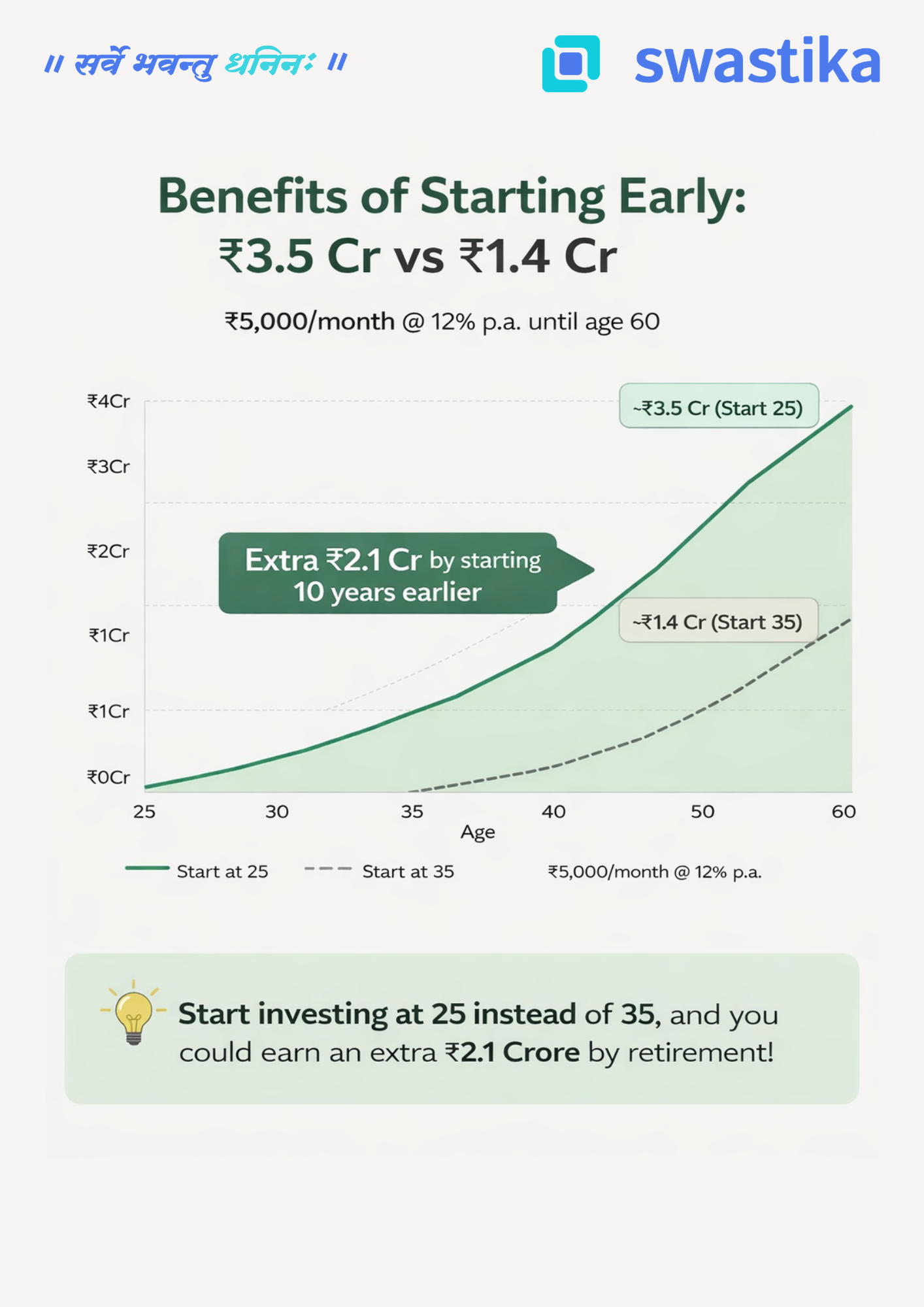
The more years you give your money to grow, the more dramatic — and life-changing — the results become. This is exactly why starting your investment journey early, even with a modest amount, can make a difference of crores by the time you retire.
A Tale of Two Investors: Arjun vs Priya
Let's bring this concept to life with a simple, real-world example.
Meet Arjun and Priya. Both are sensible, disciplined investors. Both invest ₹5,000 every month through a SIP (Systematic Investment Plan) in equity mutual funds, earning an average annual return of 12%. Both stop investing at age 60.
The only difference? Arjun starts at 25. Priya starts at 35.
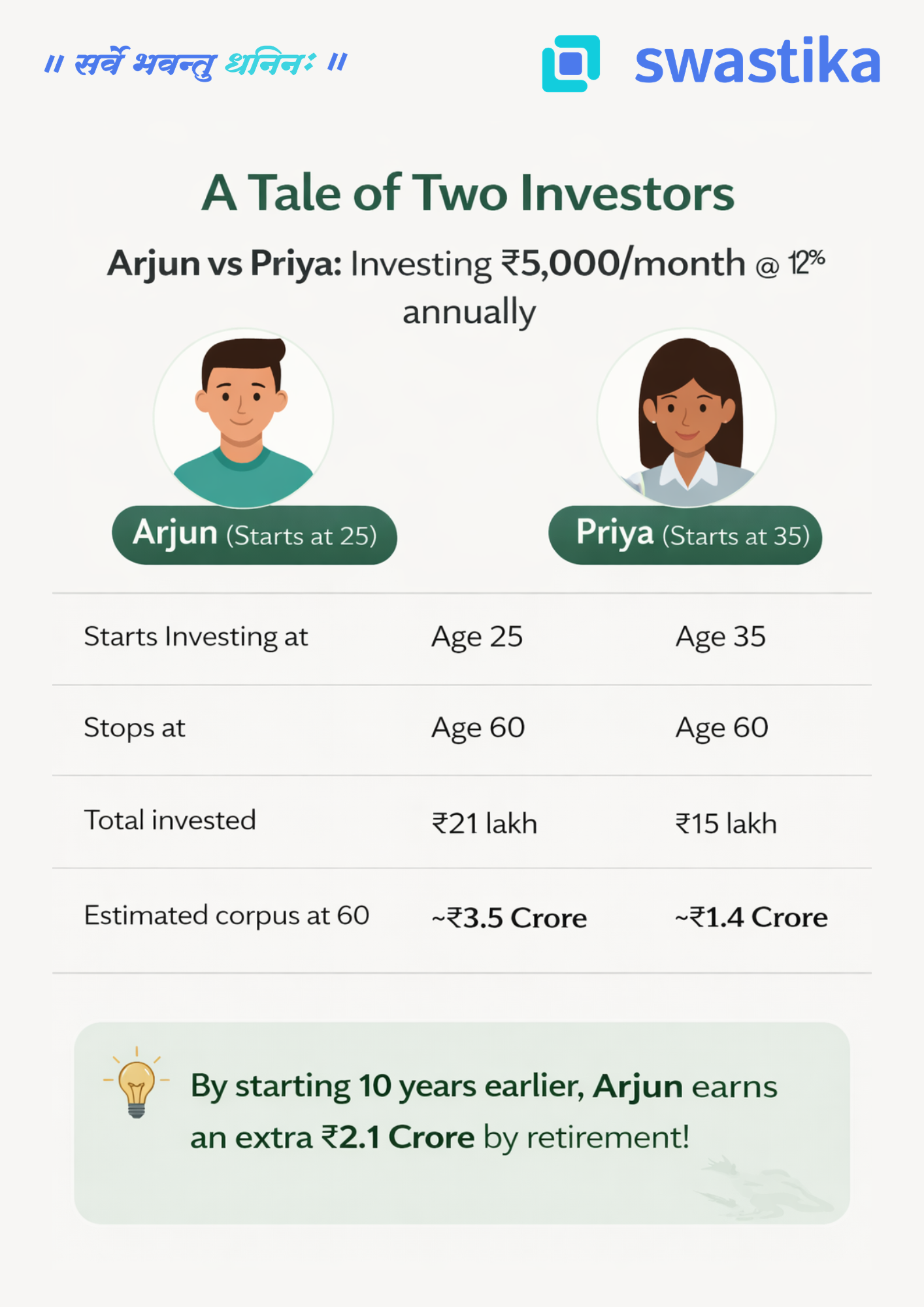
The numbers are striking. Arjun invests just ₹6 lakh more than Priya in absolute terms — yet walks away with ₹2.1 Crore more at retirement.
That extra ₹2.1 Crore didn't come from investing more aggressively or taking bigger risks. It came purely from starting 10 years earlier.
Why Does Time Make Such a Huge Difference?
This is where the magic of compounding reveals itself.
In the early years of investing, growth looks modest and almost unimpressive. But as the years pass, your corpus grows not just on your original investment, but on all the accumulated returns from previous years. The curve goes from almost flat to steeply exponential — and that steep climb happens in the later years.
When Arjun starts at 25, his money has 35 years to ride that exponential curve. Priya's money, starting at 35, only catches the last 25 years — and critically, it misses the steepest part of the climb in the final decade.
Think of it this way: the last 10 years of compounding are worth more than the first 20. That is the counterintuitive truth at the heart of long-term investing.
The Real Cost of Waiting
Many young earners tell themselves, "I'll start investing once I'm more settled — once the salary improves, once the EMI is paid off, once life is a bit easier."
But the numbers show that every year of delay is extraordinarily expensive — far more expensive than any EMI or lifestyle expense. Priya didn't invest carelessly. She invested faithfully for 25 years. Yet she ends up with less than half of what Arjun accumulated — not because she did anything wrong, but simply because she started a decade late.
The cost of waiting 10 years wasn't ₹6 lakh in additional contributions. The cost was ₹2.1 Crore in lost wealth.
Three Principles to Remember
1. Start now, not later.The best time to start investing was yesterday. The second best time is today. Even a SIP of ₹1,000–₹2,000 per month in your 20s is infinitely better than waiting for the "right time."
2. Consistency beats intensity.You don't need to invest large sums all at once. A small, steady, monthly commitment — maintained without interruption — is what unlocks the full power of compounding over decades.
3. Stay invested through market cycles.Compounding works only if you let it work. Exiting during market corrections or stopping your SIP in tough months breaks the chain. Time in the market, not timing the market, is what builds wealth.
The Bottom Line
If you are in your 20s or early 30s, you hold an asset that no amount of money can buy later: time. Use it. Start a SIP today — even a small one. Let compounding do its slow, steady, powerful work.
Because the difference between starting at 25 and starting at 35 is not just 10 years. As Arjun and Priya's story shows, that difference is ₹2.1 Crore.
Big Budget









.webp)
.webp)
.webp)
.webp)
.webp)














.webp)
.webp)
.webp)
.webp)
Latest Articles
.webp)
Share Market Setup Today 2 April 2026: Nifty & Bank Nifty Outlook


 Add Swastika as preferred source
The Indian stock market setup for 2 April 2026 signals cautious sentiment amid mixed global cues. With weakness in Asian markets and declining Dow futures, traders may witness volatility at the open. Let’s break down the key factors driving today’s market outlook, including FII DII activity, derivatives data, and crucial support and resistance levels.
Key Takeaways
- Global cues are weak with Asian markets under pressure
- FIIs remain net sellers while DIIs provide partial support
- Nifty shows a sell-on-rise trend with key support near 21800
- Bank Nifty continues its downward trajectory
Global Market Signals and Their Impact
Global markets are setting a cautious tone for Indian equities. The US market closed higher, but Dow futures are currently trading sharply lower, indicating a possible reversal in sentiment. Asian markets are also in the red, which typically weighs on early morning trade in India.
Additionally, GIFT Nifty is indicating a gap-down opening of around 300 plus points. This suggests traders should be prepared for initial weakness and potential intraday volatility.
For Indian investors, global signals matter because of increasing integration with international capital flows. Any sharp movement in US or Asian indices often triggers reactionary moves in domestic markets.
FII and DII Activity: What Smart Money Indicates
Foreign Institutional Investors have sold equities worth over ₹8300 crore, while Domestic Institutional Investors bought approximately ₹7100 crore. This results in a net outflow of around ₹1159 crore.
This divergence is important. FIIs typically react to global macro trends such as interest rates and currency movement, often guided by policies from institutions like the Reserve Bank of India and global central banks. On the other hand, DIIs provide stability by investing based on long-term domestic fundamentals.
The derivatives data shows a mixed picture. While there is some long buildup in futures, heavy call writing and put activity indicate uncertainty and resistance at higher levels.
Derivatives Insight: PCR, VIX and Open Interest
The Put Call Ratio is around 0.93, slightly lower than the previous session. This suggests a mildly bearish undertone. India VIX has jumped over 10 percent, signaling rising fear and expected volatility.
Open Interest data shows the highest call writing near 24000 and strong put writing near 20200. The max pain level stands around 23000, indicating where the market might gravitate in the short term.
For traders, rising VIX combined with heavy call writing usually favors a sell-on-rise strategy rather than aggressive buying.
Nifty Outlook: Key Levels to Watch
Nifty continues to trade in a downtrend, with a clear sell-on-rise bias. After a likely gap-down opening, the following levels become crucial:
Support levels
- 22283
- 22150
- 21800
Resistance levels
- 22500
- 22680
- 22800
A break below 22150 could accelerate downside momentum, while any recovery toward 22500 may face selling pressure.
Bank Nifty Outlook: Continued Weakness
Bank Nifty is also showing signs of sustained weakness. The index is under pressure due to global uncertainty and cautious sentiment in financial stocks.
Key support levels
- 50500
- 50000
- 49500
Resistance levels
- 51000
- 51500
Traders should watch PSU and private bank stocks closely, as they often drive directional moves in the index.
How Traders Can Approach Today’s Market
Given the current setup, a cautious approach is advisable. Intraday traders may look for shorting opportunities near resistance levels, while positional traders should wait for confirmation before entering fresh long positions.
Risk management is crucial, especially with rising volatility. Following SEBI guidelines on leverage and maintaining disciplined stop-loss strategies can help avoid unnecessary losses.
Platforms like Swastika Investmart offer robust research insights, advanced trading tools, and reliable support, helping traders make informed decisions even in volatile markets.
Frequently Asked Questions
What is the expected opening for Nifty today?
Nifty is likely to open gap-down due to weak global cues and negative GIFT Nifty indications.
Why are FIIs selling heavily?
FIIs often react to global factors like US interest rates, currency fluctuations, and geopolitical risks.
What does India VIX rising mean?
A rising VIX indicates increased market volatility and uncertainty among investors.
Is it a good time to buy stocks?
It is better to wait for stability or clear reversal signals before making fresh investments.
Final Thoughts
The market setup for 2 April 2026 suggests a cautious and volatile session ahead. With FIIs selling and global cues weak, traders should focus on disciplined strategies and avoid impulsive decisions.
For those looking to navigate such market conditions with confidence, exploring a reliable and research-driven platform can make a difference.
%20(3).webp)
FII FPI & DII Trading Activity on 1 April 2026 : Key Insights from April 1, 2026
Add Swastika as preferred source
Understanding FII DII trading activity today is crucial for decoding market direction in India. On April 1, 2026, the data shows a sharp contrast between foreign and domestic institutional investors, offering valuable signals for traders and long-term investors alike.
Quick Takeaways
- DIIs remained strong net buyers, supporting market stability
- FIIs continued aggressive selling, creating downward pressure
- Domestic liquidity is currently offsetting foreign outflows
- Market sentiment remains cautious but not weak
What Happened on April 1, 2026
The latest data highlights a clear divergence between institutional players:
- DII Activity (NSE Capital Market): Net buying of ₹7,019 crore
- FII Activity (NSE Capital Market): Net selling of ₹8,072 crore
When combining NSE, BSE, and MSEI data:
- DIIs: Net buyers of ₹7,171 crore
- FIIs: Net sellers of ₹8,331 crore
This pattern reflects a familiar trend where domestic institutions absorb selling pressure from foreign investors.
Why Are FIIs Selling?
Foreign Institutional Investors often react to global cues. Some key reasons include:
Global Interest Rate Outlook
With central banks like the US Federal Reserve maintaining a cautious stance, capital tends to flow back to safer assets. This impacts emerging markets like India.
Currency Fluctuations
The Indian rupee’s volatility can reduce returns for FIIs when converted back to their home currency.
Risk-Off Sentiment
Geopolitical tensions and global uncertainty often trigger FII outflows.
Why DIIs Are Buying Aggressively
Domestic Institutional Investors, including mutual funds and insurance companies, are playing a stabilizing role.
Strong SIP Inflows
Retail participation through Systematic Investment Plans continues to provide steady liquidity.
Confidence in Indian Growth
India’s long-term growth story remains intact, supported by government policies and economic reforms guided by institutions like SEBI and RBI.
Valuation Opportunities
Market corrections due to FII selling often create attractive entry points for DIIs.
What This Means for Retail Investors
Understanding FII DII trading activity today helps you make smarter decisions:
Market Direction Is Not One-Sided
Even though FIIs are selling, strong DII buying prevents sharp crashes.
Focus on Fundamentals
Short-term volatility should not distract from long-term investment goals.
Sectoral Opportunities
DII buying often focuses on fundamentally strong sectors like banking, infrastructure, and manufacturing.
Role of Regulations and Market Stability
The Indian stock market operates under strict regulatory oversight by SEBI, ensuring transparency in institutional trades. RBI policies also influence liquidity and currency stability, indirectly affecting FII flows.
This strong regulatory framework makes India one of the most resilient emerging markets.
How Swastika Investmart Helps You Navigate Markets
In times of mixed signals like these, having the right platform matters. Swastika Investmart stands out with:
- SEBI-registered credibility ensuring trust and compliance
- Advanced research tools that decode FII and DII trends
- Reliable customer support for timely assistance
- A tech-driven platform designed for modern investors
- Strong focus on investor education
These features help investors interpret market data and act with confidence.
Common Questions on FII DII Activity
1. Why is FII selling considered negative for markets?
FII selling often leads to short-term volatility because of large capital outflows, but it does not always signal a long-term downturn.
2. Can DII buying fully offset FII selling?
In many cases, yes. Strong domestic inflows, especially through mutual funds, can stabilize markets.
3. Should retail investors follow FII trends?
FII trends are important but should not be the only factor. Always consider fundamentals and long-term goals.
4. Is this a good time to invest?
Market dips caused by FII selling can offer good opportunities if the underlying fundamentals remain strong.
Final Thoughts
The FII DII trading activity today clearly shows a tug of war between global caution and domestic confidence. While FIIs continue to pull out funds, DIIs are stepping in with strong buying support, keeping the market balanced.
For investors, this is not a time for panic but for informed decision-making. Staying updated with institutional trends and focusing on long-term growth remains key.
If you want deeper insights and smarter investing tools, explore Swastika Investmart here:
.png)
Market Closing Summary Today 1 April 2026: Nifty, Sensex, and Bank Nifty Surge Strongly & What’s Driving the Surge?
The Indian stock market rally April 2026 has caught the attention of investors across the country. Benchmark indices like Nifty 50 and Sensex posted strong gains, signaling renewed optimism after a volatile March. But what exactly is fueling this momentum, and more importantly, can it sustain?
Let’s break it down in a simple, practical way.
Key Takeaways
- Indian markets surged over 1.5% driven by global geopolitical easing
- Banking, IT, and metal sectors led the rally
- FIIs showed renewed buying interest after weeks of selling
- Volatility may persist due to global macro uncertainties
- Long-term investors should stay disciplined and avoid chasing momentum
What Triggered the April 2026 Market Rally?
Geopolitical Relief Boosted Sentiment
One of the biggest catalysts behind the Indian stock market rally April 2026 was easing tensions in West Asia. Markets had been under pressure due to uncertainty around global conflicts, especially impacting crude oil prices.
With signs of de-escalation, investor confidence improved rapidly. Lower crude oil expectations are particularly positive for India, as it is a major oil importer.
Strong Domestic Macros
India’s macroeconomic fundamentals remain resilient. Inflation is under control within the RBI’s tolerance band, and GDP growth continues to outperform most major economies.
The Reserve Bank of India (RBI) has maintained a balanced stance, supporting growth while keeping inflation in check. This stability acts as a strong backbone for equity markets.
FII Inflows Return
Foreign Institutional Investors had been net sellers in March 2026. However, early April saw a shift, with FIIs turning buyers again. This added liquidity played a key role in pushing indices higher.
Sector-Wise Performance: Who Led the Rally?
Banking and Financials
Banking stocks were among the top performers. Strong credit growth, stable asset quality, and improving margins supported the uptrend.
IT Sector Gains Momentum
IT stocks rebounded as global recession fears eased slightly. A stable US outlook often benefits Indian IT companies, given their export-heavy business model.
Metals Shine on Global Hopes
Metal stocks surged on expectations of improved global demand. Any positive shift in China or global infrastructure spending tends to boost this sector.
What Should Investors Do Now?
Avoid Emotional Investing
Sharp rallies often trigger FOMO. However, disciplined investing remains key. Avoid entering stocks purely based on momentum.
Focus on Fundamentals
Look for companies with strong balance sheets, consistent earnings growth, and good management quality.
Diversification is Crucial
A well-diversified portfolio across sectors like banking, IT, FMCG, and pharma helps manage risk effectively.
Keep an Eye on Regulations
Market participants should stay updated with guidelines from the Securities and Exchange Board of India (SEBI). Regulatory changes can influence market behavior, especially in derivatives and margin trading.
Role of Research and Advisory
Navigating such market phases requires reliable insights. This is where platforms like Swastika Investmart add value. As a SEBI-registered broker, it offers robust research tools, actionable advisory, and a tech-enabled investing experience. Their focus on investor education helps individuals make informed decisions rather than speculative bets.
Risks That Could Impact the Rally
Global Uncertainty
Any escalation in geopolitical tensions or unexpected macro shocks can quickly reverse gains.
Interest Rate Outlook
If global central banks adopt a hawkish stance again, it may impact liquidity flows into emerging markets like India.
Profit Booking
After a sharp rally, short-term corrections are natural as traders lock in profits.
Frequently Asked Questions
What caused the Indian stock market rally in April 2026?
The rally was driven by easing geopolitical tensions, FII inflows, and strong domestic economic indicators.
Which sectors performed best during the rally?
Banking, IT, and metal sectors were the top gainers.
Is it a good time to invest in the stock market now?
Yes, but with caution. Focus on fundamentally strong stocks and avoid chasing short-term trends.
How do RBI and SEBI impact the stock market?
RBI influences liquidity and interest rates, while SEBI regulates market practices to ensure transparency and investor protection.
Final Thoughts
The Indian stock market rally April 2026 reflects improving sentiment and strong underlying fundamentals. While the outlook remains positive, investors should stay cautious and avoid impulsive decisions.
A balanced approach combining research, discipline, and long-term thinking is the best way forward.
If you are looking to make smarter investment decisions with expert-backed insights, you can explore Swastika Investmart’s platform here

US War Department Briefing Done: What Was Announced & Market Impact
Key Takeaways
- The latest US war department briefing has increased global uncertainty
- Crude oil and gold prices reacted sharply to geopolitical tensions
- Indian markets showed volatility, especially in oil-sensitive sectors
- Defensive sectors like IT and Pharma remained relatively stable
- Investors should stay cautious and focus on risk-managed strategies
What Happened in the US War Department Briefing?
The recent US war department briefing has grabbed global attention and triggered a wave of reactions across financial markets. While the briefing did not officially declare a full-scale escalation, it highlighted rising geopolitical tensions, strategic preparedness, and potential military actions if required.
For investors, this is not just political news. It directly impacts global liquidity, commodity prices, currency movement, and overall market sentiment.
The key takeaway is simple. Markets hate uncertainty. And this briefing has added another layer of it.
Key Announcements from the Briefing
1. Strategic Military Readiness
The US confirmed heightened military preparedness in sensitive regions. This indicates that the situation remains fluid and could escalate if conditions worsen.
2. Focus on Energy Supply Routes
A major highlight was the emphasis on securing global energy supply chains. This is critical because any disruption here can push crude oil prices higher.
3. Diplomatic Channels Still Open
Despite the aggressive tone, the US also signaled that diplomatic efforts are ongoing. This creates a mixed sentiment in markets, balancing fear with hope.
4. No Immediate Economic Sanctions Expansion
There was no major announcement regarding new sanctions. This provided slight relief to global markets in the short term.
How Global Markets Reacted
Sharp Movement in Commodities
Crude oil prices saw an immediate spike due to fears of supply disruption. For example, Brent crude moved upward as traders priced in geopolitical risk.
Gold, often considered a safe-haven asset, also gained momentum as investors looked for stability.
Currency Volatility
The US dollar strengthened initially as investors moved towards safer assets. Emerging market currencies, including the Indian Rupee, came under pressure.
Impact on Indian Stock Markets
Indian markets are highly sensitive to global cues, especially geopolitical developments. The impact of this briefing was visible across sectors.
1. Pressure on Indices
Benchmark indices like Nifty and Sensex showed volatility. Intraday swings increased as traders reacted to global uncertainty.
2. Oil and Gas Stocks in Focus
India is a major importer of crude oil. Rising oil prices negatively impact companies dependent on fuel.
- Aviation stocks faced pressure due to higher fuel costs
- Paint and chemical companies also saw weakness
3. IT Sector Stability
IT stocks acted as a cushion. A stronger US dollar benefits Indian IT companies as a large portion of their revenue comes from exports.
4. Pharma as a Defensive Bet
Pharma stocks remained relatively stable. During uncertain times, investors often shift towards defensive sectors like healthcare.
Real-World Example
We saw a similar pattern during earlier geopolitical tensions like the Russia-Ukraine conflict. Crude prices surged, inflation fears increased, and markets became volatile.
In that phase:
- Oil crossed $100 per barrel
- Indian markets corrected sharply
- Defensive sectors outperformed cyclical stocks
The current situation is showing early signs of a similar trend, although not at the same scale yet.
What Should Investors Do Now?
Stay Calm and Avoid Panic Selling
Market volatility can trigger emotional decisions. It is important to stay focused on long-term goals.
Diversify Your Portfolio
A well-diversified portfolio helps reduce risk during uncertain times. Exposure to defensive sectors can provide balance.
Track Crude Oil and Currency
Keep an eye on crude oil prices and INR movement. These are key indicators for market direction in such scenarios.
Focus on Quality Stocks
Companies with strong balance sheets and stable earnings tend to perform better during global uncertainty.
Regulatory and Policy Angle in India
From an Indian perspective, regulators like SEBI ensure market stability through surveillance and risk management frameworks.
In times of high volatility:
- Circuit breakers prevent panic crashes
- Margin requirements may be adjusted
- Liquidity measures may be introduced if needed
This ensures that even during global shocks, Indian markets remain relatively resilient.
How Swastika Investmart Helps You Navigate Such Markets
In uncertain times, having the right research and guidance makes a big difference.
Swastika Investmart, a SEBI-registered broker, offers:
- Strong research-backed insights for better decision-making
- Advanced trading platforms for smooth execution
- Dedicated customer support for quick assistance
- Investor education to help you understand market risks
Whether you are a beginner or an experienced trader, having access to reliable analysis can help you stay ahead.
FAQs
1. What is a war department briefing?
It is an official communication where military and defense authorities share updates on geopolitical and security situations.
2. Why do stock markets react to such briefings?
Markets react because geopolitical tensions impact global trade, oil prices, inflation, and investor sentiment.
3. Which sectors benefit during geopolitical tensions?
Defensive sectors like IT, Pharma, and FMCG tend to perform better, while oil-dependent sectors may face pressure.
4. Should I sell my investments during such news?
Not necessarily. It is better to stay calm, review your portfolio, and avoid panic-driven decisions.
5. How does crude oil impact Indian markets?
Higher crude prices increase inflation and reduce corporate margins, which negatively affects many sectors.
Conclusion
The US war department briefing has once again reminded investors how closely markets are linked to global events. While the situation is still evolving, the immediate impact has been increased volatility, rising commodity prices, and cautious investor sentiment.
For Indian investors, the key is not to react impulsively but to stay informed and prepared. Market corrections and volatility are part of the journey, but they also create opportunities for disciplined investors.
If you want to navigate such uncertain markets with confidence, having the right partner matters.

Financial Planning for FY27: How to Plan Your Budget, Taxes & Investments for FY27
Key Takeaways
- Start FY27 with a clear budget and defined financial goals
- Choose between old vs new tax regime based on your income profile
- Balance investments across equity, debt, and gold
- Focus on discipline, not timing the market
Introduction
Financial Planning for FY27 is not just about saving money. It is about building a structured approach towards budgeting, taxes, and investments so that your money works efficiently for you.
With changing tax rules, volatile markets, and rising inflation, planning early in the financial year gives you a major advantage. Instead of rushing in March, a well-thought-out strategy in April itself can help you optimize returns and reduce stress.
Let’s break down how you can plan your FY27 finances step by step.
Step 1: Build a Realistic Budget for FY27
Budgeting is the foundation of financial planning. Without knowing where your money is going, it is impossible to invest wisely.
Understand Your Cash Flow
Start with a simple calculation:
Income minus Expenses equals Savings
Track your fixed expenses like rent, EMIs, and insurance. Then estimate variable costs such as travel, shopping, and entertainment.
Follow the 50-30-20 Rule
A simple framework many investors follow:
- 50 percent for needs
- 30 percent for wants
- 20 percent for savings and investments
If you are early in your career, even saving 10 to 15 percent consistently can make a big difference.
Real Example
If your monthly salary is ₹80,000:
- ₹40,000 for essentials
- ₹24,000 for lifestyle
- ₹16,000 for savings and investments
This structure helps avoid overspending and ensures regular investing.
Step 2: Tax Planning for FY27
Tax planning is most effective when done throughout the year, not at the last minute.
Choose the Right Tax Regime
In India, you can choose between:
- Old Tax Regime with deductions
- New Tax Regime with lower tax rates but fewer exemptions
If you have investments like ELSS, PPF, home loan, or insurance, the old regime may work better. Otherwise, the new regime could be simpler.
Key Sections to Consider
- Section 80C for investments up to ₹1.5 lakh
- Section 80D for health insurance
- HRA and LTA benefits for salaried individuals
Avoid Last-Minute Decisions
Investing in random tax-saving products in March often leads to poor choices. Plan your tax-saving investments from the beginning of FY27.
Step 3: Smart Investment Strategy for FY27
Once your budget and taxes are planned, the next step is investing.
Asset Allocation Matters
A balanced portfolio could include:
- Equity for long-term growth
- Debt for stability
- Gold as a hedge
Your allocation should depend on your risk appetite and goals.
SIP vs Lump Sum
For most investors, SIPs are a better option because they reduce timing risk and build discipline.
For example, investing ₹10,000 monthly in an equity mutual fund can help you benefit from market volatility through rupee cost averaging.
Market Context for FY27
With global uncertainties like interest rate cycles, crude oil volatility, and geopolitical tensions, markets may remain volatile.
This makes diversification even more important.
Step 4: Emergency Fund and Insurance
Before aggressive investing, secure your financial base.
Emergency Fund
Keep at least 6 months of expenses in liquid funds or savings accounts. This protects you during job loss or unexpected expenses.
Insurance
- Health insurance is essential due to rising medical costs
- Term insurance ensures financial security for your family
Avoid mixing insurance with investment unless it fits your financial plan.
Step 5: Align Investments with Goals
Investing without a goal often leads to confusion.
Short-Term Goals
Travel, gadgets, or a car
Use safer options like debt funds or fixed deposits
Long-Term Goals
Retirement, buying a house, children’s education
Equity investments are more suitable here
Example
If you plan to buy a house in 5 years, aggressive equity exposure may not be ideal. A balanced approach works better.
Impact on Indian Markets
Retail participation in Indian markets is increasing rapidly. More investors are entering through SIPs and direct equities.
A disciplined financial planning approach helps:
- Reduce panic during market corrections
- Improve long-term wealth creation
- Avoid impulsive decisions based on news or social media
Regulatory bodies like SEBI continue to promote investor awareness and transparency, making it safer for individuals to participate in markets.
Common Mistakes to Avoid
- Delaying financial planning till year-end
- Ignoring asset allocation
- Over-investing in trending sectors
- Not reviewing portfolio regularly
Consistency matters more than chasing high returns.
FAQs
When should I start financial planning for FY27?
The best time is at the beginning of the financial year. Early planning gives you more flexibility and better decision-making.
Which tax regime is better for FY27?
It depends on your income and deductions. Compare both regimes before making a choice.
How much should I invest every month?
Ideally, aim for at least 20 percent of your income, but start with what is comfortable and increase gradually.
Is SIP better than lump sum investment?
For most retail investors, SIP is better as it reduces market timing risk and builds discipline.
Do I need an emergency fund before investing?
Yes, an emergency fund is essential before taking exposure to market-linked investments.
Conclusion
Financial Planning for FY27 is about clarity, discipline, and consistency.
Start with a budget, plan your taxes smartly, and invest based on your goals. Avoid shortcuts and focus on long-term wealth creation.
Markets will always have ups and downs, but a well-structured plan helps you stay on track.
If you are looking for a reliable platform to begin or streamline your investment journey, Swastika Investmart offers strong research tools, SEBI-registered services, and technology-driven solutions to support your decisions.

Why Flight Tickets Are Getting Expensive in 2026? - The ATF Price Shock Explained
Key takeaways
- Aviation fuel prices have surged sharply, increasing airline costs
- Flight capacity has reduced, leading to supply-demand imbalance
- Airlines now have pricing freedom, pushing fares higher during peak demand
- Government intervention may help, but relief will take time
Introduction
If you’ve recently booked a flight and felt the pinch, you’re not imagining things. Flight ticket prices in India have gone up noticeably in 2026. Whether it’s a last-minute business trip or a family vacation, fares are higher across routes.
At the heart of this surge lies one major factor: aviation turbine fuel, or ATF. But that’s not the only reason. A mix of global tensions, operational challenges, and policy changes is reshaping the aviation landscape.
Let’s break it down in simple terms.
What Is ATF and Why Does It Matter So Much?
Aviation Turbine Fuel is the lifeline of the airline industry. It accounts for nearly 35 to 45 percent of an airline’s total operating cost.
When fuel prices rise, airlines have limited options. They can either absorb the cost, which hurts profitability, or pass it on to passengers through higher ticket prices. Most airlines choose the latter.
In April 2026, ATF prices in India crossed record levels, even touching above ₹2 lakh per kilolitre in some reports. While domestic airlines were partially shielded, the increase was still significant enough to impact fares.
The Real Trigger: Global Geopolitics
The surge in fuel prices is not happening in isolation. Global tensions, especially in the Middle East, have disrupted energy supply chains.
The Strait of Hormuz, a key oil transit route, has been under pressure due to geopolitical conflicts. This has led to uncertainty in oil supply, pushing crude prices higher.
When crude oil rises, ATF follows. And when ATF rises, ticket prices go up. It’s a direct chain reaction.
For example, during previous crises like the Russia-Ukraine conflict in 2022, similar spikes in fuel prices led to higher airfares globally. We are seeing a repeat of that pattern.
Fewer Flights, Higher Demand
Another important factor is the reduction in flight capacity.
As per recent updates, weekly flights in India have dropped from around 25,600 to nearly 23,000. That’s roughly a 10 to 12 percent decline.
Why is this happening?
The aviation regulator has instructed airlines to schedule flights only based on available aircraft, not on expected future deliveries. This has reduced the number of operational flights in the system.
Now, combine fewer flights with strong travel demand during summer and holidays. The result is simple economics: higher prices.
Fare Caps Removed: Airlines Get Pricing Power
Earlier, there were certain fare caps in place to prevent excessive pricing. But now, those caps have been removed.
This means airlines have more flexibility to price tickets based on demand.
During peak seasons, weekends, or festive periods, airlines can increase fares significantly. This dynamic pricing model is similar to what we see in ride-hailing apps.
While this benefits airlines, it adds pressure on passengers.
Government’s Response: Partial Relief
The government is aware of the situation and has taken some steps.
Oil Marketing Companies have implemented only a partial increase in ATF prices for domestic airlines, around 25 percent instead of the full spike. This is aimed at cushioning the impact on domestic travel.
Additionally, states have been urged to reduce VAT on aviation fuel. Lower taxes can help bring down operational costs.
However, these measures take time to reflect in ticket prices. For now, passengers may continue to face higher fares.
Impact on Indian Markets and Stocks
The rising cost environment has a mixed impact on the stock market.
Airline companies may face margin pressure due to higher fuel costs. Stocks in the aviation sector can remain volatile in such conditions.
On the other hand, oil marketing companies and energy-related businesses may benefit from higher prices.
For investors, this creates both risks and opportunities. Understanding sectoral impact becomes crucial in such times.
Platforms like Swastika Investmart help investors track these trends through research-backed insights, sector analysis, and real-time market tools. This can be especially useful when global events start influencing domestic markets.
Real-Life Scenario: Why Your Ticket Costs More
Let’s take a simple example.
Suppose last year, a Delhi to Mumbai ticket cost around ₹5,000. Now, due to higher fuel prices and limited flights, the same ticket may cost ₹7,000 or more during peak days.
That extra ₹2,000 is not random. It reflects increased fuel cost, operational constraints, and higher demand.
Multiply this across thousands of passengers daily, and you see the scale of the impact.
A Small Positive: New Airlines Entering the Market
While the current situation looks tight, there is a long-term positive.
New airlines are entering the Indian market, focusing on regional connectivity and smaller cities. This could increase competition and improve supply over time.
More players in the market usually lead to better pricing and more options for travelers. However, this is a gradual process.
What Should You Do as a Consumer or Investor?
For travelers:
- Book tickets in advance whenever possible
- Avoid peak travel days
- Compare prices across platforms
For investors:
- Track aviation and oil sector developments
- Watch global crude price trends
- Focus on diversified portfolios to manage risk
A disciplined and informed approach can help you navigate such phases better.
FAQs
Why are flight tickets so expensive in 2026?
Flight tickets are expensive mainly due to rising aviation fuel prices, reduced flight capacity, and increased demand during peak travel seasons.
What is ATF and why does it impact ticket prices?
ATF is aviation fuel and forms a major part of airline costs. When its price rises, airlines increase ticket fares to maintain profitability.
Will flight ticket prices come down soon?
Prices may stabilize if fuel costs ease and flight capacity increases. However, in the short term, high fares may continue.
How does this affect Indian stock markets?
Airline stocks may face pressure due to higher costs, while oil-related companies could benefit. Market volatility may increase due to global factors.
Conclusion
The rise in flight ticket prices in 2026 is not due to a single factor. It’s a combination of global geopolitics, rising fuel costs, reduced capacity, and pricing freedom for airlines.
While short-term relief may be limited, understanding the bigger picture helps both travelers and investors make better decisions.
If you’re looking to stay ahead of such market-moving developments, having the right platform matters. Swastika Investmart, a SEBI-registered broker, offers strong research tools, reliable customer support, and tech-enabled investing solutions to help you navigate changing market conditions with confidence.


.webp)
.webp)

.webp)






START YOUR INVESTMENT JOURNEY
Get personalized advice from our experts
- Dedicated RM Support
- Smooth and Fast Trading App