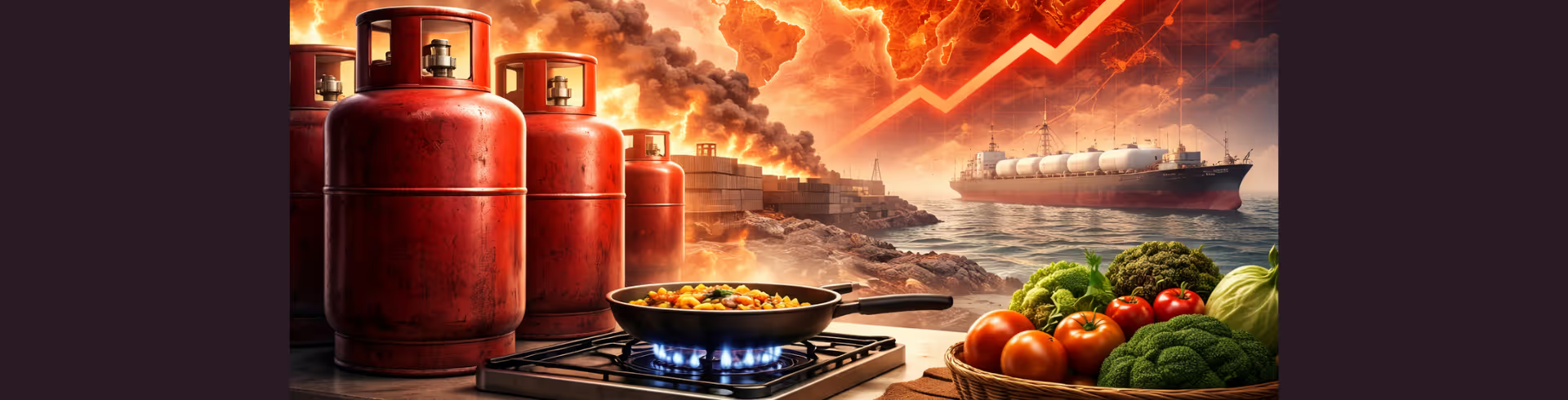

From War Zones to Kitchen Cylinders: How Global Conflicts Affect Domestic LPG Availability


From War Zones to Kitchen Cylinders: How Global Conflicts Affect Domestic LPG Availability
Key Takeaways
• Global conflicts can disrupt LPG supply chains and increase international energy prices.
• India imports a large portion of its LPG requirement, making it sensitive to global energy shocks.
• Rising LPG costs can affect household budgets and inflation.
• Government policies and subsidies often play a key role in stabilizing domestic LPG prices.
• Investors should monitor energy trends as they influence inflation, markets, and economic stability.
From War Zones to Kitchen Cylinders: How Global Conflicts Affect Domestic LPG Availability
For most households in India, the kitchen gas cylinder is a routine necessity. Millions of families rely on LPG for cooking every day. Yet, few people realize how events thousands of kilometers away in conflict zones can influence the price and availability of the cylinder delivered to their homes.
Global energy markets are deeply interconnected. When geopolitical tensions rise in major oil and gas producing regions, the impact travels through supply chains, shipping routes, and commodity markets. Eventually, it reaches domestic energy supplies such as LPG.
Understanding this connection is important not only for consumers but also for investors and market watchers who want to track how global conflicts influence the Indian economy.
Why Global Conflicts Influence LPG Availability
Liquefied Petroleum Gas is largely produced as a byproduct of crude oil refining and natural gas processing. As a result, any disruption in oil and gas production or transportation can affect LPG supply.
When conflicts erupt in energy-rich regions such as the Middle East, markets react quickly. Oil prices often spike, shipping routes may become risky, and supply chains tighten.
Countries that rely heavily on energy imports, including India, feel the ripple effects.
India consumes more than 28 million tonnes of LPG annually, and a significant portion of this demand is met through imports. When global supply tightens, domestic prices and availability can come under pressure.
The Role of the Middle East in Global LPG Supply
The Middle East plays a central role in global LPG production and exports. Countries such as Saudi Arabia, Qatar, and the United Arab Emirates are among the largest suppliers of LPG to Asian markets.
Any instability in the region can create uncertainty in energy markets.
For example, tensions involving Iran, the United States, or Israel often raise concerns about the security of energy transport routes in the Persian Gulf. This is particularly important because a large share of global oil and gas shipments pass through the Strait of Hormuz.
Even the possibility of disruptions in this narrow maritime corridor can push up energy prices worldwide.
Higher crude prices often translate into higher LPG costs because both markets are closely linked.
How Higher LPG Prices Affect Indian Households
For millions of Indian households, LPG is an essential part of daily life. A rise in cylinder prices can quickly affect monthly household budgets.
Consider a typical middle-class family that consumes one LPG cylinder every month. If international energy prices rise and domestic LPG prices increase by even ₹50 to ₹100 per cylinder, the annual household expenditure rises noticeably.
For lower-income households, this impact can be even more significant.
Government schemes such as the Pradhan Mantri Ujjwala Yojana have expanded LPG access across rural India. While these programs improve clean cooking adoption, they also make price stability even more important for household affordability.
Government Policies That Stabilize LPG Supply
The Indian government actively intervenes in LPG pricing and distribution to protect consumers from sudden price shocks.
Public sector oil marketing companies such as Indian Oil Corporation, Bharat Petroleum, and Hindustan Petroleum manage most of the LPG distribution network in the country.
These companies import LPG, manage storage infrastructure, and distribute cylinders across India.
In times of global price volatility, the government may take several steps such as:
Subsidy Support
Targeted subsidies can help lower-income households manage rising cylinder costs.
Strategic Procurement
Oil marketing companies often diversify import sources to reduce dependence on a single region.
Price Adjustments
Sometimes the government absorbs part of the cost increase to maintain affordability.
These mechanisms help ensure that even during global energy shocks, LPG supply remains stable across the country.
Impact on Inflation and the Indian Economy
Energy prices have a direct influence on inflation. When LPG and fuel costs rise, household expenses increase and transportation costs go up.
This has a cascading effect across the economy.
Food distribution becomes more expensive, manufacturing costs rise, and service sectors also feel the pressure. As a result, inflation indicators such as the Consumer Price Index can move higher.
The Reserve Bank of India closely monitors energy prices while setting monetary policy. Persistent energy inflation may influence interest rate decisions and economic forecasts.
Market Impact: What Investors Should Watch
Energy shocks caused by global conflicts can also influence stock market trends.
Certain sectors tend to react strongly to changes in energy prices.
Oil marketing companies may experience margin pressure if international prices rise faster than domestic retail prices. Transportation and aviation sectors may also face cost increases.
On the other hand, upstream oil exploration companies may benefit from higher global energy prices.
Investors often track energy prices, global geopolitical developments, and government policy decisions to understand how markets may react.
Reliable research and timely insights become particularly valuable during such uncertain periods.
This is where research-driven platforms like Swastika Investmart can play a meaningful role. As a SEBI registered brokerage, Swastika Investmart provides investors with advanced trading tools, market insights, and dedicated support. The platform also focuses on investor education, helping individuals understand how macroeconomic events such as global conflicts can affect markets.
The Bigger Picture: Energy Security and India’s Future
Events like geopolitical conflicts remind policymakers about the importance of energy security.
India has been gradually expanding its energy strategy through measures such as:
• Diversifying energy import sources
• Expanding strategic petroleum reserves
• Increasing renewable energy capacity
• Promoting alternative fuels and clean energy
These initiatives aim to reduce dependence on volatile global energy markets in the long run.
However, in the short term, international developments will continue to influence domestic energy prices and supply chains.
For consumers, this means staying aware of global developments. For investors, it means understanding how macroeconomic events translate into market opportunities and risks.
Frequently Asked Questions
Why do global conflicts affect LPG prices in India?
India imports a significant portion of its LPG requirement. When global oil and gas prices rise due to geopolitical tensions, import costs increase, which can influence domestic LPG prices.
Does India produce its own LPG?
Yes, India produces LPG through domestic refineries and gas processing plants. However, domestic production is not enough to meet total demand, so imports are necessary.
How does the government control LPG prices?
The government uses subsidy programs, policy adjustments, and public sector oil marketing companies to manage LPG distribution and pricing.
Can global conflicts cause LPG shortages in India?
While supply disruptions are possible globally, India maintains diversified import sources and storage infrastructure to ensure consistent LPG availability.
How do energy price changes impact stock markets?
Energy price changes affect sectors differently. Companies dependent on fuel may face higher costs, while energy producers can benefit from rising prices.
Conclusion
The connection between global conflicts and the LPG cylinder in your kitchen may seem distant, but the link is very real. Energy markets are interconnected, and geopolitical tensions often ripple through global supply chains before reaching domestic consumers.
For India, which relies heavily on energy imports, monitoring global developments is essential for economic stability.
For investors, such developments offer valuable signals about inflation trends, sectoral shifts, and potential market opportunities.
If you want to navigate markets with better insights, reliable research, and powerful trading tools, consider opening an account with Swastika Investmart. With SEBI registration, strong customer support, and technology driven investing solutions, the platform helps investors stay informed in a rapidly changing global environment.