


RBI Currency In Circulation Update: June 30, 2026 Data And What It Means For Retail Investors




Key Takeaways
- RBI currency in circulation stood at Rs 42.94 lakh crore as of June 30, 2026.
- Fortnightly change in currency in circulation fell 0.50% while reserve money rose 0.30% to Rs 52.56 lakh crore.
- Currency in circulation grew 12.4% year-on-year, up from 7.3% a year ago.
- In the fiscal year to date, currency in circulation rose 3.1% and reserve money 2.9%.
What happens when money in circulation shifts quietly? A single data point might reshape liquidity expectations, policy timing, and your investment approach. RBI currency in circulation data for June 30, 2026 shows Rs 42.94 lakh crore in active circulation, marking a 3.1% gain for the fiscal year to date. The fortnightly change in currency in circulation fell 0.50%, while reserve money ticked up 0.30% to Rs 52.56 lakh crore. For retail investors, this snapshot is a key thermometer of liquidity and potential market impulses. For investors, tracking rbi currency in circulation is an essential barometer of liquidity and policy signaling. The variables interact with bank credit, domestic demand, and global liquidity conditions, shaping the trading tone across equities, bonds, and money markets.
To give readers a quick snapshot, the table below consolidates the key RBI currency in circulation figures for June 30, 2026. The numbers are RBI data points, which investors often use as a fundament for short- to mid-term liquidity expectations. The gap between currency in circulation and reserve money highlights the portion of liquidity that banks hold as reserves in addition to the currency circulating outside the central bank. In practice, this gap (reserve money minus currency in circulation) reflects the reserves banks hold with the central bank, which can influence money market rates and debt yields in the near term.
| Metric | Value | Fortnightly Change |
|---|---|---|
| Currency In Circulation (June 30, 2026) | Rs 42.94 lakh crore | -0.50% |
| Reserve Money (June 30, 2026) | Rs 52.56 lakh crore | +0.30% |
| Currency In Circulation YoY | 12.4% | – |
| YoY Change Last Year | 7.3% upmove | – |
| FYTD Currency In Circulation | 3.1% | – |
| FYTD Reserve Money | 2.9% | – |
For readers evaluating liquidity conditions, the data also illustrates how rbi money supply – a broader gauge that includes currency in circulation and bank reserves – interacts with the measured currency in circulation. The latest figures imply a continuity of gradual expansion in broad money, consistent with a liquidity environment that supports ongoing investment activity without overheating. As markets weigh policy expectations and growth signals, practitioners should monitor monthly changes in currency in circulation alongside reserve money to gauge the tempo of liquidity shifts. If you want deeper stock-specific analysis, Swastika offers a powerful tool: Swastika's Sarthi AI stock assistant for institutional-grade research on any stock or index to retail investors.
Rbi Currency In Circulation Update: June 30, 2026 Data And What It Means For Investors
At the headline level, the RBI currency in circulation figure on June 30, 2026 is Rs 42.94 lakh crore. This number is the sum of cash held by the public and currency that circulates outside the Reserve Bank of India. The year-on-year growth rate of 12.4% signals substantial expansion in cash in public hands compared with the prior year. The 7.3% upmove recorded at the same time last year provides a benchmark for evaluating whether current liquidity growth is accelerating or normalizing as the economy evolves. For investors, a higher currency in circulation often accompanies stronger demand optimism in nominal terms, occasional pressures on short-end yields, and a nuanced effect on credit uptake by households and businesses. However, liquidity dynamics are multifaceted, and currency in circulation is only one piece of the puzzle.
The fortnightly movement – a decrease of 0.50% – indicates a carbon copy of a momentary demand-supply gap in the currency market. A modest decline like this can stem from factors such as banks adjusting currency holdings, remittance flows, and the seasonality of cash usage. It is important to view this as part of a broader cycle rather than a standalone signal. In the same frame, reserve money rose by 0.30% to Rs 52.56 lakh crore, underscoring that the monetary base narrowed the gap toward a more balanced liquidity footprint. In practice, reserve money growth can cushion or amplify price signals, depending on where the currency is circulating and how banks monetize reserves.
Reserve Money Vs Currency In Circulation: A Clearer Picture For Retail Investors
To interpret the RBI currency in circulation data properly, it helps to distinguish between currency in circulation and reserve money. Currency in circulation refers to the cash held by the public and circulating outside the RBI. Reserve money, on the other hand, includes currency circulating in the economy plus the deposits that banks hold with the central bank and other components of the monetary base. The June 30, 2026 snapshot shows Rs 42.94 lakh crore in currency in circulation and Rs 52.56 lakh crore in reserve money, illustrating that reserve money exceeds currency in circulation by roughly Rs 9.62 lakh crore. This gap is the financial foundation for bank reserves, and it interacts with short-term rate dynamics, money market liquidity, and the pass-through to lending conditions. For a retail investor, this distinction matters because it clarifies where liquidity is being held and how policy moves could influence short-term financial conditions.
From a practical trading standpoint, the relationship suggests that even with robust currency in circulation growth, the central bank may target reserve money levels to manage liquidity and policy rates. The 0.30% fortnightly rise in reserve money signals a cautious expansion in the base that can support market functioning without fanning excessive spillovers into risk assets. The RBI currency in circulation data, in combination with reserve money movements, forms a core part of the macro backdrop that shapes earnings, commodity prices, and interest-rate expectations. This is a lens through which investors should view instrument choices across equities, rates, and currency markets. In this context, ongoing monitoring of rbi updates and the evolving rbi money supply numbers can help investors calibrate entry and exit points with greater confidence.
Fortnightly Changes In Currency In Circulation And Market Liquidity
The 0.50% decline in the fortnightly currency in circulation points to a temporary tightening in cash with the public. While this may appear modest, it matters for day-to-day liquidity, particularly in segments such as overnight money markets and short-duration bonds. In periods of modest declines in currency in circulation, market participants may observe a subtle uptick in liquidity preference by banks, which can influence short-term funding costs. The take-home for traders and investors is to watch how this pace interacts with bank credit flows and consumer spending momentum over the next few weeks. When currency in circulation rises again, it could signal a softening in liquidity demand from the public or an expansion in cash usage for transactions as the calendar turns toward the festive or harvest seasons. The RBI data point remains a key input for forecasting near-term liquidity trends and assessing the risk premium embedded in short-term debt instruments.
Year-On-Year Growth In Currency In Circulation And Its Economic Implications
The 12.4% year-on-year growth in currency in circulation stands out as a robust indicator, reflecting a larger cash footprint in the economy compared with the prior year. This level of YoY expansion can be influenced by a range of factors, including consumer demand, cash usage in transactions, remittance flows, and the pace of digitization. While a high YoY growth in currency in circulation hints at strong cash usage, the interpretation must be balanced against other macro metrics such as inflation, consumer credit, and the evolution of non-cash payment adoption. For investors, a higher currency in circulation can signal a supportive nominal environment for consumption-oriented sectors and services, but it can also signal pressure on real yields if inflation rises alongside cash in hand.
Practical Takeaways For Investors From The June 2026 RBI Data
For retail investors, the June 30, 2026 RBI currency in circulation numbers offer several practical implications. First, the sustained YoY growth in currency in circulation at 12.4% indicates a cash footprint that remains meaningful, even as digital payments expand. This environment can support consumer-facing sectors and services with a cash-intensive transaction mix, particularly in regions where cash usage still plays a central role. Second, the modest fortnightly decline in currency in circulation (-0.50%) paired with a positive reserve money trajectory (+0.30%) suggests that while cash in hands fluctuates, the monetary base is being maintained to support liquidity. This combination tends to keep short-term financial conditions relatively stable, reducing the likelihood of abrupt liquidity squeezes that could spike volatility in risk assets.
Third, the gap between reserve money and currency in circulation highlights the portion of liquidity banks hold with the RBI, which influences money market yields and the availability of funds for short-term credit. Investors should watch how this balance evolves, especially in the lead-up to policy decisions or when macro shocks occur. A stable or gradually expanding reserve money environment can support a softening of near-term yield curves and provide a supportive backdrop for income-oriented investments while equity valuations are aligned with earnings momentum. Fourth, the fiscal-year-to-date figures–currency in circulation up 3.1% and reserve money up 2.9%–suggest a moderate expansion in liquidity through the year, which may support ongoing consumer spending and corporate investment activity. For risk management, this means maintaining diversification across asset classes while staying alert to shifts in liquidity regimes that could accompany policy shifts or inflation surprises.
Frequently Asked Questions
What is the latest RBI currency in circulation as of June 30, 2026?
Rs 42.94 lakh crore.
What was the fortnightly change in currency in circulation?
It fell 0.50%.
What is the total reserve money as of June 30, 2026?
Rs 52.56 lakh crore, with a fort- nighty change of 0.30%.
What is the year-on-year growth in currency in circulation?
12.4%.
How much currency in circulation gained in the current fiscal year to date?
3.1%.
How much reserve money added in the current fiscal year to date?
2.9%.
Conclusion
For the retail investor, the latest RBI currency in circulation data signals that liquidity conditions remain orderly with a broad base of monetary support, even as cash in circulation grows faster year-on-year. The 3.1% FYTD rise in currency in circulation alongside a 2.9% FYTD rise in reserve money points to a measured expansion in the liquidity framework rather than a sudden liquidity deluge. The takeaway is clear: maintain a balanced portfolio, monitor monthly RBI currency in circulation and reserve money data, and be prepared for policy signals that could alter liquidity dynamics in the quarters ahead.
Open your trading and demat account here
Reference :
Latest Articles
RBI Currency In Circulation Update: June 30, 2026 Data And What It Means For Retail Investors


Key Takeaways
- RBI currency in circulation stood at Rs 42.94 lakh crore as of June 30, 2026.
- Fortnightly change in currency in circulation fell 0.50% while reserve money rose 0.30% to Rs 52.56 lakh crore.
- Currency in circulation grew 12.4% year-on-year, up from 7.3% a year ago.
- In the fiscal year to date, currency in circulation rose 3.1% and reserve money 2.9%.
What happens when money in circulation shifts quietly? A single data point might reshape liquidity expectations, policy timing, and your investment approach. RBI currency in circulation data for June 30, 2026 shows Rs 42.94 lakh crore in active circulation, marking a 3.1% gain for the fiscal year to date. The fortnightly change in currency in circulation fell 0.50%, while reserve money ticked up 0.30% to Rs 52.56 lakh crore. For retail investors, this snapshot is a key thermometer of liquidity and potential market impulses. For investors, tracking rbi currency in circulation is an essential barometer of liquidity and policy signaling. The variables interact with bank credit, domestic demand, and global liquidity conditions, shaping the trading tone across equities, bonds, and money markets.
To give readers a quick snapshot, the table below consolidates the key RBI currency in circulation figures for June 30, 2026. The numbers are RBI data points, which investors often use as a fundament for short- to mid-term liquidity expectations. The gap between currency in circulation and reserve money highlights the portion of liquidity that banks hold as reserves in addition to the currency circulating outside the central bank. In practice, this gap (reserve money minus currency in circulation) reflects the reserves banks hold with the central bank, which can influence money market rates and debt yields in the near term.
| Metric | Value | Fortnightly Change |
|---|---|---|
| Currency In Circulation (June 30, 2026) | Rs 42.94 lakh crore | -0.50% |
| Reserve Money (June 30, 2026) | Rs 52.56 lakh crore | +0.30% |
| Currency In Circulation YoY | 12.4% | – |
| YoY Change Last Year | 7.3% upmove | – |
| FYTD Currency In Circulation | 3.1% | – |
| FYTD Reserve Money | 2.9% | – |
For readers evaluating liquidity conditions, the data also illustrates how rbi money supply – a broader gauge that includes currency in circulation and bank reserves – interacts with the measured currency in circulation. The latest figures imply a continuity of gradual expansion in broad money, consistent with a liquidity environment that supports ongoing investment activity without overheating. As markets weigh policy expectations and growth signals, practitioners should monitor monthly changes in currency in circulation alongside reserve money to gauge the tempo of liquidity shifts. If you want deeper stock-specific analysis, Swastika offers a powerful tool: Swastika's Sarthi AI stock assistant for institutional-grade research on any stock or index to retail investors.
Rbi Currency In Circulation Update: June 30, 2026 Data And What It Means For Investors
At the headline level, the RBI currency in circulation figure on June 30, 2026 is Rs 42.94 lakh crore. This number is the sum of cash held by the public and currency that circulates outside the Reserve Bank of India. The year-on-year growth rate of 12.4% signals substantial expansion in cash in public hands compared with the prior year. The 7.3% upmove recorded at the same time last year provides a benchmark for evaluating whether current liquidity growth is accelerating or normalizing as the economy evolves. For investors, a higher currency in circulation often accompanies stronger demand optimism in nominal terms, occasional pressures on short-end yields, and a nuanced effect on credit uptake by households and businesses. However, liquidity dynamics are multifaceted, and currency in circulation is only one piece of the puzzle.
The fortnightly movement – a decrease of 0.50% – indicates a carbon copy of a momentary demand-supply gap in the currency market. A modest decline like this can stem from factors such as banks adjusting currency holdings, remittance flows, and the seasonality of cash usage. It is important to view this as part of a broader cycle rather than a standalone signal. In the same frame, reserve money rose by 0.30% to Rs 52.56 lakh crore, underscoring that the monetary base narrowed the gap toward a more balanced liquidity footprint. In practice, reserve money growth can cushion or amplify price signals, depending on where the currency is circulating and how banks monetize reserves.
Reserve Money Vs Currency In Circulation: A Clearer Picture For Retail Investors
To interpret the RBI currency in circulation data properly, it helps to distinguish between currency in circulation and reserve money. Currency in circulation refers to the cash held by the public and circulating outside the RBI. Reserve money, on the other hand, includes currency circulating in the economy plus the deposits that banks hold with the central bank and other components of the monetary base. The June 30, 2026 snapshot shows Rs 42.94 lakh crore in currency in circulation and Rs 52.56 lakh crore in reserve money, illustrating that reserve money exceeds currency in circulation by roughly Rs 9.62 lakh crore. This gap is the financial foundation for bank reserves, and it interacts with short-term rate dynamics, money market liquidity, and the pass-through to lending conditions. For a retail investor, this distinction matters because it clarifies where liquidity is being held and how policy moves could influence short-term financial conditions.
From a practical trading standpoint, the relationship suggests that even with robust currency in circulation growth, the central bank may target reserve money levels to manage liquidity and policy rates. The 0.30% fortnightly rise in reserve money signals a cautious expansion in the base that can support market functioning without fanning excessive spillovers into risk assets. The RBI currency in circulation data, in combination with reserve money movements, forms a core part of the macro backdrop that shapes earnings, commodity prices, and interest-rate expectations. This is a lens through which investors should view instrument choices across equities, rates, and currency markets. In this context, ongoing monitoring of rbi updates and the evolving rbi money supply numbers can help investors calibrate entry and exit points with greater confidence.
Fortnightly Changes In Currency In Circulation And Market Liquidity
The 0.50% decline in the fortnightly currency in circulation points to a temporary tightening in cash with the public. While this may appear modest, it matters for day-to-day liquidity, particularly in segments such as overnight money markets and short-duration bonds. In periods of modest declines in currency in circulation, market participants may observe a subtle uptick in liquidity preference by banks, which can influence short-term funding costs. The take-home for traders and investors is to watch how this pace interacts with bank credit flows and consumer spending momentum over the next few weeks. When currency in circulation rises again, it could signal a softening in liquidity demand from the public or an expansion in cash usage for transactions as the calendar turns toward the festive or harvest seasons. The RBI data point remains a key input for forecasting near-term liquidity trends and assessing the risk premium embedded in short-term debt instruments.
Year-On-Year Growth In Currency In Circulation And Its Economic Implications
The 12.4% year-on-year growth in currency in circulation stands out as a robust indicator, reflecting a larger cash footprint in the economy compared with the prior year. This level of YoY expansion can be influenced by a range of factors, including consumer demand, cash usage in transactions, remittance flows, and the pace of digitization. While a high YoY growth in currency in circulation hints at strong cash usage, the interpretation must be balanced against other macro metrics such as inflation, consumer credit, and the evolution of non-cash payment adoption. For investors, a higher currency in circulation can signal a supportive nominal environment for consumption-oriented sectors and services, but it can also signal pressure on real yields if inflation rises alongside cash in hand.
Practical Takeaways For Investors From The June 2026 RBI Data
For retail investors, the June 30, 2026 RBI currency in circulation numbers offer several practical implications. First, the sustained YoY growth in currency in circulation at 12.4% indicates a cash footprint that remains meaningful, even as digital payments expand. This environment can support consumer-facing sectors and services with a cash-intensive transaction mix, particularly in regions where cash usage still plays a central role. Second, the modest fortnightly decline in currency in circulation (-0.50%) paired with a positive reserve money trajectory (+0.30%) suggests that while cash in hands fluctuates, the monetary base is being maintained to support liquidity. This combination tends to keep short-term financial conditions relatively stable, reducing the likelihood of abrupt liquidity squeezes that could spike volatility in risk assets.
Third, the gap between reserve money and currency in circulation highlights the portion of liquidity banks hold with the RBI, which influences money market yields and the availability of funds for short-term credit. Investors should watch how this balance evolves, especially in the lead-up to policy decisions or when macro shocks occur. A stable or gradually expanding reserve money environment can support a softening of near-term yield curves and provide a supportive backdrop for income-oriented investments while equity valuations are aligned with earnings momentum. Fourth, the fiscal-year-to-date figures–currency in circulation up 3.1% and reserve money up 2.9%–suggest a moderate expansion in liquidity through the year, which may support ongoing consumer spending and corporate investment activity. For risk management, this means maintaining diversification across asset classes while staying alert to shifts in liquidity regimes that could accompany policy shifts or inflation surprises.
Frequently Asked Questions
What is the latest RBI currency in circulation as of June 30, 2026?
Rs 42.94 lakh crore.
What was the fortnightly change in currency in circulation?
It fell 0.50%.
What is the total reserve money as of June 30, 2026?
Rs 52.56 lakh crore, with a fort- nighty change of 0.30%.
What is the year-on-year growth in currency in circulation?
12.4%.
How much currency in circulation gained in the current fiscal year to date?
3.1%.
How much reserve money added in the current fiscal year to date?
2.9%.
Conclusion
For the retail investor, the latest RBI currency in circulation data signals that liquidity conditions remain orderly with a broad base of monetary support, even as cash in circulation grows faster year-on-year. The 3.1% FYTD rise in currency in circulation alongside a 2.9% FYTD rise in reserve money points to a measured expansion in the liquidity framework rather than a sudden liquidity deluge. The takeaway is clear: maintain a balanced portfolio, monitor monthly RBI currency in circulation and reserve money data, and be prepared for policy signals that could alter liquidity dynamics in the quarters ahead.
Open your trading and demat account here
Reference :

Goldiam International Share Price: Bonus Issue And Q4 Results
Key Takeaways
- The goldiam international share price swung on ex-bonus day with a ~24% decline due to the 1:3 bonus adjustment.
- The company announced a 1:3 bonus issue, with nearly 4 crore shares and Rs 2 face value; record date is July 10 and credits by July 25.
- Q4 FY26 delivered consolidated net profit of Rs 37 crore on Rs 235 crore revenue, with 61% profit growth and 18% revenue growth year over year.
- Longer-term, the stock is up about 17% in 2026, with 22% returns over one year and 227% over three years; market cap stands near Rs 4,784 crore.
The goldiam international share price swung wildly on the ex-bonus day as the 1:3 bonus issue was factored in. The decline, about 24% in a single session, was purely an adjustment due to the bonus shares and not a reflection of the company’s fundamentals. The stock opened at Rs 321.5 apiece on the NSE on Friday, while Thursday's closing price stood at Rs 420.50 apiece. After adjusting for the bonus, the price gained more than 3% to trade at around Rs 325 apiece, seen at 10:15 AM. This event highlights how bonus adjustments can create short-term distortions in price even as the underlying business story remains intact.
Goldiam International Share Price Movements After Ex-Bonus And 1:3 Split
Following the ex-bonus day, the goldiam international share price reflected the adjustment mechanics rather than a change in fundamentals. The immediate reaction was a sharp intraday fall, but the post-adjustment path showed resilience as investors digested the bonus structure and the implications for the equity base. The price path in the immediate aftermath serves as a practical reminder for retail investors to separate technical shocks from long-run value signals when evaluating a listing with a bonus issue in the mix.
Goldiam International Bonus Issue Details: Record Date, Credit Date, And Share Allotment
The board approved a 1:3 bonus issue – one bonus share of Rs 2 face value for every three shares held as of the record date. The company will issue nearly 4 crore shares, amounting to Rs 7.53 crore as part of the bonus issue. The capitalization will be funded through capital redemption reserves (Rs 5.67 crore), securities premium account (Rs 196 crore), and free reserves (Rs 311 crore); retained earnings available as of March 31, 2026, also form part of the balance sheet considerations. Bonus shares will be credited by July 25 this year. Notably, this is the first bonus issue announced by the diamond jewellery maker in around 21 years, according to Trendlyne's reference data. The record date is fixed on July 10, and investors taking fresh positions today will not be eligible to receive the bonus shares.
| Event | Detail |
|---|---|
| Bonus Ratio | 1:3 (one bonus for every three shares) |
| Face Value Of Bonus Shares | Rs 2 per share |
| New Shares Issued | Nearly 4 crore shares |
| Total Value Of Bonus Shares | Rs 7.53 crore |
| Record Date | July 10 |
| Credit Date | By July 25 |
| Funding Sources | CRR Rs 5.67 crore; Securities premium Rs 196 crore; Free reserves Rs 311 crore; Retained earnings (as of Mar 31, 2026) |
| Notes | First bonus issue in about 21 years (Trendlyne) |
Goldiam International Quarterly Results: Q4 FY26 Profit, Revenue, And YoY Growth
Goldiam International reported Q4 FY26 consolidated net profit of Rs 37 crore for the January-March quarter, with year-over-year net profit growth of 61% from Rs 23 crore in the corresponding quarter of the previous financial year. Revenue from operations stood at Rs 235 crore during the quarter, marking a YoY revenue growth of over 18%. The company stated that it delivered a superior performance in FY26 despite US tariffs and volatile gold prices, underscoring resilience in its export and domestic markets.
Market Cap, Returns, And Long-Term Trends For Goldiam International Share Price
The market capitalization sits near Rs 4,784 crore, reflecting a mid-cap diamond jewellery maker with a diversified footprint. The stock is up around 17% in 2026 so far, driven by the bonus issue and a healthy quarterly run rate. Looking longer term, investors would be rewarded with a 22% return over one year and an impressive 227% over three years, indicating meaningful equity growth for those who held through the volatility. The near-term ex-bonus action should be weighed against these longer-run fundamentals when evaluating the trajectory of the goldiam international share price.
What Retail Investors Should Do Next: Practical Outlook And Tools
Retail investors should distinguish between the noise of ex-bonus price movements and the underlying value story. The bonus issue expands the equity base, which could influence earnings per share and potential dividend capacity in the near term, even as Q4 FY26 results point to robust profitability. The record date (July 10) and the credit date (by July 25) are critical for eligibility considerations. For more precise stock-by-stock analysis and to benchmark strategies across sectors, consider using Swastika's Sarthi AI stock assistant – Swastika's Sarthi AI stock assistant.
Frequently Asked Questions
What caused the goldiam international share price to crash after ex-bonus?
The decline of about 24% in a single day was purely due to the 1:3 bonus share adjustment and not a reflection of business fundamentals.
When is the record date for the goldiam international bonus issue?
The record date for the 1:3 bonus issue is July 10.
How many bonus shares will be issued and what is the face value?
Nearly 4 crore bonus shares will be issued, with a face value of Rs 2 per share, on a 1:3 basis (one bonus for every three shares held).
When will the bonus shares be credited to shareholders?
Bonus shares are expected to be credited by July 25 this year.
What were Goldiam International quarterly results for Q4 FY26?
Q4 FY26 consolidated net profit was Rs 37 crore, with revenue from operations of Rs 235 crore. YoY profit growth was 61%, and revenue growth was over 18%.
Conclusion
For retail investors today, the immediate takeaway is to separate the ex-bonus price reaction from the longer-term fundamentals. The 1:3 bonus issue expands the equity base and could influence near-term EPS, while Q4 FY26 results reinforce resilience in earnings and revenue. The goldiam international share price trajectory around the bonus event is a reminder that short-term moves can diverge from longer-term growth, and patient readers could benefit from focusing on the company’s underlying profitability and return profile rather than on day-to-day fluctuations.
Open your trading and demat account here
Reference :
1 : Economictimes

TCS Share Price Sparks IT Rally: What It Means For Retail Investors
Key Takeaways
- tcs share price surged after a stronger-than-expected Q1, signaling AI-led upside for the IT rally.
- Infosys stock price rose 4% to Rs 1,091; hcl tech stock price rose to Rs 1,192; mahindra tech stock price rose to Rs 1,478; stock price of wipro rose over 2% to Rs 177.
- Nifty IT index jumped 3.5% to 28,439.55, lifting midcaps like Coforge, persistent systems stock, Oracle Financial Services, and l&t technology services stock up to 3%.
- Brokerages turned positive, with Nuvama seeing 46% upside, MOFSL targeting Rs 2,350 (about 15%), and Dolat Capital at Rs 2,580 (around 26%), driven by AI-led opportunities and margin resilience.
tcs share price moved decisively after a stronger-than-expected Q1 print, fueling a broader IT rally across major peers. infosys stock price rose 4% to Rs 1,091; hcl tech stock price gained around 4% to Rs 1,192; mahindra tech stock price rose around 4% to Rs 1,478; stock price of wipro added over 2% to Rs 177. The day’s Nifty IT index moved up 968 points, or 3.5%, to 28,439.55 as investors priced in AI-led opportunities and resilient margins.
At the heart of the rebound is resilience in margins even as wage costs begin to bite, and an ongoing belief that AI-enabled services can unlock new deal volumes. TCS’s Q1 beat reinforces a narrative of select pockets of growth in a sector facing macro headwinds, with investors focusing on deal wins, pricing power in high-value segments, and the ability to scale AI-enabled offerings.
Brokerage optimism followed the headline numbers, with Nuvama projecting a 46% upside for TCS based on margin stability and sustained deal flow. Motilal Oswal Financial Services (MOFSL) continues to rate the stock as Buy, with a target price of Rs 2,350, implying a potential upside of around 15%. Dolat Capital has upgraded TCS to Buy, with a higher target of Rs 2,580, valuing the stock at about 16x FY28E earnings of Rs 161.5.
Analysts note that although management expects demand to improve in 2Q, growth is likely to come from select pockets rather than broad-based acceleration. In the near term, AI-led opportunities, partnerships, and continued investments in sales appear key to sustaining earnings momentum, even as discretionary spending and wage costs pose ongoing challenges.
To help readers visualize the move, here is a snapshot of the day’s stock moves: the TCS share price advanced to Rs 2,118 (up 3.5%), Infosys stock price rose to Rs 1,091 (up 4%), the hcl tech stock price touched Rs 1,192 (up around 4%), and the mahindra tech stock price climbed to Rs 1,478 (up around 4%). The stock price of wipro rose to Rs 177 (up over 2%). The Nifty IT index reached 28,439.55, a 3.5% gain, while midcap IT names Coforge, persistent systems stock, Oracle Financial Services, and l&t technology services stock rose as much as 3%.
For investors seeking deeper, stock-specific insights, Swastika’s Sarthi AI stock assistant can help tailor ideas to your risk profile. Swastika's Sarthi AI stock assistant serves as a bridge between the day’s headlines and a practical, research-backed plan for your portfolio.
TCS Share Price And Q1 Outlook: Margin Resilience And AI Upside
The Q1 FY27 print from TCS beat expectations on the top line and showed margin resilience despite wage hikes. Management indicated that margin pressure was felt sequentially as wage costs took effect, yet the company continued to win deals and invest in high-growth AI-enabled services. The implication for the broader IT space is that AI-led demand can help offset some of the margin headwinds from wage growth, supporting a constructive view on the sector.
Analysts highlight that while near-term demand improvement is anticipated in 2Q, growth will be selective. The 1QFY27 commentary is viewed as better than expected, reinforcing a view that AI capabilities, partnerships, and a disciplined focus on profitable growth can drive sustained earnings momentum for TCS and its peers.
Brokerage commentary reflects an upbeat stance on valuations and potential upside. Nuvama projects a 46% upside, underpinned by margin delivery and ongoing deal wins. MOFSL maintains a Buy rating with a target of Rs 2,350, implying about 15% upside. Dolat Capital upgrades the stock to Buy with a target price of Rs 2,580, suggesting roughly 26% upside. All three views acknowledge AI-led opportunities as a key growth lever even as macro uncertainty lingers.
From an investor’s perspective, the takeaway is clear: the TCS share price change signals confidence in AI-driven services and margin discipline, even in a backdrop of macro uncertainty. The stock’s current valuation sits in a zone that rewards quality, scale, and the ability to translate AI investments into earnings growth over time.
Infosys Stock Price And The IT Rally: A Sector Wide Move
Infosys stock price participated in the rally as the IT sector extended gains beyond TCS. The Infosys stock price climbed 4% to Rs 1,091, coinciding with a broader mood that large-cap IT names can navigate inflationary pressures and wage dynamics while pursuing AI-enabled growth. The continued strength in Infosys and other large-cap peers reflects improving demand in select pockets, as well as an ongoing shift toward higher-value services that command premium pricing.
Wipro stock price moved higher by more than 2% to Rs 177, consistent with a sector-wide revaluation as investors chase consistency in earnings growth and AI-enabled services' potential. Midcap IT names Coforge, Persistent Systems, Oracle Financial Services, and L&T Technology Services also advanced, rising as much as 3%, signaling that the rally is broad-based rather than a narrow leadership push.
Brokerage Perspective On TCS Valuation: Upgrades And Targets
Nuvama’s bullish view on TCS centers on margins and deal wins, projecting a 46% upside from current levels. MOFSL’s Buy rating carries a target price of Rs 2,350, suggesting about 15% upside, with the team noting that growth in 2Q will be driven by selective pockets rather than broad-based acceleration. Dolat Capital’s upgrade to Buy with a target of Rs 2,580 puts the stock at roughly 16x FY28E earnings of Rs 161.5. Taken together, these views reflect optimism that AI-enabled offerings and resilient services demand can sustain valuation momentum despite ongoing macro headwinds.
More specifically, MOFSL’s commentary notes that management’s 2Q demand improvement is expected to come from “select pockets,” while 1QFY27 commentary exceeded expectations. This nuance matters for investors who prefer a stock-picking approach within IT – a sector where winners are increasingly defined by executable AI strategies, client wins, and margin discipline rather than headline revenue alone.
For retail investors seeking a disciplined way to navigate this rally, the emphasis should be on quality earnings growth, sustainable margins, and the ability to monetize AI investments. Swastika's Sarthi AI stock assistant can help tailor stock ideas to your risk profile and investment horizon.
Midcap IT Stocks In Focus: Coforge, Persistent Systems, Oracle Financial Services, And L&AmpT Technology Services
Coforge, Persistent Systems, Oracle Financial Services, and L&T Technology Services resonated with the broader sector strength, each rising up to 3%. These midcap names illustrate how the IT services ecosystem is widening beyond the largest players, with execution momentum in cloud-native projects and AI-enabled offerings supporting earnings growth. The rally in persistent systems stock reflects improving margins and deal wins in cloud, data, and AI-enabled services, underscoring the sector’s shift toward higher-value, subscription-style models.
The performance of persistent systems stock is particularly noteworthy as investors look for durable growth trajectories in midcaps. While macro pressures persist, the growth in AI-enabled capabilities and partnerships is translating into visible value creation for select players with strong execution and scalable delivery models.
Investors should keep an eye on sector-wide indicators such as the Nifty IT index and the performance of other large-cap IT names to gauge the strength of the rally. A diversified approach that balances valuations, risk tolerance, and time horizon can help you participate in momentum while managing downside risk.
How To Use This IT Rally For Your Portfolio
Practical steps to align with the IT rally include focusing on quality earnings growth and margin resilience, maintaining diversified exposure across large-cap leaders like TCS and Infosys, and using risk-managed entry points into midcaps with AI-enabled strengths. The rally is underpinned by AI-led opportunities that can unlock higher-value services, but valuations vary across names. Investors should combine a stock-picking approach with a macro-aware framework–watch for secular demand momentum, cloud migrations, and automation adoption that translates into sustainable cash flows.
Related Reads
- TCS share price Outlook: Brokerages Cut Targets On Tata Consultancy Services And The IT Sector
- TCS Share Price Outlook: Q1FY27 Preview, AI Momentum, And Growth Signals
- TCS Share Price Crash Signals Deep IT Sector Repricing And Opportunities
Frequently Asked Questions
Which IT stocks moved higher after TCS's Q1 results?
Infosys stock price rose 4% to Rs 1,091; hcl tech stock price gained around 4% to Rs 1,192; mahindra tech stock price rose around 4% to Rs 1,478; stock price of wipro added over 2% to Rs 177. Midcap IT stocks Coforge, persistent systems stock, Oracle Financial Services, and l&t technology services stock also rose, each by up to 3% as the Nifty IT index climbed.
What happened to the TCS share price on the day of the Q1 results?
The tcs share price advanced 3.5% to Rs 2,118 during the session as the broader IT rally gained momentum following the better-than-expected Q1 performance.
What are brokerages saying about TCS valuations after Q1?
Nuvama sees a 46% upside, MOFSL has a Buy with a target price of Rs 2,350 (about 15% upside), and Dolat Capital upgrades to Buy with a target of Rs 2,580 (around 26% upside). They cite resilient margins, solid deal wins, and AI-led opportunities as key drivers.
Which midcap IT stocks led the rally alongside TCS?
Coforge, Persistent Systems, Oracle Financial Services, and L&T Technology Services rose as much as 3%, signaling broad participation beyond the top-tier names in the IT index.
What is the broader takeaway for retail investors from this IT rally?
The rally reflects margins resilience and AI-led growth potential amid macro uncertainty. Retail investors should focus on durable AI-enabled services, selective P/L growth pockets, and maintain a balanced approach to risk, using tools like Swastika's Sarthi AI stock assistant to tailor ideas to risk tolerance.
Conclusion
The IT sector’s resilience in margins and AI-led opportunities is drawing fresh investor interest even as macro uncertainty persists. For retail investors, the key takeaway is to focus on durable, AI-enabled growth, monitor margin trajectory and deal wins, and maintain a balanced, risk-aware approach to stock selection.
Open your trading and demat account here
Reference :
1 : Economictimes

Vedanta Aluminum Stock: Growth Drivers, Debut Details, And Risks For 2026
Key Takeaways
- vedanta aluminum stock stands as India's largest pure-play primary aluminum company and the third-largest globally outside China.
- EBITDA is forecast to grow over 18% CAGR FY26-28, driven by volume expansion, cost cuts, and value-added products.
- Motilal Oswal has a Buy rating with a Rs 540 target, implying about 22% upside from the prior close.
- Demerger debut on June 15 priced vedanta aluminum stock at Rs 522; current market cap around Rs 1.73 lakh crore.
vedanta aluminum stock stands at the crossroads of a fast-growing Indian demand and a global supply squeeze – a dynamic that could re-rate valuations if volume growth, structural cost relief, and more value-added products align. vedanta aluminum stock is India's largest pure-play primary aluminum company and the third-largest aluminum producer globally, excluding China. The stock debuted on June 15 at Rs 522 per share after a mega demerger that spun out four new companies, and the vedanta aluminum stock price has since moved to Rs 443.80 per share, a decline of about 15% in under a month. The company currently has a market capitalization around Rs 1.73 lakh crore, while debut market cap was over Rs 2 lakh crore. Domestic brokers have signaled strong earnings growth and cash flow generation in the medium term. The backdrop of a structurally tighter global aluminum market outside China, coupled with India's robust demand growth, creates a potentially favorable setup for vedanta aluminum stock. For retail investors, the question is whether the fundamentals justify a structural re-rating despite near-term volatility.
Vedanta Aluminum Stock: The Indian Leader In Primary Aluminum And Global Standing
Vedanta Aluminum stock represents the apex of Indian aluminum exposure in a market where supply discipline outside China has tightened. The company is described as India's largest pure-play primary aluminum company, and it is the third-largest aluminum producer globally when excluding China. This global standing matters because it positions the stock to capture benefits from a tighter aluminum market outside the world’s largest producer. In addition to scale, the business has a strong backing by the Vedanta Group, which supports capital allocation and strategic execution. The combination of domestic market strength and global position helps explain why street analysts cite favorable earnings trajectories and the potential for a structural re-rating as the company executes its plan to become more captive and backward integrated.
Demerger Debut: How Vedanta Aluminum Stock Became A Market Watch
The listing story for vedanta aluminum stock began on June 15 when the shares were priced at Rs 522. This debut price set a high-water mark for the stock’s early narrative, as it reflected a moment when investors priced in the potential of a stand-alone aluminum champion emerging from a broader conglomerate. In the weeks that followed, the stock retraced about 15% from the listing price and closed around Rs 443.80 apiece. The initial market capitalization at debut exceeded Rs 2 lakh crore, a gauge of the scale investors anticipated for the aluminum subsidiary of the Vedanta Group. Presently, the market capitalization sits around Rs 1.73 lakh crore, illustrating a common post-listing adjustment where early enthusiasm moderates as the stock begins to trade on standalone fundamentals.
Growth Drivers Behind Vedanta Aluminum Stock: Volume Expansion, Cost Reductions, And Value-Added Products
Analysts expect vedanta aluminum stock to display robust earnings growth in the medium term, buoyed by three concurrent forces. First, volume expansion: as India’s demand for aluminum intensifies across construction, packaging, and electricals, Vedanta Aluminum stands to benefit from higher production volumes. Second, structural cost reductions: ongoing efforts to improve efficiency, optimize input costs, and leverage scale are expected to shrink the cost base, supporting higher EBITDA margins. Third, value-added products: increasing contribution from higher-margin value-added aluminum products will widen the margin mix and enhance cash flow generation. Taken together, the brokerage view suggests an EBITDA CAGR of over 18% between FY26 and FY28, a projection that aligns with both volume growth and a favorable cost structure. In an environment where the global aluminum market is tightening due to China’s production cap, disruptions in Europe and Russia, and years of underinvestment outside China, the case for vedanta aluminum stock rests on a combination of domestic demand resilience and supply-side discipline on the global stage. The Indian market’s robust demand trajectory also feeds a substantial opportunity for import substitution, which can support a favorable pricing environment for the company. As the company moves toward greater captive operations and backward integration, the valuation multiples could re-rate further as predictable cash flows strengthen investor confidence. For investors seeking to track these dynamics, it’s essential to watch the evolution of volume, unit costs, and the mix of value-added products over the next few quarters.
Analyst View: Motilal Oswal's Buy Call On Vedanta Aluminum Stock
A key bullish view on vedanta aluminum stock emerges from a Buy rating and a target price of Rs 540, implying an upside of approximately 22% from the stock’s previous close. This outlook underscores confidence in the company’s earnings growth and cash flow prospects over the medium term, driven by the trilogy of volume growth, cost optimization, and higher value-added products. The broker’s stance reflects an expectation that the structural re-rating could occur as the company advances its backward integration and captive strategies, reducing exposure to external supply shocks and improving cost competitiveness. While the upside scenario is compelling, the risk factors highlighted by the brokerage–execution risk, aluminum price volatility, input cost inflation, and trade-related challenges–remain at the top of mind for investors. The balance of these factors will shape the stock’s trajectory as it continues to execute its strategic plan.
Key Risks And Safeguards For Vedanta Aluminum Stock
As with any commodity-linked equity, vedanta aluminum stock carries several material risks. Execution risk stands out because the company’s plan depends on successful ramp-ups, project completions, and timely realization of efficiency gains. Aluminum price volatility can compress margins if raw material costs rise faster than the price realizations the firm can secure in its product mix. Input cost inflation, including energy and key inputs used in aluminum production, could constrain earnings if not offset by productivity or pricing power. In addition, trade-related challenges–tariff changes, duties, and policy shifts–could alter the competitive landscape and impact export or import dynamics. The investment thesis rests on the ability to manage these risks while continuing to capitalize on India’s favorable demand environment and the global supply-tight backdrop outside China.
Valuation Trends And Market Dynamics For Vedanta Aluminum Stock
The aluminum market globally remains structurally tight outside China, a trend supported by China's production cap, ongoing disruptions in Europe and Russia, and years of underinvestment beyond China’s border. For vedanta aluminum stock, this backdrop could translate into favorable demand-supply dynamics and container-friendly pricing, particularly with India’s escalating demand and import substitution opportunities. The transition toward captive and backward integration echoes through the market’s broader rotation toward companies that can demonstrate predictable cash flows and cost efficiency. In this context, the stock’s valuation multiple could re-rate as earnings visibility solidifies and the company’s capital allocation aligns more closely with shareholder value creation. Investors should monitor how the company sustains volume growth, improves its cost curve, and expands its share of higher-margin value-added products as catalysts for a potential re-rating.
Frequently Asked Questions
What is Vedanta Aluminum stock?
Vedanta Aluminum stock refers to Vedanta Aluminum, India's largest pure-play primary aluminum company and the third-largest aluminum producer globally outside China.
What did Motilal Oswal say about Vedanta Aluminum stock?
Motilal Oswal Financial Services initiated coverage on Vedanta Aluminum with a Buy rating and a target price of Rs 540, implying an upside of about 22% from the stock's previous closing price.
What are the growth drivers for Vedanta Aluminum stock in FY26-28?
EBITDA is forecast to post over 18% CAGR over FY26-28, driven by volume expansion, structural cost reductions, and an increasing contribution from value-added products.
What were Vedanta Aluminum stock's listing details and current market cap?
The shares listed on June 15 at Rs 522 per share. The debut market cap was over Rs 2 lakh crore, and the current market capitalization is around Rs 1.73 lakh crore.
What are the key risks to Vedanta Aluminum stock?
Key risks include execution risks, aluminum price volatility, input cost inflation, and trade-related challenges.
Conclusion
Vedanta Aluminum stock sits at an inflection point where a favorable global aluminum backdrop meets India’s growing consumption and a company-focused plan for captive supply and value-added products. For retail investors, the setup combines meaningful growth with tangible risks–chiefly execution and commodity-price volatility. The key is balancing the structural upside from tight markets and Indian demand with proactive risk management around costs and external disruptions. As always, a disciplined approach–clarified by clear entry levels, stop-loss discipline, and ongoing monitoring of volume trends, cost improvements, and product mix–will determine how this stock fits into a broader portfolio. For deeper, stock-specific insights, you can explore Swastika's Sarthi AI stock assistant: Swastika's Sarthi AI stock assistant.
In practical terms, investors could consider a phased approach to building exposure, layering in additional units as volume growth materializes and cost improvements prove durable. The story is as much about the resilience of demand in India as it is about the efficiency of the aluminum value chain outside a tightly regulated global market. If vedanta aluminum stock can deliver on the promised EBITDA expansion and cash flows while managing execution risks, the stock could remain a focal point for retail investors seeking exposure to metals-cycle opportunities intertwined with India’s growth story.
Open your trading and demat account here
Reference :
1 : Economictimes
.jpg)
Dixon-Vivo Joint Venture: What Investors Need to Know About the New Manufacturing Partnership
India's electronics manufacturing sector has received another major boost as Dixon Technologies and Vivo Mobile India move ahead with their joint venture (JV) in smartphone manufacturing. After receiving government approval, the partnership is expected to strengthen India's position as a global smartphone manufacturing hub while creating new growth opportunities for Dixon.
What is the Dixon-Vivo Joint Venture?
Dixon Technologies and Vivo Mobile India have entered into a new manufacturing joint venture, with:
- Dixon Technologies owning 51%
- Vivo Mobile India owning 49%
The Government of India has approved Vivo's investment, allowing the company to proceed with incorporation of the JV. The newly formed company will manufacture Vivo smartphones in India and can also undertake electronics manufacturing for other brands, providing long-term expansion opportunities.
The joint venture begins with an initial paid-up capital of ₹5 crore, distributed according to the ownership ratio.
Why Did Dixon and Vivo Form this Joint Venture?
The partnership offers strategic benefits to both companies. For Vivo, it strengthens local manufacturing while supporting India's Make in India initiative and reducing dependence on imports. For Dixon, the JV secures long-term manufacturing volumes from one of India's largest smartphone brands while expanding its electronics manufacturing services (EMS) business.
Unlike a traditional contract manufacturing agreement, this partnership creates a deeper business relationship, making it more stable over the long term.
How will the Dixon-Vivo Joint Venture Work?
Once incorporated, the joint venture will become a subsidiary of Dixon Technologies. The company will:
- Acquire selected manufacturing assets
- Manufacture and package Vivo smartphones
- Offer OEM manufacturing services for other electronics brands
- Operate under a board where both Dixon and Vivo nominate two directors each
This governance structure gives both companies equal representation while Dixon retains majority ownership.
The Importance of the Dixon-Vivo JV for Investors?
For investors, this is much more than a manufacturing agreement. The partnership significantly increases Dixon's future production capacity and strengthens its position as India's leading electronics manufacturing company.
Several factors make the deal noteworthy:
- Long-term manufacturing commitment from Vivo
- Higher smartphone production volumes
- Opportunity to attract additional OEM clients
- Expansion into higher-value smartphone manufacturing
- Improved capital efficiency despite slightly lower margins
Overall, the JV improves business visibility for the coming years.
How Many Smartphones will Dixon Manufacture Under the JV?
One of the biggest investor questions is about production volume. Analysts expect Dixon to manufacture approximately:
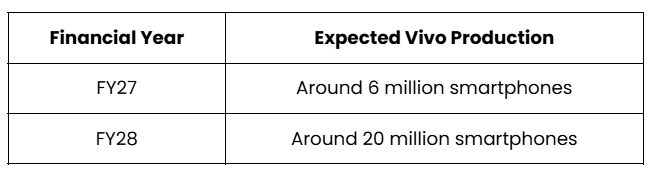
Management expects the partnership to eventually contribute 20–22 million smartphones annually. Considering Dixon manufactured approximately 32–33 million smartphones in FY26, the JV could significantly increase overall manufacturing volumes.
Expected total production:
- FY27: 43–45 million smartphones
- FY28: 55–58 million smartphones
This represents substantial growth in manufacturing scale.
Will the Dixon-Vivo JV Increase Revenue?
Most analysts believe the answer is yes. Since Vivo commands one of India's largest smartphone market shares, higher manufacturing volumes are expected to translate into significantly higher revenue.
According to analyst estimates:
- Revenue forecasts have been increased by 24–39% for FY27–FY29 by some brokerages.
- Earnings estimates have also been revised upward following the announcement.
Higher production volumes remain the primary growth driver.
Will the Joint Venture Improve Dixon's Profit Margins?
Not necessarily. This is one of the most discussed aspects of the deal. Analysts expect the Vivo business to operate at slightly lower manufacturing margins compared to Dixon's existing portfolio.
Estimated impact:
- Margin dilution of approximately 10–40 basis points during FY27–FY29.
However, lower margins don't automatically mean weaker financial performance. The business is expected to generate faster asset turnover, improving capital efficiency.
How could the JV Affect Dixon's ROCE?
One of the biggest positives highlighted by analysts is the expected improvement in Return on Capital Employed (ROCE). Despite lower margins, higher asset utilisation could increase ROCE by approximately 400–700 basis points. For long-term investors, improving capital efficiency often matters as much as improving operating margins.
Why are Higher Smartphone Realisations Important?
Another positive factor is product mix. Vivo smartphones generally command 20–30% higher average selling prices than many devices currently manufactured by Dixon. Higher realisations help offset part of the expected margin pressure while increasing revenue per device manufactured.
How Does this Fit Into India's Manufacturing Strategy?
The JV aligns with India's broader manufacturing push. Recent government initiatives include:
- Faster approval timelines for investments from neighbouring countries
- Duty exemptions on several electronics manufacturing inputs until March 2029
- Increased support for electronics component manufacturing
These policy measures are designed to strengthen India's electronics ecosystem and attract additional manufacturing investments. For Dixon, this creates a supportive operating environment over the coming years
What Risks Should Investors Watch?
While the opportunity is significant, investors should monitor several execution risks.
Production Ramp-Up
Meeting projected manufacturing volumes during FY27 and FY28 will be critical.
Margin Pressure
If manufacturing margins decline more than expected, earnings growth could moderate.
Customer Concentration
Although the JV provides stable volumes, heavy dependence on one major client can increase business concentration risk.
Execution
Successfully integrating manufacturing assets and scaling production efficiently will determine whether analyst expectations are achieved.
Is the Dixon-Vivo Joint Venture Good for Dixon Shareholders?
Based on current analyst commentary, the joint venture appears strategically positive. The partnership offers:
- Higher manufacturing volumes
- Stronger revenue visibility
- Better capital efficiency
- Long-term customer commitment
- Expansion opportunities beyond Vivo
The primary trade-off is slightly lower operating margins, although analysts generally expect improved returns on capital to offset much of this impact. For long-term investors, execution will remain the key factor to monitor over the next two financial years.
Frequently Asked Questions (FAQs)
Is the Dixon-Vivo joint venture approved?
Yes. The Government of India has approved Vivo's investment, allowing the joint venture to proceed with incorporation.
What is Dixon's ownership in the JV?
Dixon Technologies will own 51%, while Vivo Mobile India will hold 49%.
How many smartphones will the JV manufacture?
Analysts expect approximately 6 million smartphones in FY27 and 20 million in FY28, with annual production eventually reaching 20–22 million units.
Will the JV improve Dixon's earnings?
Most brokerages expect higher revenue and earnings because of increased production volumes, although operating margins may see a slight decline.
Why is the Dixon-Vivo JV important?
The partnership secures long-term manufacturing business from one of India's largest smartphone brands, improves production scale, and strengthens Dixon's leadership in India's electronics manufacturing industry.
Conclusion
The Dixon-Vivo joint venture represents one of the most significant developments in India's electronics manufacturing sector. While investors should expect some pressure on operating margins, the partnership has the potential to drive higher manufacturing volumes, stronger revenue growth, and improved capital efficiency.
As the JV scales operations over FY27 and FY28, investors will be closely watching production execution, earnings growth, and whether the expected benefits translate into sustained shareholder value.
For the latest stock market news, company updates, IPO insights, expert analysis, and investment research, stay connected with Swastika Investmart. Our market experts regularly publish timely updates and in-depth insights to help investors navigate the evolving financial markets with confidence.

Infosys Share Price Momentum: IT Stocks Lift Nifty And Sensex
Key Takeaways
- Nifty trades above 24,150 with Sensex rising as IT names lead the rally.
- infosys share price is in focus as the IT sector leads gains with the Nifty IT index up 1.75%.
- Kusumgar IPO attracted 23.75x bids while Laser Power & Infra subscribed just 0.30x.
- Global markets strengthened with Asian equities higher and Brent crude around $76, as US indices firm.
Infosys Share Price Momentum In The IT Rally: What Retail Investors Should Know
As of 11:30 IST on 10 July 2026, the market looked constructive: Nifty traded above 24,150 and the Sensex jumped 681.95 points to 77,423.77. The Nifty 50 rose 251.10 points to 24,167.75, while the broader market outpaced the frontliners; the BSE 150 MidCap Index added 1.15% and the BSE 250 SmallCap Index rose 1.10% in the session. In focus was infosys share price, a marquee IT name whose movements often set the tempo for the sector. The IT index itself climbed 1.75% to 27,950.95, rebounding from two sessions of decline (-1.67%).
What you see at this level is a classic IT-led rotation where marquee names participate alongside mid-cap IT players. The day’s breadth was robust: 2,716 shares advanced, 1,173 declined, and 229 were unchanged on the BSE. Such breadth supports a broader narrative beyond a handful of big movers and hints at genuine participation across market cap bands. The Nifty IT strength also helped lift several individual IT constituents, including cofoge stock, persistent systems stock, Oracle Financial Services Software, Mphasis, LTM, stock price of wipro, mahindra tech stock price, Infosys, HCL Technologies, and tcs share price–each contributing to the sector's higher beta relative to the broader market. For a practical read on the live picture, you can consult Swastika's Swastika's Sarthi AI stock assistant.
Infosys Share Price And The IT Rally: What Retail Investors Should Know
The infosys share price tends to be a leading indicator within the IT pack, reflecting investor sentiment toward the sector’s growth trajectory. The afternoon session data show a continued preference for tech names with the Nifty IT index rising meaningfully, underscoring that the IT sector remains a key driver behind today’s market momentum. The broader market’s outperformance–evidenced by mid-cap and small-cap gains–suggests that investors are rotating into growth and quality names, albeit with caution around near-term volatility sparked by global macro dynamics.
Nifty And Sensex Momentum: Index Levels, Breadth, And Sector Leadership
From a price action standpoint, the Sensex at 77,423.77 (+681.95 points, +0.89%) and the Nifty at 24,167.75 (+251.10 points, +0.86%) capture a strong intraday impulse. The intraday strength comes as the market breadth remains positive, with 2,716 advancing and 1,173 declining, while 229 were unchanged. The net effect is a market with broad participation, validating the up-move beyond just a handful of heavyweights.
Coforge Stock And The IT Rally: Coforge Stock And Its Peers In Focus
Among IT stocks leading the charge, Coforge stock moved higher, contributing to the sector’s updraft along with persistent leadership from persistent systems stock which advanced in today’s session. The tech landscape shows persistent strength: cofoge stock, persistent systems stock, Oracle Financial Services Software, Mphasis, LTM, stock price of wipro, mahindra tech stock price, Infosys, HCL Technologies, and tcs share price all reported gains. The Nifty IT index’s 1.75% advance to 27,950.95 marks a resilient bounce after a prior two-day decline, reinforcing the notion that liquidity and earnings momentum in tech remain supportive for Indian equities.
Persistent Systems Stock: Growth Outlook In The IT Momentum
Persistent Systems stock has joined the list of notable gainers with a jump in today’s session, paralleling other IT behemoths. The flexibility of the stock to hold amid volatility adds to a narrative that the IT space remains a core driver of market performance through 2026. Wipro’s stock price movement mirrors the sector’s broader cycle, while Infosys and HCL Technologies continue to contribute to the broader IT leadership. For investors tracking risk-adjusted value, the price action in these names should be weighed against the macro backdrop and sector catalysts such as client wins and digital transformation demand.
Kusumgar IPO And Laser Power &Amp Infra IPO: What The Subscription Data Signifies
The Kusumgar IPO opened for bidding on 08 July 2026 and will close on 10 July 2026, with a price band of Rs 398-419 per share. The issue received bids for 27,23,16,555 shares against 1,14,68,094 on offer, resulting in a subscription of 23.75 times. In contrast, the Laser Power & Infra IPO opened for bidding on 09 July 2026 and closes on 13 July 2026, with a price band of Rs 203-214 per share. It saw bids for 75,81,420 shares against 2,55,86,207 on offer, subscribing just 0.30 times. These figures highlight divergent investor appetite across new issues and offer a snapshot of the market’s current risk appetite.
Global Markets: Oil, AI Chips, Asia, And US Indices
Global markets turned constructive as Asian stocks traded higher on Friday, led by chip and AI firms amid easing concerns about the Strait of Hormuz. Brent crude futures hovered around $76.03 per barrel, with the week expected to close up about 5%–the strongest weekly performance since early May. The AI supply chain theme continues to draw demand, with SK Hynix’s U.S. market debut priced at $149 per ADR, raising about $26.5 billion, marking the world’s second-largest share sale after SpaceX’s IPO. On Wall Street, the Nasdaq Composite gained 1.30% to 26,206.89, the S&P 500 advanced 0.81% to 7,543.64, and the Dow Jones Industrial Average rose 139.02 points to 52,487.41.
Related Reads
- Infosys Share Price And The Indian Growth Reboot: Large-Cap Leaders In Focus
- Infosys Share Price Outlook: Why Infosys, TCS, And HCL Are Navigating A Price Reset
- Infosys Share Price Signals In July 2026: IT Sector Pulse And Market Liquidity
Frequently Asked Questions
What were the Nifty and Sensex levels as of 11:30 IST on 10 July 2026?
Sensex was 77,423.77, up 681.95 points; Nifty 50 stood at 24,167.75, up 251.10 points.
How did the Nifty IT index perform and which IT stocks led the move?
The Nifty IT index rose 1.75% to 27,950.95. Leading movers included Coforge stock, Persistent Systems stock, Oracle Financial Services Software, Mphasis, Wipro, Tech Mahindra, Infosys, HCL Technologies, and TCS.
What were the IPO subscription details for Kusumgar and Laser Power & Infra on July 10, 2026?
Kusumgar IPO received bids for 27,23,16,555 shares against 1,14,68,094 on offer, subscribed 23.75 times. Laser Power & Infra IPO attracted bids for 75,81,420 shares against 2,55,86,207 on offer, subscribed 0.30 times.
What does the market breadth data tell us about this session?
On the BSE, 2,716 shares rose, 1,173 declined, and 229 were unchanged, indicating broad participation in the rally.
What global market signals were observed on that day?
Asian stocks advanced; Brent crude near $76.03 per barrel with a ~5% weekly gain; SK Hynix's U.S. market debut priced at $149; Nasdaq 26,206.89; S&P 500 7,543.64; Dow 52,487.41.
Conclusion
Today’s session underscores an IT-led rally that is broadening beyond the top-five names and pulling along mid-and small-cap peers. For the retail investor, the key takeaway is to couple optimism with discipline: monitor infosys share price and other IT movers, track market breadth, and stay aware of IPO supply and macro signals. The next step is to apply a structured mental model: use Sarthi AI stock assistant to run multiple scenarios, compare valuations, and set risk-aware triggers before committing fresh capital.
Open your trading and demat account here
Reference :
Big Budget


Popular Articles



.avif)
.avif)

.avif)



START YOUR INVESTMENT JOURNEY
Get personalized advice from our experts
- Dedicated RM Support
- Smooth and Fast Trading App
