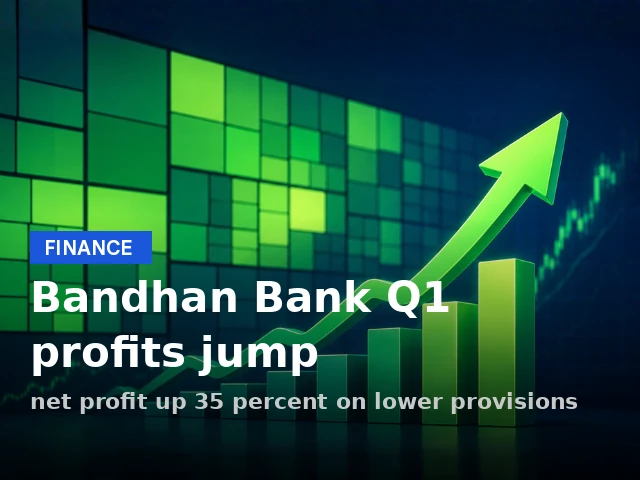
Bandhan Bank Results: Q1 FY26 Profit Jumps 34.9% On Lower Provisions



Key Takeaways
- Bandhan Bank results for Q1 show net profit up 34.9% YoY to Rs 502 crore.
- Net interest income rose 6% YoY to Rs 2,921 crore, with NIM at 6.2%.
- Asset quality improved: GNPA 3.15% and NNPA 0.93%.
- Provisioning declined to Rs 683 crore, enabling stable profitability.
Bandhan Bank results for the June quarter show a sharp profit expansion to Rs 502 crore, up 34.9% YoY from Rs 372 crore a year earlier, according to its regulatory filing. The bandhan bank results reflect cost discipline and improved asset quality. Net interest income (NII) rose 6% YoY to Rs 2,921 crore, while net interest margin (NIM) remained at 6.2% on a sequential basis, underscoring stable core profitability amid tightening credit conditions. Asset quality also improved as GNPA declined to 3.15% from 3.27% in the March quarter, and NNPA eased to 0.93% from 0.97%.
Bandhan Bank Results: Q1 FY26 Profit Jumps 34.9% On Lower Provisions
According to the bank's regulatory filing, the 34.9% YoY rise in profit was driven by lower credit costs. The bank set aside Rs 683 crore in the quarter, significantly lower than Rs 1,147 crore in the year-ago period, though broadly unchanged from Rs 677 crore in the preceding quarter.
| Metric | Value | Comment |
|---|---|---|
| Net Profit (YoY) | Rs 502 crore | Up 34.9% YoY |
| NII | Rs 2,921 crore | Up 6% YoY |
| NIM | 6.2% | Unchanged sequentially |
| GNPA | 3.15% | Down from 3.27% |
| NNPA | 0.93% | Down from 0.97% |
| Provisions | Rs 683 crore | Lower vs Rs 1,147 crore YoY; Rs 677 crore prior quarter |
| Interim CFO | Vinay Jain | Effective Sept 26 |
Analysts note that Bandhan Bank's earnings trajectory remains sensitive to credit costs, even as core profitability holds steady. The improved asset quality reduces the risk of future credit losses and supports sustainable earnings in the near term. Investors should monitor how loan growth, funding costs, and recoveries evolve in the coming quarters to gauge the durability of these gains.
For deeper stock insights, you can explore Swastika's Sarthi AI stock assistant, which offers institutional-grade research on stocks and indices to retail investors.
Frequently Asked Questions
What was Bandhan Bank's standalone net profit in Q1?
Bandhan Bank's standalone net profit rose to Rs 502 crore in the June quarter, up 34.9% from Rs 372 crore a year earlier, per its regulatory filing.
What were Bandhan Bank's net interest income and net interest margin in Q1?
Net interest income stood at Rs 2,921 crore, up 6% YoY, with net interest margin remaining at 6.2% on a sequential basis.
How did Bandhan Bank's asset quality change in Q1?
GNPA eased to 3.15% from 3.27% in the March quarter, and NNPA eased to 0.93% from 0.97%.
What was the provisioning level in Q1, and how does it compare to prior periods?
Provisioning was Rs 683 crore in the quarter, significantly lower than Rs 1,147 crore in the year-ago period and broadly in line with Rs 677 crore in the preceding quarter.
Who was appointed interim CFO at Bandhan Bank?
Vinay Jain was appointed as interim Chief Financial Officer, effective September 26.
Conclusion
Bandhan Bank results point to a healthier credit cost structure and improving asset quality, translating into a steadier earnings base for the quarter. For retail investors, the key takeaway is to watch the trajectory of provisioning and NII in upcoming quarters, as these drivers will determine whether Bandhan Bank can sustain its earnings momentum amid macro headwinds.
Next-step mental model: focus on the quality of growth versus the price of growth. Track NII growth, NIM stability, and any shifts in GNPA/NNPA trends in subsequent quarters, and consider using Swastika's Sarthi AI stock assistant to compare Bandhan Bank with peers and indices as new data arrives.
Open your trading and demat account here
Reference :
1 : Ndtvprofit
Latest Articles

Is Glenmark Pharma's 5x Profit a Buy for You Today?


Key Takeaways
- Glenmark Pharma stock faces a bullish reframing as Motilal Oswal reiterates a positive stance, signaling a potential 5x profit trajectory over two years.
- This broker note could attract renewed attention to the pharma stock and related healthcare names as the sector reactions unfold.
- Monitor any explicit target price or management guidance to validate upside and refine your stance on Glenmark shares.
- If you are willing to take on risk, consider a measured entry rather than a full allocation and set clear risk controls.
Glenmark Pharma Share Price - Key Data
Why Glenmark Shares Could Rally After Motilal Oswal Note
Glenmark Pharma stock has captured attention after Motilal Oswal reiterated a bullish stance, signaling upside from a supportive broker note. The note highlights improving earnings visibility and potential multiple expansion over the next two years, which could lift valuations for the pharmaceutical mid-cap. Retail investors should monitor for any explicit price targets or management commentary that could confirm the growth narrative for Glenmark shares.
Motilal Oswal's thesis and what to watch
The broker's positive stance acts as a catalyst for near-term upside, while the absence of specific numbers means investors should await clarity on the target price before committing large sums. In the Indian pharma space, a broad recovery in margins and recurring product approvals could further support gains for Glenmark stock, particularly if cost controls improve.
Impact on Investors - What Should You Do?
HOW this affects specific holdings
For existing holders of Glenmark Pharma shares, the brokerage note can justify holding with tighter risk controls; for new buyers, consider staggered entry rather than a full allocation to manage volatility in mid-cap pharma stocks.
WHICH sectors/stocks by name
- 1st Priority: Pharma - Glenmark peers like Sun Pharma and Cipla offer related upside if the sector rallies.
- 2nd Priority: Healthcare services - demand signals could support valuations beyond pure pharma.
- Avoid Now: IT and tech heavyweights - relative valuation and risk-off moves may keep these muted.
What SIP, Lumpsum and Traders Should Do Now
- SIP investors: Maintain existing SIPs in healthcare exposure and avoid concentrated bets; consider gradual additions if volatility allows.
- Lumpsum investors: Consider a small starter allocation and wait for clearer guidance on the target price before loading up.
- Traders: Use logical stop-losses and hedging strategies to manage volatility while awaiting confirmation of a sustained up-move.
Swastika Investmart notes that Motilal Oswal's bullish stance could provide a near-term uplift for Glenmark Pharma, particularly in the pharma mid-cap space. Given the regulatory and earnings uncertainties that typical mid-cap pharma stocks face, using our stock research tools to track price action and broker commentary can help you time selective entries with defined risk controls.
Key Risks to Watch
Why regulatory risk could hit mid-cap pharma stock valuations
- Regulatory approvals and pricing dynamics in India can impact earnings visibility.
- Competitive pressure from generics may compress margins over time.
- Market volatility and global risk-off moves can cap upside in the near term.
FAQ
What is driving Glenmark Pharma's stock move today?
The renewed attention stems from Motilal Oswal's reiterated positive stance and the prospect of a multi-year upside hinted by the broker.
Should retail investors buy Glenmark Pharma now?
Depends on risk tolerance; a small, measured exposure with defined stop-losses is prudent for most retail investors.
What is the time horizon for the upside?
The broker's framework suggests a potential multi-year path toward higher earnings and multiples over the next two years.
Which other stocks could move with this theme?
Other pharma names like Sun Pharma and Cipla may see sympathy gains if pharma sector sentiment improves.
Conclusion
Glenmark Pharma faces a potential upside if Motilal Oswal's bullish stance translates into sustained momentum. Retail investors should consider a cautious entry aligned to risk appetite and monitor broker updates and price action for confirmation before scaling up.

Wipro ₹15,000 crore buyback Should You tender shares?
Key Takeaways
- Wipro's ₹15,000 crore buyback opens on June 10, 2026 with a tender price of ₹250 per share.
- Retail investors can tender at ₹250, a 38% premium to the prior close of ₹181.67, potentially monetising holdings.
- This buyback creates near term price action risk and opportunity, so review your position and consult equity research.
- If you already own Wipro, consider tendering a portion or waiting for post window price action based on management commentary.
Wipro Share Price - Key Data
Wipro's Rs 15,000 crore buyback opens on June 10, 2026 and runs through June 17, 2026. The tender price is ₹250 per share, which represents a 38% premium to the stock's previous close of ₹181.67.
WHY WIPRO'S ₹15,000 CRORE BUYBACK MATTERS FOR RETAIL INVESTORS
The buyback creates a near‑term price anchor and liquidity option for shareholders. Retail investors can decide to tender a portion of their holdings to secure cash at a premium while keeping some exposure to potential upside if the stock remains resilient.
Deep context: Buyback size and terms
The ₹15,000 crore buyback size and a 17 June tender window are large for Wipro; the premium suggests management aims to support stock price but actual tender acceptance may be limited by proportionate offer and tax treatment.
What This Means for Investors
HOW this affects Wipro shareholders
Shareholders holding Wipro shares can choose to tender, which lets them cash out at ₹250; those who do not tender retain exposure and potential price movement beyond the window.
WHICH sectors/stocks by name
- 1st Priority: Information technology stocks - look for buyback‑related price actions in large‑cap IT names.
- 2nd Priority: Financials and capital markets - tender windows can influence liquidity and trading volumes.
- Avoid Now: High‑valuation, growth‑sensitive names with limited buyback catalysts.
What SIP, Lumpsum and Traders Should Do Now
- SIP investors: Do not chase the buyback; maintain long‑term discipline and avoid turbo‑charged entries.
- Lumpsum investors: Consider allocating a small portion to tender if you want cash at a premium, after reviewing tax implications.
- Traders: Watch price action during the open window and use protective stops if you maintain a position beyond the tender period.
Swastika Investmart notes that the ₹15,000 crore Wipro buyback introduces near‑term price action risk; investors should review price action and consult our equity research before tendering.
Key Risks After This Buyback
Regulatory and price action risks in the IT large‑cap space
- The tender process may not capture all potential gains if the stock trades down after the window closes
- Market volatility during June 10–17 can distort price discovery and post‑close performance
- Tax treatment on buyback gains depends on holding period and regime
FAQ
When does the Wipro buyback open and close?
It opens on June 10, 2026 and closes on June 17, 2026.
What is the tender price for the buyback?
₹250 per share, with a 38% premium to the last close.
Who can tender their shares?
All shareholders on record during the open window; retail investors can tender within the window.
What should retail investors do now?
Review your Wipro holding, consult equity research, and decide whether to tender a portion or hold.
Conclusion
Wipro's buyback offers a near term cash premium for tendering, but post window price action is uncertain. Review your holdings, consult equity research, and decide on tendering a portion based on your risk tolerance and tax considerations.

Is ₹52,290 crore IPO Wave Worth Your Money Today, Retail Investors?
Key Takeaways
- The ₹52,290 crore IPO wave across two months signals one of the busiest listing pipelines in 2026.
- Retail investors may see liquidity shifts as new listings hit the market, with banks and consumer names likely to lead.
- Keep an eye on listing data and GMP to gauge quality and pricing before subscribing to any issue.
- Take a disciplined approach today by using IPO research and small allocations to manage risk.
IPO Wave in India – What’s Happening and Why It Matters
WHY ₹52,290 crore IPO wave matters for your money
The current wave of listings totals about ₹52,290 crore across roughly a dozen issuances in the next two months, encompassing IPOs, institutional placements, and government stake sales. For retail investors, this means heightened deal flow and greater choice, but also a tighter liquidity environment that can test stock selection discipline.
Deeper context and timing
NDTV Profit reports a busy two‑month window with government stake sales and placements supplementing traditional IPOs, signaling a sustained capital-raising cycle. Market participants should watch subscription momentum, GMP trends, and the quality of management teams as these issues come to market.
Impact on Investors
How this affects your holdings
Fresh listings can reallocate investor money and shift price action away from established mid‑caps, potentially weighing on some existing holdings while offering new entry points in other sectors. Retail portfolios should avoid crowding into many IPOs at once and instead prefer well‑funded names with clear visibility.
Which sectors/stocks by name
- 1st Priority: Financials - new listings could influence valuations and capital allocation in banks and NBFCs
- 2nd Priority: Consumer staples and discretionary - stable demand supports listing visibility but valuations remain key
- Avoid Now: Small-cap IPOs lacking robust business models and credible earnings visibility
What SIP, Lumpsum and Traders Should Do Now
- SIP investors: Maintain diversification and avoid overweighting IPOs; continue systematic investments in broad funds
- Lumpsum investors: Use small starter allocations to credible, well‑funded issues; wait for GMP movement before big commitments
- Traders: Consider listing-day hedges and avoid chasing every issue; use price limits and stop‑loss orders to manage risk
Swastika Investmart notes that a ₹52,290 crore IPO wave signals a busy two‑month calendar across multiple sectors. The immediate risk is listing‑day volatility, so investors should monitor subscription data and GMP signals. Consider using our IPO research desk to guide allocations.
Key Risks After This IPO Wave
Why listing day volatility can challenge your holdings
- Listing‑day jumps and sudden price drops can trap unseasoned investors
- Valuations across the new issues may be stretched in the initial weeks
- Liquidity can shift away from existing mid‑cap names as new listings soak up capital
FAQ
What is the size of the current IPO wave?
Around ₹52,290 crore across roughly a dozen issuances over two months.
Which sectors are most involved in this wave?
A mix of financials (banks and NBFCs), government stake sales, and consumer‑facing names.
What should a retail investor do before subscribing?
Review subscription data, GMP signals, and avoid allocating too much to a single issue; prefer high‑quality issuers with clear business models.
Should SIP/Lumpsum investors participate in IPOs now?
Exercise caution; diversify across funds and limit IPO allocations to well‑understood opportunities.
Conclusion
The current ₹52,290 crore IPO wave offers selective opportunities but demands disciplined risk management. Retail investors should rely on IPO research, monitor GMP data, and allocate cautiously. Start by building a focused watchlist and subscribe only to credible issues with defined growth paths.

Rupee ₹95.54 level You Should Rebalance Your Portfolio Today?
Key Takeaways
- Rupee trades at ₹95.54 per dollar this morning as oil prices rise, signaling currency pressure.
- The weaker rupee can lift import costs and pressure margins for oil and consumer staples exposed players.
- Watch the USD/INR level and crude price trajectory to gauge exposure in your holdings.
- Today, hedge currency risk using a USD/INR futures or other FX hedging strategy on Swastika Investmart's platform.
Rupee Opens Lower at 95.54 Against Dollar Amid Oil Pressure
The Indian rupee opened weaker at 95.54 per US dollar as global crude benchmarks climbed and demand for the greenback rose, underscoring elevated currency risk for importers and businesses with USD liabilities. Rising oil prices push up the current account deficit and keep the rupee under pressure, particularly in sessions following geopolitical or supply-side developments. In parallel, domestic equities priced in higher energy costs and potential inflationary effects, which can influence consumer sentiment and corporate profitability in the near term.
WHY Rupee Moves to ₹95.54 Against the Dollar
The currency move reflects a combination of rising crude prices and persistent USD strength, which tends to elevate import costs for India’s energy import bill and widen the trade deficit. Given India’s energy mix, crude sensitivity remains a key driver of near-term rupee volatility, with macro headlines and oil-market signals feeding into daily price action. Traders and investors should monitor the path of oil futures and the greenback’s trajectory for guidance on next steps in their portfolios.
Oil Prices, Oil Price Movements and Market Read
Oil-market dynamics remain pivotal for the rupee, as a sustained oil rally compounds external pressures on the currency and domestic inflation expectations. Any escalation in crude prices can keep rupee levels sticky around the mid-95s, potentially affecting the cost structure of import-heavy industries and capital-intensive sectors. For equity investors, sector performance may hinge on how quickly inflation expectations adjust and whether market sentiment stabilizes after initial volatility.
Impact on Investors
HOW this affects specific holdings
Currency moves directly influence companies with USD-denominated costs or revenues. Importers, commodity-linked players, and IT firms that incur USD expenses can see margin pressure if the rupee remains weak. Exporters and software services with USD revenue streams may benefit from a weaker rupee on a relative basis, but rapid movements can create earnings visibility challenges if hedging is incomplete or misaligned with reporting cycles. Overall, portfolios with concentrated USD exposure or heavy commodity bills should reassess hedging policies and risk budgets for the near term.
WHICH sectors/stocks by name
- 1st Priority: Oil importers and energy-heavy consumer goods - higher input costs can dent margins if USD strength persists.
- 2nd Priority: IT services with USD expenses - earnings can be affected by INR depreciation and hedging needs.
- Avoid Now: Unhedged high USD-exposed importers - added currency risk could amplify downside in a volatile environment.
What SIP, Lumpsum and Traders Should Do Now
- SIP investors: Maintain discipline and avoid large changes based on daily rupee moves; focus on long-term asset allocation and diversified exposure.
- Lumpsum investors: Consider partial hedges or staggered entries to manage currency risk while tracking oil and USD signals.
- Traders: Use defined currency hedges (e.g., USD/INR futures) to cap downside on USD liabilities and monitor hedge effectiveness as oil moves evolve.
Swastika Investmart view on this news will be shared below in the dedicated paragraph.
Key Risks for Investors
Key Risks
- Persistent oil-price-driven currency weakness could erode margins for import-intensive sectors.
- Dollar strength may complicate hedging effectiveness and escalate inflation concerns.
- Short-term volatility can lead to mispricing in commodity-linked stocks and IT services with USD costs.
FAQ
What caused the rupee move today?
Rising crude oil prices and dollar strength contributed to the rupee weakening to about ₹95.54 per dollar.
Which sectors are most affected by the rupee move?
Oil importers and commodity-linked sectors are most sensitive to USD-INR volatility.
Should you hedge currency exposure now?
Yes—if you have USD costs or receivables, consider currency derivatives to manage downside risk.
What indicators should I watch this week?
Oil price trajectory and USD/INR movements around the 95–96 band; also monitor any policy signals that affect hedging costs.
Conclusion
The rupee’s move to ₹95.54 against the dollar signals oil-driven currency risk that can affect importers and USD-exposed stocks. Consider a disciplined hedging plan and monitor USD/INR and oil trends through the week to guard portfolio value.

Afcons Infra ₹5,301 crore breakwater win, Should You Invest?
Key Takeaways
- Afcons Infra won a ₹5,301 crore breakwater contract for Vadhvan Port, making the project one of the world’s longest.
- The win improves revenue visibility for Afcons Infra and signals strength in the infra and marine engineering space.
- Execution risk and milestone delays could temper near-term gains in related stocks.
- If you hold Afcons Infra, consider hedging or a disciplined exit plan if momentum fades.
Afcons Infra Breakwater Order: Key Details
Afcons Infra has secured a ₹5,301 crore contract to construct a 10.14-km breakwater for Vadhvan Port in Maharashtra. The project is poised to become one of the world’s longest breakwaters once completed, underscoring the company’s capability in large-scale marine infrastructure.
Why Afcons Infra Won This ₹5,301 crore Breakwater Order
This significant order showcases Afcons Infra’s execution strength in port and coastal projects, which can translate into stronger revenue visibility and backlog for the next few years.
Deeper Context: Market Significance and Milestones
The Vadhvan Port project aligns with India’s push to expand coastal infrastructure and improve freight corridors, potentially benefiting related marine and civil EPC players by signaling a robust order pipeline.
Impact on Investors
How this deal affects Afcons Infra stock and related holdings
Afcons Infra shares rose over 9% intraday on the contract announcement, reflecting improved sentiment around mega infra projects. Nonetheless, the stock can remain sensitive to execution milestones and ramp-up timing.
Which sectors and stocks may react
- 1st Priority: Infra - Large port and marine projects could lift sentiment for related EPC names such as L&T and Afcons itself.
- 2nd Priority: Marine infrastructure stocks - Positive order flow may support re-rating of players with strong execution records.
- Avoid Now: Small-cap infra peers with thin order backlogs or weak balance sheets.
What SIP, Lumpsum and Traders Should Do Now
- SIP investors: Maintain diversified exposure to infra themes and avoid adding overweight Afcons Infra based solely on this single order.
- Lumpsum investors: Consider a small initial allocation to Afcons Infra if your risk appetite allows, with a plan to add only after milestone progress confirms execution clarity.
- Traders: Use tight stop-losses and monitor milestone-based news to avoid being caught in a momentum reversal.
Swastika Investmart notes that Afcons Infra’s ₹5,301 crore breakwater order for Vadhvan Port highlights execution risk in large marine infrastructure projects – investors should monitor progress milestones and consider using F&O hedges to manage downside while tracking the project timeline.
Key Risks To Watch
Specific Risks for Afcons Infra Breakwater Order
- Execution delays or cost overruns could affect the project’s profitability and cash flow timing.
- Funding and financing arrangements for such large projects may tighten in adverse macro conditions.
- Contract-specific risks, including change orders and geopolitical factors impacting port development timelines.
FAQ
What happened with Afcons Infra in this news?
Afcons Infra won a ₹5,301 crore contract to build a 10.14-km breakwater for Vadhvan Port in Maharashtra, which could become one of the world’s longest breakwaters.
How big is the order and what does it imply?
The order size is ₹5,301 crore, signaling strong execution capability in mega marine projects and improving revenue visibility.
Should you buy Afcons Infra stock after this news?
A cautious stance is recommended due to execution risk and milestone reliance; consider waiting for clearer progress before adding exposure.
What to watch next for Afcons Infra?
Watch for milestone progress, project initiation dates, cost management updates, and any funding terms related to the Vadhvan Port project.
Conclusion
Afcons Infra’s ₹5,301 crore win for the Vadhvan Port breakwater signals solid order flow in marine infra, but investors should stay prudent and track milestones before increasing exposure. A targeted, milestone-driven approach is recommended to participate in potential upside while managing risk.

Is NLC India OFS ₹1,263 crore Worth Your Investment Today?
Key Takeaways
- NLC India shares fell 3% on Wednesday even as the government OFS drew bids worth ₹4,158 crore on day one.
- The OFS oversubscription option raised the total size to ₹1,263 crore, signaling institutional interest despite near-term volatility.
- Watch the energy mid-cap space and regulatory signals as price discovery begins during the retail window.
- If you hold the stock, consider hedging and wait for clearer post-offer guidance before adding new exposure.
NLC OFS Summary: Day One Demand vs Price Action
NLC India shares traded lower on Wednesday, even as the government’s Offer for Sale drew bids of ₹4,158 crore on day one, with oversubscription option exercising the total OFS size to ₹1,263 crore. Retail investors get access to the window today, which could lead to heightened price discovery in the near term.
WHAT DOES THE OFS MEAN FOR RETAIL INVESTORS?
The OFS is a governance move rather than a fresh equity issue, and it can create short-term volatility around the stock’s price.
Market Context and Deeper Look
In a rising rate environment and volatile energy prices, state-owned energy names can swing around OFS windows. Institutional demand signals long-term interest, but near-term price action may reflect speculative trading and regulatory chatter rather than fundamentals.
Impact on Investors – What This Means for Your Holdings
HOW this OFS affects specific holdings
Current holders may see continued volatility as the OFS unfolds; new buyers should wait for price stability before taking new positions.
Which sectors/stocks to watch by name
- 1st Priority: Energy sector – renewable energy mid-caps and utilities
- 2nd Priority: Financials – market liquidity and related equities
- Avoid Now: Information Technology – valuations may come under pressure in uncertain times
What SIP, Lumpsum and Traders Should Do Now
- SIP investors: Maintain existing core exposure through diversified funds and avoid adding highly volatile OFS-dependent names in fresh lumpsums
- Lumpsum investors: Postpone fresh bets on the stock until price stabilization and clearer post-OFS guidance
- Traders: Use hedging strategies and defined stops around the window to manage downside risk
Swastika Investmart notes that day one OFS demand underscores government involvement in the energy space, which can create longer-term value if price discovery aligns with fundamentals. For risk management, hedging energy stock exposures with protective options can help limit downside while awaiting further updates from management and market cues.
KEY RISKS AFTER THIS OFS NEWS
- Regulatory overhang on energy names can sustain volatility for 1-3 weeks
- Uncertain price discovery during the retail window may distort near-term returns
- Potential price adjustment after the OFS completes and clarity on stake changes emerges
FAQ
What is the Offer for Sale for this stock?
The OFS is a government-led stake sale to institutional and retail investors, allowing the government to reduce its stake without issuing new shares.
Should retail investors participate in the OFS?
Participation is optional; decide based on risk tolerance, price discovery expectations and post-offer price behavior.
How could this OFS impact the stock in the near term?
Near-term moves may be driven by demand-supply dynamics in the window and regulatory sentiment rather than fundamentals.
What risk management steps should I take?
Consider hedging with options or using trailing stops, and avoid overexposure to a single government stake-change scenario.
Conclusion
NLC India's OFS event shows sustained institutional interest, but retail participation may lead to short-term volatility. Stay patient, monitor price action during the window, and consider hedging if you hold related energy exposure. Reassess after the OFS window closes and management provides clarity.
Big Budget


Popular Articles



.avif)
.avif)

.avif)



START YOUR INVESTMENT JOURNEY
Get personalized advice from our experts
- Dedicated RM Support
- Smooth and Fast Trading App