The Power of Compounding – Why Starting Early Matters




Introduction
Albert Einstein reportedly called compound interest the "eighth wonder of the world." Whether or not he actually said it, the math is undeniable. Compounding is the process where your investment returns begin earning their own returns — and over time, this snowball effect becomes truly extraordinary.
The catch? Compounding needs one essential ingredient: time.
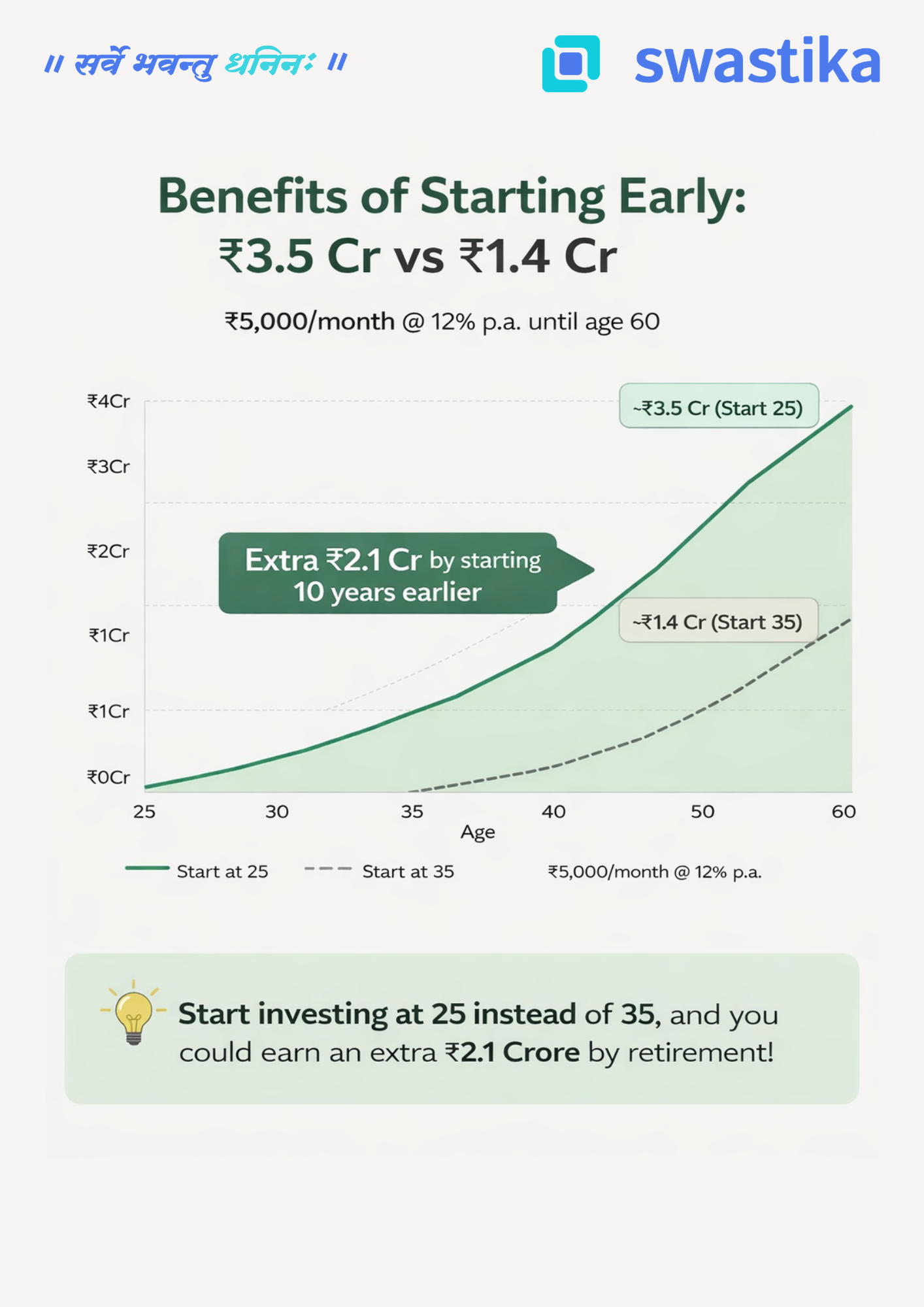
The more years you give your money to grow, the more dramatic — and life-changing — the results become. This is exactly why starting your investment journey early, even with a modest amount, can make a difference of crores by the time you retire.
A Tale of Two Investors: Arjun vs Priya
Let's bring this concept to life with a simple, real-world example.
Meet Arjun and Priya. Both are sensible, disciplined investors. Both invest ₹5,000 every month through a SIP (Systematic Investment Plan) in equity mutual funds, earning an average annual return of 12%. Both stop investing at age 60.
The only difference? Arjun starts at 25. Priya starts at 35.
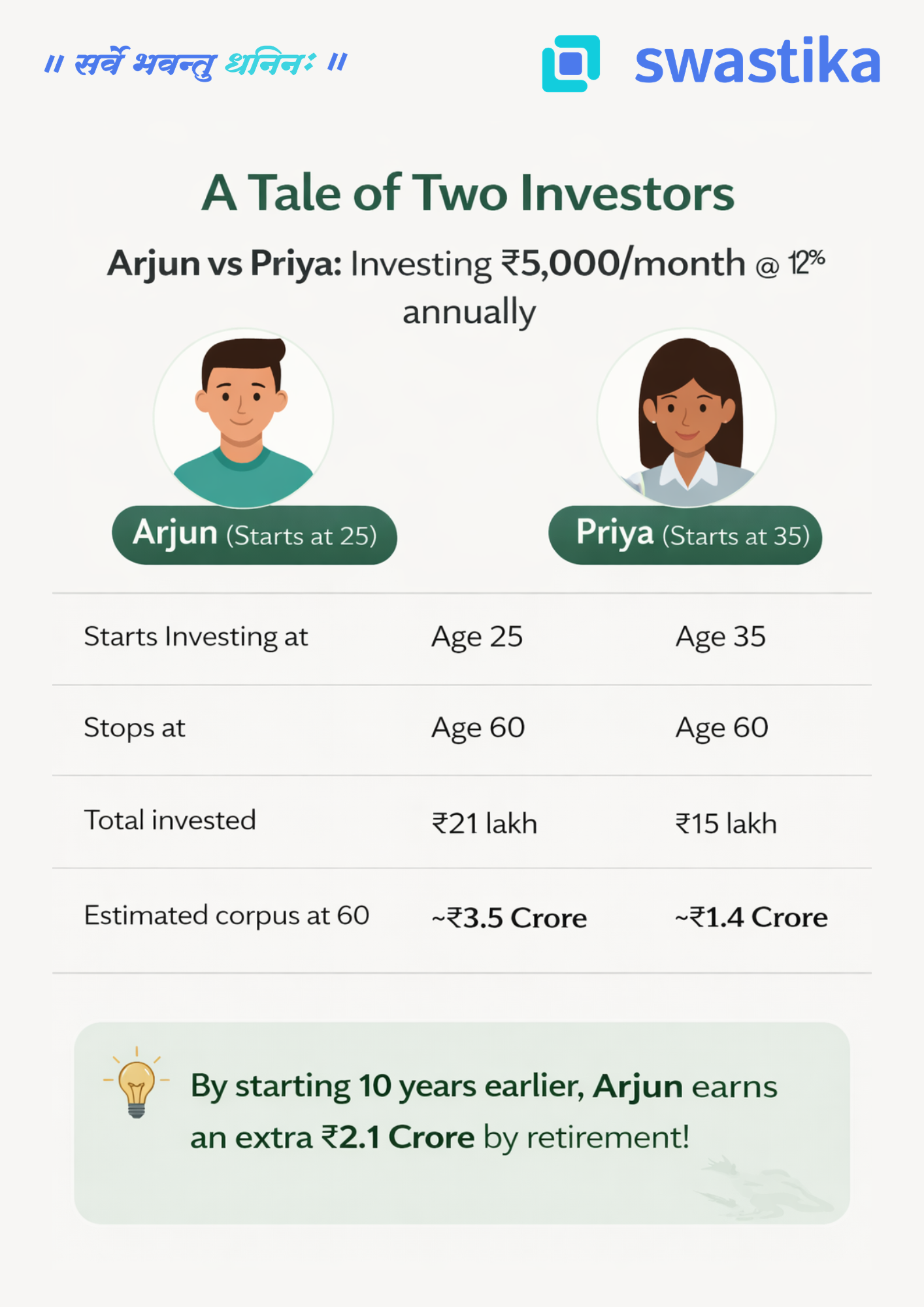
The numbers are striking. Arjun invests just ₹6 lakh more than Priya in absolute terms — yet walks away with ₹2.1 Crore more at retirement.
That extra ₹2.1 Crore didn't come from investing more aggressively or taking bigger risks. It came purely from starting 10 years earlier.
Why Does Time Make Such a Huge Difference?
This is where the magic of compounding reveals itself.
In the early years of investing, growth looks modest and almost unimpressive. But as the years pass, your corpus grows not just on your original investment, but on all the accumulated returns from previous years. The curve goes from almost flat to steeply exponential — and that steep climb happens in the later years.
When Arjun starts at 25, his money has 35 years to ride that exponential curve. Priya's money, starting at 35, only catches the last 25 years — and critically, it misses the steepest part of the climb in the final decade.
Think of it this way: the last 10 years of compounding are worth more than the first 20. That is the counterintuitive truth at the heart of long-term investing.
The Real Cost of Waiting
Many young earners tell themselves, "I'll start investing once I'm more settled — once the salary improves, once the EMI is paid off, once life is a bit easier."
But the numbers show that every year of delay is extraordinarily expensive — far more expensive than any EMI or lifestyle expense. Priya didn't invest carelessly. She invested faithfully for 25 years. Yet she ends up with less than half of what Arjun accumulated — not because she did anything wrong, but simply because she started a decade late.
The cost of waiting 10 years wasn't ₹6 lakh in additional contributions. The cost was ₹2.1 Crore in lost wealth.
Three Principles to Remember
1. Start now, not later.The best time to start investing was yesterday. The second best time is today. Even a SIP of ₹1,000–₹2,000 per month in your 20s is infinitely better than waiting for the "right time."
2. Consistency beats intensity.You don't need to invest large sums all at once. A small, steady, monthly commitment — maintained without interruption — is what unlocks the full power of compounding over decades.
3. Stay invested through market cycles.Compounding works only if you let it work. Exiting during market corrections or stopping your SIP in tough months breaks the chain. Time in the market, not timing the market, is what builds wealth.
The Bottom Line
If you are in your 20s or early 30s, you hold an asset that no amount of money can buy later: time. Use it. Start a SIP today — even a small one. Let compounding do its slow, steady, powerful work.
Because the difference between starting at 25 and starting at 35 is not just 10 years. As Arjun and Priya's story shows, that difference is ₹2.1 Crore.
Big Budget










.webp)
.webp)
.webp)
.webp)
.webp)
















.webp)
.webp)
.webp)
.webp)
Latest Articles
%20(3).webp)
Market Closing Summary Today 24 March 2026: Nifty, Sensex, and Bank Nifty Surge Strongly & Reasons & What Investors Should Do


The Indian stock market today witnessed a broad-based rally, with benchmark indices like the Nifty 50, Sensex, and Bank Nifty closing firmly in the green. Positive global cues, easing macro concerns, and strong sectoral participation pushed markets higher, boosting investor sentiment across segments.
What Happened in the Market Today
Indian equities ended the session on a strong note:
- Nifty 50 gained nearly 1.8 percent to close above 22,900
- Sensex surged close to 1.9 percent, crossing 74,000
- Bank Nifty outperformed with a sharp rise of over 2.2 percent
- Nifty IT also posted solid gains of around 1.7 percent
This upward momentum signals renewed confidence among institutional and retail investors.
Key Takeaways
- Broad-based buying seen across banking, IT, and large-cap stocks
- Bank Nifty leads rally, indicating strength in financial sector
- Positive global cues and easing volatility support sentiment
- Midcaps and large caps both participated in the uptrend
Why Did the Indian Stock Market Rise Today
1. Strong Global Cues
Global markets showed signs of stability after recent volatility. Easing geopolitical concerns and steady US economic indicators helped improve risk appetite, which reflected positively in Indian equities.
2. Banking Sector Momentum
Banking stocks played a crucial role in today’s rally. Strong credit growth outlook and stable asset quality expectations continue to attract institutional money into financial stocks.
3. IT Sector Recovery
The IT index saw buying interest after recent corrections. Investors are selectively accumulating quality IT stocks at lower levels, expecting demand recovery in global tech spending.
4. FII and DII Activity
Foreign Institutional Investors and Domestic Institutional Investors both showed buying interest, which provided stability and upward momentum to the markets.
5. Technical Breakout
From a technical perspective, Nifty moving above key resistance levels triggered fresh buying. Momentum traders and algorithmic systems added to the rally once breakout levels were sustained.
Sector-Wise Performance
Banking and Financials
The banking sector emerged as the top performer. PSU banks and private lenders both saw strong buying. This indicates confidence in India’s economic growth and credit cycle.
Information Technology
IT stocks showed a rebound after a phase of consolidation. Companies with strong deal pipelines and stable margins attracted investor interest.
FMCG and Defensive Stocks
Defensive sectors like FMCG remained stable but underperformed compared to high-beta sectors. Investors preferred growth-oriented segments today.
Midcap and Smallcap Stocks
Broader markets also participated, though gains were relatively moderate. Select midcap stocks continued to outperform based on strong earnings visibility.
What This Means for Investors
Short-Term Outlook
The market trend remains bullish in the short term. However, after a sharp rally, some consolidation or profit booking cannot be ruled out.
Long-Term Perspective
India’s long-term growth story remains intact. Factors such as strong GDP growth, policy stability under RBI and SEBI regulations, and increasing retail participation continue to support markets.
Risk Factors to Watch
- Global geopolitical tensions
- Crude oil price fluctuations
- Inflation and RBI policy stance
- Earnings season surprises
Investors should stay cautious and avoid chasing momentum blindly.
Smart Investment Strategy in Current Market
1. Focus on Quality Stocks
Invest in fundamentally strong companies with consistent earnings growth and strong balance sheets.
2. Diversify Your Portfolio
Spread investments across sectors like banking, IT, FMCG, and capital goods to reduce risk.
3. Use SIP Approach
Systematic Investment Plans help reduce volatility risk and ensure disciplined investing, especially in uncertain markets.
4. Follow Research-Based Investing
Rely on credible research and advisory platforms rather than market rumors.
Platforms like Swastika Investmart provide investors with SEBI-registered research, advanced tools, and reliable support to make informed decisions.
Role of Regulations in Market Stability
Regulatory bodies like SEBI and RBI play a crucial role in maintaining transparency and stability in financial markets. Recent reforms have improved investor protection, reduced systemic risks, and enhanced trust in the Indian equity ecosystem.
Frequently Asked Questions
Is the current market rally sustainable
The rally looks strong, but short-term corrections are possible. Long-term sustainability depends on earnings growth and macroeconomic stability.
Which sector is leading the market right now
Banking and financial stocks are currently leading the rally, followed by IT.
Should I invest now or wait
Instead of timing the market, consider staggered investments through SIPs or phased buying.
What are the biggest risks in the market currently
Global uncertainties, inflation trends, and interest rate decisions are key risks to monitor.
How can beginners start investing in stocks
Beginners should start with research-backed platforms, diversify investments, and focus on long-term goals.
Conclusion
Today’s strong rally in the Indian stock market highlights renewed optimism among investors. While the trend remains positive, disciplined investing and risk management are essential in volatile conditions.
If you are looking to take advantage of market opportunities with expert guidance and reliable tools, you can explore investing with Swastika Investmart.

GR Infra Bags ₹2,440 Cr NHAI Project: Order Book Growth & Future Outlook
Quick Summary
- G R Infraprojects wins a ₹2,440 crore project from National Highways Authority of India
- Order book strength improves, boosting revenue visibility
- Execution timelines and margins will be key for profitability
- Positive long-term outlook driven by India’s infra push
A Big Win for GR Infra: What This ₹2,440 Cr Order Means
India’s infrastructure story continues to gain momentum, and the latest development reinforces this trend. GR Infra has secured a ₹2,440 crore highway project from NHAI, one of the country’s largest infrastructure awarding bodies.
This order is not just another contract. It significantly strengthens the company’s order book and provides long-term revenue visibility.
For investors, this kind of development often acts as a confidence booster because infrastructure companies rely heavily on a strong pipeline of projects to sustain growth.
Understanding the Project Details
The project awarded by NHAI typically involves:
- Construction and development of national highways
- Engineering, procurement, and construction responsibilities
- Defined timelines with milestone-based payments
Such projects are usually executed under EPC or HAM models, both of which have different risk and return profiles.
Why NHAI Projects Matter
NHAI is backed by the Government of India, which reduces counterparty risk. Payments are relatively secure, making these contracts attractive for infrastructure companies.
Additionally, India’s focus on road development under programs like Bharatmala has increased project flow for companies like GR Infra.
Impact on Order Book: A Key Growth Indicator
What Is an Order Book?
An order book represents the total value of projects a company has secured but not yet executed.
For GR Infra, this ₹2,440 crore order adds significant visibility to future revenues.
Why It Matters
- Ensures steady revenue flow over the next few years
- Improves investor confidence
- Supports valuation multiples
For example, if a company has an order book of 3 to 4 times its annual revenue, it indicates strong growth visibility.
With this new order, GR Infra’s order book is expected to remain robust, supporting its medium-term growth trajectory.
Revenue and Margin Outlook
Revenue Growth Potential
Infrastructure projects are typically executed over 2 to 3 years. This means:
- Revenue will be recognized gradually
- Growth will depend on execution speed
If GR Infra maintains strong execution efficiency, this project can contribute significantly to its top line.
Margin Considerations
Margins in infrastructure projects depend on:
- Input costs such as cement and steel
- Execution efficiency
- Project complexity
In recent years, companies have faced margin pressure due to rising commodity prices. However, efficient project management can help maintain healthy margins.
Real-World Context: India’s Infrastructure Boom
India is currently in the middle of a massive infrastructure expansion phase.
Government initiatives include:
- Bharatmala Pariyojana for highways
- Increased budget allocation for capital expenditure
- Focus on logistics and connectivity
This creates a favorable environment for companies like GR Infra.
For instance, over the past decade, India’s highway construction pace has increased significantly, creating consistent opportunities for EPC players.
Stock Market Reaction: What Should Investors Expect?
Short-Term Impact
In the short term, such order wins usually lead to positive sentiment in the stock.
However, the actual price movement depends on:
- Market conditions
- Broader indices trend
- Investor expectations
Long-Term Perspective
For long-term investors, the focus should be on:
- Order book growth
- Execution track record
- Balance sheet strength
GR Infra has historically demonstrated strong execution capabilities, which is a positive sign.
Competitive Landscape
GR Infra competes with companies like:
- L&T
- KNR Constructions
- Dilip Buildcon
While each company has its strengths, GR Infra stands out due to:
- Strong execution track record
- Healthy order book
- Focus on operational efficiency
That said, competition remains intense, and bidding discipline will be crucial.
Risks to Watch
Every infrastructure project comes with its own set of risks:
- Delays in project execution
- Cost overruns
- Changes in government policies
- Rising input costs
Investors should keep a close eye on quarterly updates to track progress.
Regulatory Framework and Industry Support
Infrastructure projects in India are governed by multiple regulatory bodies and frameworks:
- Ministry of Road Transport and Highways
- NHAI guidelines
- Environmental and land acquisition norms
The government’s continued focus on infrastructure spending provides long-term visibility for the sector.
How Swastika Investmart Helps You Track Such Opportunities
Tracking infrastructure stocks requires understanding both macro trends and company fundamentals.
With Swastika Investmart, you get:
- SEBI-registered research insights
- Detailed company analysis
- Advanced trading platforms
- Strong customer support and investor education
Whether you are investing in infra stocks or diversifying your portfolio, expert guidance can help you make informed decisions.
FAQs
1. What is the value of GR Infra’s new NHAI project?
The project is worth approximately ₹2,440 crore.
2. How does this order impact GR Infra’s growth?
It strengthens the order book and provides long-term revenue visibility.
3. What is an order book in infrastructure companies?
It represents the total value of secured but unexecuted projects.
4. Is this news positive for GR Infra stock?
Yes, it is generally seen as positive, but execution will determine actual benefits.
5. What risks should investors consider?
Key risks include project delays, cost overruns, and changes in input prices.
Conclusion
GR Infra’s ₹2,440 crore NHAI project win is a strong positive development that highlights the ongoing momentum in India’s infrastructure sector. A robust order book, coupled with efficient execution, can drive sustained growth for the company.
For investors, the key lies in tracking execution and margin trends over the coming quarters. While short-term market movements may vary, the long-term outlook remains promising.
With the right research partner like Swastika Investmart, you can stay ahead of such opportunities and build a well-informed investment strategy.

Tata Power’s Mundra Deal Explained: How New PPAs Can Boost Future Revenues
Quick Summary
- Tata Power is restructuring its Mundra plant through new Power Purchase Agreements
- Long-term PPAs can ensure stable cash flows and reduce earnings volatility
- The deal may significantly improve plant utilization and profitability
- Positive for long-term investors, but execution remains key
Understanding Tata Power’s Mundra Deal
The Mundra Ultra Mega Power Project has been a challenging asset for Tata Power for years. Located in Gujarat, this coal-based power plant faced significant issues due to rising imported coal costs and rigid tariff agreements.
Now, the company is working on fresh Power Purchase Agreements, commonly known as PPAs, to revive the plant’s financial viability.
So what exactly is changing?
Earlier, Tata Power was locked into fixed tariffs that did not account for fluctuations in coal prices. This created a mismatch between costs and revenues. With new PPAs, the company aims to introduce more flexible pricing structures, allowing better cost recovery.
What Are PPAs and Why Do They Matter?
A Power Purchase Agreement is a long-term contract between a power producer and a buyer, usually a state distribution company.
Key Features of PPAs
- Fixed or variable tariff structures
- Long-term revenue visibility
- Reduced market risk
- Assured offtake of electricity
For a project like Mundra, PPAs are critical because they determine whether the plant operates profitably or at a loss.
Think of it like a rental agreement. If your rent is fixed but your expenses keep rising, your profitability suffers. But if your rent adjusts with inflation, your financial stability improves.
Why Mundra Was Struggling Earlier
The Mundra plant primarily uses imported coal. Over the years, global coal prices have been highly volatile.
Major Challenges
- Rising international coal prices
- Fixed tariff agreements with no pass-through mechanism
- Legal disputes with state utilities
- Underutilization of plant capacity
At one point, the plant was operating at very low capacity because generating power was simply not viable.
This had a direct impact on Tata Power’s consolidated financials, dragging down profitability.
How New PPAs Can Boost Future Revenues
1. Better Cost Pass-Through
The new agreements are expected to include provisions where fuel cost increases can be passed on to buyers.
This means:
- Reduced margin pressure
- Improved earnings predictability
- Lower financial stress
2. Higher Plant Utilization
Once the plant becomes economically viable, utilization levels are likely to increase.
Higher utilization leads to:
- Increased power generation
- Higher revenue
- Better absorption of fixed costs
3. Stable Cash Flows
Long-term PPAs provide revenue visibility, which is crucial for capital-intensive sectors like power.
This stability can also improve the company’s credit profile and reduce borrowing costs.
Real-World Context: Why This Matters for India
India’s power demand is growing rapidly due to:
- Industrial expansion
- Rising urbanization
- Increased electrification
Coal-based plants still play a critical role in ensuring base load power supply, despite the push towards renewable energy.
The revival of Mundra aligns with India’s broader energy security goals.
Additionally, regulatory bodies like the Central Electricity Regulatory Commission and state regulators have been supportive of resolving legacy issues in power projects.
Stock Market Impact: What Should Investors Expect?
Short-Term Reaction
Markets usually respond positively to clarity.
The Mundra deal reduces uncertainty around a loss-making asset, which is a key positive trigger.
However, investors should watch:
- Final terms of PPAs
- Approval timelines
- Execution risks
Long-Term Outlook
For long-term investors, this development strengthens Tata Power’s overall business profile.
The company is already transitioning towards renewable energy, with significant investments in solar and EV infrastructure.
With Mundra potentially turning around, Tata Power gets the best of both worlds:
- Stable thermal power cash flows
- High-growth renewable business
Competitive Landscape
Other power companies like NTPC and Adani Power also operate in the thermal segment.
While each company has its own challenges and strengths, Tata Power’s diversified portfolio gives it an edge.
The Mundra resolution could further strengthen its position in the sector.
Risks Investors Should Keep in Mind
No investment is risk-free. Here are some factors to watch:
- Delays in regulatory approvals
- Discom payment issues
- Coal price volatility
- Policy changes in the power sector
A delay or unfavorable terms in PPAs could limit the expected benefits.
How Swastika Investmart Adds Value for Investors
Understanding complex developments like the Mundra deal requires deep research.
With Swastika Investmart, investors benefit from:
- SEBI-registered research insights
- Detailed sectoral analysis
- User-friendly trading platforms
- Strong customer support and educational resources
Whether you are tracking power stocks or building a diversified portfolio, having expert guidance can make a real difference.
FAQs
1. What is Tata Power’s Mundra deal?
It refers to new Power Purchase Agreements aimed at making the Mundra plant financially viable.
2. How will new PPAs benefit Tata Power?
They allow better cost recovery, improve margins, and ensure stable revenues.
3. Why was the Mundra plant unprofitable earlier?
Due to high imported coal costs and fixed tariffs that did not allow cost pass-through.
4. Is this deal positive for Tata Power stock?
Yes, it reduces uncertainty and improves long-term earnings visibility.
5. What should investors track next?
Watch for regulatory approvals, PPA terms, and quarterly financial performance.
Conclusion
Tata Power’s Mundra deal marks an important step in resolving a long-standing challenge. By restructuring PPAs, the company is moving towards a more sustainable and predictable revenue model.
For investors, this is a classic example of how regulatory support and strategic decisions can revive stressed assets.
While short-term uncertainties remain, the long-term outlook appears promising. Keeping a close eye on execution will be crucial.
With the right research partner like Swastika Investmart, you can stay ahead of such opportunities and make informed investment decisions.

Asian Paints Price Hike 2026: Impact on Margins, Demand & Stock Outlook
Quick Summary
- Asian Paints has implemented a price hike to offset rising raw material costs.
- Margins may improve in the short term, but demand sensitivity remains a key risk.
- Rural demand recovery and festive season trends will be crucial triggers.
- Stock outlook remains stable with long-term growth intact but near-term volatility possible.
Why Did Asian Paints Announce a Price Hike in 2026?
The Indian paint industry has been facing persistent cost pressures, mainly due to fluctuations in crude oil prices. Since most paint inputs are crude derivatives, companies like Asian Paints often adjust prices to protect profitability.
In 2026, rising global crude prices and supply chain disruptions forced the company to take a calibrated price hike. This is not unusual. Historically, Asian Paints has demonstrated strong pricing power, allowing it to pass on costs without significantly hurting demand.
A similar situation was seen in 2021–22 when raw material inflation surged sharply. Back then, the company increased prices multiple times to maintain margins.
Impact on Margins: Can Profitability Improve?
Short-Term Margin Boost
Price hikes directly support operating margins. When input costs rise faster than revenue, margins shrink. By increasing prices, Asian Paints aims to restore its EBITDA margins.
For example
If raw material costs rise by 10 percent and prices increase by 6 to 7 percent, margin pressure reduces significantly.
In FY25, Asian Paints reported margin compression due to volatile crude prices. The 2026 price hike is expected to stabilize margins in the coming quarters.
Risks to Watch
- If crude prices remain elevated, further hikes may be needed
- Competitive intensity may limit pricing flexibility
- Demand slowdown could offset margin gains
Demand Outlook: Will Consumers Accept Higher Prices?
Demand elasticity is the biggest concern after any price hike.
Urban vs Rural Demand
- Urban demand tends to be more resilient due to higher disposable income
- Rural demand is more price-sensitive and may see temporary slowdown
For instance, during previous price hikes, premium product demand remained stable, while entry-level products saw slower growth.
Seasonal Impact
The timing of the price hike is crucial. If implemented before festive seasons like Diwali, demand may remain strong due to:
- Home renovation trends
- Increased discretionary spending
- Real estate activity
However, if the macro environment weakens, demand could soften.
Competitive Landscape: How Are Rivals Positioned?
Asian Paints operates in a highly competitive market with players like:
- Berger Paints
- Kansai Nerolac
- New entrants such as Grasim Industries
While competitors may also raise prices, Asian Paints has a clear edge:
- Strong brand recall
- Wide distribution network
- Premium product positioning
That said, aggressive pricing by competitors could impact market share in the mass segment.
Stock Market Impact: Should Investors Be Concerned?
Short-Term View
In the near term, the stock may remain volatile due to:
- Demand uncertainty
- Global crude price trends
- Broader market sentiment
Markets typically react cautiously to price hikes because they signal cost pressures.
Long-Term Investment Case
Despite short-term challenges, Asian Paints remains a strong compounder due to:
- Consistent earnings growth
- Industry leadership
- Strong return ratios
For long-term investors, temporary corrections may present buying opportunities.
Real Market Example: How Price Hikes Affect Stocks
A useful example is the FMCG sector. Companies like Hindustan Unilever have historically increased prices during inflationary periods.
Initially, stocks may react negatively due to demand concerns. However, once margins stabilize, stocks tend to recover.
Asian Paints follows a similar pattern.
Regulatory & Economic Context in India
While there is no direct price control on paints in India, companies operate under:
- Competition Commission of India guidelines
- Consumer protection norms
- GST framework
Additionally, macroeconomic factors such as inflation and interest rates influence demand in sectors like housing and construction, indirectly impacting paint companies.
What Should Investors Do Now?
Investors should focus on three key triggers:
- Crude oil trend
- Demand recovery in rural markets
- Quarterly margin improvement
If these factors remain favorable, the long-term story of Asian Paints remains intact.
How Swastika Investmart Helps You Make Better Decisions
Navigating such market developments requires the right research and tools.
With Swastika Investmart, you get:
- SEBI-registered advisory support
- In-depth equity research reports
- Advanced trading platforms
- Strong customer support and investor education
Whether you are a beginner or an experienced investor, having access to reliable insights can make a big difference.
FAQs
1. Why did Asian Paints increase prices in 2026?
The price hike was mainly due to rising raw material costs linked to crude oil prices.
2. Will the price hike affect demand?
Yes, especially in rural markets, but urban demand is expected to remain stable.
3. Is Asian Paints stock still a good investment?
For long-term investors, the company remains fundamentally strong despite short-term volatility.
4. How do price hikes impact margins?
They help offset cost pressures and improve profitability if demand remains stable.
5. What should investors track next?
Keep an eye on crude prices, demand trends, and upcoming quarterly results.
Conclusion
The Asian Paints price hike in 2026 is a strategic move to protect margins in a challenging cost environment. While short-term demand risks exist, the company’s strong brand and pricing power provide a solid cushion.
For investors, the key lies in balancing short-term volatility with long-term growth potential. Staying informed and making data-driven decisions is crucial in such scenarios.
With the right partner like Swastika Investmart, you can navigate these market moves with confidence and clarity.

Should You Apply for Sai Parenteral IPO? Full Analysis & Verdict
Quick Summary
- Sai Parenteral IPO shows strong growth potential but comes with execution risks
- Margins and profitability trends will be key for long-term investors
- Suitable for investors with moderate to high risk appetite
- Not ideal for pure listing gain seekers
- Apply with a balanced allocation strategy
Introduction
The Indian IPO market continues to remain active, especially in the pharma and CDMO space. The Sai Parenteral IPO has attracted attention due to its niche positioning and growth prospects.
But the real question investors are asking is simple: Should you apply for Sai Parenteral IPO or stay cautious?
In this blog, we break down the company’s business model, financial performance, strengths, risks, and valuation to help you make an informed decision.
About Sai Parenteral
Sai Parenteral operates in the pharmaceutical manufacturing space, focusing on injectable formulations and contract manufacturing. The company benefits from increasing demand for specialized pharma products, both in domestic and export markets.
India’s pharma sector has been growing steadily due to global outsourcing trends, making companies like Sai Parenteral part of a larger structural opportunity.
IPO Details at a Glance
- Issue Type: Book Building IPO
- Industry: Pharma Manufacturing
- Use of Funds: Capacity expansion, debt reduction, and general corporate purposes
- Listing: NSE and BSE
Investors should always refer to the Red Herring Prospectus before applying, as mandated by SEBI regulations.
Business Model & Growth Drivers
Strong Industry Tailwinds
India is becoming a global hub for pharmaceutical manufacturing. Increasing exports, cost advantages, and regulatory approvals are driving growth.
Sai Parenteral operates in a segment that benefits from:
- Rising demand for injectables
- Growth in contract manufacturing
- Export opportunities in regulated markets
Expansion Plans
The company plans to utilize IPO proceeds for capacity expansion. This can help in scaling operations and improving revenue visibility over the next few years.
Financial Performance Analysis
A company’s financial health is critical before investing in any IPO.
Revenue Growth
Sai Parenteral has shown consistent revenue growth, indicating strong demand for its products. However, investors should check whether this growth is sustainable.
Profitability
Margins are a key factor in pharma companies. While growth is important, stable margins reflect operational efficiency.
Key Insight
If revenue grows but profits do not improve proportionately, it may indicate rising costs or pricing pressure.
Strengths of Sai Parenteral IPO
1. Growing Pharma Sector
The company operates in a high-growth industry supported by global demand.
2. Export Opportunities
Export-driven growth can significantly boost revenues and margins.
3. Scalable Business Model
Capacity expansion plans can improve long-term earnings potential.
Risks You Should Not Ignore
1. Regulatory Risks
Pharma companies are highly regulated. Any compliance issue can impact operations.
2. Margin Pressure
Rising raw material costs or pricing pressure can affect profitability.
3. Competition
The pharma manufacturing space is competitive, with many established players.
4. Execution Risk
Expansion plans need to be executed efficiently to generate returns.
Valuation & Market Sentiment
Valuation plays a crucial role in IPO investment decisions. Even a good company can deliver poor returns if it is overpriced.
Investors should compare the company’s valuation with listed peers in the pharma and CDMO space.
Market sentiment, grey market premium trends, and overall IPO environment also influence listing performance.
Real-World Context
In recent years, several pharma IPOs have delivered mixed results. Some companies performed well due to strong fundamentals, while others struggled due to overvaluation or weak margins.
This highlights an important lesson: Not every IPO guarantees quick gains.
Final Verdict: Should You Apply?
Sai Parenteral IPO appears to be a decent long-term opportunity with moderate risk.
- Long-term investors may consider applying with a selective approach
- Short-term listing gain seekers should remain cautious
- Portfolio diversification is important before taking exposure
👉 Overall View: Apply with caution and limited allocation
FAQs
1. Is Sai Parenteral IPO good for listing gains?
Not necessarily. Listing gains depend on market sentiment and valuation.
2. Who should invest in this IPO?
Investors with moderate to high risk appetite and long-term horizon.
3. What are the key risks?
Regulatory issues, margin pressure, and execution risks.
4. Is the pharma sector a good investment theme?
Yes, India’s pharma sector has strong long-term growth potential.
Conclusion
Sai Parenteral IPO offers exposure to India’s growing pharmaceutical manufacturing sector. While the opportunity looks promising, investors should carefully evaluate risks and valuation before applying.
A disciplined approach with proper research is always better than blindly chasing IPO trends.
If you’re looking for expert-backed IPO insights, advanced research tools, and a seamless investing experience, Swastika Investmart can help you make smarter investment decisions.
Stock Market Midday Live Updates 24 March 2026: Indian Stock Market Rally Nifty, Sensex, and Bank Nifty Surge
The Indian stock market rally today has caught investor attention as benchmark indices like the Nifty 50 and BSE Sensex posted strong gains. With banking and IT stocks leading the momentum, the broader market sentiment appears bullish. But what is driving this surge, and how should investors approach it?
Key Takeaways
- Benchmark indices surged over 2 percent, signaling strong bullish sentiment
- Banking and IT sectors led the rally with robust gains
- Positive global cues and FII inflows supported the uptrend
- Investors should remain cautious of short-term volatility
What’s Driving the Indian Stock Market Rally?
Strong Performance Across Key Indices
The rally was broad-based, with all major indices closing in the green. The Nifty Bank outperformed with gains above 2.5 percent, reflecting strong buying in financial stocks. Similarly, the Nifty IT index also saw notable gains, supported by improved global tech sentiment.
This synchronized movement across sectors often indicates institutional participation, which tends to sustain market trends for longer periods.
Global Cues and Liquidity Boost
Global market stability has played a key role in boosting investor confidence. Positive signals from US and Asian markets have encouraged Foreign Institutional Investors to increase exposure to Indian equities.
Additionally, liquidity conditions remain favorable due to accommodative monetary policies. While the Reserve Bank of India has maintained a cautious stance on inflation, its policies continue to support market growth indirectly.
Sectoral Rotation and Banking Strength
The banking sector remains the backbone of the current rally. Large-cap banks are witnessing steady credit growth and improving asset quality. This aligns with regulatory oversight by the Securities and Exchange Board of India, which has strengthened investor confidence through improved transparency norms.
Sectoral rotation is also visible, with investors shifting from defensive stocks to growth-oriented sectors like IT and financials.
Should Investors Chase the Rally?
Short-Term Momentum vs Long-Term Strategy
While the current rally looks promising, chasing momentum blindly can be risky. Markets often experience pullbacks after sharp gains. A disciplined approach is essential.
Investors should focus on fundamentally strong stocks rather than short-term price movements. Diversification across sectors can help mitigate risks.
Importance of Risk Management
Risk management becomes crucial during such rallies. Setting stop-loss levels and avoiding over-leveraging are key practices. Retail investors should also avoid herd mentality and make decisions based on research.
Platforms like Swastika Investmart provide access to advanced research tools and insights, helping investors make informed decisions rather than emotional ones.
Role of Retail Investors
Retail participation has increased significantly in recent years. While this adds liquidity, it also increases volatility. Investor education is essential to navigate such market conditions effectively.
Swastika Investmart emphasizes investor awareness through educational resources, ensuring clients understand market dynamics before making investment choices.
Indian Market Outlook: What Lies Ahead?
Key Factors to Watch
- Inflation trends and RBI policy decisions
- Global economic indicators and interest rates
- Corporate earnings growth in upcoming quarters
- Continued FII and DII activity
If these factors remain favorable, the rally could sustain. However, any negative trigger may lead to short-term corrections.
Expert Insight
Historically, Indian markets have shown resilience during global uncertainties. Long-term investors who stay invested during volatility often benefit from compounding returns.
The current rally reflects strong economic fundamentals, but disciplined investing remains the key to success.
FAQs
1. Why is the Indian stock market rising today?
The rally is driven by strong global cues, FII inflows, and sectoral gains in banking and IT stocks.
2. Is it a good time to invest in the stock market?
It depends on your investment horizon. Long-term investors can consider staggered investments rather than lump sum entries.
3. Which sectors are leading the rally?
Banking and IT sectors are currently leading, supported by strong fundamentals and global demand.
4. What risks should investors consider?
Short-term volatility, global economic uncertainties, and interest rate changes are key risks to watch.
5. How can beginners start investing?
Beginners should start with research-backed platforms, diversify investments, and focus on long-term goals.
Conclusion
The Indian stock market rally today highlights strong investor confidence and favorable macroeconomic conditions. While the momentum is encouraging, a balanced approach with proper risk management is essential.
For those looking to navigate the markets with expert guidance and robust tools, exploring platforms like Swastika Investmart can be a smart step. Start your investing journey.


.webp)
.webp)

.webp)






START YOUR INVESTMENT JOURNEY
Get personalized advice from our experts
- Dedicated RM Support
- Smooth and Fast Trading App