


Inside the IPO Filing Process from DRHP to Listing Day


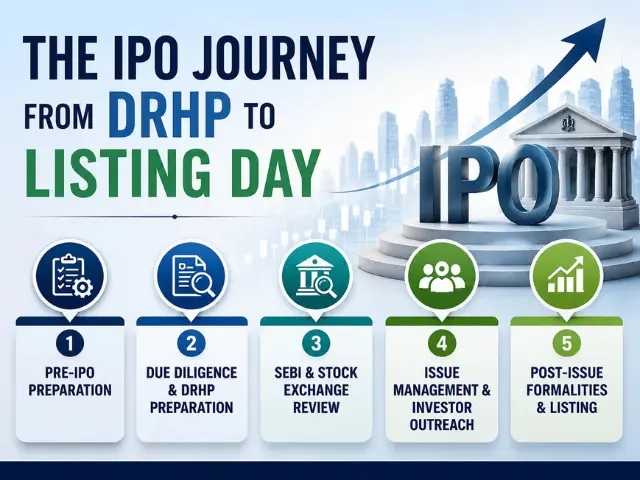

An IPO is often perceived as a single event. In reality, it is a tightly regulated capital markets transaction that tests a company’s governance, financial maturity and disclosure standards. Long before the stock lists, months of preparation go into drafting, verification, regulatory review and investor positioning.
Why the Filing Process Matters
The offer document is the backbone of the IPO. For SEBI, it is a legal disclosure document. For investors, it is the primary source of truth.For the company, it becomes a permanent public record. Gaps in statutory disclosures or inconsistencies in financial reporting may result in approval delays and affect investor confidence.
Phase I: Pre IPO Preparation
The IPO process begins well before drafting the prospectus. At this stage, the company prepares itself to operate as a listed entity. Key actions include finalising the issue structure, converting into a public limited company, updating constitutional documents, strengthening board and committee structures, appointing key managerial personnel and dematerialising shareholding.
Phase II: Due Diligence and DRHP Preparation
This is the most intensive stage of the IPO journey. The Merchant Banker conducts detailed financial, legal and business due diligence, followed by preparation of the Draft Red Herring Prospectus covering company profile, industry overview, risks, financials and utilisation of proceeds.
Phase III: SEBI and Stock Exchange Review
SEBI, along with the stock exchanges, reviews the DRHP to ensurefull and fair disclosures, eligibility, and governance compliance. All queries and observations are addressed before final In-Principal approval.
Phase IV: Issue Management and Investor Outreach
Post regulatory clearances, the Red Herring Prospectus is finalised and the issue pricing is decided. Merchant Bankers, working closely with syndication and underwriting teams, drive investor outreach and roadshows, while market makersplay a role in supporting orderly trading and liquidity (in case of SME-IPO), in line with applicable issue regulations.
Phase V: Post Issue Formalities and Listing
After the issue closes, the basis of allotment is finalised, funds are reconciled by the banker to the issue, and shares are credited to investors’ demat accounts. In cases of oversubscription, allotment is carried out as per category-wise allocation norms, with proportionate or lottery-based distribution and refunds/unblock of excess application amounts. The company then lists on the stock exchanges and enters the post-listing compliance framework. Syndication and underwriting teams continue to support investor engagement, while issuer-led marketing and investor interactions remain ongoing. Anchor investors participate up to one working day prior to the issue opening, helping establish early demand visibility and confidence in the offering.
Role of the Merchant Banker
The Merchant Banker anchors the IPO end-to-end, beginning with comprehensive due diligence and preparation of offer documentation. They act as the primary interface with SEBI and Stock Exchanges, provide valuation and structuring advice, and lead investor marketing efforts. In coordination with syndication and underwriting teams, the merchant banker supports book building, demand aggregation, and risk underwriting. Post listing, they also facilitate market-making arrangements and ensure regulatory and compliance requirements are met, enabling a smooth transition from a privately held company to the public markets.
Closing Thoughts
The IPO process shows how ready a company is to operate in public markets. With the right Merchant Banker guiding the company at every stage, the journey becomes well-planned and manageable, helping the business move smoothly into the listed space and build long-term, sustainable growth.
👉 To Connect with us today, please click here.
Latest Articles

Impact of Rupee Appreciation and Depreciation on the Stock Market


You often come across the news that the value of the rupee is appreciating or depreciating against the dollar.
- Have you ever tried to find out the root cause of it?
- Why do we always measure the rupee in reference to the dollar?
The answer is because of the exchange rate. The exchange rate tells us that the worth of one currency in terms of another currency.
For example: if we buy 1$ = 73.81 Indian rupees, means the exchange rate of the two currencies would be $ 1 =73.81 Indian rupees.
The exchange rates are of two types: Fixed Exchange Rate and Floating Exchange Rate.
The fixed exchange rate is the rate that doesn’t fluctuate due to the government’s interference.
In the case of floating exchange rate, it keeps on changing such as stock market. here, the government intervention is almost null.
Here, the question arises: which type of exchange rate does India have?
In India, there is a managed floating rate exchange system where the Indian government interferes only if the exchange rates go beyond the boundaries set by the country.
This can be done by increasing or decreasing the money supply as the situation demands.
Now, let’s discuss the common terminology used: Rupee Appreciation and Rupee Depreciation.
Rupee Appreciation means the currency i.e. Rupee is gaining strength and its value is growing with respect to the dollar.
When the value of the Rupee is depreciating, that means the value of the currency is going down and its value is decreasing with respect to the dollar.
Let’s understand it with an example:
Suppose, the current exchange rate is $1= Rs 73.81. After few weeks, let’s say after 11 months, you will notice the changes happen in the rupee.
Case 1:
The exchange rate is $1= Rs 70. This clearly indicates the value of the Rupee has gotten stronger and you are required to pay less amount for a dollar.
Case 2:
Suppose the exchange rate is $1 = Rs 75. This shows that the value of the Rupee has gone down and you end up paying more amount for a dollar.
The import-export business; pharma and IT sector are susceptible to changes in the forex rate and have an abundance of stake in the Indian stock market.
Why Does the Rupee Appreciate or Depreciate?
Appreciation or depreciation of a rupee heavily depends on the change in the demand and supply for both currencies. If the demand for the Rupee grows up, the Rupee appreciates; if the demand for the Rupee goes down; it depreciates.
Now, the question arises: what are factors affects a currency?
Interest Rate
A demand for a currency heavily depends on the interest rate differential between the two countries.
A country like India where the interest rate is around 7-8% shows a great capital inflow as investors get much better returns than what they get in the US (as the inflation rate in the US is 2-3% ).
This gives rise to rupee appreciation.
Inflation Rate
The demand for a country’s goods and services would be more if the inflation rate is lower in that country compared to other countries. Higher demand for goods and services means higher demand for that currency which results in the appreciation of that currency.
Import-Export
If a country exports more than its imports from other countries, that means the demand for that currency is more and hence the currency gains wide appreciation against other currencies.
Trading in Currencies in the Forex Market
Rupee’s appreciation or depreciation also depends on the exchange rate fluctuates every minute due to the speculative currency trading in the market.
Impact of Rupee Appreciation and Depreciation
When the Rupee Appreciates
Needless to say, the appreciation of the Rupee against other currencies will definitely uplift the economy. However, it can put a downturn in the stock market. Let’s understand it with a suitable example:
When the Rupee Appreciates, the markets that mostly get affected by the appreciation are IT and exports. When the value of the Rupee grows higher against the dollar, IT sectors are mostly affected as most of their revenue is generated by exports.
This is because the appreciation of the Rupee makes exports costlier while the domestic exporters face losses as they end up earning less Rupee when exchanging the dollars.
Hence, the companies who are majorly into exports (IT, pharma, petroleum products and jewellery) will get affected more. This may heavily affect their share prices to a greater extent.
When the Rupee Depreciates
When the Rupee depreciates, companies that imports commodities such as oil and gas, food, beverages suffer the most. This can happen only as the value of the Rupee goes down against the US dollars and imports becomes much expensive.
Hence, when the value of the Rupee is depreciating, it mainly affects the company that imports raw materials, foreign borrowings etc.
Besides, the company that majorly relies on exports will benefit the most from Rupee depreciation. Therefore, stocks of IT and pharma will mark a bullish trend.
It is essential to know that the depreciation can affect the market sentients a lot as it causes a decline in foreign investment. When the value of the Rupee starts to decrease, foreign investors pull out their investments, which may put an adverse effect on the stock market.
Conclusion
Indian IT sector heavily depends on foreign clients. Our 70% revenue comes from the IT sector. Thus, when an IT company receives a project from a foreign client, a contract is signed where the cost of the project is pre-decided. The contracts with the US clients are fully quoted in terms of dollars. Hence, the fluctuation in the exchange rates makes a huge difference in the performance of a company.

PPF Vs Mutual Fund SIP: Which Investment Instrument Gives You Better Returns
Nowadays, people are much aware of their future goals, and plans. To accomplish this, they seek the best investment options which can help them to generate outstanding stock trading returns.
While selecting the investment instruments, investors are mostly looking for options that provide them low risk, tax benefits and liquidity.
Many people often start their investments either with SIP or PPF. However, some experienced investors park their money into equity (i.e. stocks).
PPF and Mutual Funds are the two main investment options that suit ordinary people of India. Let’s understand the investment instruments in detail and try to understand which one provides high liquidity and interest rates.
SIP or Systematic Investment Plan
A systematic Investment Plan or SIP is considered one of the best ways of investing in mutual funds. Newbies or students prefer to choose SIP over other investments because it teaches the financial discipline with wealth building for the future.
In SIP, you are allowed to invest a fixed amount for the investment in the market at regular intervals.
SIP needs a regular investment that helps you average out the purchase price and guards you from inadvertently catching a market peak when you invest.
How do SIPs Work?
SIP work on the two principles:
Rupee Cost Averaging
As investors, we don't know which is the right time to enter the market? Even top-notch investors often experience the same difficulty in finding the right moment when to enter and exit the market.
This mostly happens, when we start to rely on our emotions, getting sentimental by the market movements and end up buying when the market is going higher and selling when they are lower.
This is what we should not be doing.
Rupee cost averaging helps us to reduce the guesswork. In Rupee Cost Averaging, you need to invest a fixed amount of money no matter, the market goes up or down. This makes you buy more units when the market faces a downward trend and lesser units when it is at the peak.
This approach brings down your average cost per unit in the long run.
Compounding
The amount you save for the long term may provide an exponential impact on your investment. This all happens because of the effect of the compounding.
Let’s understand it with a suitable example:
Person A starts investing for his retirement at the age of 40. Considering interest rates of 7% with a monthly investment of Rs 1000, his total investment at the end of 20 years will be Rs 5,28,000.
Person B, on the other hand, starts investing for his retirement at the age of 20. Considering interest rates of 7% with a monthly investment of Rs 1000, his total investment at the end of 40 years would be Rs 26,56,436 - almost 5 times higher than person A.
Advantages of Investing in SIP
Financial Discipline
Needless to say, the regular investment amount brings financial discipline to the inventors. In other words, it encourages discipline and helps you earn wealth without disturbing your lifestyle.
Lower Risks
Even if mutual funds are subject to market risks, they are still better than equity. This is because SIP diversifies your investment amount thus minimize the risk to capital that will help you achieve volatility.
Convenience
SIPs give you the flexibility to increase or decrease the amount of investment at any time which in turn makes it the most hassle-free mode of investment.
Public Provident Fund or PPF
Public Provident Fund or PPF is a government-backed scheme where you will get fixed returns but set by the government every quarter. Many people consider PPF is a retirement saving scheme offered by GOI with the motive of providing a secure life post-retirement.
In PPF, the minimum deposit one can make is Rs 500 per financial year whereas the maximum deposit amount is Rs 1.5 Lakh.
As said earlier, the PPF interest rate for Q2 (July-September) has been fixed at 7.1%.
Difference Between SIP and PPF
ParametersPPFSIPInvestment AmountMin-Rs 500, Maximum Rs 1.5 LakhMinimum Rs 500, No Max. LimitInvestment Tenure15 Years minimum, Extendable in blocks of 5 yearsCan be low as 6 months and high as 20 years.Lock-in-period15 YearsNo-lock-in-periodInvestment RiskSince it’s a govt.backed scheme. Hence totally safeIt is risky as SIP is linked with market-linkedTax-BenefitsEEE (Exempt-Exempt-Exempt) category of taxDepends on the type of mutual fund. For instance, ELSS is eligible for tax deduction under Section 80CLiquidityLowHighReturns7.1% (Q1of FY 2021-22)**Market Linked
SIP Vs PPF: A Comparison
1. Safety
PPF is a government-backed saving investment instrument where the money deposited in PPF is utilized by the government. Also, the interest on the same is also paid by the government. Therefore, it is considered the safest instrument to invest in.
On the other hand, money in the mutual fund is subject to market risk. The value of equity funds also fluctuates every day. Debt funds also grow up and down due to changes in the bond prices.
However, a mutual fund offers higher growth in the long run. Also, investment in mutual funds through SIP will minimize the market risk and volatility by diversifying your money into different sections.
2. Returns
The returns of a PPF account are fixed and guaranteed by the government. However, the interest rate is declared by the government every quarter.
Here is the interest rate of PPF
Period Interest Rates January to March 20217.1%October to December 20207.1%July to September 20207.1%April to June 20207.1%January to March 20207.90%October to December 20197.90%April to June 20198.0%
Returns of the mutual fund, on the other hand, are market-linked. The returns of mutual funds vary as per the market conditions and the performance of the fund manager. The returns of a few of India’s largest funds are mentioned below:
Fund SIP Return Aditya Birla Sun Life Frontline Equity9.60%Kotak Standard Multicap Fund13.29%ICICI Balanced Advantage Fund10.22%SBI Small Cap Fund15.83%
3. Liquidity
Mutual funds are much more liquid than PPF. This is because PPFs have a lock-in period of 15 years. In a mutual fund, you can redeem your investments on any business day. This is the reason mutual funds are more liquid than PPF.
4. Tax-Benefits
Investment in PPF accounts for a tax deduction up to 1.5 Lakh per annum under section 80C of the income tax act, 1961. The interest that arrives on the PPF is exempt from the tax but must be declared in the annual income tax return.
The PPF maturity amount is also exempt from tax. Hence, PPF provides exempt-exempt-exempt-tax treatment.
Mutual fund returns are taxed according to the type of mutual fund scheme and investment time period.
Investment in a specific category of mutual funds is called ELSS funds tax also gives you a tax deduction of up to 1.5 Lakh per annum under section 80C. This exemption does not apply to other mutual fund categories.
Which Investment Option Should You Select?
It is difficult to compare one investment instrument with the other i.e. market-linked. PPF is apt for those who want zero risks in their investments. While mutual funds are for those investors, who are willing to take the moderate risk so that they can earn higher returns. The risk can further be reduced by investing through a long-term SIP in mutual funds.

T+1 Settlement Cycle: How Will it Benefit Investors
SEBI is currently planning to implement its new strategy about allotment of shares which is currently T+2. Now, the time of settlement of shares has changed, the new time of allotment of shares is T+1.
Suppose, if an investor purchases shares in any company be it BSE or NSE, he will receive his shares in his Demat account in T+2 days i.e. trade +2. After receiving shares in a Demat account, he has a right to sell his share or hold it.
On the other hand, if the investor wants to share his shares, he will get funds transferred to his account within T+48 days.
Now, as per the SEBI rule, the settlement is proposed to be T+1 day. Earlier, the settlement cycle was T+3 days.
The settlement cycle refers to the time between the trade date when the order is executed, and the settlement date when the participants exchanged cash for securities; then only trade is considered final.
SEBI proposed the option to adopt T+1 based on readiness starting from 2022. The SEBI circular said that if the stock exchange wants to opt for the T+2 settlement cycle in between, it needs to give notice one month in advance.
Why did SEBI bring this new arrangement of settlement of shares?
SEBI has come up with this proposal only after some of the market participants have requested it. Here the T+1 refers to the shares that will be transferred in T+24 hours.
SEBI did not take this decision overnight, there are certain things involved such as consultation with market infrastructure institutions such as stock exchange, clearing corporations and depositors.
Very few market players have expressed their concerns on the operation problems in this arrangement such as the T+1 settlement cycle.
Minimizing the settlement cycle will directly impact the efficiencies in the stock market which in turn further protects investor’s interest. The new settlement cycle eliminates liquidity requirements, operational risks, counterparty risks that in turn minimize the margin requirement and collateral requirement for broker-dealers.
How Does It Impact Different Types of Investors?
The decision to change the settlement cycle leaves a great impact on many investors. For instance, high net worth investors such as FIIs, DIIs will extract a huge benefit from it. Earlier settlement i.e. T+1 can provide them more liquidity and minimize margin requirement.
It shall not impact small or retail investors as well.
Advantages and Disadvantages for Common Investors for T+1 Settlement Cycle:
With the help of the T+1 settlement cycle, investors now receive an earlier receipt of their funds after trade execution and settlement.
T+1 settlement cycle will require significant planning, execution and testing and it would change the market structure for sure.
If the infrastructure is upgraded with robust technology; the settlement process will be seamless and fast which in turn mitigates the probabilities of technical glitches.
Will the new cycle of settlement make any difference to the volatility in the market?
The new settlement of the cycle will increase the volatility in the market. Many developed countries such as the USA, UK, and Japan currently follow the T+2 trade cycle.
Needless today, there are some difficulties in the arrangement but minimizing the settlement cycle will generate greater operational efficiencies with low capital requirements.
Hence, we recommend you to do a test for two days and if everything is alright; it can be extended to one week and on successful testing, these things can be implemented permanently.

Zee Entertainment To Merge with Sony Pictures - Shares Up to 31%
Media and entertainment giant Zee entertainment Enterprises Ltd said in an interview that it has given official approval for its merger with Sony Pictures Network India. Post this announcement, the stocks of Zee entertainment limited rose nearly 20% on the 24th of September.
It has marked that Zee, has been experiencing constant pressure from the top investors in regards to management shuffle which also include the exit of the chief executive Punit Goenka from the board.
Zee further said that the company and Sony Pictures signed a non-binding term sheet into which they had to work together in multiple streams such as digital assets, production operations, linear networks, program libraries and more.
As part of the proposed deal, Sony Pictures Network India will hold a 52.93% stake in Zee entertainment while Zee shareholders will hold a 47.07% stake.
The total period of a term sheet is of 90 days during which both the companies will conduct mutual diligence and finalize definitive agreements, the filing said.
As a part of the merged entity, Punit Goenka will continue to be the managing director and CEO of the whole deal.
Let’s understand, what’s the merger means to Zee entertainment and its shareholders:
How Does the Deal Benefit Zee Entertainment?
Zee Entertainment is considered as one of the largest entertainment players in the industry with an outstanding market share including a strong pan-India presence. Apart from the Hindi entertainment segment, the company nailed its presence in regional languages as well.
Currently, the company operates 49 channels in 11 different languages which in turn help the company to generate an extra audience base in the country. Also, Zee has its own OTT app called Zee5, which attracts its young audience as well.
However, during the pandemic, many things have been restricted which also hits the company hard in terms of revenue and fresh content availability. However, the company again took a fresh start and now it has started growing again.
The promoter's stake sale has been addressed and the company has some plans to undertake investment in the upcoming years. At this time, Sony’s merger with the company would aid the growth of Zee entertainment in the upcoming year.
Now, the company is planning to increase its content offering on the OTT platform Zee5 app to receive worldwide attention from the audience. The increased consumption of the content on the OTT platforms will surely benefit Zee entertainment in many ways.
As per the sources, the company continues to increase its viewership base and is likely to see a rise in it due to its lowered annual subscription fee which is Rs. 499 per year.
Recently, Zee released 11 shows and movies on the Zee5 platform. With fresh investments, there are more such shows and movies are likely to be released in the upcoming months. This, in turn, improves its overall subscription revenue.
As per the source, the company is all set to release 30 new shows in September month that is going to be featured in Hindi, Marathi and Tamil languages.
Also, it has started thinking to expand its movie production business which has suffered a lot in this pandemic.
Although the company faced a huge loss during the pandemic; it keeps maintaining its audience through the OTT platform Zee5.
As Zee entertainment is one of the oldest and leading companies in the entertainment and media industry, it has a strong audience base. It leaves no stone unturned in retaining and mesmerizing its new audience base through the television channel. In addition to this, Zee also plans to expand the movie production business that assists the company to monetize from different business segments.
Financials
If we look at the revenue model of Zee entertainment, then we will get to know that the company gets 40-45% of its revenue from its subscription and the rest is generated from the advertisements.
In the June quarter FY22, the company achieved revenue growth of nearly 30% than the last year. This was only due to the low base effect of the June quarter last year. The main reason behind the 30 per cent recovery growth is the subscription and the advertising revenue which has helped the company a lot.
If you compare the revenue of the company to the previous quarter i.e. March, id had failed by 17% due to the lockdown restrictions due to the second wave of COVID 19.
How Does This Deal Impact on the Investors
As everything looks good with the Zee-Sony merger, it takes a while for it to start generating revenue. This is because the pandemic leaves a heavy impact on all of us. In such cases, going to a theatre would be a huge risk.
However, the company can achieve revenue growth with the help of advertisements and the OTT platform Zee5.
The company’s advertisement revenue will heavily depend on the corporates’ performance also. Hence, in the long run, the Zee-Sony merger will bring something positive for the company and the investors.
Let’s quickly review the highlights of the Zee-Sony Pictures Limited Deal
Highlights
Sony Pictures will hold a majority stake in the Zee-Sony merger, where Zee holds 47.07% and the remaining stakes 52.93% to be held by Sony Pictures shareholders.
The board of directors will be nominated by Sony Pictures.
This merger is going to be a publicly listed company in India.
As per the non-binding term sheet, the promoters of the Zee-Sony group are free to raise their shareholders from 4% to 20%.
The final transaction would be subject to completion of customary due diligence and execution of definitive agreements and required third party approval, regulatory and corporates, including the votes of Zee’s shareholders.
Takeaway
Zee-Sony merger would take a drastic turn in investors lives. As the deal is closed, the shares of Zee entertainment ltd have increased to a greater extent. This will improve investors’ portfolios. The merger also leaves a heavy impact on retail investors as they can benefit a lot from Zee entertainment shares.

Stock Market Trading: How to Plan Simple and Effective Exit Trading Strategies
Traders invest most of their time in planning entry strategies but ending up taking bad exits. Do remember, just like entry trading, exit also matters in stock trading.
Many of us lack in planning effective share trading exit strategies which in turn force us to leave the stock market at the worst possible price.
There are bundles of questions that revolve in our minds while online trading. For instance, people don’t know how to deal with the fear of missing out. Do they think what happens if the scrip goes up after I sell?
The question often circulates in the mind of retail investors. If you are the one who has many doubts about exit trading, we have got you covered.
Before getting started, let’s take a quick tour of the holding period i.e. why the holding period is so important and how it plays an important role in the successful exit strategies.
Holding Periods
It’s impossible to discuss exit strategies without explaining holding periods. The holding period is the duration at which you can hold the stock and sell it after the relevant time. The time frame in the holding period helps you to identify the time you need to extract money from the stock market.
- Day Trading or Intraday Trading: Minutes to Hours
- Swing Trading: Hours to Days
- Position Trading: Days to Week
- Investment Timing: Week to Month
Here, you need to select the category that aligns most closely with your market because it shows how long you have to book profit or loss. This approach requires strict discipline as some positions perform exceptionally well so that you want to hold them beyond time constraints.
While you can stretch the holding period according to market conditions, don’t forget to take an exit within the time limits. Because such things increase your profitability and stock market trading skills.
Market Timings
Before entering the stock market, it would be ideal to get into the habit of profit and loss and risks associated with it. Try to figure out the next resistance level within the time constraints of your holding period.
Now, try to analyze the point at which you will be proven wrong if the stock prices go against your prediction and hit it. That’s your risk. Now calculate the risk-reward ratio which should be 2:1. If anything less and you should skip the trade, move for a better opportunity.
Signs That Shows to Exit from the Particular Stock
Let’s understand it with an example:
Imagine a situation where you invested in a company called ABC Limited. The price of the stock went high within a few years to touch a level of Rs 700 but started to make a fall and now it is trading at Rs 27 today.
Now, let’s think you did full stock market research in the company ABC limited and you believe the company may show a heavy growth and hence you have decided to stick with the stock even if the prices drop.
So, where did you go wrong? Aren't, you supposed to buy right, sit tight? The answer is Yes. Yes should do so but this is not the case sometimes.
There are few things you need to ponder that give you an idea: what is the best time to exit from a stock?
1. Fundamentals of a Company are Constantly Changing
Is there any change in the fundamentals of a company that affects a stock’s price?
Check out the quarter performance of the company. If you see any sort of delays in the company’s growth report and the company consistently underperforms, then it’s high time to deeply monitor the company’s fundamentals.
Check the company’s fundamentals for at least 3-4 quarters. Also, check the other parts such as the utilization of a company (if there is any decline) or if the NPA is growing up.
Another important factor to check the company’s performance is Debt. Many stocks now have become multi-baggers only because they have zero or negligible debt. Take a quick tour of the debt to market cap ratio.
The debt to market ratio is a way to measure the debt against the company’s ability to raise capital. If the debt percentage is less, the company’s performance is more stable. If you see the number has increased, it’s high time to exit from the stock.
2. Company’s Involvement in Corporate Governance Issues
Corporate governance issues tell you many things such as how well a company manages its stakeholder relations. Here, as an investor checkout for their disclosure policy, dividend policy, conflict resolution between internal and external shareholders. It’s also important how well the upper management handles these setbacks.
Another important thing to note is: if there has been any legal dispute between the senior authorities that haven't been resolved yet or if the company suffers a lot where you can see the exit of the senior business leader. These heavily impact the price of scrip and you see it gets down to a greater extent.
3. When the Company becomes Extremely Overvalued in Short Time
Normally, the share price of a fundamentally strong company goes high with time. There are certain cases, where the price of a stock goes too high compared to a very short period. In such circumstances, it would be ideal if you immediately sell the stock and book profit.
What to do After You Sell the Stock?
Many times it happens that after selling a stock, you keep questioning your decisions. This is apt for the investors who have worked with the company for years and get emotionally attached to the company.
The bottom line here is that you are in the stock market only to create wealth and hence you should not have stuck with the emotions. Don’t let your emotions overpower your mind.
Takeaway
Planning an exit strategy is effectively important as an entry into the stock market. Proper exit from stock not only prevents you from huge losses but also helps you to take certain actions on time which will help you in the near future. See, the stock market always depends on the strategies and therefore a meaningful strategy will lead you to achieve more returns from the stock market.

सुस्त घरेलु मांग और मौद्रिक नीति पर नियंत्रण से कीमती धातुओं में दबाव।
पिछले सप्ताह की शुरुवात में सोने के कीमतों में अच्छी बढ़त देखि गई लेकिन अमेरिकी फ़ेडरल रिज़र्व की बैठक में मौद्रिक नीति को नियंत्रित करने के निर्णय पर सोने और चांदी के भाव ऊपरी स्तरों से टूटे गए। 10 वर्ष अमेरिकी बांड उपज में भी लगातार बढ़त दर्ज की गई है। फेड के अतिरिक्त कुछ देशो की अर्थव्यवस्थाओं में मौद्रिक नीति को नियंत्रित करने की बात से कीमती धातुओं में दबाव रहा है।
घरेलु बाज़ारो में श्राध्द के चलते सोने और चांदी की खुदरा मांग में कमी रहने के आसार है जिससे कीमती धातुओं में दबाव बना हुआ है। लेकिन, फेस्टिवल सीजन करीब होने के कारण निचले स्तरों पर सपोर्ट रहने की सम्भावना है। चीन मे चल रहे रियल स्टेट संकट के कारण कीमती धातुओं में निवेश की मांग बढ़ सकती है।
एमसीएक्स वायदा सोने के भाव में 300 रुपये प्रति दस ग्राम की साप्ताहिक बढ़त रही और पिछले सप्ताह के अंत तक कीमते 46100 प्रति दस ग्राम के करीब रही है। अमेरिकी फ़ेडरल रिज़र्व के निर्णय का असर चांदी के भाव में कम रहा और घरेलु वायदा चांदी के भाव में भी 700 रुपये प्रति किलो का साप्ताहिक सुधार देखा गया है। अमेरिकी बेरोज़गारी और सर्विस पीएमआई के कमजोर आकड़ो से भी चांदी के भाव को सपोर्ट रहा है। डॉलर जो सोने की विपरीत दिशा में चलता है, सप्ताह के निचले स्तरों पर है।
तकनीकी विश्लेषण
इस सप्ताह प्रमुख अर्थव्यवस्थाओं के केंद्रीय बैंक सदस्यों के बयान होने के कारण कीमती धातुओं में उठा पटक रहने के आसार है लेकिन कीमतों में निचले स्तरों से सुधार होने की संभावना तकनीकी चार्ट पर नज़र आ रही है। सोने में 45600 रुपये पर सपोर्ट है और 46500 रुपये पर प्रतिरोध है। दिसंबर वायदा चांदी में 58000 रुपये पर सपोर्ट और 61800 रुपये पर प्रतिरोध है।
Big Budget


Popular Articles




.avif)
.avif)

.avif)



START YOUR INVESTMENT JOURNEY
Get personalized advice from our experts
- Dedicated RM Support
- Smooth and Fast Trading App
