


Inside the IPO Filing Process from DRHP to Listing Day


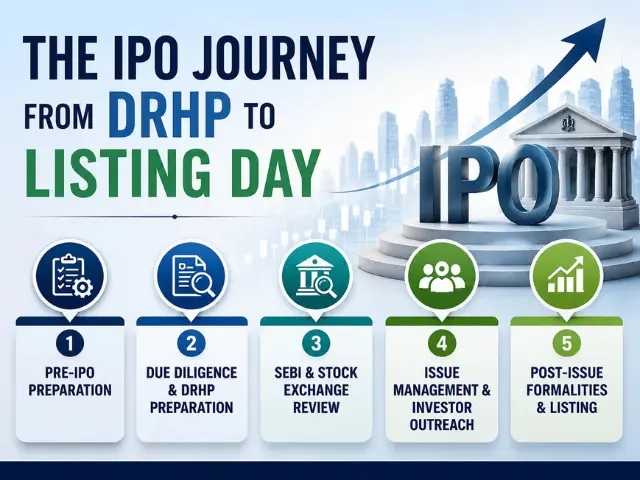

An IPO is often perceived as a single event. In reality, it is a tightly regulated capital markets transaction that tests a company’s governance, financial maturity and disclosure standards. Long before the stock lists, months of preparation go into drafting, verification, regulatory review and investor positioning.
Why the Filing Process Matters
The offer document is the backbone of the IPO. For SEBI, it is a legal disclosure document. For investors, it is the primary source of truth.For the company, it becomes a permanent public record. Gaps in statutory disclosures or inconsistencies in financial reporting may result in approval delays and affect investor confidence.
Phase I: Pre IPO Preparation
The IPO process begins well before drafting the prospectus. At this stage, the company prepares itself to operate as a listed entity. Key actions include finalising the issue structure, converting into a public limited company, updating constitutional documents, strengthening board and committee structures, appointing key managerial personnel and dematerialising shareholding.
Phase II: Due Diligence and DRHP Preparation
This is the most intensive stage of the IPO journey. The Merchant Banker conducts detailed financial, legal and business due diligence, followed by preparation of the Draft Red Herring Prospectus covering company profile, industry overview, risks, financials and utilisation of proceeds.
Phase III: SEBI and Stock Exchange Review
SEBI, along with the stock exchanges, reviews the DRHP to ensurefull and fair disclosures, eligibility, and governance compliance. All queries and observations are addressed before final In-Principal approval.
Phase IV: Issue Management and Investor Outreach
Post regulatory clearances, the Red Herring Prospectus is finalised and the issue pricing is decided. Merchant Bankers, working closely with syndication and underwriting teams, drive investor outreach and roadshows, while market makersplay a role in supporting orderly trading and liquidity (in case of SME-IPO), in line with applicable issue regulations.
Phase V: Post Issue Formalities and Listing
After the issue closes, the basis of allotment is finalised, funds are reconciled by the banker to the issue, and shares are credited to investors’ demat accounts. In cases of oversubscription, allotment is carried out as per category-wise allocation norms, with proportionate or lottery-based distribution and refunds/unblock of excess application amounts. The company then lists on the stock exchanges and enters the post-listing compliance framework. Syndication and underwriting teams continue to support investor engagement, while issuer-led marketing and investor interactions remain ongoing. Anchor investors participate up to one working day prior to the issue opening, helping establish early demand visibility and confidence in the offering.
Role of the Merchant Banker
The Merchant Banker anchors the IPO end-to-end, beginning with comprehensive due diligence and preparation of offer documentation. They act as the primary interface with SEBI and Stock Exchanges, provide valuation and structuring advice, and lead investor marketing efforts. In coordination with syndication and underwriting teams, the merchant banker supports book building, demand aggregation, and risk underwriting. Post listing, they also facilitate market-making arrangements and ensure regulatory and compliance requirements are met, enabling a smooth transition from a privately held company to the public markets.
Closing Thoughts
The IPO process shows how ready a company is to operate in public markets. With the right Merchant Banker guiding the company at every stage, the journey becomes well-planned and manageable, helping the business move smoothly into the listed space and build long-term, sustainable growth.
👉 To Connect with us today, please click here.
Latest Articles

Add Sweetness in 2021 by Trading in NCDEX Gur


National Commodity and Derivatives Exchange of India (NCDEX) has again re-launched the future contract in GUR (Feed Grade) and will be available for trading from December 15, 2020, with a lot size of 10MT.
OVERVIEW:
Jaggery (GUR) is produced all over the country, wherever sugarcane is produced. Similarly, it is consumed in all parts of the country. Further, the product is seasonal in nature i.e. its production takes place only from October to April in a year but its consumption takes place throughout the year. It is primarily produced from Sugarcane.
Globally India is the leading producer of jaggery contributing to 60% of total production, where Brazil is the major exporter of jaggery, and the USA, China, and Indonesia being the largest importer in the world. If we look into India, then Uttar Pradesh, Maharashtra, Karnataka and Tamil Nadu are the top jaggery producing states contributing to around 80% of the total production in India.
The major stakeholders in the GUR value chain include Farmers, Processors, and Traders who perform various activities from production, harvesting to processing, jaggery making, packaging and marketing.
FUTURE CONTRACT IN GUR:
As there has been continuous growth in the overall production of GUR and because of high volatility in its prices so to hedge the risk, NCDEX has launched the futures contract in GUR (Feed Grade). A considerable amount of the total production of Gur is used as feed. Therefore, the price has a considerable impact on the overall feed cost.
Muzaffarnagar (Uttar Pradesh) is the basis centre for the GUR Futures contract because of the availability of good infrastructure support and various processing units, Further, it is the only delivery centre for the same.
KEY BENEFITS:
- Hedging can be done by the ones who are the major users of GUR as whether they are producers, commission agents, traders, processors or retailers.
- Being the alternative to sugar, it will be a good trading option as there are no active future contracts of sugar.
CONTRACT SPECIFICATIONS:
- Ticker symbol - GUR
- Trading Unit – 10 MT
- Delivery Unit - 10 MT
- Maximum Order Size - 500 MT
- Quotation / Base Value - per 40 Kg
- Tick Size – Re.0.50 (50 paise)
- Quantity Variation - +/- 5%
- Basis - Ex-Cold Storage Warehouse Muzaffarnagar, inclusive of local taxes, exclusive of GST
- Delivery Logic - Compulsory Delivery
- Delivery Specification - Upon expiry of the contracts all the outstanding open positions shall result in compulsory delivery.
- Due date/ Expiry Date 20th day of the delivery month - If the 20th happens to be a holiday, a Saturday, or a Sunday, then the expiry date (or due date) shall be the immediately preceding trading day of the Exchange, which is other than a Saturday.

Mrs. Bectors Food Specialities Ltd IPO Blog
Company Background
Mrs Bectors Food Specialities Ltd was founded by Mrs Rajni Bector and promoted by Mr Anoop Bector which was incorporated in 1995, Mrs Bectors Food Specialities Ltd is one of the leading companies in the premium and mid-premium biscuits segment and the premium bakery segment in North India.
Mrs Bectors Food Specialities Ltd manufactures and markets a wide range of biscuits such as cookies, creams, crackers, digestives and glucose under the flagship brand ‘Mrs. Bector’s Cremica’. Mrs Bectors Food Specialities Ltd also manufactures and markets bakery products in savoury and sweet categories which include loaves of bread, buns, pizza bases and cakes under the brand ‘English Oven’.
Mrs Bectors Food Specialities Ltd supplies products to retail consumers in 26 states within India, as well as to reputed institutional customers with pan-India presence and to 64 countries across six continents during the Financial Year ended March 31, 2020.
‘Mrs. Bector’s Cremica’ is one of the leading biscuit brands in the premium and mid-premium segment in Punjab, Himachal Pradesh, Jammu and Kashmir and Ladakh and ‘English Oven’ is one of the largest selling brands in the premium bakery segment in Delhi NCR, Mumbai and Bengaluru.
We are the largest supplier of buns in India to reputed QSR chains such as Burger King India Limited, Connaught Plaza Restaurants Private Limited, Hardcastle Restaurants Private Limited, and Yum! Restaurants (India) Private Limited.
Mrs Bectors products are manufactured in-house at six manufacturing facilities located in Phillaur and Rajpura (Punjab), Tahliwal (Himachal Pradesh), Greater Noida (Uttar Pradesh), Khopoli (Maharashtra) and Bengaluru (Karnataka), which enables them to have effective control over the manufacturing process and to ensure consistent quality of our products.
Manufacturing facilities are strategically located in proximity to our target markets, which minimizes freight and logistics related to time and expenses.
Basic IPO details
IPO Opening Date15-Dec-20IPO Closing Date17-Dec-20Face Value₹10 per equity shareIPO Price₹286 to ₹288 per equity shareMarket Lot50 SharesIssue SizeAggregating up to ₹540.54 CrFresh IssueAggregating up to ₹40.54 CrOffer for SaleAggregating up to ₹500.00 CrRetail Allocation35%Listing AtBSE, NSETentative Listing Date28-Dec-20
Objects of the Issue
The company will not receive any proceeds from OFS while the proceeds from the fresh issue will be utilized
- To finance the cost of Rajpura Expansion Project.
- To meet general corporate purposes.
Financial Performance (in INR crore)
FY2018FY2019FY2020H1 FY2021Revenue696786765439Expenses643735726387Net income36333038Net margin (%)5.24.23.98.8
Outlook
Seeing the attraction in Burger King IPO and the outlook for QSR we expect that Mrs Bectors Food Specialities Ltd will be another attractive IPO for the investors. The fundamentals of the company don’t look good as of now as they have seen very slow growth in the last 3 years also debt have increased form 35 cr in 2017 to 85 cr in 2020.
The company is well-positioned in North India and has an opportunity to expand in the South and other parts of India. The company does not have any contract with the institutional customer which is the key risk for the company also bakery business has low entry barrier as it can be started with low investment.
However, the demand from the QSR chains will be a key beneficiary for the company. We recommend a SUBSCRIBE rating to the IPO only for the aggressive investors for listing gain and short term.
.avif)
What is Future Trading? Basics of Stock Market
Concept of Future Trading
Just like trading in the spot market trading in futures is also possible in the Indian stock market, but before moving ahead let's clear some concept about it. Trading in futures is categorized under the head of Derivative trading.
The term Derivative means " Derive from others" i.e A derivative is a product or contract which actually derives its value from its underlying asset.
Common derivative contracts available are Forwards, Futures, Options, & Swaps, Here we will look into a Futures contract.
Futures is a contract between two parties to buy & sell an asset at a certain time in the future at a certain price.
The derivatives trading started on 12 June 2000, NSE started its first derivative contract in Index Future, later on, option started on June 4 2001, in NSE. Currently, more than 160 plus companies are trading under derivative contracts along with Index contracts.
Important Terminologies of Future Contract:
Spot Price: Price at which underlying asset available in the spot market.
Future Price: Price at which future contract available in the future market.
Contract Cycle: It is defined as a time period for which a contract trades in the future market, Future contract is available in 3 months contract cycle period.
Lot Size: Defined as a standardized quantity of assets available for delivery at future date.
Expiry: Final day of settlement of a contract i.e. last Thursday of the month.
Initial Margin: Amount which is required to deposit to purchase any future contract.
How to Trade in Future Market:
Trading in futures is as similar as trading in the cash market, the only difference is that in cash a trader needs to pay the full amount to purchase quantity & whereas in the future you need to deposit only a margin amount to purchase the same.
A trader then can hold the given quantity of futures up to expiry or can roll over for the next month, Once can rollover the contract up to 3 months
A trader is more beneficial in future trading as the initial investment requirement is less and returns are more.
For example, A trader who wish to purchase 1000 shares of XYZ ltd @price of 200 where the requirement is Rs 200,000 (1000*200) while in futures you need to deposit only a margin of Rs 25000/-
(Initial Margin 12.5% of the total value of the contract i.e. 1000*200).
Benefits of Trading in Futures:
Low investment cost: In future trading, a trader needs to deposit only the margin amount required to be deposited with the broker.
More suitable for Speculators: Traders require fast money future contract is more suitable for them.
Possible to carry short position: One of the most important benefits of futures trading is that a trader can carry a short position, In cash short trading can be done only for intra-day, while in futures one can carry a short position up to expiry.

HINDUJA GROUP OF COMPANIES
INTRODUCTION
In 1914, the company was founded by a man, who was having great visionary to build an empire named Parmanand Deepchand Hinduja, established a family business that spread rapidly throughout the world. In 1919, Company’s started its International operation in Iran, but after the Islamic Revolution, it was moved to Europe.
Group Chairman Mr. Srichand P. Hinduja along with his brothers Gopichand, Prakash, and Ashok Formulated and Implemented a strategy for the diversified growth of the group and transformed it into an international level.
Presently companies are operating in 38+ countries with 150,000+ team members. Today Hinduja Group has become one of the largest diversified groups not only in India but also in the world.
Groups are operating in Banking & Finance, Automotive, Healthcare, IT, Media, Power, Real-estate, Oil, and so on.
GROUP OF COMPANIES
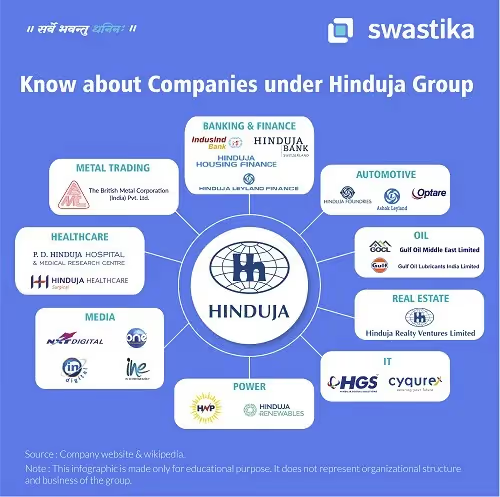
BANKING & FINANCE
IndusInd Bank – It is a private sector bank in India and it was started in 1994. It is the only commercial bank in India to receive ISO-9001:2000 Certification for its branches network. It has 2000+ branches & 2700+ ATMs, spread across 750+ locations in India.
Hinduja Bank (Switzerland) Ltd – It was founded in 1978 and is formerly known as Amas Bank. In 1994 it was regulated by the Swiss Bank. Its headquarters is in Geneva.
Hinduja Leyland Finance Ltd. – It was incorporated in November 2008. It is engaged in a wide range of vehicle finance (Like MHCVs, LCVs, SCVs, CAR, Three Wheelers, Two Wheelers).
Hinduja Housing Finance – It was incorporated in April 2015. It offers a wide range of Home Loans. It is a subsidiary of Hinduja Leyland Finance, which is one of the leading NBFCs in vehicle finance.
AUTOMOTIVE
Ashok Leyland - It was incorporated in 1948 as named Ashok Motors & in 1955 it becomes Ashok Leyland. It’s headquartered in Chennai. It is the 2nd largest manufacturer of commercial vehicles in India
Hinduja Foundries – It is a division of Ashok Leyland. It is India’s largest foundry business group.
Optare – It is an English bus manufacturer based in Sherburn-in-Elmet, North Yorkshire. It is a subsidiary of the Indian company Ashok Leyland.
OIL
Gulf Oil Lubricants India Ltd – It is the Indian Lubricants Industry. Gulf Oil International (GOI), the parent of GOLIL, owns the Gulf brand globally (except USA, Spain & Portugal).
REAL ESTATE
Hinduja Realty Ventures Ltd – It Aggregate Hinduja Group's real estate assets under Hinduja Realty Ventures Limited (HRVL) - the flagship real estate development arm of the Group.
POWER
Hinduja National Power Corporation Ltd – It is a thermal power plant (coal-based) located in Palavalasa village in the Visakhapatnam district, Andhra Pradesh.
Hinduja Renewables Energy Private Ltd. – It is an independent, future-facing power producer with a vision to grow through both organic and inorganic means in renewable energy.
IT
Hinduja Global Solutions Ltd – It is a service provider headquartered in Bangalore, India. It is a business process management organization. It operates globally with 69 Customers and around 45000+ employees across the world.
Cyqurex Systems Private Limited – It is a joint venture between Hinduja Group and NJK Holding a cybersecurity firm headquartered in London. It is basically engaged with cybersecurity solutions to address the challenges that enterprises face today.
MEDIA
INE and Indigital – It is one of India's largest integrated media companies running one of the largest digital cable TV platforms in the country under the brand "INDigital".
HEALTHCARE
P D Hinduja Hospital – It was established in the 1950s by the late Shri P.D. Hinduja with a vision to deliver Quality Health Services.
Hinduja Healthcare Limited – It is Mumbai based Multi-specialty Hospital. It offers advanced medical facilities.
METAL TRADING
The British Metal Corporation (India) Pvt. Ltd – It is the Joint Venture between Hinduja Group & Amalgamated Metal Corporation Group (UK). It was established before India’s Independence and is engaged in the trade of materials.
.avif)
Systematic Investment Plan : The Best Way to Start First Investment
Investment & savings are two topics which we never learn in school or any college, what we learn is how to get a job. Yes after getting a job, we actually focus on purchasing new things, accessories, parties, etc but we never give a single thought to save a single penny for our future. And this is actually happening with every person at an early age but yes we all bring in it later on after we understand its importance.
Approx at age of 23-24 we entered into the job and simple human tendency is to first enjoy the time being earnings and savings can be done later, yes the basic reason is lack of proper financial planning which make our investments delay. So what can be done? A question arises in the mind of every individual when they face any uncertain situation. It's not so hard to invest what all is required is a mindset of doing it so.
How Can We Make the First Investment?
Systematic Investment Plan (SIP)
It is a simple way of investing a fixed amount regularly with discipline irrespective of the stock market hours. It is a recurring deposit in mutual funds.
A very basic instrument in which investment can be done is the Mutual Fund. One can allocate 10 to 20 % of salary in its initial stage for start investing, Yes for starting up mutual funds SIP are the best route and it's not required to go with a huge sum one can proceed it with a small sum of Rs.500/-, yes this is correct seems easy.
Actually when we all move out with friends & family spending a huge sum on a normal dinner in the restaurant seems very low, though it cost more.
Importance of Systematic Investment Plan:
The investment amount is small: SIP investment requires a very small sum of Rs. 500/- which actually doesn't create any sort of burden on any individual earnings. Even many funds offer a minimum sum of Rs. 100/- too.
Disciplined way of investment:
SIP is the best way to start investing regularly as it takes one-time registration with help of ECS funds will be directly debited from a bank account
Monthly installment:
SIP is a kind of investment deducted on a fixed date every month from your bank account. It's actually like depositing regular installments for our future benefits.
Increase or decrease the amount:
An individual can increase the number of SIPs or can increase the amount as per his/her convenience, It actually depends upon the goal of an investor.
Benefits in long run:
SIP is a route of indirect investment in the equity market via a route of mutual funds, we all know equity markets are very volatile in nature on day to day basis but it gives the best return in the long term horizon. As in long term, we receive the benefit of rupee cost averaging.
Rupee cost averaging:
We are aware of the market it is volatile in nature which sometimes leads to a fall in stock prices also, in a similar manner NAV of funds also falls in continuation of SIP it is more beneficial because in this case buying is done with a low price compare to the previous month.
Corporate Dividend Policy AND Decisions
Once a person hears the word dividend he simply understands it to be a profit or a reward, but why a company does profit sharing with its customers. Here are the answers:
A dividend is cash or reward which is given, for delivering returns to the equity shareholders, on the capital invested by them in the business. It is often a part of the profit that the company shares with its shareholders.
What is a Dividend Policy?
A company uses dividend policy to structure its dividend payout to the shareholders. Dividend decisions refer to the decision-making mechanism of the management to declare the dividends.
Why do we need to have a dividend policy?
These are the major reasons as to why do we need dividend policy.
1. Maximize the shareholder’s wealth
The company’s ultimate objective is to maximize the shareholder’s wealth. The shareholders invest in the company and the company should pay them in such a manner that they further continue to invest.
2. Fulfilling the financial needs of the company
If the shareholders continue to invest in the company, the company would have enough money to sustain in the competitive market.
Factors influencing the dividend decision that a company takes:
There does not exist a single dividend decision factor that can work for every organization.
- The earnings of the company and its prospects.
- The Company’s cash inflows, which includes its stability and liquidity requirements.
- Shareholder’s expectation towards dividend as a source of income.
- Stability in the dividend payouts, irregularity in dividend payout should be avoided.
- The tax considerations, as the company would be left with fewer profits after paying out the taxes.
- Restrictive covenants such as creditors, lenders, debenture holders because of them there is a huge impact on the decisions.
- Long terms payout decision of the company.
- Control policy of the company so that the shareholder's control would be less in the company.
- Impact of the trade cycle
- Government policies as the government intervene in a particular industry and can restrict the issue of shares or debentures.
Forms of Dividend:
Cash dividend
A dividend which is paid out in cash. It will reduce the cash reserves of a company.
Bonus shares
Bonus shares are the shares in the company which are distributed to shareholders at no cost. It is not done in the place of cash dividend but in addition to a cash dividend.
How does a company approach towards the dividend policy?
Well, there are two approaches to the same:
- When the company thinks of itself first that is when it looks for profitable avenues for reinvestment and pooling the funds into the company and whatever remains is then distributed to the shareholders.
- When the company thinks of shareholders first that is it takes an active decision of distributing the dividend in a planned and strategic manner.
What patterns do the companies follow while paying out dividends?
Stable Dividend Policy
The company decides to pay periodically a fixed amount of dividend to the shareholders. Even when the company incurs loss or generates high profit, there is no change in the dividend paid.
Regular Dividend Policy
A certain percentage of the company’s profit is allowed as dividends to the shareholders. When the gain is high, the shareholders’ earnings will also rise and vice-versa.
Irregular Dividend Policy
The company may or may not pay dividends to the shareholders. As per their priorities, the top management i.e., the board of directors solely take all dividend decisions.
No Dividend Policy
The company has no intention of declaring any dividends to its shareholders. The company always retain its profits to fund further projects.
What is a Sound Dividend Policy?
When the company is at the initial stage and it earns little profit, then it should give lower dividends to the shareholders.
When the company is growing it should provide a dividend to the shareholders in a proportionate manner.
When the company can survive in the market, it should provide a stable dividend to its shareholders.
What will be the impact of dividend decision on the share prices of the company?
If the company is paying dividends regularly, there is a pressure for maintaining the stability in the dividend payout. If it does not pay dividends even for one year and retains the funds for capital investment then it may prove hazardous for the company.
In cases of the company which has no stability in dividend policies, when the company does declare a dividend, the share prices will rise before the ex-dividend date. On dividend declaration more and more people invest by buying its shares, these shares are then sold. This is then followed by a fall in the share prices. It would result in great volatility.
A company’s dividend decisions and policy depict its future and financial well-being. Dividend payout policies are considered to be a bridge between the company and shareholders for profit-sharing. It would be difficult for investors to know the intentions of the management if the management does not have a sound dividend policy.
The dividend policies of an organization also result in a significant bearing on the market value of stocks, it also impacts the valuation of the company. Hence, it needs to be systematically framed and implemented.
Big Budget


Popular Articles



.avif)
.avif)

.avif)



START YOUR INVESTMENT JOURNEY
Get personalized advice from our experts
- Dedicated RM Support
- Smooth and Fast Trading App
