


Inside the IPO Filing Process from DRHP to Listing Day


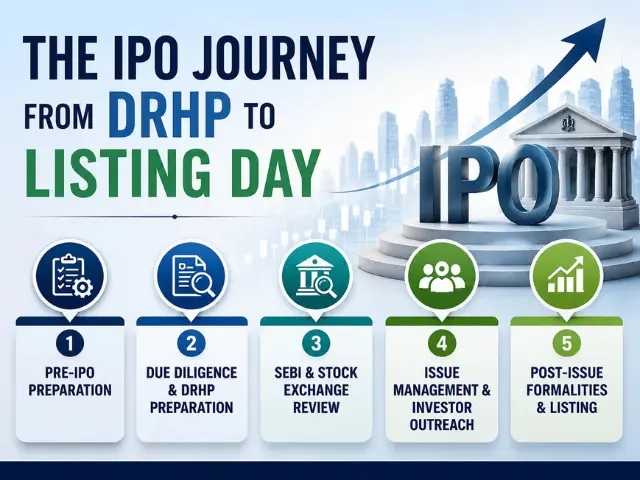

An IPO is often perceived as a single event. In reality, it is a tightly regulated capital markets transaction that tests a company’s governance, financial maturity and disclosure standards. Long before the stock lists, months of preparation go into drafting, verification, regulatory review and investor positioning.
Why the Filing Process Matters
The offer document is the backbone of the IPO. For SEBI, it is a legal disclosure document. For investors, it is the primary source of truth.For the company, it becomes a permanent public record. Gaps in statutory disclosures or inconsistencies in financial reporting may result in approval delays and affect investor confidence.
Phase I: Pre IPO Preparation
The IPO process begins well before drafting the prospectus. At this stage, the company prepares itself to operate as a listed entity. Key actions include finalising the issue structure, converting into a public limited company, updating constitutional documents, strengthening board and committee structures, appointing key managerial personnel and dematerialising shareholding.
Phase II: Due Diligence and DRHP Preparation
This is the most intensive stage of the IPO journey. The Merchant Banker conducts detailed financial, legal and business due diligence, followed by preparation of the Draft Red Herring Prospectus covering company profile, industry overview, risks, financials and utilisation of proceeds.
Phase III: SEBI and Stock Exchange Review
SEBI, along with the stock exchanges, reviews the DRHP to ensurefull and fair disclosures, eligibility, and governance compliance. All queries and observations are addressed before final In-Principal approval.
Phase IV: Issue Management and Investor Outreach
Post regulatory clearances, the Red Herring Prospectus is finalised and the issue pricing is decided. Merchant Bankers, working closely with syndication and underwriting teams, drive investor outreach and roadshows, while market makersplay a role in supporting orderly trading and liquidity (in case of SME-IPO), in line with applicable issue regulations.
Phase V: Post Issue Formalities and Listing
After the issue closes, the basis of allotment is finalised, funds are reconciled by the banker to the issue, and shares are credited to investors’ demat accounts. In cases of oversubscription, allotment is carried out as per category-wise allocation norms, with proportionate or lottery-based distribution and refunds/unblock of excess application amounts. The company then lists on the stock exchanges and enters the post-listing compliance framework. Syndication and underwriting teams continue to support investor engagement, while issuer-led marketing and investor interactions remain ongoing. Anchor investors participate up to one working day prior to the issue opening, helping establish early demand visibility and confidence in the offering.
Role of the Merchant Banker
The Merchant Banker anchors the IPO end-to-end, beginning with comprehensive due diligence and preparation of offer documentation. They act as the primary interface with SEBI and Stock Exchanges, provide valuation and structuring advice, and lead investor marketing efforts. In coordination with syndication and underwriting teams, the merchant banker supports book building, demand aggregation, and risk underwriting. Post listing, they also facilitate market-making arrangements and ensure regulatory and compliance requirements are met, enabling a smooth transition from a privately held company to the public markets.
Closing Thoughts
The IPO process shows how ready a company is to operate in public markets. With the right Merchant Banker guiding the company at every stage, the journey becomes well-planned and manageable, helping the business move smoothly into the listed space and build long-term, sustainable growth.
👉 To Connect with us today, please click here.
Latest Articles

Learn the Fundamentals of Intraday, Currency and Commodity Trading


Many traders seek short term goals while trading in the stock market as they want to make quick money in a short period. Such things usually work but sometimes, traders may suffer heavy losses. Buying and selling of shares within a single day is a short-term strategy to produce high returns. This method is known as Intraday trading.
How Intraday Trading is Different from Regular Trading
Although day trading and regular trading are similar, the main difference between them is delivery. Intraday trading gives you a facility to square off your position on the same day. In case you do not square off your positions at the end of the day, your holdings can automatically sell at the day’s closing price under certain brokerage plans.
Whereas regular trading or delivery trading allows you to buy stocks and hold them in your Demat account. There is no such concept of square off positions in delivery trading. The stocks will remain in your Demat account until you sell them off. The duration can be days, weeks, months and even years.
Who should participate in Intraday Trading?
Intraday trading gives you promising returns and hence they may sound attractive. However, there are certain risks associated with it. In intraday trading, you have to square off your position before the session ending time. This requires your full attention until the market closes. Also, you need to have a good experience in intraday trading, only then you can achieve positive returns.
Currency Trading
Currency trading has been gaining a lot of popularity in India. Also, it becomes one of the greatest emerging trading platforms in India. The reason behind this huge popularity is the inclination of investors towards trading in currencies. In forex trading, investors trade over a pair of currencies and earn profits from it. They actually keep monitoring price movements on currencies and generate a high income from it.
In India, currency trading is done on apex stock exchanges such as NSE (National Stock Exchange), BSE (Bombay Stock Exchange) and Multi Commodity Stock Exchange. The timings of currency trading are available from 9 am to 5 pm. To trade in currency, investors don't need to have cash or equity.
Commodity Trading
Commodity trading refers to the trading of precious metals, oil & gas, energy, spices and so on. Several metals such as gold, silver are traded in several ways like physical holdings, ETFs, futures contracts and more. As there are many options available to trade, commodity trading allows investors to trade that suits their temperament.
How to Invest in Commodity Trading
Among all of the ways, a futures contract is the best way to invest in commodities. Futures contracts are an agreement to buy and sell shares of commodities at a fixed price at a later date. The best thing about futures contracts is the futures contracts are available for every commodity type.
Takeaway
It is extremely important to gain proper knowledge in stock trading as having adequate knowledge of fundamentals of trading may give you certain ideas about trading such which trading type is better for you? Intraday trading, currency trading or commodity trading.

सोने के भाव पहुंचे पचास हजार के अंदर।
सोने और चाँदी के भाव मे ऊपरी स्तरों पर दबाव लगातार बना हुआ है और अगस्त महीने के बाद से ही कीमती धातुओं के भाव मे गिरावट जारी है। सोने के भाव मे अत्यधिक तेज़ी होने के कारण हाज़िर की मांग कमजोर रही और दिसंबर वायदा की एक्सपायरी करीब है जिससे क़रीबारिओ के सौदे की कटान ज्यादा हुई है। अमेरिकी चुनाव के दौरान डॉलर इंडेक्स मे बने बिकवाली का दबाव कम हुआ है जिससे कीमती धातुओं से निवेशकों ने दुरी बना रखी है।
दुनिया की केंद्रीय बैंको द्वारा लगातार सोने मे की जा रही ख़रीददारी अब दस साल के निचले स्तरों पर आ चुकी है। कीमती धातुओं की खुदरा मांग, भाव अधिक होने से कम है। वैश्विक आर्थिक आकड़ों मे लगातार सुधार जारी है और डॉलर सुचकांक दो साल के निचले स्तरों पर होने से, इसकी मांग मजबूत होने के आसार है। स्विट्ज़रलैंड से एशिया के सोने का आयात गिर गया है और मई 2019 के बाद के महीने में भारत को अधिक निर्यात किया गया जबकि चीन को स्विट्ज़रलैंड सोने का निर्यात निचले स्तरों पर रहा है।
कोरोनोवायरस लॉकडाउन से मांग कम हो गई और स्विट्ज़रलैंड एशिया से सोना आयात करने के बजाय, अमेरिका और ब्रिटेन को निर्यात करने लगा है। वैक्सीन विकास पर प्रगति से आर्थिक सुधार में तेजी आएगी इस कारण बुलियन की सुरक्षित-हेवन अपील खत्म होती दिखाई दी है। मजबूत डॉलर और अमेरिकी आर्थिक प्रोत्साहन मे अनिश्चितता, सोने के भाव मे दबाव बना रही है और अमेरिकी ट्रेज़री सचिव मुचिन द्वारा कोवीड -19 राहत पैकेज के विपरीत जाते हुए फ़ेडरल रिज़र्व से महामारी मे इस्तेमाल कर्ज को लौटने के लिए कहा है। घरेलु वायदा सोना सप्ताह मे 2 प्रतिशत और चाँदी के भाव 4 प्रतिशत तक टूट गए है। घरेलु वायदा सोना 49800 रुपय प्रति दस ग्राम और कॉमेक्स वायदा सोना 1850 डॉलर प्रति औंस के निचले स्तरों को पिछले सप्ताह छू चुके है।

An Ideal Annual Financial Planning Checklist
Failing to plan is planning to fail. The global pandemic has taught us all a valuable lesson of the ages, that there can be unforeseen circumstances that can’t just be a rainy day, but the rainy season of unfortunate events that can be capable of derailing or breaking your life. At such times, just having an annual financial plan just doesn’t work; you need to have an Ideal Financial Plan.
An Ideal Financial Planner is the immunity booster to your financial health. Not only does it help you manage your short-term and long-term financial situation, but also helps you make sound financial decisions on your goals, and determine the methods to achieve them.
Creating an ideal financial plan includes taking into consideration all your assets (how much you get paid, what's in your savings and checking accounts, how much is in your retirement fund), as well as your liabilities, including loans, credit cards, and other personal debts.
Now that your resolve to make a debt plan is strong, here are some key highlights that you need to include as part of your financial inventory:
- A list of assets, including items like your emergency fund, retirement accounts, other investment and savings accounts, real estate equity, education savings, etc. (any valuable jewellery, such as an engagement ring, belongs here, too).
- A list of debts, including your mortgage, student loans, credit cards, and other loans.
- A calculation of your credit utilization ratio, which is the amount of debt you have versus your total credit limit.
- Your credit report and score.
- Tax Assessment Information
Review Your Investments
It’s important for investors to take stock of where their investments are during the annual financial planning process. This is especially true when the economy undergoes a shift, as is happening now.
- Check your asset allocation. If stocks are taking a dive, for example, you may consider adding real estate investments into your portfolio mix to offset some of the volatility.
- Then identify your risk tolerance based on your risk appetite, mark the investment opportunities that suit your risk profile, set them towards a calculated goal and direct your asset allocation goals towards it. If in case your current investment does not do justice to your risk profile, it will be time for you to rethink.
Increase Your Contribution to Ongoing Investments
Proportionally increase your contribution towards your long-term investments so that the inflation rate doesn’t catch up with you and your money starts making money for you. For instance, if currently, you are contributing 20% of your income towards investments, consider making it 25% to 30% depending on your family's requirements. Let your increments become your investment in due course.
Pay off your Credit Card Debt
If you have any outstanding credit card debt, make it your first priority to pay that off. Interest rates charged by credit cards are exorbitant and can go up to 40-50% per annum (compared to 15% for a personal loan). It is even worth borrowing some amount from your friend or parents and pay off your credit card debt immediately and then slowly return them the money from your savings
Max out your tax-saving investments
Every year you can invest up to Rs 1.5 lakh in certain tax savings instruments like PPF, Tax Saver FDs, Tax Saver Mutual Funds, etc which are tax-exempt under section 80C. Make sure you are maxing out on these. Consult your financial advisor on which 80C investments to make as per your risk profile.

Tips and Tricks for Every New Stock Investor
1. How much of your portfolio should be in stocks?
There is no set-in-stone rule, but generally speaking, as you get older and closer to retirement, you should reduce your exposure to stocks in order to preserve your capital. As a rule of thumb, take your age and subtract it from 110 to find the percentage of your portfolio that should be invested in stocks, and adjust this up or down based on your particular appetite for risk.
2. Index funds vs. individual stocks
An index fund allows you to invest in many stocks by purchasing one investment. For example, an index fund gives you exposure to all 500 stocks in that index.
Index funds can be an excellent tool to diversify your portfolio and reduce your risk. After all, if your money is spread across hundreds of stocks and one crashes, the impact on your overall portfolio is minimal.
3. How many different stocks should you buy?
If you only want to buy individual stocks, I suggest buying at least 15 different stocks across several different industries in order to properly diversify your portfolio. However, this may not be practical when you're just starting out.
An alternative to buying lots of individual stocks is to invest the bulk of your money in index funds and buy one or two stocks with the rest. This takes most of the guesswork out of investing, while still allowing you to get some experience with evaluating stocks.
4. Dividends or no dividends?
Many stocks choose to distribute their profits to shareholders in the form of dividends, while others choose to use their profits to reinvest in the growth of the company. In general (but not always), dividend stocks tend to be less volatile and more defensive than non-dividend stocks. It's important to note that just because a company pays a high dividend doesn't necessarily mean that it's a better investment.
Over the past 80 years, dividends have been responsible for 44% of the total return of the S&P 500 index, and dividend reinvestment can be an extremely powerful tool for creating long-term wealth.
5. How much profit can you expect?
I'd advise new investors to take a long-term view of the markets. In any given year, the market could gain or lose a substantial portion of its value. However, over long periods of time, the markets are surprisingly consistent. Over any recent 25-year period, the S&P 500 produced average annual total returns of at least 9.28%, so it's fair to expect this level of performance over the long run -- even though over any shorter stretch it can vary significantly.
6. Only buy What you Know
One investment rule I never break is that if I can't clearly explain what a company does in a sentence or two, I won't invest in it. For example, I really don't understand most biotech companies (nor have I really tried to), so I'm not going to invest in their stocks. On the other hand, the business models of my largest stock holdings such as Realty Income, FedEx, and Google are rather straightforward. It's important to only invest in businesses that are easy for you to understand, especially while you're just starting out. Watch out for red flags.
There are several red flags to watch for when choosing stocks. Just to name a few, beginners should avoid the following types of stocks:
- Companies that don't earn any profits
- Stocks whose share prices seem to always drop (look at the three- or five-year chart)
- Companies that are under investigation
- Companies with lots of debt
- Stocks with recent dividend cuts, or an unstable dividend history
8. Know how volatile your stocks are
Before you buy a stock, it helps to know how volatile you can expect it to be, which you can determine by looking at its beta (included in virtually any stock quote). A stock's beta essentially compares its volatility to that of the overall S&P 500 index. If the beta is less than one, the stock can be expected to react less to market swings, and if it's greater than one it is more reactive. For example, if a stock's beta is 2.0 and the S&P 500 drops by 5%, its share price could be expected to drop 10%.
9. History tends to repeat itself
Although past performance doesn't guarantee future results, there are some historical patterns that tend to continue. Specifically, stocks with a history of profitability and consistent earnings growth tend to keep up. And stocks with a strong history of dividend increases are extremely likely to increase their dividends in the future. Do a little research and compare the historical behavior of the stocks you're considering.
10. Rookie mistakes to avoid
Finally, there are some dangerous traps rookie investors should avoid. This is not an exhaustive list, but these are among the costliest:
- Buying penny stocks: Avoid "penny stocks," which I define as any stock that doesn't trade on BSE, NSE, MCX, or any other regulated market. Of course, there are exceptions, but it's probably a good idea for beginners to steer clear of these.
- Buying stocks on "rumours": Never buy a stock because it's "about to" do anything. Always do thorough research and make a well-informed decision with the long-term mind.
- Using margin: There are some valid reasons to use margin (borrowed money), but beginners shouldn't touch it. Investing on margin can amplify your returns, but it can also increase your losses.

Common Stock Market Myths: What You Need to Know
Stocks are the only investment asset class in the world that have the capacity to grow the invested amount more than 10k times, and yet the myths surrounding the stock market make people wonder if or not stocks are worth investing in. At the same time, it's equally essential to have realistic expectations from the market. Regardless of the real problems, common myths about the stock market often arise. Here are five of those myths.
1. Investing in Stocks Is Just Like Gambling.
Unfortunately, in our society, Risk and Gamble have become synonymous. People talk about the Stock Markets being risky or akin to gambling in the same vein, and this is the main reasoning that causes many people to shy away from the stock market. To understand why investing in stocks is inherently different from gambling, we need to review what it means to buy stocks.
A share of common stock is ownership in a company. It entitles the holder to a claim on assets as well as a fraction of the profits that the company generates. Too often, investors think of shares as simply a trading vehicle, and they forget that stock represents the ownership of a company.
In the financial exchange, speculators are continually attempting to survey the benefits that will be left over for investors. This is the reason stock costs vary. The viewpoint for business conditions is continually changing, as is the future income of an organization.
Assessing the estimation of an organization isn't a simple practice. There are endless factors including that the momentary value developments have all the earmarks of being irregular (scholastics call this the Random Walk Theory); in any case, over the long haul, an organization should be worth the present value of the benefits it will make.
For the time being, an organization can get by without benefits in view of the desire for future profit, yet no organization can trick speculators perpetually—inevitably, an organization's stock cost can be relied upon to show the genuine estimation of the firm.
When you gamble, you can initiate your action, but then you are helpless about the outcome! Obviously, specialists can help you a tad in making the probable estimation, but it will be exactly that: simply a round of possibility, by the day's end.
Trading has a collection of information and science that upholds. You have a key methodology where you take a gander at information and news streams prior to making an informed investment.
2. The Stock Market Is an Exclusive Club for Brokers and Rich People.
Many market guides guarantee the option to call the business all sectors' turns. The truth of the matter is that pretty much every examination done at this point has refuted that these cases are.
Most market prognosticators are famously incorrect; moreover, the appearance of the web has made the market considerably more open to people in general than at any other time. All the information and exploration apparatuses beforehand accessible just to financiers are presently accessible for people to utilize.
In addition, discount brokerages and Robo-advisors can permit speculators to get to the market with a genuinely negligible investment.
3. Fallen Angels Will Go Back up, Eventually.
Whatever the reason for this myth's allure, nothing is more damaging to novice speculators than the feeling that a stock exchange at almost a 52-week low is a decent purchase. Think about this regarding the old Wall Street maxim, "The individuals who attempt to get a falling blade just get injured."
Suppose you are looking at two stocks:
- X made an all-time high last year around ₹5000 but has since fallen to ₹1000 per share.
- Y is a smaller company but has recently gone from ₹500 to ₹1000 per share.
Which stock would you purchase? In all honesty, taking everything into account, a larger part of financial specialists pick the stock that has tumbled from ₹5000 in light of the fact that they trust it will, in the end, make it back up to those levels once more. Thinking this way is a cardinal sin in contributing.
Cost is just a single piece of the contributing condition (which is unique in relation to exchanging, which utilizes specialized examination). The objective is to purchase acceptable organizations at a sensible cost.
Purchasing organizations exclusively in light of the fact that their market costs have fallen will waste your time. Ensure you don't mistake this training for esteem contribution, which is purchasing top-notch organizations that are underestimated by the market.
4. Stocks That Go up Must Come Down.
The laws of physics do not apply to the stock market. This makes a difference to the securities exchange. There's no gravitational power to pull stocks back to even. More than 20 years prior, Berkshire Hathaway's stock cost went from $7,455 to $17,250 per share in somewhat more than a five-year time span.
Had you felt that this stock planned to re-visitation of its lower starting position, you would have passed up the ensuing ascent to over $303,000 per share toward the start of 2018.
We're making an effort not to reveal to you that stocks never go through an adjustment. The fact is that the stock cost is an impression of the organization. On the off chance that you locate an extraordinary firm run by amazing supervisors, there is no explanation the stock won't continue going up.
5. A Little Knowledge Is Better Than None
Realizing something is commonly a way that is better than nothing, yet it is vital in the securities exchange that singular speculators have an away from what they are doing with their cash. Speculators who get their work done are the ones that succeed.
In the event that you don't have the opportunity to completely comprehend how to deal with your cash, at that point having counsel is certainly not an awful thing. The expense of putting resources into something that you don't completely comprehend far exceeds the expense of utilizing a speculation guide.
Bottom Line
Forgive us for ending with more investing clichés, but there's another adage worth repeating: "What's obvious is obviously wrong."
Like anything worth anything, effective contributing requires difficult work and exertion. Consider a somewhat educated speculator a halfway educated specialist; the mix-up could be seriously harmful to your monetary well-being.

Basics of Algorithmic Trading Concepts in India
Algo trading, algorithmic trading, or automated trading is to trading that artificial intelligence is to computing: the next big thing. With the promise of being fast, accurate, and large; this blog discovers and discusses the unlimited opportunities and possibilities of what Swastika’s Algo Trading has to offer.
The Definition of Algo Trading: An Overview of its Significance
By definition, in Algo trading, computer-generated algorithms are used to execute trades, where machines oversee the tasks (called program sets) that would otherwise be done manually by a trader. In simplest words, Algo trading is a computer program that determines and executes the manual steps in trading as a defined set of instructions. These sets are notably based on timing, price, quantity, or any mathematical model. According to research by The Cost of Algorithmic Trading: A First Look at Comparative Performance, algorithmic trading is especially beneficial for large order sizes that may comprise as much as 10% of the overall trading volume.
In India, algorithmic trading is still less than 50%, and firms are relatively small in size. A significant amount of Algo-trading volumes is in pure arbitrage (trading between the National Stock Exchange or NSE and BSE, for instance).
But complex Algos will, at some point, take over the Indian stock market. Given the rapidly growing trend and demand of HFT and Algorithmic Trading in developing economies & emerging markets, there have been efforts by various exchanges to educate their members and develop the skill sets required for this technology-driven field.
The Benefits: How is it better?
Making the trade process automated helps in tracking even the smallest changes in price and execute the trades on-the-go, faster than the trader can. That helps in improving the order entry speed, diversifying trading systems by permitting the user to trade multiple accounts or various strategies at one time by optimizing the potential to spread risk over various instruments while creating a hedge against losing positions
Also, an algorithm such as ours is able to scan for trading opportunities across a range of markets, generate orders and monitor trades. Since a system can respond immediately to changing market conditions, our Algo trading systems are able to generate orders as soon as trade criteria are met.
In simplest words:
If you are a Mid to Long-Term Investor, you can purchase stocks in bulk when you systematically wish to invest in the market with discrete, large-volume investments
If you are a Short-Term Trader, you can create liquidity and automated trading, it helps them to make the most of the automated trade execution
The Cons? What are the trade-offs?
The algorithms also tend to have a short life span. As good as they can be for menial strategy implementation, the customizability is lost. The speed of order execution, an advantage in ordinary circumstances, can become a problem when several orders are executed simultaneously without human intervention. It is highly probable that the strategies formulated on paper may not turn out to be successful and effective during live trading. This is called over-optimization, wherein the trading plan becomes unreliable in live markets. Despite strategies being built on historical data, there is a large possibility of the strategy failing as soon as it goes live if the right methods are not employed! Not all strategies cannot be automated and converted into an algorithm. So, the use of such strategies is not possible in Algo trading.
Damage Control: How can I manage the cons and make the most of the Algo Trading
As automated as Algo trading can be, it requires constant and consistent monitoring, so Algo trading platforms are not really the wealth-makers for you, but the team of experts that can help you make the most of it.
No human is better than a machine, and no machine is better than a machine. With that said, Swastika’s team of Algo trading experts will be your kingmaker, not just because of their expertise in the algorithm or their wealth-making ability for the past 27 years, but their commitment towards their promise of सर्वे भवन्तु धनिनः
Big Budget


Popular Articles



.avif)
.avif)

.avif)



START YOUR INVESTMENT JOURNEY
Get personalized advice from our experts
- Dedicated RM Support
- Smooth and Fast Trading App
