


Infosys Share Price And The Indian Growth Reboot: Large-Cap Leaders In Focus




Key Takeaways
- Macro headwinds are behind us, paving the path for large-cap outperformance.
- The IT sector remains a value play as AI spending expands.
- Private banks offer compelling valuations amid rising credit growth.
- Stock picking remains essential in a post-correction small- and mid-cap universe.
Is India stepping into a new growth phase where large-caps lead the charge? The narrative hinges on improving domestic fundamentals, a stabilizing external balance, and valuations that look constructive after a long period of headwinds. In this environment, the infosys share price becomes a handy gauge of how the IT sector is recalibrating to AI-driven demand and global enterprise budgets. With the Nifty trading around 24,175.70 and a day gain of about 169.86 points, investors are asking where the next round of earnings upgrades will come from.
Beyond the macro backdrop, the market is shifting toward stock-specific outcomes. The rebound in large-caps mirrors stronger domestic demand, resilient corporate earnings, and a return of foreign participation as valuations attractors stabilize. The unwinding of long-held foreign positions appears to be nearing completion, a development that could set a more favorable tone for large-cap earnings growth across sectors. The path forward, however, remains selective: the market will reward quality leaders with sustainable earnings trajectories.
Infosys Share Price In The Context Of A New Growth Phase
The infosys share price has become a useful lens on how the IT space is re-pricing in response to AI-enabled technology budgets across global enterprises. IT sector presents value despite near-term challenges, as U.S. and global companies accelerate technology spend to adopt AI, automation, and cloud-native capabilities. In global peers, similar businesses outside India trade at 20-30% lower multiples even as they chase AI-led growth, creating potential upside in Indian tech names for patient investors. While Prashant Jain cautions against commenting on ER&D names, his view underscores that the domestic IT ecosystem remains a core driver of earnings momentum for India’s large-caps.
For investors, this segment is less about a single stock and more about an operating theme: the acceleration of digital transformation. The infosys share price, while a single data point, reflects the broader shift in enterprise budgets. Investors should monitor how IT majors allocate capital toward AI initiatives, how offshoring trends evolve, and how margins respond to higher technology spend. If the AI adoption cycle maintains its current pace, earnings revisions could support multiple expansion in the IT space, which in turn helps the broader market sustain a constructive trajectory.
Within the IT universe, value is not uniform. There is compelling value in IT as enterprises increase technology spending to adopt AI, and it’s worth noting that all other things equal, similar businesses outside India are trading at 20-30% lower multiples. This differential creates a stock-selective environment where some names in the IT space may outperform meaningfully. Investors should be mindful of the ER&D exposure and the unit economics that underpin sustainable margin expansion. And as you evaluate names like infosys share price in context with peers, keep your focus on the long-term earnings growth trajectory rather than short-term price moves.
Large-Cap Leaders And The Road To Outperformance
Largecaps are poised to outperform as foreign selling eases and the unwinding of foreign positions concludes, according to the latest outlook. The underlying economy is doing extremely well; earnings could accelerate even in large-cap space. Healthy demand conditions, rising GST collections, and supportive nominal GDP trends build a favorable backdrop for large-cap earnings growth. In this environment, a stock-picker's approach becomes essential: after the correction in small and midcaps, value emerges on a stock-specific basis and strong performers are likely to deliver outsized returns. The broad theme is constructive: maintain exposure to a handful of large-cap leaders while selectively adding on weakness in high-quality private banks and consumer discretionary leaders.
The focus on large-caps aligns with a constructive macro view: the macro headwinds are behind us, and strong domestic fundamentals combined with improving external balances support valuation stability. Earnings could accelerate across the large-cap space as demand stays resilient and input costs stabilize. In practice, this means investors should look to companies with robust balance sheets, high quality earnings, and the ability to sustain growth through cyclical upturns. The IT and finance sectors have historically served as key pillars during such transitions, and the current environment strengthens that pattern.
IT Sector Valuation And The AI Adoption Theme
The IT sector presents value despite near-term challenges, as enterprises increase technology spending to adopt AI. The de-rating of IT earnings multiples relative to global peers may have run its course, as the AI spend cycle supports revenue growth and process improvements. A notable feature is the valuation gap: similar businesses outside India are trading at 20-30% lower multiples, suggesting India could catch up as demand strengthens and margins stabilize. Investors should be mindful of sector-specific risks such as client concentration and project-based revenue, but the long-run growth thesis for IT remains intact as digital modernization accelerates across sectors.
Within this theme, Infosys and other large IT names could benefit from structural secular demand, while choosing names with exposure to digital services, cloud migrations, and AI-enabled offerings. Swastika's Sarthi AI stock assistant offers institutional-level analysis on any stock or index to assist retail investors in decision-making.
Private Banks And The Value Proposition In A Recovery
Private banks offer compelling value as credit growth inches up sharply and valuations become attractive. The unwinding of foreign positions could help private lenders outperform as asset quality improves and fundamentals strengthen. In addition to the improved credit environment, private sector banks are being supported by a robust macro backdrop with healthy demand and rising GST collections. Investors should monitor the trajectories of loan growth, asset quality, and deposit mobilization alongside the valuations that now look reasonable given the earnings trajectory. In the Indian financial space, stocks like HDFC Bank stock price, ICICI Bank stock, Kotak Mahindra Bank stock price, and other private banks are among the more closely watched names; the exact price points will vary, but the theme remains the same: quality franchises with strong balance sheets stand to benefit as credit growth remains supportive.
For context on stock references, the hdfc bank stock price, icici bank stock, stock price of tcs, and kotak mahindra bank stock price often provide practical, real-time snapshots of where the market is pricing forward earnings. The emphasis for investors is to align holdings with durable earnings growth and solid capital adequacy, not just momentum moves. In a constructive macro environment, the private banking complex remains a critical pillar of portfolio resilience.
Stock-Picker's Market: After Correction In Small And Mid Caps
The unwinding of foreign positions and the correction in small and mid-caps has created a stock-specific value opportunity. After the correction in small and midcaps, value is emerging on a stock-specific basis; it will be a stock picker’s market. This means that selecting the right franchises with sustainable cash flows and return on capital becomes the central investment discipline. Investors should build a watchlist to focus on businesses with durable competitive advantages, workable capital structures, and clear earnings visibility. The market environment supports a more disciplined approach to stock picking rather than broad-based beta allocations.
Within small and mid-cap opportunities, investors can look for sectors with secular demand tailwinds–consumer discretionary beneficiaries, select tech names, and niche manufacturers with strong balance sheets. The key message is that while broad indices may not exhibit the same pace of gains as in the pre-correction period, selective stock selection still offers meaningful upside potential. As valuations normalize, patient investors who do their homework can harvest outsized returns.
Consumer Discretionary Versus Staples: Where The Growth Lies
Consumer discretionary is preferred over staples in the current construct. Discretionary universe includes autos, airlines, consumer durables, building materials, food delivery, cosmetics, and apparel retail; these segments have relatively higher growth opportunities and clearer catalysts in a strengthening macro backdrop. By contrast, consumer staples are highly penetrated with slow growth and rising competition; valuations remain demanding relative to likely growth. For investors, this means focusing on durable brands and businesses with pricing power in discretionary categories while avoiding stretched multiples in staples with limited growth upside.
The macro environment implies that consumer-facing names with superior product appeal and an expanding addressable market could generate outsized earnings, even as the structural headwinds in staples persist. The overall market remains constructive, with the stock-selection discipline the primary driver of returns in the small- to mid-cap universe. Investors should align their allocations toward a few high-quality consumer discretionary players and a handful of IT and financial services leaders that have robust earnings visibility.
Key Economic Indicators And Earnings Trajectory
Indicators cited by the market narrative include healthy demand conditions, strong credit growth, rising GST collections, and supportive nominal GDP trends. The underlying economy is doing extremely well; earnings could accelerate even in the large-cap space. The domestic growth impulse, fortified by improving external balances, supports a constructive earnings path for the large-cap space. In practice, this means investors should look for firms with resilient earnings, disciplined capital allocation, and clear earnings visibility.
In this context, the "stock picker’s market" thesis remains relevant. After the correction, selective names with durable earnings power and scalable business models could lead the pack. A practical approach is to focus on fundamentals–return on invested capital, balance sheet strength, and cash flow generation–rather than chasing broad momentum across the entire market. The synergy between macro tailwinds and micro-level stock selection is what could drive outsized results for retail investors who stay disciplined and patient.
Practical Steps For Retail Investors In The Current Phase
For retail investors, the core takeaway is to focus on quality franchises with sustainable earnings growth. Start by charting a few core holdings in large-cap leadership, including financials and select IT names with AI-enabled growth trajectories, and then look for compelling value opportunities in the private banking and discretionary consumer space. The unwinding of foreign positions and improving domestic demand create a window to add on dips in well-managed franchises with strong balance sheets and proven earnings models.
Executing this plan requires a deliberate framework: define a long-term horizon, categorize stocks by risk tolerance, and identify a handful of stocks with high ROIC and scalable business models. Consider low-cost, diversified exposure to the broad market via index funds or ETFs as a base, and complement with stock-specific bets in high-quality picks. Also, incorporate risk controls such as stop-loss levels and position-sizing rules to manage downside risk during volatility.
To deepen stock-level research, you can explore Swastika's Sarthi AI stock assistant. Swastika's Sarthi AI stock assistant.
Frequently Asked Questions
What is the current outlook for Indian equities as macro headwinds ease?
The outlook is constructive with large-caps likely to outperform as foreign selling eases and valuation stability improves, supported by healthy demand, strong credit growth, rising GST collections, and favorable nominal GDP trends.
Which sectors are considered value plays in the current cycle?
The IT sector offers value due to AI-driven spending; large private banks are attractive amid improving credit growth; and selective consumer discretionary names may provide upside.
What indicators support earnings acceleration in large-cap space?
Healthy demand conditions, strong credit growth, rising GST collections, and supportive nominal GDP trends point to potential earnings acceleration.
How should investors approach small- and mid-cap stocks in the current environment?
After the correction, value emerges on a stock-specific basis; it will be a stock-picker’s market where high-quality franchises with durable earnings are favored.
What is the recommended approach to stock selection today?
Stock selection remains the key driver of returns in the small- and mid-cap universe; focus on durable earnings growth, strong balance sheets, and clear catalysts.
Conclusion
The retail investor stands at the start of a constructive phase for Indian equities, where macro headwinds have receded and large-cap earnings momentum could lift the market. With a stable macro backdrop, a narrowing gap between IT valuations and global peers, and attractive private-bank franchises, now is an opportune time to blend quality, value, and stock-specific research. The Infosys share price movement is a useful barometer for the IT space, but the real payoffs come from disciplined stock selection and a close watch on earnings trajectories across sectors.
Take the next step by building a small, well-researched watchlist of durable franchises and using a robust decision framework to add positions on dips.
Latest Articles

The Hindenburg vs. Adani Clash: Everything You Need to Know


The Adani Group, one of India’s biggest companies, recently launched the country's largest Follow-on Public Offering (FPO) to raise ₹20,000 crores from investors. However, the response has been surprisingly low, with only 1% of the shares being subscribed and just 2% of the retail portion taken up. This poor response is mainly due to a report released by Hindenburg Research just before the FPO, which has caused a lot of controversy.
What Did Hindenburg Say?
Hindenburg Research, known for investigating companies they believe are overvalued or involved in wrongdoing, published a 106-page report making serious allegations against the Adani Group. Here are the key points:
- Pledged Shares: Hindenburg raised concerns that a large portion of Adani Group shares has been used as collateral for loans. This is risky because if the share prices fall, the lenders might sell these shares, causing prices to drop even more.
- Tax Evasion and Financial Tricks: Despite being one of India’s richest people, Gautam Adani is reportedly only the 10th highest taxpayer. Hindenburg accused the Adani Group of avoiding taxes through activities like diamond trading, over-invoicing, and other financial schemes.
- Offshore Payments: The report highlighted a ₹780 crore payment made by Adani Enterprises to an offshore company in Australia. Hindenburg suggested this payment might not have been transparent because the offshore company was allegedly owned by the Adani Group itself.
- Market Manipulatioeased their holdings, which raised suspicions of manipulation.
- Complicated Corpon: Hindenburg claimed that in 2019, Adani Green, part of the Adani Group, used a broker involved in market rigging for its share sale. After the sale, some foreign investors incrrate Structure: Hindenburg criticized the Adani Group’s complex structure, with 578 subsidiaries and over 6,000 related-party transactions in one year. This complexity makes it hard to track financial activities, raising concerns about transparency.
- Questionable Shareholdings: Hindenburg questioned the large number of Adani Group shares held by offshore funds, suggesting these funds might be controlled by the Adani Group to manipulate stock prices.
- Silencing Journalists: Another serious accusation was that the Adani Group has used its influence to silence journalists who report critically on the company, with some even being jailed.
Hindenburg’s Key Points
Hindenburg’s report wasn’t just about new accusations; it also pointed out existing issues:
- Overvalued Stocks: Hindenburg claimed that the seven key listed companies of the Adani Group are overvalued by as much as 85%, even without considering the new allegations.
- High Debt Levels: The Adani Group has taken on a lot of debt, much of it backed by shares that Hindenburg claims are inflated. This puts the group in a risky financial position.
Financial Health of Adani Group
Despite these allegations, the Adani Group has shown some positive financial trends:
- Lower Debt: The group has managed to reduce its debt-to-EBITDA ratio, meaning its debt is now smaller compared to its earnings.
- Earnings Growth: The group’s earnings have been growing at a healthy rate of 22% per year.
- Continued Borrowing: However, the group’s debt has also been growing, showing it still relies heavily on borrowing.
Adani Group’s Response
In response to the Hindenburg report, the Adani Group issued a 413-page rebuttal, strongly denying all allegations and defending its practices:
- Transparency and Compliance: The group argued that most of the issues raised by Hindenburg were already disclosed in their financial reports.
- Legal Standards: Adani stated that it follows the highest standards of governance and accused Hindenburg of not understanding Indian laws.
- Market Manipulation Claims: The group suggested that Hindenburg’s report was a deliberate attempt to manipulate the market for financial gain, as Hindenburg stands to profit from a decline in Adani’s stock prices.
Impact on Adani Group Stocks
The Hindenburg report has significantly impacted the Adani Group’s stock prices:
- Massive Losses: The group has lost over $48 billion in market value since the report was published, causing a sharp decline in investor confidence.
- Stock Performance:some text
- Adani Enterprises: -1.50%
- Adani Green: -3.08%
- Adani Ports: -6.59%
- Adani Transmission: -8.85%
These sharp declines have also affected the broader Indian stock market, with Adani Group stocks dragging down the indices.
Conclusion
The clash between Hindenburg and the Adani Group has created significant turmoil in the Indian stock market and raised serious questions about the Adani Group’s business practices. While the Adani Group has strongly denied the allegations, the controversy has led to a massive drop in stock prices and a loss of investor confidence. The long-term impact on the Adani Group remains to be seen as the situation continues to unfold.

भारतीय बजट और फेड बैठक से मिलेगी कीमती धातुओं को नई दिशा
कॉमेक्स में सोने की कीमते 9 महीने की उचाई 1941 डॉलर प्रति औंस, की उचाई पर चल रही है जबकि एमसीएक्स में सोना उच्चतम स्तरों पर चल रहा है। हालांकि, चांदी की कीमतों में, औद्योगिक मांग में कमी के रहते दबाव देखने को मिल रहा है। साल 2023 में आर्थिक मंदी का डर अभी बना हुआ है और कीमती धातुओं में निवेशकों को आगे के नज़रिये के लिए अमेरिका के प्रमुख आकड़ो का इंतजार है। पिछले सप्ताह चीन में लूनर न्यू ईयर हॉलिडे के चलते वैश्विक बाज़ारो में कारोबार कम रहा। बेंचमार्क अमेरिकी ट्रेज़री यील्ड में दबाव बना हुआ है जिसके कारण अमेरिकी डॉलर, जो सोने के विपरीत दिशा में चलता है, में दबाव बना हुआ है और पिछले सप्ताह यह 101 के स्तरों को छु चूका है। अमेरिकी फेड द्वारा ब्याज़ दर वृद्धि पर नरमी दिखाई गई है जबकि यूरोपियन सेंट्रल बैंक अगली दो बैठकों में 0.50 प्रतिशत वृद्धि करने का अनुमान है। हाल के सप्ताहों में, कीमती धातुओं के भाव में हैवन मांग और फेडरल रिजर्व द्वारा आने वाले महीनों में ब्याज दरों में वृद्धि की गति को धीमा करने की बढ़ती उम्मीदों से, कीमती धातुओं में तेजी आई है। निवेशकों की इन उम्मीदों से डॉलर और अमेरिकी ट्रेज़री यील्ड में गिरावट आई है और कीमती धातुओं को इससे फायदा हुआ है। हालांकि, फेड द्वारा ब्याज दर वृद्धि को धीमा किया गया है, लेकिन इसके उच्चतम स्तर के बारे में कोई संकेत नहीं है और मुद्रास्फीति अभी भी 40 साल की उचाई के करीब बनी हुई है। अमेरिकी डेब्ट सीलिंग लिमिट की चिंता भी निवेशकों को कीमती धातुओं की और आकर्षित कर रही है।
इस सप्ताह अमेरिकी पैरोल के आंकड़े, एफओएमसी और यूरोपियन सेंट्रल बैंक की बैठक, और भारतीय आम बजट कीमती धातुओं के लिए महत्वपूर्ण है, जिससे इनके भाव को नई दिशा मिल सकती है।
तकनिकी विश्लेषण
इस सप्ताह कीमती धातुओं के भाव में महत्वपूर्ण इवेंट्स के चलते अस्थिरता रहने की सम्भावना है। सोने में सपोर्ट 56000 रुपये पर है और रेजिस्टेंस 58000 रुपये पर है। चांदी में सपोर्ट 66500 रुपये पर है और रेजिस्टेंस 70500 रुपये पर है।

Important Pointers of Economic Survey 2023-24
A day before the Union Budget, which will be unveiled by Finance Minister Nirmala Sitharaman on Wednesday, February 1, 2023, the Economic Survey for 2023–24 was introduced in Parliament on Tuesday, January 31, 2023. The Economic Survey, which is issued every year a day before the budget and analyses the performance of every area of the economy before making recommendations for the future, is a report card on the state of the economy.
Key Highlights
- India's economy will expand by 6.5% in 2023–2024 compared to this fiscal's 7% growth and 2021–2022's 8.7% expansion. In the upcoming fiscal year, nominal GDP (gross domestic product) is expected to reach 11%.
- Private consumption, more capital expenditures, a better corporate balance sheet, increased financing to small enterprises, and the return of migrant workers to cities all contributed to growth.
- Depending on global economic and political developments, real GDP growth is expected to be between 6 and 8.0% in the upcoming fiscal year.
- The probability of additional interest rate increases by the US Fed presents a challenge to the rupee's decline.
- As long as global commodity prices stay high and the pace of economic expansion is maintained, the current account deficit (CAD) may continue to increase. The rupee may see devaluation pressure if CAD widens much more.
According to the most recent Reserve Bank of India (RBI) figures, the nation's current account deficit increased to 4.4% of GDP in the quarter ending in September from 2.2% of GDP during the April-June period as a result of a larger trade imbalance.
- India has enough foreign exchange reserves to cover CAD and participate in the Forex Trading market to control currency volatility.
- The second half of the current fiscal year has seen a slowing in export growth after the first half of the year and the increase in growth rates in 2021–22 caused production processes to move from "mild acceleration" to "cruise mode."
- The loss of export stimulus in the second part of this year was caused by the slowing global economy and declining worldwide commerce.
- On the strength of low inflation and moderate lending costs, bank credit growth is anticipated to be robust in FY24.
- Over 30.5% more credit was extended to small firms between January and November of 2022.
- In the current fiscal year's April to November, central government capital expenditures increased by 63.4%.
- The stock market generated gains in 2022 despite the removal of FPI.
- In the current fiscal year, private consumption and capital formation have driven economic growth and helped create jobs; urban employment rates have decreased while Employee Provident Fund registration has increased.
- The survey suggested that "entrenched inflation" could prolong the tightening cycle, causing borrowing costs to remain higher for longer.

The K-Shaped Economic Recovery Explained
K-Shaped Recovery
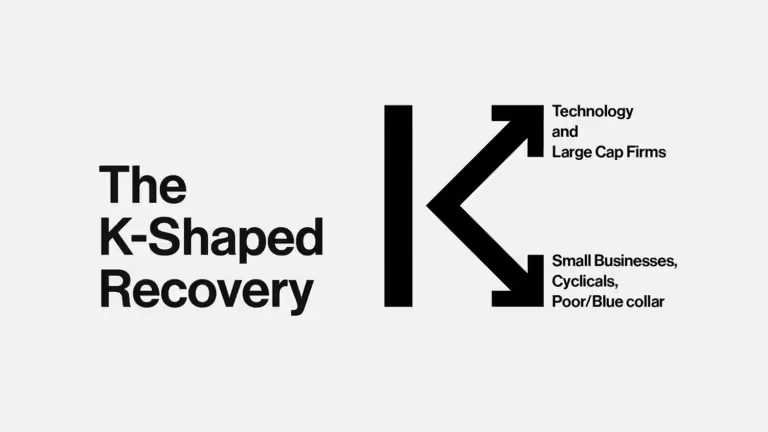
A K-shaped recovery happens when various sectors, industries, or groups of people in the economy recover at various speeds, periods, or amounts. In this type of recovery, certain industries flourish while others stagnate or even dip more. K-shaped recoveries are typically brought on by pre-existing discrepancies or by a recession that has distinct effects on different populations and groups.
The image below is an example of a K-shaped recovery wherein certain industries or sectors perform well and grow while others go into decline and continue to stagnate.
(IMG Credits: Drishti IAS)
A K-shaped recovery could be caused by a variety of distinct economic events. First, a K-shaped recovery can represent the creative destruction that takes place in an economy during a recession when new technology and industries displace older ones. Second, it may show how the government has responded to a downturn in terms of fiscal and monetary policy, which might favor particular parts of the economy more than others.
Alternately, it may merely reflect the disparate effects that the initial recession had on the various sectors of the economy, particularly when the recession occurs concurrently with or is brought on by adverse real economic shocks that target particular sectors of the economy and may have longer-lasting effects on those sectors than on others. Keep in mind that these three requirements might not be exclusive of one another; they might all be at work in a particular K-shaped recovery together with additional elements.
It is hard to say for sure if India is experiencing a K-shaped recovery. However, certain indicators which indicate a K-shaped recovery in India are:
- Two-wheelers are a symbol of India's small businesses as well as the economic position of the lower and middle classes. According to a survey by the analytical firm CRISIL, two-wheeler sales are predicted to fall between 3% and 6% in 2021. This is on top of a lower base that was already impacted by the pandemic in 2020. The actual decrease in two-wheeler sales from before the pandemic must be significantly greater as a result of the base effect. Two-wheeler sales are at their second-lowest level in seven years. It is crucial to remember that among two-wheelers, entry-level vehicles are the ones most adversely impacted. The festival season was supposed to address this issue, but it failed to do so. On the other hand, premium cars and premium motorcycles have been resistant to the pandemic slowdown.
- Over 5 lakh people lost jobs after the lockdown started. Post this, there was a need for an increase in NREGA expenditure to accommodate more people for jobs. However, in the year 2021-2022, the Government of India cut its budget allocation towards MGNREGA by 34%. Thus, the unemployment rate didn’t ease off to pre-COVID levels even after the lockdown was lifted.
A deeper dive into the data of disposable income of the lower, middle, and upper class will show a similar trend which is the reason for the K-shaped recovery.

बेहतर रोज़गार के आकड़ो से कीमती धातुओं में सुधार
सोने की कीमते पिछले सप्ताह कॉमेक्स वायदा बाजार में सात महीने के उच्च स्तरों को छू चुकी है जबकि एमसीएक्स में कीमते 56000 रूपये प्रति दस ग्राम के स्तरों को छू चुकी है। हालांकि, अमेरिका से जारी एडीपी नॉन फार्म एम्प्लॉयमेंट चेंज, बेरोज़गारी के दावे और पैरोल के आकड़ो का बेहतर प्रदर्शन से कीमती धातुओं में उच्च स्तरों पर मुनाफ़ा वसूली रही। फेड मीटिंग के मिनट्स के अनुसार छोटी ब्याज दरों में बढ़ोतरी की संभावना ने डॉलर इंडेक्स पर दबाव बनाया है, जिससे 2022 में एक बुल रन के बाद ग्रीनबैक उच्चतम स्तरों से पलट गया है, और आने वाले महीनों में इसकी कमजोरी कीमती धातुओं को सपोर्ट करेंगी। अमेरिकी ट्रेजरी यील्ड, फेड मिनटों के बाद तेजी से गिरकर तीन सप्ताह के निचले स्तर पर आ गई। फेड मिनट्स स्पष्ट हुआ है कि नीति निर्माताओ की प्राथमिकता मुद्रास्फीति को कम करना है, और उच्च ब्याज दरों को लंबे समय तक बनाए रखने के लिए तैयार हैं। जिससे कीमती धातुओं की तेज़ी सीमित रह सकती है।
लेकिन, अन्य प्रमुख अर्थव्यवस्थाओं में धीमी व्यावसायिक गतिविधि के संकेतों का भी कीमती धातुओं के लिए सकारात्मक है। चीन और अमेरिका की मैन्युफैक्चरिंग पीएमआई के आंकड़े 50 के स्तरों के नीचे है, जो आर्थिक मंदी के डर को बढ़ा रहा है। इंटरनेशनल मॉनेटरी फण्ड द्वारा दुनिया की तीन बड़ी अर्थव्यवस्था अमेरिका, चीन और यूरोप की अर्थव्यवस्था को संकट में बताया है, जिससे कीमती धातुओं में सेफ हैवन मांग बनी हुई है।
सप्ताह के आंकड़े
इस सप्ताह अमेरिका से, मंगलवार को फेड चेयर जेरोम पॉवेल की स्पीच, गुरुवार को सीपीआई (मुद्रास्फीति) और शुक्रवार को कंस्यूमर सेंटीमेंट के आंकड़े प्रमुख है।
तकनिकी विश्लेषण
इस सप्ताह कीमती धातुओं में तेज़ी रहने की सम्भावना है। सोने में सपोर्ट 54000 रुपये पर है और रेजिस्टेंस 56100 रुपये पर है। चांदी में सपोर्ट 67000 रुपये पर है और रेजिस्टेंस 70500 रुपये पर है।
ऐसी और कमोडिटी मार्केट की लेटेस्ट अपडेट के लिए आज ही स्वस्तिका में अपना अकाउंट खुलवाएं

Top Four Rulers of UPI Market
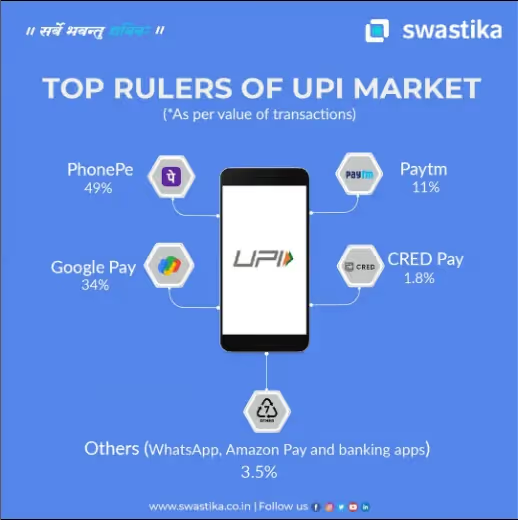
India's digital economy has changed thanks to Unified Payments Interface, which has also sped up the country's move toward a cashless society. In comparison to other payment systems throughout the world, India's UPI system is noticeably more advanced.
According to NPCI, Unified Payments Interface transactions in India increased by 7.7% in October to reach 730 crores, with a total value of more than Rs. 12.11 lakh crore. There were 678 billion UPI transactions in September, with a total value of Rs. 11.16 lakh crore.
Phone Pe
PhonePe is an Indian financial technology and digital payments company with its headquarters in Bengaluru, Karnataka, India. Sameer Nigam, Rahul Chari, and Burzin Engineer cofounded PhonePe In December 2015. The PhonePe app, which is based on the Unified Payments Interface (UPI), went online in August 2016. Flipkart is the owner of PhonePe.
G-Pay
Google Pay is a mobile payment service that allows customers to use their Android watches, tablets, or phones to make payments for goods and services in-app, online, and in-person.
PhonePe and Google Pay made up 83% of the total amount of Unified Payments Interface payments
Paytm
Based in Noida, Paytm is an Indian provider of financial services and digital payments. Vijay Shekhar Sharma launched it in 2010 under One97 Communications.
The transaction values at Paytm Payments Bank, the third-largest UPI provider, increased by 34% month over month to Rs 80,508 crore with an 11% market share.
CRED
CRED is a Bangalore-based fintech business in India. It is a credit card payment app that uses rewards that was established in 2018 by Kunal Shah. Additionally, Cred offers short-term credit lines and allows customers to pay their rent on their homes
Cred, a financial start up, tripled its market share to 1.8% in H1FY22 from a mere 0.42% in H1FY21 on the strength of its inclusion on the coveted unicorn list.
Others
Whatsapp Pay
Despite a sluggish start, analysts predict that Whatsapp Pay will quickly overtake Walmart's PhonePe and GPay to win the most market share if it receives regulatory approval to launch fully.
Since its inception in December 2020, Whatsapp Pay has garnered a minuscule amount of market share in India's escalating UPI competition. Only 0.58 million UPI transactions out of the total 2.7 billion were handled by WhatsApp Pay in March. In reality, Whatsapp's payment service's transaction volume dropped to 0.56 million in January, the second month after it launched, from 0.81 million in December. Since then, the volume of transactions has remained constant.
Bhim
The National Payments Corporation of India created the Unified Payments Interface-based mobile payment app called BHIM.
Amazon Pay
Online payment processing service Amazon Pay is owned by Amazon. Launched in 2007, Amazon Pay focuses on offering consumers the opportunity to use their Amazon accounts to make purchases on websites run by external merchants while utilizing the customer base of Amazon.com.
NPCI Take and Rules ahead
The country's UPI operator, NPCI, declared last month that it will impose a cap of 30% on each player's transaction volume starting in 2021.
According to the rules, the market cap will be determined by the monthly transactions made on the app and will not take into account the total number of users.
When the number of transactions on a certain app exceeds the 25% transaction limit, NPCI will send an alert to the firm that owns the app. When the transactions on the same app exceed the 27% mark, a second alert will be sent. The total number of transactions conducted by UPI over the previous three months will be considered to determine the cap of 30%.
Existing players and third-party app providers (TPAPs) who exceed the set cap will have two years starting in January 2021 to gradually comply with the new rules.
Market giants Google Pay and PhonePe have strongly criticized this decision, arguing that it violates UPI's "free market" principles and might impede the development of the nation's payment infrastructure.
Conclusion
According to UPI's announcement in October 2020, there were 2,071.62 million total transactions, of which 1,655 million were completed using either PhonePe or Google Pay. Just four UPI applications handled over 97% of all transactions, while the remaining 17 UPI apps managed less than 3%.
Big Budget


Popular Articles



.avif)
.avif)

.avif)



START YOUR INVESTMENT JOURNEY
Get personalized advice from our experts
- Dedicated RM Support
- Smooth and Fast Trading App
