


RBI Monetary Policy Signals And The Rupee Rally: A Retail Investor's Guide



Key Takeaways
- Rupee Opens 43 Paise Higher Against U.S. Dollar As Crude Oil Prices Ease.
- The rupee opened at 96.14 per U.S. dollar, compared with its previous close of 96.57.
- Oil prices declined by more than 5% as a pause in military strikes between the U.S. and Iran eased risk appetite.
- The RBI is likely to continue intervening to support the rupee during periods of weakness.
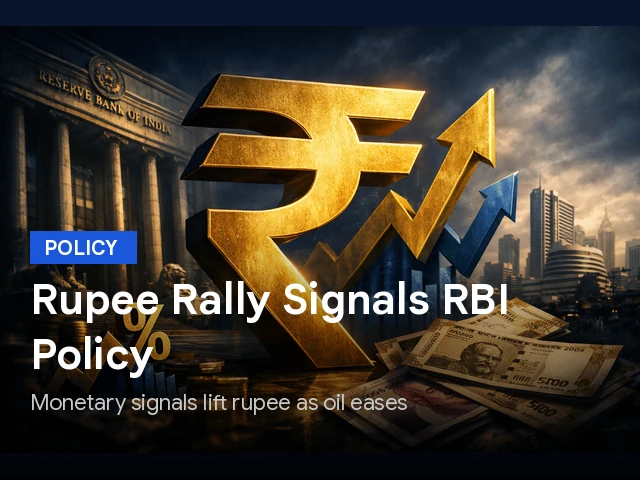
Rupee Opens 43 Paise Higher Against U.S. Dollar As Crude Oil Prices Ease – a move that underscores how global oil flows and geopolitical signals are shaping the currency's near-term trajectory. The domestic currency opened at 96.14 per U.S. dollar, compared with its previous close of 96.57, signaling renewed resilience as oil prices retreat from recent highs. In the backdrop, the rbi monetary policy stance remains a central driver of currency moves, with traders parsing central-bank commentary alongside oil dynamics and global risk appetite. This article unpacks what the price action implies for retail investors and how to prepare your portfolio for the road ahead.
RBI Monetary Policy Signals And The Rupee Rally: What The Open Price Indicates
The opening price around 96.14 per U.S. dollar, and the 43 paise move, reflect a shift in risk sentiment as crude prices ease and political risk cools. The 96.14 level sits near Finrex's expectation of a stronger start near 96.10, which adds to the sense of a supportive baseline for the rupee today. Exporters may wait for more favourable levels to sell USD, while importers could use the stronger rupee to hedge near-term obligations.
The rebound in the rupee came as investors responded to a pause in military strikes between the U.S. and Iran over the weekend, which led to a decline of more than 5% in crude oil prices. Lower oil prices are generally seen as supportive for the Indian currency because India imports a significant share of its crude oil requirements.
RBI intervention is expected to continue to support the rupee during periods of weakness, ensuring that the currency does not overshoot on either side. Markets will watch for signals emanating from the Federal Reserve in terms of its monetary policies, as well as central bank commentary that could steer near-term flows.
Asian currencies trade mixed: Thai baht gained 0.31%, Philippine peso rose 0.206%, Japanese yen gained 0.165%, Malaysian ringgit appreciated 0.13%, Singapore dollar appreciated 0.116%, Renminbi appreciated 0.049%, South Korean won declined 0.324%, Indonesian rupiah slipped 0.15%, Taiwan dollar eased 0.009%.
The U.S. dollar weakened against major global currencies at the start of Asian trading. The softer dollar, combined with lower crude oil prices, provided additional support to emerging market currencies, including the rupee. Crude oil prices and geopolitical events, together with central bank commentary, will be crucial for the rupee. For investors, the implication is clear: monitor RBI policy communications and the Fed's next steps as you plan entries and hedges in USD/INR and related assets. If you want deeper stock-level insights and research that aligns with this macro view, consider Swastika's Sarthi AI stock assistant: Swastika's Sarthi AI stock assistant.


Rupee Opens At 96.14 Per U.S. Dollar: Implications For Importers And Exporters
The rupee's early level around 96.14 underscores near-term hedging considerations for importers and potential selling windows for exporters. Exporters may wait for more favourable levels before selling USD, while importers could use the stronger rupee to hedge their near-term payment obligations. Finrex's forecast of a stronger open near 96.10 reinforces the sense that the current level offers a cushion for hedges rather than a clear trend for a breakout.
In practical terms, near-term risk management matters more than guessing the exact top or bottom. Retail investors should align exposures to rupee-driven currency movements with their stock and bond holdings, rather than chasing headlines. The RBI's approach to smoothing volatility via occasional interventions remains a key anchor, even as oil prices and geopolitics drive daily moves.
Oil Prices, Geopolitics, And The Rupee: Why A More Than 5% Drop In Crude Oil Helps The Currency
The drop in crude oil prices by more than 5% following the weekend pause in U.S.-Iran strikes provides a direct cost relief for India, a major oil importer. Lower oil prices tend to ease the import bill and improve the current account backdrop, which often translates into a more supportive rupee environment. The immediate pricing environment thus ties oil dynamics to currency moves, particularly when the rupee tests key levels or experiences volatility in other risk assets.
With import costs easing, domestic inflation dynamics may get relief, potentially influencing monetary policy expectations and timing. Traders watch for how the oil story interacts with central bank commentary, and with the Fed's path in coming weeks. The interlinked chain of crude, risk sentiment, and policy signals means any positive surprise on oil can help maintain a defined trading range for INR in the near term.
Global Dollar Trends And RBI Intervention: How The Fed And The Softening Dollar Affects Indian Markets
The U.S. dollar weakened against major global currencies at the start of Asian trading, helping EM assets including the rupee. The softer dollar, combined with lower crude oil prices, provided additional support to emerging market currencies and the rupee alike. Markets will watch for signals emanating from the Federal Reserve regarding monetary policy timing, as those cues tend to inform capital flows into India and around the region.
On the policy front, the RBI is likely to continue its interventions to steady the currency during bouts of weakness, aiming to prevent excessive volatility that can feed into inflation and financial conditions. The regional currency performance has been mixed: Thai baht up 0.31%; Philippine peso up 0.206%; Japanese yen up 0.165%; Malaysian ringgit up 0.13%; Singapore dollar up 0.116%; Renminbi up 0.049%; South Korean won down 0.324%; Indonesian rupiah down 0.15%; Taiwan dollar down 0.009%.
What Retail Investors Should Do Now: Strategies In The RBI Monetary Policy Cycle
In this macro backdrop, retail investors can adopt a few disciplined steps to manage risk and capture potential upside from currency-driven moves. Start with a simple framework around the rbi monetary policy cycle and the oil-dollar dynamic described above:
- Hedge USD exposures that arise from international stock purchases or debt servicing; use forwards or options depending on risk tolerance and cost considerations.
- Maintain diversification across asset classes to reduce beta against currency shocks; emphasize high-quality, cash-flow-rich equities and resilient sectors.
- Define a price range for INR pairs and adjust hedges as the rupee moves toward or away from key levels (for example around 96.10 or in the 96.1–96.3 zone).
- Monitor oil prices and Fed cues in parallel with RBI communications; adjust portfolio tilt if the macro picture shifts.
Frequently Asked Questions
What is the current rupee opening level against the U.S. dollar?
The rupee opened at 96.14 per U.S. dollar, compared with its previous close of 96.57.
What factors supported the rupee movement today?
Rupee movement was supported by easing crude oil prices and a pause in U.S.-Iran tensions, with crude prices down more than 5%.
How do lower oil prices affect the rupee?
Lower oil prices are generally supportive for the rupee because India imports a significant share of its crude oil requirements.
What role does the RBI play in currency moves?
The RBI is likely to continue intervening to support the domestic currency during periods of weakness.
What should importers and exporters do in light of the rupee movement?
Importers could use the stronger rupee to hedge near-term payment obligations, while exporters may wait for more favourable levels before selling USD.
Conclusion
The near-term rupee move is a reminder that currency dynamics hinge on a tight fuse between crude oil, policy signals, and global dollar trends. For retail investors, the practical takeaway is to anchor decisions to risk management, hedge near-term exposures, and stay attuned to RBI policy communications and oil-price signals. The road ahead will be defined by how oil prices evolve, how the Fed positions itself, and how the RBI continues to calibrate its interventions to smooth volatility without distorting inflation dynamics. A simple mental model you can apply is: Oil, Dollar, RBI – watch these three knobs, and let discipline in hedging and asset allocation guide your decisions.
Latest Articles
%20(3).avif)
Stock Market Midday Live Updates 23 March 2026: Nifty, Sensex, Bank Nifty Slide Over 2%


The Indian stock market witnessed a sharp sell-off today, with benchmark indices facing heavy losses across sectors. The Nifty 50, Sensex, and Bank Nifty all declined significantly, reflecting weak investor sentiment and broad-based selling pressure. If you’re tracking the stock market crash today, here’s a clear breakdown of what happened, why it matters, and what investors should do next.
Key Takeaways
- Nifty 50 dropped around 2.7 percent, while Sensex fell over 2.5 percent
- Bank Nifty was the worst hit, losing more than 3.4 percent
- Selling pressure was visible across banking, financials, and large-cap stocks
- Weak global cues and profit booking triggered the sharp fall
- IT sector showed relative resilience compared to others
Market Overview: A Broad-Based Sell-Off
Today’s session saw heavy selling right from the opening bell. The Nifty 50 slipped to around 22,489 levels, while the Sensex plunged close to 1,900 points. The Bank Nifty index saw even sharper declines, indicating stress in the financial sector.
The fall was not limited to a few stocks. Instead, it was a widespread correction across sectors, especially in heavyweight banking and financial stocks. This kind of movement typically signals institutional selling or risk-off sentiment among investors.
Why Did the Stock Market Fall Today?
1. Global Market Weakness
Global cues played a major role in today’s downturn. Weakness in US and Asian markets often spills over into Indian equities, especially when foreign institutional investors turn cautious.
2. Profit Booking at Higher Levels
Markets had been trading near record highs in recent sessions. Such sharp corrections are often triggered by profit booking, where investors lock in gains after a rally.
3. Banking Sector Pressure
The steep fall in Bank Nifty suggests strong selling in banking stocks. This could be due to concerns around interest rates, liquidity tightening by the Reserve Bank of India, or valuation concerns.
4. FII Outflows
Foreign Institutional Investors tend to withdraw funds during uncertain global conditions. Increased outflows can put significant pressure on large-cap indices like Nifty and Sensex.
5. Caution Ahead of Economic Data
Markets may also be reacting to upcoming macroeconomic data or policy signals from the RBI or global central banks. Uncertainty often leads to risk-off behavior.
Sector-Wise Impact
Banking and Financials
Banking stocks led the decline, dragging the broader market down. PSU banks and private lenders both faced selling pressure.
IT Sector
Interestingly, the IT sector showed relative stability, with only minor declines. This is often seen when investors rotate into defensive sectors during volatility.
FMCG and Defensive Stocks
Some defensive sectors like FMCG provided mild support but were not strong enough to offset the broader market weakness.
What Should Investors Do Now?
Stay Calm and Avoid Panic Selling
Sharp market falls can trigger emotional decisions. However, panic selling during corrections often leads to losses. Long-term investors should stay focused on fundamentals.
Review Portfolio Allocation
This is a good time to reassess your portfolio. Ensure you are not overexposed to a single sector, especially high-beta sectors like banking.
Look for Buying Opportunities
Corrections often present opportunities to buy quality stocks at lower valuations. Focus on fundamentally strong companies with consistent earnings growth.
Follow SEBI and RBI Guidelines
Investors should always adhere to guidelines set by SEBI and RBI, especially regarding risk management, margin trading, and derivatives exposure.
How Swastika Investmart Can Help
During volatile times like these, having the right broker and advisory support can make a significant difference. Swastika Investmart stands out as a SEBI-registered broker offering:
- Advanced research and advisory tools
- A tech-enabled trading platform for seamless execution
- Strong customer support during market volatility
- A focus on investor education and risk management
These features can help investors make informed decisions rather than reacting emotionally to market swings.
Frequently Asked Questions
Why did the stock market crash today?
The fall was driven by global market weakness, profit booking, banking sector pressure, and possible FII outflows.
Is this a market crash or a correction?
This appears to be a short-term correction rather than a full-scale crash, as markets often consolidate after strong rallies.
Should I invest during a market fall?
Yes, but selectively. Focus on fundamentally strong stocks and avoid speculative investments.
Which sector was hit the most?
Banking and financial stocks saw the sharpest decline, pulling down the overall market.
Is it a good time to start SIPs?
Yes, market corrections are ideal for starting or continuing SIPs, as they allow you to average your investment cost.
Conclusion
Today’s sharp decline in the Indian stock market highlights how quickly sentiment can shift. While the stock market crash today may seem alarming, it is important to view it in the context of a broader market cycle. Corrections are a natural part of investing and often create opportunities for disciplined investors.
If you’re looking to navigate such volatility with confidence, consider exploring a reliable and research-driven platform like Swastika Investmart.
Stay informed, stay patient, and focus on long-term wealth creation.

Set-Off & Carry Forward of Losses: A Complete Tax Guide
Here's the complete blog in copyable text:
META TITLE: Set-Off & Carry Forward of Losses: Tax Guide
META DESCRIPTION: Learn how to set off and carry forward losses under Indian tax law. Save tax legally with this complete guide by Swastika Investmart.
Losing Money in the Market? Here's How the Tax Department Lets You Win It Back
You had a rough year in the markets. Maybe you sold some stocks at a loss, your mutual fund SIP didn't pan out, or that F&O trade went sideways. It stings — but here's something most investors don't fully appreciate: the Income Tax Act actually rewards you for those losses, provided you know how to use them correctly.
Set-off and carry forward of losses is one of the most powerful and underutilised tools in an Indian investor's tax planning toolkit. Done right, it can significantly reduce your tax liability over multiple years. Done wrong — or ignored entirely — and you're leaving real money on the table.
Let's break it down, simply and clearly.
What Does "Set-Off of Losses" Actually Mean?
When your income from one source is negative (i.e., a loss), you're allowed to adjust it against income from another source to reduce your overall taxable income. This process is called set-off.
Think of it like this: if you earned ₹1,00,000 in short-term capital gains from equity mutual funds but lost ₹40,000 selling shares, you don't pay tax on the full ₹1,00,000. You set off the ₹40,000 loss and pay tax only on ₹60,000.
There are two types of set-off:
Intra-Head Set-Off
This means adjusting a loss against income within the same head of income. For example, a loss from one house property can be set off against income from another house property. Similarly, a short-term capital loss can be set off against short-term capital gains.
Inter-Head Set-Off
This involves adjusting a loss from one head of income (say, capital gains) against income from a different head (say, salary or business income). However, the Income Tax Act places strict restrictions here — not everything is allowed.
The Rules: What Can Be Set Off Against What?
This is where most people get confused. Here's a clean breakdown:
Capital Losses
Short-Term Capital Loss (STCL) can be set off against both short-term capital gains (STCG) and long-term capital gains (LTCG).
Long-Term Capital Loss (LTCL) can only be set off against long-term capital gains. It cannot touch short-term gains. This rule changed after Budget 2018, when LTCG on equity was reintroduced — and along with it, LTCL on equity became claimable too.
Real Example: Ravi sold his blue-chip shares in FY2024-25 and booked an LTCL of ₹80,000. He also had LTCG of ₹1,20,000 from a debt mutual fund. He can set off the ₹80,000 loss and pay tax only on ₹40,000. Simple, legal, and effective.
Business & Profession Losses
A loss from a non-speculative business can be set off against any other head of income except salary. However, a speculative business loss (such as intraday equity trading) can only be set off against speculative business profits.
This is crucial for F&O traders. F&O trading is classified as a non-speculative business under Section 43(5). That means an F&O loss can be set off against income from other business activities — or even against salary income in some interpretations, though this remains an area of ongoing tax guidance.
House Property Loss
Loss from house property (usually interest on home loan for a let-out property) can be set off against any other head of income — but only up to ₹2,00,000 per year as per Section 71(3A), introduced in Budget 2017.
What Is Carry Forward of Losses?
Sometimes you can't fully absorb a loss in the same financial year. Maybe your gains aren't large enough. In that case, the Income Tax Act allows you to carry forward the remaining unadjusted loss to future years.
Here's what you need to know:
Type of Loss | Carry Forward Period | Can Be Set Off AgainstShort-Term Capital Loss | 8 years | STCG & LTCGLong-Term Capital Loss | 8 years | LTCG onlyNon-Speculative Business Loss | 8 years | Business incomeSpeculative Business Loss | 4 years | Speculative income onlyHouse Property Loss | 8 years | Income from house propertyUnabsorbed Depreciation | Indefinite | Any head except salary
Important: To carry forward any loss, you must file your Income Tax Return (ITR) on or before the due date. If you miss the deadline, you lose the right to carry forward — except for house property loss and unabsorbed depreciation, which are exceptions.
A Common Mistake That Costs Investors Dearly
Every year, lakhs of investors miss the ITR filing deadline and unknowingly forfeit their right to carry forward capital losses. This is especially common among first-time investors who booked losses in a volatile year and assumed there was "nothing to report."
If you had a net capital loss in any year — file your return on time, even if your total income is below the basic exemption limit. The loss carry forward itself has financial value in future years.
How This Impacts Your Investment Strategy
Understanding these rules should shape how and when you book losses. This practice is widely known as tax-loss harvesting — strategically selling losing positions before year-end to generate a loss you can use to offset gains elsewhere.
For example, if it's March and you're sitting on unrealised LTCG from equity worth ₹1.5 lakh (taxable at 12.5% above ₹1.25 lakh), but you also hold a stock showing an unrealised LTCL of ₹40,000 — selling that loss-making stock before March 31 reduces your net LTCG to ₹1.1 lakh, potentially bringing it within the exemption limit.
This is entirely legal and is a smart move that disciplined investors make every year.
Key Sections of the Income Tax Act to Know
Section 70: Intra-head set-off of lossesSection 71: Inter-head set-off of lossesSection 72: Carry forward and set-off of business lossesSection 74: Carry forward and set-off of capital lossesSection 71B: Carry forward of house property losses
These sections together form the backbone of loss management under Indian tax law.
Frequently Asked Questions
Q. Can I set off my stock market losses against my salary income?A. Generally, no. Capital losses (short-term or long-term) cannot be set off against salary income. However, F&O losses, being business losses, can potentially be set off against other non-salary business income. Always consult a tax advisor for your specific situation.
Q. What happens if I don't file my ITR on time — do I lose my losses forever?A. For most losses (except house property loss and unabsorbed depreciation), yes — you lose the carry forward benefit if you file a belated return. This is one of the strongest reasons to always file on time.
Q. Can long-term capital loss on equity shares be set off after Budget 2018?A. Yes. Since April 1, 2018, LTCG on listed equity exceeding ₹1.25 lakh is taxable at 12.5%, and correspondingly, LTCL on equity is now an allowable loss that can be set off against other LTCG and carried forward for 8 years.
Q. Is intraday trading loss treated differently from regular equity loss?A. Yes. Intraday equity trading is classified as speculative business income. Losses from it can only be set off against speculative profits and carried forward for only 4 years, not 8.
Q. Can I carry forward losses even if I have zero taxable income that year?A. Yes, as long as you file your ITR before the due date. Filing on time is the only condition. Zero income is not a disqualifier.
Conclusion: Losses Are Not Dead Money — If You Plan Right
Most investors treat a loss as a setback and move on. Savvy investors treat it as a tax asset — something that can quietly reduce their tax bill for years to come. The difference between the two often comes down to awareness and timely action.
India's tax framework, while complex, is actually quite generous when it comes to loss utilisation. Eight years of carry forward for capital losses is a long runway. Use it.
If you're unsure how to record, report, or utilise your investment losses, having the right broker and the right research support makes all the difference.
At Swastika Investmart, a SEBI-registered broker with decades of experience in Indian capital markets, you get more than just a trading account. You get access to expert research, tax-aware investment guidance, and a support team that helps you make informed decisions — not just buy and sell decisions.

Infosys Partners with Formula E: How AI is Transforming Motorsport Analytics
Quick Summary
- Infosys has partnered with Formula E to enhance AI-driven race analytics
- Real-time data, predictive insights, and fan engagement are key focus areas
- The deal strengthens Infosys’ positioning in global digital transformation
- Highlights India’s growing influence in AI and sports technology
- Positive long-term sentiment for IT sector innovation
Infosys Partners with Formula E: A New Era of AI in Motorsport
When Infosys collaborates with Formula E, it’s not just a sponsorship. It’s a strategic move that showcases how artificial intelligence is reshaping high-performance sports.
This partnership is a clear signal that motorsport is no longer just about speed and engineering. It is now equally about data, analytics, and real-time intelligence.
What the Infosys and Formula E Partnership Means
Infosys has stepped in as a digital innovation partner for Formula E, focusing on advanced analytics, AI-powered insights, and fan engagement platforms.
Key Focus Areas
Real-Time Race Analytics
AI systems process massive volumes of race data, including battery performance, lap times, and driver behavior. This helps teams make split-second decisions during races.
Predictive Performance Models
Using machine learning, teams can predict outcomes such as energy usage, tire wear, and overtaking opportunities.
Enhanced Fan Experience
Fans now get access to deeper insights, including race predictions and interactive dashboards, making the viewing experience more engaging.
How AI is Transforming Motorsport Analytics
Motorsport has always been data-driven, but AI is taking it to the next level.
From Data Collection to Decision Making
Earlier, teams relied on historical data and human analysis. Now, AI can process millions of data points in seconds.
For example, during a race, AI can suggest the optimal moment to conserve battery or push for overtaking. This can be the difference between winning and losing.
Real-World Example
Imagine a Formula E car nearing the final laps with limited battery. AI algorithms can instantly calculate whether the driver should defend position or attempt an aggressive move.
This kind of decision-making was nearly impossible a decade ago.
Why This Partnership Matters for Infosys
This collaboration strengthens Infosys’ global brand as a leader in digital transformation.
Expanding Beyond Traditional IT Services
Infosys is no longer just an outsourcing company. It is positioning itself as an innovation-driven enterprise focusing on AI, cloud, and analytics.
High-Visibility Global Platform
Formula E is a global championship with strong sustainability messaging. Associating with it enhances Infosys’ ESG narrative and global visibility.
Impact on Indian IT Sector and Markets
This partnership is not just about motorsport. It has broader implications for Indian markets.
Boost to IT Sector Sentiment
Deals like this reinforce investor confidence in Indian IT companies’ ability to lead in emerging technologies like AI and data analytics.
Peers such as Tata Consultancy Services and Wipro are also investing heavily in similar capabilities.
AI as a Growth Driver
With global demand for AI solutions rising, Indian IT firms are well-positioned to capture this opportunity.
Market Perspective
Such strategic partnerships often improve long-term valuations, as they signal strong order pipelines and innovation capabilities.
Competitive Landscape
Infosys operates in a highly competitive environment, where global players and Indian peers are all racing toward AI dominance.
However, partnerships like Formula E give Infosys a unique edge by showcasing real-world applications of its technology.
This is not just theory or lab innovation. It is live, high-pressure deployment.
What It Means for Investors
For investors, this partnership is a subtle but important signal.
Long-Term Growth Potential
AI and analytics are expected to drive the next wave of IT sector growth. Infosys is positioning itself right at the center of this shift.
Not an Immediate Trigger
While the deal may not cause immediate stock movement, it strengthens the company’s long-term narrative.
Strategic Positioning
Investors should look at such partnerships as indicators of future revenue streams and innovation capabilities.
Regulatory and Industry Context in India
India is actively promoting AI adoption through initiatives like Digital India and increased focus on data infrastructure.
Regulatory bodies such as Securities and Exchange Board of India are also encouraging transparency and tech-driven innovation in financial markets.
This creates a favorable ecosystem for companies like Infosys to scale their AI capabilities.
FAQs
1. What is the Infosys Formula E partnership about?
Infosys has partnered with Formula E to provide AI-powered analytics, improve race strategies, and enhance fan engagement.
2. How is AI used in motorsport?
AI is used for real-time data analysis, predictive modeling, energy management, and strategic decision-making during races.
3. Does this partnership impact Infosys stock?
It may not have an immediate impact, but it strengthens long-term growth prospects and brand positioning.
4. Why is Formula E important for this collaboration?
Formula E focuses on electric mobility and sustainability, aligning well with Infosys’ innovation and ESG goals.
5. What does this mean for Indian IT companies?
It highlights the growing global demand for AI solutions and strengthens the position of Indian IT firms in advanced technologies.
Conclusion
The Infosys and Formula E partnership is a perfect example of how technology and sports are merging in powerful ways.
It shows that AI is no longer a futuristic concept. It is already shaping decisions in high-speed, real-world environments.
For investors, this is a reminder to look beyond short-term numbers and focus on long-term innovation trends.
If you want to stay ahead in such evolving market opportunities, having the right platform matters. Swastika Investmart offers SEBI-registered services, strong research tools, reliable customer support, and a tech-enabled investing experience designed for modern investors.

Powerica IPO: ₹1,400 Crore Issue – Full Breakdown & Investment Verdict
Quick Summary
- Powerica IPO comes with a price band of ₹375–₹395 and a moderate valuation of ~24.45x P/E
- Revenue growth is decent, but profits and margins are declining
- Strong presence in DG sets and renewable energy, but high dependency risks exist
- Suitable for long-term, risk-tolerant investors, not ideal for listing gains
- Apply cautiously with limited allocation
Powerica IPO: A Detailed Breakdown for Investors
The Powerica IPO has entered the primary market with a total issue size of around ₹1,400 crore, attracting attention from investors looking at the power and energy sector. But does it truly offer value, or is it another case of growth without profitability?
Let’s break it down in a simple, practical way so you can make an informed decision.
About Powerica Limited
Powerica Limited is an integrated power solutions company focused on manufacturing and supplying diesel generator sets. Its products range from 7.5 kVA to 10,000 kVA, catering to industries that require reliable backup and primary power solutions.
Beyond traditional generators, the company has also expanded into renewable energy, particularly wind power, where it operates as an independent power producer and provides EPC and maintenance services.
In simple terms, Powerica operates in both conventional and green energy segments, which is a positive diversification move.
Powerica IPO Details
- IPO Size: ₹1,400 crore
- Price Band: ₹375 – ₹395 per share
- Lot Size: 37 shares
- Listing: NSE & BSE
- Market Cap (Pre-IPO): ₹4,998.60 crore
Issue Allocation
- QIB: 50%
- NII: 15%
- Retail: 35%
Important Dates
- IPO Opens: March 24, 2026
- IPO Closes: March 27, 2026
- Listing Date: April 2, 2026
Financial Performance: Growth vs Profitability
Let’s look at what really matters, the numbers.
Revenue Trend
- FY23: ₹2,422 crore
- FY24: ₹2,356 crore
- FY25: ₹2,710 crore
The company posted around 15% growth in FY25, showing demand traction.
Profit Trend
- FY23: ₹106 crore
- FY24: ₹226 crore
- FY25: ₹175 crore
Despite revenue growth, profits declined by ~22% YoY in FY25, which raises concerns.
Margins
- EBITDA Margin FY24: 15.38%
- EBITDA Margin FY25: 12.76%
This drop indicates rising costs and pressure on profitability.
Valuation Check: Expensive or Fair?
The IPO is priced at a P/E of ~24.45x, which appears reasonable compared to some high-valued peers.
However, valuation alone doesn’t tell the full story.
When profits are declining and margins are shrinking, even a reasonable valuation can turn expensive.
Strengths of Powerica
Diversified Power Business
The company operates across diesel generators and renewable energy, giving it a broader revenue base.
Strong Industry Demand
With rising infrastructure and power needs in India, DG sets continue to see steady demand.
Long Operating History
Powerica has built a solid presence in power solutions, which adds credibility.
Expansion into Renewables
The move into wind and hybrid projects aligns with India’s clean energy push.
Key Risks You Should Not Ignore
Declining Profitability
Revenue is growing, but profits and margins are falling. This is a major red flag.
Heavy Dependency on DG Sets
A large chunk of revenue comes from generator sets, making the business less diversified than it appears.
Supplier Dependency
Reliance on key suppliers like Cummins and Hyundai increases operational risk.
Legal and Operational Risks
Ongoing legal proceedings involving promoters could impact future performance.
Renewable Segment Uncertainty
The wind power business depends heavily on OEM relationships and project execution.
Real-World Perspective
Think of Powerica like a company selling backup power solutions in a country where electricity reliability is improving.
As India strengthens its power infrastructure and shifts toward renewable energy, long-term demand for diesel generators could face pressure.
At the same time, their renewable segment is still evolving and not yet strong enough to fully offset this risk.
Powerica IPO: Investment Verdict
Powerica IPO presents a mixed picture.
On one hand, it operates in a critical sector with steady demand and is expanding into renewables.
On the other hand, declining profits, shrinking margins, and dependency risks cannot be ignored.
Final Take
- Not ideal for short-term listing gains
- Suitable for long-term investors with high risk appetite
- Best strategy is to apply cautiously with limited allocation
How This IPO Impacts Indian Markets
The Powerica IPO reflects a broader trend in India where traditional industrial companies are attempting to transition into renewable energy.
Investors are increasingly focusing not just on growth, but also on profitability and sustainability.
This shift means IPOs with inconsistent earnings may face muted listing responses unless backed by strong narratives or demand.
FAQs
1. Is Powerica IPO good for listing gains?
Not really. Due to declining profits and moderate valuation, listing gains may be limited.
2. What is the minimum investment required?
You need to apply for at least 37 shares, which is around ₹14,615 at the upper price band.
3. Is Powerica a profitable company?
Yes, but profits have declined recently despite revenue growth, which is a concern.
4. What are the biggest risks in this IPO?
Declining margins, supplier dependency, and legal issues involving promoters.
5. Should long-term investors consider this IPO?
Yes, but only with a small allocation and a long-term perspective.
Conclusion
The Powerica IPO is neither a clear winner nor a complete avoid. It sits somewhere in between.
If you are a cautious investor, it’s better to wait and watch post-listing performance. If you are comfortable with risk and looking for long-term exposure to the power solutions sector, a small allocation can be considered.
To make smarter IPO decisions backed by research, tools, and expert insights, consider opening an account with Swastika Investmart. Their SEBI-registered platform, strong research capabilities, and investor-first approach make navigating IPOs much easier.

Amir Chand Jagdish Kumar IPO: GMP, Price Band, Dates & Full Analysis
Quick Summary
- IPO price band is set at ₹201 to ₹212 per share
- Issue opens on March 24, 2026 and closes on March 27, 2026
- Strong revenue growth but relatively low return ratios
- Valuation appears expensive compared to industry peers
- Risk factors include customer concentration and governance concerns
Introduction
The Amir Chand Jagdish Kumar IPO has attracted attention in the primary market, especially among investors looking for opportunities in the FMCG and export-driven businesses. The company operates in the basmati rice segment, a niche yet competitive space in India’s agri-export ecosystem.
But the real question is simple: Is this IPO worth your money, or should you stay cautious? Let’s break it down in a structured and practical way.
IPO Details at a Glance
Key Information
- IPO Opening Date: March 24, 2026
- IPO Closing Date: March 27, 2026
- Price Band: ₹201 to ₹212 per share
- Lot Size: 70 shares
- Listing: BSE and NSE
- Tentative Listing Date: April 2, 2026
- Total Issue Size: ₹2,195 crore
Reservation Breakdown
- QIB: 50%
- NII: 15%
- Retail: 35%
The IPO primarily aims to fund working capital requirements and general corporate purposes, which is common in businesses dealing with inventory-heavy operations like rice processing.
About the Company
Amir Chand Jagdish Kumar (Exports) Limited is engaged in processing and exporting basmati rice along with other FMCG products. The company operates across the entire value chain including procurement, storage, processing, packaging, and distribution.
Business Highlights
- Strong presence in domestic and international markets
- Exports to Middle East and other regions
- Portfolio includes basmati rice, brown rice, sona masuri, and more
- FMCG expansion with products like atta, maida, and besan
- Flagship brand “Aeroplane” with multiple sub-brands
The company operates processing units in Punjab and Haryana, with packaging facilities in Delhi.
Financial Performance
A company’s financials tell the real story, and here’s how this one looks:
Revenue Growth
- FY23: ₹1,317 crore
- FY24: ₹1,551 crore
- FY25: ₹2,004 crore
This consistent growth reflects strong demand and expansion.
Profitability
- Net Profit FY23: ₹17.5 crore
- Net Profit FY24: ₹30.4 crore
- Net Profit FY25: ₹60.8 crore
Profit has nearly doubled in one year, which is a positive signal.
Margins
- EBITDA Margin FY25: 42.06%
Margins are strong, indicating efficient operations.
Key Financial Ratios
- P/E Ratio (Pre-IPO): 28.86x
- ROCE: 9.16%
While profitability looks good, the return on capital is relatively low. This means the company is not using its capital as efficiently as expected for this type of business.
Peer Comparison
When compared with companies like LT Foods, KRBL, and GRM Overseas, the valuation appears on the higher side.
For example, several listed peers trade at lower P/E multiples, which raises concerns about overpricing.
This becomes important because even a good business can be a poor investment if bought at a high valuation.
Strengths of the IPO
Strong Business Model
The company has an integrated model covering the entire rice value chain, which improves efficiency and control.
Established Brand Presence
Its flagship brand has recognition in both domestic and export markets.
Wide Distribution Network
Over 400 distributors in India and 50+ overseas distributors provide a strong reach.
Diversification
Expansion into FMCG products reduces dependency on a single category.
Key Risks You Should Know
High Valuation
The IPO is priced higher than most of its peers, leaving limited upside for investors.
Low ROCE
A return of 9.16% is not very attractive for a business of this nature.
Customer Concentration Risk
A significant portion of revenue comes from a limited number of clients.
Working Capital Intensive
The business requires heavy investment in inventory, especially during procurement seasons.
Governance Concern
The absence of product liability insurance is a serious red flag for an export-oriented food company.
GMP and Listing Expectations
As of now, the Grey Market Premium for the Amir Chand Jagdish Kumar IPO remains uncertain and volatile. Investors should avoid relying solely on GMP for decision-making.
In many recent IPOs, GMP has failed to accurately predict listing performance. Hence, focusing on fundamentals is a smarter approach.
Should You Apply or Avoid?
This IPO presents a mixed picture.
On one hand, the company shows strong revenue growth, improving profitability, and a scalable business model. On the other hand, high valuation, low capital efficiency, and governance concerns cannot be ignored.
For conservative investors or long-term portfolios, it may be better to wait and watch post-listing performance.
For aggressive investors, this could be a risky bet rather than a high-conviction opportunity.
Real Market Context
India is one of the largest exporters of basmati rice, and demand from regions like the Middle East remains strong. However, the sector is highly competitive with established players already listed.
Moreover, agri-based businesses are exposed to raw material price fluctuations, government policies, and export restrictions, which can impact margins.
FAQs
1. What is the price band of Amir Chand Jagdish Kumar IPO?
The price band is ₹201 to ₹212 per share.
2. What is the lot size?
The minimum lot size is 70 shares.
3. What are the key risks in this IPO?
High valuation, low ROCE, customer concentration, and governance concerns.
4. Is this IPO good for long-term investment?
It may not be ideal for conservative long-term investors due to valuation concerns.
5. Where will the shares be listed?
The shares will be listed on BSE and NSE.
Conclusion
The Amir Chand Jagdish Kumar IPO offers growth potential but comes with noticeable risks. While the company’s financial growth is impressive, valuation and operational concerns make it less attractive at current levels.
Investors should carefully evaluate their risk appetite before applying and avoid making decisions based solely on hype or GMP.
If you are looking for well-researched IPO insights, smart tools, and expert-backed recommendations, platforms like Swastika Investmart can help you make informed investment decisions with confidence.
Market Opening Updates for Today 23 March 2026: Nifty 50, Sensex, Bank Nifty and IT Stocks Open in Red
The Indian stock market started the session on a weak note today, reflecting cautious investor sentiment and broad-based selling across key indices. Early trends indicate pressure in banking, IT, and large-cap stocks, suggesting global cues and profit booking are weighing on the market.
Summary
- Nifty 50 falls over 1.2 percent in early trade
- Sensex drops more than 800 points, signaling weak sentiment
- Bank Nifty leads losses with nearly 1.6 percent decline
- IT stocks remain under pressure amid global concerns
- Overall market breadth hints at cautious investor positioning
Market Opening Snapshot: Weak Start Across Indices
The benchmark index Nifty 50 opened at 22,824.35, down by 290.15 points or 1.26 percent, reflecting selling pressure in frontline stocks.
Similarly, BSE Sensex declined sharply to 73,732.58, losing 800.38 points or 1.07 percent in early trade.
The broader weakness was more visible in the banking space. Nifty Bank dropped 850.95 points or 1.59 percent, making it the worst-performing sector at the open.
Meanwhile, the tech-heavy Nifty IT slipped 1.20 percent, continuing its recent trend of volatility.
Why Is the Market Falling Today?
1. Global Market Weakness
Global markets have been under pressure due to rising bond yields and uncertainty around interest rate policies. Weak cues from the US and Asian markets often impact Indian equities, especially large-cap and IT stocks.
2. Banking Stocks Drag the Market
The sharp decline in Bank Nifty suggests selling in major banking stocks. This could be due to profit booking after recent rallies or concerns related to liquidity and credit growth outlook.
3. IT Sector Under Pressure
The IT sector continues to face headwinds due to slowdown concerns in global economies. Since Indian IT companies derive a large share of revenue from overseas markets, any slowdown impacts sentiment.
4. Cautious Institutional Activity
Foreign Institutional Investors tend to reduce exposure during uncertain global conditions. As per trends observed in recent sessions, FIIs may be booking profits or shifting to safer assets.
Sectoral Overview: Who’s Losing the Most?
Banking Sector
Banking stocks are leading the decline today. This is critical because Bank Nifty often sets the tone for the broader market. Weakness here usually signals short-term caution.
IT Sector
IT stocks are also under pressure, indicating concerns about global demand. Investors are closely watching upcoming earnings guidance for clarity.
Broader Market Sentiment
The overall market sentiment appears risk-off. Midcap and smallcap stocks may also see volatility if the weakness continues.
What Should Investors Do Now?
Stay Calm and Avoid Panic Selling
Market corrections are a normal part of investing. Sudden falls at the opening often stabilize during the session.
Focus on Quality Stocks
Investors should focus on fundamentally strong companies rather than reacting to short-term volatility.
Watch Key Levels
Technical levels in Nifty and Bank Nifty will be crucial for intraday traders. A break below support could lead to further downside.
Follow Regulatory Guidance
Investors should rely on credible sources and adhere to guidelines from Securities and Exchange Board of India and Reserve Bank of India for safe investing practices.
How Swastika Investmart Helps in Volatile Markets
Navigating market volatility requires the right tools and guidance. Swastika Investmart stands out as a SEBI-registered broker offering:
- Strong research-backed insights
- Advanced trading platforms
- Reliable customer support
- Investor-focused education resources
Their tech-enabled ecosystem helps investors make informed decisions even during uncertain market conditions.
Frequently Asked Questions
Why is the stock market down today?
The market is down due to weak global cues, selling in banking stocks, and continued pressure in the IT sector.
Which sector is the worst performer today?
The banking sector is currently the worst performer, with Bank Nifty falling the most.
Should I invest during a falling market?
Yes, but focus on fundamentally strong stocks and adopt a long-term perspective rather than reacting to short-term dips.
How are global markets affecting India?
Indian markets are closely linked to global trends. Weakness in US and Asian markets often impacts investor sentiment in India.
Is this a short-term correction or a trend reversal?
It is too early to confirm. Investors should watch key support levels and upcoming global and domestic triggers.
Conclusion
The market opening on 23 March 2026 reflects a cautious and slightly bearish sentiment, driven by global uncertainties and sector-specific weakness. While indices like Nifty, Sensex, Bank Nifty, and IT stocks are under pressure, such phases are not uncommon in equity markets.
For investors, the key lies in staying disciplined, focusing on quality investments, and avoiding impulsive decisions. Market volatility often creates opportunities for those with a long-term vision.
If you are looking to navigate such market conditions with confidence, explore expert-backed insights and tools offered by Swastika Investmart.
Big Budget


Popular Articles





.avif)
.avif)

.avif)



START YOUR INVESTMENT JOURNEY
Get personalized advice from our experts
- Dedicated RM Support
- Smooth and Fast Trading App
