


Inside the IPO Filing Process from DRHP to Listing Day


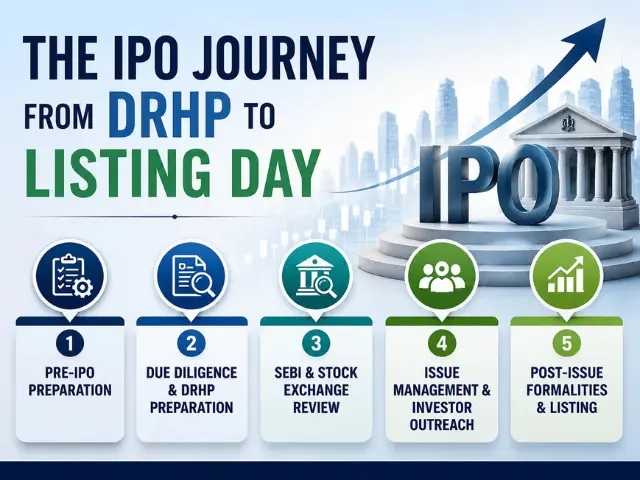

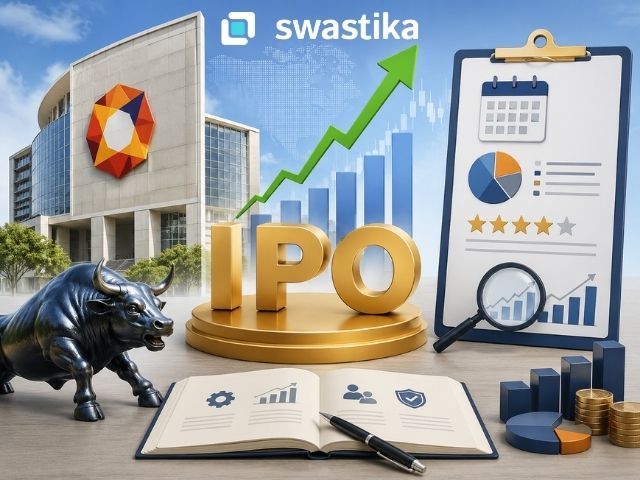
An IPO is often perceived as a single event. In reality, it is a tightly regulated capital markets transaction that tests a company’s governance, financial maturity and disclosure standards. Long before the stock lists, months of preparation go into drafting, verification, regulatory review and investor positioning.
Why the Filing Process Matters
The offer document is the backbone of the IPO. For SEBI, it is a legal disclosure document. For investors, it is the primary source of truth.For the company, it becomes a permanent public record. Gaps in statutory disclosures or inconsistencies in financial reporting may result in approval delays and affect investor confidence.
Phase I: Pre IPO Preparation
The IPO process begins well before drafting the prospectus. At this stage, the company prepares itself to operate as a listed entity. Key actions include finalising the issue structure, converting into a public limited company, updating constitutional documents, strengthening board and committee structures, appointing key managerial personnel and dematerialising shareholding.
Phase II: Due Diligence and DRHP Preparation
This is the most intensive stage of the IPO journey. The Merchant Banker conducts detailed financial, legal and business due diligence, followed by preparation of the Draft Red Herring Prospectus covering company profile, industry overview, risks, financials and utilisation of proceeds.
Phase III: SEBI and Stock Exchange Review
SEBI, along with the stock exchanges, reviews the DRHP to ensurefull and fair disclosures, eligibility, and governance compliance. All queries and observations are addressed before final In-Principal approval.
Phase IV: Issue Management and Investor Outreach
Post regulatory clearances, the Red Herring Prospectus is finalised and the issue pricing is decided. Merchant Bankers, working closely with syndication and underwriting teams, drive investor outreach and roadshows, while market makersplay a role in supporting orderly trading and liquidity (in case of SME-IPO), in line with applicable issue regulations.
Phase V: Post Issue Formalities and Listing
After the issue closes, the basis of allotment is finalised, funds are reconciled by the banker to the issue, and shares are credited to investors’ demat accounts. In cases of oversubscription, allotment is carried out as per category-wise allocation norms, with proportionate or lottery-based distribution and refunds/unblock of excess application amounts. The company then lists on the stock exchanges and enters the post-listing compliance framework. Syndication and underwriting teams continue to support investor engagement, while issuer-led marketing and investor interactions remain ongoing. Anchor investors participate up to one working day prior to the issue opening, helping establish early demand visibility and confidence in the offering.
Role of the Merchant Banker
The Merchant Banker anchors the IPO end-to-end, beginning with comprehensive due diligence and preparation of offer documentation. They act as the primary interface with SEBI and Stock Exchanges, provide valuation and structuring advice, and lead investor marketing efforts. In coordination with syndication and underwriting teams, the merchant banker supports book building, demand aggregation, and risk underwriting. Post listing, they also facilitate market-making arrangements and ensure regulatory and compliance requirements are met, enabling a smooth transition from a privately held company to the public markets.
Closing Thoughts
The IPO process shows how ready a company is to operate in public markets. With the right Merchant Banker guiding the company at every stage, the journey becomes well-planned and manageable, helping the business move smoothly into the listed space and build long-term, sustainable growth.
👉 To Connect with us today, please click here.
Latest Articles
Different Types of Bonds


Introduction
Welcome! Today, we’re going to explore the world of bonds, a key component of the financial markets. Bonds are essentially loans made by investors to borrowers, usually corporations or governments. In return, the borrower agrees to pay interest over a specified period and repay the principal at maturity. Let's break down the different types of bonds you might encounter.
1. Government Bonds
Government bonds are issued by a national government and are considered one of the safest investments since they are backed by the government's credit. In India, these are known as Government Securities (G-Secs).
- Example: Indian Government Bonds, such as the 10-Year G-Sec, offer a fixed interest rate and are a preferred choice for conservative investors.
2. Corporate Bonds
Corporate bonds are issued by companies to raise capital. They typically offer higher interest rates than government bonds to compensate for the increased risk.
- Example: Reliance Industries issues corporate bonds that offer investors a higher return compared to government bonds but with a slightly higher risk.
3. Municipal Bonds
Municipal bonds are issued by local government bodies, such as states or municipalities, to finance public projects like schools or infrastructure. These bonds often provide tax advantages to investors.
- Example: In the U.S., municipal bonds are common, but in India, similar bonds are less prevalent. However, urban development bonds issued by state governments can be considered a counterpart.
4. Zero-Coupon Bonds
Zero-coupon bonds do not pay periodic interest. Instead, they are issued at a discount to their face value and mature at par. The difference between the purchase price and the face value represents the investor's return.
- Example: Treasury Bills (T-Bills) in India are short-term zero-coupon bonds issued by the government, typically maturing in less than a year.
5. Convertible Bonds
Convertible bonds offer the option to convert the bond into a predetermined number of the company's equity shares. This feature provides potential upside if the company's stock performs well.
- Example: A company like Tata Motors might issue convertible bonds that can be converted into equity shares after a certain period, allowing investors to participate in the company’s growth.
6. Inflation-Linked Bonds
These bonds are designed to protect investors from inflation. The principal and interest payments are adjusted based on inflation rates, ensuring that the purchasing power of the investment is maintained.
- Example: The Government of India issues Inflation-Indexed Bonds (IIBs) that adjust the principal amount based on the inflation rate, protecting investors from the eroding effects of inflation.
7. Callable and Puttable Bonds
- Callable Bonds: These bonds can be "called" or redeemed by the issuer before the maturity date, usually when interest rates drop.
- Puttable Bonds: These allow investors to "put" or sell the bond back to the issuer before maturity, typically if interest rates rise or if they need liquidity.
- Example: A callable bond issued by a corporation may be redeemed if interest rates decline, allowing the company to refinance at a lower rate.
8. Foreign Bonds
Foreign bonds are issued in a country by a non-domestic entity and are denominated in the currency of the country where they are issued.
- Example: Masala Bonds are a type of foreign bond issued by Indian companies in Indian Rupees but sold to foreign investors.
Conclusion
Bonds are a versatile investment option, offering something for every type of investor, from the risk-averse to those seeking higher returns. Whether you’re interested in the safety of government bonds or the potential growth from corporate and convertible bonds, understanding the different types of bonds can help you make more updated investment decisions.

Understanding Reverse Stock Splits
Introduction
Welcome! Today, we’re delving into the intriguing concept of reverse stock splits. Though it might sound complex, it's a straightforward concept once you break it down. A reverse stock split is a corporate action where a company reduces the number of its outstanding shares. This process effectively increases the share price proportionally. Let’s explore what this means and why companies might choose to perform a reverse stock split.
What is a Reverse Stock Split?
In a reverse stock split, a company consolidates its shares. For instance, in a 1-for-10 reverse stock split, every 10 existing shares are merged into 1 new share. This reduces the total number of shares outstanding but increases the share price accordingly.
Why Do Companies Perform Reverse Stock Splits?
- Increase Share Price: Companies often use reverse stock splits to boost their share price. This is especially useful for maintaining a minimum share price requirement for listing on stock exchanges. A higher share price can help avoid delisting from major stock exchanges.
- Improve Perception: A higher share price can positively affect how investors and analysts view the company. It may attract more investment and improve the company's overall market perception.
- Reduce Volatility: By consolidating shares, companies can reduce the volatility of their stock price. This makes the stock less susceptible to small price fluctuations, which can be beneficial for both the company and its investors.
How Does a Reverse Stock Split Work?
Here’s a simple example to illustrate:
- Before the Split: Imagine a company with 1,000,000 shares outstanding, each priced at ₹10. The total market capitalization is ₹10,000,000.
- After a 1-for-10 Reverse Split: The company will have 100,000 shares outstanding, each priced at ₹100. The total market capitalization remains ₹10,000,000.
Effects on Shareholders
- Shareholder Equity: Shareholders will own fewer shares after the split. However, the total value of their investment remains the same, assuming no other market changes. For example, if you owned 1,000 shares priced at ₹10 each before the split, you would own 100 shares priced at ₹100 each after the split.
- Stock Price: The price per share increases proportionally to the reverse split ratio. While the price per share rises, the overall value of the investment does not change immediately.
- Future Trading: A higher share price might make the stock more attractive to institutional investors and reduce the risk of being delisted from major exchanges. This could lead to increased trading activity and improved market perception.
Risks and Considerations
- Market Perception: Reverse stock splits can sometimes be viewed negatively. They might signal that a company is struggling or trying to artificially boost its stock price. This perception can affect investor confidence.
- Impact on Liquidity: Reducing the number of shares can impact trading liquidity. Fewer shares available in the market might make it harder for investors to buy or sell shares, potentially leading to wider bid-ask spreads.
Examples of Reverse Stock Splits
- Company A: Tata Motors: Tata Motors performed a 1-for-10 reverse stock split in 2018. Before the split, the share price was around ₹40, and after the split, it was adjusted to ₹400. The split was intended to increase the share price and improve liquidity.
- Company B: Zee Entertainment: Zee Entertainment executed a 1-for-5 reverse stock split in 2022. Before the split, the share price was approximately ₹30, and after the split, it increased to ₹150. This move aimed to meet the listing requirements and attract more institutional investors.
Conclusion
Reverse stock splits are strategic actions by companies to manage their share price and market perception. While they can offer benefits such as increased share price and improved investor perception, they also come with risks and considerations. It’s essential to stay informed and understand the broader context when evaluating the impact of reverse stock splits on your investments.

Sapphire Foods India Limited IPO
Sapphire Foods India limited one of YUM’s franchisee operators in the Indian subcontinent. They are also Sri Lanka’s largest international QSR chain, in terms of revenue. Company also established a presence in the Maldives. Company-owned and operated 209 KFC restaurants in India and the Maldives, 239 Pizza Hut restaurants in India, Sri Lanka and the Maldives, and two Taco Bell restaurants in Sri Lanka. They operate their restaurants in high traffic and high visibility locations in key metropolitan areas and cities across India and develop new restaurants in new cities as part of their brand and food category expansion. The company has an in-house supply chain function and works with vendor partners for food ingredients, packaging, warehousing, and logistics. The company operates warehouses across 5 Indian cities and has invested in building technology solutions in their restaurants. The company employs YUM brand's global online and digital channel solutions to enhance customer experience and achieve operational efficiency and financial control.
- Food services is a key segment in the Indian economy, with a market size of US$26.8 billion in the financial year 2021 growth of the food services sector in India is expected to grow more.
- Company’s franchisee Arrangement also provides a right to use YUM’s system and system property covering all aspects of business operations, as well as the flexibility to undertake, with YUM’s approval, local or regional promotions, while meeting YUM’s global quality assurance standards.
- The organized market, consisting of chain and organized standalone outlets, is expected to increase its share in the food services market in India from 37.8% in financial year 2020 to 51.3% in financial year 2025.
Outlook & Valuation:
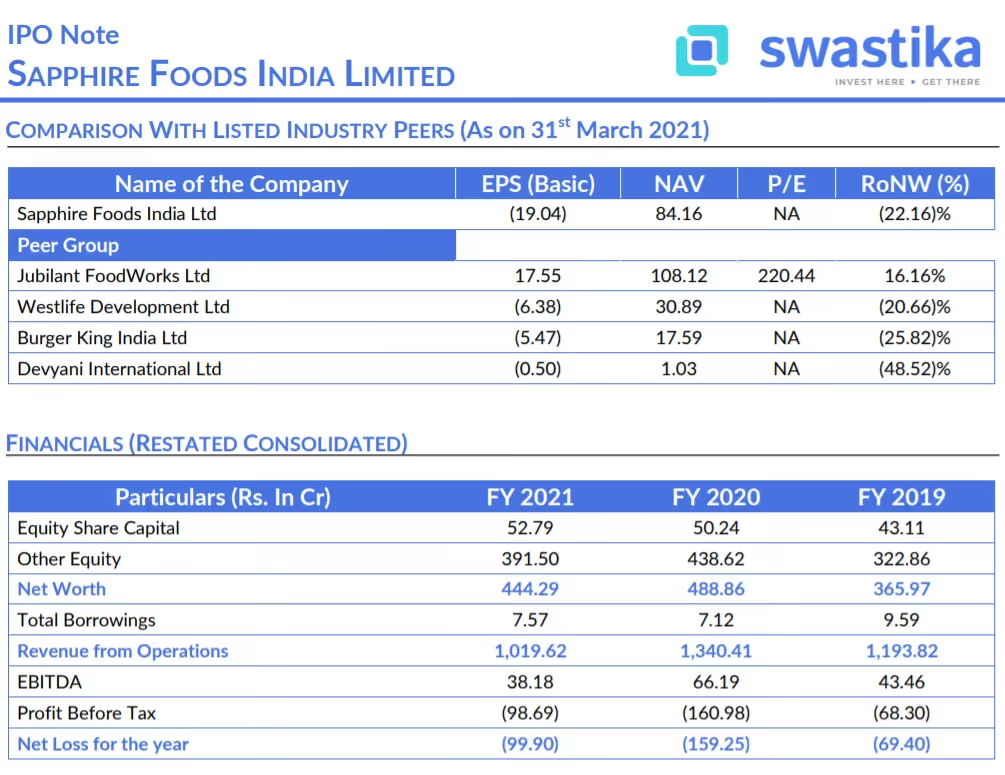
The Company recorded a loss of Rs (99.89) cr. in the financial year FY21 against a loss of Rs (159.25) cr. in the previous year FY20. Revenue from operations in the same period declined to Rs 1,019.62 cr. in FY21 from Rs 1,340.41 cr. in FY20 due to the Covid-19 crisis. The issue is priced at a P/BV of 14.63 based on its NAV of Rs. 80.67 as of June 30. Sapphire Foods is a Leading quick-service restaurant brand with a large market presence and size. Their initial public offer will be a pure offer for the sale of its equity shares; also the company is loss-making in the last three financial years. The company aims to break even in the near future. We are in a bull run of IPO's where new edge businesses are on the front seat. IPO euphoria might lead to listing gain as the IPO is arriving at a P/S of 7x which is half to its peers however we expect the peers to outperform Sapphire Food over the long run. Thus we assign a "SUBSCRIBE" rating with a cautious view.

KEY MANAGERIAL PERSONNEL
- Sanjay Purohit is the Whole Time Director and Group CEO of the Company. He has over 30 years of work experience across consumer product categories including food and apparel retail, packaged food, and paints.
- Sunil Rewachand Chandiramani is the Chairman and Independent Director of the Company. He has experience of over 29 years and has worked in the field of accounting and advisory services.
- Sumeet Subhash Narang is a Non-Executive Director of the Company as a nominee of Sapphire Foods Mauritius Limited.
- Manish Mehta is a Non-Executive Director of the Company as a nominee of Sapphire Foods Mauritius Limited. He has experience of over 17 years.
- Vikram Ranjan Agarwal is a Non-Executive Director of the Company as a nominee of QSR Management Trust for the past 13 years and has worked in the field of private equity.
- Kabir Kishin Thakur is a Non-Executive Director of the Company. He has experience of over 14 years
- Deepa Gopalan Wadhwa is an Independent Director of the Company.
- Anu Ram Aggarwal is an Independent Director of the Company.
COMPETITIVE STRENGTHS
- Leading QSR brands with a substantial market presence and scale
- Strong relationship with YUM
- Continuous focus on delivering great customer experience
- Operational excellence
- Scalable new restaurant economic model for expansion
- Great place to work led by experienced management team and backed by institutional capital
KEY CONCERNS
- Company reported loss for the last three financial years and may incur additional losses in the future.
- The Coronavirus disease (COVID19) pandemic has substantially affected and may continue to affect the business
- Company will not receive any proceeds from the Offer for Sale. The Selling Shareholders will receive the net proceeds from the Offer for Sale.
- Company incurred indebtedness and may incur additional indebtedness in the future which could affect their ability to obtain future financing or pursue any growth strategy.
- There are material outstanding legal proceedings involving the Company, Subsidiaries, and Directors...
Paytm (One97 Communications Ltd) IPO: Outlook & Valuation
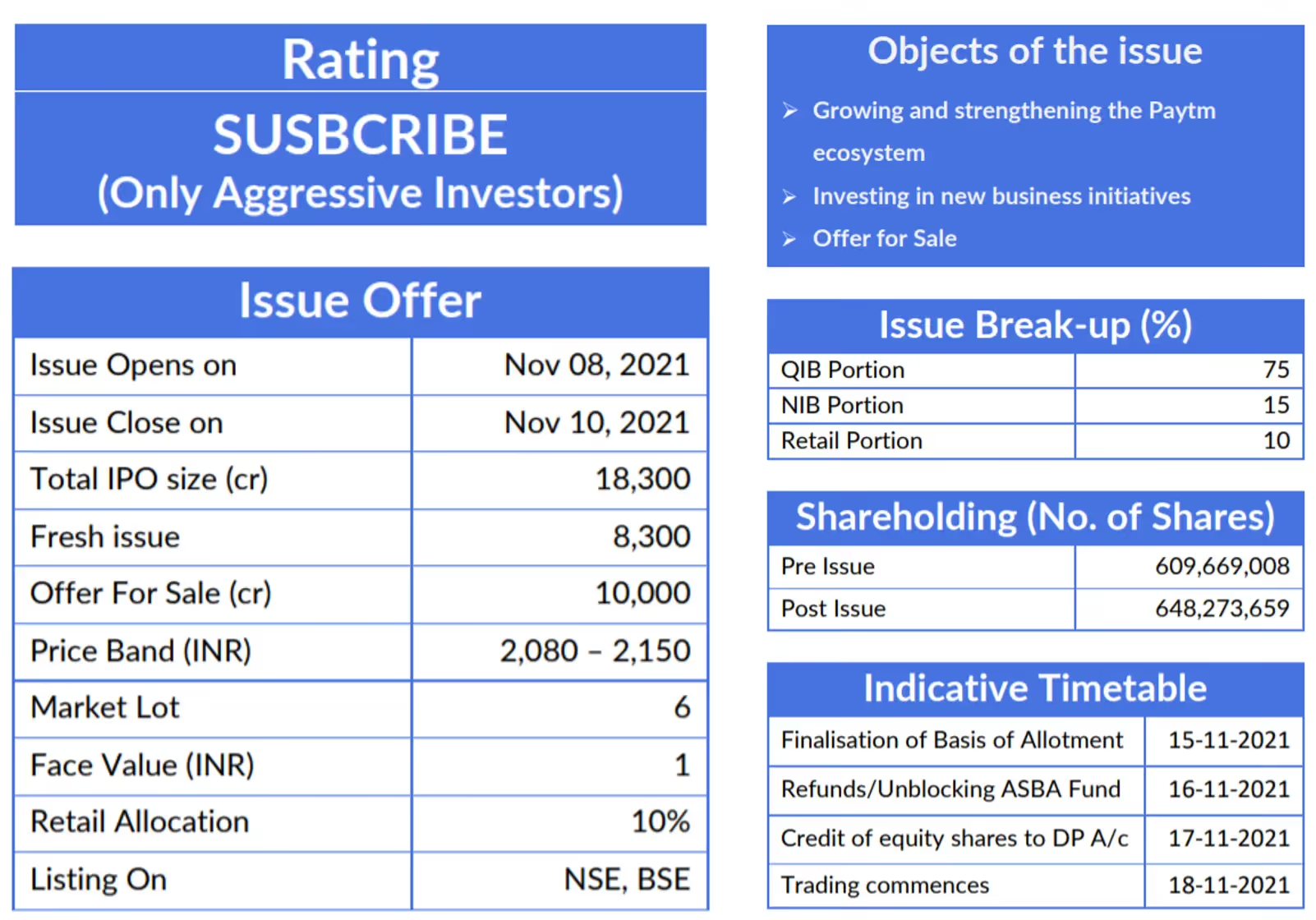
Incorporated in 2000, One97 Communications Limited (Paytm) is India’s leading digital ecosystem for consumers and merchants. Paytm offers ‘Payment Services’, ‘Commerce and Cloud Services’, and ‘Financial Services’ to 33.3 crore consumers and over 2.18 crore merchants registered with them, as of June 30, 2021.
Their 2-sided (consumer and merchant) ecosystem enables commerce, and provides access to financial services, by leveraging technology to improve the lives of their consumers and help their merchants grow their businesses.
In 2009, the company launched the first digital mobile payment platform, "Paytm App" to offer cashless payment services to customers and now, it became India's largest payment platform and the most valuable payments brand with a total brand value of US$6.3 billion as per Kantar Brands India 2020 Report.
The app enables customers to do cashless transactions at stores, top-up mobile phones, online money transfers, pay bills, access digital banking services, purchase tickets, play games online, buy insurance, make investments, and more. However, merchants can use the platform for advertising, online payment solutions, offering products to customers, and loyalty solutions. They have created a payments-led super-app, through which they offer their consumers innovative and intuitive digital products and services. They offer their consumers a wide selection of payment options on the Paytm app, which includes:
- Paytm Payment Instruments, which allow them to use digital wallets, sub-wallets, bank accounts, buy-now-pay-later, and wealth management accounts.
- Major third-party instruments, such as Debit and Credit Cards and Net Banking.
Offer services such as Paytm Wallet, Paytm QR, Paytm Soundbox, Gold investments, and Fixed Deposit, Paytm Postpaid, Merchant Cash Advance and FASTag.
Outlook & Valuation
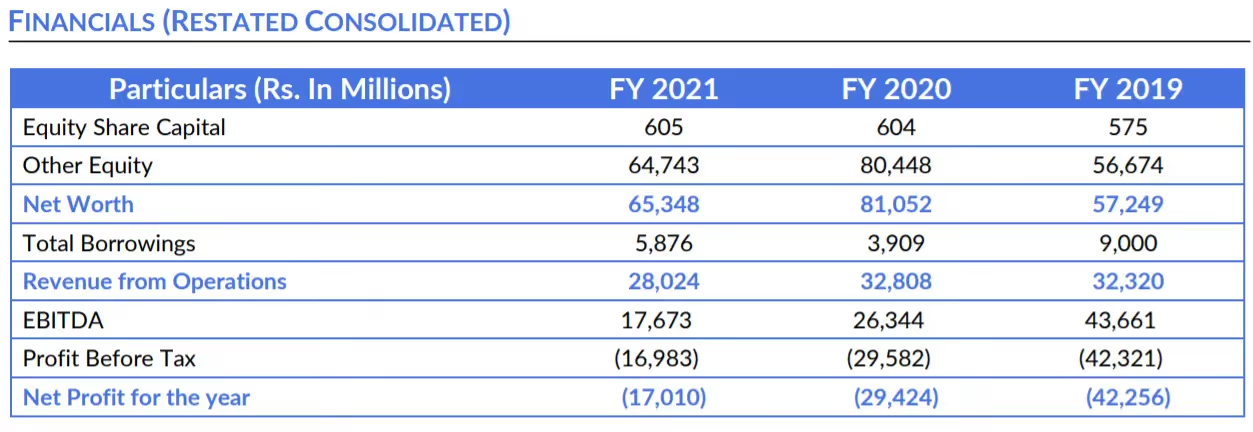
The revenues of the company have been on the declining side, in FY19 revenue was at ₹3,579 cr while in FY21 it was at ₹3,186 cr. Also, it is a loss-making company with a loss of ₹(4,230.9) cr in FY19 which however reduced to ₹(1,701) cr in FY21.
We are in an era of new-age businesses where we have seen many unicorns getting listed recently. It is really arduous to provide a valuation for such types of companies. We expect only leaders will survive over a period of time and only a few such companies will be wealth creators while many can be wealth destroyers. As India is on the verge of digitalization, we may expect the company to get benefited from the same also new acquisition and strengthening of the PAYTM ecosystem from the IPO will be beneficial for the company. Thus we assign a "SUBSCRIBE" rating only for aggressive investors.
KEY MANAGERIAL PERSONNEL
- Vijay Shekhar Sharma is the Founder, Managing Director, and Chief Executive Officer of the company, and the Chairman of the Board. He oversees the Company's key strategic efforts including engineering, design, and marketing.
- Madhur Deora is the President and Group Chief Financial Officer of the company. He has been associated with the company since October 3, 2016.
- Manmeet Singh Dhody is the Chief Technology Officer, Payments. He has been associated with the company since April 1, 2020.
- Vikas Garg is the Chief Financial Officer of the company. He has been associated with the company since May 21, 2014, and was previously associated with the company from August 25, 2008, to September 28, 2012.
- Sudhanshu Gupta is the Chief Operating Officer of Paytm First Games Pvt Ltd, their Subsidiary. He has been associated with Paytm First Games Pvt Ltd since June 1, 2018.
- Bhavesh Gupta is the Chief Executive Officer of the Lending Business of the company. He has been associated with the company since August 4, 2020.
- Renu Satti is the Chief Operating Officer of Offline Payments of the company. She has been associated with the company since October 11, 2006.
- Praveen Kumar Sharma is the Managing Director and Chief Executive Officer of Paytm Payments Services Ltd. He has been associated with the company since September 2, 2019.
- Harinderpal Singh Takhar is the Chief Executive Officer of Paytm Labs Inc, their Subsidiary. He has been associated with Paytm Labs Inc. since June 2013.
COMPETITIVE STRENGTHS
- India's leading digital payment service platform.
- Strong brand identity with a brand value of US$6.3 billion.
- Large customer base with 333 million total customers, 114 million annual transacting users, and 21 million registered merchants.
- Paytm Super-app to access a wide range of digital payment services over mobile phones.
- Strong macro tailwinds.
- Increasing pace of digitization.
- Digital payments in India evolving rapidly
- Under-penetration and rising digitization of financial services
KEY CONCERNS
- They have a history of net losses and we may not be able to achieve profitability.
- The ongoing COVID-19 pandemic and measures intended to prevent its spread have had, and may continue to have, a material and adverse effect on the business and results of operations.
- The company may suffer if they are unable to retain existing customers, acquire new customers, grow the amount of consumer transactions, or increase in the client acquisition expenses.
- Their payment services account for the majority of their income. Their attempts to broaden their service offerings and market reach may not be successful, which might have a negative impact on their income.
- The business might suffer if they do not maintain or develop their technological infrastructure.
COMPARISON WITH LISTED INDUSTRY PEERS
There are no listed companies in India that engage in a business similar to that of the Company. Accordingly, it is not possible to provide an industry comparison in relation to the company
Why Did Paytm Stock Fall Sharply On The First Day Itself?
India’s leading digital payments system company Paytm made history after successfully launching India’s biggest ever IPO in the current month. As per the sources, the total worth of this public offering was Rs 18,300 Crores with the fixed price band at Rs 2080 to Rs 2,150 for each share.
The company hit headlines when the shares of the company made their market debut after much anticipation on Thursday at a 9 per cent discount. Against the expectations, Paytm Stock listed at Rs 1,955 dropped 9% from its issue price on the BSE. After some hours, the stock prices declined further and reached Rs 1,564 a share (a drop of 27.25%) & hit the lower circuit limit at the end of the day trade.
It has been seen that Paytm's market capitalization dropped to about $13.6 billion from its IPO valuation of $20 billion.
Here comes a question: How did India’s greatest IPO fail to give an outstanding performance? Let’s figure it out.
High Valuation Led to Losses for the Investors
Experts said that the company’s high valuation, loss-making business decisions and muted investor’s response are some of the primary reasons for the downfall, even though the company expects to break even by next year or in early 2023.
HNIs or and other powerful investors usually borrow funds for the IPO offerings at highly competitive rates. Hence, the investors will make a profit only if the IPO lists at a higher premium than the cost of funding.
After June 2021, merely 25% of the IPO were listed at a discount which led to a huge loss for the investors.
In the case of Paytm, the debut price was lower than anticipated as the stock opened at Rs 1,955 against the issue price of Rs 2,1050 at the upper end at BSE. The stock price is falling at 9.1 per cent. According to Money control, only aggressive investors were requested to put their money for future investments.
The weak response is being viewed as a sign that investors had become disillusioned with a recent string of IPOs with high valuations.
There are numerous reports out there that have claimed that Paytm’s business model lacks focus and attention.
Macquarie Stock Market Research firm has further said that achieving scale with profitability is the biggest challenge for the company. Also, the target price of Rs 1200 for the stock against its issue price of Rs 2,150 clearly shows the 40 per cent downside risks.
Competition May Drive Down Unit Economics
Also, the research firm points out that competitors of Paytm such as Amazon, Flipkart, Google etc are offering the same services. The competition became tough when new services such as Buy Today Pay Later were launched by the competitors.
This can be clearly seen from the fact that despite Paytm’s offering being much larger than other offerings, the demand was weaker than the recent stock sale. This is because Paytm has lost much of its market share to its competitors like Google and Flipkart.
Stiff Competition with Disruption in Business
Paytm holds its major competition with significant giants in the eCommerce industry like Amazon, GooglePay and Flipkart's Phone Pe. It faces intense competition from these adversaries in specific business areas like purchase currently pay later or buy today and pay later (BTPL)
Although Paytm's Rs. 18,300 crores IPO was listed at the top of the indicator range, it neglected to earn a lot of interest rather than other ongoing IPO events.
The biggest reason behind the market loss to Google Pay and Phone Pe was mainly responsible for this. It is also believed that the company’s FCF (Free cash flow) will not regain its pace till FY 2030.
In addition, the huge development in UPI-based payment structure hampered Paytm's business model.
UPI was presented by GOI in 2019 to build and promote a unified platform for payment in the whole country.
At this point, UPI represents almost 65% of Paytm's GMV, with a strong possibility to reach 85% by FY26
In any case, Paytm actually procures around 70% of its income from the payment business. It is a key part of the mobile wallet section. Nonetheless, this section has lost pertinence because of the advent of UPI payments.
Trouble to Achieve Scale with Profitability
According to a report by Macquarie Research, Paytm needs concentration, innovation and development in its business model. The firm accepts Paytm doesn't have the ability to accomplish scale with productivity.
The digital payment platform is associated with various business verticals, including consumer lending, payment gateway, monetary services etc. It has been consuming a lot of its money while attempting to maintain a few business fragments along with no emphasis on accomplishing benefits. In addition, Paytm procures lower revenue for every dollar it spends through advertising.
As such, the organization has been forced to move into other business segments as it is continuously looking for profitability. In any case, Paytm enjoys a huge client base with 50 million active customers and 22 million merchant banking clients.
Major Decline in Ecommerce Revenue
Paytm Mall, Paytm's internet business arm, contributes around 55% of its income in this income. During FY2019-21, the segment saw a sharp fall in income. This was predominantly because of rising competition from other significant adversaries.
Paytm neglected to stay aware of the internet business giants like Amazon and Walmart-possessed Flipkart. These players accompany a huge client merchant ecosystem and huge buyer offers.
Conclusion
Paytm stock crash tells us a lot. Only a good company is not the one that can offer you amazing benefits. There are certain things you need to ponder before subscribing to an IPO.
Therefore investors, keen to subscribe to SME IPOs must check the company’s financial and fundamentals. Carefully read the financial statements of a company, analyze its strength and weakness and valuations of a company before subscribing to the IPOs.

The IPO Rush: Why 2021 Proves To Be The Best Year of IPOs
Investment bankers and many investors tracking SME IPOs say that 2021 will be a record-breaking year for fundraising.
India is ready to make a record of the biggest IPO launching in the year 2021. In this blog, we will uncover all the reasons that why so many companies are going public this year:
Numerous companies including Policybazaar, Zomato, Paytm have gone public this year. Following the path of these giants, many more firms are expected to launch their IPO later this year.
This year, the companies are planning to raise the highest amount through IPO launching. Despite the impact of COVID 19, the companies are in a rush to go public.
Let’s try to figure out what is the top reason behind the IPO launching:
What is an IPO?
Initial public offering or IPO is a process under which a privately owned company offers its shares to people so that it can generate funds from investors. The process denotes the progress of a privately owned company to a public firm.
If an organization wants to become public, it has to follow two basic processes. Enter in the primary market to launch its IPO. Second, get listed on the stock exchange to become a publicly-traded company.
A few IPOs also include an Offer For Sale (OFS), which permits existing investors or promoters to minimize their shareholding in the listed companies.
Nevertheless, the amount raised through the OFS generally goes to private investors making their value available for sale.
Initial public offerings are a huge achievement for any company. They are raised when the company concludes it requires capital for a specific reason, like development, growth debt clearance, and funding corporate costs.
Any organization or startup doesn't grow immediately since its inception; they in the long run develop over a period to become more profitable and organized.
Different rounds of funding at the beginning stage and the further mixture of capital through private and private supporters lead to a company’s development.
There comes a turning point in any organization where its growth is soaked, and however the development rate may be positive, there is a flattened growth by a reduction in the rate.
At such a period, many companies are planning to go public via IPO to raise capital from the public.
There are times when a company is making a good profit, however, it needs more capital for development, growth and expansion as all the profits generated by it goes into debt clearance.
In such cases, going public not only helps the company to clear its debt but also utilizes its raised capital for the company’s further growth.
How do IPO’s Work?
Before going public, the privately held company seeks approval from the market regulator i.e. SEBI. Once it’s done, it starts revealing key insights regarding the IPO.
The key details include the price band for the IPO, lot size, launching date and distribution of share sales for various types of financial investors — non-institutional financial investors, institutional financial investors, existing employees and angel investors.
When the IPO process has begun, the company’s shares first start trading in the grey market — the informal market for unlisted shares. The process continues to take place till they are listed on the bourses.
It may be noticed that the grey market stocks are exchanged over-the-counter (OTC) and are not presented by the stock exchange; only traders are permitted to deal with them.
Investors normally get a small period i.e. typically 2-3 days to subscribe to a company’s public offering post IPO launching date.
During this period, investors (mostly retail investors) can bid for the offers through different stock trading platforms.
As the time period of IPO gets over, investors are required to check their IPO allotment status at their designation status on accessible channels - either the registrar or at the BSE site.
After the completion of allotment, the shares of the company get listed on the stock exchanges on a predetermined date.
Why IPO Rush: Reasons Why So Many Companies Going Public This year?
It has been seen that Several organizations have gone public regarding fundraising a year ago. Data suggest that organizations raised funds as much as $4.6 billion from IPOs last year. Analysts and investment bankers feel that this sum will be effectively outperformed in 2021 as more organizations are going for public offerings.
A head of investment banking at UBS India told Bloomberg that companies will generate twice the revenue as expected in the last year.
Many organizations have decided on IPOs at the end of 2020, because of the effect of the Covid-19 pandemic on business and the several securities exchange movements.
Experts further suggested that organizations are going public because of the highest performance found in the stock market and higher support of HNIs or high net worth individuals.
A State Bank of India (SBI) report recommended that over 14.2 million new individual investors have taken an interest in the stock market in 2020-21.
Indeed, even as the pandemic hits hard on India's economy, the domestic stock market has not been affected at all.
In fact, stock market indices such as Nifty 50 and BSE 30 have performed better than before.
If we talk about the market performance, a higher percentage of IPOs have done outstandingly well and more investors are hoping to capitalize on this period.
Organizations that are going public either bring capital because of the losses experienced during the Covid-19 pandemic or finance business expansion because of high demand.
Many techs and online delivery companies like Paytm, Nykaa, Zomato have gone public and the key reason is to raise capital and extend the business as the demand grows rapidly.
In the next few years, analysts expect over 50 digital tech companies will get listed on the bourses.
Big Budget


Popular Articles

.avif)
.avif)

.avif)



START YOUR INVESTMENT JOURNEY
Get personalized advice from our experts
- Dedicated RM Support
- Smooth and Fast Trading App
