


Inside the IPO Filing Process from DRHP to Listing Day


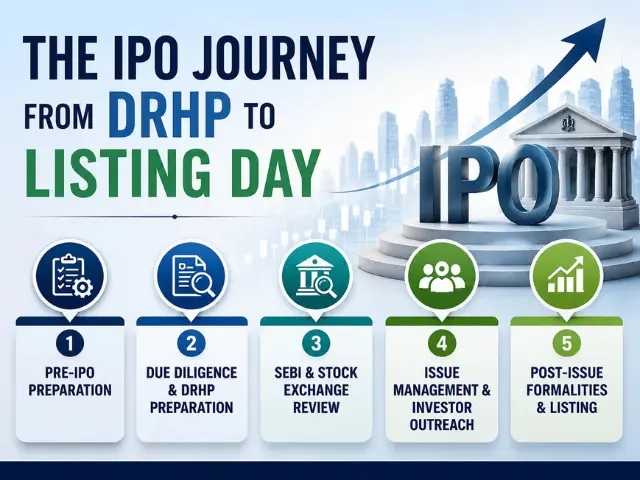

An IPO is often perceived as a single event. In reality, it is a tightly regulated capital markets transaction that tests a company’s governance, financial maturity and disclosure standards. Long before the stock lists, months of preparation go into drafting, verification, regulatory review and investor positioning.
Why the Filing Process Matters
The offer document is the backbone of the IPO. For SEBI, it is a legal disclosure document. For investors, it is the primary source of truth.For the company, it becomes a permanent public record. Gaps in statutory disclosures or inconsistencies in financial reporting may result in approval delays and affect investor confidence.
Phase I: Pre IPO Preparation
The IPO process begins well before drafting the prospectus. At this stage, the company prepares itself to operate as a listed entity. Key actions include finalising the issue structure, converting into a public limited company, updating constitutional documents, strengthening board and committee structures, appointing key managerial personnel and dematerialising shareholding.
Phase II: Due Diligence and DRHP Preparation
This is the most intensive stage of the IPO journey. The Merchant Banker conducts detailed financial, legal and business due diligence, followed by preparation of the Draft Red Herring Prospectus covering company profile, industry overview, risks, financials and utilisation of proceeds.
Phase III: SEBI and Stock Exchange Review
SEBI, along with the stock exchanges, reviews the DRHP to ensurefull and fair disclosures, eligibility, and governance compliance. All queries and observations are addressed before final In-Principal approval.
Phase IV: Issue Management and Investor Outreach
Post regulatory clearances, the Red Herring Prospectus is finalised and the issue pricing is decided. Merchant Bankers, working closely with syndication and underwriting teams, drive investor outreach and roadshows, while market makersplay a role in supporting orderly trading and liquidity (in case of SME-IPO), in line with applicable issue regulations.
Phase V: Post Issue Formalities and Listing
After the issue closes, the basis of allotment is finalised, funds are reconciled by the banker to the issue, and shares are credited to investors’ demat accounts. In cases of oversubscription, allotment is carried out as per category-wise allocation norms, with proportionate or lottery-based distribution and refunds/unblock of excess application amounts. The company then lists on the stock exchanges and enters the post-listing compliance framework. Syndication and underwriting teams continue to support investor engagement, while issuer-led marketing and investor interactions remain ongoing. Anchor investors participate up to one working day prior to the issue opening, helping establish early demand visibility and confidence in the offering.
Role of the Merchant Banker
The Merchant Banker anchors the IPO end-to-end, beginning with comprehensive due diligence and preparation of offer documentation. They act as the primary interface with SEBI and Stock Exchanges, provide valuation and structuring advice, and lead investor marketing efforts. In coordination with syndication and underwriting teams, the merchant banker supports book building, demand aggregation, and risk underwriting. Post listing, they also facilitate market-making arrangements and ensure regulatory and compliance requirements are met, enabling a smooth transition from a privately held company to the public markets.
Closing Thoughts
The IPO process shows how ready a company is to operate in public markets. With the right Merchant Banker guiding the company at every stage, the journey becomes well-planned and manageable, helping the business move smoothly into the listed space and build long-term, sustainable growth.
👉 To Connect with us today, please click here.
Latest Articles

Changing Investment Habits of Women in India


In recent years, there has been a significant shift in the investment habits of women in India. With greater financial independence and increasing awareness of the importance of wealth creation, more women are actively participating in the world of investments. The traditional approach of relying solely on savings or leaving financial decisions to male family members is rapidly evolving. Today, women are making informed choices, diversifying their portfolios, and seeking financial growth through various investment avenues.
The Rise of Financial Independence Among Women
As women continue to break barriers in professional fields and achieve higher levels of education, they are also gaining more control over their finances. This has resulted in a growing trend of women taking the reins of their own investment decisions. Unlike in the past, where savings accounts and fixed deposits were the preferred options, today’s women are more inclined towards mutual funds, stocks, real estate, and even cryptocurrencies.
Financial independence is no longer just about earning; it’s about making that money grow. Many women are now recognizing the power of compound interest and the need to invest in high-return instruments to secure their future. This shift is a result of increased access to financial education, digital tools, and platforms that empower women to manage their investments with ease.
Women are More Risk-Aware
One of the defining characteristics of women investors is their approach to risk. While women are often labeled as conservative investors, recent trends suggest that they are not afraid to take calculated risks. However, women tend to be more risk-aware, which means they conduct thorough research and are more cautious about where they put their money.
Rather than chasing short-term gains, many women prefer long-term investments that offer steady returns. This makes them more likely to invest in balanced portfolios that combine equity, debt, and other assets. The growing interest in Systematic Investment Plans (SIPs) and other diversified instruments highlights how women are keen on creating a stable financial foundation for themselves and their families.
Investment in Mutual Funds and Stocks
Mutual funds have become one of the top choices for women investors due to their ability to diversify risk and provide professional management. SIPs, in particular, have gained immense popularity as they allow women to invest small amounts regularly, reducing the burden of lump-sum investments. Moreover, with the rise of online platforms, investing in mutual funds has become convenient and accessible.
The stock market, once considered a male-dominated space, is now seeing increased participation from women. With a better understanding of market trends and investment strategies, more women are trading in stocks, either directly or through investment advisors. This change indicates a growing confidence in their ability to navigate the complexities of the stock market and generate returns.
Real Estate and Gold: Traditional Yet Evolving Choices
Real estate and gold have always been popular investment choices among women, and this trend continues to hold. However, the way women approach these investments has evolved. Rather than merely buying gold in the form of jewelry, more women are now investing in gold exchange-traded funds (ETFs) and sovereign gold bonds, which provide better returns and liquidity.
In terms of real estate, women are making informed decisions by investing in properties that offer long-term value appreciation. Government initiatives like tax benefits for women homebuyers and lower stamp duties in certain states have also encouraged more women to invest in real estate.
The Role of Digital Platforms in Women’s Investments
The digital revolution has played a crucial role in transforming the investment habits of women in India. With the advent of mobile apps, online trading platforms, and robo-advisors, women now have access to real-time financial information, investment tools, and expert advice at their fingertips. This has not only simplified the investment process but has also empowered women to take charge of their financial journeys.
Financial literacy programs targeting women have also contributed to this shift. With more resources available online, women are educating themselves about different investment options, the importance of diversification, and the need for financial planning. This has led to a rise in women making informed decisions and exploring investment options beyond traditional methods.
Challenges and the Way Forward
Despite the progress, certain challenges remain. Many women still face societal pressures and stereotypes that discourage them from taking financial risks or managing their own investments. Additionally, the gender pay gap and career breaks due to family responsibilities can limit their ability to invest as aggressively as their male counterparts.
However, as more women continue to challenge these norms and seek financial independence, the landscape is gradually changing. Employers, financial institutions, and policymakers can further support this trend by offering women-centric investment products, financial education programs, and flexible work arrangements that allow them to build their wealth without compromising on other responsibilities.
Conclusion
The changing investment habits of women in India reflect a broader shift towards financial independence and empowerment. As more women take control of their financial futures, the focus has shifted from simply saving money to growing wealth through informed investment decisions. With the rise of digital platforms, financial literacy, and a variety of investment options, women are now more confident and equipped to make smart financial choices. This growing trend not only benefits individual women but also contributes to the overall economic development of the country.

अमेरिका और चीन मे तनाव से कीमती धातुओं को सपोर्ट
करीब एक महीने के सबसे तेज साप्ताहिक उछाल के साथ सराफा बाजार में सोने के भाव शुक्रवार को सीधे दूसरे दिन भी उंचाई पर पहुंच गए। बांड पैदावार में कमी, अमेरिकी डॉलर मे कमजोरी, और बिटकॉइन में -4% की ऊपरी स्तरों से गिरावट से कीमती धातुओं को फायदा हो रहा है।
कॉमेक्स में जून वायदा सोना गुरुवार को 1.8% की बढ़त के बाद शुक्रवार को 1% तक तेज़ हुआ और 1784 डॉलर प्रति औंस के स्तरों को छुआ। सप्ताह के लिए, सोना 1.8% तेज़ हुआ, जो कि 19 मार्च के बाद से इसकी सबसे बड़ी साप्ताहिक तेज़ी को दर्शाता है।
10-वर्षीय ट्रेजरी नोट 1.57% पर है, जो इसकी हालिया सीमा 1.60% और 1.75% के निचे है। सरकारी ऋण पैदावार में गिरावट से कीमती धातुओं के लिए निवेश की मांग बढ़ी है। इस बीच, अमेरिकी डॉलर इंडेक्स, शुक्रवार को -0.14% गिरकर 91.542 पर पहुंच गया है। डॉलर सप्ताह में 0.7% और अप्रैल में 1.8% टूटा है।
एक कमजोर डॉलर विदेशी खरीदारों को डॉलर में आंकी गई संपत्ति को अधिक आकर्षक बना सकता है। बाजार सहभागियों के मुताबिक चीन और रूस के साथ बढ़ते अमेरिकी तनाव ने कीमती धातु की सुरक्षा अपील को बढ़ावा देने में मदद की है। ताइवान पर अमेरिका और चीन के बीच तनाव बढ़ गया है, और बिडेन प्रशासन ने गुरुवार को कुछ रूसी राजनयिकों को निष्कासित कर दिया है। पिछले साल के राष्ट्रपति चुनाव में रूस के हस्तक्षेप के प्रतिशोध में आंशिक रूप से दर्जनों लोगों और कंपनियों के खिलाफ प्रतिबंधों की घोषणा की है।
तकनिकी विश्लेषण
इस सप्ताह कीमती धातुओं मे तेज़ी रह सकती है। घरेलु वायदा सोने मे 47500 रुपये पर प्रतिरोध है और 46600 रुपये पर सपोर्ट है। चाँदी मे 70500 रुपये पर प्रतिरोध तथा 67800 रुपये पर सपोर्ट है।

A Quick Brief of Online Communities
Online (or virtual) communities are online platforms or virtual rooms where a bunch of individuals are interacting with one another on an everyday basis.
The technical evolution in dynamic content of internet sites and interacting with alternative users allowed the large development into the community world and eventually the social network world.
With therefore known as social media monitoring. Last year they learned to look at, analyze, and interpret the postings of individuals. So that they were able to react to any or all positive and negative opinions of them.
In contrast to marketplaces, online community members are united in an exceedingly common activity or interest. They will get to understand one another, move post queries and find answers. The most important characteristic, therefore, is that of member interaction.
Types of Online Communities
1. Web Pages
Not as permanent as ancient media. Like paper, websites archive data for extended periods. World Wide Web users post content on websites for others to look at. The content could also be straightforward text, however, it would additionally contain multimedia system files together with pictures, sounds, videos, or streaming content. Examples include: wikipedia.com
2. Forums
Typically hosted online, mixes several aspects of email and sites. they involve discussion around one, restricted topic, however will crop up over months or years and involve dozens or perhaps many participants conversations that prolong indefinitely, involve massive numbers of individuals, and aren't similar to the temperament to email. Examples include:
- 2channel
- 4chan
- 6park
- 8chan (infinite chan)
- Aelyria
- airliners.ne
3. Email
In contrast to instant messages, emails are typically not expected to browse now upon receipt. The email could be a methodology originally supposed to imitate physical mail. Messages are delivered from one specific address to 1 or a lot of specific addresses. Users are alerted to the presence of recent messages in their inboxes by email shoppers that show the content and provide a chance to reply. Messages are primarily text. Therefore, email is ideally fitted for long, concerning conversations between 2 folks or among tiny teams of individuals. Examples include:
- Gmail
- Yandex mail
- Protonmail
- Zoho mail
4. Text Messaging
Typically supposed to be near-instant communication and maybe faster than a telephone text messaging uses cellular airwaves and protocols to deliver matter messages from one mobile phone to a different one or from one phone to a bunch of alternative phones.
The sender does not need to look ahead to the recipient to answer before delivering a message. Text electronic communication is informal and simple, it's typically referred to as chatting. Examples include:
- Skype
- Trillion
- Eztalks cloud meeting
- join. me
- Digsby
5. Social Media
In contrast to text messages that are delivered to solely tiny teams, social networking sites facilitate communication among folks with common interests or affiliations. Sites like Facebook and LinkedIn give places for folks to act, typically in real-time.
Microblogging services like Twitter, permit short-matter messages of no over a hundred and forty characters to be broadcast to an outsized audience microblog users will repost messages that they need to share with their followers, thus a microblog post will unfold quickly. Examples include:
6. Social Communities
- Linked-in
- YouTube
7. Video Chat
Nothing beats face-to-face spoken communication. Video chats give associates immediacy to spoken communication.
Video chat is like instant electronic communication, most video chatting is conducted over web protocols that stream pictures from one device to a different one. Businesses typically use videoconferencing to assist in virtual conferences. Examples include:
- Google video chat (web-based, windows/mac os x)
- ichat (mac os x)
- skype (windows/mac/Linux)
- vsee (windows only)
- tokbox (web-based, supports all platforms)
8. Task Structured
The relationships established or increased online are a means to a mutual finish, like increased profits.
A lot of specifically, internet communities are established between business partners, between businesses and their customers, between totally different teams of shoppers, inside firms, and between individuals and teams dedicated to specific topics.
Task centered communities typically are additional structured and impersonal. His functionality of key tasks is integrated and synthesized. This necessitates less personnel, paperwork, and software system, and boosts potency, thereby minimizing operative prices and enhancing profit.
Conclusion
In times of the internet, the social media movement firms should not underestimate the ability of those channels online/virtual communities are the place wherever the web user is posting its opinions and receiving their data.
The community world has a big unmanageable world of many blogs, boards, communities, chats, and portals. n 2011 solely seven-membered of all cash pay on online advertising within America went to Facebook, whereas Google and yahoo took a combined share of fifty-two. being a part of it and making valuable content will influence the success financially and image-wise of an organization.

कच्चे तेल का उत्पादन बढ़ने से कीमतों पर दबाव पड़ने की संभावना है
शुक्रवार को हुई ओपेक और नॉन ओपेक देशो की बैठक के कारण कच्चे तेल के भाव मे उठापटक देखि गई। ओपेक देशो के आश्वासनों से पहले क्रूड की कीमतें गुरुवार से अस्थिर रही, क्योंकि मांग बढ़ोतरी मे संदेह के बावजूद, मई से वैश्विक तेल उत्पादन बढ़ने की सहमति हुई है।
ओपेक और नॉन ओपेक देशो के सदस्य, दो-दिवसीय कॉन्फरेंस के माध्यम से बैठक करते हुए, मई और जून में प्रति दिन 350,000 बैरल और जुलाई में 400,000 बैरल प्रतिदिन उत्पादन बढ़ाने पर सहमत हुए है।
सऊदी अरब को कटौती के प्रति दिन 250,000 बैरल मई और जून में घटाने पर विचार करना था, ताकि बाजार को निरंतर समर्थन प्रदान किया जा सके। लेकिन इसने उस विचार को अन्य उत्पादकों के साथ आम सहमति पर पहुंचने के बाद समाप्त कर दिया कि उत्पादन मे बढ़ोतरी तेल मांग मे बढ़ोतरी के अनुरूप है। लगभग 2.5 मिलियन बैरल प्रति दिन, कई सप्ताह तक रुके रहने के बाद, अमेरिकी कच्चे तेल का निर्यात पिछले हफ्ते बढ़कर 3.2 लाख बैरल प्रति दिन हो गया है।
अमेरिकी तेल उत्पादन भी पिछले सप्ताह बढ़कर 11.1 लाख बैरल प्रतिदिन हो गया है। पिछले कुछ महीनों में संयुक्त राज्य अमेरिका के लिए 11 मिलियन बैरल या उससे कम का दैनिक उत्पादन मानक बना हुआ था। कॉमेक्स मे कच्चे तेल के भाव सप्ताह मे मामूली बढ़त के साथ 61 डॉलर तथा ब्रेंट कच्चा तेल 64.7 डॉलर और घरेलु कच्चे तेल की कीमते 4516 रुपये प्रति बैरल पर रही।
तकनिकी विश्लेषण
कच्चे तेल की कीमतों मे ऊपरी स्तरों पर दबाव रहने की सम्भावना है। इसमें 4670 रुपये पर प्रतिरोध तथा 4300 रुपय पर सपोर्ट है।

Macrotech Developers Limited IPO (Lodha Developers IPO)
Incorporated in 1995, Macrotech Developers [Formerly known as Lodha Developers] is the largest real estate developer in India. The company is primarily engaged in affordable residential real estate developments and in 2019, it entered into the development of logistics and industrial parks and also developed commercial real estate.
The company’s large ongoing portfolio of affordable and mid-income housing projects include Palava (Navi Mumbai, Dombivali Region), Upper Thane (Thane outskirts), Amara (Thane), Lodha Sterling (Thane), LodhaLuxuria (Thane), Crown Thane (Thane), Bel Air (Jogeshwari), LodhaBelmondo (Pune), Lodha Splendora (Thane) and Casa Maxima (Mira Road).
The affordable and mid-income housing developments accounted for Sales of Rs.3055 crores during the financial year 2020 and constituted 57.77% of our total residential sales.
Company Business:
- The Company develops Real estate across the residential and commercial sectors in the Mumbai Metropolitan Region, Pune, and London.
- In the Residential Portfolio, the price of the Flat they sell is in the range of 35 Lacs to 59 Cr.
- In the commercial portfolio, they develop office and retail projects as income-generating assets on the lease model and sale models, with an increasing focus on the former.
- The company has a good track record of completing projects from acquisition to launch to completion thereby improving Return on investment.
Strength of the Company
- Largest residential real estate developer in India.
- Strong sales distribution network across India as well as NRI markets
- Brand equity and premium pricing.
- Strong project execution capabilities.
- Experienced Management Team.
RISKS RELATING TO BUSINESS:
- There are material outstanding legal proceedings involving Company, Subsidiaries, Associates, Directors, Promoters, and Group Companies
- The company may not be able to successfully identify and acquire suitable land or development rights, which may affect business and growth.
- The company’s business and results of operations could be adversely affected by the incidence and rate of property taxes and stamp duties.
- Compliance with, and changes in, environmental, health and safety, and labor laws and regulations could adversely affect the development of projects and financial conditions.
IPO Details:
IPO DateApr 7, 2021to Apr 9, 2021Issue TypeBook Built Issue IPOIssue Size51,440,328 Eq Shares of ₹10(aggregating up to ₹2,500.00 Cr)Fresh Issue5,14,40,329Eq SharesOffer for SaleNILFace ValueRs.10 per equity shareIPO PriceRs.483 to Rs.486 equity shareMin Order Quantity30Listing AtBSE, NSE
IPO Objective:
- Reduce the aggregate outstanding borrowings of the company on a consolidated basis.
- To acquire land or land development rights.
- To meet general corporate purposes.
Financial Performance:
FY2018FY2019FY20209M FY2021Revenue13,726.611,979.912,561.03,160.5Expenses11,017.09,490.011,560.23,218.8Comprehensive income1,767.91,641.6732.5-264Margin (%)12.913.75.8-8.2
Tentative Time Table:
- IPO Opens on: Apr 7, 2021
- IPO Closes on Apr 9, 2021
- Basis of Allotment Date: Apr 16, 2021
- Initiation of Refunds: Apr 19, 2021
- The credit of Shares to Demat Account: Apr 20, 2021
- IPO Listing Date: Apr 22, 2021
Outlook:
Lodha Group has been involved in the real estate business since 1995. Further, the Company is led by Abhishek M. Lodha, Managing Director and Chief Executive Officer. The company has a leadership team of experienced professionals with relevant functional expertise across different industries who are instrumental in implementing the business strategies.
The company commenced operations in Mumbai, developing affordable housing projects in the suburbs of Mumbai, and later diversified into other segments and regions in the MMR and Pune. In addition to the ongoing and planned projects, as of 31 December 2020, the company has land reserves of approximately 3,803 acres for future development in the MMR, with the potential to develop approximately 322 million square feet of Developable Area.
The company has clocked sales of approximately INR 6,569 crores with gross collections of approximately INR 8,189 crores for FY 19-20. The company reported a total income of ₹3,160.49 crores for the period ended December compared with ₹9,357.35 crores a year ago. The net loss stood at ₹264.30 crores compared to a profit of ₹503.08 crores.
Their residential and commercial spaces are aimed at every segment, right from super luxury to budget, thereby enabling every aspiring consumer to fulfill their dream. The company’s brands include “Lodha”, “CASA by Lodha” and “Crown – Lodha Quality Homes” for our affordable and mid-income housing projects. The “Lodha” and “Lodha Luxury” brands for premium and luxury housing projects, and the “iThink”, “LodhaExcelus” and “LodhaSupremus” brands for office spaces.
The company’s in-house sales team is supported by a distribution network of multiple channels across India as well as key non-resident Indian (“NRI”) markets, such as the Gulf Cooperation Council, United Kingdom, Singapore, and the United States.
The real estate market in India has grown at a CAGR of approximately 10 percent from $ 50 billion in 2008 to $120 billion in 2017 and is expected to further grow at a CAGR of 17.7% to reach $1 trillion by 2030. The real estate market contributed approximately 6 percent to India’s GDP in 2017 and is likely to contribute approximately 13% to India’s GDP by 2025.
Valuation of Macrotech Developers (as of FY2020)
Earnings Per Share (EPS): INR18.46Price/Earnings (PE ratio): 26Return of Net Worth (RONW): 17.8%Net Asset Value (NAV): INR103.86 per share
Macrotech Developers has a strong reputation in the Mumbai region with delivery of close to 10,000 homes annually. Has the ability to price at a premium which results in higher margins.
The listed peers are Brigade Enterprises Ltd, DLF Limited, Godrej Properties Ltd, Oberoi Realty Ltd, Prestige Estates Projects Ltd, Sobha Ltd, and Sunteck Realty Limited. Among these, only Sobah Ltd has the lowest P/E ratio of 15.12, while Godrej Properties Ltd has the highest P/E ratio of 135.51

What Are Corporate Actions & Its Impact On Stock Price
Corporate actions are key events that companies undertake, which can directly impact their stock prices, financial health, and how investors perceive them. Whether it's issuing dividends, conducting stock splits, or merging with another company, these actions play a significant role in the stock market. Let’s break down the most common corporate actions and their effects on stock prices, with examples from Indian stocks to illustrate.
What Are Corporate Actions?
Corporate actions are decisions made by a company that affect its shareholders. These actions can lead to changes in stock prices, which investors need to understand to make informed decisions. Here are some of the most common corporate actions:
Types of Corporate Actions
1. Dividends
- Dividends are payments made to shareholders from a company’s earnings. They can be in the form of cash or additional shares.
- Impact on Stock Price: When a dividend is declared, the stock price usually drops by the dividend amount on the ex-dividend date. For instance, if a company announces a ₹5 dividend, the stock price might decrease by ₹5 on the ex-dividend date.
- Example: Consider a company like HDFC Bank. When it declares a cash dividend, the stock price adjusts to reflect the dividend payout. If HDFC Bank declares a ₹10 dividend, its stock price might drop by ₹10 on the ex-dividend date.
2. Stock Splits
- A stock split increases the number of shares outstanding by issuing more shares to existing shareholders. For example, in a 2-for-1 split, shareholders receive two shares for every one they own, but the share price is halved.
- Impact on Stock Price: The total value of shares held by an investor remains the same, but the price per share changes according to the split ratio. If a stock priced at ₹200 undergoes a 2-for-1 split, the new price would be ₹100, and shareholders would own twice as many shares.
- Example: Reliance Industries has conducted stock splits in the past. For instance, if Reliance's stock was trading at ₹2,000 and underwent a 5-for-1 split, the price would adjust to ₹400, but shareholders would now have five times more shares.
3. Bonus Shares
- Bonus shares are additional shares given to existing shareholders at no extra cost, usually based on the number of shares they already own.
- Impact on Stock Price: The stock price typically drops to reflect the increase in the number of shares. For example, if a company issues a 1:1 bonus, the share price might halve, but shareholders will own double the number of shares.
- Example: Tata Motors has issued bonus shares before. If Tata Motors issues a 1:1 bonus, the stock price might decrease, but shareholders will have twice as many shares as before.
4. Mergers and Acquisitions
- Mergers involve two companies combining to form a new entity, while acquisitions occur when one company takes over another.
- Impact on Stock Price: The stock price reaction depends on the deal. Generally, the acquiring company's stock price might drop due to the costs involved, while the target company's stock price usually rises. The long-term effect depends on how well the deal is executed.
- Example: When Hindustan Aeronautics Limited (HAL) acquired smaller defense firms, HAL’s stock price reacted to the perceived benefits of the acquisition. Conversely, the stock of the acquired firms often saw a spike.
5. Rights Issues
- A rights issue allows existing shareholders to buy additional shares at a discount to the current market price.
- Impact on Stock Price: The stock price might fall to account for the dilution due to the new shares being issued. For example, if a company issues new shares at ₹50 while the current price is ₹83, the market price might adjust downward to reflect the dilution.
- Example: If Infosys announces a rights issue at ₹1,000 when the market price is ₹1,200, the stock price might fall to around ₹1,050 to reflect the new shares being issued.
Impact on Stock Prices
Immediate Reaction: Corporate actions often cause immediate fluctuations in stock prices. For instance, a dividend announcement can lead to a temporary drop in stock price on the ex-dividend date.
Long-Term Effects: The long-term impact depends on how the corporate action affects the company's overall financial health and future prospects. Successful mergers or strategic stock splits can lead to increased stock prices if they create value and growth opportunities.
Conclusion
Corporate actions are significant events that can influence stock prices in various ways. By understanding these actions—such as dividends, stock splits, bonus shares, mergers, and rights issues—investors can better navigate the stock market. Monitoring these events helps investors make informed decisions and anticipate market reactions, allowing them to align their strategies accordingly.
Big Budget


Popular Articles



.avif)
.avif)

.avif)



START YOUR INVESTMENT JOURNEY
Get personalized advice from our experts
- Dedicated RM Support
- Smooth and Fast Trading App
