


Inside the IPO Filing Process from DRHP to Listing Day


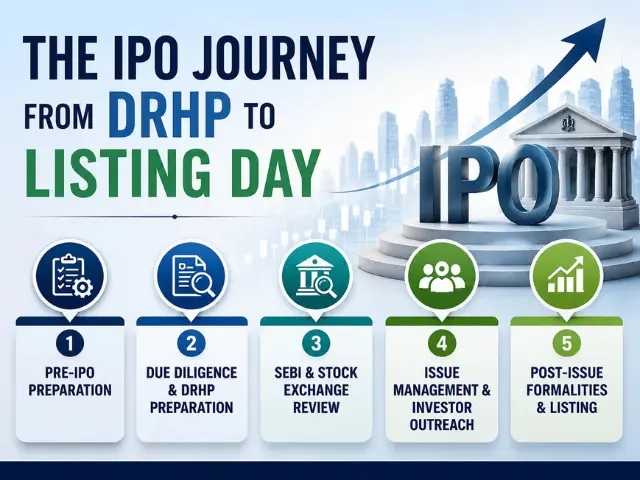

An IPO is often perceived as a single event. In reality, it is a tightly regulated capital markets transaction that tests a company’s governance, financial maturity and disclosure standards. Long before the stock lists, months of preparation go into drafting, verification, regulatory review and investor positioning.
Why the Filing Process Matters
The offer document is the backbone of the IPO. For SEBI, it is a legal disclosure document. For investors, it is the primary source of truth.For the company, it becomes a permanent public record. Gaps in statutory disclosures or inconsistencies in financial reporting may result in approval delays and affect investor confidence.
Phase I: Pre IPO Preparation
The IPO process begins well before drafting the prospectus. At this stage, the company prepares itself to operate as a listed entity. Key actions include finalising the issue structure, converting into a public limited company, updating constitutional documents, strengthening board and committee structures, appointing key managerial personnel and dematerialising shareholding.
Phase II: Due Diligence and DRHP Preparation
This is the most intensive stage of the IPO journey. The Merchant Banker conducts detailed financial, legal and business due diligence, followed by preparation of the Draft Red Herring Prospectus covering company profile, industry overview, risks, financials and utilisation of proceeds.
Phase III: SEBI and Stock Exchange Review
SEBI, along with the stock exchanges, reviews the DRHP to ensurefull and fair disclosures, eligibility, and governance compliance. All queries and observations are addressed before final In-Principal approval.
Phase IV: Issue Management and Investor Outreach
Post regulatory clearances, the Red Herring Prospectus is finalised and the issue pricing is decided. Merchant Bankers, working closely with syndication and underwriting teams, drive investor outreach and roadshows, while market makersplay a role in supporting orderly trading and liquidity (in case of SME-IPO), in line with applicable issue regulations.
Phase V: Post Issue Formalities and Listing
After the issue closes, the basis of allotment is finalised, funds are reconciled by the banker to the issue, and shares are credited to investors’ demat accounts. In cases of oversubscription, allotment is carried out as per category-wise allocation norms, with proportionate or lottery-based distribution and refunds/unblock of excess application amounts. The company then lists on the stock exchanges and enters the post-listing compliance framework. Syndication and underwriting teams continue to support investor engagement, while issuer-led marketing and investor interactions remain ongoing. Anchor investors participate up to one working day prior to the issue opening, helping establish early demand visibility and confidence in the offering.
Role of the Merchant Banker
The Merchant Banker anchors the IPO end-to-end, beginning with comprehensive due diligence and preparation of offer documentation. They act as the primary interface with SEBI and Stock Exchanges, provide valuation and structuring advice, and lead investor marketing efforts. In coordination with syndication and underwriting teams, the merchant banker supports book building, demand aggregation, and risk underwriting. Post listing, they also facilitate market-making arrangements and ensure regulatory and compliance requirements are met, enabling a smooth transition from a privately held company to the public markets.
Closing Thoughts
The IPO process shows how ready a company is to operate in public markets. With the right Merchant Banker guiding the company at every stage, the journey becomes well-planned and manageable, helping the business move smoothly into the listed space and build long-term, sustainable growth.
👉 To Connect with us today, please click here.
Latest Articles

Why a Crisis is the Best Time to Invest


“Be fearful when others are greedy and greedy when others are fearful.”
-Warren Buffet
A falling knife is risky to catch as it may hurt, but the one who catches the falling knife perfectly without getting hurt is called a genius. Investing at a time of crisis is too risky but one who invests in a fundamentally sound company at the time of crisis can generate good wealth.
At the time of the COVID-19 pandemic outbreak when investors and traders were selling the stocks in bulk, it did create an opportunity for the new investors to build their portfolio. Globally, when stock markets were getting crashed, individuals were selling in bulks which did create a history for the fastest decline in history.
There has been a “V” shaped recovery across the board from the COVID-19 economic crisis on the back of the strong recovery in the economy. We have seen large swings in the market in this period of 9 months where the market crashed recovered and broke out its all-time high.
The stock market is speculative and always has a forward approach. In March, until when the lockdown was initiated market was getting crashed and made its low on 24th March it’s the same day when the lockdown was announced.
Having its forward outlook it NIFTY50 touched its new all-time high breaking the previous high of 12430.50 on 9th November. We saw a massive rally of approximately 5000 points in just 9 months which was the fastest recovery in the history including its high and low.
In this period of 9 months, fundamentally sound stocks have multiplied themselves and generated huge wealth for the investors. Below is the list of top 10 stocks from NIFTY200 which have generated ample wealth for the investors considering and individual have bought the shares around the close price of 24th March.
[caption id="attachment_194" align="alignnone" width="1102"]
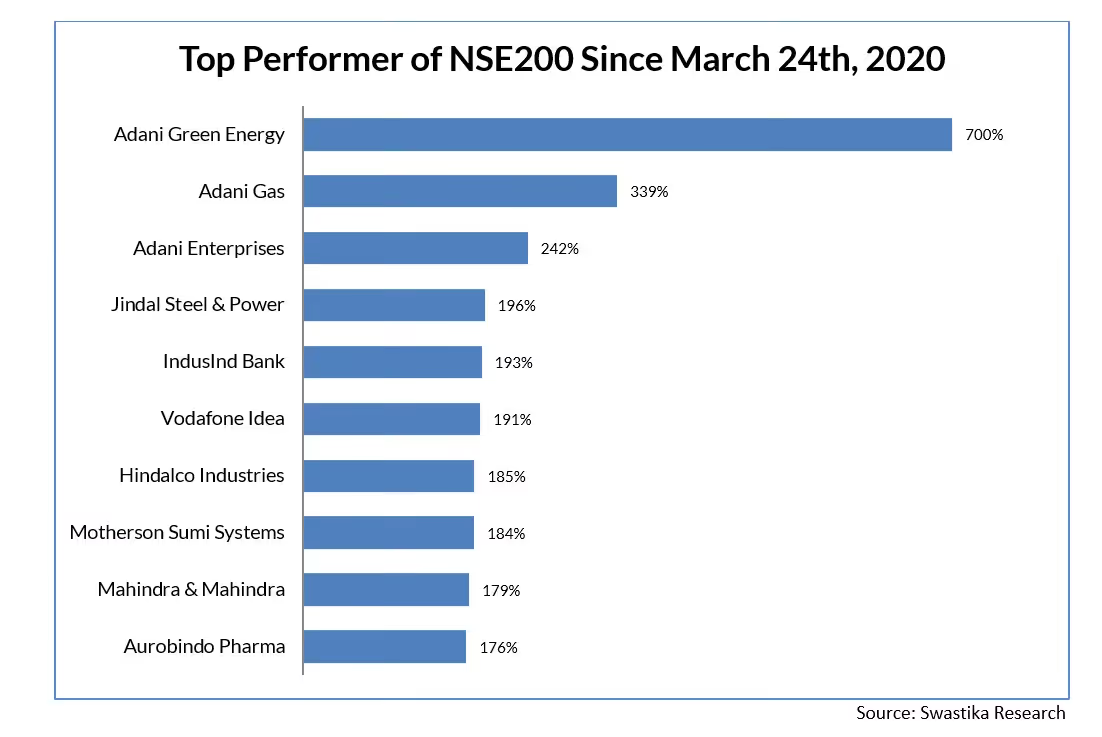
As we can see in the above graph, Adani Green Energy has rejoiced the wealth of investors by 700% which is the most NIFTY200 list of companies; the list is followed by two more companies from the Adani Group namely Adani Gas and Adani Enterprises.[/caption]
In the period of lockdown when everything came to a halt, we saw many new traders and investors entered the market and earned handsome money by investing in some of the good quality companies. The valuations were cheaper and they got an opportunity to be a long term investor.
At the time of crisis stocks were falling and buying at that price does need courage which is equivalent to catch a falling knife but the market has again proved that investing in a fundamentally sound company will always reward investors.
When we buy goods, lower prices are generally a good thing. That’s not the same case in terms of stocks as we never know how much a stock can fall. However, if you would have bought the dip in quality stocks then it will surely benefit the investors. While if an individual wants to invest for a long term then a crisis is the best time to buy because as soon as the economy will recovering it will benefit the investor.
Historically, there has been an economic crisis timely in the stock market. It can occur in the form of a pandemic, recession, or any bubble. People generally sell their portfolio when any crisis happens but as said earlier it does create an opportunity for the investors to average out their portfolio also it creates an opportunity for new investors to build their portfolio.
There have been twelve crises in the 20th century excluding the geopolitical event and the still market had hit an all-time high on 04th December 2020. Thus, a new investor should look for a dip or any crisis event to build a portfolio and invest in the long term.

Understanding the Concept of the Financial Market
The financial market plays a crucial role in any economy, and understanding its basic concepts is essential for anyone interested in investing or managing finances. In simple terms, the financial market is a platform where people buy and sell financial assets such as stocks, bonds, commodities, and currencies. It helps businesses raise capital, allows investors to make profits, and enables the economy to grow.
This blog will explain the financial market in easy-to-understand language, covering its types, key participants, and why it is important.
What is the Financial Market?
A financial market is a place where buyers and sellers come together to trade different types of financial assets. These assets can include:
- Stocks: Shares of a company that represent ownership.
- Bonds: Loans given to companies or governments in exchange for interest.
- Currencies: Trading of different currencies, such as U.S. Dollars, Euros, or Indian Rupees.
- Commodities: Physical items like gold, silver, oil, and agricultural products.
In the financial market, the prices of these assets fluctuate based on supply and demand. For example, if many people want to buy a particular stock, its price will go up. If fewer people are interested, the price will go down.
Types of Financial Markets
The financial market is broad and consists of several sub-markets that specialize in different types of trading. Here are the key types of financial markets:
1. Stock Market
The stock market is where shares of companies are bought and sold. When you buy a share, you become part-owner of the company. If the company grows and makes profits, the value of your shares can increase, and you may receive dividends. Stock markets are divided into two categories:
- Primary Market: When a company first issues shares to the public, this is called an IPO (Initial Public Offering), and it happens in the primary market.
- Secondary Market: After the IPO, the shares can be traded among investors on stock exchanges like the New York Stock Exchange (NYSE), the Bombay Stock Exchange (BSE), or the National Stock Exchange (NSE).
2. Bond Market
The bond market allows governments, municipalities, and companies to borrow money from investors by issuing bonds. When you buy a bond, you are essentially lending money to the issuer in exchange for periodic interest payments and the return of the principal amount at the end of the bond’s term.
Bonds are typically considered less risky than stocks, but the returns are also generally lower. This makes them a popular choice for conservative investors.
3. Foreign Exchange Market (Forex)
The foreign exchange market is where currencies are traded. It is the largest and most liquid financial market in the world. Investors trade currencies to make profits from changes in exchange rates. For example, if you believe the U.S. Dollar will strengthen against the Euro, you can buy Dollars and sell Euros. If the Dollar rises, you make a profit.
4. Commodities Market
In the commodities market, physical goods like gold, oil, and agricultural products are traded. Commodities can be traded either in their physical form or through financial contracts called futures, which are agreements to buy or sell a commodity at a future date for a predetermined price.
For example, a trader might buy gold futures if they believe the price of gold will increase in the coming months.
5. Derivatives Market
The derivatives market involves contracts whose value is derived from an underlying asset, such as stocks, bonds, currencies, or commodities. Common derivatives include options, futures, and swaps. These contracts allow traders to speculate on the future price movements of assets or to hedge against risk.
For instance, a wheat farmer might use a futures contract to lock in a price for their crop, protecting themselves from potential price drops in the future.
Key Participants in the Financial Market
The financial market consists of various participants, each playing a different role. The major players include:
- Investors: Individuals or institutions (like mutual funds or pension funds) that buy assets to make a profit.
- Companies: Businesses that raise money by issuing stocks or bonds.
- Governments: National and local governments that issue bonds to fund public projects.
- Financial Institutions: Banks, brokerage firms, and insurance companies that facilitate buying and selling of assets.
- Regulators: Authorities like the Securities and Exchange Commission (SEC) in the U.S. or the Securities and Exchange Board of India (SEBI) that ensure the financial markets operate fairly and transparently.
Importance of the Financial Market
The financial market plays a critical role in the global economy. Here are some of its key benefits:
1. Capital Formation
The financial market allows businesses to raise funds by selling stocks or issuing bonds. These funds are then used to invest in projects, expand operations, and create jobs, contributing to overall economic growth.
2. Investment Opportunities
The financial market offers individuals and institutions a wide range of investment options. Investors can diversify their portfolios by investing in different types of assets, helping to manage risk while aiming for higher returns.
3. Liquidity
One of the primary advantages of financial markets is liquidity. Liquidity refers to how quickly and easily an asset can be bought or sold. The financial market ensures that investors can buy or sell their assets when they need to, without significant price changes.
4. Price Discovery
In financial markets, prices are determined by supply and demand. This process of price discovery helps investors understand the fair value of an asset based on market conditions.
5. Risk Management
The financial market offers tools like derivatives that allow investors and companies to manage risks. For example, a company can use foreign exchange derivatives to hedge against currency fluctuations, protecting its profits from adverse movements in exchange rates.
Conclusion
The financial market is a dynamic system that brings together buyers and sellers of financial assets like stocks, bonds, currencies, and commodities. Understanding the different types of financial markets and how they function is essential for making smart investment decisions. Whether you’re a new investor or someone looking to expand your knowledge, the financial market offers various opportunities to grow wealth, manage risk, and achieve financial goals.
By including a mix of assets from different markets in your portfolio, you can diversify your investments and better manage risks, ensuring a more balanced approach to wealth creation.
Commodity Trading: Tips On How To Avoid Losses?
Commodity trading offers exciting opportunities, whether you’re dealing with agricultural products like corn and soybeans, or more popular markets such as oil, gas, gold, and silver. To increase your chances of making a profit and to manage risks effectively, follow these ten essential tips:
Use a Trailing Stop Loss:
A trailing stop loss is a tool that helps protect your gains by adjusting your stop loss order as the market price moves in your favor. For example, if you buy a commodity and its price increases, you can move your stop loss to the break-even point (the price at which you bought it) to ensure that you don't lose money if the price drops. While this strategy doesn't guarantee profits—since prices can fluctuate and hit your stop loss before moving further in your direction—it provides a safety net that locks in profits as the market trends in your favor.
Avoid Averaging Winning Trades:
Averaging down means buying more of a commodity at a lower price to reduce the average cost of your position. However, this can be risky if the market reverses. If you add to a winning trade at reversal points, it could increase your average entry price and make it harder to sell at a profit. Instead of averaging down, consider booking your profits once the market moves in your favor and wait for a more favorable entry point if you want to re-enter the trade later. This approach is particularly useful in range-bound markets where prices move within a certain range.
Trade Smaller Contracts:
If you have a smaller trading account, it’s wise to trade smaller contracts or mini contracts rather than standard ones. For example, if you have ₹1,00,000 in your trading account, trading 15-20 lots of mini Crude Oil futures (10 barrels per lot) is safer than trading just 2 lots of the standard Crude Oil futures (100 barrels per lot). Smaller contracts allow for greater flexibility in managing trades, scaling in and out of positions, and mitigating risks. This way, if a trade goes against you, the impact on your account is less severe.
Use Options for Protection:
Options can be an effective way to protect your gains or limit potential losses. Suppose you bought Crude Oil futures at ₹5200 and the price rises to ₹5500. To safeguard your profits, you can buy an At The Money (ATM) put option. This option gives you the right to sell at a specified price and costs less than the potential profit you could make. For instance, if the put option costs ₹100 per barrel, your total cost is ₹10,000, but it provides a safety net if the market turns against you. If prices continue to rise, the option can be sold for a profit, allowing you to benefit from further price increases.
Book Profits Regularly:
It’s important to take profits regularly rather than holding onto them for too long. While it’s common advice to let your profits run, this strategy may not always work, especially in volatile markets. By booking smaller, more frequent profits, you can build your account size and reduce the risk of losing all your gains. Regularly locking in profits also allows you to manage your risks better and take on new trades with a more stable financial base.
Track Inventories, but Don’t Trade Blindly:
Inventory reports, such as those for crude oil and natural gas, can lead to sudden price changes. However, these reports often cause unpredictable spikes that may not be rational for trading, especially if you lack detailed knowledge of the market’s supply and demand dynamics. Instead of making trades based solely on inventory numbers, use this information to inform your broader market strategy and avoid blind trading based on short-term data.
Follow Currency Trends:
Commodity prices are often influenced by currency trends. For example, if the rupee is depreciating, the price of commodities will be higher in rupee terms. This means it’s generally unwise to short commodities when the rupee is weakening, as the price in local currency is already higher. Always consider currency trends when making trading decisions to avoid losses due to currency fluctuations.
Watch Regulatory Changes:
Regulatory developments can impact commodity prices significantly. For instance, if the Indian government is considering imposing additional import duties on gold, the price of gold may rise even if international prices fall. Being aware of such regulatory changes helps you avoid trades that go against these trends and adjust your strategy accordingly.
Set a Daily Stop-Loss Limit:
To manage risk effectively, set a daily stop-loss limit that you are not willing to exceed. If you hit this limit, avoid trying to recover the losses on the same day. Emotional trading to recover losses can lead to poor decision-making and further losses. Stick to your pre-determined stop-loss limit to prevent significant damage to your trading account.
Diversify Your Trades:
Diversification helps reduce risk by spreading your trades across different commodities that are less correlated. Instead of trading commodities that move in the same direction, like gold and silver, consider trading a mix of commodities, such as crude oil and agricultural products. This approach can protect you from losses in one market and help balance your overall trading risk.
By following these tips, you can enhance your commodity trading strategy, manage risks more effectively, and increase your chances of making profitable trades. Remember, successful trading requires careful planning, constant learning, and a disciplined approach.

How to Choose the Best Mutual Funds?
If you are willing to invest in the best performing mutual funds but don't know how to get started, it's pretty easy to pick up the best one that suits your pocket. Before picking the best mutual funds, it is crucial to understand your investment objectives along with the risk tolerance.
Choosing best mutual funds involves a lot of factors such as expense ratio, past performance, fund manager’s experience and more. Once you are ready to go through with your research, you will get a clear idea of which mutual fund you would want to invest your money in.
Key Aspects to Select the Right Mutual Funds
In this blog, we will cover the key aspects to select the right mutual funds as per your requirements.
Identify Your Goals
Before investing in top mutual funds, it is crucial to identify your goal first. A goal can be anything, like short term purchasing utility goods, rent of a house or long term like providing for the school education for children.
Don't Neglect Risk Tolerance
You should also consider personal risk tolerance before starting investing in mutual funds. Ask these questions to yourself:
Are you able to tolerate dramatic swings in portfolios that may have huge ups and downs?
Is a conservative investment strategy suitable for you?
For how much time you need to invest your funds in mutual funds?
Remember, risks and returns are directly proportional to each other. Hence, it is suggested to get ready with the risks associated with these mutual funds.
Plan Investment Strategy
Planning a successful investment strategy is extremely crucial for better returns because a proper investment strategy helps you to know about the goals regarding investments and your willingness to take risks. Thus, you can find the best mutual funds for SIP.
Check Fund Performance
It is important to keep an eye on a mutual fund’s performance. This is because mutual fund cycles have to go through multiple market cycles. In a case, where the fund has not been able to beat its benchmark over 3 years, you need to understand that the mutual fund might not be an apt investment for future growth.
To check the fund’s better performance, it would be ideal to contact your fund manager as they hold a proven track record of all the mutual funds that may be beneficial for multiple investors.
Expense Ratio
Expense ratio is basically the commission, investors need to pay for the management of their funds. It is a fund manager’s fee that all clients have to pay for ensuring better gains. If you are targeting best mutual funds to invest in, it is suggested to target the mutual fund which has a low expense ratio.
Takeaway
Mutual funds tend to provide maximum profits if you choose the right one. Therefore. it is said to choose that fund which suits your requirements. Although there are a lot of options in hand, it is difficult to choose the best mutual funds for lumpsum investment. Therefore, all the factors should be taken into consideration while selecting the best mutual funds as it provides you with maximum gains with less time.

बेहतर मांग से चमके सोने -चाँदी के भाव।
लगातार बिकवाली का दबाव झेल रहे कीमती धातुओं के भाव मे पिछले सप्ताह सुधार दर्ज किया गया। सोने के भाव 47600 रुपय प्रति दस ग्राम के निचले स्तरों से पलट गए और सप्ताह मे 1700 रुपय प्रति दस ग्राम से ज्यादा की तेज़ी देखि गई। घरेलु वायदा चाँदी के भाव भी 58880 रुपय प्रति किलो के निचले स्तरों से पलट गए और यह सप्ताह मे 4500 रुपय प्रति किलो तक तेज़ हुई। घरेलु बाजार मे शादियों के सीज़न के दौरान सोने के भाव भी कम हो गए थे जिससे मांग को सपोर्ट मिला और कीमती धातुओं के भाव मे वापस चमक लौट आई। ब्रिटैन द्वारा कोवीड के टिके को अप्रूवल देने के बाद भी सोने के भाव निचले स्तरों से बढ़ गए है।
निवेशकों को अमेरिका से मिलने वाले राहत पैकेज का इंतजार है जिसमे अभी तक अनिश्चिता बनी हुई है। 908 लाख करोड़ का द्विपक्षीय पार्टी के प्रस्ताव मे भी अनिश्चित होने से और 11 दिसंबर से होने वाले अवकाश के पहले निर्णय पर निवेशकों की नज़र रहेंगी जिससे सोने और चाँदी के भाव बढ़ रहे है। अमेरिकी कंपनी द्वारा निर्मित कोविड टिके पर भी इस सप्ताह होने वाली बैठक महत्वपूर्ण है।डॉलर सूचकांक मे 1.22 प्रतिशत की सप्ताह मे गिरावट दर्ज की गई है और यह ढाई साल के निचले स्तरों पर पहुंच गया है।
डॉलर मे गिरावट होने से अन्य मुद्रा के निवेशक कीमती धातुओं की तरफ आकर्षित हुए है। सोने में निवेश को राजकोषीय प्रोत्साहन योजनाओं के खिलाफ बचाव के रूप में देखा गया है जो मुद्रास्फीति को बढ़ाने के साथ ऋण और मुद्रा अवमूल्यन को बढ़ाने की क्षमता रखते हैं। अमेरिका से जारी होने वाले पैरोल के मासिक आंकड़े धीमी हुई अर्थव्यवस्था के कारण 6.1 लाख से घट कर 2.45 लाख पर पहुंच गए है जो कीमती धातुओं के भाव को सपोर्ट कर रहे है।
तकनिकी विश्लेषण
इस सप्ताह कीमती धातुओं के भाव को नीचले स्तरों सपोर्ट मिल सकता है। फरवरी वायदा सोने मे 48500 रुपय पर सपोर्ट और 49700 रुपय पर प्रतिरोध है। चाँदी के भाव भी इस सप्ताह सकारात्मक रह सकते है और इसमें 62000 रुपय पर सपोर्ट तथा 66000 रुपय पर प्रतिरोध है।

Tips and Tricks to Learn Stock Market Trading in India
Share market is a place where everyone wants to make money through investments irrespective of terms. Many investors are masters in doing intraday trading, however, some of them want to play safe and often go for long term investments.
For beginners, it is always difficult to decide whether to invest or not to invest in the stock market as they think that stock trading is full of risks. Well, they are not wrong. Although the share market is full of risks, it offers a huge positive return to many investors.
Share Market Investment Tips
To successfully trade in the stock market, all you need is to learn some highly impactful stock market tips and tactics and you are ready to go.
Before you get a deep dive into stock market trading:
Let's understand the basics first.
Demat and Trading Account
This is the foremost step to enter into the stock market. Opening a Demat account is a must as without it you can't trade online. Demat account is a dematerialization where you can buy, sell and hold your shares in a dematerialized form. Once you open a Demat account, you can start to invest in the stock market.
Stock Market Research
Many beginners believe that stock research is not that important, they instead rely on futile stock tips and unreliable sources.
As you all know, financial markets are full of risks, inconsistencies and volatility. Therefore it is crucial to do a bit of research and planning before buying any stock.
Stock market research and analysis are crucial for any investor because it helps them to get the full insight of stocks such as stock’s history, its past performance, its share price and trends.
Based on the research, you can get an idea when the stock will give you a positive return or not.
Difference Between Primary And Secondary Market
When a company first time lists its shares (IPO) in the share market, it is known as the primary market. Once the shares get listed on the stock exchange, the company gets an authority to trade in the market, which is termed as the secondary market.
Who determines the share price in the Stock Market?
The share market majorly depends on demand and supply. When a company is earning many profits, its share prices go up. As the demand for the stocks goes high, more investors want to buy those stocks which in turn increase the prices of stocks or vice versa.
Role of Broker in Share Market
A stockbroker assists you in buying and selling of shares. Apart from helping in buying and selling, they also provide tips and recommendations on stocks such as which stocks one should buy, how to successfully invest in the share market, which is the best time to sell a share and more.
The Bottom Line
The stock market is indeed a great way to achieve financial gains. Anyone who has done enough research and analysis can easily earn money from the stock market. Although there are many risks and uncertainty associated with the stock market, a smart investment will definitely give you positive returns. For beginners, there are numerous stock broking companies available in India. These companies assist beginners in selecting the right investment type while trading in the stock market.
Big Budget


Popular Articles



.avif)
.avif)

.avif)



START YOUR INVESTMENT JOURNEY
Get personalized advice from our experts
- Dedicated RM Support
- Smooth and Fast Trading App
