


RBI Fixed Deposit Rules 2026: What Investors Should Know



Key Takeaways
- RBI Fixed Deposit Rules now require small finance banks to disclose interest rates before offering any FD.
- This move aims to boost transparency, clarity, and fairness for retail depositors.
- The changes come into force on October 1, 2026 under the Second Amendment Directives-2026.
- Retail investors should compare RBI interest rates and RBI fixed deposit rates across banks to choose the best option.
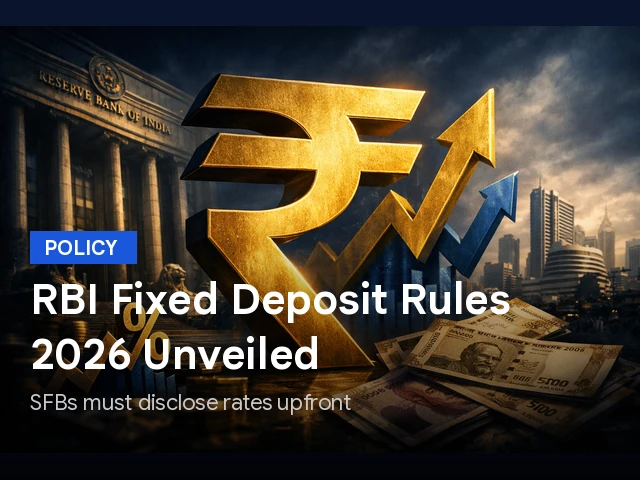
RBI Fixed Deposit Rules for Small Finance Banks (SFBs) are set to reshape how retail investors evaluate fixed deposits. On Oct 1, 2026, the central bank's new guidelines under the Second Amendment Directives-2026 require SFBs to disclose interest rates upfront before accepting a fixed deposit. This simple change translates into more transparency, clearer terms, and fairer competition across lenders. For a retail investor juggling multiple FD offers, this shift can fundamentally alter the process of choosing where to park money.
The central bank's framework outlines five major changes. The first change is mandatory disclosure of interest rates before offering a deposit, ensuring customers know the exact rate they are being offered before they commit. The remaining four changes are designed to improve transparency, standardization, and fairness across the sector, though the publicly summarized focus remains on rate disclosure and clarity of terms. All these reforms are scheduled to take effect from 1 October 2026, giving lenders time to update their processes. The overarching aim is to make the entire deposit ecosystem more transparent, comparable, and fair for retail depositors in India.
What The RBI Fixed Deposit Rules Change For SFBs In 2026
Under the RBI's Second Amendment Directives-2026, five major changes are introduced to the way fixed deposits are offered by SFBs. The first change requires deposit offers to disclose interest rates before the FD is accepted, ensuring that customers know the exact rate they are being offered before they commit. The remaining four changes are designed to improve transparency, standardization, and fairness across the sector, though the public summary highlights rate disclosure and clarity of terms. All these reforms become effective on 1 October 2026, giving lenders time to update their processes. The RBI’s aim is to bring more clarity and fairness to the deposit ecosystem across the country by ensuring depositors understand the exact rates, any applicable charges, and the true cost of funds before they commit.


Why RBI Interest Rates And RBI Fixed Deposit Rates Matter More Under The New Rules
When you shop for an FD now, you will see RBI interest rates and RBI fixed deposit rates displayed more consistently across SFBs. The new RBI deposit rules ensure that rate quotes are not hidden in fine print, making it easier to compare offers across banks. For retail investors, this means less guesswork and more precise decision-making about where to place funds for the duration that fits liquidity needs. In practice, you can align the rate you are offered with the posted RBI fixed deposit rates and your own requirements for safety, liquidity, and tax considerations. These changes reflect RBI’s broader objective to uplift transparency in deposit pricing while reducing the risk of mis-selling.
How To Compare RBI Deposit Rules Across Banks And SFBs For Best Returns
To maximize returns under the new rules, consider a simple comparison framework. Start by noting the headline interest rate quoted for the FD; confirm the compounding frequency (monthly, quarterly, or yearly) and the applicable term. Check for any maintenance charges, premature withdrawal penalties, or step-up features that could affect total returns. Compare the effective rate after considering compounding and any fees, rather than just the nominal rate. Use an apples-to-apples basis by comparing the same tenor across multiple SFBs and traditional banks, and keep an eye on any changes announced in RBI fixed deposit rates. By building a small decision checklist, you can ensure you are choosing the best available option under RBI deposit rules and RBI fixed deposit rules.
What The Oct 1, 2026 Deadline Means For Retail Investors
The October 1, 2026 deadline marks the practical implementation date for the new disclosure norms. Depositors can expect that, moving forward, rate quotes will be explicit and consistently presented across SFBs. This reduces information asymmetry, enabling investors to evaluate the true cost of deposits and compare products on a like-for-like basis. If you currently hold or are considering FD with an SFB, now is the time to inventory your options, ask for rate sheets, and verify terms before you commit. The rule change is designed to help you avoid surprises and ensure you understand exactly what you are getting when you sign an FD agreement.
Frequently Asked Questions
What Are The Key Changes In The RBI Fixed Deposit Rules For SFBs?
The RBI's Second Amendment Directives-2026 introduces five major changes aimed at improving transparency in fixed deposit products. The first change requires deposit offers to disclose interest rates before acceptance.
When Do The RBI Fixed Deposit Rules Take Effect?
The new rules become effective on October 1, 2026.
Which Banks Are Affected By The RBI Deposit Rules?
The rules primarily apply to Small Finance Banks (SFBs) and their depositors.
How Will The New RBI Deposit Rules Benefit Retail Investors?
By mandating upfront rate disclosures and clearer terms, the rules help investors compare RBI interest rates and RBI fixed deposit rates across banks, reducing confusion and mis-selling.
Where Can I Learn More About These Changes?
Consult RBI communications and your bank's published rate sheets for the most official guidance. Retail-investor education resources from Swastika can also help interpret these changes in the broader market context.
Conclusion
The RBI fixed deposit rules for 2026 are not about complicating the FD landscape; They are about making the market more transparent for retail investors. With explicit rate disclosures starting Oct 1, 2026, you now have a clearer basis to compare offers, decide tenure, and optimize your deposit strategy. The practical step is to build a simple comparison checklist that captures rate quotes, compounding, terms, and charges, and to apply it consistently across your options. By staying informed and using the right tools, you can navigate the change confidently and optimize your returns while keeping your liquidity needs intact.
Open your trading and demat account here
Reference :
1 : Bhaskar
Latest Articles

Thematic Investments: The Next Generation For Better Returns


The pandemic of 2020 has completely changed the outlook of everyone’s life. Stuck to the confines of their homes, many people have tried to find some solace in other activities to avoid boredom.
As the government from every country continues to grapple with the economic and health activities, a different scenario of the stock market has come out.
After the significant drop of 45% across major stock indices in the stock market, the market witnessed a speedy recovery after 3-4 months. All thanks to the retail investors who did an outstanding job by maintaining the liquidity in the stock market.
These things have put a major impact on global thematic funds. As per the research report of Morning star; the assets under management in thematic investment grew nearly three times from 75 billion dollars to around 195 billion dollars worldwide.
Let’s understand what is a thematic investment, how does it work and what are the benefits of investing in thematic investment:
What is Thematic Investment
Thematic investments are open-ended equity schemes that are directly linked to distinct yet predetermined investment themes. The themes are mostly linked to the major trends which are emerging in the world at large.
With thematic investment, investors park their money so that they can become a part of various investment themes which impact the world.
Thematic investment enables you to invest in long term trends or themes in an attempt to capitalize on major technological, societal and other trends that keep a huge impact on the world.
The Mindset of a Thematic Investor Pursuing Megatrends
While pursuing megatrends, the mindset of thematic investors roams around transport, technology, robotics, energy, fuel etc. Before investing in megatrends, a thematic investor asks himself the following questions: Concerning transport as a megatrend, should I only invest in auto stocks if the auto company has planned to build electric cars?
Similarly, if a thematic investor seeking a megatrend called the older population, the first thing he asks himself is: should I invest in pharma stocks as the senior citizen depends more on medication and pills for their overall wellbeing. What old fashioned companies will robots disrupt?
Asking such questions will help investors to move to a trend early and achieve bountiful benefits to earn good returns.
What are the Mega Trends Someone Looks at?
Here are the megatrends that investors might consider pursuing:
- Clean Energy
- Gig Economy
- Digital Economy
- Nutrition
- Agribusiness
How Do Thematic Funds Work?
All the mutual funds have underlying assets which bring them adequate stock trading returns. If we talk about large-cap funds, the underlying assets are stocks of renowned companies with a huge market capitalization.
Same things about thematic investments: thematic funds have a company’s stocks as underlying assets that are united by predetermined themes.
Let’s understand it with an example:
If a fund has an SG fund, it will invest in the companies that are based on environmental, social and corporate governance factors from different sectors such as technology and financial services.
This is what makes thematic investment different from other investment approaches which are based on value and growth, market cap, sectoral based (pharma, technology, infrastructure).
As per the SEBI guidelines, the minimum investment in equity and equity-related instruments of a particular theme shall be 80% of total assets.
What Sort of Cautions One Need to Take Before Investing in Thematic Investing:
While putting money in thematic investing, one needs to do a lot of stock market research on the companies you want to invest in and constantly monitor the themes that are working well in the world. The frequent changes in the trends will give you an idea of which companies will increase your ROI.
It is good to invest in the companies that are actually on a boom but one thing to keep remember is that’s exactly what people were doing when they invested in useless companies in the 80s.
Carefully invest in the companies that have published and have strong financial records. Hence, it is recommended to carefully invest in the trends of the companies that you can understand and track.
Also, keep in mind the fact that there is a huge difference between investing in a company that is currently in business and delivering good returns and investing in the new-fangled business.
To successfully invest in a good company, one should have the ability to see foresight and evaluate the financial performance of a company.
Portfolio diversification is imperative when investing in thematic investment because diversifying your money in different sectors mitigate the risk of losing money.
Benefits of Investing in Thematic Funds
1. Helps you to Create a High Powered Portfolio
Global investors like Warren Buffet and Peter Lynch once said that the successful way to create wealth for a long duration is only through focused themes that possess a strong profit generation potential.
2. Enables you to Leverage on a Particular Theme
If you measure the performance of thematic stocks vs indexes over a fixed duration, then you may see a lot of difference in the performance of these stocks. Here, the former outperformed the other.
3. Sustainable themes can outperform the equity funds
It's a fact that the themes that are sustainable for a longer period can outperform the equity funds. Hence, if you shift 10-15% of your portfolio into specific themes can bring a huge difference in your portfolio returns.
4. Specific themes can be added to mitigate the portfolio risks
In order to reduce the portfolio risk, you can add specific thematic stocks to your portfolio. When you add multiple themes to your portfolio, it not only diversifies it but also reduces the risks associated with certain stocks, which in turn improves the share trading returns.
5. It can multiply your amounts in the coming years
You have all heard of how an investment of Rs 10,000 in Wipro in 1980, costs around Rs 450 Crore today. Also, a minimum investment in Eicher motors in 2001 would give you a maximum profit today. That’s the power of a thematic investment.
Takeaway
Thematic investing requires a full understanding of the business models and market prospects and hence many people seek advice from experts who have in-depth knowledge about it.
Thematic investment is a lot more complicated than just investing your money in a diversified equity fund. It may be noted that not all themes will give you big returns. Hence you are required to carefully choose thematic funds.

Everything You Need To Know About Right Entitlement of Shares
Right Entitlements of shares a term that recently made the headlines these days when India’s famous brokerage firm reported that it lost a huge amount of Rs 10 Crore in expired Rights Entitlements.
Rights Entitlements is a fresh concept that was introduced in India’s share markets only in 2020 with RILs Rs 53,125 crore rights issue.
Rights Entitlement is issued by a company launching its share to its shareholders, which ultimately give them the right to subscribe to the issue or sell it to the other investors. Rights entitlement are issued similar to the rights issue in the same ratio to the shareholders as on the record date.
As per the capital market regulators SEBI, a shareholder may trade the entitlement in favor of another person for a price.
Before getting a deep down into this, let’s have a quick understanding of what Rights Issue is:
In a Rights Issue, a company gives its shareholders the right to buy more shares at a discounted price.
Here, the Rights shares issued by a company are of two types: Fully paid-up shares or partly paid shares. In fully paid-up shares, you don't have any obligation to the company which means you don’t have to pay any additional amount to the company as you are a shareholder with limited liability.
If your company has partly paid rights share to you, then in this case you need to pay installments over a given period. In case, if you failed to pay the fixed amount decided by the company, you need to pay interest on the called amount.
The rights entitlement has a specific time frame within which one has to apply for rights share or sell it before they stop trading. These instruments cannot be traded on an intraday basis. Hence, one has to take delivery of these instruments before applying for the rights issue within the issue period or selling them again in the stock market.
Several investors have zero clues on what it is and have just bought them from the market thinking it will be like regular shares in the market. Some of them have not applied for the rights share within the issue period and saw them disappear from their Demat account.
Rights Entitlement - A New Instrument
In January 2020, SEBI did an announcement regarding the launch of rights entitlements tradable in the Demat form. The Right Entitlement instrument was first made available to the shareholders of Reliance Industries when its rights issue launched in May 2020.
All the shareholders will get Rights Entitlement credited to their Demat account after a few days from the record date. Rights Entitlement usually traded in the secondary market for a definite period of time.
For instance, if you had 15 shares of Reliance Industries and the companies announced that they are raising more funds through the Rights issue at a ratio of 1:5 at a price of Rs 1200. You will get 3 quantities of Rights Entitlement that you can choose to apply for the rights issue or sell in the secondary market.
What Happens If You Don't Apply for the Rights Issue through Rights Entitlement
The Rights Entitlement will lapse at the rate of 0 and the RTA (Registrar and Share Transfer Agent) will debit the REs from your Demat Account. To make use of REs that were credited to the DEMAT account, you can either sell it in the secondary market or apply for the Rights Issue shares.
Difference Between Fully Paid Up Shares and Partly Paid Up Shares
Fully Paid Up Shares
When a company is raising funds in a shot and issues the actual shares if the client is applying for the rights issue, it is said to be a fully paid up issue. The company will announce the price at which an eligible shareholder can apply for the Fully paid Rights Issue a few days before crediting the Rights Entitlement to the Demat account.
M & M financial services announced a fully paid up rights issue in the month of January 2021, where the shareholders 1 Rights Entitlement (RE), against 1 share of M&M financial services and the RE holders had the rights to apply up for the fully paid up shares at the rate of Rs 50 (including a premium of Rs 48 per fully paid-up equity share).
Partly Paid Up Shares
Here, a company is said to raise funds partially with a formal notice to the shareholder on every call. Irrespective of one applying for the next partly paid up shares will get extinguished with zero value, so it's better to apply for the next call or to sell it in the secondary market as it will trade for a temporary period of time in the secondary market.
Example:
Reliance Industries announced a partly paid up rights issue in May 2020 where the RE holders had the right to apply for the partly up shares of Reliance Industries and the company is set to raise funds in the first call (From May 17, 2021, to May 31, 2021) at the rate of Rs 314.25 per partly paid-up equity share.
And the second call will be in the month of November. We recommend you either pay the first call in order to carry forward to get the next partly paid-up shares or sell them within the last trending day which is on 10 May 2021. Contact us to learn more.

Leverage Hedging to Cover the Potential Losses in The Stock market
Any investment portfolio whether it is of the stock market or other, is often associated with different types of risks.
No one knows when there may be a stock market crash but to cope with it, we can take certain measures to minimize the stock market risks by using tested and certified tactics.
The most appropriate way to save your portfolio from the stock market crash is hedging and diversification.
Whether you are planning to pick an individual stock or ETF investing, a lot of hedging strategies can be used to minimize the downside risks and other risks as well.
Hedging in finance refers to a list of strategies that help us to reduce the risk of uncertainties while monitoring our current finances.
Hedging tactics help investors to limit their strategies arising because of ups and downs in the price of the investment.
In short, hedging in the stock market acts as a safeguard against the losses occurring from the investment strategies.
Understanding Hedging with an Example
Portfolio hedging is a list of strategies used by investment managers that mitigate the risks of adverse price movements in an asset.
For example: if we have an open position in the stock that is trading at Rs. 200, but due to some negative news circulating in the market regarding the stock, the price of the stocks has fallen.
Now, to mitigate the losses, we can choose an alternative path by taking a short position in the same stock in the derivative market.
You can implement a hedging process by buying another asset that has the ability to give you high returns with less time or by short selling an asset. Many investors use short selling during the stock market crash as they find the best way to overcome the potential losses.
It may be noted that hedging is used to reduce or minimize the losses but it cannot eliminate the complete risks associated with the stocks. Hence many investors only hedge a part of their portfolio so as they can save themselves from a complete loss.
Tools for Hedging
Derivatives
Derivatives are the most effective hedging tool that is used against their underlying assets. Traders mostly use derivatives as a strategy where the loss for one investment is compensated by the gain of incomparable derivatives.
Derivatives are the financial contracts that derive their value from an underlying asset such as stock, commodity, currency or more. An option is a type of derivative that gives you the right but not an obligation to buy or sell a specific stock within a particular time.
Using Derivative as a Hedging Tool
Let’s consider a hypothetical situation, where you bought a stock with a belief that the price would go up. At the same time protect your stocks against the losses if the prices move down.
Here, we can hedge several risks associated with a stock with a put option. In a put option, we can have the right to sell the stock at the same price. For that, you have to buy a premium.
If the price of the stock falls, then we can exercise the put option and bring back the amount we invested minus the premium amount that we paid for the put option.
What if we have not used the premium option?
If we couldn't use the premium option as a hedging tool here, we would have lost the full investment amount.
Using diversification as a hedging tool
Another hedging tool we can use is “Diversification”. In this strategy, we add multiple stocks to our portfolio that doesn’t rise or fall simultaneously. If the price of one asset collapses, the others remain safe. For instance, to minimize risks, many investors own bonds to compensate for the losses occurring from the stocks.
Thus when the stock price falls, the bond prices rise or vice versa.
Below are the 5 hedging strategies commonly used by investment managers to minimize the risks:
1. Forward
The forward contract refers to the agreement in which traders can buy or sell underlying assets at a fixed price on a date that is pre-defined by the two parties. Forward contracts include many contracts such as forward exchange contracts for currencies, commodities and more.
2. Futures
A futures contract refers to a contract where two parties agree to buy and sell a particular asset at a predetermined price at a specified date in the future.
3. Money Market
A money market is a type of financial market where short term buying and selling can be made with financial assets that are having a maturity of one year or less such as selling, borrowing, lending with a maturity of one year or less.
Strategies of Hedging
1. Asset Allocation
Traders use asset allocation to diversify their portfolio with more than one asset class used. For instance, traders can invest 60% in equity and the rest 40% in other asset classes such as bonds, derivatives in order to have a balanced portfolio.
2. Structure
Traders can invest a part of the portfolio in debt and others in derivatives. As the debt portion maintains the stability of the portfolio, derivatives on the other hand protect the portfolio from the downside risk.
3. Options
The option is a good strategy that helps traders to buy a put option to reduce the losses from the equity market.
Takeaway
Hedging is used to overcome potential losses in the stock market. A hedge is an investment that protects our finances from a risky situation. It is done for minimizing the chance that your asset will lose its value and also limits our losses to a known amount if the asset does lose value.

Companies under RPG (RAMA PRASAD GOENKA ) Enterprises
Harsh Goenka is the Mumbai head-quartered RPG Group leader (RAMA PRASAD GOENKA ENTERPRISES), which comprises more than fifteen organizations across central areas of the economy with a turnover of US ~$4 Billion.
The Group's Vision is to Unleash Talent, Touch Lives, Outperform and Be Happy. The following are the subsidiaries of the RPG group.
CEAT SPECIALTY was founded in 1989. Its headquarters is in Mumbai. CEAT SPECIALTY Tyres Ltd. is CEAT's particular auxiliary for off-highway (OTR and Agri) tyres in homegrown and global business sectors, with a product portfolio across band spiral tyres.

CEAT, the Mumbai head-quartered CEAT established in 1981, is one of India's leading tyre producers and has a solid presence in worldwide business sectors.
HARRISONS was established in 1988. Its headquarters is in Kochi. Harrisons Malayalam is the biggest producer of pineapples in India and of tea in South India. Not only banana, cardamom, cocoa, espresso, coconut, pepper, and vanilla, its essential items also include elastic, tea, and pineapple.

KEC INTERNATIONAL was established in 1982. Its headquarters is in Mumbai. It is one of the biggest engineering procurement and construction companies in the world.

RAYCHEM RPG LIMITED. Headquartered in Mumbai. A pioneer in Heat-Shrink technology and established in 1989 it is a 50:50 joint endeavour among RPG and US group TE Connectivity and is engaged with designing items and administrations taking into account the infrastructure sections of the economy.
RPG CABLE is a division of KEC International. It is headquartered in Mumbai. It is a Top tier plant and machinery and consists of a World Class Quality and IT frameworks.

RPG LIFE SCIENCE establishment dates back to 1983. It is a speciality developer of pharmaceutical products with the new approaches to work with admittance towards the manufacturing and marketing of fermentation and biotechnology, active pharmaceutical ingredients, and its formulation.

RPG VENTURE is the funding arm of the RPG group, which makes interests in creating new businesses in various areas like health and wellness, technology, automotive, infrastructure, and project management. Its headquarter is situated in Mumbai.

SAE TOWER is headquartered in Mumbai. SAE Towers is one of the largest operating capacities globally. It is also the largest steel lattice tower manufacturers in Latin America

ZENSAR was established in 1989 and headquartered in Mumbai. Zensar is a leading digital solutions and technology services company in alliance with global organizations on their digital transformation journey.

Interested to know about the companies stocks and their fundamental and technical reports. Open a demat account and get expert recommendations before investing.

Smart Ways to Save Tax with Investment
If you are a salaried person whose income is between 5 lakh to 15 lakh annually, you must be aware of the term tax liability. As the famous saying goes “ A penny saved is a penny earned”. Tax planning is the best way through which you can not only save tax but also increase your salaried income in an effective way.
Once you ascertain the amount of tax you have to pay, you must plan to save tax by availing of tax deduction under the provision act of Income Tax Act.
To achieve maximum tax benefits, you can choose to invest in tax saving options under several provisions of the Income Tax Act.
It could be anything from making voluntary donations, taking a home loan or asking your employer to restructure your salary.
The perfect time to plan for tax saving is earlier as much as you can, mainly at the beginning of the FY to prevent any stress or hassle while filing your INR.
Saving Tax Under Section 80C, 80D and 80E
Making an investment of Rs 1.5 lakh under section 80C helps you to minimize your taxable income in the best possible way. Additional deduction of Rs 50,000 can be claimed by investing in NPS under 80CCD.
On buying Medical Insurance, the maximum deduction allowed is Rs 100000 out of which Rs 50000 is for self and family and Rs 50000 for parents if they come under the senior citizen category under Section 80C.
Claim deduction up to Rs 50,000 on Home Loan Interest under section 80EE.
Understanding Income Tax Slab Rates
The income tax department deduces your tax liability based on your annual income. As per the IT act, individuals who have an income between 2.5 Lakh and 5 Lakh comes under the tax slab of 5% for an annual income. The age limit is 60 years.
Similarly, there are different income tax slabs for individuals having different incomes. For instance, a tax slab of 20% is applicable for an annual income that comes between Rs 5 Lakh and Rs 10 Lakh.
While the tax slab of 30% is applicable for the individuals whose annual earnings come above 10 Lakh. It may be noted that an additional amount is also payable for health (4%) and education (4%).
However, the government provides a full tax rebate for individuals who have an income below 5 Lakh.
Investment Options Under Section 80 C
The foremost way to save tax is only through investing your money into several tax saving instruments. Here, you can avail of tax up to 1.5 lakh under section 80C of the Income Tax Act.
- Public Provident Fund (PPF)
These are government-backed savings schemes that come with a lock-in period of 15 years. The interest rate of PPC changes every quarter. However, the current interest rate of PPF is 8%.
- Employee Provident Fund
Employee provident fund is the perfect scheme for salaried employees. Here, 12% of the basic salary and dearness allowance can be deducted by the government. This fund is then invested in numerous government-backed securities.
- National Savings Certificate (NSC)
NSC has a minimum lock-in period of 5 years with a fixed return of 8%. The interest on NSC is often counted as Rs.1.5 lakh under 80C and is tax-deductible if no investment options are using up the limit.
- National Pension Scheme (NPS)
A national pension scheme is backed by the government, providing retirement benefits to employees. It provides for two accounts: Tier 1 and Tier 2.
- Equity Linked Saving Scheme
These are tax saving mutual fund schemes giving the dual benefits of tax saving along with high market-linked returns. The minimum lock-in period of the equity-linked saving scheme is 3 years.
- Tax Saving Fixed Deposit
These schemes are similar to fixed deposits but have a minimum lock-in period of 5 years. The interest earned on Tax saving fixed deposits from 7% to 9%.
- Sukanya Samriddhi Yojna
This is a government-backed scheme where you can invest a maximum of Rs 1.5 lakh annually. If you are blessed with a baby girl, you can easily open an account in the name of a baby girl and earn an interest of up to 8.5%.
- Senior Citizen Saving Schemes
Senior Citizen Saving Schemes have a minimum lock-in period of 5 years and are available to those whose ages cross above 60 years. The interest rate of SCSS is higher than prevailing FD rates and is currently 8.7%.
Other Tax Saving Options Beyond Section 80C
Take a Home Loan
Did you know that taking a home loan could also provide you with tax saving? As per section 80C under the Income Tax Act, paying the amount for both the principal and interest rate of your home loan will be exempt from taxation.
Make Voluntary Donations
You can also save tax by making voluntary donations in numerous relief funds such as the PM relief fund, funds for control of drug abuse and other similar funds. All these donations are completely exempt from taxation under section 80G of the Income Tax Act.
Restructuring of Salary
Restructuring of salary allows employees to restructure their salary in such a way that they are eligible for tax saving allowances.
These allowances include conveyance, House Rent Allowance (HRA), medical treatment etc. You can also claim tax exemptions on Leave Travel Allowance twice in four years.
Tax Saving on Education Loan
Interest paid on education loan is allowed as deduction under section 80E.
How to Plan Your Tax Saving Investments for the Year
The best time to start your tax planning investment is at the beginning of the financial year. Many taxpayers deliberately delay their tax planning which results in hurried decisions. Instead, if you plan tax saving at the beginning of the year, your investment can compound and achieve long term goals.
Conclusion
The above methods explained are various tax-saving methods that allow people to save taxes under different sections of the IT Act.
However, it is important to note that not all tax savers are the same, hence one should select the investments that best suit their individual needs.
The liquidity, safety and returns of the tax investment should be taken into consideration. Make sure that your financial decision is not only based on the returns to be gained from the products but also depends on the different goals that you have set for yourself.
Therefore, it is important to have a clear cut objective about investments and the tax-saving scheme should be linked to the desired objectives.
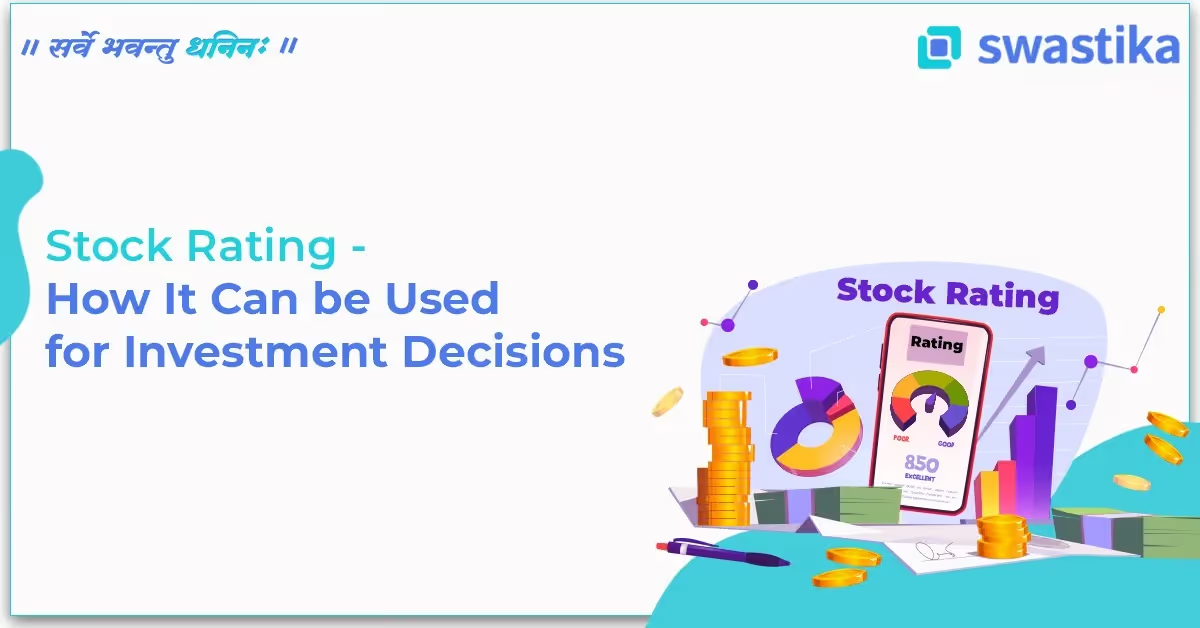
What are Stock Ratings - How It Can be Used for Investment Decisions
Many people are aware of the stock market and its functioning. The people who seek stocks as an investment material always prefer to do a bit of stock market research and homework before investing their money in any trade.
When you see any business channel, a single word you often come across is Stock rating. People have many questions regarding the term stock trading such as when to buy, sell or hold a stock.
In this blog, we will highlight the fundamental yet important term share market trading and how the right knowledge of stock rating helps investors and traders to achieve their best trading decisions.
Introduction of Stock Ratings
Stock ratings are used to measure the performance of a stock in a given specific time period. Analysts and numerous brokerage firms keep you aware of many stocks when they issue stock recommendations to investors and traders.
In order to provide effective stock ratings, analysts and brokerage firms go through the financial statements of various companies, talk to the management, and attend conference calls.
The stock ratings are issued once three months or quarterly.
By reading stock ratings, you may notice that the ratings include a target price that helps traders to reach its intrinsic value which in turn gives people an idea about the potentiality of a stock.
Hence by evaluating a stock’s rating, one can get a clear idea of whether you buy, sell or hold a stock.
What Does a Stock Rating Mean?
Research Analysts give recommendations regarding stocks by evaluating their financial performance, reviewing the company’s management, and listening to the company's financial calls on their future prospects.
Sometimes, these analysts have direct access to contact the management team and the customers to get an idea about how the company is performing compared to its past performance.
To get a deep insight into a stock, research analysts also conduct surveys that help them decide which stock deserves the best rating and which does not?
Types of Stock Ratings
Above we discussed stock ratings and how to use them for investment decisions. Here, we will discuss the five types of stock ratings:
1. Buy Ratings
Buy ratings gives recommendations to traders and investors to buy a specific stock which analysts expect that the price of a stock will increase in the short to mid-term.
2. Sell Rating
A sell rating recommends selling a particular stock which means that the analysts expect that the price of a stock will subsequently fall from its current price.
3. Hold Ratings
This rating suggests that the particular stock will stick to the same price for the near term.
The hold ratings tell the traders to not buy or sell the stock but to hold it for a short term.
Hold rating is assigned to a stock where there are some uncertainties or some company’s prediction. For example company’s new service or product launch.
4. Underperform Stock Rating
An underperform rating indicates that the stocks are going to perform down as compared to the market performance or set benchmark.
In such a situation, the analysts suggest you stay away from such stocks or avoid investing in stocks.
For instance, if a stock’s total return is 3% and Nifty’s return is 6%, then it underperformed the index by 3%.
5. Outperform Stock Rating
An outperform stock rating tells you that the particular stock is going to perform well in the stock market and will give outstanding stock market trading returns in the future.
For example, if a stock’s total return is 12% and Dow Jones Industrial Total average return is 6%, then the stock has outperformed the index by 6%.
Analyze Stock Rating For Investment in the Stock Market
Stock ratings provide a lot of impact on the individual stock as it helps traders and investors to get the intrinsic value of a stock that will tell its past and future performance. Also, it gives investors an idea of whether to buy, sell or hold a particular stock.
Although stock ratings tell many things about a stock, investors can also use their own experience to predict the potential value of a stock.
Overall, stock ratings help you to make an appropriate equity trading plan to earn maximum profit.
Hence, if you strategize your move regarding a stock, you may not neglect the stock rating and stay updated with every stock rating.
Key Takeaways
A stock rating is a measure of a stock's performance in a specific period.
Stock’s rating can be categorized into five types: buy, sell, hold, underperform and outperform.
Analysts define the stock rating by researching various companies, talking to management, listening to customer’s reviews, and attending conference calls.
Big Budget


Popular Articles





.avif)
.avif)

.avif)



START YOUR INVESTMENT JOURNEY
Get personalized advice from our experts
- Dedicated RM Support
- Smooth and Fast Trading App
