


Gobardhan Scheme: How India Plans To Scale Compressed Biogas With Rs 23,731 Crore Push


Key Takeaways
- India's Gobardhan Scheme unlocks Rs 23,731 crore to scale CBG production from FY2026-27 to FY2035-36.
- Key levers include offtake assurance, administered pricing, capital support, pipeline connectivity, and district-level ecosystem funding.
- The program targets a ten-fold jump in domestic CBG output and rural income opportunities.
- Retail investors should track implementation milestones and financing aids, including credit guarantees for MSMEs.
Gobardhan Scheme: A 23,731 Crore Push To Multiply Compressed Biogas Capacity By FY2035-36
India's energy future is being reshaped by a Rs 23,731 crore, circular bioenergy bet that turns farm waste and urban organic waste into clean fuel and organic manure. The Gobardhan Scheme, approved by the Union Cabinet, runs from FY2026-27 to FY2035-36 and aims to lift domestic compressed biogas production nearly ten-fold. Administered by the Ministry of Petroleum and Natural Gas, this scheme consolidates several earlier CBG initiatives into a single framework designed to strengthen energy security, attract private investment, and create new rural income opportunities.
India sits on a largely underutilised reservoir of agricultural residue, cattle dung, press mud and municipal organic waste that can feed a growing bioenergy economy. CBG has the same chemical properties as natural gas and can be integrated into the existing gas ecosystem, making it a timely lever as the country looks to expand gas use while reducing import dependence. The Gobardhan Scheme builds on more than 200 CBG plants already commissioned under earlier programs like SATAT and related organic-manure schemes, but now scales up with a unified framework and predictable support for developers.
The broader aim is not only cleaner energy but rural livelihoods. By converting waste into energy, the scheme creates opportunities for private developers, MSMEs, cooperatives and rural entrepreneurs to participate in gas production, feedstock collection, and value addition. This is critical because it addresses both demand and supply constraints that have historically limited CBG projects–especially upfront capital costs, feedstock availability, and reliable offtake.
Six Interventions To Resolve CBG Project Bottlenecks
To move from pilot plants to a nationwide, commercially viable CBG industry, the Gobardhan Scheme concentrates on six core interventions. These are designed to de-risk projects, scale up feedstock networks, and connect producers to gas networks and the end-users they serve. The six pillars include guaranteed offtake, a government-backed pricing framework, targeted capital support, improved pipeline connectivity, a credit guarantee mechanism for MSMEs, and district-level ecosystem development. These measures are designed to deliver measurable progress over the 10-year window allocated by the programme.
First, an Offtake Assurance framework ensures that City Gas Distribution (CGD) entities procure CBG to support the government’s CBG blending obligations in CNG transport and PNG domestic segments. The obligation begins at 3% in FY2026-27, rises to 4% in FY2027-28, and reaches 5% from FY2028-29 onwards. This creates revenue visibility for project developers, improving the economics of new CBG facilities even in early stages when feedstock aggregation and plant utilisation can be volatile.
Second, the scheme introduces an administered price of Rs 2,110 per MMBTU for CBG, supported by a pricing framework that operates over a minimum 10-year horizon. A stable price trajectory helps project promoters forecast revenue, access longer-tenor debt, and secure bank financing for brownfield expansions or greenfield plants.
Third, eligible greenfield CBG projects can receive up to Rs 2 crore of capital assistance per tonne-per-day (TPD) of installed capacity. This includes not only core plant equipment but also feedstock collection and organic-manure processing infrastructure. Brownfield expansions are eligible as well, enabling existing players to scale up without starting from scratch.
Fourth, to address evacuation and logistics costs, the government will fund pipelines that connect CBG plants with trunk pipelines and City Gas Distribution networks. This improves market access and lowers the marginal cost of delivering CBG to end-users across cities and rural districts alike.
Fifth, a credit guarantee mechanism for MSME-based CBG projects will share part of lending risk to improve access to institutional finance and reduce dependence on collateral. This is especially important for first-time promoters and women entrepreneurs who may face higher hurdles in securing debt financing for green-energy projects.
Sixth, the CBG Ecosystem Challenge Fund targets district-level feedstock mapping, local aggregation infrastructure, district-level CBG plans, technology adoption, process improvements and capacity building. District-level planning is a practical recognition that a CBG plant can operate efficiently only if biomass is available within an economically viable distance of the plant.


How Offtake Assurance And Administered Pricing Shape CBG Economics
The combination of guaranteed offtake and administered pricing is the most consequential economic lever in Gobardhan. The offtake obligation creates a reliable revenue floor for CBG plants, which reduces the perceived project risk and lowers the cost of capital. The 3%/4%/5% progression is designed to provide a ramp-up path, synchronised with the growth in pipeline connectivity and feedstock networks. Meanwhile, the Rs 2,110 per MMBTU price point lays out a predictable revenue path over at least a decade, helping financiers model returns more accurately and commit longer-tenor loans for new capacity or capacity expansion.
For investors evaluating green energy exposure, these policy mechanisms are critical because they translate policy intent into bankable economics. They also reflect a broader recognition that the energy transition in India will be a mix of public policy, private capital, and rural entrepreneurship. The administration of these mechanisms through a single ministry and a unified framework should also reduce administrative frictions that often plague multi-program ecosystems.
Capital Support, Pipelines, And Credit Guarantees: Financing The CBG Ecosystem
Capital support under Gobardhan is not merely a grant; it is a signal that private developers, MSMEs, cooperatives and rural entrepreneurs can participate at scale. Eligible new greenfield CBG projects can receive up to Rs 2 crore per TPD installed capacity, which significantly lowers upfront capital barriers and accelerates project development. The scheme also funds ongoing brownfield expansions, so existing players can grow without building entirely new facilities.
Pipeline connectivity is another critical enabler. By facilitating cluster-based or standalone pipelines that link CBG plants to trunk pipelines and CGD networks, the government aims to improve evacuation efficiency and broaden the markets for CBG. In addition, the credit guarantee mechanism will reduce lending risk for MSMEs and small promoters who often struggle to secure project finance due to limited collateral or track record. These steps are particularly important for women-led ventures and first-time promoters who bring innovative approaches to feedstock aggregation and value addition to manure processing.
The CBG Ecosystem Challenge Fund takes the district-level approach seriously. It supports map-based feedstock identification, local aggregation infrastructure, district-level CBG plans, technology adoption, process improvements and capacity building. The district-level approach recognises that the most cost-efficient CBG operations rely on local biomass within a viable logistics radius and well-planned value chains that connect farmers, collectors and processors with end users.
District-Level Planning To Build A National CBG Supply Chain
While the macro numbers tell a strong story, the real test lies in execution at the district level. The CBG ecosystem hinges on a reliable feedstock supply that can be aggregated cost-effectively and transported to plants, and then evacuated to the gas networks. The Rs 23,731 crore outlay is designed to fund this chain from feedstock capture to offtake integration. The government has already established a robust base of more than 200 commissioned CBG plants, but reaching nationwide scale will require disciplined district-level planning and partnerships with local cooperatives, MSMEs, and rural entrepreneurs who will coordinate feedstock collection, processing and marketing.
Strong feedstock availability does not guarantee success; proximity, price stability, and access to infrastructure matter, too. The Gobardhan Scheme addresses all three by: (1) guaranteeing a future demand path with the 3%/4%/5% offtake obligations; (2) fixing a price horizon that reduces revenue uncertainty; and (3) investing in pipelines and district-level capacity building to ensure feedstock is aggregated efficiently and delivered to the right markets. If executed well, the program could transform CBG from a niche fuel into a mainstay of India’s energy mix, with significant rural development spillovers.
What This Means For Retail Investors And How To Track Progress
For the retail investor, Gobardhan Scheme signals a major policy push into a scalable, commodity-like energy asset class: compressed biogas. The combination of assured offtake, price certainty, and targeted capital support reduces some of the classic risk components of green-energy projects–yet it does not eliminate them. Feedstock risk, project implementation speed, and the time required to connect to CGD networks remain important risk factors to monitor. The ten-year horizon for pricing and the ongoing rollout means investors should think in multi-year timeframes rather than quarterly results.
From an investment strategy standpoint, the Gobardhan Scheme could improve the bankability of CBG projects and related manure value additions. It expands the potential pipeline for MSMEs and rural entrepreneurs, creating a broader ecosystem of suppliers, aggregators and off-takers. The presence of a district-level fund, credit guarantees for smaller promoters, and a pipeline-expansion plan all point to a policy environment where credible CBG players can secure project finance more readily than before. As always, diversification across feedstock types, plant sizes, and geographic clusters will help manage risk in this evolving space.
As you assess opportunities, remember that policy-driven sectors respond to government execution and private-sector capability in equal measure. The 10-year implementation window gives the sector time to scale, but the eventual outcomes will depend on feedstock availability, pipeline connectivity, and offtake realization. For those who want a practical way to explore investable ideas, Swastika's Sarthi AI stock assistant can help synthesize company prospects and policy-driven catalysts. Swastika's Sarthi AI stock assistant can be a useful companion as you evaluate names that could benefit from this policy tailwind.
Frequently Asked Questions
What is the Gobardhan Scheme?
The Gobardhan Scheme is the National Circular Bioenergy Scheme approved by the Union Cabinet to scale up compressed biogas (CBG) production with an outlay of Rs 23,731 crore, running from FY2026-27 to FY2035-36 and administered by the Ministry of Petroleum and Natural Gas.
What is the timeframe for Gobardhan Scheme?
The scheme will run from FY2026-27 to FY2035-36, providing a 10-year horizon for pricing and project ramp-up.
What is the administered price for CBG under Gobardhan?
An administered price of Rs 2,110 per MMBTU is set for CBG under a pricing framework that covers at least a 10-year horizon.
How does the Offtake Assurance framework work?
City Gas Distribution entities will procure CBG to support the government's CBG blending obligation in CNG transport and PNG domestic segments, with the obligation progressing from 3% in FY2026-27 to 5% from FY2028-29 onwards.
Who administers Gobardhan Scheme and who benefits?
The Ministry of Petroleum and Natural Gas administers the scheme. Benefits include capital assistance for greenfield projects, credit guarantees for MSMEs, pipeline connectivity, and district-level ecosystem development that can help rural entrepreneurs, cooperatives, and private developers participate in CBG projects.
What impact is expected on rural economy and energy security?
The scheme aims to strengthen energy security, attract private investment, and create new income opportunities across rural India by turning biomass into clean energy and value-added manure.
Conclusion
In the near term, the Gobardhan Scheme is not a single stock tip but a policy framework that can alter the risk-reward calculus of many allied players in the energy value chain. For a retail investor, the most important takeaway is to view this Rs 23,731 crore outlay as a catalyst that could unlock a new breed of CBG producers, feedstock aggregators and manure processors, all of which may attract project finance as the offtake and pricing foundations firm up.
With a decade-long horizon, the key to translating policy into returns lies in execution: feedstock reliability, pipeline connectivity, and the timely roll-out of district-level plans. The Gobardhan Scheme provides a credible framework for this journey, but the ultimate fortunes of CBG projects will depend on how well public and private players translate the framework into commercially viable plants across districts. Retail investors can position themselves by monitoring project pipelines, credit-guarantee uptake, and the growth of feedstock networks over the next few years, while staying alert to policy updates and central-government signals.
Open your trading and demat account here
Reference :
1 : Ndtvprofit
Latest Articles

Weekly Market Outlook - 14th Dec to 18th Dec 2020


Nifty hits new all-time high of oddest number 13579 with positive closing for the sixth consecutive week.
As we said earlier that we are in a roaring bull market because of Nifty and Sensex both end with a weekly gain for the sixth consecutive week whereas they hit a new all-time high for the fifth consecutive week. Nifty hits a new high of 13579 which is the oddest number in the oddest year which has an even number 2020 while Sensex hits an all-time high of 46309. At the end of the week, they both ended with a gain of around 2%.
If we talk about last week hero then it was the FMCG sector which ends with a gain of more than 6% in the leadership of heavyweights ITC and HUL.
Data Analysis:
Foreign Institutional Investors remain on the driver’s seat where they bought around 16719cr in the cash market last week while DIIs are still in the mood of selling as they sold around 12434 Cr in the cash market.
If we talk about F&O data then FIIs long exposure in index future stands at 77% which was the same as last week but it is still a little elevated level. PCR ratio stands at 1.55 mark which is a comfortable level.
What do Technical Charts Say?
Technical charts say that Nifty is in strong bullish momentum but last week's high of 13579 is a critical number as per Gann's theory, therefore, we could see some resistance at this point while above the 13579 levels, 13689/13770 will be the next target levels for the Nifty. On the downside, 13400-13300 is an immediate demand zone while 13150-12950 is a critical demand zone because below the 12950 levels, we can expect any trend reversal.
If we talk about Bank nifty then it is also showing decent strength where 30800-31000 is an immediate supply zone; above this, 31500/32000 will be the next resistance levels. On the downside, 30200-29800 will be an immediate demand zone while 29000-28500 will be the critical demand zone.
Important cues for the next week:
- Inflation numbers: Both CPI and WPI numbers will be announced on Monday for India and they may have a significant impact on the market because the stock market is worrying about high inflation numbers amid a rise in commodity and vegetable prices.
- US Fed meeting outcome: We will have the outcome of the US Fed meeting on 16th December which will have a significant impact on global markets.
- Other central banks meeting: BOE and BOJ will also come out their monetary policy on 17th December and 18th December respectively.
- Covid19 cases and vaccine-related news: The trend in COVID19 cases and news flow regarding vaccines will continue to impact global markets.
- FIIs’ behavior: FIIs’ behavior will be the key for the market direction as they are driving the current bull market.
Tips for Equity Investment: Essential Stock Market Basics for Beginners
Equity investment is one of the most important investment avenues for investors as it always gives multiple returns in a long duration. But yes the major question is how can we select that stock, just by hearing the name only, Is that enough? Probably not, but you try to understand the basic structure of the company can surely benefit.
Every investor tries to invest in those companies which are having a long record of performance along with high trust value. Because it's business it may run long or can collapse soon. So while investing in equities there lies a risk of investment also, which actually makes Indian investors stay away from the equity asset class. And Investors shift themself towards other instruments like FD, Bonds Gold, etc which are having criteria of fixed return which many investors enjoy.
How to Identify Good Stock for Investments:-
It's been always a big question to identify a good stock as there are more than 6000+ companies listed on the exchange and it's not easy to track each company from an investment perspective. As all it takes a long time just to understand about the company better one should the basic approach to understand it.
Identification of Sector:
Before proceeding towards investment in any stock we should first select the sector in which we want to invest, Selection of the sector actually depends upon the understanding of the business model of the company so that investor should relate it with the current market condition. In the stock market, it's better to go with the flow instead of going against the flow.
Understand the Business Model of the Stock:
Once the sector selection process is done. We must look into the business of a selected company, what kind of business the company is doing will it be suitable for the long-term, how its revenue generated, the impact of government policy etc, these all things actually play a vital role while selecting any stock.
Company Management:
Warren Buffett Quoted once – "I look for integrity, energy, and intelligence in management."
Management is considered as the backbone of the company, A fair management always gives a clear outlook of the business as well as present a fair image of the company. One should look at what kind of management is in the company is it Professional management or Family management. Professional management is more favorable while selecting any stock.
Past track record of the company:
Investment is actually a game of numbers along with facts & figures, Companies showing consistent growth with positive returns are always considered more favorable, Though the business is not the same all-time some times its profit some times its loss, So investors actually show faith in those companies who are consistent in the market from a long run.
With the help of certain financial statements like P&L, Balance Sheet one can actually look into the company performance, though it's not easy for everyone to read the financial statements one can take the help of certain financial websites available for it.

Important Pointers for Day Trading | Basics of Stock Market
We all know that trading in the stock market is not so easy as it considered orally, for daily trading in you need to track the market on all basis especially those are indulge in Day Trading / Intraday Trading, Before we proceed lets clear the concept of Intraday Trading:-
“A person or individual who is engaged in purchasing or selling of stocks within the same day is Intraday Trading “
But how can we do it? Is still a question mark for many. For this just follow a very simple top-down approach to understand how the market can behave for the very next day.
For a trader, it is very important to know the next day market for which need to look not only the domestic ques but the global outlook is also very important as the Indian market is on its developing stages.
Tracking of Market:-
For an everyday trader, it is essential to know about the global ques along with domestic market So a trader first need to check out the Closing of “US & Europe Market”.
After this, we should check the Opening of Asian Market, whatever happened overnight in US & Europe market will make an impact on the opening of the Asian market.
Once Asian market opened its important for Indian traders to check the opening of SGX NIFTY, it acts as an opening indicator for the Indian market, it also takes the cues from another market ( US & Europe Impact on Asian Market) which leads to indicate the opening of the Indian market.
At last, a trader should check the impact of any News or Data which can create an impact on market should be tracked prior, Impact of any Micro or Macroeconomic news should be considered while one is tracking the market because it may give impact on the same day or can affect later on.
Once a trader is clear about the opening of market the second most important work is to track the stock for trading, No one can directly jump and purchase any stock after just hearing the name though many newcomers do that only as they are not aware of the process.
Points to Remember while Day Trading:-
Trade-in Liquid Stocks:
Volume plays a vital role while you trade in the market so a beginner its better to trade only in liquid stocks or in blue chips & always follow proper research and self-study before taking any trade. The market is inherently volatile in nature you cannot blame anyone for your loss.
Follow Market News & Views:
One should always be aware of market updates as it actually impacts on the performance of that particular sector/stock.
Avoid Unplanned Trades:
Many often if you are not clear about the market condition, avoid taking any trades into the market because it's better to sit without trade rather then booking an unnecessary loss.

Safe & Easy Investments in US Stock Markets | International Investments from India
Google, Facebook, Amazon, Apple Netflix, etc have been household names in our homes and our lives, and it goes without saying that these will continue to become more prevalent and relevant in the years to come. But…why haven’t we been able to be a part of this bull ride? Just because these are international stock?
For a long time, the Fortune 500 and the S&P 500 have remained the domain of the rich and investments in the US stock market remained elusive to us; not anymore! With Swastika, you can make your investment portfolio diversified and invest in the US stock market with the simple click of a button.
With swastika, it is now possible to invest in companies you know and love, from all around the world.
Invest in US Stock Markets with Swastika at Zero Minimum Balance
With Swastika, you can invest in the US stock market without any minimum invest, absolutely at zero minimum balance!
Invest in U.S. Stock Markets with Swastika and Diversify your Portfolio Internationally
You can invest in multiple economies without any restrictions and lower your trading and investment risk. With Swastika, you get a personalized team of experts.
Make your Investments International with Swastika
Go International and invest in futuristic global companies listed on US stock markets with Swastika. Grow your wealth with investments in the fastest growing companies in the US like never before!
- Invest in Global Stocks & ETF
- Hassle-free investments in S&P 500 Companies
- 4,000+ International Securities
- Fractional Shares of stocks with no minimum investment
- Superior Returns, Corporate governance and Financial Transparency
- AI-powered online trading platforms
- Pay only when you trade
- Get live market quotes & do real-time trading
- Brokerage - 0.5% of transaction value
- No hidden charges
Fractional Shares of Stocks
On our online trading platform, you can invest in either full or fractional shares. If the investment is in full shares, then our broker partner, Drivewealth, will route the orders to market centres on an agency basis. If the investment is in fractional shares, our broker partner, Drivewealth, will satisfy the order form on its own account on a principal basis, at the National Best Bid or Offer. NBBO means that the broker partner cannot add a margin to the price. Therefore, any order for both full or fractional shares will be executed via both methods, part as an agent and part as a principle. Under the RBI’s Liberalised Remittance Scheme guidelines (LRS). Reserve Bank of India (RBI) has laid out a set of policies that governs the maximum amount and purposes of remittance. Under LRS, an Indian Resident can annually send or invest up to USD 250000 abroad without seeking approval from RBI. This scheme has simplified it for Indian residents to study abroad, travel and make investments in other countries. For latest up to date information, refer RBI’s website and also see article 6(iii) for specific LRS regulations regarding investment in equity. If you want to buy $50 dollar worth of a share of Apple or Microsoft, you can! WE have democratized access to international investing with fractional investments.
Value Partnership
Swastika has partnered with a US brokerage - DriveWealth. The US brokerage ecosystem recommends that every investor account should have insurance. DriveWealth is a member of Securities Investor Protection Corporation (SIPC) which currently ensures your account against broker default by up to $500,000 of which $250,000 may be in cash.*
Start your global investment journey
Open a Demat Account - Only Just 3 steps
- Sign Up & enter your details to open a US brokerage account.
- Fill up the KYC details, PAN & address and upload a photocopy of your documents.
- After KYC verification, add funds to your US brokerage account to start investing.
Farm Bill 2020 & Farmers Protest
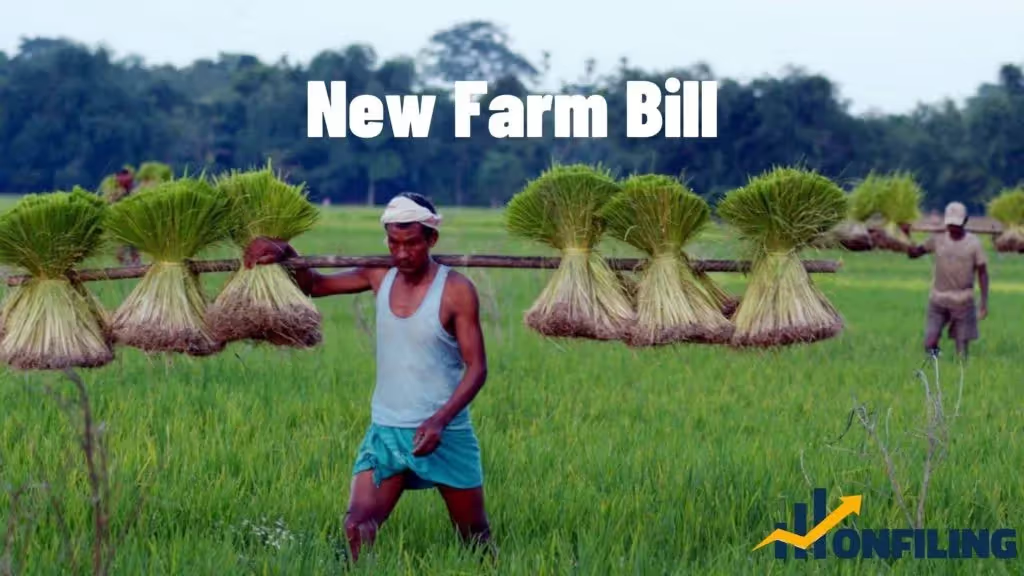
What are Farm Bills?
On September 27, India's President gave consent to three farm bills herein listed below:
Farmer's Produce Trade and Commerce (Promotion and Facilitation) Bill, 2020
As per this bill, farmers can enter into a written agreement for a specified period of time with companies and companies can customize the price, standard, and quality for the produce and other legalities in advance.
Farmer's (Empowerment and Protection) Agreement of Price Assurance and Farm Services Bill, 2020
The new Marketplace law says that farmers can sell their produce anywhere – and not just in the APMC approved marketplace or mandis, they can sell it into not only their state but outside their state even online. Whereas state governments are prohibited from levying any market fee, cess, or levy outside APMC or Mandi areas.
The Essential Commodities (Amendment) Bill, 2020
This Act mainly controls and deals with the production, supply, and distribution of certain essential commodities. Companies and Supermarkets etc cannot accumulate the items listed in this act when there is a shortage and they can’t artificially increase the price.
Why Are Farmers Protesting?
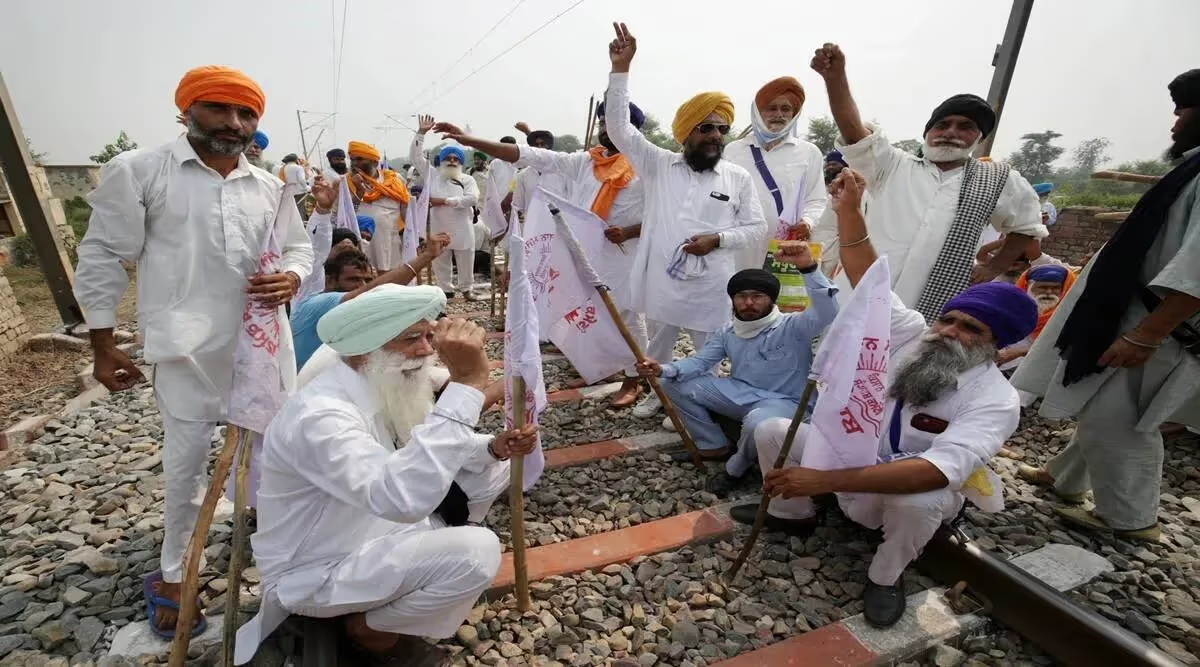
The Farmers of UP, Haryana, and Punjab are upset with these bills and fear that this may be an excuse to pull off the MSP safety net from under their feet.
What is MSP?
MSP stands for Minimum Support Price, It is the price lay down by the government to purchase crops from the farmers, whatever may be the market price for the crops. It is a significant part of India's agricultural price policy that assures the farmers about agricultural income before the sowing. MSP protects the farmers against excessive fall in price during bumper production years
Further State like Haryana & Punjab has vested interest of reduction in their state earnings as state governments are prohibited from levying any market fee, cess, or levy outside APMC or Mandi areas.
Haryana levies 2% Mandi Tax that goes to Mandi Board & 2% Rural Development cess that goes to state govt. whereas in Punjab it is 3% Mandi Tax and 3% rural development cess. Punjab is a smaller state and that earns Rs. 1700 crore in a year through rural development cess & Mandi tax. Besides this 2.5% commission agent also take home 2.% of the sale price.
So. these are some controversies on Farm Bills, Now let's see what comes out on round table conference between Farmer Unions and Centre.
Source:
https://www.indianeconomy.net/splclassroom/what-is-minimum-support-price/

Open A Demat Account With Swastika to avail of the following schemes
Entertainment Industry:
Eros Now: 1 Year Subscription at Rs 299
Open a Demat Account with Swastika and get a 1-year subscription to Eros now at just Rs 299. This offer is valid to all the users. Users are required to apply the coupon code to avail this offer and you are ready to go. The offer is valid on all types of transactions such as COD/Credit card/ Debit Card/Net Banking. This is a sole offer and cannot be clubbed with any other offer. Offer expires on 31st Oct 2020.
So what are you waiting for? Get a 1-year subscription at Rs 299 only and enjoy all the movies available on Eros Now.
Alt Balaji: 10% off on the annual plan
Alt Balaji gives you a 10% off on 1-year subscription plan. Open a Demat account with Swastika, apply coupon code on the payment page and enjoy the full benefits of this offer. This is a solo offer that is valid on web, m-web and app. The offer is not combined with any other offer/discount and is valid on credit card/ debit card/net banking. The offer expires on 31st Oct 2020.
Make this Dussehra cool and happening with Swastika. Open a Demat account and enjoy the annual plan of Alt Balaji with 10% off.
Gaana: Get 3 Months Gaana + For Free:
Get a 3-month Gaana + subscription for free. This offer is only valid on the Gaana app. To avail this offer, Register on Gaana, click on My Account, then go to settings, click on redeem coupon where you can enter the coupon. Next, enter your card details for activation and you are ready to go. Users will get 90 days of free Gaana.
This offer is valid for fresh users i.e the user should not be existing of any Gaana subscriber. The offer cannot be clubbed with any other user and accepts all modes of payment such as COD/Credit card/Debit Card/Net Banking. The Offer expires on 31 Oct 2020.
Licious: Get 20% Off
Dussehra, let's celebrate victory over hunger. Open a Demat account with Swastika and get 20% off on your order at Licious. The offer is only valid once per user. Users are required to order a minimum of Rs 499 to avail the offer. The offer is applicable for discounted products and schedule offers. Licious accepts all modes of payment such as COD/Net Banking. Credit Card/Debit Card. This offer expires on 31 Oct 2020.
Udyan Tea: Flat Rs 500 off on Rs 1499
Let this Dussehra mark the trump of your good habits over the bad ones. Take a sip of Udyan Tea and get the maximum benefits with it.
Udyan Tea comes with an offer of flat Rs 500 off on your orders. The minimum order amount is Rs 1499. The offer cannot be clubbed with any other offer and is valid only once per user. To get the maximum benefits of the discount, you must apply coupon code on the checkout page. All modes of payments (COD/Net Banking/Credit Card/Debit Card) are acceptable on this offer.
Health:
Mamaearth: Flat 15% off + 10% Extra CashBack.
Get 15% discount plus an additional 10% cashback on the purchase of selected products at Mamaearth. The coupon is valid for all the users and can be valid multiple times. Once your order is done, cashback will be credited to mamawallet within 24 hours after the delivery of the order. The offer cannot be clubbed with any other offers, The offer is available for selected days and expires on 31 Oct 2020.
Open a Demat account with Swastika and enjoy the benefits offered by Mamaearth.
TheMomsCo: Get 15% off on Rs 1500
Now get 15% off on your orders at the MomsCo. The minimum order amount is Rs 1500 and the offer is valid for all the users. You can avail this offer throughout India. The offer expires on 31 Oct 2020.
Greenberry Organics: Get 30% off on Rs 999
Now get 30% off on your orders at Greenberry organics. To avail the offer, use the coupon provided by Greenberry organics. The minimum order amount is Rs 999 and the offer is valid for all the users. This offer is not valid on discounted offers. The offer expires on 31 Oct 2020.
Electronics:
Mivi: Get Rs 200 Off on Rs 1000
At Mivi, Now get Rs 200 off on your orders with a minimum order of Rs 1000. The offer cannot be clubbed with any other discount offers. The best thing about this offer is the offer can be availed throughout India and can be easily valid on COD/Net banking/Credit Card/ debit Card. The offer expires on 31 Oct 2020. Hurry up! Open a Demat account with Swastika and get Rs 200 off on Mivi earphones.
Conclusion:
Swastika is one of the best stock broking companies that offers numerous financial services such as stock trading, loan syndication, mutual funds, investment banking, and insurance. Dussehra Swastika comes with unlimited offers for you. Open a Demat account with Swastika and enjoy all the benefits provided by the top giants.
Big Budget


Popular Articles





.avif)
.avif)

.avif)



START YOUR INVESTMENT JOURNEY
Get personalized advice from our experts
- Dedicated RM Support
- Smooth and Fast Trading App
