


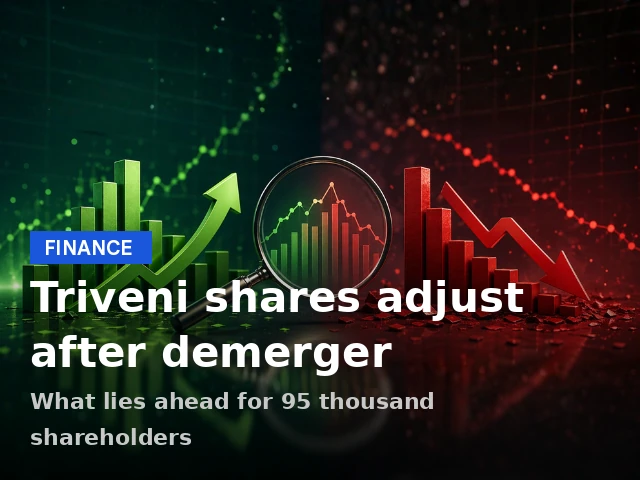
Triveni Engineering Share Price And Demerger: What 95,000 Shareholders Should Watch



Key Takeaways
- Triveni Engineering moves into a new two-vehicle structure after the demerger.
- Record date is July 22, 2026, with 1 Triveni Power Transmission share for every 3 Triveni Engineering shares.
- Opening SPOS price was Rs 289.95; TE stock shed about 38.5% ex-demerger.
- Triveni Power Transmission is expected to list on NSE and BSE with a global install base.
Triveni Engineering Share Price After Demerger: What Investors Should Watch
On July 22, 2026, Triveni Engineering traded ex-demerger as price discovery sought to price in the removal of Triveni Power Transmission from the combined entity. The stock opened at Rs 289.95 apiece on the NSE during a SPOS, before regular trading began at 10:00 am. The session captured a near 38.5% decline as investors reassessed the standalone value of Triveni Engineering and the newly separated Triveni Power Transmission (TPTL). For those tracking the triveni engineering share price, this day marks a transition from a single bundled entity to two separate listed vehicles.
The entitlements are straightforward: every eligible shareholder gets one share of Triveni Power Transmission for every three shares of Triveni Engineering held on the record date. The record date for the demerger was July 22, 2026. After distribution, TPTL is expected to list independently on the NSE and BSE, adding a new piece to the investment puzzle for the 95,000+ shareholder base across the country.
How The Triveni Engineering Demerger Reshapes Shareholder Entitlements
The crux of the demerger rests on a simple ratio: for each three TE shares, you will receive one share of Triveni Power Transmission. This entitles TE shareholders to become holders in two separate entities with distinct growth trajectories. The 95,000+ shareholders across India now face two linked but separate investment theses, each requiring independent monitoring. The record date for the demerger remains July 22, 2026, a pivotal point that determines eligibility for the new TPTL stake. Investors should re-evaluate their overall exposure, factoring in the potential for separate price movements in TE and TPTL once both vehicles trade in their own right. triveni engineering demerger shifts are not isolated from broad market conditions, so align your stance with both corporate actions and sector dynamics.
As a practical takeaway, keep a close eye on how your holdings are split, and assess whether the combined value pre-demerger now diverges into two logical value streams. If you are actively tracking the triveni engineering stock price path, you will want to compare the performance of TE with the new listed entity TPTL as they begin to reflect separate fundamentals. For deeper stock level analysis, consider Swastika's Swastika's Sarthi AI stock assistant to model potential scenarios based on the demerger outcomes.
Key Price And Valuation Metrics After Demerger
The day’s price action and the mechanics of the demerger imply several important valuation shifts. TE shares traded ex-demerger as investors priced in the removal of Triveni Power Transmission from the consolidated entity. Opening price details show the market immediately adjusting to the new two-vehicle structure. The 52-week range for this security has been wide, with a low of Rs 317.55 and a high of Rs 490.10 observed earlier this year. After the adjustment, the market capitalization stands at Rs 5,982 crore, reflecting the post-demerger composition and the market’s expectations for the continuing TE business. The price move underlines the importance of tracking two separate value drivers: the enduring TE business and the standalone potential of TPTL once listed.
For clarity, the table below consolidates the most relevant numeric data from the event window and the post-demerger landscape. It helps you compare the immediate post-ex-date metrics with the pre-demerger context, and it provides a quick reference for the two-entity valuation puzzle investors face in the weeks ahead.
| Metric | Value |
|---|---|
| Opening price (SPOS) | Rs 289.95 |
| Record Date | July 22, 2026 |
| Entitlement Ratio | 1 Triveni Power Transmission share for every 3 Triveni Engineering shares |
| Market Cap After Adjustment | Rs 5,982 crore |
| 52-Week Low | Rs 317.55 |
| 52-Week High | Rs 490.10 |
Triveni Power Transmission Listing: Timeline, Installations, And Global Reach
Triveni Power Transmission (TPTL) has a sizeable global footprint, with more than 14,000 installations across over 80 countries and more than 50 GW of installed gear capacity. This scale provides a strong backdrop for the newly listed entity’s potential growth trajectory, independent of the TE business. Investors should expect that TPTL’s listing on NSE and BSE will be a meaningful milestone, as it creates two vehicles that can be valued on their own merits, aligned to the performance of installed power transmission systems and the associated service ecosystem. The existence of an amalgamation with Sir Shadi Lal Enterprises earlier this year adds another layer of corporate history that investors may weigh in their assessment of the newly listed entity’s opportunities in a global market.
The SPOS day was designed to facilitate orderly price discovery ahead of the regular trading session, with the SPOS window running from 9:15 am to 9:45 am, and regular trading commencing at 10:00 am. As the two entities emerge on the exchanges, traders and retail investors should prepare for divergent price paths that reflect each company’s fundamentals and market dynamics. While the TE business continues to operate in its core markets, TPTL’s expansion into diverse geographies could catalyze upside, particularly as installation and maintenance cycles vary by region and sector demand evolves. The practical implication is that your overall exposure will now be a function of two separate investment theses rather than a single blended story.
Investor Action Plan For The Demerger And Entitlements
To navigate this transition with a clear framework, consider the following steps anchored in the facts of this event: verify the record date (July 22, 2026), confirm your TE shareholding to determine eligibility for the 1:3 TPTL entitlement, and monitor both TE and TPTL price paths as they begin trading separately. Since the entitlements will be distributed to eligible shareholders, you may see strategic moves in how you rebalance across two listed entities. Keep a watch on the liquidity and volume profiles of both TE and TPTL, as the joint value proposition may diverge in the short term before longer-term fundamentals settle in.
- Confirm you hold TE shares on the record date to qualify for the 1:3 TPTL entitlement.
- Track two separate price paths for TE and TPTL once listed to avoid conflating their signals.
- Evaluate the TPTL growth potential given its global install base and regional deployment cycles.
- Leverage research tools like Swastika's Sarthi AI stock assistant for scenario analysis and risk assessment.
Frequently Asked Questions
What is the entitlements ratio under the Triveni demerger?
Each eligible Triveni Engineering shareholder will receive one Triveni Power Transmission share for every three Triveni Engineering shares held on the record date.
When is the record date for the demerger?
July 22, 2026.
What is the listing plan for Triveni Power Transmission?
Triveni Power Transmission is expected to list independently on the NSE and BSE after the demerger.
Why did the stock ex-demerger fall by around 38.5%?
The price adjustment reflects the removal of the Triveni Power Transmission value from Triveni Engineering; after listing, the two entities will trade separately based on their own fundamentals.
What is the market cap after the demerger adjustment?
Rs 5,982 crore.
Conclusion
The Triveni demerger marks a strategic pivot that splits a blended value into two independently tradable entities. For retail investors, the key takeaway is to monitor the evolving valuations of Triveni Engineering and Triveni Power Transmission as separate investment stories, supported by the entitlements framework and the listing timeline. The next step is to build a dual-entity framework in your due diligence, weighing TE’s ongoing operations against TPTL’s growth prospects in a global market.
In practice, your mental model should treat this as two complementary bets rather than a single merged story. Track the TE and TPTL price paths, re-balance as entitlements are realized, and stay focused on the fundamentals of each business, including TE’s established operations and TPTL’s expansive installation footprint. As a concrete next step, monitor the listing performance of Triveni Power Transmission and adjust your exposure across the two shares to align with your risk tolerance and investment horizon.
Latest Articles

Laser Power Share Price Post-IPO: What Retail Investors Should Watch


Key Takeaways
- Laser Power & Infra's IPO size totals ₹742 crore, with ₹542 crore in fresh issues and ₹200 crore via OFS.
- Final issue price is ₹214 per share, with a lot size of 70 shares.
- Grey market signals imply a roughly 21% listing gain if the trend sustains, with GMP ₹44 and a grey market price near ₹258.
- Subscriptions show strong institutional demand (QIB 92.25x) but retail participation remains modest (6.59x), overall 38.94x.
Investing in IPOs often hinges on price signals, demand, and the murky signals of the grey market. As Laser Power & Infra prepared to debut on Dalal Street, investors watched the laser power share price move toward the market's mood. With a grey market premium signaling a roughly 21% listing gain, what does this mean for retail buyers who joined the IPO? This guide breaks down the numbers from the IPO's structure, demand, and post-listing implications to help you decide your next step.
Laser Power Share Price Post-IPO: Signs From The Grey Market And Listing Chances
In today’s IPO ecosystem, the grey market often becomes a quick barometer of sentiment. For Laser Power & Infra, the grey market premium stands at ₹44 per share, and the current grey market price for unlisted shares sits around ₹258. If this momentum holds, the implied listing gain would be about 21% against the ₹214 fixed price, a projection that aligns with the current GMP signals. It is crucial to note that grey market signals are unregulated and should not be used as the sole determinant of investment decisions. The official listing outcome will be established on Dalal Street on listing day, reflecting actual market demand and liquidity.
The RHP provides a clear frame for what happens after the offer. It notes: “Each of the Selling Shareholders will be entitled to their respective portion of the proceeds of the Offer for Sale...”, and clarifies that “Our Company will not receive any proceeds from the Offer for Sale and the proceeds received from the Offer for Sale will not form part of the Net Proceeds.” This distinction helps investors assess who benefits from the sale and how it may influence post-listing liquidity. The price context remains fixed at ₹214 per share, with market dynamics expected to determine whether early trading aligns with the GMP-based expectations or charts a different course.
According to the RHP: “Each of the Selling Shareholders will be entitled to their respective portion of the proceeds of the Offer for Sale…”
Reference :
From a caveat perspective, the grey market offers a color, not a guarantee. It complements, rather than substitutes, the fundamental picture, which includes the use of proceeds and balance sheet considerations. Retail investors should treat GMP signals as one data point among many, including the company's leverage, cash flow prospects, and competitive landscape. For a structured way to map this to your own portfolio, you can consult Swastika’s Sarthi AI stock assistant to map price action to your risk profile: Swastika's Sarthi AI stock assistant.
IPO Structure At A Glance: Fresh Issue, OFS And Use Of Proceeds
The Laser Power & Infra IPO comprises a total size of ₹742 crore, with ₹542 crore coming from a fresh issue and ₹200 crore through an OFS. The fresh issue involves 25.3 million equity shares, while the OFS portion can be up to 9.3 million equity shares by the promoters Deepak Goel, Rakhi Goel, and Devesh Goel. The price band stood at ₹203-₹214 per share, and the issue price was fixed at ₹214 per share. The lot size is 70 shares. The three-day IPO subscription window closed on Monday, 13 July 2026, and allotment was finalised on Tuesday, 14 July 2026.
Use of proceeds from the fresh issue includes prepayment or repayment of certain outstanding borrowings, in full or in part, with the remaining funds earmarked for general corporate purposes. This usage pattern signals a focus on strengthening the balance sheet ahead of listing. Proceeds from the OFS, by contrast, will accrue to the selling shareholders after deducting their share of offer-related expenses and applicable taxes, and will not form part of the Net Proceeds to the company. The Registrar to the issue is MUFG Intime India, with IIFL Capital Services and ICICI Securities acting as the book-running lead managers.
Subscriptions And What They Signal For Retail Investors
The overall demand for Laser Power & Infra’s IPO was robust, with subscriptions at 38.94x. Sub-category breakdown shows strong institutional interest: QIB subscriptions at 92.25x, NIIs at 43.34x, while Retail subscriptions stood at 6.59x. This distribution highlights a typical pattern where institutions back the deal more vigorously than retail participants, potentially influencing the initial price discovery and aftermarket liquidity. For a retail investor, this dynamic suggests that listing day mood might be driven by macro liquidity and the broader market environment, rather than single-stock momentum alone.
Turning to the numbers, a helpful way to view the post-listing risk-reward is to juxtapose the fixed price with the GMP-derived target. The final price is ₹214, the grey market price around ₹258 suggests an uplift if listing momentum holds; however, the actual listing day returns may differ. Spectral risk, market volatility, and sectoral catalysts will shape the first trading sessions. Retail investors should consider using limit orders, setting exit targets, and avoiding chasing a pop if price action begins to deteriorate.
Grey Market GMP And The Listing Day Outlook
As noted, the grey market premium stands at ₹44 per share, and the current grey market price for unlisted Laser Power shares is around ₹258. If the GMP holds, it implies a listing price near ₹258 on Day 1, equating to roughly 21% above the fixed issue price. While this is an encouraging signal for early subscribers, GMP is not a guarantee and should be interpreted with caution. Listing-day outcomes depend on the stock's fundamentals, the company's ability to meet growth expectations, and overall market momentum. Retail investors should keep in mind that the grey market operates outside regulation and can be volatile in response to news, macro factors, and sentiment shifts.
What The RHP Proceeds And OFS Means For Promoters And Market Confidence
From the RHP, proceeds from the OFS will accrue to the selling shareholders after deducting their share of offer-related expenses and applicable taxes, and the company itself will not receive OFS proceeds. Fresh issue proceeds are intended for prepayment or repayment of borrowings, with the remainder for general corporate purposes. These allocations can influence market confidence by signaling debt reduction and prudent capital allocation, yet the actual impact on the stock’s post-listing trajectory will depend on broader market conditions and the company’s ability to meet growth expectations. The regulatory frame, registrar MUFG Intime India, and BRs IIFL Capital Services and ICICI Securities provide a credible listing process that can help ease initial aftermarket trading for investors who are alert to the details of the deal.
Practical Takeaways For Retail Investors On Listing Day
Here are practical steps to help you navigate Laser Power & Infra’s listing day and the initial aftermarket:
- Note the fixed price and lot size: ₹214 per share and 70-share lot. Price discovery can deviate on listing day.
- Watch the price action around list day; GMP suggests potential upside but not guaranteed.
- Assess use of proceeds: Fresh issue for debt prepayment and general corporate; OFS to selling shareholders after expenses and taxes.
- Monitor institutional demand versus retail appetite: QIBs 92.25x vs Retail 6.59x, which can influence initial momentum.
- Consider using limit orders and having a clear exit plan; do not chase a quick listing pop.
Frequently Asked Questions
What is the total size of the Laser Power & Infra IPO and its structure?
The IPO size totals ₹742 crore, comprising ₹542 crore from fresh issue and ₹200 crore via OFS. Fresh issue consists of 25.3 million equity shares, while OFS may involve up to 9.3 million equity shares by promoters Deepak Goel, Rakhi Goel, and Devesh Goel.
What is the final issue price and lot size for Laser Power & Infra IPO?
The price band was ₹203-₹214 per share, with the final issue price fixed at ₹214 per share. The lot size is 70 shares.
What do Grey Market Premium signals imply for listing day?
GMP stands at ₹44 per share and the grey market price is around ₹258, implying a roughly 21% listing gain if the trend sustains. However, grey market signals are unregulated and not guaranteed.
How did subscriptions break down across categories?
Overall subscriptions were 38.94x, with QIB subscriptions at 92.25x, NIIs at 43.34x, and Retail at 6.59x.
Where will the proceeds go from the Fresh Issue and OFS?
Fresh issue proceeds are intended for prepayment or repayment of borrowings and general corporate purposes, while OFS proceeds go to selling shareholders after expenses and taxes. The company will not receive proceeds from the OFS.
Conclusion
This article was published without a generated conclusion. Please review and add a conclusion before publishing.

HDFC Life Share Price And Q1 Earnings Pulse: Tata Elxsi, L&T Technology Services, And Anand Rathi Results
Key Takeaways
- Q1 earnings heat is on as HDFC Life, HDFC AMC, ICICI Lombard, Groww, and Angel One prepare to report.
- L&T Technology Services posted 13% YoY profit growth, 11.5% revenue growth, and margin expansion in Q1.
- Tata Elxsi registered 18% profit growth and 14.5% revenue growth in Q1.
- Anand Rathi reported a modest profit rise but faced an exceptional loss; net interest income rose significantly.
Welcome to Swastika Investmart's market snapshot – as the Q1 earnings season accelerates, investors track how the hdfc life share price reacts to fresh quarterly numbers and guidance. Today, HDFC Life Insurance Company, HDFC Asset Management Company, ICICI Lombard General Insurance Company and ICICI Prudential Life Insurance Company are scheduled to announce their June quarter results, alongside other notable names such as Union Bank of India, Billionbrains Garage Ventures (the parent company of Groww), Angel One, Emmvee Photovoltaic Power, Fedbank Financial Services, GTPL Hathway, HDB Financial Services, Jana Small Finance Bank, Sai Silks (Kalamandir), Mangalore Refinery and Petrochemicals, Network18 Media & Investments and Steel Strips Wheels. The calendar remains the primary source for company-specific updates across insurance, asset management, banking, financial services and beyond.
On the numbers front, L&T Technology Services delivered a robust quarter. The company reported a 13% year-on-year rise in consolidated profit to ₹356.6 crore from ₹315.7 crore. Revenue rose 11.5% to ₹2,940.1 crore from ₹2,637.5 crore, while the dollar revenue increased marginally to $309.9 million from $308.7 million. EBIT climbed 28.1% to ₹461.3 crore from ₹360.1 crore, and the EBIT margin expanded to 15.7% from 13.7%, a 200-basis-point improvement. In short, the firm shows the classic combination of healthy revenue expansion and stronger profitability.
Tata Elxsi's quarter was equally encouraging. The company posted an 18% year-on-year increase in profit to ₹170.6 crore, up from ₹144.4 crore, as revenue rose 14.5% to ₹1,021.1 crore from ₹892.1 crore. This reflects a durable demand environment for design-led tech services and a margin-friendly mix of high-value projects.
In the same vein, Anand Rathi Share And Stock Brokers reported a 2.3% year-on-year rise in consolidated profit to ₹23.4 crore, compared with ₹22.8 crore in the prior year. Net interest income jumped 47.6% to ₹68.4 crore from ₹46.4 crore, underscoring the benefit of a capital-light mix and asset-light business model. The quarter also included an exceptional loss of ₹20.9 crore, versus none in the prior year, which framed a more limited net profit picture on a standalone basis. Investors should watch how the company manages interest income against funding costs and the impact of the exceptional item on overall earnings quality.
With several financial and technology feedback loops playing out, the broader earnings calendar will remain a key source of updates for investors. HDFC Life results, hdfc amc results and icici lombard results are among the big names slated to release numbers, alongside the June quarter disclosures from Groww's parent Billionbrains Garage Ventures and Angel One. These results will inform the near-term direction for insurance, asset management, banking, and financial services players and help frame sector risk-reward as valuations adjust post-earnings.
HDFC Life Share Price Context After Q1 Earnings
The hdfc life share price context is central as the market digests the June quarter disclosures from HDFC Life and its peers. Early indicators point to a focus on gross written premium growth, cost efficiency, and embedded value changes that can shape sentiment and multiples. The life-insurance space hinges on the balance between protection and savings products, with valuations often pricing in policyholder behavior, new business margins, and capital adequacy. The earnings calendar remains the go-to source for company-specific updates that can drive subsequent price action.
L&AmpT Technology Services Results: Profit, Revenue, And Margin Expansion
In the quarter under review, L&T Technology Services posted a 13% YoY increase in consolidated profit to ₹356.6 crore from ₹315.7 crore. Revenue rose 11.5% to ₹2,940.1 crore from ₹2,637.5 crore. Dollar revenue climbed modestly to $309.9 million from $308.7 million. EBIT grew 28.1% to ₹461.3 crore from ₹360.1 crore, and the EBIT margin widened to 15.7% from 13.7%, a 200-basis-point improvement. The numbers reinforce the market's view that engineering services remain in a favorable growth phase, supported by strong deal momentum and productive pricing strategies. For investors, a watch on client diversification and project mix could signal whether these margins sustain into the next quarter.
Tata Elxsi Results: Profit Growth And Revenue Uptick
Tata Elxsi posted an 18% YoY increase in quarterly profit to ₹170.6 crore from ₹144.4 crore, while revenue grew 14.5% to ₹1,021.1 crore from ₹892.1 crore. The margin profile benefited from higher-value project portfolios and a disciplined cost base. The quarter's momentum suggests continued demand in design-led engineering services across automotive, consumer electronics, and media domains. Investors should watch for commentary on client concentration and the mix of product design vs. system engineering projects that influence margin trajectory.
Anand Rathi Results: Profit Growth And Net Interest Income
Anand Rathi Share And Stock Brokers reported a 2.3% YoY rise in consolidated profit to ₹23.4 crore, compared with ₹22.8 crore in the year-ago quarter. Net interest income rose 47.6% to ₹68.4 crore from ₹46.4 crore, underscoring the benefits of a capital-light, asset-light business model. The quarter also included an exceptional loss of ₹20.9 crore, versus none in the prior year, which tempered the bottom line. As the company continues to refine its financial services footprint, investors should pay attention to the core profitability of wealth management and advisory services relative to funding costs and risk controls.
Upcoming Q1 Results Calendar And Sector Outlook
Beyond the named results, the earnings calendar features HDFC Life results and hdfc amc results, icici lombard results, Groww and Angel One, and other players including Emmvee Photovoltaic Power and Fedbank Financial Services. The sector's narrative depends on how insurers navigate cost discipline and premium growth, how IT services players translate demand into sustainable margins, and how asset-light financials manage yield and credit quality in a dynamic rate cycle. Retail investors could use these updates to calibrate exposure across insurance, asset management and tech services, while staying aware of macro shifts in interest rates, inflation, and consumer demand.
Insurance Sector Outlook After Q1
As Q1 results roll in, the insurance landscape is watching embedded value shifts, premium growth momentum, and premium mix. The hdfc life share price will reflect how investors price in protection versus savings products, while the broader sector evaluates cost controls, channel efficiency, and policyholder behavior. A durable margin improvement will hinge on disciplined expense management and better scale in bancassurance and distribution partnerships, which could lift valuations for leading players like HDFC Life and ICICI Prudential Life.
Conclusion
This article was published without a generated conclusion. Please review and add a conclusion before publishing.
Open your trading and demat account here
Reference :
1 : 5Paisa

Icici Prudential Life Insurance Stock Price: Q1 FY27 Performance And AUM Analysis
Key Takeaways
- Q1 FY27 net profit rose 28% YoY to Rs 386 crore.
- Total revenue for Q1 FY27 was Rs 28,395 crore, with AUM at Rs 3.34 lakh crore.
- Solvency ratio stands at 225.4%, well above the 150% regulatory threshold.
- The board approved renaming to ICICI Life Insurance Ltd, subject to IRDAI approval.
Investors tracking icici prudential life insurance stock price will want to parse the first-quarter FY27 data and what lies ahead for risk and reward in India's life-insurance space. The company posted a net profit of Rs 386 crore for the quarter ended June 2026, up 28% year-on-year, supported by net premium income of Rs 9,749 crore for the June quarter FY27, compared with Rs 8,503 crore in the year-ago period. The total revenue for Q1 FY27 stood at Rs 28,395 crore, while assets under management (AUM) surged to Rs 3.34 lakh crore as of June 30, 2026. The solvency ratio was 225.4%, well above the regulatory requirement of 150%, signaling a comfortable capital cushion for policyholders and investors alike.
For a quick snapshot, the following table consolidates the key Q1 FY27 metrics reported by the company. The numbers reflect the company’s own quarterly filing and are cited here as market-relevant data points for investors analyzing life-insurance exposure in India.
| Metric | Value |
|---|---|
| Net Profit (Q1 FY27) | Rs 386 crore (+28% YoY) |
| Net Premium Income (June Quarter FY27) | Rs 9,749 crore (vs Rs 8,503 crore in FY26) |
| New Business Premium (Q1 FY27) | Rs 4,866 crore (+21% YoY); NB policies +13.2% |
| Total Revenue (Q1 FY27) | Rs 28,395 crore |
| AUM (as on June 30, 2026) | Rs 3.34 lakh crore |
| Net Worth (June 2026) | Rs 14,375 crore |
| Solvency Ratio | 225.4% (regulatory requirement 150%) |
Contextually, the company’s FY26 Q1 net profit was Rs 302 crore, so the FY27 Q1 results reflect a meaningful YoY improvement on several frontiers, not just profitability. The total revenue expansion aligns with the broader growth in premium income and the resilience of India’s life-insurance sector, where persistency and policy issuance trends have supported top-line momentum. As of June 30, 2026, the AUM size underscores scale advantages in asset management, distribution reach, and cross-selling opportunities across life and savings products.
Icici Prudential Life Insurance Stock Price: Q1 FY27 Performance Highlights
The quarter’s headline numbers show net profit at Rs 386 crore, up 28% YoY from Rs 302 crore in Q1 FY26, signaling improving profitability. Net premium income rose to Rs 9,749 crore for the June quarter FY27, up from Rs 8,503 crore in the year-ago period, while new business premium climbed to Rs 4,866 crore, marking a 21% YoY increase. The number of NB policies grew by 13.2%, pointing to stronger market penetration and product mix; total revenue reached Rs 28,395 crore for the quarter, up from Rs 25,320 crore in the prior-year period. These dynamics together reflect a balanced growth trajectory across profitability, premium generation, and policy issuance.
Icici Prudential Life Results: Net Profit, Revenue, And NB Premium Growth In Q1 FY27
Beyond the top-line gains, the company’s AUM stood at Rs 3.34 lakh crore as of June 30, 2026, illustrating scale in asset handling and potential fee-based revenue generation. Net worth was Rs 14,375 crore in June 2026, while the solvency ratio remained robust at 225.4%, well above the regulatory threshold of 150%. The board also approved a strategic name change to ICICI Life Insurance Ltd, pending IRDAI approval, with the stated rationale that the new name reflects the strength, trust and legacy associated with the ICICI franchise. For context, the FY26 Q1 net profit was Rs 302 crore, underscoring a year-over-year improvement into FY27. Investors may want to weigh this strong financial footing against longer-term growth in life-insurance demand and product mix shifts.
From an investor’s perspective, the combination of higher profitability, expanding NB premiums, and a solid solvency buffer suggests a company with room to invest in distribution, digital channels, and product innovation. Yet, changes in regulatory branding could introduce near-term ambiguity in investor perception as branding and customer trust recalibrate around the ICICI umbrella. As you assess exposure, consider how the rebranding may affect consumer confidence, distribution partnerships, and cross-sell opportunities–variables that can influence not just stock performance but also the value chain for insurance products in India. The numeric backdrop, however, remains encouraging on a scale and strength basis.
Additionally, the company’s continued growth in NB premium and policy counts suggests a resilient demand environment for life-insurance products. In terms of risk management, a solvency ratio at 225.4% signals a strong buffer to weather underwriting volatility and claim disbursements, which is a key parameter that retail investors monitor when sizing exposure to insurance stocks. For readers who want deeper, data-driven insight on individual stocks and indexes, Swastika's Sarthi AI stock assistant can help you model scenarios and compare options across the life-insurance landscape. Swastika's Sarthi AI stock assistant is a handy resource for institutional-grade analysis translated for retail investors.
Aum Of Icici Prudential Life Insurance: What AUM Size Means For Investors
AUM of Rs 3.34 lakh crore as of June 30, 2026 highlights the company’s scale and capacity to generate investment-related revenue streams and cross-sell across its product suite. In asset-light product segments, higher AUM can correlate with higher management fees and stable earnings, particularly if the mix remains skewed toward pass-through or unit-linked models. Retail investors should observe how AUM growth aligns with net profit and NB premium dynamics, as sustained AUM expansion can support earnings stability and potential dividend capacity over time.
Solvency And Financial Strength: Why The 225.4% Ratio Matters To Policyholders
The solvency ratio of 225.4% far exceeds the regulatory requirement of 150%, signaling a robust capital cushion to meet policyholder obligations even under stress scenarios. This level of solvency improves policyholder confidence and supports long-term policy issuance, product innovation, and potential ratings stability. Net worth stood at Rs 14,375 crore as of June 2026, which, along with the solvency cushion, provides a strong financial platform for growth investments and risk management programs. Retail investors should view this as a sign of financial resilience that can translate into steadier earnings and improved policyholder trust in the company’s long-term franchise.
Name Change Proposal To ICICI Life Insurance Ltd: Investor Implications And IRDAI Approval Status
On July 6, the board approved the proposal to rename the entity to ICICI Life Insurance Ltd, with IRDAI approval pending. The rationale centers on reflecting the strength, trust, and legacy associated with the ICICI franchise, potentially enhancing brand equity and distribution partnerships. For investors, branding clarity may support improved customer acquisition and retention, though the regulatory approval timeline could influence near-term perception and stock dynamics. FY26 Q1 net profit was Rs 302 crore, providing context for understanding the YoY momentum into Q1 FY27. When evaluating the stock, consider how the branding shift may affect marketing leverage, cross-sell opportunities, and long-run value creation.
Related Reads
Frequently Asked Questions
Conclusion
This article was published without a generated conclusion. Please review and add a conclusion before publishing.
Open your trading and demat account here
Reference :
1 : Economictimes

Hero Motocorp Share Price: A Deep Dive Into The Day's Market Moves
Key Takeaways
- hero motocorp share price reacts to major EV, pharma, and logistics moves as mobility narratives shift.
- biocon block deal values ₹3,678.68 crore, with Mylan selling 9.19 crore shares at ₹400 each to institutional buyers.
- delhivery RBI approval expands the group’s financial services footprint via a Type II NBFC-ND registration.
- sg mart share price sees institutional flows from PSP and ADIA around ₹649.98–₹650 per share, with related selling activity.
hero motocorp share price has become a microcosm of India's equity narrative–investors watch mobility, pharma, and logistics moves ripple across the market. The day features a major investment by Hero MotoCorp in ather energy, a tranche of institutional activity in biocon block deal, and RBI's approval for Delhivery's financial services arm. Retail investors now face a set of linked questions: How will these moves affect stock prices, liquidity, and risk? And what mental models can guide allocating capital in this environment? This article unpacks the day’s developments, explains the numbers, and translates them into actionable insights.
Hero Motocorp Share Price Signals From Ather Energy Investment
The decision by Hero MotoCorp’s board to approve an additional investment in ather energy–up to ₹1,000 crore–signals a deliberate deepening of the strategic alliance with the electric mobility platform. Before this proposed investment, Hero MotoCorp already held a 29.48% stake in ather energy, underscoring a close linkage between traditional two-wheelers and the fast-growing EV space. For investors, the core implication is that the hero motocorp share price could begin to reflect the value of the EV ecosystem partnership rather than viewing Hero MotoCorp purely as a traditional internal-combustion engine OEM. If the collaboration accelerates product ramp, supply chains align more tightly, and regional deployments scale, the equity narrative could tilt toward higher multiple expectations for earnings growth tied to EVs and ancillary components. In practical terms, this development invites a closer look at how EV funding rounds translate into longer-term profitability. The capital comes with implied endorsements of Ather Energy’s product roadmap, manufacturing scale, and future revenue streams that may not yet be baked into simple P/E calculations. Retail investors should monitor not only the execution of the capital infusion but also how Ather Energy’s product cadence, charging infrastructure partnerships, and regional strategy evolve in lockstep with Hero MotoCorp’s distribution network. A supportive read could be a gradual re-pricing of mobility-scale bets, particularly for players positioned at the intersection of traditional bikes and next-gen electric two-wheelers.
For those who want to gauge the broader impact, the consistency between this investment and existing ties could also influence component makers, battery suppliers, and regional government programs designed to accelerate EV adoption. Investors should consider the potential for improved bargaining power within the EV value chain and the possibility of categorical shifts in margins linked to EV platforms and aftersales services. As with any strategic investment, the market’s verdict will hinge on execution, timing, and the degree to which the collaboration unlocks measurable value over the next 12–24 months.
To explore a structured view of these shifts, Swastika’s Sarthi AI stock assistant can help connect the dots across mobility, batteries, and regulatory catalysts. Swastika's Sarthi AI stock assistant can help you map scenario outcomes and build a framework for evaluating EV-related investments in real time.
Biocon Block Deal: What The ₹3,678.68 Crore Exit Means For Biocon
A notable development in the pharma space today is the biocon block deal–valued at ₹3,678.68 crore–where Mylan sold its entire stake of 9.19 crore shares, at ₹400 per share. The transaction was absorbed by a mix of domestic and global institutional investors, including mutual funds, insurance companies, and investment firms. This block deal not only rebalances Biocon’s public float but also tests the stock’s ability to sustain liquidity and price discovery under a substantial ownership shift. From a market psychology standpoint, such a sizeable block often introduces a period of price re-pricing as the new shareholder base calibrates how Biocon’s strategic focus and pipeline potential translate into earnings growth.
While the immediate price reaction may reflect a temporary liquidity swing, the longer-term implications depend on how Biocon communicates its strategic priorities–especially in oncology, biosimilars, and partnerships that shape cash-flow visibility. For retail investors, the question is whether the new owners will push for operational improvements or take a more conservative stance on capital allocation. In any case, a ₹3,678.68 crore block deal signals a high-stakes rebalancing moment that could influence Biocon’s liquidity profile and investor perception over the coming quarters.
Such block deals also illustrate how institutional appetite can help stabilize a stock after a large ownership change, potentially supporting a more orderly price formation as liquidity rebalances. Investors should watch for follow-on disclosures, such as updates on Biocon’s revenue mix, margin trajectory, and any new collaborations or licensing agreements that could influence future cash generation. It is prudent to view this as a shifting but not necessarily negative structural development for Biocon’s stock narrative over the medium term.
Delhivery RBI Approval And The NBFC-ND Play For Delhivery Financial Services
The Reserve Bank of India granted approval to Delhivery Financial Services for a Certificate of Registration as a Type II NBFC-ND, signaling regulatory clearance for its non-banking financial activities through a wholly owned subsidiary. While the approval remains subject to submission of certain documents to the RBI’s satisfaction, the move marks a formal expansion of Delhivery’s financial services footprint beyond traditional logistics. For investors, this indicates potential cross-sell opportunities with logistics solutions and financing options for merchants and customers, which could bolster earnings visibility if executed with disciplined risk controls and a clear governance framework.
From a risk management perspective, the NBFC-ND route typically brings regulatory clarity around lending operations while requiring adequate capital and portfolio governance. The market will likely assess whether Delhivery Financial Services can sustain growth while maintaining asset quality and managing credit risk in a high-growth logistics ecosystem. In the near term, the anchor risk is integration–bridging regulatory compliance, technology platforms, and the operational throughput that Delhivery already provides across the country. Investors should watch for the subsidiary’s portfolio mix and approvals that could impact the parent’s overall risk profile and free cash flow generation.
Sg Mart Share Price And Institutional Flows: PSP And ADIA In Focus
SG Mart has seen visible institutional activity on this day, underscoring the role of global and domestic funds in shaping small- and mid-cap liquidity. Public Sector Pension Investment Board purchased 10 lakh shares, representing 0.79% of the company, at ₹649.98 per share. Separately, Abu Dhabi Investment Authority bought 11.23 lakh shares, or 0.89%, at ₹650 per share. On the flip side, HR Global Manufacturing sold 22 lakh shares, or 1.74%, at ₹650.02 per share. These transactions–aggregated around ₹64.99 crore, ₹72.99 crore, and ₹143 crore respectively–illustrate how cross-border and domestic institutions are calibrating exposure to sg mart stock in this phase of the market, where liquidity and price discovery can be sensitive to large-ticket trades.
For retail investors, such flows can presage longer-term demand or offer liquidity relief during price dislocations. They can also signal a broader appetite for mid- to small-cap exposure within the portfolio, particularly when the pricing remains anchored near the ₹650 level amid a broader market context. While institutional buying adds a level of credibility to a stock’s trajectory, it is essential to triangulate these moves with the company’s fundamentals, earnings cadence, and sector dynamics to derive a balanced view of potential risk and reward.
In the same breath, keep an eye on the broader market ecosystem: a consistent stream of foreign and domestic funds entering a small-cap space could reflect a constructive risk-on mood, which may carry over to related names and index levels. Anchoring your decisions to a well-defined risk-reward framework–such as a price-to-earnings backup plan, or to a certain weighted exposure to growth versus value–can help you avoid overreliance on a single day’s flow data. Again, tools like Swastika's Sarthi AI stock assistant can help you map these flows against earnings catalysts and regulatory signals to build a more robust investment thesis.
Iol Chemicals Stock And China API Approvals: A New Global Link
IOL Chemicals & Pharmaceuticals reported a regulatory milestone from China’s Centre for Drug Evaluation, under the National Medical Products Administration, approving its Clopidogrel Bisulfate API. The company already holds a valid Certificate of Suitability for the product, reinforcing the API’s global standing. This approval creates a potential expansion path for IOL Chemicals stock as it could unlock new contract manufacturing opportunities and license collaborations in a key global market. For investors, such regulatory validations are meaningful signals that can support long-term revenue visibility in pharma APIs, especially for a company with existing CoS accreditation and an established export footprint.
From a portfolio lens, the IOL Chemicals stock story may stand as a reminder that pharmaceutical APIs–when backed by regulatory acceptances and a credible CoS profile–can become a source of steady earnings, even in a volatile pharma landscape. The market’s reaction to API-level approvals often hinges on the speed and scale at which these APIs can be monetized through OEM arrangements, licensing, or cross-border manufacturing partnerships. Keep an eye on updates about product pipelines, manufacturing capacity expansions, and any new deals that can translate regulatory milestones into revenue streams.
Other Micro-Catalysts In The Day's Market Narrative
Several other noteworthy developments rounded out the day’s market narrative. Belrise Industries launched its QIP with a floor price of ₹230.79 per share, with the potential to offer a discount of up to 5% to the floor. Kirloskar Brothers’ UK subsidiary, SPP Pumps, secured an order valued at £11.7 million for vertical pumps and spares, translating to ₹149.59 crore. PDS entered into a strategic partnership with Indonesia’s Busana Apparel Group to strengthen its manufacturing network, while Easy Trip Planners signed an MoU with the Department of Tourism, Government of Jharkhand, to promote the state’s tourism offerings via digital initiatives. IOL’s API milestones, Belrise’s QIP, and the offshore pump order collectively illustrate how diverse catalysts–ranging from capital raising to international contract wins and government collaborations–can punctuate the day’s price action across different sectors. Finally, Jain Resource Recycling reported a furnace explosion at its Tiruvallur plant in Tamil Nadu, resulting in a fatality and multiple injuries, a development that underscores the ongoing importance of safety and regulatory compliance in industrial operations.
Frequently Asked Questions
What was the value of the Biocon block deal and who completed it?
The biocon block deal was ₹3,678.68 crore in total value, with Mylan selling its entire holding of 9.19 crore shares at ₹400 per share to a group of domestic and global institutional investors.
What investment did Hero MotoCorp approve in Ather Energy and what stake did Hero MotoCorp hold before the investment?
Hero MotoCorp approved an additional investment of up to ₹1,000 crore in ather energy, and Hero MotoCorp held a 29.48% stake in ather energy before the proposed investment.
What RBI approval did Delhivery Financial Services receive?
The Reserve Bank of India approved Delhivery Financial Services’ application for a Certificate of Registration as a Type II NBFC-ND, subject to the submission of certain documents.
Who bought sg mart shares and at what price?
Public Sector Pension Investment Board purchased 10 lakh shares at ₹649.98 per share, Abu Dhabi Investment Authority bought 11.23 lakh shares at ₹650 per share; HR Global Manufacturing sold 22 lakh shares at ₹650.02 per share.
What regulatory update affected iol chemicals stock?
China’s Centre for Drug Evaluation under the National Medical Products Administration approved its Clopidogrel Bisulfate API; the company already holds a valid Certificate of Suitability for the product.
What other micro-catalysts were reported on this day?
Belrise Industries launched a QIP with a floor price of ₹230.79 per share; Kirloskar Brothers’ UK subsidiary SPP Pumps secured a ₹149.59 crore order; PDS formed a strategic partnership with Busana Apparel Group; Easy Trip Planners signed an MoU with Jharkhand’s tourism department; Jain Resource Recycling reported a furnace incident with casualties.
Conclusion
The day’s cluster of moves–Hero MotoCorp’s ather energy investment, Biocon’s block deal, Delhivery’s RBI-cleared NBFC-ND expansion, and the diverse institutional flows around sg mart–highlights a market where strategic bets across mobility, pharma, and logistics intersect with regulatory and liquidity dynamics. For the retail investor, the practical takeaway is clear: these signals are not stand-alone events but components of a broader theme–mobility-first growth, cross-border investment activity, and a regulatory environment that enables new business models. The market appears to be pricing in the potential long-term value of these strategic steps, but the path remains subject to execution risk, regulatory clarity, and macro headwinds that can swing sentiment in either direction.
Open your trading and demat account here
Reference :
1 : 5Paisa

Patanjali Foods Share Price: Why The 20% Drop Happened And What Investors Should Watch Next
Key Takeaways
- patanjali foods share price plunged 20% in a single session, touching a fresh 52-week low of Rs 328.20 on the NSE.
- Post-selloff, the stock traded around Rs 345, about 16% lower from the intraday high; one-month performance is down nearly 19% and YTD 2026 is down about 37%.
- May quarter PAT rose 46% YoY to Rs 524 crore on revenue of Rs 11,217 crore, but margins remained under pressure due to rising input costs, with edible oils and FMCG driving growth.
- Near-term levels to watch: support in the Rs 330–325 zone and resistance in the Rs 380–385 range; a break of support could accelerate toward Rs 310.
Patanjali Foods Share Price: The 20% Drop, The 52-Week Low, And The Immediate Implications
The patanjali foods share price move highlights a brutal compression of upside and a quick re-pricing of risk. The fresh 52-week low of Rs 328.20 on the NSE marks a critical price milestone that market participants are watching closely. After the 20% selloff, prices are hovering around Rs 345 per share, roughly 16% below the intra-day high, signaling a lost momentum phase that could persist if buyers fail to re-emerge at key levels. The year-to-date figure for 2026 shows a sizable draw of about 37%, a reminder that momentum trades in this stock have been unfavorable for several weeks. The one-month performance of roughly -19% further confirms the tendency of the stock to slide during risk-off periods. The company has emphasized normal business operations with no material disclosures, but investors are clearly price-spotting risk ahead of upcoming quarterly commentary.
From a technical standpoint, the breakdown in RSI and widening DI lines, coupled with a strong ADX reading, align with traders’ perception of a bearish trend. The stock’s price action being far below the lower Bollinger Band adds another layer of caution. In this context, the patanjali foods stock is exhibiting a risk-off posture despite a quarter of robust earnings growth elsewhere in the portfolio.
Patanjali Foods Stock Near-Term Price Action: Supports, Resistance, And The Potential Downside
Near-term price action remains technically fragile. The immediate support zone identified by traders sits in the Rs 330–325 range. If this zone breaks, the downside could accelerate toward Rs 310, a level that would raise questions about the sustainability of the current price compression. On the upside, the immediate resistance sits in the Rs 380–385 zone, above which some traders might see room for a reflex rally, though it would need to overcome the prevailing bearish momentum and any broader market headwinds.
Market technicians note that patanjali foods stock is trading well below the lower band of a typical Bollinger setup, consistent with a downside-biased trend. The RSI has shown a breakdown, and DI lines have widened – both indicators that the bears have the upper hand in the near term. An ADX reading pointing to strong seller dominance reinforces the caution to risk-averse investors. Investors should watch how price behaves around the Rs 330–325 support; a failure there could invite a test of the Rs 310 level, while a hold could invite a sideways to muted recovery, depending on broader macro cues.
Patanjali Foods Earnings And Patanjali Foods Results: May Quarter Snapshot
In the May quarter (Q4 FY26), patanjali foods earnings showed a YoY improvement in profitability and top-line momentum, with PAT at Rs 524 crore on revenue of Rs 11,217 crore. This translated to a 46% year-on-year increase in PAT, from Rs 359 crore in the previous year, while revenue grew 17% YoY and 6% sequentially. However, margins remained under pressure due to rising input costs, tempering the overall earnings trajectory even as edible oils and FMCG segments contributed positively to revenue growth. This juxtaposition underscores a classic growth-versus-margin dilemma that markets tend to price in during volatility. The reference to patanjali foods results and patanjali foods earnings in the quarter clarifies that the top-line momentum did not fully translate into immediate margin expansion, a nuance investors should weigh as they position ahead.
Notably, the May quarter signals strength in specific consumption categories within the company’s edible oils and FMCG portfolio, while the overall margin compression suggests that cost pressures may persist in the near term. The sequential growth in revenue, combined with strong PAT growth, indicates that core operating performance remains positive even as the stock price moves through a risk-off phase. It is crucial for investors to separate the business results from the stock’s price action and to consider how sustainable the margin recovery could be as input costs evolve and competitive dynamics in edible oils intensify.
Patanjali Foods Stock Technical View And Implications: RSI, DI, ADX, And Bollinger Bands
The technical backdrop around patanjali foods stock points to a market that remains vulnerable to further downside without an inflection in price action. The RSI breakdown signals waning momentum on the upside, while widened DI lines reflect a growing differential between buyers and sellers. An ADX reading that denotes strong seller dominance corroborates the sense that bears currently hold the upper hand. In addition, the stock trading well below the lower Bollinger Band reinforces the bearish tilt and the possibility of extended downside unless a catalysts-led reversal appears.
For traders, price action around the Rs 330–325 support could act as a critical inflection. A hold at this level would be constructive, potentially leading to a stabilization phase and watchful waiting for a broader market cue. Conversely, a break below Rs 325 could activate a fresh leg of selling toward the Rs 310 target referenced by near-term risk metrics. Given the stock’s recent halving from last year’s peak, the risk-reward profile remains heavily tilted toward the downside absent a clear turnaround in revenue or margin sustainability signals.
Patanjali Foods Stock: What Retail Investors Should Do Now: Risk Management And A Simple Playbook
Retail investors should approach the patanjali foods share price with a disciplined risk framework. The near-term risk of a break below Rs 330–325 suggests that capital should be protected with tight stop-loss levels if you own the stock, and with a careful evaluation of position sizing in a high-beta name facing headwinds in input costs and macro momentum. It may be prudent to avoid chasing a rebound without confirmation signals from volume and intraday price action. Keep an eye on how the stock behaves near the 380–385 resistance band; a sustained move above that zone could indicate a shift in momentum, but that would require strength in the underlying earnings trajectory to translate into price, especially given the current margin backdrop. If you want a structured, data-driven approach to stock research, consider Swastika's Sarthi AI stock assistant, which can help tailor a research process to your risk tolerance and time horizon: Swastika's Sarthi AI stock assistant.
Frequently Asked Questions
What happened to patanjali foods share price in the latest session?
Patanjali Foods share price fell 20% in a single session, touched a fresh 52-week low of Rs 328.20 on the NSE, and traded around Rs 345 afterwards; one-month performance is down about 19%, and YTD 2026 is down roughly 37%.
What are the near-term support and resistance levels for patanjali foods stock?
Near-term support is seen in the Rs 330–325 zone, while immediate resistance sits around Rs 380–385. A break of the support zone could accelerate downside toward Rs 310, depending on market conditions and momentum.
What were Patanjali Foods earnings for the May quarter?
Patnjali Foods earnings for the May quarter showed PAT at Rs 524 crore on revenue of Rs 11,217 crore, up 46% YoY in PAT and 17% YoY in revenue, with 6% sequential growth; margins remained under pressure due to rising input costs.
What does the technical view say about Patanjali Foods share price?
The technical view notes RSI breakdown, DI lines widening, and ADX indicating strong seller dominance, with the stock trading significantly below the lower Bollinger Band, signaling bearish momentum in the near term.
What should retail investors consider before trading Patanjali Foods stock?
Investors should consider near-term risk levels around Rs 330–325 and monitor price action around Rs 380–385; no material corporate events were disclosed, but input-cost pressures may affect margins. Consider risk-managed approaches and possibly use research aids like Swastika's Sarthi AI stock assistant for tailored analysis.
Conclusion
For the retail investor, patanjali foods share price currently presents a high-risk, high-uncertainty setup. The stock trades well below key technical thresholds, with a fresh 52-week low and a near-term risk of further downside if the Rs 330–325 support gives way. Yet the May quarter showed meaningful earnings momentum in PAT, even as margins remained tight – a signal that the business is not structurally weak, but that margins and input costs will be decisive in determining the stock’s path. The practical takeaway is to frame entry and exit decisions around clearly defined price levels, a cautious risk-reward lens, and a disciplined stop-loss strategy to avoid a full erosion of capital in a volatile stock.
Open your trading and demat account here
Reference :
1 : Economictimes

NSE Electronic Gold Receipts: A New Era For India's Gold Market
Key Takeaways
- The NSE electronic gold receipts convert physical gold into exchange-traded, dematerialised securities held in demat accounts.
- The NSE-Augmont partnership aims to deepen liquidity, standardise trading, and widen participation across investors, jewellers, and refiners.
- India holds 30,000-35,000 tonnes of private gold; FY26 imports stood around $71.98 billion, and EGRs could mobilise domestically held gold.
- Retail investors can trade, lend and redeem gold through the EGR framework, with improved price discovery and regulated settlement.
Gold is moving from a purely physical asset into a regulated, tradable instrument in India. The launch of nse electronic gold receipts marks a pivotal step in turning household gold holdings into a formal financial asset. Through the NSE's partnership with Augmont, investors can now trade, lend and redeem physical gold on a regulated exchange framework, boosting liquidity and price discovery while reducing reliance on imports. India holds an estimated 30,000-35,000 tonnes of gold in private hands, much of which lies outside the organised financial system.
How The NSE Electronic Gold Receipts Framework Works In India
The NSE electronic gold receipts (EGRs) framework allows physical gold to be converted into exchange-traded, dematerialised securities that are held in investors' demat accounts. Investors can hold, trade, pledge, redeem and lend gold through the exchange framework, enabling a seamless lifecycle from ownership to delivery. EGRs were launched on May 4 this year, establishing a transparent and exchange-regulated marketplace for physical gold. The system aims to improve liquidity, price discovery and market efficiency by standardising the process of delivery, settlement and price formation. Investors can redeem EGRs for physical gold or lend them through the Securities Lending and Borrowing mechanism, all while retaining exposure to gold prices.
According to Sriram Krishnan of NSE, the EGR framework was designed to create a transparent and exchange-regulated marketplace for physical gold.
Reference :
1 : Economictimes
Key features include dematerialised receipts that can be traded like securities, guaranteed settlement through the exchange, and the ability to pledge EGRs to unlock liquidity. This structure formalises a large, privately held gold stock into a regulated asset class and builds a more efficient value chain from mine to market. The goal is to widen participation from refiners, liquidity providers and investors, while giving household gold a direct channel into formal finance.
Augmont Partnership And Its Role In Expanding The EGR Ecosystem
The collaboration formalises India's vast household gold holdings by enabling them to be held, traded, lent and redeemed through a regulated exchange framework. Augmont brings crucial capabilities in EGR creation, redemption, liquidity provision, delivery and price discovery. By combining Augmont's platform with NSE's exchange infrastructure, the program aims to accelerate adoption and participation from investors, jewellers and other market participants. Augmont Director Ketan Kothari emphasised that digital access paired with exchange infrastructure could significantly accelerate the adoption of Electronic Gold Receipts, moving a large portion of private gold into the formal market.
According to Ketan Kothari of Augmont, EGRs could formalise India's vast household gold holdings by allowing them to be held, traded, lent and redeemed through a regulated exchange framework.
The elevated emphasis on price discovery and standardisation is designed to bring more liquidity to the bullion market, attract refiners, and improve investor participation. India Bullion and Jewellers Association National Secretary Surendra Mehta highlighted that EGRs could strengthen the organised gold market by offering exchange-based price discovery, guaranteed settlement, standardised quality and a lending mechanism that channels idle gold to jewellery manufacturers. The partnership is aligned with broader national objectives to deepen the domestic bullion market and create formal avenues for utilising household gold, a stockpile that has long been outside the financial system despite India’s status as a leading consumer of the metal.
Domestic Gold Mobilisation And Import Reduction Through EGRs
One of the strongest motivations behind EGRs is to reduce dependence on imported bullion by mobilising domestically held gold. Domestic gold mobilisation could enhance value chain efficiency, improve price discovery and reduce the current account impact of large gold imports. In FY26, gold imports stood at about $71.98 billion, underscoring the potential leverage of converting private gold into a regulated, exchange-traded form. The EGR framework thus serves as a bridge to a more self-reliant bullion ecosystem by turning idle household gold into a liquid asset that can be traded, pledged, redeemed and lent within a regulated marketplace.
| Metric | Value |
|---|---|
| Private Gold Held In India | 30,000-35,000 tonnes |
| Gold Imports FY26 | About $71.98 billion |
| EGR Launch Date | May 4, 2026 |
| Purpose | Formalise household gold holdings; enable trade, lending, redemption |
Price Discovery, Standardisation, And Lending Mechanisms In The EGR Market
The EGR framework is designed to deliver exchange-based price discovery, standardised quality and guaranteed settlement. By enabling a Securities Lending and Borrowing (SLB) mechanism, EGR holders can lend their gold to jewellery manufacturers while continuing to own the underlying asset and benefit from price movements. The participation of refiners and liquidity providers is expected to drive deeper liquidity and more robust price formation in the bullion market, ultimately translating into better price signals for retail investors and institutional participants alike.
According To Sriram Krishnan Of NSE, the EGR framework was designed to create a transparent and exchange-regulated marketplace for physical gold.
The domestic bullion market’s depth will likely grow as more participants join the EGR ecosystem. Augmont’s role in EGR creation and redemption, along with delivery and price discovery capabilities, will help standardise processes and expand access. The focus on transparency and settlement integrity is expected to boost investor confidence and reduce information asymmetry in gold pricing.
What Retail Investors Should Know About EGRs And The Sarthi AI Tool
For retail investors, EGRs provide a regulated gateway to gold where ownership can be demonstrated through a dematerialised certificate that’s tradable on an exchange. Investors can trade, pledge and redeem their receipts, while the SLB mechanism opens new lending avenues that connect idle gold with jewellery manufacturers. This structure offers a path to convert private gold into a more liquid asset class while preserving exposure to gold price movements.
As you explore these developments, you may want to dive deeper into stock- and commodity-specific analysis. Swastika’s Swastika's Sarthi AI stock assistant provides institutional-level research on stocks and indices, helping you make informed decisions in this expanding bullion ecosystem.
The EGR framework is still maturing, and investors should stay attuned to regulatory updates and market participation dynamics. In particular, the growth of refiners, liquidity providers and jewelers into the EGR market will influence liquidity, distribution, and price discovery in the near term.
Frequently Asked Questions
What are NSE electronic gold receipts (EGRs)?
NSE electronic gold receipts are dematerialised securities backed by physical gold that are exchange-traded and held in investors' demat accounts. They can be traded on the NSE, redeemed for physical gold, and lent through the Securities Lending and Borrowing mechanism within a regulated framework.
How does the NSE-Augmont partnership impact gold liquidity?
The partnership aims to deepen the adoption of EGRs, increase participation from investors, jewellers and other market participants, and improve liquidity, price discovery, standardisation and market efficiency in the bullion market.
How much private gold is held in India, and what does this imply for EGRs?
India is estimated to hold 30,000-35,000 tonnes of gold in private hands, much of which lies outside the organised financial system. EGRs could mobilise this idle private gold through a regulated exchange framework.
What is the FY26 gold import figure mentioned in relation to EGRs?
Gold imports stood at about $71.98 billion in FY26, highlighting the potential impact of mobilising domestically held gold through EGRs to reduce import dependency.
What is the Securities Lending and Borrowing mechanism in the EGR framework?
The SLB mechanism allows EGR holders to lend their gold to jewellery manufacturers while continuing to hold ownership and exposure to price changes, thereby increasing liquidity and utilisation of idle gold.
Conclusion
This article was published without a generated conclusion. Please review and add a conclusion before publishing.
Big Budget


Popular Articles



.avif)
.avif)

.avif)



START YOUR INVESTMENT JOURNEY
Get personalized advice from our experts
- Dedicated RM Support
- Smooth and Fast Trading App
