


Share Price IOCL: What The July 10, 2026 Fuel Price Pause Means For Investors


Key Takeaways
- Petrol and diesel prices remained unchanged across major Indian cities on July 10, 2026.
- Global Brent crude softened, but pump prices did not move due to the domestic price mechanism.
- Key cost components–exchange rates, taxes, and refining costs–continue to influence retail fuel rates.
- Investors can monitor the share price iocl as a market signal, alongside bpcl share price and hpcl stock peers.
Investors tracking Indian energy equities faced a quiet day on July 10, 2026, as petrol and diesel prices stayed flat even as Brent crude softened. The share price iocl – a crucial gauge for downstream stock performance – helps investors parse how domestic pricing interacts with global dynamics. Prices across major cities remained unchanged on July 10, reflecting a price mechanism that places emphasis on exchange rates, taxes, refining costs, and regulatory decisions rather than short-term crude moves.
Globally, Brent crude hovered near $76 per barrel after a drop of more than 2% on the prior day, with market signals showing easing concerns in the Persian Gulf and ongoing diplomacy between Washington and Tehran. While the crude backdrop softened, domestic price revisions in India remained anchored to the internal mechanism. This divergence between global price swings and pump-rate stability underscores why a single crude move rarely translates into an immediate change at the pump.
As of July 10, 2026 – 11:15 am, the price list across the country shows no changes since May 25. State-run oil marketing companies revise pump prices after considering the rupee-dollar exchange rate, state taxes, refining costs, and other factors. Short-term moves in international markets do not automatically translate into pump-price changes, reinforcing the importance of local policy and operations in retail pricing.
City Wise Petrol And Diesel Rates On July 10, 2026: A Quick Snapshot
| City | Petrol (₹/litre) | Diesel (₹/litre) |
|---|---|---|
| New Delhi | 102.12 | 95.20 |
| Mumbai | 111.21 | 97.83 |
| Kolkata | 113.51 | 99.82 |
| Chennai | 107.77 | 99.55 |
| Bengaluru | 111.68 | 99.56 |
| Hyderabad | 115.69 | 103.82 |
| Jaipur | 112.66 | 97.78 |
| Lucknow | 101.86 | 95.36 |
| Patna | 113.37 | 99.36 |
| Chandigarh | 115.59 | 104.41 |
Observed price status: Domestic fuel prices have not been revised since May 25, 2026, ahead of the July 10 update, and there has been no immediate pump-price change despite volatility in international crude markets. This persistence reflects the domestic mechanism that blends currency movements, policy, and costs at the refinery and distribution level rather than following every swing in global crude.
What The Price Pause Means For Retail Investors: IOCL Share Price And The Downstream Play
For investors, the price pause translates into a relatively stable backdrop for downstream stock valuations, including the IOCL share price. The sector’s bigger narrative remains grounded in refining margins, government policy, and energy demand dynamics that can drive earnings and dividends over the medium term. In this environment, it is prudent to view IOCL share price alongside other PSU oil marketers and refining peers to gauge valuation consistency and risk-adjusted upside.
Alongside IOCL, BPCL share price and bpcl share price today offer alternative lenses to gauge how the sector responds to price stability. HPCL stock and indianoil stock price provide further context for a broader energy chain view. The share price of iocl today has moved in a narrow band, suggesting company-specific dynamics are playing a meaningful role alongside policy signals. For investors tracking the downstream theme, the indianoil stock price is a relevant datapoint that supports a wider risk/return assessment.
To deepen stock-level research, use Swastika's Sarthi AI stock assistant and compare IOCL against its peers, including BPCL and HPCL, with a single, integrated analysis framework.
Key Drivers Behind Stable Pump Prices: Taxes, Exchange Rates, Refining Costs, And Policy Signals
The domestic price mechanism in India is a multi-factor equation. Retail petrol and diesel rates are revised by the oil marketing companies after considering several inputs: the rupee-dollar exchange rate, applicable taxes (both central and state levels), refining costs, and other internal factors. The short-term drift in international crude markets does not automatically trigger immediate pump-price changes because the OMCs calibrate prices with a broader view of margins, costs, and regulatory considerations.
As part of this broader framework, government officials have indicated that oil marketing companies could revise retail fuel prices if international crude remains stable over a sustained period. This nuance explains why domestic prices can stay steady even when Brent crude experiences volatility. On the political side, leaders have called for lower petrol and diesel prices to ease inflation, underscoring public demand pressures, even as policy centers on sustainability and fiscal considerations.
Analysts observe that ongoing diplomacy in the Persian Gulf region can shape expectations around supply risk; however, the immediate pump price impact tends to be muted in the short run. For investors, these dynamics highlight why the IOCL share price should not be read in isolation from the sector's macro context but rather as a component of a broader, policy-sensitive energy stock view.
For IOCL and other downstream stocks, the 'share price iocl' context remains part of the investor's toolkit to gauge sector resilience. The indianoil stock price offers an additional cross-check to see how PSU energy players navigate a dynamic market, especially when global crude and currency moves test margins.
For deep stock-level analysis, you can rely on the Swastika Sarthi AI stock assistant to run scenarios and compare IOCL to BPCL and HPCL across multiple timeframes.
A Practical Investment Mindset: How To Use IOCL Share Price For Retail Investment
In a price-stable environment, the IOCL share price can reflect company-specific fundamentals and the broader health of the energy sector. Here is a simple framework to apply today:
- Watch IOCL share price alongside BPCL share price and bpcl share price today to gauge sector-wide momentum rather than isolated stock moves.
- Assess valuations using price-to-earnings, price-to-book, and dividend yield in the context of refining margins and policy risk.
- Factor in macro drivers such as the rupee-dollar exchange rate, gasoline and diesel demand, and regulatory changes that could tilt margins.
- Use Swastika's Sarthi AI stock assistant to run deeper, institution-grade analysis for IOCL and its peers, enabling data-driven decisions rather than guesswork.
In addition, the indianoil stock price can serve as a complementary datapoint to the IOCL narrative, enriching your view of how PSU energy players navigate a dynamic market. If you want to explore in-depth stock analysis and data, visit the Sarthi AI stock assistant hub for insights across the energy complex.
Related Reads
- Share Price IOCL: OMCs, Oil Prices, And The Retail Investor Playbook
- Brent Crude Price Insights for Indian Retail Investors: Fuel Costs, Under-Recoveries, and Sector Stocks
Frequently Asked Questions
What were the petrol and diesel prices in major Indian cities on July 10, 2026?
New Delhi: Petrol ₹102.12, Diesel ₹95.20; Mumbai: Petrol ₹111.21, Diesel ₹97.83; Kolkata: Petrol ₹113.51, Diesel ₹99.82; Chennai: Petrol ₹107.77, Diesel ₹99.55; Bengaluru: Petrol ₹111.68, Diesel ₹99.56; Hyderabad: Petrol ₹115.69, Diesel ₹103.82; Jaipur: Petrol ₹112.66, Diesel ₹97.78; Lucknow: Petrol ₹101.86, Diesel ₹95.36; Patna: Petrol ₹113.37, Diesel ₹99.36; Chandigarh: Petrol ₹115.59, Diesel ₹104.41 per litre.
Why did petrol and diesel prices stay unchanged despite Brent crude falling?
Domestic pump prices are set by the price mechanism that incorporates exchange rates, taxes, refining costs, and other factors. Short-term moves in international crude do not automatically trigger immediate price revisions by oil marketing companies.
What factors influence India's domestic fuel price revisions?
The revision process considers rupee-dollar exchange rates, central and state taxes, refining costs, and other internal inputs. The last major price revision occurred on May 25, and decisions depend on a multi-factor assessment rather than solely on crude price movements.
Why should retail investors watch the IOCL share price alongside BPCL share price and HPCL stock?
IOCL, BPCL, and HPCL are major PSU energy players; tracking IOCL share price with BPCL share price and HPCL stock helps gauge downstream sector momentum and valuation changes, offering a broader picture of how policy, margins, and demand interact with market sentiment.
Where can I access Swastika's Sarthi AI stock assistant for deeper stock analysis?
Access Swastika's Sarthi AI stock assistant here:Swastika's Sarthi AI stock assistant.
Conclusion
Next-step mental model: treat price stability as a cue to focus on long-run valuation and risk-adjusted returns in the energy sector, rather than chasing daily crude swings. Combine IOCL's disclosures and sector fundamentals with a disciplined, diversified approach to downstream exposure, and use the Sarthi AI stock assistant to tailor scenarios that fit your risk appetite.
Open your trading and demat account here
Reference :
1 : 5Paisa
Latest Articles

Impact of FIIs Selling


FIIs Selling in India
In this Blog, we will discuss the Impact of FIIs Selling. In the last few days, foreign investors have sold sharply in the Indian stock market. They have withdrawn more than 17,000 crore rupees in just 5 days. Experts say investors have a good chance of buying every fall.
The Indian stock market has been declining for the past month. Experts say the selling round may continue next month. However, FIIs are expected to return in the new year. Since then the market has been in a downward trend. it has fallen to 58680 levels. The Sensex has lost 3581 points.
Foreign Investors withdraw 87,000 crore rupees from the Indian Stock Market
According to information on SEBI's website, foreign investors sold for Rs 17900 crore in November. 87,000 crore has been withdrawn from the Indian stock market since the current financial year i.e. April 1.
On the other hand, domestic investors have made purchases worth Rs 13,000 crore in November. While shares worth Rs 69,000 crore have been purchased this fiscal.
Why did this happen?
Stock market experts said that the US is the main reason for foreign investors withdrawing money from India.
Reason Foreign Investors withdrawing Money from India
In the First place, experts revealed that the US central bank, the Federal Reserve, had given a relief package to bail out the economy from the corona. Under this package, the amount was directly received by the general public. Many more steps were taken for the economy at that time.
Secondly, those relief steps are set to be withdrawn. One of these is the decision on the interest rate. next month the US the central bank could raise federal reserve interest rates. In such a situation, the Indian markets will not be very beneficial for investing money.
The U.S. dollar will rise. This will increase the weakness in the rupee. That's why investors are returning to the U.S. markets. benchmark US 10-year treasury yields rose sharply, reducing the yield gap between the US and India.
Now, the situation is like FIIs are relocating their assets to the United States because of the dollar's strength over other currencies. This permits homegrown financial investors to buy Indian equities at a flexible discount, bringing about the inconsistency between DII inflows and FII outflows.
All through this fiscal year, the Federal Reserve has been out of a way for the clearing post-pandemic time, remembering a decrease for bond buys.
At last, US 10-year depository yields expanded all the more quickly, shutting the yield divergence between the US and India. This caused FIIs to pull out certain funds, while domestic investors maintained their positions very well, another analyst said.
What to Do now Indian Investors?
Many stock market research analysts said that small investors have a good chance of buying Indian stocks. Hence, it would be the right decision to invest money in the shares of banking and financial companies.
Which countries do people invest money in the Indian Stock Market?
The US has a 34 per cent stake in foreign investors investing money in India. it is followed by Mauritius (11 per cent), Singapore (8.8 per cent), Luxembourg (8.6 per cent), Britain (5.3 per cent), Ireland (4 percent), Canada (3.4 per cent), Japan (2.8 per cent) and Norway and the Netherlands (2.4 per cent).
These 10 countries hold 83 per cent of Indian FPI investment. Coming to equity trading investment, the US accounts for 37 per cent, followed by Mauritius with 11 per cent. Singapore (29 per cent) tops debt investment and Luxembourg (11 per cent) is second.
Key Takeaways
Authorities on the matter agree worldwide that the move would diminish interest rates dissimilarity between the US and developing business markets like India, making them less appealing compared to others.

ओमीक्रॉन संस्करण से निवेशकों की नज़रे सोने के निवेश पर
सोने और चांदी के भाव में पिछले सप्ताह भी गिरावट दर्ज की गई है। कीमती धातुओं के भाव कोरोना वायरस के नए संस्करण ओमीक्रॉन आने के कारण निचले स्तरों पर सपोर्ट लेते दिखे और एक सीमित दायरे में रहे। साउथ अफ्रीका में बदले हुए वायरस के इस रूप के कारण निवेशक जोखिम भरी संपत्ति में निवेश से पीछे हटते दिखे।
वायरस के नए संस्करण का फैलाव कई देशो में हो चुका है और इसके बढ़ते प्रभाव के कारण कीमती धातुओं की मांग मजबूत होने की सम्भावना बढ़ने लगी है। भारत में भी ओमीक्रॉन के मामले मिल चुके है और प्रभावितो की कोई ट्रेवल हिस्ट्री नहीं थी जिससे यह अनुमान है की इसके फैलने की गति तेज़ है। आने वाले दिनों में वायरस का प्रभाव बढ़ता है तो यह सोने के भाव को सपोर्ट कर सकता है। अभी इसके कोई ज्यादा घातक परिणाम सामने नहीं आये है लेकिन यह अर्थव्यवस्था की गति को धीमा करने में सक्षम है जिसके कारण कीमती धातुओं में निवेश की मांग बढ़ सकती है।
जबकि अमेरिकी फेड के इन संकेतो से कि मुद्रास्फीति के दबाव को कम करने के लिए उम्मीद से पहले परिसंपत्ति की कमी और ब्याज दरों में वृद्धि की गति को तेज करेगा, जिससे सोने और चांदी के भाव में दबाव बना हुआ है। इस बीच, गुरुवार को जारी अमेरिकी आंकड़ों से पता चला है कि पूरे सप्ताह में 222,000 प्रारंभिक बेरोजगार दावे दायर किए गए, जो अनुमान से बेहतर रहे।
जबकि अमेरिकी नॉनफार्म एम्प्लॉयमेंट चेंज के आंकड़े अनुमान से कमजोर दर्ज किये गए जिससे सोने और चांदी के भाव को सपोर्ट मिला है। सोने के विपरीत चलने वाला, डॉलर में अभी मजबूती बनी हुई है जबकि अमेरिकी बॉन्ड यील्ड में अस्थिरता है। इस सप्ताह मुद्रास्फीति के आंकड़े कीमती धातुओं के लिए महत्वपूर्ण होंगे।
तकनीकी विश्लेषण
इस सप्ताह सोने और चांदी के भाव सीमित दायरे में रह सकते है। फ़रवरी वायदा सोने में 47000 रुपए पर सपोर्ट और 48600 रुपए पर प्रतिरोध है। मार्च वायदा चांदी में 59800 रुपए पर सपोर्ट और 62700 रुपए पर प्रतिरोध है।

RateGain Travel Technologies Limited IPO
IPO Note : RATEGAIN TRAVEL TECHNOLOGIES LTD.
KEY MANAGERIAL PERSONNEL
⮚ Bhanu Chopra is the Chairman and Managing Director of the Company. He is also one of the Promoters of the Company and has been a member of the company’s Board since incorporation. He is an entrepreneur with experience of over 15 years.
⮚ Megha Chopra is an Executive Director of the Company. She is also one of the Promoters of the Company and has been a member of the Company’s Board since incorporation. Prior to her directorship in this Company, she was associated with HCL Infosystems Limited.
⮚ Nishant Kanuru Rao is a Non-Executive Nominee Director of the Company. Currently, he is a partner at Avataar Venture Partners, which was founded by him in 2019.
⮚ Girish Paman Vanvari is an Independent Director of the Company. He was appointed to the Board of the Company on June 29, 2021.
Previously, he has been associated with KPMG, India as the national head of tax. Currently, he is a partner at Transaction Square, which was founded by him in 2018.
⮚ Aditi Gupta is an Independent Director of the Company. She was appointed to the Board of the Company on July 15, 2021. She has experience of over 10 years as a company secretary.
⮚ EC Rajakumar Konduru is an Independent Director of the Company. He was appointed to the Board of the Company on July 15, 2021. He is a venture capitalist with an experience of over 13 years in equity investments.
COMPETITIVE STRENGTHS
⮚ Marquee global customers with long-term relationships
⮚ Innovative AI-driven industry-relevant SaaS solutions.
⮚ Diverse and comprehensive portfolio of revenue maximization and business-critical solutions
⮚ Strong financial performance with a track record of successful acceleration post acquisitions
⮚ Strong Global and diverse management team with relevant technology and domain expertise and focus on employee welfare
KEY STRATEGIES
⮚ New product development capabilities.
⮚ Continue to scale DaaS and Distribution offerings through cross-selling and geographical expansion in existing and adjacent verticals
⮚ Focus on MarTech solutions for the hospitality and travel sector
⮚ Continue to leverage unique data assets to create new AI product offerings
⮚ Pursue strategic investment and acquisition opportunities
KEY CONCERNS
⮚ The company is running at a loss for the last two financial years.
⮚ The hotel and travel industry has suffered a lot due to the COVID epidemic.
⮚ The activities of a small number of marketplaces account for a substantial percentage of their revenue.
⮚ Exchange rate changes may negatively affect their results of operations.
⮚ Failure to defend their intellectual property rights may have a negative impact on their business and brand
⮚ Failure to deliver excellent customer service and assistance may have a negative impact on their existing client relationships.
COMPARISON WITH LISTED INDUSTRY PEERS
There are no listed companies in India that engage in a business similar to that of the Company. Accordingly, it is not possible to provide an industry comparison in relation to the Company
FINANCIALS (RESTATED CONSOLIDATED)
Particulars (Rs. In Millions) FY 2021 FY 2020 FY 2019Equity Share Capital 6.55 6.55 6.55Instrument entirely equity in nature 1.48 0.85 0.85Other Equity 2,441.18 1,369.84 1,424.89Net Worth 2449.21 1377.24 1432.29Total Borrowings 1117.93 1158.08 244.19Revenue from Operations 2,507.93 3,987.14 2,615.74EBITDA 194.57 338.59 328.84Profit Before Tax (246.28) (177.62) 94.87Net Profit for the year (285.75) (201.04) 110.34
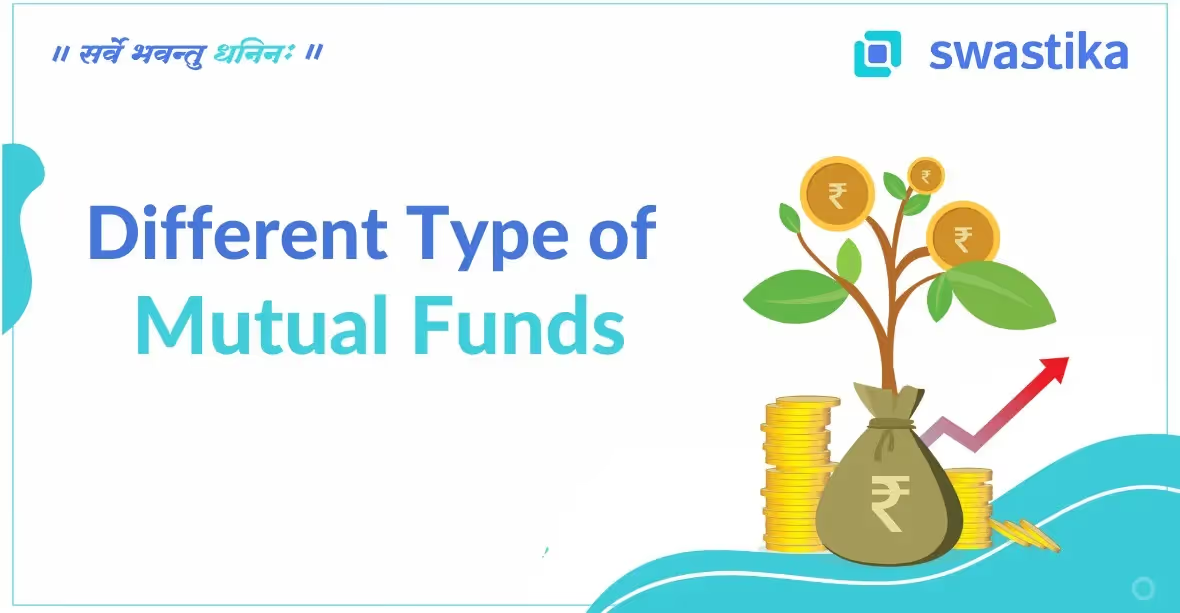
Different Types of Mutual Funds
Mutual funds have emerged as a popular investment option for people looking to grow their wealth. They offer the benefit of professional management, diversification, and the potential for attractive returns. Whether you’re a beginner or an experienced investor, understanding the various types of mutual funds can help you make insightful decisions that align with your financial goals.
In this guide, we’ll explore the different types of mutual funds based on asset class, investment goals, risk appetite, and other factors.
Types of Mutual Funds
These funds also include some subcategories which we will discuss below.
1. Equity Mutual Funds
Equity mutual funds are primarily focused on investing in stocks. The main objective is capital appreciation over the long term. These funds are considered high-risk, but they also offer the potential for higher returns.
Types of Equity Mutual Funds:
- Large-Cap Funds: These funds invest in well-established, large companies with a proven track record. They tend to be more stable but offer moderate returns.
- Mid-Cap Funds: Mid-cap funds focus on companies with medium-sized market capitalizations. These companies have growth potential, offering a higher risk-reward ratio.
- Small-Cap Funds: Small-cap funds invest in smaller companies with the potential for significant growth. These funds carry higher risks but can offer substantial returns if the companies perform well.
- Sectoral/Thematic Funds: These funds invest in specific sectors like technology, healthcare, or real estate. Their performance is closely tied to the growth of that particular sector.
- ELSS (Equity-Linked Savings Scheme): This is a tax-saving mutual fund that qualifies for tax deductions under Section 80C of the Income Tax Act. It comes with a lock-in period of three years.
2. Debt Mutual Funds
Debt mutual funds invest in fixed-income instruments like bonds, debentures, government securities, and treasury bills. They are less volatile than equity funds, making them ideal for conservative investors looking for steady income rather than aggressive growth.
Types of Debt Mutual Funds:
- Liquid Funds: These funds invest in debt instruments with a short maturity period of up to 91 days. They are ideal for parking surplus money for short durations.
- Short-Term and Ultra Short-Term Debt Funds: These funds invest in debt securities with shorter durations, generally up to three years. They are less affected by interest rate changes.
- Long-Term Debt Funds: These funds invest in securities with a longer duration, offering potentially higher returns but with increased sensitivity to interest rate movements.
- Gilt Funds: Gilt funds invest in government securities. These are ideal for risk-averse investors as they come with minimal credit risk.
- Credit Risk Funds: These funds invest in low-rated corporate bonds, which offer higher yields but come with a higher credit risk.
- Dynamic Bond Funds: These funds have the flexibility to adjust the portfolio's duration based on interest rate movements, making them suitable for changing market conditions.
3. Hybrid Mutual Funds
Hybrid mutual funds, also known as balanced funds, invest in both equity and debt instruments, offering a balanced risk-return trade-off. These funds are suitable for investors looking for moderate risk with the potential for growth as well as regular income.
Types of Hybrid Funds:
- Aggressive Hybrid Funds: These funds allocate a significant portion (around 65-80%) of the portfolio to equities and the rest to debt, offering higher growth potential.
- Conservative Hybrid Funds: Conservative hybrid funds have a greater allocation to debt instruments (around 75-90%) and a smaller portion to equities, making them less volatile.
- Balanced Advantage Funds: These funds dynamically manage the allocation between equity and debt based on market conditions, aiming to minimize risks while optimizing returns.
4. Index Funds
Index funds replicate the performance of a specific stock market index like the Nifty 50 or the Sensex. They offer diversification and are ideal for investors looking for long-term returns without the risk of active stock picking. Since these funds are passively managed, they come with lower expense ratios compared to actively managed funds.
5. Exchange-Traded Funds (ETFs)
Exchange-Traded Funds (ETFs) are similar to index funds but are traded on the stock exchange like individual stocks. They offer the benefits of both mutual funds and direct stock trading, including diversification and liquidity. ETFs typically have lower expense ratios and can be bought or sold at any time during market hours.
How to Choose the Right Mutual Fund?
Selecting the right mutual fund depends on various factors, including:
- Investment Goals: Whether you're looking for short-term gains, long-term growth, or regular income, your financial goals should guide your choice of mutual funds.
- Risk Appetite: Equity funds carry higher risks but offer greater returns, while debt funds are more stable but with lower returns.
- Time Horizon: For short-term goals, debt funds or liquid funds are ideal, while for long-term goals, equity or hybrid funds may be more suitable.
- Expense Ratios: Lower expense ratios mean more of your money is being invested, so it’s important to consider this when choosing between similar funds.
Conclusion
Understanding the different types of mutual funds is essential to making the right investment choices. Whether you're looking for aggressive growth through equity funds or stable returns via debt funds, there’s a mutual fund for every investor. By aligning your investment choices with your financial goals, risk tolerance, and time horizon, you can build a portfolio that helps you achieve your financial objectives.

Different Types of Bonds
Introduction
Welcome! Today, we’re going to explore the world of bonds, a key component of the financial markets. Bonds are essentially loans made by investors to borrowers, usually corporations or governments. In return, the borrower agrees to pay interest over a specified period and repay the principal at maturity. Let's break down the different types of bonds you might encounter.
1. Government Bonds
Government bonds are issued by a national government and are considered one of the safest investments since they are backed by the government's credit. In India, these are known as Government Securities (G-Secs).
- Example: Indian Government Bonds, such as the 10-Year G-Sec, offer a fixed interest rate and are a preferred choice for conservative investors.
2. Corporate Bonds
Corporate bonds are issued by companies to raise capital. They typically offer higher interest rates than government bonds to compensate for the increased risk.
- Example: Reliance Industries issues corporate bonds that offer investors a higher return compared to government bonds but with a slightly higher risk.
3. Municipal Bonds
Municipal bonds are issued by local government bodies, such as states or municipalities, to finance public projects like schools or infrastructure. These bonds often provide tax advantages to investors.
- Example: In the U.S., municipal bonds are common, but in India, similar bonds are less prevalent. However, urban development bonds issued by state governments can be considered a counterpart.
4. Zero-Coupon Bonds
Zero-coupon bonds do not pay periodic interest. Instead, they are issued at a discount to their face value and mature at par. The difference between the purchase price and the face value represents the investor's return.
- Example: Treasury Bills (T-Bills) in India are short-term zero-coupon bonds issued by the government, typically maturing in less than a year.
5. Convertible Bonds
Convertible bonds offer the option to convert the bond into a predetermined number of the company's equity shares. This feature provides potential upside if the company's stock performs well.
- Example: A company like Tata Motors might issue convertible bonds that can be converted into equity shares after a certain period, allowing investors to participate in the company’s growth.
6. Inflation-Linked Bonds
These bonds are designed to protect investors from inflation. The principal and interest payments are adjusted based on inflation rates, ensuring that the purchasing power of the investment is maintained.
- Example: The Government of India issues Inflation-Indexed Bonds (IIBs) that adjust the principal amount based on the inflation rate, protecting investors from the eroding effects of inflation.
7. Callable and Puttable Bonds
- Callable Bonds: These bonds can be "called" or redeemed by the issuer before the maturity date, usually when interest rates drop.
- Puttable Bonds: These allow investors to "put" or sell the bond back to the issuer before maturity, typically if interest rates rise or if they need liquidity.
- Example: A callable bond issued by a corporation may be redeemed if interest rates decline, allowing the company to refinance at a lower rate.
8. Foreign Bonds
Foreign bonds are issued in a country by a non-domestic entity and are denominated in the currency of the country where they are issued.
- Example: Masala Bonds are a type of foreign bond issued by Indian companies in Indian Rupees but sold to foreign investors.
Conclusion
Bonds are a versatile investment option, offering something for every type of investor, from the risk-averse to those seeking higher returns. Whether you’re interested in the safety of government bonds or the potential growth from corporate and convertible bonds, understanding the different types of bonds can help you make more updated investment decisions.

Understanding Reverse Stock Splits
Introduction
Welcome! Today, we’re delving into the intriguing concept of reverse stock splits. Though it might sound complex, it's a straightforward concept once you break it down. A reverse stock split is a corporate action where a company reduces the number of its outstanding shares. This process effectively increases the share price proportionally. Let’s explore what this means and why companies might choose to perform a reverse stock split.
What is a Reverse Stock Split?
In a reverse stock split, a company consolidates its shares. For instance, in a 1-for-10 reverse stock split, every 10 existing shares are merged into 1 new share. This reduces the total number of shares outstanding but increases the share price accordingly.
Why Do Companies Perform Reverse Stock Splits?
- Increase Share Price: Companies often use reverse stock splits to boost their share price. This is especially useful for maintaining a minimum share price requirement for listing on stock exchanges. A higher share price can help avoid delisting from major stock exchanges.
- Improve Perception: A higher share price can positively affect how investors and analysts view the company. It may attract more investment and improve the company's overall market perception.
- Reduce Volatility: By consolidating shares, companies can reduce the volatility of their stock price. This makes the stock less susceptible to small price fluctuations, which can be beneficial for both the company and its investors.
How Does a Reverse Stock Split Work?
Here’s a simple example to illustrate:
- Before the Split: Imagine a company with 1,000,000 shares outstanding, each priced at ₹10. The total market capitalization is ₹10,000,000.
- After a 1-for-10 Reverse Split: The company will have 100,000 shares outstanding, each priced at ₹100. The total market capitalization remains ₹10,000,000.
Effects on Shareholders
- Shareholder Equity: Shareholders will own fewer shares after the split. However, the total value of their investment remains the same, assuming no other market changes. For example, if you owned 1,000 shares priced at ₹10 each before the split, you would own 100 shares priced at ₹100 each after the split.
- Stock Price: The price per share increases proportionally to the reverse split ratio. While the price per share rises, the overall value of the investment does not change immediately.
- Future Trading: A higher share price might make the stock more attractive to institutional investors and reduce the risk of being delisted from major exchanges. This could lead to increased trading activity and improved market perception.
Risks and Considerations
- Market Perception: Reverse stock splits can sometimes be viewed negatively. They might signal that a company is struggling or trying to artificially boost its stock price. This perception can affect investor confidence.
- Impact on Liquidity: Reducing the number of shares can impact trading liquidity. Fewer shares available in the market might make it harder for investors to buy or sell shares, potentially leading to wider bid-ask spreads.
Examples of Reverse Stock Splits
- Company A: Tata Motors: Tata Motors performed a 1-for-10 reverse stock split in 2018. Before the split, the share price was around ₹40, and after the split, it was adjusted to ₹400. The split was intended to increase the share price and improve liquidity.
- Company B: Zee Entertainment: Zee Entertainment executed a 1-for-5 reverse stock split in 2022. Before the split, the share price was approximately ₹30, and after the split, it increased to ₹150. This move aimed to meet the listing requirements and attract more institutional investors.
Conclusion
Reverse stock splits are strategic actions by companies to manage their share price and market perception. While they can offer benefits such as increased share price and improved investor perception, they also come with risks and considerations. It’s essential to stay informed and understand the broader context when evaluating the impact of reverse stock splits on your investments.
Big Budget


Popular Articles



.avif)
.avif)

.avif)



START YOUR INVESTMENT JOURNEY
Get personalized advice from our experts
- Dedicated RM Support
- Smooth and Fast Trading App
