


Inside the IPO Filing Process from DRHP to Listing Day


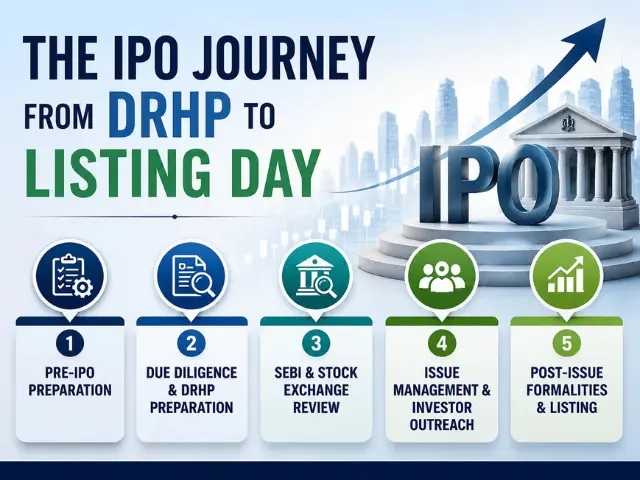

An IPO is often perceived as a single event. In reality, it is a tightly regulated capital markets transaction that tests a company’s governance, financial maturity and disclosure standards. Long before the stock lists, months of preparation go into drafting, verification, regulatory review and investor positioning.
Why the Filing Process Matters
The offer document is the backbone of the IPO. For SEBI, it is a legal disclosure document. For investors, it is the primary source of truth.For the company, it becomes a permanent public record. Gaps in statutory disclosures or inconsistencies in financial reporting may result in approval delays and affect investor confidence.
Phase I: Pre IPO Preparation
The IPO process begins well before drafting the prospectus. At this stage, the company prepares itself to operate as a listed entity. Key actions include finalising the issue structure, converting into a public limited company, updating constitutional documents, strengthening board and committee structures, appointing key managerial personnel and dematerialising shareholding.
Phase II: Due Diligence and DRHP Preparation
This is the most intensive stage of the IPO journey. The Merchant Banker conducts detailed financial, legal and business due diligence, followed by preparation of the Draft Red Herring Prospectus covering company profile, industry overview, risks, financials and utilisation of proceeds.
Phase III: SEBI and Stock Exchange Review
SEBI, along with the stock exchanges, reviews the DRHP to ensurefull and fair disclosures, eligibility, and governance compliance. All queries and observations are addressed before final In-Principal approval.
Phase IV: Issue Management and Investor Outreach
Post regulatory clearances, the Red Herring Prospectus is finalised and the issue pricing is decided. Merchant Bankers, working closely with syndication and underwriting teams, drive investor outreach and roadshows, while market makersplay a role in supporting orderly trading and liquidity (in case of SME-IPO), in line with applicable issue regulations.
Phase V: Post Issue Formalities and Listing
After the issue closes, the basis of allotment is finalised, funds are reconciled by the banker to the issue, and shares are credited to investors’ demat accounts. In cases of oversubscription, allotment is carried out as per category-wise allocation norms, with proportionate or lottery-based distribution and refunds/unblock of excess application amounts. The company then lists on the stock exchanges and enters the post-listing compliance framework. Syndication and underwriting teams continue to support investor engagement, while issuer-led marketing and investor interactions remain ongoing. Anchor investors participate up to one working day prior to the issue opening, helping establish early demand visibility and confidence in the offering.
Role of the Merchant Banker
The Merchant Banker anchors the IPO end-to-end, beginning with comprehensive due diligence and preparation of offer documentation. They act as the primary interface with SEBI and Stock Exchanges, provide valuation and structuring advice, and lead investor marketing efforts. In coordination with syndication and underwriting teams, the merchant banker supports book building, demand aggregation, and risk underwriting. Post listing, they also facilitate market-making arrangements and ensure regulatory and compliance requirements are met, enabling a smooth transition from a privately held company to the public markets.
Closing Thoughts
The IPO process shows how ready a company is to operate in public markets. With the right Merchant Banker guiding the company at every stage, the journey becomes well-planned and manageable, helping the business move smoothly into the listed space and build long-term, sustainable growth.
👉 To Connect with us today, please click here.
Latest Articles
Smart Phone Market Share by Player


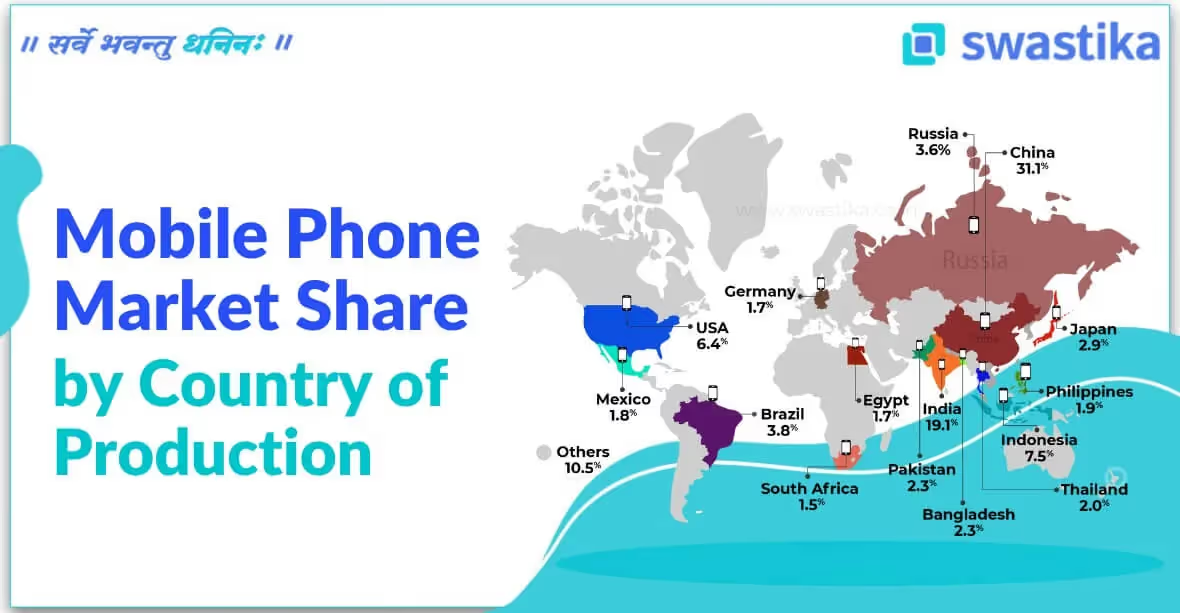
The Smartphone Industry has been steadily developing and evolving; both, in terms of market size and varied models. Factors such as the rise in disposable income of individuals, the development of robust telecom infrastructure, the introduction of budget-centric smartphones, and the increasing number of product launches are collectively contributing to the holistic growth of the smartphone market.
List of Smartphone Players by Market Share
Samsung topped the list of smartphone players with a market share of 19 per cent, followed by Apple with a 15 per cent of market share. Huawei stood third, holding 14 per cent of the market share. Xiaomi came in fourth on the list with an 11 per cent market share, followed by Oppo at 8 per cent, rest 33 per cent are held by other players in the market.
Of late, Samsung is the market leader that makes numerous best-selling Android phones, and with over 300 million sales a year, it is now the largest smartphone maker in the world. Keeping pace with advancing technology, Samsung also expanded its 5G smartphone lineup at entry and midrange price bracket of phones.
Right behind Samsung, there's Apple, an ultra-premium brand that offers flagship iOS-based smartphones, unlike other brands which are dealing in the Android OS.
China's stronghold in the world smartphone market can't be overlooked. Huawei is the largest smartphone manufacturer in China and the second-largest in the world, after South Korea’s Samsung. Huawei has a subsidiary brand, named 'Honor' that also designs and sells smartphones.
Xiaomi is another china's big giant emerging as one of the top leaders in the market with a mighty online customer base and fast expansion in the global markets beyond the Asian-Pacific region driven by investments via retail channels and partnerships with top communication services providers.
Another renowned china based smartphone maker 'Oppo' has grown tremendously by popular-priced mid-range smartphones, a wider distribution network, and robust marketing strategies in Western Europe.
Demand for smartphones continued to grow as users tilted towards higher specifications and a better user-friendly experience. The improvement in consumer outlook sustained learning, and work from home culture, along with pent-up demand from 2020, is also boosting sales of smartphones in 2021.

30 साल की ऊँचाई पर पहुंची मुद्रास्फीति से सोना -चांदी तेज़
अमेरिका के उपभोक्ता मूल्य सूचकांक में साल-दर-साल वृद्धि सितंबर में 5.4 प्रतिशत की वृद्धि को पार कर गई है। सितंबर से लेकर अक्टूबर तक अमेरिका में, कीमतों में 0.9 प्रतिशत की वृद्धि हुई, जो जून के बाद से महीने-दर-महीने की उच्चतम वृद्धि है। कच्चे तेल, गैस और खाद्य सामग्री की बढ़ती लागत के कारण अमेरिकी उपभोक्ता मूल्य सूचकांक पिछले वर्ष की तुलना में अक्टूबर में 6.2 प्रतिशत पर पहुंच गया है। यूएस सीपीआई डेटा के अनुसार, जो यह मापता है कि उपभोक्ता वस्तुओं और सेवाओं के लिए कितना भुगतान करता है, बढ़कर 4.6 प्रतिशत हो गया है, जो कि संयुक्त राज्य अमेरिका (यूएस) में 1990 में देखी गई मुद्रास्फीति का उच्चतम स्तर है। जिसके कारण पिछले सप्ताह घरेलु वायदा सोना 1400 रुपये प्रति दस ग्राम और चांदी 3000 रुपये प्रति किलो तक तेज़ हुई है।
मुद्रास्फीति हाल के महीनों में श्रमिकों को मिलने वाले वेतन में मजबूत लाभ को कम कर रही है और राजनितिक मुश्किलें बढ़ा रही है। लगभग एक दशक पहले की बड़ी मंदी के बाद की तुलना में महामारी से उबरने के दौरान नौकरी और वेतन वृद्धि अधिक अच्छी रही है। लेकिन उस मंदी के बाद के वर्षों के विपरीत, मुद्रास्फीति अब तेजी से बढ़ रही है और अर्थव्यवस्था में विश्वास को कम कर रही है।
जिसके कारण निवेश के लिए सुरक्षित मांग बढ़ती जा रही है। खाद्यान्न, खाद्य तेल, धातु और बिजली आपूर्ति समेत आवश्यक वस्तुओं के दाम बढ़ने से और दुनिया भर में आपूर्ति बाधित होने से महंगाई बढ़ रही है। हालांकि, अमेरिकी फेड का मुद्रास्फीति लक्ष्य 2 प्रतिशत है जो पहले से ही इस स्तर से काफी ऊपर है लेकिन अर्थव्यवस्था की वर्तमान स्थिति के अनुसार और अधिक आर्थिक सुधारों की आवश्यकता है। अमेरिकी फेड और यूरोपीय सेंट्रल बैंक ने कहा है कि वे बांड खरीद को कम कर रहे हैं, लेकिन निकट अवधि में ब्याज दर में वृद्धि नहीं करने जा रहे हैं क्योंकि अर्थव्यवस्था को महामारी के कारण बिगड़ी हुई आर्थिक स्थिति से बाहर आने के लिए अधिक नौकरियों और प्रोत्साहन की आवश्यकता है।
तकनिकी विश्लेषण
इस सप्ताह सोने और चांदी के भाव तेज़ रह सकते है। दिसंबर वायदा सोने में 49700 रुपये पर प्रतिरोध और 48000 रुपये पर सपोर्ट है। चांदी में 69000 रुपये पर प्रतिरोध और 63500 रुपये पर सपोर्ट है।

Sigachi Industries Limited IPO - Outlook & Valuation
RatingSubscribeIssue OfferIssue Opens on Nov 01, 2021Issue Close on Nov 03, 2021Total IPO size (cr) 125.43Fresh issue 125.43Offer For Sale (cr) NilPrice Band (INR) 161-163Market Lot 90Face Value (INR) 10Retail Allocation 35%Listing On NSE, BSEObjects of the issue ⮚ CAPEX of MCC at Dahej, Gujarat ⮚ CAPEX of MCC at Jhagadia, Gujarat ⮚ CAPEX of CCS at Kurnool ⮚ For General Corporate Purposes.Issue Break-up (%)QIB Portion 50NIB Portion 15Retail Portion 35Share Holding Pattern %Promoters & Promoter group 64.6 48.5Public 35.4 51.5Indicative TimetableFinalisation of Basis of Allotment 10-11-2021Refunds/Unblocking ASBA Fund 11-11-2021Credit of equity shares to DP A/c 12-11-2021Trading commences 15-11-2021
Sigachi Industries was incorporated as a private limited company in 1989, with the business to manufacture chlorinated paraffin and hydrochloric acid in its manufacturing unit situated at Hyderabad.
In the year 1990, Company diversified its product portfolio to manufacture microcrystalline cellulose which is widely used as an excipient for finished dosages in the pharmaceutical industry.
The inert non-reactive, free-flowing and versatile nature of MCC have varied applications in the pharmaceutical, food, nutraceuticals and cosmetic industries. The company manufactures MCC of various grades ranging from 15 microns to 250 microns.
- The major grades of MCC manufactured and marketed by our Company are branded as HiCel and AceCel. It operates three manufacturing units namely, Unit I situated at Hyderabad and two manufacturing units, Unit II and Unit III are situated at Jhagadia and Dahej, respectively located in Gujarat.
- The company has an in-house research and development division located in Unit II and Unit III with the objective to implement a performance-oriented approach with the help of technologies developed in-house.
- Received a certificate of suitability from the European Directorate for the Quality of Medicines and HealthCare on December 4, 2020
- The company commenced its export operations in the year 1996 by exporting its first order of MCC to Bangkok
- The company foresees an increase in demand for MCC and to tap the growing market, it intends to utilize the Net Proceeds of this Issue to enhance the production capacity 154 of MCC by increasing the existing capacity of Unit II and Unit III and manufacturing of CCS in the Proposed Unit at Kurnool.
Outlook & Valuation
The company had consistent revenue growth in the last 3 years where they grew at a CAGR of 13%. In FY21 revenue was at Rs 196 crore VS Rs 133 cr in FY19 while profit grew at CAGR of 17% and in FY21 net profit was Rs 30 cr Vs Rs 19 cr in FY19. The margins of the company are improving gradually. The CAPEX from the IPO would also help the company to increase its revenue further.
The Indian foods and beverage market, as well as the pharmaceutical market, are growing rapidly which should drive MCC’s demand forward.
Due to the small size of the IPO the company is going to list in the T2T Segment. The IPO is arriving at a PE of 14x on the average EPS of the last three years i.e. Rs. 10.88 and P/BV of 2.19 which seems to be reasonably priced for investors. Thus, we assign a “SUBSCRIBE” rating to the IPO for listing gains and long term.
IPO Note
SIGACHI INDUSTRIES LTD
KEY MANAGERIAL PERSONNEL
- Swami Das Nigam is the Chairman of the Board and Non-Executive Director of the Company and has been associated with the Company since the year 2014.
- Rabindra Prasad Sinha, is the Whole-time Director, the Chairperson of the Company and one of the Promoters who has been associated with the Company since its inception
- Chidambarnathan Shanmuganathan is the Whole-time Director of the Company and is one of the Promoters associated with the Company since its inception
- Amit Raj Sinha, is the Managing Director, Chief Executive Officer and is one of the Promoters of the Company
- Vijaykumar Amrutlal Bhavsar is the Whole-time Director of the Company. He has an experience of more than two decades in the chemical and pharmaceutical industry
- Dhanalakshmi Guntaka is an Additional Independent Director of the Company. She was appointed as an Additional Director of the Company with effect from October 18, 2021.
- Lijo Stephen Chacko is an Independent Director of our Company
- Sarveswara Reddy Sanivarapu, aged 56 years is an Independent Director of the Company. He is an associate of the Institute of Company Secretaries of India and has also received the certificate of practice as a company secretary.
COMPETITIVE STRENGTHS
- One of the leading manufacturers of MCC (cellulose-based excipient) in India with over 30 years of experience.
- Pan India and International market presence.
- Well experienced management team with proven project management and implementation skills.
- A comprehensive product portfolio enables them to serve diverse end-use applications.
- Presence across diverse industry verticals with long-standing relationships with customers.
- Growth led by continuous investment and focus on R&D.
- Quality Assurance and Quality Control of products
- Strategically located manufacturing facilities
KEY STRATEGIES
- Increasing manufacturing capacity to focus on the growing demand for core products.
- Increasing focus on its core business segment
- Diversifying and increasing penetration in markets
- Increasing its global presence
KEY CONCERNS
- Depending on a few customers, for a significant portion of their revenue
- The company has received a Demand Notice from Saffron Capital Advisors Private Limited, under the Insolvency and Bankruptcy Code, 2016
- The company has benefited from certain export benefits from the Government of India, which is withdrawn or modified may have a significant impact on results operations.
- There are outstanding litigations involving the Company
- The company is subject to foreign exchange control regulations which can pose a risk of currency fluctuations.
IPO Note
SIGACHI INDUSTRIES LTD
COMPARISON WITH LISTED INDUSTRY PEERS
There are no listed companies in India that engage in a business similar to that of the Company. Accordingly, it is not possible to provide an industry comparison in relation to the Company. However, The IPO is arriving at a PE of 14x on the average EPS of the last three years i.e. Rs. 10.88 and P/BV of 2.19 which seems to be reasonably priced for investors.
FINANCIALS (RESTATED CONSOLIDATED)
Particulars (Rs. In Lacs) FY 2021 FY 2020 FY 2019Equity Share Capital 768.25 768.25 307.30Other Equity 8,651.69 5,690.27 4,180.97Net Worth 9,419.94 6,458.52 4,488.27Total Borrowings 2092.70 3,037.94 2,519.11Revenue from Operations 19,275.58 13,906.26 12,898.81EBITDA 4,204.44 2,965.00 2,985.12Profit Before Tax 3,848.37 2,534.39 2,472.84Net Profit for the year 3,026.03 2,031.55 1,901.27
Policy Bazaar Fintech IPO
RatingSubscribe(Aggressive Investors)Issue OfferIssue Opens on Nov 01, 2021Issue Close on Nov 03, 2021Total IPO size (cr) 5,625Fresh issue 3,750Offer For Sale (cr) 1,875Price Band (INR) 940-980Market Lot 15Face Value (INR) 2Retail Allocation 10%Listing On NSE, BSEObjects of the issue ⮚ For enhancing visibility and business expansion ⮚ To expand consumer base including offline presence. ⮚ Strategic investments and acquisitions ⮚ For General corporate purposes.Issue Break-up (%)QIB Portion 75NIB Portion 15Retail Portion 10Indicative TimetableFinalisation of Basis of Allotment 10-11-2021Refunds/Unblocking ASBA Fund 11-11-2021Credit of equity shares to DP A/c 12-11-2021Trading commences 15-11-2021
PB Fintech is India’s largest online platform for insurance and lending products leveraging the power of technology, data and innovation.
It provides convenient access to insurance, credit and other financial products and aims to create awareness amongst Indian households about the financial impact of death, disease and damage. The company launched Policybazaar, its flagship platform, in 2008 to respond to Consumers’ need for more awareness, choice and transparency and create a consumer-pull based, provider-neutral model for insurance distribution.
In 2014, the company launched Paisabazaar with the goal to transform how Indians access personal credit by accentuating ease, convenience and transparency in selecting a variety of personal loans and credit cards.
⮚ In Fiscal 2020, Policybazaar was India’s largest digital insurance marketplace among all online insurance distributors with a 93.4% market share based on the number of policies sold.
⮚ Paisabazaar was India’s largest digital consumer credit marketplace with a 53.7% market share, based on disbursals in Fiscal 2021
⮚ Follows an asset-light capital strategy and do not underwrite any insurance or retain any credit risk on their books. Policybazaar is registered with and regulated by IRDAI as a direct insurance broker.
⮚ The market for insurance products as well as the lending market in India is expected to be more than double by 2030, which represents a meaningful market opportunity for the company.
⮚ Policybazaar offers an information-rich, user-friendly, and tech-driven self-service platform for
- pre-purchase research,
- purchase, including application, inspection, medical check-up, and payment; and
- post-purchase policy management, including claims facilitation, renewals, cancellations, and refunds
Outlook & Valuation
The company had consistent revenue growth in the last 3 years. The company's revenue for FY21 was at Rs 957.4 crore VS Rs 855.56 cr in FY20 while the company has never registered profit.
The company recorded a loss of (150.24) cr in FY21 against a loss of Rs (304.03) cr in FY20. New edge businesses are garnishing investors' interest in India and we have seen many multi-baggers from such kinds of businesses in the USA and China.
PB fintech is the operator of India's largest online platform for insurance and lending products and aiming toward expansion of its offline and customer base. The valuation of the company cannot be ascertained as the company is loss-making while the EV/Sales work out 47.6x.
Eying the positive outlook of the company and under penetration of the insurance industry, we assign a “SUBSCRIBE” only for Aggressive investors.
IPO Note
PB FINTECH IPO (POLICY BAZAAR)
KEY MANAGERIAL PERSONNEL
⮚ Mr Yashish Dahiya is the Chairman, Executive Director and CEO of the Company He holds a bachelor’s degree in technology from IIT, Delhi, a PGDM from IIM, Ahmedabad
⮚ Mr Alok Bansal is a Whole-time Director and CFO of the Company. He was previously associated with Voltas Ltd., GE (India), iGate Global Solutions Ltd, M&M and FE Global Technology Services Pvt. Ltd.
⮚ Ms Kitty Agarwal is a Non-executive Director of the Company. She is currently associated with Info Edge Ventures as a partner and was previously associated with Info Edge Ltd. as head of corporate development.
⮚ Mr Sarbvir Singh is the President of Policybazaar and Non-executive Director of the Company.
⮚ Mr Munish Ravinder Varma is a Non-executive Director of the Company. He currently serves as a managing partner at SoftBank Investment Advisers. He was also associated with Deutsche Bank AG.
⮚ Mr Kaushik Dutta is an Independent Director of the Company He is a fellow member of the Institute of Chartered Accountants of India with over 25 years of experience.
⮚ Ms Veena Vikas Mankar is an Independent Director of the Company. Ms. Mankar started her career with ICICI Limited and has worked with various financial institutions.
⮚ Ms Lilian Jessie Paul is an Independent Director of the Company.
⮚ Mr Nilesh Bhaskar Sathe is an Independent Director of the Company.
⮚ Mr Gopalan Srinivasan is an Independent Director of the Company.
COMPETITIVE STRENGTHS
⮚ Created strong, Consumer-friendly brands offering wide choice, transparency and convenience well-diversified business model.
⮚ Proprietary Technology, Data and Intelligence Stack
⮚ Benefits from economies of segmentation
⮚ Strong network effects for Policybazaar and Paisabazaar platforms.
⮚ High renewal rates provide clear visibility into future business and deliver superior economics.
⮚ Capital efficient model with low operating costs.
⮚ Founders with clarity of purpose backed by experienced management.
KEY CONCERNS
⮚ The company has a history of losses and it anticipates increased expenses in the future.
⮚ The COVID-19 pandemic, or a similar public health threat, could adversely affect their business, financial condition, and results of operations.
⮚ Failure to deal effectively with any fraud perpetrated on our platforms could harm our business.
⮚ Their strategy to expand internationally involves risks that could increase expenses, adversely affect results of operations and require increased time and attention from the management.
⮚ Business is subject to intense competition.
⮚ Failure to maintain brand recognition and reputation will adversely affect business financials.
⮚ The insurance broking business is subject to various laws and regulations.
⮚ Highly dynamic and competitive online fintech industry.
IPO Note
PB FINTECH IPO (POLICY BAZAAR)
COMPARISON WITH LISTED INDUSTRY PEERS
There are no listed companies in India that engage in a business similar to that of the Company. Accordingly, it is not possible to provide an industry comparison in relation to the Company while the EV/Sales work out to be 47.6x.
FINANCIALS (RESTATED CONSOLIDATED)
Particulars (Rs. In Millions) FY 2021 FY 2020 FY 2019Equity Share Capital 12.35 11.09 8.77Other Equity 19,904.99 12,647.38 4,894.17Net Worth 19,917.34 12,658.47 4,902.94Total Borrowings -- -- --Revenue from Operations 8,866.62 7,712.97 4,922.45EBITDA (1,597.63) (3,198.92) (2,512.32)Profit Before Tax (1,419.14) (2,948.41) (3,374.30)Net Profit for the year (1,502.42) (3,040.29) (3,468.11)
IRCTC Shares Turn Ex-Split: Key Things to Know
On Thursday, the shares of IRCTC was revitalized 16% after the stock turned into an ex-split. The organization had fixed October 29 as the record day for the stock split in the proportion of 1:5. Earlier, the board of IRCTC had endorsed a stock split on August 12.
Essentially, this implies that each stock will be split into 5 shares This builds the liquidity of the stock by reducing its stock value, subsequently making it more reasonable for investors and traders.
On October 19, 2021, the stock made a record high of Rs1,279 (acclimated to stock split) and has increased the investor’s wealth to a greater extent, which is more than 100% in the recent months.
Understanding Stock Split
A stock split builds the number of portions of a firm. In this case, the total number of shares will uplift 5 times however the offer cost will decrease.
This doesn't influence the market cap of the firm. Existing shares might slip yet the worth remains the same as before.
If we take the case of IRCTC, if investors possess 5 shares of the organization, the number of shares will increment to 25. The price of the stock of each share will get reduced. However, their fundamental value will remain the same as before.
The primary reason behind the stock split is to make shares more reasonable for the investors. It happens after a significant run-up of a stock's price.
Before declaring a stock split, the share price of IRCTC was around Rs 4000, even after a major decline from its all-time high of Rs 6,369.
Earlier, the stocks of IRCTC was quite expensive for small investors but after the stock split, the share prices had reduced to Rs 900, making it more appealing for investors.
It does not just advantage the current investors but also for the future investors. This is because IRCTC expanding the number of shares they hold.
It may be noted that there are no extra costs incurred during a stock split. The organization’s finances like revenue, income, operational expenses etc are not much affected after the stock split, nor is the market cap of the firm.
Objectives of IRCTC
Maximize the ROI by increasing areas of core competencies.
Increase business opportunities through effective partnership between public and private agencies.
Adopt ethical and strong work culture by teamwork as well as the reposition of Railways in the emerging economy.
Concern for heritage and environment.
To be totally friendly to customers and driven by the innovation, and development of human resources.
Analysts Recommendation on IRCTC
The fundamentals of IRCTC are very strong even before the stock split. Hence, the analysts recommended their investors hold their stocks instead of buying because of higher valuations. The split just makes the stock more appealing to the investors.
Aside from the stock split declaration, the sudden increase in railway bookings because the economy gets railed again and a decline in COVID cases are the positive news for the IRCTC stocks.
Services
Online Ticketing
IRCTC has started an online rail ticketing system where any user can book a ticket via SMS or GPRS. It likewise gives an SMS office to check the current PNR status and live train status also.
Catering and Hospitality
IRCTC additionally offers catering administrations to its travelers by serving freshly cooked food. IRCTC has also taken the rights for onboard catering of food on all trains operated by Indian railways.
It also has cafeterias such as a food plaza, Jan Aahar at numerous railway stations.
IRCTC accepted its approval for the stock split solely after it declared its quarterly income in August.
IRCTC took this choice simply because it will assist the organization with improving its liquidity in the securities exchange, which thus makes shares accessible for the small financial backers and investors.
The organization further said that the approved offer capital will remain the same at Rs 250 Crore while post-split, the share price will increment up to 1,25,00,00,000 from 25,00,00,000.
IRCTC launched its IPO in October 2019 and thus it entered the primary market. Since launching, the company has also enjoyed its monopoly in the capital market because it's the only company that provides and manages catering services to Indian Railways and at major units at railway stations.
It has been seen that after launching its IPO, the company has managed to give steady returns to its shareholders. The share price of IRCTC has increased more than 10 times from Rs 320 per share to Rs 3,790 within 2 years.
In the June quarter, the net profit of IRCTC has marked at Rs 82.5 crore, whereas its revenue rose up to Rs 257 Crore. Also, the company has increased its revenue to Rs 149 Crore and from the tourism category, the expected revenue was more than doubled to Rs 7 Crore.
Future Planning of IRCTC
The future plans of IRCTC are moving its business to transport, air tickets, tour and travel planners that could bring a new opportunity for the organization to reinforce its position.
IRCTC is the only approved organization that provide online tickets and catering services to the Indian Railways. Hence, we can say that it holds a pure monopoly in business.
Takeaway
Ex split of IRCTC has various advantages as it improves the liquidity in the capital market to build the investor base and makes the share affordable to small investors.
If you are a newbie who wants to start investing in stocks, then IRCTC would be a safe game to play. IRCTC is a government-owned organization and hence investing in it will give you significant gain in the future.

Government Seeks a Massive Valuation of Rs 10 Trillion from LIC IPO
The government of India seeks a gigantic valuation of Rs 10 Lakh Trillion or more from the biggest insurance company of India. The government took a reference from the Zomato IPO, which accumulated a valuation of Rs 1 trillion and suggested its advisors discover if LIC has the potential to be valued at Rs 10 trillion or more.
The government intends to sell a 5-10% stake in the LIC by means of IPO. Through this, the government raise to 1 Lakh Crore according to the people with the knowledge of the matter who have requested to not be recognized, as the matter is confidential.
This, in turn, will help the government to meet Rs 1.75 trillion disinvestments in the current fiscal.
Although the valuation is much lower than Jefferies’ estimate of Rs 19 crore, it can come under the category of RBSA Advisors’ whose estimated valuation is considered as Rs 10 Lakh Crore to Rs 11.6 Lakh Crore.
The central government is pushing ahead with LIC’s IPO to help plug a widening budget gap as it aims to raise Rs 1.75 Lakh Crore via disinvestment. The LIC deal is vital to the government accomplishing this objective.
Why LIC IPO is Crucial for the Indian Government?
As said above, the government is looking forward to its LIC IPO as with the help of it, the government aims to meet its disinvestment target. The secondary reason behind the popularity of LIC IPO is that the government is planning to privatize two banks and one insurance company.
From Rs 1.75 Lakh Crore disinvestment, Rs 1 Lakh Crore will be made from the sale of stakes in the financial institution and PSU banks. The leftover of Rs 75,000 Crores will come as a CPSE disinvestment receipt.
Above all, while LIC will have autonomous directors and operate in a corporate structure, it will carry on with the sovereign guarantee. This could end up being of great comfort to the investors and foreign portfolio investment.
Investors met government and LIC authorities last week to officially start the deal process. A listing is expected between January and March in the FY22 said a news official.
The government has selected 10 banks, including Kotak Mahindra Bank, Gold Sachs Group, JP Morgan Chase and Co, ICICI Securities etc to arrange the IPO.
This means that the central government could fuel LIC with more capital if the need emerges.
LIC IPO: Mother of All IPOs
The offer for sale in LIC IPO could be the mother of all IPOs so far in India - said, research analysts. In spite of the fact that there will be hunger, the sale begins at the end of the financial year which implies that it could deplete the liquidity and impact the secondary market to some extent, analysts said.
FAQ’s
Why is Government Selling a Stake?
The LIC IPO is the biggest plan of the Indian government to raise 1.75 trillion rupees by selling its assets. The money earned after the launching of LIC IPO would be used to minimize the country’s budget deficit which is calculated as 6.8% the current year.
Also, the government aims to offer the majority of its stakes in four major state-run firms including Air India, Bharat Petroleum Corporation of India, Container Corporation of India and Shipping Corporation of India.
What is the Date of IPO Launching?
The government plans to list LIC shares in the first three months of the year 2022. Earlier, the IPO was planned to be launched at the beginning of the fiscal year April 1, 2020. However, it got delayed due to the Covid 19 and the pandemic issues which interrupted the IPO process to a greater extent.
For What Reason does The Valuation Get So Troublesome?
Calculating the valuation of the biggest insurance company in India is without a doubt a challenging job. LIC, which cover the total size of India’s mutual fund industry, holds $ 511 billion of assets. The firms, that has been appointed to work on the valuation process, will look through million trillion of policies to represent the parameters such as morbidities, mortalities, lapses and surrenders. Additionally, they need to compute the worth of LIC’s fixed property across its 2000 branches.
Few people know that LIC release its balance sheet only once a year and there is no exact number to arrive at its embedded value that incorporates the current worth of future benefit with the net value of assets.
Are there any Matches in Different Countries?
Japan Post, whose privatization began in 2015, was Japan's greatest holder of bank stores and its biggest backup plan while it ran the public postal service.
Like LIC, it was exceptionally apparent, with the greatest chain of retail facades in Japan and a fleet of 86,000 motorbikes for mail conveyance.
Saudi Aramco, which organized the world's greatest IPO in 2019, was in like manner an image of Saudi Arabia's economy might be creating almost 90% of the Saudi government's income.
Will Investors Go for It?
The huge measure of liquidity presently kicking around in worldwide monetary business sectors could help the IPO sail through. Organizations have raised about $10.2 billion through IPOs in India so far this year, putting 2021 on target to beat the unsurpassed record of $11.8 billion.
Final Thoughts
Market observers now see great potential in LIC IPO as it may heavily improve future growth as well. Insiders predict that if 22 lakh agents sell one policy per year, it will result in huge volume.
Apart from that, the LIC of India comes with a huge investment portfolio that can create a massive investment return in the future.
Big Budget


Popular Articles



.avif)
.avif)
.avif)



START YOUR INVESTMENT JOURNEY
Get personalized advice from our experts
- Dedicated RM Support
- Smooth and Fast Trading App
