


Gurugram Infrastructure Update Rs 171 Crore For 26 Projects


Key Takeaways
- Gurugram Infrastructure gets Rs 171 crore for 26 projects to upgrade roads, water, sewerage, and CCTV in Sadar Bazar.
- This allocation signals a focused push on essential urban services in Gurugram.
- Retail investors should watch for execution timelines and procurement to gauge local infrastructure beneficiaries.
- Sarthi AI stock assistant can help analyze related stock implications.
Across India's dynamic capital region, Gurugram Infrastructure captures attention as a prime case of urban modernization aligned with retail investor interests. The municipal corporation's Finance and Contract Committee approved 26 development works worth Rs 171 crore on its ninth meeting, chaired by Mayor Rajrani Malhotra. This decisive step marks a focused push to upgrade the city’s backbone assets–from roads to water networks–paving the way for more reliable municipal services and potentially more resilient local business conditions. The move comes as Gurugram continues to be a trending topic in India’s urban infrastructure narrative, reflecting a larger pattern of city-scale upgrades in the NCR region.
In this post, we break down what the Rs 171 crore means for Gurugram Infrastructure, the areas that will see upgrades, the potential impact on local real estate and consumer services, and how retail investors can monitor execution risk and timelines.
Gurugram Infrastructure: What The Rs 171 Crore Push Covers
The approved works aim to strengthen basic infrastructure across the city and include the construction and reconstruction of roads, expansion of drinking water and sewerage networks, storm water drainage, strengthening of the electrical system, installation of CCTV cameras in Sadar Bazar, and technology-based water management systems. The Finance and Contract Committee approved these 26 development works worth Rs 171 crore, signaling a clear intent to push fundamental urban services forward.
- Road construction and reconstruction
- Expansion of drinking water networks
- Expansion of sewerage networks
- Storm water drainage improvements
- Electrical system strengthening
- CCTV cameras installation in Sadar Bazar
- Technology-based water management
These upgrades are spread across multiple city sectors, addressing some of the long-pending deficiencies that have affected daily life and business activity. While Rs 171 crore is a substantial sum for municipal works, the real test for investors will be whether procurement timelines, contractor selection, and on-ground execution align with the city’s growth needs.


The 26 Projects And Their Core Focus Areas
Each project in the batch targets a core infrastructure domain. Roads and drainage improvements are designed to reduce traffic bottlenecks and flood risk, while water and sewerage expansions aim to deliver reliable service to households and commercial premises. The electrical system upgrades are intended to improve reliability for critical commercial corridors, and the CCTV installation in Sadar Bazar is aimed at crime deterrence and better city management. Technology-based water management signals a move toward smarter, data-driven resource handling that can influence municipal service delivery and future planning.
From a retail investor perspective, the distribution of these works across categories suggests that projects in traditional public works–construction and utilities–will be the primary beneficiaries of the initial Rs 171 crore outlay. If vendors or contractors align with the city’s project priorities, local infrastructure-linked equities could see earnings visibility tied to execution progress.
Impact On Local Economy And Retail Investors
Gurugram’s real estate and retail sectors stand to gain from a more reliable urban infrastructure backbone. For investors, improved roads, water supply, and drainage reduce business risk by lowering logistics costs and mitigating flood-related disruptions. CCTV deployment in busy commercial zones can enhance safety, supporting higher footfall in retail corridors. The technology-based water management approach hints at a future where, beyond capital works, smart city investments can improve utility efficiency and data-driven policy decisions.
As with any municipal program, the ultimate investor takeaway is the tempo of delivery. Delays in tendering, contractor mobilization, or supply chain constraints can affect timelines and the degree to which project benefits translate into visible improvements in property prices or consumer demand. Monitoring progress through official communications and tender announcements will be crucial.
For data-driven investors, Swastika’s Swastika's Sarthi AI stock assistant offers a deeper, stock-focused lens on how municipal infrastructure upgrades can influence listed names in the infrastructure, construction, and utilities spaces. It can help contextualize company earnings visibility and risk factors as progress unfolds.
Delivery Timeline, Risks And Monitoring
Because the announcement references the ninth meeting of the FCC, the execution timeline will hinge on tendering cycles and contract award processes. The combination of road, water, sewerage, drainage, electrical upgrades, CCTV deployments, and smart water management requires coordination across multiple municipal departments and private partners. Investors should watch for monthly progress reports, tender issuances, and project-level milestones, which provide signals about pace and potential bottlenecks.
While the aggregate Rs 171 crore outlay signals strong intent, the actual pace of benefits depends on timely award of contracts, procurement schedules, material supply, and on-site efficiency. In the near term, you may see incremental improvements in inspection and maintenance outcomes, even before the full roster of works completes.
How To Track Progress And Invest
Tracking progress on Gurugram Infrastructure upgrades is a mix of municipal communications, tender notices, and project dashboards, along with macro indicators like real estate activity and local business sentiment. For the retail investor, a few practical steps can help translate this municipal initiative into an informed investment thesis:
- Monitor MCG’s official updates for tender issuances and contractor awards linked to the 26 works.
- Cross-check progress against the stated project categories (roads, water, sewerage, drainage, electrical, CCTV, water management).
- Correlate infrastructure progress with property development activity in Gurugram’s key corridors (Gurugram Manesar Expressway, existing business hubs, and Sadar Bazar precinct).
- Look for financial disclosures from mid-cap infrastructure and construction peers that reference city-specific projects or similar urban upgrades.
- Engage with data and research tools such as Swastika’s Sarthi AI stock assistant to contextualize how municipal progress could affect stock-level earnings visibility and risk assessments.
Given the scale of the project, there is a natural curiosity about how quickly benefits will translate into improved service levels and property demand. The 26 initiatives represent a concentrated reform push, and the cadence of tenders, procurement, and contractor mobilization will be the critical near-term watchpoints for investors. As always, diversification across infrastructure-linked names and a focus on balance sheets, order inflows, and execution risk will help manage the uncertainty inherent in municipal-led programs.
Frequently Asked Questions
What does the Rs 171 crore Gurugram infrastructure initiative cover?
The Finance and Contract Committee approved 26 development works worth Rs 171 crore, covering roads, expansion of drinking water and sewerage networks, storm water drainage, strengthening of the electrical system, CCTV cameras in Sadar Bazar, and technology-based water management.
How many projects were approved and by whom?
26 development works were approved by the Finance and Contract Committee of the Municipal Corporation of Gurugram (MCG) in its ninth meeting.
What areas are included in Gurugram Infrastructure upgrades?
Areas include roads, drinking water networks, sewerage networks, storm water drainage, electrical system upgrades, CCTV in Sadar Bazar, and technology-based water management.
What should retail investors watch for next in Gurugram infrastructure progress?
Investors should monitor tender issuances, contractor awards, and project milestones, and consider how progress could affect local infrastructure-related equities.
Where can investors get stock-focused insights on these municipal upgrades?
Investors can use Swastika's Sarthi AI stock assistant for deeper analysis of earnings visibility and risk in infrastructure-related stocks.
Conclusion
Gurugram’s latest Rs 171 crore push across 26 infrastructure projects signals a deliberate strategy to strengthen the city’s urban framework, with roads, water, drainage, CCTV, and smart water management at the center. For retail investors, the key takeaway is to track execution milestones, tender notices, and procurement timelines to gauge the pace of value realisation in local infrastructure-related equities and related service providers.
To stay ahead, translate these municipal improvements into a robust investment framework–track execution milestones, assess contractor capacity, and diversify across infrastructure names while keeping risk in check. For deeper, stock-specific insights aligned with public works progress, consider Swastika's Sarthi AI stock assistant.
Open your trading and demat account here
Reference :
1 : Tribuneindia
Latest Articles

CPSE ETF Mega Breakout Explained: Are PSU Stocks Entering a New Uptrend?


Key Takeaways
- CPSE ETF has broken out after nearly a year of consolidation
- Weak dollar and rising commodities are supporting PSU stocks
- Government reforms are improving PSU efficiency and profitability
- CPSE ETF offers diversified exposure to India’s top government companies
A Big Signal from the Markets
Sometimes the stock market sends quiet signals. And sometimes, it flashes a bold one. Right now, the CPSE ETF is doing the latter.
After spending almost a full year moving sideways, the CPSE ETF has delivered a decisive breakout. This is not about one PSU stock performing well. It is about an entire basket of government-owned companies showing renewed strength together.
Historically, such breakouts after long consolidation phases often mark the beginning of a broader trend. For investors tracking PSU stocks, this move deserves close attention.
What the CPSE ETF Represents
The CPSE ETF is designed to track some of India’s largest and most strategically important central public sector enterprises. These include leaders from power, energy, and financial segments such as NTPC, ONGC, PFC, and REC.
Instead of picking individual PSU stocks, the ETF allows investors to participate in the overall performance of this space through a single instrument. This diversification reduces stock-specific risk while still capturing sector-wide momentum.
The Technical Breakout Story
From a chart perspective, the CPSE ETF spent nearly a year in consolidation. Prices moved within a narrow range, frustrating short-term traders and testing the patience of long-term investors.
Such phases usually reflect uncertainty and lack of conviction. What changes the narrative is volume-backed price expansion. The recent move in CPSE ETF ticks that box.
A breakout after prolonged consolidation often suggests fresh participation from institutional investors and renewed confidence in the underlying theme.
Macro Tailwinds Supporting PSU Stocks
This breakout is not happening in isolation. Macro conditions are lining up in favour of PSU-heavy sectors.
One key factor is the weakening Dollar Index. Historically, a softer dollar benefits emerging markets like India. It also supports capital flows into sectors linked to commodities and infrastructure, where PSUs have significant exposure.
The second major driver is the global commodity upcycle. Prices of oil, metals, and energy commodities have remained firm. India’s largest commodity-linked businesses are government-owned companies. As commodity prices rise, their revenues and cash flows tend to improve, strengthening investor sentiment.
The Government Reform Angle
Perhaps the most important change is happening at the policy level.
Over the last few years, the government’s approach towards PSUs has evolved. There is a stronger focus on operational efficiency, accountability, and return on capital. Strategic disinvestment and privatisation discussions have improved discipline and transparency.
Initiatives aligned with the Atmanirbhar Bharat vision have also helped PSUs sharpen their business objectives. Many companies that were once seen as slow-moving are now reporting consistent profits, healthier balance sheets, and improved dividend payouts.
This structural shift is gradually changing how the market values PSU stocks.
Why CPSE ETF Makes Strategic Sense
For investors, the CPSE ETF offers a practical way to benefit from multiple trends at once.
It captures the commodity upcycle without betting on a single metal or energy stock. It benefits from PSU reforms without the risk of choosing the wrong company. And it aligns with India’s infrastructure and energy growth story, which remains a long-term theme.
Post-breakout, the risk-reward profile appears favourable, especially for investors with a medium to long-term horizon.
Impact on Indian Equity Markets
The renewed momentum in PSU stocks adds another layer of strength to Indian markets. When government-owned companies participate in rallies, it usually indicates broader economic confidence.
PSUs play a crucial role in power generation, fuel supply, credit flow, and infrastructure funding. Their improved performance supports economic stability and capital expenditure cycles, which eventually benefit the wider market.
Where Swastika Investmart Adds Value
Understanding thematic shifts like the CPSE ETF breakout requires more than just chart watching. It needs macro insight, sector analysis, and disciplined execution.
Swastika Investmart, a SEBI-registered brokerage, supports investors with strong research tools, sector reports, and timely market insights. Its tech-enabled platforms, responsive customer support, and focus on investor education help clients navigate opportunities like PSU revivals with confidence.
Frequently Asked Questions
What is driving the CPSE ETF breakout?
The breakout is supported by technical strength, a weakening dollar, rising commodity prices, and improved fundamentals of PSU companies.
Does this mean PSU stocks are entering a long-term uptrend?
While no trend is guaranteed, the combination of policy reforms and macro support increases the probability of sustained momentum.
Is CPSE ETF suitable for retail investors?
It can be suitable for investors seeking diversified exposure to PSU stocks, especially those aligned with commodities and infrastructure.
Which sectors dominate the CPSE ETF?
The ETF mainly includes power, energy, and financial PSUs such as NTPC, ONGC, PFC, and REC.
Should investors enter after the breakout?
Investors should evaluate risk appetite and investment horizon, and consider professional advice before taking positions.
Final Thoughts
The CPSE ETF mega breakout is more than a technical event. It reflects a deeper shift in how government-owned companies are performing and how markets are valuing them.
For investors looking to participate in India’s commodity cycle, policy reforms, and PSU revival, this space deserves attention. The key is to stay informed, disciplined, and aligned with long-term fundamentals.
If you want to explore such opportunities with research-backed insights and reliable execution, you can take the next step with Swastika Investmart.

Swiggy Q3 Results FY26: Strong Revenue Growth Meets Profitability Pressure
Summary
- Swiggy’s consolidated net loss widened to ₹1,065 crore in Q3 FY26
- Revenue from operations surged nearly 54 percent year-on-year to ₹6,148 crore
- Quick-commerce and supply chain segments drove the highest growth
- EBITDA losses increased, reflecting expansion-led cost pressures
- Markets remain focused on the timeline to sustainable profitability
Swiggy Q3 FY26 Financial Performance at a Glance
In its exchange filing dated January 29, Swiggy reported a wider consolidated net loss of ₹1,065 crore for the December 2025 quarter. This compares with a loss of ₹799 crore in the same quarter last year, although losses marginally narrowed compared to Q2 FY26 levels.
The headline positive was revenue. Revenue from operations jumped to ₹6,148 crore, up from ₹3,993 crore in Q3 FY25. This nearly 54 percent growth underscores the rising frequency of digital ordering and deeper penetration into India’s urban and semi-urban markets.
EBITDA loss for the quarter stood at ₹782 crore, compared to a loss of ₹725 crore earlier. The EBITDA margin moderated to 12.72 percent, reflecting increased spending on logistics, dark stores, rider incentives, and technology investments.
Segment-Wise Performance: Where the Growth Is Coming From
Food Delivery: Steady but Maturing
Food delivery continues to be Swiggy’s core business, generating ₹2,041 crore in revenue, with year-on-year growth of nearly 25 percent. While growth remains healthy, it is notably slower than newer segments.
This reflects a maturing urban food delivery market where customer acquisition costs are stabilising and competition remains intense. The focus here is increasingly on order frequency, subscription models, and operational efficiency rather than aggressive expansion.
Out-of-Home Consumption: A Revival Story
Revenue from out-of-home consumption grew 56 percent to ₹103 crore. This segment benefited from a strong revival in dining, events, and experiential consumption post-pandemic.
While still a small contributor to overall revenue, it provides diversification and aligns well with changing consumer behaviour, especially among younger urban Indians.
Quick-Commerce: The Growth Engine
Quick-commerce stood out, with 76 percent growth to ₹1,016 crore. This segment reflects India’s fast adoption of instant delivery for groceries, essentials, and daily-use items.
The growth comes at a cost. Dark store expansion, last-mile delivery infrastructure, and competitive pricing continue to pressure margins. However, for long-term investors, quick-commerce represents one of the most scalable digital consumption opportunities in India.
Supply Chain and Distribution: The Silent Heavyweight
The largest contributor this quarter was supply chain and distribution, generating ₹2,981 crore in revenue, also growing 76 percent year-on-year.
This highlights Swiggy’s evolution from a consumer-facing app to a deeper logistics and distribution platform. As India’s e-commerce and food ecosystems expand, this segment could play a critical role in improving unit economics over time.
Platform Innovations: Strategic but Volatile
Platform innovations saw a sharp decline in revenue to ₹9 crore. This reflects Swiggy’s recalibration of experimental initiatives, prioritising capital efficiency over aggressive diversification.
Why Losses Are Still Rising Despite Revenue Growth
For Indian investors, widening losses often raise concerns. However, in Swiggy’s case, the losses are largely strategic rather than structural.
Key cost drivers include:
- Heavy investments in quick-commerce infrastructure
- Rider and logistics expansion across Tier 2 and Tier 3 cities
- Technology, data, and AI-led optimisation initiatives
- Customer acquisition and retention spending
This mirrors the broader trend seen across India’s platform economy, where companies prioritise scale, reach, and ecosystem dominance before shifting focus to profitability.
Impact on Indian Markets and Investor Sentiment
While Swiggy is not yet listed, its performance has broader implications for:
- Valuations of listed tech and platform companies
- Sentiment around India’s digital consumption theme
- Institutional appetite for pre-IPO and private market investments
Regulatory oversight by SEBI and tighter disclosure norms have increased transparency in how such companies report financials. For retail investors, this underscores the importance of understanding business models, cash flows, and long-term scalability, not just headline growth numbers.
What Investors Should Track Going Forward
Rather than quarterly losses alone, investors should focus on:
- Improvement in contribution margins by segment
- Reduction in delivery and fulfilment costs
- Path to EBITDA breakeven in food delivery
- Capital allocation discipline in quick-commerce
This is where research-driven platforms like Swastika Investmart play a key role by helping investors decode complex business models and market narratives beyond surface-level headlines.
FAQs on Swiggy Q3 Results
Why did Swiggy’s net loss increase in Q3 FY26?
The higher loss was driven by expansion-led costs, especially in quick-commerce, logistics, and supply chain investments.
Which segment contributed the most revenue?
Supply chain and distribution emerged as the largest revenue contributor during the quarter.
Is Swiggy’s revenue growth sustainable?
Revenue growth remains strong, supported by rising digital adoption, but profitability will depend on cost optimisation and scale efficiencies.
Does Swiggy’s performance impact listed stocks?
Indirectly, yes. It influences sentiment around tech-enabled consumption, logistics, and platform-based business models in India.
What should long-term investors focus on?
Unit economics, cash burn trends, regulatory compliance, and the company’s roadmap to profitability.
Final Thoughts: Reading Beyond the Numbers
Swiggy’s Q3 FY26 results reflect the realities of building scale in India’s hyper-competitive convenience economy. Strong revenue growth confirms market demand, while widening losses highlight the cost of staying ahead in a rapidly evolving landscape.
For investors, the key is not short-term volatility but understanding how such platforms mature into sustainable businesses. Making informed decisions requires reliable research, regulatory awareness, and access to quality market insights.
If you are looking to invest with clarity and confidence, consider opening an account with Swastika Investmart, a SEBI-registered brokerage known for strong research tools, tech-enabled investing, and dedicated customer support.
Smart investing starts with informed decisions.
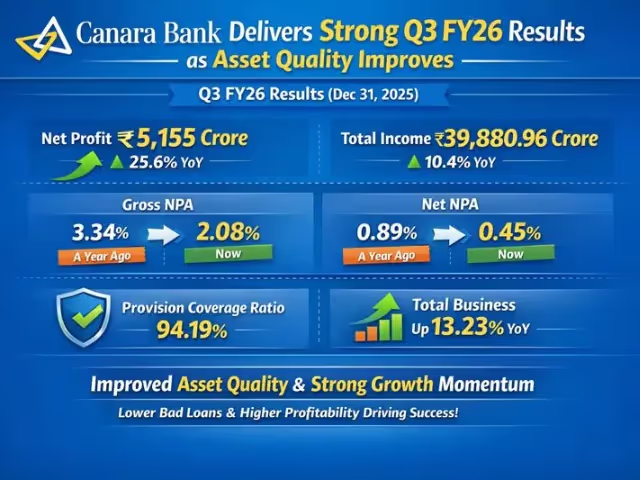
Canara Bank Delivers Strong Q3 FY26 Results as Asset Quality Improves
Canara Bank Delivers Strong Q3 FY26 Results as Asset Quality Improves
Canara Bank’s Q3 FY26 performance marks another important milestone in the transformation journey of India’s public sector banks. The lender reported a solid rise in profitability, supported by healthier core income, tighter control on bad loans, and a comfortable capital buffer.
At a time when investors are closely tracking bank earnings for signs of sustainability rather than one-off gains, Canara Bank’s latest numbers point toward structural improvement rather than temporary relief. For market participants, this quarter offers useful insights into how PSU banks are evolving in a more disciplined credit environment.
Key Highlights from Canara Bank Q3 FY26 Results
- Standalone net profit rose sharply to ₹5,155 crore
- Asset quality improved with Gross NPAs falling close to 2 percent
- Core income remained stable with healthy Net Interest Income
- Capital adequacy stayed well above RBI requirements
- Treasury and retail segments supported overall profitability
These indicators together suggest that the bank’s earnings quality has strengthened, a factor increasingly valued by long-term investors.
Profit Growth Reflects Better Balance Sheet Management
Net Profit Growth Signals Stability
For the quarter ended December 2025, Canara Bank reported a standalone net profit of ₹5,155 crore, a significant improvement compared to the same period last year. This growth was not driven by aggressive risk-taking but by steady income generation and controlled provisioning.
Unlike earlier cycles where PSU bank profits were volatile due to stressed assets, the current earnings trajectory appears more predictable and resilient.
Net Interest Income Remains the Backbone
Net Interest Income for the quarter crossed ₹9,250 crore, indicating that the bank continues to earn well from its lending operations despite fluctuations in interest rates. Stable spreads and controlled funding costs helped protect margins.
For investors, consistent NII growth is crucial because it reflects the strength of the bank’s core business rather than reliance on market-linked gains.
Asset Quality Improvement Continues to Build Confidence
Sharp Decline in NPAs
One of the most positive aspects of Canara Bank’s Q3 FY26 results is the improvement in asset quality. The Gross NPA ratio declined to around 2.08 percent, while Net NPAs fell to 0.45 percent.
This reflects years of focused recovery efforts, cautious loan approvals, and better monitoring of stressed accounts. In practical terms, it means fewer surprises on the balance sheet and lower credit risk going forward.
High Provision Coverage Adds Comfort
The Provision Coverage Ratio stood above 94 percent, offering a strong safety cushion against potential loan slippages. A high PCR reduces the probability of sudden profit shocks in future quarters.
Additionally, the absence of major divergences in asset classification under RBI supervision strengthens the credibility of reported asset quality numbers.
Segment Performance Shows Balanced Business Mix
Treasury Segment Boosts Earnings
The Treasury division played a major role in supporting profitability during the quarter. Gains from investments and bond portfolio management contributed meaningfully to overall profits.
While treasury income can fluctuate, its contribution in this quarter helped offset pressures in other segments.
Retail Banking Remains a Steady Contributor
Retail Banking delivered stable profits, backed by demand in home loans, vehicle loans, and personal finance. Retail loans typically offer better risk-adjusted returns and are less vulnerable to large defaults.
This segment’s performance highlights the gradual shift of PSU banks toward a more retail-oriented lending model.
Wholesale Banking Faces Selective Stress
The Wholesale Banking segment reported a loss during the quarter. However, this should be seen in the context of a cautious stance toward large corporate exposures.
Rather than chasing volume, the bank appears focused on asset quality, even if it means short-term pressure on profitability.
Consolidated Performance and Strategic Changes
On a consolidated basis, Canara Bank posted a net profit of over ₹5,250 crore for Q3 FY26. This includes contributions from associate companies such as Canfin Homes and Canara Robeco Asset Management.
During the quarter, the bank reclassified certain entities from subsidiaries to associates following stake dilution through Offer for Sale. This move unlocked value and resulted in a notable one-time gain at the consolidated level, improving overall shareholder returns.
Capital Position Strengthens Growth Visibility
Canara Bank’s capital adequacy ratio under Basel III norms stood at a healthy 16.50 percent, with CET-1 capital above 12 percent. These levels provide ample headroom for future loan growth without immediate dilution concerns.
The successful raising of Additional Tier 1 bonds during the quarter further reinforced the balance sheet. A strong capital base is especially important as credit demand gradually picks up across sectors.
Regulatory Comfort and Risk Management
The bank confirmed that there were no defaults on loans or debt obligations during the quarter. It also noted that the implementation details of new labour codes are awaited, and any financial impact will be assessed once clarity emerges.
Such disclosures reflect improved transparency and governance standards, which are increasingly important for institutional and retail investors alike.
What Canara Bank Q3 FY26 Results Mean for Investors
From a market perspective, Canara Bank’s performance reinforces the broader narrative that PSU banks are no longer just turnaround candidates. Many are now delivering consistent profits with manageable risk.
For equity markets, stable bank earnings support index strength, given the heavy weight of financial stocks. For retail investors, the results underline the importance of tracking asset quality trends rather than focusing solely on profit growth.
Tracking Bank Stocks with Research-Driven Support
Analysing banking results requires a clear understanding of financial ratios, regulatory norms, and economic context. This is where a structured research approach becomes essential.
Swastika Investmart, a SEBI-registered intermediary, offers robust equity research tools, detailed result breakdowns, and investor education initiatives. Its tech-enabled investing platform and responsive customer support help investors navigate complex market data with confidence.
Open your trading and investment account today
Frequently Asked Questions
How did Canara Bank perform in Q3 FY26?
The bank reported strong profit growth, improved asset quality, and stable core income during the quarter.
Is the improvement in NPAs sustainable?
The consistent decline in Gross and Net NPAs over multiple quarters suggests structural improvement rather than a temporary trend.
Which segment contributed the most to profits?
The Treasury segment was a major contributor, while Retail Banking provided stable support.
Does Canara Bank have sufficient capital for growth?
Yes, its capital adequacy ratios are well above regulatory requirements, offering growth flexibility.
How should investors view PSU banks after these results?
Investors may consider PSU banks as part of a diversified portfolio, focusing on asset quality and earnings consistency.
Final Thoughts
Canara Bank’s Q3 FY26 results highlight a bank that is steadily strengthening its foundations rather than chasing short-term gains. With improving asset quality, stable income streams, and a strong capital position, the bank reflects the broader recovery underway in India’s PSU banking space. For investors seeking disciplined exposure to financial stocks, staying informed through research-backed platforms like Swastika Investmart can add meaningful value.
Open your trading and investment account today
Smart investors do not just follow the news. They understand it.
.avif)
Stocks in News on 29 January 2026: Key Corporate Developments Investors Should Track
Summary
- IT stocks like Wipro and HCLTech remain in focus due to AI-led partnerships
- RVNL gains attention after emerging as the lowest bidder for a major railway project
- Cupid strengthens its regulatory standing with CE certification
- These updates may influence short-term sentiment and sectoral action
Stocks in News on 29 January 2026: Key Corporate Developments Investors Should Track
Tracking stocks in news helps investors stay aligned with real-time developments that often drive short-term price action and long-term valuation shifts. On 29 January 2026, several Indian companies made headlines due to strategic partnerships, regulatory approvals, and large infrastructure wins.
From IT majors expanding their AI footprint to public sector-linked companies securing large contracts, today’s updates offer valuable insight into where market attention may gravitate during the session.
Let us break down the key stocks in news today and understand what these developments could mean for Indian equity markets.
Wipro: Strengthening Its Position in Agent-Native Software
Wipro is in focus after announcing a strategic partnership with Factory for software development and agent-native solutions. The company will also participate in Factory’s latest funding round, signalling confidence in next-generation software models.
This move aligns with the broader trend among Indian IT services companies pivoting towards AI-led, automation-driven offerings. Agent-native solutions are designed to operate autonomously with minimal human intervention, a space that global enterprises are increasingly exploring to improve efficiency and reduce costs.
For investors, such partnerships highlight Wipro’s intent to remain competitive in a rapidly evolving global IT services market. While near-term stock movement will depend on broader IT sentiment, the development reinforces Wipro’s long-term digital transformation strategy.
HCL Technologies: Accelerating AI Adoption in Insurance
HCL Technologies has been selected by Guardian Life to support its AI-driven technology transformation journey. This collaboration focuses on modernising systems, improving data-driven decision-making, and enhancing customer experience.
The insurance sector globally is undergoing a technology overhaul, with artificial intelligence playing a critical role in underwriting, claims processing, and customer engagement. HCLTech’s involvement in such projects strengthens its presence in the high-value BFSI technology segment.
From a market perspective, consistent deal wins in AI and digital transformation projects help IT companies maintain revenue visibility amid global macro uncertainty. Investors often view such announcements as a sign of stable order pipelines rather than immediate triggers for sharp price movement.
RVNL: Major Boost from Railway Project Win
Rail Vikas Nigam Limited, commonly known as RVNL, has emerged as the lowest bidder for a ₹1,201 crore project awarded by Northern Railway. Infrastructure-linked stocks often react positively to such announcements due to improved order book visibility.
RVNL plays a key role in India’s railway infrastructure expansion, supporting electrification, track doubling, and modernisation initiatives. Government-led capex remains a strong theme in Indian markets, especially ahead of policy announcements and budget-related expectations.
This development reinforces RVNL’s position as a beneficiary of India’s long-term infrastructure push. While execution timelines and margins will be closely watched, order inflows of this scale generally support medium-term sentiment in PSU-linked stocks.
Cupid: Regulatory Milestone with CE Certification
Cupid has received CE certification for its HIV and Hepatitis test kits, a significant regulatory milestone that enables wider access to European and international markets.
CE certification confirms that a product meets stringent safety, health, and environmental protection standards. For diagnostic companies, such approvals are critical for expanding export opportunities and building credibility in global healthcare markets.
In the Indian context, diagnostic and healthcare stocks with strong regulatory compliance often attract investor interest due to their scalability and defensive nature. While Cupid remains a niche player, regulatory approvals can act as long-term growth enablers.
Broader Market Impact and Sectoral View
The updates from stocks in news on 29 January 2026 reflect three key themes shaping Indian markets.
First, the IT sector continues its gradual shift toward AI-led growth. Partnerships and client wins in advanced technology areas indicate adaptation rather than stagnation.
Second, infrastructure and railway-linked companies remain supported by government spending priorities. Large project wins often bring renewed interest in PSU and EPC stocks.
Third, healthcare and diagnostics companies are strengthening their regulatory and export positioning, adding depth to India’s pharmaceutical and medical device ecosystem.
For traders, such news-driven stocks may see short-term momentum. For long-term investors, these developments are better viewed as confirmation of strategic direction rather than standalone triggers.
How Investors Can Use Stocks in News Effectively
Reacting blindly to headlines can be risky. A disciplined approach involves evaluating the scale of the announcement, its revenue impact, and alignment with long-term business strategy.
SEBI-regulated brokers and research platforms play an important role in filtering noise and offering structured insights. Investors benefit most when news analysis is combined with technical levels, valuation metrics, and sector trends.
Why Swastika Investmart Stands Out for Active Investors
Swastika Investmart, a SEBI-registered brokerage, provides research-backed insights that help investors interpret daily market developments with clarity.
With robust research tools, timely market updates, and strong customer support, Swastika empowers investors to make informed decisions rather than emotional trades. Its tech-enabled platforms and investor education initiatives cater to both beginners and experienced market participants.
Frequently Asked Questions
Why do stocks in news matter for traders?
Stocks in news often experience higher volumes and volatility, creating short-term trading opportunities.
Do all news-driven stocks move positively?
No. Market reaction depends on expectations, valuations, and overall sentiment, not just the headline.
Are infrastructure stocks still attractive in 2026?
Government-led capex remains a supportive theme, but stock selection and execution quality are crucial.
How should long-term investors react to daily stock news?
Long-term investors should focus on whether the news strengthens the company’s core business strategy.
Is it safe to trade news-based stocks?
It can be risky without proper analysis. Using research-backed platforms reduces guesswork.
Conclusion: Stay Informed, Stay Disciplined
The stocks in news on 29 January 2026 highlight how strategic partnerships, regulatory approvals, and infrastructure wins continue to shape market narratives. While headlines can influence short-term price action, sustainable returns come from informed and disciplined investing.
If you want structured insights, reliable research, and a SEBI-registered partner to support your market journey, Swastika Investmart offers the right blend of technology and expertise.
Open your trading and investment account today
Smart investors do not just follow the news. They understand it.
.avif)
Market Setup for 29 January 2026: What Indian Investors Should Track Today
Summary
- Global cues are mixed with mild pressure from Dow futures and weak GIFT Nifty
- FIIs and DIIs remain net buyers, but derivatives data signals caution
- Nifty is building a base near 24,900 with strong resistance ahead
- Bank Nifty shows recovery momentum but faces immediate hurdles
Market Setup for 29 January 2026: What Indian Investors Should Track Today
The Indian stock market enters the session of 29 January 2026 with a cautiously balanced tone. Global cues are mixed, derivatives data shows hedging activity, and benchmark indices are attempting to stabilise after recent volatility.
With the Union Budget just around the corner, traders and investors are increasingly selective, focusing on levels, liquidity flows, and short-term signals rather than aggressive positioning. Let us break down today’s market setup, covering global markets, FII activity, derivatives data, and the technical outlook for Nifty and Bank Nifty.
Global Market Cues Setting the Tone
Overnight cues from global markets offer no clear directional push.
US markets ended on a mixed note, with the Dow Jones closing marginally higher, while Dow futures are currently trading lower. This suggests cautious sentiment ahead of key economic data and earnings commentary.
Asian markets are trading mixed in early hours, reflecting uncertainty rather than risk-on enthusiasm. For Indian markets, the early indicator, GIFT Nifty, is down around 74 points, hinting at a subdued or mildly negative opening.
In recent weeks, Indian markets have shown resilience despite global volatility. However, short-term traders should stay alert to intraday swings driven by global headlines.
Institutional Flow Analysis: FIIs and DIIs
One of the supportive factors for Indian equities remains domestic and foreign institutional participation.
Foreign Institutional Investors recorded net buying of approximately ₹480 crore in the cash market, while Domestic Institutional Investors added a strong ₹3,361 crore. This takes the combined net inflow to nearly ₹3,841 crore.
Such participation reflects confidence in India’s medium-term growth outlook, even as short-term uncertainty persists. It also aligns with SEBI-regulated transparency in institutional reporting, helping investors assess real money flow rather than speculation.
Derivatives and Volatility Snapshot
The derivatives segment presents a mixed picture.
The Nifty Put Call Ratio has moved to around 0.97, rising sharply from earlier levels near 0.70. This shift indicates increased put writing, suggesting some confidence near support zones but not outright bullish conviction.
India VIX has cooled by over 6 percent and now hovers around 13.5. Lower volatility often signals reduced panic, but it also means traders must manage risk carefully as sharp moves can still occur near event days like the Budget.
Options data shows the highest open interest at 26,000 on the call side and 25,000 on the put side for the upcoming expiry, with a max pain level near 25,300. This range may act as a magnet for price action in the near term.
FII Positioning in Index Derivatives
Changes in FII index derivatives positions indicate hedged and cautious participation.
There has been addition in both long and short positions across futures and options. Call and put writing activity suggests range-bound expectations rather than directional aggression.
Such behaviour is common ahead of major policy events and reflects professional risk management rather than bearishness.
Nifty Technical Outlook: Key Levels to Watch
Nifty spot is attempting to form a base around the 24,900 zone, which has acted as a demand area in recent sessions.
Immediate support lies near 25,200 and 25,000. A decisive break below these levels could increase selling pressure, especially in the absence of fresh triggers.
On the upside, 25,450 and 25,600 remain strong resistance zones. Any move above these levels would require sustained buying and positive global support.
For positional investors, this phase calls for patience and stock-specific strategies rather than broad index bets.
Bank Nifty Outlook: Recovery with Resistance
Bank Nifty has shown a smart recovery from the 58,000 support zone, supported by selective buying in large private banks.
The index faces an immediate hurdle near 59,800. A breakout above this level could open the door towards 60,200 in the short term.
Key supports are placed at 59,200 and 58,800. As banking stocks carry significant weight in benchmark indices, their movement will play a crucial role in determining intraday sentiment.
How This Market Setup Impacts Indian Investors
For traders, today’s market setup suggests a range-bound to mildly volatile session. Option strategies focusing on defined risk may be more effective than aggressive directional trades.
For long-term investors, such consolidations often present opportunities to accumulate quality stocks aligned with India’s growth themes like infrastructure, manufacturing, banking, and energy.
SEBI-regulated platforms and research-driven brokers can add value during such phases by offering risk-managed insights rather than noise.
Why Many Investors Rely on Swastika Investmart
Swastika Investmart, a SEBI-registered brokerage, stands out for its research-backed market insights, strong derivatives analytics, and investor education initiatives.
With a focus on disciplined investing, tech-enabled trading platforms, and responsive customer support, Swastika helps investors navigate both volatile and sideways markets with clarity.
Their daily market setup reports, technical views, and derivatives analysis are particularly useful for active traders and informed investors.
Frequently Asked Questions
Is today’s market setup bullish or bearish?
The setup is neutral to mildly cautious, with strong supports holding but resistance zones still intact.
What does GIFT Nifty indicate for Indian markets today?
A negative GIFT Nifty suggests a subdued opening, but intraday direction will depend on global cues and institutional flows.
Should traders avoid positions ahead of the Budget?
Not necessarily, but risk management is critical. Smaller position sizes and defined-risk strategies are advisable.
Why is Bank Nifty important in today’s setup?
Bank Nifty heavily influences overall market sentiment due to its weight in benchmark indices.
How reliable is FII data for short-term trading?
FII data offers directional clues but should always be combined with technical levels and volatility indicators.
Conclusion: Stay Disciplined in a Data-Driven Market
The market setup for 29 January 2026 reflects a phase of consolidation rather than conviction. With mixed global cues, supportive institutional flows, and clear technical levels, investors should stay disciplined and selective.
This is where research-driven decision-making matters more than speculation.
If you are looking for structured insights, reliable research, and a SEBI-registered partner to support your investing journey, explore Swastika Investmart’s platforms and tools.
Open your trading and investment account today:
Smart investing begins with informed decisions.

India–EU Trade Deal Finalized: Opportunities for Indian Stocks and Sectors
Key Takeaways
- India and the EU finalised the long-awaited Free Trade Agreement on January 27, 2026
- Over 90 percent of traded goods will see tariff reductions or removal
- Indian exporters in textiles, pharma, engineering and chemicals stand to gain
- The deal strengthens India’s manufacturing and services growth amid global trade shifts

India–EU Trade Deal Finalised: Why This Agreement Matters
After nearly two decades of negotiations, pauses and restarts, India and the European Union finally sealed what many are calling the “mother of all trade deals.” Announced at the India–EU Summit in New Delhi on January 27, 2026, the Free Trade Agreement marks a turning point in India’s global trade strategy.
Once operational, expected around 2027 after legal and parliamentary approvals, this pact will create one of the world’s largest free trade areas, covering close to two billion people and roughly a quarter of global GDP. For Indian markets, this is not just a diplomatic win but a meaningful economic catalyst.
At a time when global trade faces uncertainty from protectionist policies and supply chain disruptions, the India–EU trade deal finalised provides Indian businesses and investors with long-term visibility and opportunity.
What the India–EU Free Trade Agreement Covers
The agreement goes well beyond conventional tariff cuts. It aims to reshape trade flows, improve market access and enhance investment confidence on both sides.
Key elements include substantial tariff reductions on goods, expanded access for services, regulatory cooperation and commitments on sustainability. Sensitive sectors such as certain agricultural and dairy products have been excluded to safeguard domestic interests.
Bilateral trade between India and the EU currently stands at around 136 to 140 billion dollars, with the EU being India’s largest trading partner. The agreement is expected to significantly deepen this relationship over the next decade.
Tariff Reductions and Their Market Impact
One of the most closely watched aspects of the deal is tariff liberalisation. India has agreed to sharply reduce import duties on European goods, including automobiles, where tariffs will fall from levels as high as 110 percent to about 40 percent initially, with a roadmap towards 10 percent over time.
While this benefits European automakers, it also signals India’s confidence in its domestic manufacturing ecosystem. For Indian ancillary suppliers, auto component manufacturers and logistics players, increased volumes and cross-border integration could open fresh growth avenues.
More importantly for Indian exporters, duties and non-tariff barriers will be reduced or eliminated on over 90 percent of traded goods. This restores competitiveness for Indian companies that were impacted when the EU withdrew GSP benefits in 2023.
Indian Sectors Likely to Benefit the Most
Textiles and Apparel
Labour-intensive sectors like textiles, garments and leather are among the biggest beneficiaries. With easier access to European markets, Indian exporters can regain lost market share and improve margins. Companies with strong compliance and sustainable sourcing practices may see faster order inflows.
Pharmaceuticals and Chemicals
India’s pharma sector gains from improved regulatory cooperation and smoother access for formulations and bulk drugs. This is particularly important as European healthcare demand remains structurally strong. Specialty chemical exporters also benefit from scale and diversification away from China.
Engineering and Capital Goods
Electrical machinery, industrial equipment and engineering goods are well-placed to benefit as EU firms diversify supply chains. Indian manufacturers with global quality certifications stand to see long-term export growth.
Gems and Jewellery
With tariff relief and stable demand from Europe, organised jewellery exporters could see improved volumes, especially in studded jewellery and precision-crafted segments.
Services and Digital Trade
The agreement also supports liberalisation in services such as telecom, transport, accounting and auditing. India’s strength in skilled services aligns well with European demand, particularly as discussions on worker mobility and data security move forward.
Strategic Advantages Beyond Trade Numbers
The India–EU trade deal finalised is not just about exports and imports. It strengthens India’s role in global supply chains at a time when Europe is actively reducing dependence on China.
Around 6,000 European companies already operate in India, and this number is expected to rise as investment confidence improves. The agreement also supports collaboration in critical technologies, clean energy, defence manufacturing and sustainability initiatives.
Concerns around mechanisms like the EU’s Carbon Border Adjustment Mechanism were addressed pragmatically, with sensitive sectors receiving protection. This balanced approach reassures Indian businesses navigating evolving global climate regulations.
What It Means for Indian Stock Markets
From a market perspective, the deal reinforces India’s long-term growth story. Export-oriented sectors, companies with European exposure and firms integrated into global supply chains are likely to attract investor interest.
While immediate stock price reactions may be measured, the real impact unfolds over time as trade volumes rise and margins improve. Investors should track companies with strong execution capabilities, regulatory readiness and diversified revenue streams.
For long-term investors, this agreement adds another layer of structural support to India’s manufacturing and services expansion.
How Swastika Investmart Helps Investors Navigate This Opportunity
Understanding trade agreements and translating them into investment decisions requires research depth and market insight. Swastika Investmart, a SEBI-registered brokerage, empowers investors with robust research tools, sectoral analysis and timely market updates.
With tech-enabled investing platforms, responsive customer support and a strong focus on investor education, Swastika Investmart helps clients identify emerging opportunities while managing risks prudently.
As global developments increasingly influence Indian markets, having a reliable research partner becomes crucial.
Frequently Asked Questions
When was the India–EU trade deal finalised?
The agreement was announced on January 27, 2026, during the India–EU Summit in New Delhi.
When will the agreement come into force?
After legal scrubbing and ratification, the deal is expected to take effect around 2027.
Which Indian sectors benefit the most from this deal?
Textiles, pharmaceuticals, engineering goods, chemicals, gems and jewellery and services are among the key beneficiaries.
Does the deal impact Indian agriculture?
Sensitive agricultural and dairy sectors have largely been excluded to protect domestic producers.
How can investors approach opportunities from this deal?
Investors should focus on export-oriented companies with strong compliance standards and European market exposure.
Conclusion
The India–EU trade deal finalised in 2026 is a landmark development for India’s economic and market outlook. By opening doors to one of the world’s largest consumer blocs, it strengthens India’s export competitiveness, investment appeal and strategic positioning.
For investors, this agreement reinforces the case for a long-term, research-driven approach to Indian equities. If you are looking to explore such opportunities with expert guidance and reliable tools, now may be a good time to take the next step.
Big Budget


Popular Articles





.avif)
.avif)

.avif)



START YOUR INVESTMENT JOURNEY
Get personalized advice from our experts
- Dedicated RM Support
- Smooth and Fast Trading App
