


Inside the IPO Filing Process from DRHP to Listing Day


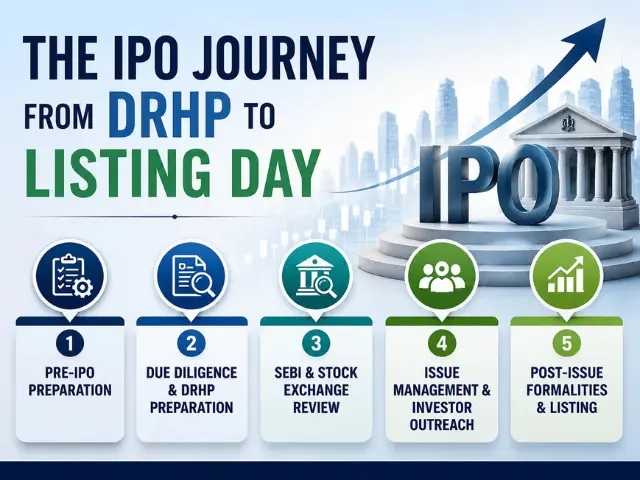

An IPO is often perceived as a single event. In reality, it is a tightly regulated capital markets transaction that tests a company’s governance, financial maturity and disclosure standards. Long before the stock lists, months of preparation go into drafting, verification, regulatory review and investor positioning.
Why the Filing Process Matters
The offer document is the backbone of the IPO. For SEBI, it is a legal disclosure document. For investors, it is the primary source of truth.For the company, it becomes a permanent public record. Gaps in statutory disclosures or inconsistencies in financial reporting may result in approval delays and affect investor confidence.
Phase I: Pre IPO Preparation
The IPO process begins well before drafting the prospectus. At this stage, the company prepares itself to operate as a listed entity. Key actions include finalising the issue structure, converting into a public limited company, updating constitutional documents, strengthening board and committee structures, appointing key managerial personnel and dematerialising shareholding.
Phase II: Due Diligence and DRHP Preparation
This is the most intensive stage of the IPO journey. The Merchant Banker conducts detailed financial, legal and business due diligence, followed by preparation of the Draft Red Herring Prospectus covering company profile, industry overview, risks, financials and utilisation of proceeds.
Phase III: SEBI and Stock Exchange Review
SEBI, along with the stock exchanges, reviews the DRHP to ensurefull and fair disclosures, eligibility, and governance compliance. All queries and observations are addressed before final In-Principal approval.
Phase IV: Issue Management and Investor Outreach
Post regulatory clearances, the Red Herring Prospectus is finalised and the issue pricing is decided. Merchant Bankers, working closely with syndication and underwriting teams, drive investor outreach and roadshows, while market makersplay a role in supporting orderly trading and liquidity (in case of SME-IPO), in line with applicable issue regulations.
Phase V: Post Issue Formalities and Listing
After the issue closes, the basis of allotment is finalised, funds are reconciled by the banker to the issue, and shares are credited to investors’ demat accounts. In cases of oversubscription, allotment is carried out as per category-wise allocation norms, with proportionate or lottery-based distribution and refunds/unblock of excess application amounts. The company then lists on the stock exchanges and enters the post-listing compliance framework. Syndication and underwriting teams continue to support investor engagement, while issuer-led marketing and investor interactions remain ongoing. Anchor investors participate up to one working day prior to the issue opening, helping establish early demand visibility and confidence in the offering.
Role of the Merchant Banker
The Merchant Banker anchors the IPO end-to-end, beginning with comprehensive due diligence and preparation of offer documentation. They act as the primary interface with SEBI and Stock Exchanges, provide valuation and structuring advice, and lead investor marketing efforts. In coordination with syndication and underwriting teams, the merchant banker supports book building, demand aggregation, and risk underwriting. Post listing, they also facilitate market-making arrangements and ensure regulatory and compliance requirements are met, enabling a smooth transition from a privately held company to the public markets.
Closing Thoughts
The IPO process shows how ready a company is to operate in public markets. With the right Merchant Banker guiding the company at every stage, the journey becomes well-planned and manageable, helping the business move smoothly into the listed space and build long-term, sustainable growth.
👉 To Connect with us today, please click here.
Latest Articles
Online Platform Based Companies


BSE -

BSE Exchange (Bombay Stock Exchange), India’s largest stock exchange by a number of companies listed. The Bombay Stock Exchange was established in the year 1875 as the first stock exchange in Asia. Today BSE has over 5000 companies listed on it, the highest in any exchange around the world.
World's two leading global exchanges, Deutsche Bourse and Singapore Exchange, are strategic partners of BSE. BSE offers to trade in Equity, Debt Instruments, Derivatives, Mutual Funds and SME Equity. The S&P BSE SENSEX is India’s most widely tracked stock market benchmark index.
BSE also offers services including risk management, clearing, settlement, market data services, IT services and solutions, licensing index products such as the S&P BSE SENSEX and financial & capital markets training. BSE Limited has the following strengths: 1.
Strong brand recognition with a track record of innovation 2. Diversified and integrated business model and active relationship with market participants 3. State-of-the-art infrastructure and technology.
CAMS -

Computer Age Management Services Ltd (CAMS) is a mutual fund (MFs) transfer agency with a focus on technology-based solutions. It offers services to alternative investment funds (AIFs) and insurance companies, through service centres, white label call centres, online mobile applications and chatbot services.
Mutual Fund distribution is a big business in India and the transaction processing environment is complex. There are many sub-agents of distributors in the country leading with a retail investor base and they will need information regarding Mutual Fund transactions. So, CAMS offer Distributor Services packages to all distributors who operate using retail sub-agents.
CDSL -
CDSL is the leading securities depository in India in terms of incremental beneficial owner (BO) accounts. CDSL earns revenue by charging annual issuer fee to corporates and account maintenance charges, user facility charges and transaction fees to depository participants (DPs).
The asset-light model, duopoly play on the secular increase in stockholder accounts coupled with potential market share gains is an added positive. While this itself is a successful recipe for growth, the icing on the cake could be the massive unexploited revenue opportunities in CDSL’s core activities, and leveraging its customer base and data for new businesses, a feat adroitly accomplished by similar sectors such as credit rating agencies (not to mention internet companies).
IEX –

INDIAN ENERGY EXCHANGE LIMITED (IEX) is the first and largest energy exchange in India providing a nationwide, automated trading platform for physical delivery of electricity, Renewable Energy Certificates and Energy Saving Certificates. The exchange platform enables efficient price discovery and increases the accessibility and transparency of the power market in India while also enhancing the speed and efficiency of trade execution.
IEX’s subsidiary Indian Gas Exchange Ltd. (IGX) is India’s first automated national level Gas Exchange to promote and sustain an efficient and robust Gas market and to foster gas trading in the country. The exchange features multiple buyers and sellers to trade in spot and forward contracts at designated physical hubs.
INDIAMART–

Indiamart Intermesh Limited is an online platform (www.indiamart.com.) for business buyers to connect with suppliers of products and services. Buyers can place a business enquiry by visiting suppliers (small and medium) online and explore their products and services. It has organised its listings across 54 industries.
It provides a platform for SMEs, large enterprises, and even individual buyers. Nearly 2.6 crore buyers can reach out to over 22 lakh suppliers coming from 52 different categories of industries and choose from the list of 3.3 crore products.
It is now rated as one of the largest e-commerce platforms for businesses of different kinds with a market share of more than 60%. It deals with 97000 product categories that cover a wide range of industries. IndiaMART is also one of the very few companies with zero debt and a sizeable cash balance.
IRCTC -
IRCTC is a ‘Mini-Ratna' company that derives revenues from four broad business segments — catering (selling food on rail journeys), travel & tourism (tour and destination-specific packages), e-ticketing and packaged drinking water (known for its brand Rail Neer).
Catering contributes 55 per cent to the company’s total revenues, followed by travel & tourism which provides 23.3 per cent, e-ticketing contributes 12.3 per cent and packaged drinking water, which contributes 9.2 per cent.
INFO EDGE (NAUKRI) -

Info Edge generates revenue through the provision of various services through its online recruitment, property, matrimonial, and education classifieds portals. The Company derives its revenue in the form of fees associated with its various services and advertising solutions.
It also derives revenue through commission income on property bookings placed with builders and developers. Today InfoEdge group directly operates 8 ventures and controls the other 6 through investments.
Jeevansaathi.com, the famous matrimonial site, was launched in 1998. In later years they came up with Shiksha.com, NaukriGulf, and Quadrangle. In 2012, they also launched their mobile app for Naukri.com In 2010, InfoEdge made an investment that realized much late but shows the vision of this investment was now food delivery and restaurant catalogue giant, Zomato.
This is what lies in the InfoEdge group. Zomato was not their only key investment. They also own now much known ‘Policybazaar’. The other ownerships are ‘Meritnation’ and ‘MyDala’. However, the one doing buzz lately is ‘99Acres’.
Zomato is one of the most anticipated IPOs of 2021.
Info Edge’s Startup Investment
Zomato, policy bazaar, happily unmarried, Unnati Pvt ltd, Zippserv, Wishbook, Nopaperforms, University, gramophone, Bijnis, Medcords, printo, Shopkirana, Greyt HR , adda247, terra economics & analytics lab, legit quest, Shipsy, Coding ninjas, Ayuki.
MATRIMONY -

Matrimony.com (till recently known as Consim Info Pvt Ltd) claims it has 60 per cent of the estimated Rs 300-crore online matchmaking market. The company runs 15 matrimonial websites under Bharat Matrimony and around 300 websites under Community Matrimony. From a one-man venture almost 15 years ago, the company now has 4,000 employees.
Matchmaking is only a small pie of the huge business opportunity in a conventional Indian marriage. "Around Rs, 8 lakh is spent on an average for a marriage and we were getting only one per cent of it as our revenue. We can get more and there is a huge opportunity lying there," says Janakiraman. Almost 90 per cent of its revenue comes from user subscription fee, which ranges from Rs 3,290 to Rs 50,000 (elite) for three months. It has 2.5 million active members.
MCX-

The Multi Commodity Exchange of India Limited (MCX), India's first listed exchange, is a state-of-the-art, commodity derivatives exchange that facilitates online trading of commodity derivatives transactions, thereby providing a platform for price discovery and risk management.

डॉलर इंडेक्स में मजबूती से दबाव में कीमती धातुएँ।
मार्च के शुरुवाती महीने में निचले स्तरों से उछाल होने के बाद कीमती धातुओं के भाव मे दबाव बढ़ने लगा है। सोने में पिछले दो सप्ताह तक कीमते सकारात्मक रहने के बाद पिछले सप्ताह ऊपरी स्तरों पर दबाव बना और घरेलु वायदा सोने मे 500 रुपय प्रति दस ग्राम की मंदी देखि गई और कीमते 44500 रुपय के स्तरों पर रही। चांदी के भाव में ऊपरी स्तरों से 4900 रुपय प्रति किलो तक की साप्ताहिक मंदी देखि गई, लेकिन इसमें निचले स्तरों से सुधार भी आया और चांदी के भाव सप्ताह मे 2500 रुपय की मंदी रहने के साथ 65000 रुपय प्रति किलो के करीब कारोबार किया।
डॉलर इंडेक्स अपने निचले स्तरों से ऊपर बढ़ने की कोशिश मे दिखाई पड़ता है। जो सोने की कीमतों को आगे भी दबाव मे रख सकता है। बढ़ती हुई ट्रेज़री उपज ने भी सोने की कीमतों पर दबाव बनाया है। पिछले सप्ताह अमेरिका से जारी होने वाले बेरोज़गारी के दावे एक साल के निचले स्तरों पर पहुंच गए है। अमेरिकी तिमाही जीडीपी मे भी बढ़त दर्ज की गई है।
अर्थव्यवस्था मे सुधार से ट्रेज़री उपज में बढ़त होने से निवेशकों का रुझान बॉन्ड निवेश मे बढ़ा है जो डॉलर को सपोर्ट कर रहा है। उभरती अर्थव्यवस्थाओं की मुद्राओं मे रुपया डॉलर की अपेक्षा मजबूत हुआ है और एक साल की उचाई पर पहुंच गया है। सोने मे कस्टम ड्यूटी घटने के बाद, रुपये मे मजबूती आयात को सस्ता बना रहा है जिससे सोने की कीमतों मे दबाव है। सोने मे वर्तमान निचले स्तरों पर ज्वेलर्स की मांग बढ़ने की सम्भावना है।
आगामी सम्भावना
इस सप्ताह सोने के भाव में दबाव बना रह सकता और अप्रैल वायदा सोने मे 43700 रुपये पर सपोर्ट है और 45200 रुपये पर प्रतिरोध है। चांदी में 63500 रुपये पर सपोर्ट तथा 68500 रुपये पर प्रतिरोध है।

Identifying When to Buy or Sell A Stock
Investing in stocks can be considered a quite challenging task. This is because a lot of information investors need to gather before starting investing in the stock market. Maybe building a portfolio or the selection of the right stock, share market trading is not as easy as it seems to be.
Selection of the right stock with the right amount can often turn out to be a successful deal as it allows investors to earn a huge profit in the long run. Buying and selling of stocks are equally important as buying, selling of the stocks at the appropriate time can be equally rewarding which in turn make investors earn maximum returns from it.
Investment in the stock market is a sensitive task as investing in the wrong stock can lead to huge losses which may take years to break even.
Do remember that the stock market is full of volatility, uncertainty. Therefore, one should be clear about all the aspects of a stock market. The stock market is not for the people who fear the ups and downs of the stock market. It is for those who have patience and can take risks in the long term.
There is massive information available in the market. Anyone who wants to invest in the stock market, can study stock and decide between buying and selling.
How to Identify Trading Stocks?
1. Volume:
It is extremely important to identify the change in volume of the stock. If you notice any sudden fluctuation in stock’s volume and its price, then it should be on your radar.
If you identify any stock price’s movement such as an upward or downward trend, you need to clearly monitor the stock’s fluctuations and observe the pattern. However, it is also said that don’t go with the first day rise in the stock price as the first-day rise may be a fluke.
It is important to identify the trend first. Many analysts take an aggressive approach by monitoring the stocks if there is an increase in the stock price for 2 consecutive days.
In case, where you are sure of stock performance like IRCTC, then you can consider a sharp dig as a stock trading opportunity. Besides, considering delivery-based volume, you should consider a minimum of 5 days average volume.
Also, you can do one thing, you should filter out stocks that are thinly traded i.e traded volume for comparison purposes less than 5 lakhs.
2. Select the company or industry with which you are familiar:
Analysts said that it would be feasible to invest in such stocks that you may gain interest in. This is because investing in such stocks will help you to get better-informed decisions.
Also, industry-specific stocks will make you more interested and therefore you know all the information associated with the stocks which in turn makes it easy for you to identify the fundamentals of a stock.
Hence, it is advisable to invest in stocks that you are familiar with.
3. Avoid Circuit Stocks
Circuit stocks are the ones that are hitting upper or lower circuits frequently. Research analysts believe that circuit stocks should be avoided as much as you can.
It is a misconception that you will earn a huge profit in upper circuit stocks. A majority of small investors made huge mistakes by putting their money in the upper circuit stocks. If you want to extract money from such stocks, then you should be a seasoned trader and know how to play in the stock market.
4. Avoid Only Buyers/Only Seller Stocks
You may observe the stocks with a huge number of buyers. Such stocks may have only buyers or sellers. This doesn't mean that the stocks have a huge demand. It might be an operator driven stock. Therefore, it is advisable to avoid such stocks.
5. Evaluate Valuation and Price of a Stock
Before picking any stock, it is important to go through the valuation and price of the stock. If the company is trading at PE multiples of less than 20, then the stocks are considered as an undervalued stock and hence a good buy.
On the flip side, a company trading at PE multiples of more than 20, then it is considered overvalued and hence good to sell.
6. Seeking Margins
Mainly companies survive by selling their products and services in the market. If the sales or margin of the company are increasing at a good pace, then there is a good potential rise in the price of a stock in future. It is suggested to always look for the margins of the company. Don’t forget to compare the cost of goods sold and other expenses for the increase in sales.
7. Technical Indicators
Nowadays, technical indicators have been gaining huge popularity. They are basically in the form of charts that predict the future moment of the stock based on the current stock price.
The technical indicators take into account the volume traded. The information provided by technical indicators can be quite valuable while considering buying and selling of shares.
8. Examine Financial Reports
It is good to go through the financial reports of the company before making any decision regarding stock. Financial reports enable investors to analyze the performance of a company. Besides you can also compare the stock’s profitability in the past five years. Also, look for cash pay-outs for stock investors in the form of dividends. The above points help you to decide whether to buy or sell the stocks.
Conclusion
Any upcoming event regarding a company can lead to several triggers in the price movements of a stock. It is important to analyze and knows the events as it helps you to determine the trend of the stock such as which stock going forward.
Therefore, buying and selling of stock can be initiated based on such events, for which you need a trusted stock broking firm with a solid track record and a dedicated team of researchers and analysts.

Best Investment Strategies for Investors to Deal with Volatile Markets
During volatile times, new investors get disturbed and start to question their own investment strategies. This holds true for new investors who get easily affected by the stock market volatility and wait for the right time until it seems safe for them to dive back into the market.
One thing that investors must be aware of the fact that the stock market volatility can’t be ignored. The basic nature of the stock market is to have highs and lows over the short term. During tough times of volatility, the one-stop solution is "to go for long-term investment and ignore the short-term market fluctuations and gains".
Many experienced investors must be aware of this strategy but also at the same time, they need to have a clear understanding of the volatile market which helps them to overcome any losses.
Before taking a dig deep into investment strategies for investors, let’s have a clear understanding of stock market volatility and its causes:
What is the Stock Market Volatility?
Stock market volatility is simply a statistical measure of the tendency of a stock market that may rise or fall short at a specific point in time. Volatility occurs due to heavy fluctuations in stock prices and heavy share market trading. Such a situation occurs due to a heavy imbalance of trade orders that happens only in one direction.
Also, the stock market volatility occurs when there are many ups and downs in economic activities.
Other reasons behind the stock market volatility are intraday trading, institutional investors, short-sellers for the high volatility in the stock market.
Besides the above reasons, there is also a behavioral approach that says volatility also depends on the change of mind of the investors. Generally, upward volatility is often considered good by investors, while on the flip side, downward volatility makes investors panic which in turn leads them to radical decision making.
Stock market volatility is usually measured by the standard deviation of the return on investment.
Tips for Investors in a Volatile Market
One of the best strategies implemented by investors to deal with the stock market volatility is to stay invested and ignore short term market fluctuations. Implementation of such things can be harder than anyone can imagine as, during a bear market, one’s portfolio can show a loss of at least 50%.
Traders also need to understand the misconception on the buy and hold strategy as such types of investments require a lot of study and understanding how the markets are handled by the fundamentals of a company.
If you have made investments in those stocks in a company that has a strong balance sheet and consistent returns, then your portfolio won’t necessarily get affected by the short-term fluctuations. In fact, such a downfall of the stock market is a good opportunity for the investors as they can buy more potential stocks at a lower price.
What do Investors need to do during crazy stock market volatility?
A volatile market often seeks a high volume of trading which in turn causes a delay in the execution of orders. Also, due to stock market volatility, the execution of orders occurs at a different price than the market price quoted.
Traders also face slight difficulty in executing trades due to the limited availability of systems and internet access. Even when traders do online trading, one can experience difficulty in accessing the account and hence alternate methods such as calling your broker or faxing them are to be considered.
When the markets are not moving in the predicted direction or deviating from their usual patterns, investors need to be cautious about the stocks they select. In such cases, placing orders with specific instructions can help minimize potential losses due to incorrect quotes.
Diversify Your Portfolio
Diversifying the portfolio can turn out to be a successful stock trading strategy. Diversifying simply means the proper mixing of stocks from different sectors. This strategy can help the best in eliminating the associated risks of the stocks.
A portfolio having stocks from different sectors such as the steel sector, the technology sector, pharma sector will diversify your risk to a greater extent. In case, if there is any fall in one particular sector, you are blessed with other sectors that will help you to regain profit. While selecting a portfolio, it is always suggested to use technical tools for stock analysis and only make a diversified portfolio.
Risk Management
Risk management can turn out to be one of the most efficient strategies, especially during stock market volatility. Being aware of such situations can help you to protect your losses. Also, volatility causes the downfall of stock prices which acts as a good opportunity for the investors to add more stocks to their portfolio. If you have high beta stocks, you can easily manage the risks by swapping the risky stocks with safe stocks.
Have Cash in Hand
It’s not necessary to keep all your money invested in the stock market. Keep some money in hand so that you can grab the opportunity if volatility hits the stock market. As volatility occurs in the stock market, the stock price falls drastically and this is the time when cash in hand comes handy.
Purchasing shares during such times when prices are at the bottom can help you make high profits in the long run.
Stock market volatility is inevitable and therefore whenever you enter a stock market, come with the acceptance that every day would not be a good day for a portfolio and when the volatility strikes, it can get worse.
By reading the above points, you can handle the situation in a much better way.
Conclusion
It can be said that investors have to be aware of any potential risks that can occur during stock market volatility. Hence, the experts suggest staying invested, if you are confident about your investment strategy. If you have decided to trade in a volatile market, it is important to be aware of how sudden fluctuations can affect your trades.

FIIs reduce stake Consistently in 40 Large Caps in Q3 FY 21
India has been the most liked investment destination for FIIs and also FIIs were net buyers in Indian equity trading markets to the tune of Rs 17 lakh crore in 2020, reduced stake in over 40 large-cap companies sequentially in the quarter ended in December.
Since 2012, banks have remained the investment choice for FIIs. In the last eight years, FIIs favorite sector was banking, oil and gas, capital products financials and more. Within the last 3 years, insurance as a sector got the eye of FIIs and attracted important flows.
Recently, it has come into notice that foreign institutional investors are reducing their stacks in the large caps in India as large-cap stocks have not been performing well in the Indian market.
Foreign investors are expecting that if the market falls, the large-cap stocks will be the first to bear huge losses.
Let’s have a detailed insight into Foreign Institutional Investors and their impact on Indian investors.
Who are FIIs?
FIIs or foreign institutional investors are those investment funds that invest in foreign countries’ assets outside their headquarters. FII plays a significant role in any country’s economy. FIIs are those entities that invest in the Indian stock market.
There are numerous large organizations such as mutual fund entities, and banks that invest a huge amount in the Indian financial market. The presence of FIIs in stock trading and securities purchased by FIIs helps to move the market upward.
FIIs raising or reducing stakes should not be the only parameter by which investors should track before buying or selling a share or investing in a company.
Experts advise investors to do their own study and pick stocks that also match their risk profile. Investors can use both technical and fundamental parameters to make their buy or sell decisions.
Under fundamental parameters one can track Cash flows, EPS, PEG ratio, leverage on the books, revenue growth, as well as future CAPEX, spends, etc.
The reasons for buying, holding or selling any stock depends on the market participant – short term or positional trader, short-term or long-term investor, they say. Based on the financial and portfolio positioning, different actions can be taken.
“Besides fundamentals, there are technical parameters too that one tracks for making buying or selling decisions. One of the key parameters is the positioning of stocks relative to their respective 50, 100, and 200-day moving averages, as well as the direction of each of those averages,” says Kavalireddi, head at a renowned financial institution.
“A trader or a positional investor can use 50-day moving averages to identify short-term entry opportunities and 100/200-day moving averages to identify medium-term entry opportunities. Another technical parameter of importance is the price trend, both on the daily and weekly time frame charts,” he said.
Kavalireddi further added that investors can also track the put-call ratio of stock and index options, market breadth, ratio charts of stocks to indices, etc. “While these parameters do not provide an outright buy or sell signal, they can help one understand market sentiment and market positioning,” he said.
The companies in which FIIs have reduced stakes are mostly blue-chip companies and sector leaders. The primary reason behind the reduction of stakes in large-cap companies may be rebalancing the portfolio or booking the portfolio at a higher level. So if someone is holding any of the large-caps, they could still remain, net buyers, as the long term potential is intact.
Another reason for minimizing their stakes could be profit bookings as stocks like IFB Industries Limited and Adani Industries Limited have generated more than 200 percent returns, Likhita Chepa, a senior research analyst who works at a financial consultations company.
Chepa further added that the underlying reason for reducing their stake may be different for different stocks. Hence, it is advisable to go through a careful study with respect to each stock before making any decision.
Experts also said that the companies coming under Nifty 50 gave phenomenal returns. Most large-cap stock prices have gained a price hike, some delivering returns greater than 100 percent in a short time.
The four large-cap companies that have rallied more than 100 percent are JSW steel, Adani Enterprises, Tata Motors, and Laurus Labs. Meanwhile, nine stocks rose 50-100 percent since June 30.
What Should Investors Do?
Many investors think that FII’s decision to reduce stakes in large-cap companies is a negative sign for them. However, this is not so true. Instead, investors grab these opportunities to purchase high-quality stocks.
However, it should be noted that FII's decision to increase or reduce the percentage of shares should not be the only parameters investors should track before buying or selling stock in a company. Therefore, many experts advise investors to do stock market research and do their own study and pick stocks that also match their risk appetite. Also, investors can use both fundamental and technical analysis to make their buy or sell decisions.
Under fundamental analysis, one can track EPS, cash flow, leverage on the books, revenue growth, and more. Buying, holding, and selling any stock depends on the market participant - whether it is a short term or long-term investor. Different actions can be taken based on financial and portfolio positioning.
Final Thoughts
Foreign institutional investors and FIIs reduce their stakes in large-cap funds to book profits. This decision of FIIs is affecting Indian investor’s psychology that affects their decision whether to buy large-cap stocks or not. Therefore, many experts suggest not to panic about the situation and stick with quality stocks that will help you to develop future wealth creation. Staying or exiting in the large cap completely depends on the individual's decision. But before making any decision, do thorough research and analysis about a company that you want to invest in.

Why is an SME IPO considered to be a Good Option for Small and Midsize Businesses?
In the past few years, SME IPO has turned out to be the most crucial and dazzling sector of the Indian economy. This is because the employment intensity of SMEs is four times greater than the large-scale enterprise which in turn makes SME the biggest contributor to the GDP of India.
Also, the government has recognized the role and importance of SMEs in their economy. The biggest challenge faced by these enterprises is access to capital. To overcome this, numerous capital markets have recognized the need for a separate exchange for the SME sector.
Keeping this in mind, the BSE and NSE have launched their own platform for small and medium enterprises to list on BSE and NSE. Thus, BSE SME and NSE Emerge are a new source for SME IPOs and provide a listing opportunity to the SMEs with minimum compliances and cost compared to the main board.
An SME exchange is a stock trading platform for small and medium enterprises. The SME trading platform was first set up by SEBI in 2008. However, the major step has been taken by the prime minister’s task force in January 2010 on Micro, Small and Medium Enterprises, which recommended setting up of SME exchange to promote inflow of equity capital in this sector.
Before we dig deep into this, let's understand the meaning of SME IPO, its procedures and its benefits.
SME BSE is a trading platform where only SMEs trade their shares in this exchange trading platform. So, if a company wants to get listed on the exchange, they have to come out with their IPO.
The eligibility criteria for SME IPO is somewhat different from the main board of NSE, BSE. Here are the requirements for the BSE SME IPO.
The listing requirements for BSE SME IPO
- It must be a public limited company. To successfully launch an IPO, proprietorship, partnership firms, private limited companies needs to convert it to a public limited company.
- The company’s net tangible asset in the latest audited financial statement should be at least 3 Crore.
- The company’s net worth in the latest audit should be at least 3 Crore.
- The company’s post paid-up capital should be at least 3 crores and not more than 25 crores. In case, if the paid-up capital of a company is more than 25 Crore, then it has to be listed on the main exchange board.
- Distributable profits for at least two years out of the immediately preceding three years.
- The company must have a financial statement of 3 years. Also, the company have its own website.
- It must come into the contact with both the depositories i.e. CDSL, NSDL and facilitate DEMAT trading of securities.
- There should be no winding-up petition by the applicant company which has been admitted by the court.
- The issue should be 100% underwritten and 15% of the issue must be undertaken by the merchant banker in his own account.
- The number of allottees needed by the company at the time of listing through IPO is 50.
- The minimum lot size for share market trading and application is Rs 1 Lakh. Also, the company has not been referred to (BIFR) Board for Industrial and Financial Reconstruction.
The listing criteria for EMERGE - NSE SME IPO
- The company must be registered under the Companies Act 1956 or Companies Act 2013.
- The companies post paid-up capital should not be more than 25 crores.
- It must have certified copies of the annual reports for 3 years.
- A business plan of at least 5 years is required along with a balance sheet and P&L statement.
- The company must come into the contact with both the depositories and must facilitate DEMAT trading of securities.
- The promoters must have relevant experience of at least 3 years.
- An auditor’s certificate is required mentioning that there is no default in payment of interest by the promoters or by the promotor’s holding company.
- If there is any litigation case filed against the company, its promoters then it must be disclosed.
- A minimum of 50 allottees is required by the company at the time of listing through IPO.
How can the companies benefit from SME IPO listing?
SME listing not only provides benefits to the company but also benefits its investors, both existing and proposed such as providing an exit route to private equity investors as well as liquidity to the ESOP holding employees.
SME capital market allows many companies to scale up their business. As of now, the BSE SME platform of over 300 companies is listed on it and NSE Emerge has over 180 companies listed on it.
SME listing provides relaxed listing norms and minimal cost of listing as compared to the main exchange which in turn is ideal for the SMEs to raise capital and meet their growth requirement.
Difference Between Traditional Exchange and SME Exchange
BSE and NSE are the platforms where companies list their securities which are also known as the mainboard. SME IPO is the main platform IPOs have been taking place for years. This is because NSE and BSE follow strict eligibility criteria that must be adhered to list on their platform.
BSE SME and NSE Emerge on the other hand, have no so strict eligibility criteria. In addition to this, other requirements for IPO listing such as the requirement of track record, reporting requirements, time frame for listing are quite easy for SME, making a listing on an SME platform quite easier.
Reasons for the Current Spurt in SME IPOs
SEBI is all set to allow startups to list on the SME platform. Also, the companies seek an opportunity to raise capital as the SME platform gives special relaxations to startups in terms of net worth and profitability. The primary reason for giving special relaxation is to provide capital raising opportunities to SMEs who cannot list on the mainboard because of the huge compliance norms.
To successfully list on SME platform, one should have a demat account with the top stock broker like Swastika who offers promising IPO services to its clients.
There are numerous small firms that seek capital growth. Since they have limited options to raise capital, providing an SME platform for them would be a positive step for the investors who seek growth for their company. With proper relaxation, the SME platform would come out as a primary option for startups to raise capital.
Big Budget


Popular Articles



.avif)
.avif)

.avif)



START YOUR INVESTMENT JOURNEY
Get personalized advice from our experts
- Dedicated RM Support
- Smooth and Fast Trading App
