


Oil India Share Price: Market Signals For Retail Investors



Key Takeaways
- Oil price moves and US yields shape the near-term India oil stock outlook.
- Two-year yields at 4.194% imply revised Fed expectations and lower near-term rate risk; the 10-year yield sits at 4.635% with a 44-bps gap.
- Oil price declines and a softer rate-hike path may support Indian equities, including Oil India and other energy stocks.
- Watch the Treasury borrowing plan for Q3 and yield-curve signals to position with risk awareness.
Oil prices have tumbled more than 5% to a three-week low amid hopes of a deal to end the Iran war, while two-year U.S. Treasury yields fell 6.22 basis points to 4.194%, the lowest level since July 21. For Indian investors watching the Oil India Share Price alongside global macro moves, this confluence suggests a recalibration: energy prices, inflation risk, and policy expectations are now pricing a different balance for rate hikes and risk in energy equities.
Oil India Share Price: How Global Oil Prices And US Yields Interact
Oil price moves drive energy stocks and thereby influence Oil India Stock valuations. In the latest phase, oil prices tumbled more than 5% to a three-week low, providing relief to energy-sensitive sectors while easing near-term inflation pressures. The two-year yield’s decline to 4.194% signals a market pricing a slower pace of monetary tightening, whereas the 10-year yield at 4.635% suggests investors are still weighing growth and inflation risks. The 2-year/10-year yield gap of about 44 basis points and a 59% probability of a September rate hike–down from 68%–underscore a more nuanced policy path ahead. The Treasury’s borrowing plan for the next two quarters highlights larger long-term debt issuance: $739 billion in Q3, about $68 billion more than May’s forecast, with auction sizes to be detailed on Wednesday.
Geopolitics adds another layer: Qatar said mediators were making progress toward ending the US-Iran conflict, and Treasury Secretary Scott Bessent warned that an agreement to reopen the Strait of Hormuz could be reached as early as Tuesday or Wednesday. As the macro narrative shifts, traders monitor the potential spillovers into energy equities and the Oil India Share Price trajectory.
According to Lou Brien of DRW Trading, 'It\'s like Groundhog Day,' he said. 'I don\'t think that (U.S. President Donald) Trump wants the war going on when the (midterm) election is here. I don\'t think any of the other countries around there really want the war going on any further. They want just to find some status quo and then just exist with it.'
In this environment, Swastika’s research tools can help you drill down into stock-specific ideas beyond macro headlines. For a deeper, data-driven view across any stock or index, explore Swastika's Sarthi AI stock assistant.
Reliance Stock: What The Macro Signals Mean For Indian Markets
Reliance stock is a bellwether for the broader Indian market, and its price action often reflects shifts in global risk sentiment, commodity prices, and domestic policy cues. As oil and yields swing, Reliance Ind stock price may show heightened volatility, even as long-term investors focus on growth pillars like energy, petrochemicals, and consumer businesses. The current macro mix suggests traders should balance energy exposure with the defensive tilt provided by large IT and consumer stocks.
Investors watching the Reliance stock will look at how macro updates, corporate earnings guidance, and commodity cycles shape risk-reward. Tracking oil price trends and the path of US rates helps calibrate entry and exit levels for Reliance stock.


Infosys Stock: Tech Sector Momentum In A Slower-Rate World
Infosys stock has shown resilience as demand for digital services persists in a world of uncertain rate paths. Infosys stock price movements can reveal how global tech demand translates into Indian IT earnings, especially when the dollar strength and cost of capital influence margins. IT giants like Infosys and TCS stock often move with the broader tech cycle and investor appetite for growth in a high-quality Indian software export story.
Future price action in Infosys stock will depend on US macro data, currency moves, and company-specific commentary on cloud and digital services growth. If the Fed’s policy path remains uncertain but not hawkish, Infosys stock could benefit from a steadier revenue backdrop and disciplined cost management.
TCS Stock: IT Sector Momentum And Valuation In A Fluid Rate Environment
TCS stock is a key barometer of Indian IT services demand and pricing power. A softer near-term rate path can reduce the discount rate used to value growth, supporting TCS stock price, while wage costs and pipeline visibility keep a watchful eye on earnings momentum. In a market where macro headlines dominate sentiment, TCS stock benefits from steady digital transformation spend and resilient client budgets across geographies.
Oil India Stock: Energy Sector Catalysts And Portfolio Impacts
Oil India stock can be sensitive to energy-market catalysts, including oil price trends, refinery margins, and domestic energy policy. The observed oil-price declines may relieve near-term inflation pressure and bolster energy equities, yet the longer-term trajectory will rely on supply-demand dynamics and geopolitical risk. A diversified portfolio with measured exposure to Oil India Stock can help manage energy-sector volatility while staying aligned with macro trends.
IOC Share Price: Oil Major Trends In The Global Market
IOC share price movements often mirror the energy complex’s risk appetite. In a macro backdrop shaped by oil-price moves and shifting rate expectations, the stock can experience bouts of volatility tied to crude, refining margins, and policy signals. For investors, IOC share price dynamics underscore the need to balance energy exposure with other sectors to avoid concentration risk during period of policy ambiguity.
ONGC Stock: Domestic Oil And Gas Plays In A Shifting Macro
ONGC stock represents the domestic exploration-and-production angle of India’s energy story. Its price path is sensitive to global oil price trends, domestic demand, and policy support for domestic energy companies. In a macro environment characterized by a softer near-term rate path, energy equities like ONGC stock may benefit from a supportive risk-on environment, though price volatility in crude markets can quickly alter valuations.
Related Reads
- Ustr Tariff Impact On Indian Exports And Stocks: A Retail Investor's Guide
- Crude Oil Price Movements And Indian Bonds: A Retail Investor's Guide
- Infosys Share Price Momentum Amid Nifty IT Rally
Frequently Asked Questions
What caused the fall in the US two-year yields recently?
The two-year yield fell 6.22 basis points to 4.194%, its lowest level since July 21, as oil prices tumbled more than 5% amid hopes for a deal to end the Iran conflict, reducing expectations of a September rate hike.
What is the current probability of a Fed rate hike in September?
Fed funds futures imply a 59% chance of a rate hike at the September 15–16 meeting, down from 68% on the previous day.
What is the Treasury borrowing plan for Q3 and its implications?
The Treasury Department plans to borrow $739 billion in the third quarter, about $68 billion more than forecast in May, with detailed auction sizes due on Wednesday.
What progress has been reported on ending the US-Iran conflict?
Mediators in Qatar said they were making progress toward ending the US-Iran conflict, and there is talk that an agreement to reopen the Strait of Hormuz could be reached as early as Tuesday or Wednesday.
What do the yield curve levels indicate about market expectations?
The two-year yield stands at 4.194% and the 10-year yield at 4.635%, with a yield gap of about 44 basis points, signaling a nuanced view of inflation and growth ahead.
Conclusion
The latest macro mix–oil-price moves, a softer near-term rate path, and a clearer, if still uncertain, path for global liquidity–has important implications for Indian investors. The Oil India Share Price, together with energy peers and tech-dominated names, suggests a market that remains sensitive to both energy headlines and central-bank cues. Retail investors should use this cross-pressure to inform risk management: maintain a balanced exposure across energy, IT, and consumer names, and align position sizing with your tolerance for macro-driven volatility.
Latest Articles

Pyramid Technoplast Limited IPO Details


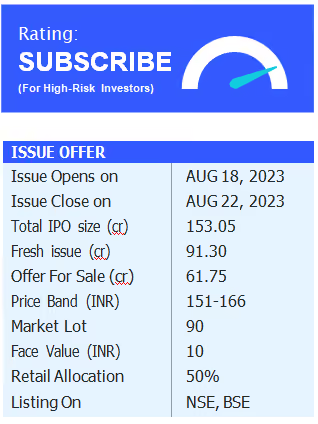
Pyramid Technoplast Limited is an industrial packaging company engaged in the business of manufacturing polymer based molded products (Polymer Drums) mainly used by chemical, agrochemical, speciality chemical and pharmaceutical companies for their packaging requirements. They are one of the leading manufacturers of rigid Intermediate Bulk Containers (IBC) in India manufacturing 1,000 litre capacity IBC. They also manufacture MS Drums made of mild steel (MS) used in the packaging and transport of chemicals, agrochemicals and speciality chemicals.
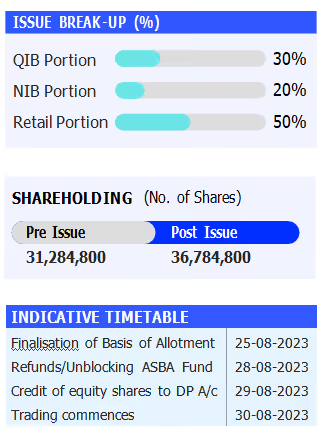
OBJECTS OF THE ISSUE
- Prepayment or repayment of certain outstanding borrowings.
- Funding working capital requirements of the company.
- General corporate purposes.
KEY MANAGERIAL PERSONNEL
1. Bijaykumar Agarwal
Managing Director & Chairman of the Company. He has been associated with the Company since 2002. He has over three decades of experience in packaging industry. He looks after various functions in the Company such as finance, raw material procurement, customer servicing, and business development.
2. Jaiprakash Agarwal
Whole-time Director & Chief Financial Officer of the Company. He has been associated with the Company since June 2003. He has over 19 years of experience in the packaging industry. He looks after various functions in the Company such as manufacturing, finance, accounts, sales & marketing and business development.
3. Madhu Agarwal
Whole-time Director of the Company. She holds a bachelor’s degree of commerce from the Calcutta University. She has been associated with the Company since May 2006. She has over sixteen (16) years of experience in human resource compliance and administration.
4. Chandrakant Joge
e Company Secretary and Compliance Officer of the Company. He looks after the overall corporate governance and secretarial matters of the Company. He has an experience of more than seven years.
COMPANY PROFILE
- The Company use blow molding technology to manufacture Polymer Drums and IBCs. Injection molding technology is used for manufacturing caps, closures, bungs, lids, handles, lugs, etc. for in-house use. Their products are marketed and sold under the brand name “Pyramid”.
- The company started commercial production in the year 1998 in Unit I. Presently, they have six strategically situated manufacturing units out of which four (4) are in Bharuch, GIDC, Gujarat and two (2) are situated at Silvassa, UT of Dadra and Nagar Haveli. The seventh (7) manufacturing unit is under construction at the Bharuch, GIDC, Gujarat adjacent to the existing six units.
- The total installed capacity of their Polymer Drum manufacturing units is 20,612 MTPA. The total installed capacity of their IBC manufacturing unit is 12,820 MTPA and the total installed capacity of MS Drums unit is 6,200 MTPA.
COMPETITIVE STRENGTHS
- Diverse customer base. Comprehensive product portfolio.
- Strategic location of their manufacturing units.
- Quality Standard Certifications & Quality Tests.
- Experienced Promoters and senior management team.
KEY STRATEGIES
- Continued focus on Intermediate Bulk Containers (IBC) by expanding their existing facilities.
- Continued focus on Polymer Drums and Mild Steel (MS) drums.
- Explore organic growth opportunities to increase capacity and business.
- Exploit industry opportunities arising out of the current geo-political situation and government policies.
KEY CONCERNS
- Unsecured loans of ₹ 205.39 lakhs taken by the Company from lenders can be recalled at any time. Polymer including polypropylene and polyethylene is the primary raw material consumed by the Company. Polymer is a derivative of crude oil and any substantial increase in price of crude oil or decrease in the supply of polymer could materially adversely affect the Company’s business.
- Their Business has substantial working capital requirements. They require significant amount of working capital for purchasing key raw materials which they procured from domestic and international suppliers.
- The company has experienced negative net cash flow from operating activities in the past . The company face competition from various domestic manufacturers and traders.
- Any ban on polymer based packaging by the Government of India may affect the business.
COMPARISON WITH LISTED INDUSTRY PEERS (AS ON 31ST MARCH 2023)

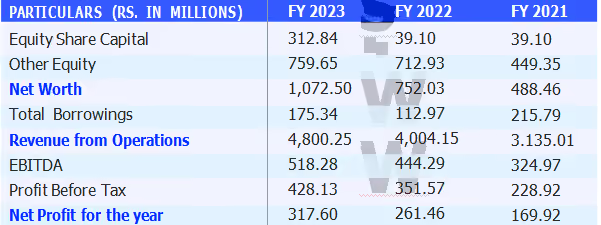
FINANCIALS (RESTATED CONSOLIDATED)
OUTLOOK & VALUATION
Pyramid Technoplast is a well-established player in the plastic packaging industry with a proven track record of financial performance. The company has a strong brand presence and a wide customer base, and it is also expanding its operations. It has strategic locations for its manufacturing units. However, the company faces some risks, such as competition from new entrants, fluctuations in the price of raw materials, and changes in government policies. Additionally, the company has experienced negative cash flow in the past. Nevertheless, the IPO is fairly priced at a P/E of around 16.24x. Thus, after considering all these factors, high-risk investors may apply for this IPO.
DISCLAIMER:
The information contained herein are strictly confidential and are meant solely for the information of the recipient and shall not be altered in any way, transmitted to, copied or distributed, in part or in whole, to any other person or to the media or reproduced in any form, without prior written permission of Swastika Investmart Ltd. (“SIL”). The contents of this document are for information purpose only. This document is not an investment advice and must not alone be taken as the basis for an investment decision. Before taking any decision to invest, the recipient of this document must read carefully the Red Herring Prospectus (“RHP”) issued to know the details of IPO and various risks and uncertainties associated with the investment in the IPO of the Company. All recipients of this document must before acting on the given information/details, make their own investigation and apply independent judgment based on their specific investment objectives and financial position. They can also seek appropriate professional advice from their own legal and tax consultants, advisors, etc. to understand the risks and investment considerations arising from such investment. The investor should possess appropriate resources to analyze such investment and the suitability of such investment to such investor’s particular circumstances before making any decisions on the investment. The Investor shall be solely responsible for any action taken based on this document. SIL shall not be liable for any direct or indirect losses arising from the use of the information contained in this document and accept no responsibility for statements made otherwise issued or any other source of information received by the investor and the investor would be doing so at his/her/its own risk. The information contained in this document should not be construed as forecast or promise or guarantee or assurance of any kind. The investors are not being offered any assurance or guaranteed or fixed returns on their investments. The users of this document must bear in mind that past performances if any, are not indicative of future results. The actual returns on investment may be materially different than the past. Investments in Securities market products and instruments including in the IPO of the Company are highly risky and they are generally not an appropriate avenue for someone with limited resources/ limited investment and low risk tolerance. Such Investments are subject to market risks including, without limitation, price, volatility and liquidity and capital risks. Therefore, the users of this document must carefully consider all the information given in the RHP including the risks factors before making any investment in the Equity Shares of the Company.Swastika Investmart Ltd or its analysts did not receive any compensation or other benefits from the companies mentioned in the report or third party in connection with preparation of the research report. Accordingly, neither Swastika Investmart Ltd nor Research Analysts have any material conflict of interest at the time of publication of this report. Compensation of our Research Analysts is not based on any specific merchant banking, investment banking or brokerage service transactions. Swastika Investment Ltd may have issued other reports that are inconsistent with and reach different conclusion from the information presented in this report. Research entity has not been engaged in market making activity for the subject company. Research analyst has not served as an officer, director or employee of the subject company. We have not received any compensation/benefits from the Subject Company or third party in connection with the Research Report.CORPORATE & ADMINISTRATIVE OFFICE - 48, Jaora Compound, M.Y.H. Road, Indore - 452 001 | Phone 0731 - 6644000Compliance Officer: Ms. Sheetal Duraphe Email: compliance@swastika.co.inPhone: (0731) 6644 241Swastika Investmart Limited, SEBI Reg. No. : NSE/BSE/MSEI: INZ000192732 Merchant Banking: INM000012102 Investment Adviser: INA000009843 MCX/NCDEX: INZ000072532 CDSL/NSDL: IN-DP-115-2015 RBI Reg. No.: B-03-00174 IRDA Reg. No.: 713.

SBFC Finance Limited IPO - Review,valuation, price and Grey Market Premium (GMP)
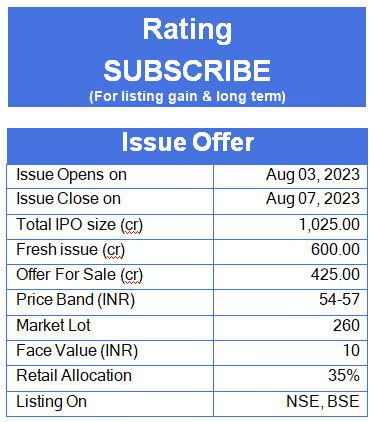
SBFC Finance Limited is a non-deposit taking non-banking finance company (“NBFC-ND-SI”) offering Secured MSME Loans and Loans against Gold, with a majority of its borrowers being entrepreneurs, small business owners, self-employed individuals, salaried and working-class individuals.
- Among MSME-focused NBFCs in India, SBFC has one of the highest assets under management (“AUM”) growth, at a CAGR of 44% in the period from Fiscal 2019 to Fiscal 2023.
- The company has a diversified pan-India presence, with an extensive network in its target customer segment. As of March 31, 2023, it has an expansive footprint in 120 cities, spanning 16 Indian states and two union territories, with 152 branches.
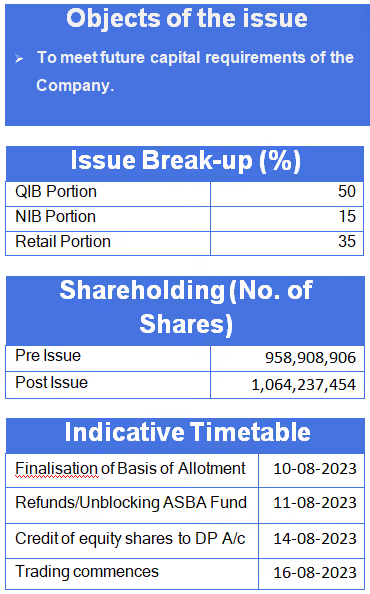
- The Company’s complete portfolio of loans has in-house origination and benefits from its risk management framework. Leveraging its significant operational experience, it has set up stringent credit quality checks and customised operating procedures that exist at each stage for comprehensive risk management.
- The company primarily focus on small enterprise borrowers, whose monthly income is up to ₹ 0.15 million, with a demonstrable track record of servicing loans such as gold loans, loans for two-wheeler vehicles and have a CIBIL score above 700 at the time of origination.
- SBFC source customers directly through its sales team of 1,911 employees as of March 31, 2023, and has adopted a direct sourcing model through branch-led local marketing efforts, repeat customers or through walk-ins, which has helped it to maintain contact with customers and establish strong relationships with them.
- The company has also created an onground collections infrastructure that is extensive, to ensure that it maintain a high asset quality.
KEY MANAGERIAL PERSONNEL
- Neeraj Swaroop is an Independent Director and Chairperson of the Board. He has been associated with the Company since November 21, 2017. Prior to joining this Company, he was associated with Pond’s (India) Limited, Bank of America, HDFC Bank Limited, Standard Chartered Bank and Singapore Exchange Limited
- Aseem Dhru is the Managing Director and Chief Executive Officer of the Company. He has over 25 years of experience in the banking industry and has been associated with the Company since September 28, 2017.
- Narayan Barasia, is the Chief Financial Officer of the Company. In his current role, he is responsible for financial management, accounts, tax, treasury, secretarial and legal matters. He has more than two decades of experience.
- Jay Mistry, is the Company Secretary and Compliance Officer of the Company. In his current role, he is responsible for secretarial and regulatory compliance of the Company. He has more than five years of experience in securities and corporate laws, and corporate compliances.
- Mahesh Dayani, is chief business officer of the company. He has over 22 years of experience across wholesale and retail banking.
- Saiprashant Menon is the chief collection officer of the company.He has more than 21 years of experience in collections.
COMPETITIVE STRENGTHS
- Diversified pan-India presence with an extensive network to cater the target customer segment.
- 100% in-house sourcing, leading to favourable business outcomes.
- Comprehensive credit assessment, underwriting and risk management framework.
- Extensive on-ground collections infrastructure leading to maintenance of asset quality.
- Healthy liability franchise with low cost of funds.
- Consistent financial performance backed by profitable growth
- Experienced, cycle-tested and professional management team
KEY STRATEGIES
- Leverage pan-India network to deepen its penetration in the target customer segment.
- Expand its product portfolio through offering affordable housing finance.
- Diversify its source of borrowings and improve operating leverage.
KEY CONCERNS
- It require substantial capital for its business and any disruption in its sources of capital could have an adverse effect on the business.
- Their business is particularly vulnerable to interest rate risk, and volatility in interest rates for both lending and treasury operations, could have an adverse effect on it.
- Inability to compete effectively in an increasingly competitive industry may adversely affect its net interest margins, income and market share.
- Any downgrade in its credit ratings could increase borrowing costs.
- Risk arising from collateral for its portfolio.
COMPARISON WITH LISTED INDUSTRY PEERS (AS ON 31ST MARCH 2023)
FINANCIALS (RESTATED CONSOLIDATED)


OUTLOOK & VALUATION:
SBFC is a well-established company with consistent financial performance and a stable asset quality; it is showing growing AUM and a decline in its NPAs. It has a diversified presence across India, and its access to diversified funding sources is a key contributor to its growth. However, there are a few risks as well. SBFC is dependent on a few key customers. Secondly, The company is also exposed to fluctuations in the price of securities it takes as collateral for loans. Additionally, an increase in interest rates could pose a challenge for the company. Nevertheless, the Issue looks fairly priced, and after considering all these factors, we believe that investors may consider to apply for this IPO.
Disclaimer: The content provided above is for informational and educational purposes only. It does not constitute or imply a recommendation to engage in any securities transactions or investment strategies. We do not provide personalized advice or determine suitability for individuals' financial needs. Please conduct your own analysis and consider your personal circumstances before making any investment decisions.

फेड के हॉकिश आउटलुक से टुटा सोना।
कीमती धातुओं में इस सप्ताह भी ब्याज दरों में बढ़ोतरी की सम्भावना के बीच, कीमतों में बिकवाली का दबाव देखा गया। दुनिया की सबसे बड़ी अर्थव्यवस्था में मजबूती और मुद्रास्फीति में बढ़ोतरी निवेशकों को वैश्विक ब्याज दरों के दायरे पर पुनःविचार करने के लिए बाध्य कर रहा है। ग्लोबल बॉन्ड मार्केट में बिकवाली के कारण अमेरिकी बेंचमार्क ट्रेज़री यील्ड 2007 के स्तरों के करीब जबकि यूके में बांड यील्ड 2008 के उच्च स्तरों के करीब पहुंच गई है। दरसल, पिछले सप्ताह फेड के मीटिंग मिनट्स जारी हुए जिसमे स्पष्ट हुआ है की फेड के ज़्यादातर सदस्य आगे भी ब्याज दर बढ़ोतरी के पक्ष में है, जिससे बांड यील्ड में बढ़ोतरी देखने को मिल रही और इसके सपोर्ट से अमेरिकी डॉलर इंडेक्स मजबूत हुआ है। मजबूत बांड यील्ड से डॉलर 83.1 रुपये हो गया है जिससे घरेलु बाज़ार में सोने में कॉमेक्स वायदा की तुलना में कम गिरावट रही।अमेरिकी डॉलर के मुकाबले रुपये के मूल्य में गिरावट के प्रमुख कारणों में से एक 10-वर्षीय भारत सरकार बांड और अमेरिकी सरकार बांड के बीच कम होती स्प्रेड है। भारत और अमेरिका में बॉन्ड यील्ड स्प्रेड 2007 के बाद न्यूनतम स्तरों पर है। एमसीएक्स सोने में लगातार तीसरे सप्ताह भी गिरावट रही है और अक्टूबर वायदा सोने में पिछले सप्ताह 0.90 प्रतिशत की गिरावट दर्ज की गई है और भाव 58375 रुपये प्रति दस ग्राम के स्तरों पर पहुंच गए है। हालांकि एमसीएक्स में सितम्बर वायदा चांदी में पिछले सप्ताह मामूली बढ़ोतरी दर्ज की गई है।
तकनिकी विश्लेषण : इस सप्ताह कीमती धातुओं के भाव दबाव में रहने की सम्भावना है। एमसीएक्स अक्टूबर वायदा सोने में सपोर्ट 57000 रुपये पर है और रेजिस्टेंस 59000 रुपये पर है। सितम्बर वायदा चांदी में सपोर्ट 68000 रुपये पर है और रेजिस्टेंस 71500 रुपये पर है।
Understanding Bond Futures
Introduction
Bond futures—a financial instrument that’s widely used by investors, traders, and institutions to hedge against interest rate risks or speculate on the future movements of bond prices. If you’re new to bond futures, don’t worry! We’ll break down the concept in simple terms and help you understand how they work, why they’re used, and their potential benefits.
What are Bond Futures?
Bond futures are standardized contracts that allow investors to buy or sell a bond at a predetermined price on a future date. These contracts are traded on exchanges, and they derive their value from an underlying bond, often a government bond like the Indian Government Securities (G-Secs).
For example, if you buy a bond future contract, you’re agreeing to purchase a specific bond at a set price on a set date in the future. This allows you to lock in the bond’s price today, regardless of future market fluctuations.
Why Do Investors Use Bond Futures?
- Hedging Interest Rate Risk: One of the primary uses of bond futures is to hedge against interest rate fluctuations. Since bond prices are inversely related to interest rates, investors use bond futures to protect themselves from potential losses due to rising interest rates.
- Speculation: Traders also use bond futures to speculate on the direction of interest rates. For instance, if a trader believes that interest rates will rise, they might sell bond futures, anticipating that bond prices will fall.
- Leverage: Bond futures allow investors to gain exposure to bonds without having to pay the full price upfront. This leverage can amplify both potential gains and losses.
How Do Bond Futures Work?
Here’s a simple example to illustrate how bond futures work:
- Assume you are an investor who believes that interest rates will drop in the next three months. You buy a bond future contract at a price of ₹1,000.
- If interest rates do drop, the price of the bond in the market increases, say to ₹1,050. You can now sell your bond future contract at this higher price, making a profit of ₹50 per contract.
- However, if interest rates rise instead, and the bond price drops to ₹950, you would incur a loss if you decide to sell the contract.
Benefits of Bond Futures
- Risk Management: Bond futures are an excellent tool for managing interest rate risk. By locking in prices, investors can protect their portfolios from unfavorable market movements.
- Liquidity: Bond futures are traded on exchanges, making them highly liquid. This allows investors to enter and exit positions with ease.
- Transparency: Since bond futures are traded on regulated exchanges, they offer a transparent pricing mechanism, ensuring fair value transactions.
Examples of Bond Futures in the Indian Market
- NSE Bond Futures: The National Stock Exchange (NSE) in India offers bond futures contracts based on government securities. These contracts allow investors to hedge their positions or take speculative bets on the movement of government bond yields.
- 10-Year G-Sec Futures: A popular bond future in India is based on the 10-year government bond. Investors use this contract to hedge against long-term interest rate movements.
Risks and Considerations
- Leverage Risk: While leverage can magnify gains, it can also magnify losses. Investors must be cautious when using leverage in bond futures trading.
- Market Risk: The value of bond futures is affected by changes in interest rates and bond prices. Unexpected market movements can lead to significant losses.
- Complexity: Bond futures can be complex instruments, requiring a solid understanding of interest rates, bond pricing, and market dynamics.
Conclusion
Bond futures are powerful tools for managing interest rate risks and speculating on bond price movements. They offer benefits such as risk management, liquidity, and transparency but also come with risks like leverage and market volatility.

What is Last Traded Price (LTP)? Meaning, Importance, Calculation & How Traders Use It
What is Last Traded Price?
Last Traded Price (LTP) is the price at which the most recent transaction of a stock, ETF, commodity, or any other listed security takes place on a stock exchange. Simply put, it represents the latest price agreed upon by a buyer and a seller.
For example, if Reliance Industries' latest executed trade occurs at ₹1,495, then ₹1,495 becomes the Last Traded Price (LTP) until another trade occurs at a different price. The LTP keeps changing throughout market hours because thousands of buy and sell orders are matched every second on exchanges like the NSE and BSE.
Quick Answer: Last Traded Price (LTP) is the price at which the latest trade of a stock or security is executed on the exchange. It reflects the most recent market transaction and updates every time a new trade occurs.
What Does LTP Stand For?
LTP stands for Last Traded Price. It is one of the most frequently used indicators across trading platforms because it provides investors with an instant snapshot of where a stock is trading. Whether you're investing for the long term or actively trading during the day, the Last Traded Price is usually the first number you'll notice while tracking any stock.
Why is Last Traded Price Important?
The Last Traded Price serves as the latest indicator of market sentiment. Although it doesn't necessarily represent the exact price you'll receive when placing an order, it tells you the most recent value at which buyers and sellers agreed to trade.
Suppose HDFC Bank's LTP is ₹2,080.
This means the most recent transaction happened at ₹2,080. It indicates that at least one buyer and one seller agreed on this price based on current market conditions.
Investors use the Last Traded Price to:
- Understand current market sentiment.
- Track intraday price movements.
- Compare current prices with previous closing prices.
- Monitor portfolio performance.
- Plan entry and exit points.
- Evaluate price momentum before placing an order.
While LTP is useful, experienced investors never rely on it alone. They also consider trading volume, bid-ask spread, technical indicators, and overall market conditions.
How Does Last Traded Price Work?
Every stock exchange maintains an electronic order book where buyers place bids, and sellers place offers. Whenever a buyer agrees to purchase shares at the seller's asking price, or a seller accepts a buyer's bid, the trade gets executed. The execution price immediately becomes the new Last Traded Price.
As more trades occur, the LTP continues updating throughout the trading session. Since thousands of transactions happen every second in actively traded stocks, the Last Traded Price changes continuously during market hours.
How One Trade Changes the LTP
Many beginner investors believe that a stock's price changes only after a large number of shares are traded. In reality, even a single executed trade can change the Last Traded Price.
Consider the following example:
Notice how each successful transaction immediately updates the Last Traded Price. This is why prices fluctuate every second during active trading sessions.
How is Last Traded Price Calculated?
Unlike financial ratios or averages, the Last Traded Price is not calculated using a mathematical formula. It is simply the price at which the latest trade is executed. Whenever:
- A buyer's bid matches a seller's asking price, and
- The exchange confirms the transaction,
the execution price automatically becomes the new LTP.
This makes the Last Traded Price one of the simplest yet most important real-time indicators in the stock market.
How Traders or Investors Use Last Traded Price
The Last Traded Price plays an important role in everyday investing and trading decisions. Some of these areas are:
Intraday Trading
Intraday traders continuously monitor the LTP to identify short-term price movements and momentum.
Swing Trading
Swing traders compare the Last Traded Price with support and resistance levels before entering a position.
Long-Term Investing
Long-term investors use the LTP to determine suitable buying opportunities, especially during market corrections.
Portfolio Monitoring
Existing investors monitor the LTP to understand how their holdings are performing throughout the day.
Example of Last Traded Price
Suppose ICICI Bank opens the day at ₹1,400. During the trading session:
- First trade: ₹1,401
- Second trade: ₹1,405
- Third trade: ₹1,398
- Fourth trade: ₹1,410
The Last Traded Price after the fourth transaction becomes ₹1,410 because that was the most recent successfully executed trade. It doesn't necessarily mean every buyer or seller is willing to trade at ₹1,410 now, it simply reflects the latest completed transaction.
Where Can You See the Last Traded Price?
Almost every stock market platform displays the Last Traded Price prominently. You can find it on:
- Trading apps
- Stock broker platforms
- NSE and BSE websites
- Demat account dashboards
- Trading terminals
- Market watchlists
- Stock screeners
Alongside the Last Traded Price, you will generally see:
- Previous Close
- Open Price
- Day High
- Day Low
- Trading Volume
- Bid Price
- Ask Price
- Percentage Change
Looking at these metrics together provides a much better understanding of the market than relying on the LTP alone.
Last Traded Price vs Bid Price vs Ask Price
Many new investors confuse the Last Traded Price (LTP) with the Bid Price and Ask Price. Although all three appear together on a trading screen, they represent different aspects of the market.
Example
Suppose you are tracking Infosys.
- Bid Price: ₹1,592
- Ask Price: ₹1,594
- Last Traded Price: ₹1,593
Here, the latest trade happened at ₹1,593, buyers are currently willing to pay up to ₹1,592, while sellers want at least ₹1,594 for their shares. Understanding this difference helps investors place better limit orders instead of buying or selling at unfavourable prices.
Last Traded Price vs Market Price vs Closing Price vs VWAP
Another common point of confusion is the difference between the Last Traded Price, Market Price, Closing Price, and VWAP (Volume Weighted Average Price).
Last Traded Price (LTP)
Reflects the latest completed transaction and changes after every executed trade.
Market Price
This is the approximate price at which your market order is likely to be executed. It may differ slightly from the displayed LTP because prices keep changing every second.
Closing Price
The closing price is the official price determined by the stock exchange at the end of the trading session. Investors often compare the current LTP with the previous day's closing price to understand whether a stock is trading higher or lower.
VWAP
VWAP considers both price and trading volume throughout the day. Unlike the Last Traded Price, which reflects only one transaction, VWAP provides a broader view of the stock's average trading price.
Professional intraday traders often monitor both LTP and VWAP together before making trading decisions.
Factors Affecting Last Traded Price
The Last Traded Price constantly changes because markets continuously react to new information and trading activity. Some of the biggest factors influencing the LTP include:
Demand and Supply
Like any market, stock prices are primarily driven by demand and supply. If buyers significantly outnumber sellers, the Last Traded Price generally moves upward. Similarly, heavy selling pressure can pull the LTP lower.
Order Flow
Large institutional orders, mutual fund buying, FII activity, or sudden retail participation can quickly influence the Last Traded Price. Stocks with heavy order flow usually experience frequent LTP updates throughout the trading session.
Company News
Corporate announcements can significantly impact the Last Traded Price. Examples include:
- Quarterly earnings
- Dividend announcements
- Stock splits
- Bonus issues
- Mergers and acquisitions
- Management changes
Positive news often increases buying interest, while negative developments may trigger selling pressure.
Economic Events
Macroeconomic developments also influence stock prices. Some major events include:
- RBI monetary policy decisions
- Inflation data
- GDP growth figures
- Union Budget announcements
- Global interest rate changes
- Crude oil price movements
These events affect overall market sentiment, causing the Last Traded Price of many stocks to change rapidly.
Liquidity
Highly liquid stocks usually witness smoother price discovery because thousands of shares are traded every minute. On the other hand, stocks with lower liquidity may experience sharp jumps in the Last Traded Price, even with relatively small trades.
How Trading Volume Complements the Last Traded Price
Looking only at the Last Traded Price may not provide the complete picture. Trading volume helps investors understand whether the current price movement is supported by genuine market participation. For example:
Scenario 1
A stock moves from ₹500 to ₹525 with exceptionally high trading volume. This indicates strong buying interest, making the price move more reliable.
Scenario 2
Another stock rises from ₹500 to ₹525 with very low trading volume. Since only a few trades caused the increase, the movement may not be sustainable.
So, combining Last Traded Price with trading volume allows investors to identify stronger trading opportunities and avoid false price movements.
Why Last Traded Price Matters to Traders and Investors
Although the Last Traded Price is just one market indicator, it plays an important role in almost every investment decision. For intraday traders, it helps identify momentum and execute trades quickly.
For swing traders, it acts as a reference while planning entries near support or resistance levels.
For long-term investors, it provides the latest valuation before accumulating or exiting positions.
Institutional investors, analysts, and fund managers also monitor the Last Traded Price to evaluate market activity, liquidity, and investor sentiment. However, experienced market participants rarely rely on the LTP alone. They combine it with technical indicators, company fundamentals, market news, and trading volume for a more comprehensive analysis.
Common Misconceptions About Last Traded Price
Many beginners misunderstand what the Last Traded Price actually represents.
LTP is Not Guaranteed Execution Price
The price displayed as the LTP may change before your order reaches the exchange. If market conditions change quickly, your trade may execute at a different price.
A Rising LTP Doesn't Always Mean the Stock is Bullish
Sometimes a stock's Last Traded Price rises briefly because of temporary buying interest. Without strong trading volume or sustained demand, the trend may reverse quickly.
A Falling LTP Doesn't Always Signal Weakness
Short-term profit booking or overall market volatility can temporarily reduce the Last Traded Price even when a company's long-term fundamentals remain strong.
LTP Alone shouldn't Drive Investment Decisions
Successful investors combine the Last Traded Price with:
- Company fundamentals
- Technical analysis
- Market sentiment
- Trading volume
- Economic developments
- Sector performance
This holistic approach leads to more informed investment decisions.
Things to Remember Before Using Last Traded Price for Buying or Selling
The Last Traded Price (LTP) is an important market indicator, but it should never be the only factor guiding your investment decisions. A stock's price can change multiple times within a single minute, especially in volatile market conditions. Here are a few practical points every investor should keep in mind before acting solely on the Last Traded Price.
Don't Judge a Stock Only by Its LTP
A stock trading at ₹2,000 is not necessarily expensive, and one trading at ₹50 is not automatically cheap. The Last Traded Price only tells you the price of the latest executed trade—it does not indicate whether the stock is overvalued or undervalued.
Before investing, also evaluate:
- Company fundamentals
- Earnings growth
- Valuation ratios
- Industry outlook
- Overall market trend
Check Trading Volume Along With LTP
A price movement backed by strong trading volume is generally more reliable than one occurring on low volumes.
For example, if a stock's Last Traded Price rises 5% while millions of shares are traded, it indicates stronger market participation than a similar rise supported by only a few thousand shares.
Watch the Bid-Ask Spread
Sometimes the Last Traded Price may appear attractive, but the difference between the Bid Price and Ask Price is unusually wide. A wider spread usually indicates lower liquidity, meaning you may not get your desired execution price immediately.
Avoid Emotional Decisions
Many beginners buy a stock simply because its Last Traded Price is rising rapidly. Similarly, panic selling during temporary declines often leads to unnecessary losses. Instead of reacting emotionally, always analyse:
- Why the price is moving
- Whether the movement is supported by volume
- Current news or announcements
- Overall market sentiment
Understand That LTP Changes Every Second
During active trading hours, the Last Traded Price updates continuously. By the time you place a market order, another trade may already have occurred, resulting in a different execution price.
For this reason, many experienced traders prefer Limit Orders, especially when trading volatile stocks.
Combine LTP with Technical Analysis
The Last Traded Price becomes much more meaningful when used alongside technical indicators such as:
- Support and resistance levels
- Moving averages
- RSI (Relative Strength Index)
- MACD
- VWAP
- Trendlines
This combination provides a clearer picture of the market instead of relying on a single data point.
Expert Suggestions on How to View Last Traded Price
Professional traders rarely treat the Last Traded Price as a standalone indicator. Instead, they use it as one part of a broader decision-making process. Here are a few best practices followed by experienced market participants:
View LTP as a Real-Time Market Snapshot
Think of the Last Traded Price as a live snapshot rather than the stock's "true value." It simply reflects the most recent agreement between a buyer and seller at a particular moment.
Look Beyond Price Movement
Instead of asking, "The LTP has increased. Should I buy?", ask,
- Is the trend supported by volume?
- Has the stock crossed an important resistance level?
- Is there any significant company announcement?
- What is the overall market direction?
These questions lead to much better investment decisions.
Use Multiple Time Frames
Intraday traders often monitor the Last Traded Price on shorter timeframes like 1-minute or 5-minute charts. Swing traders may focus on 30-minute, hourly, or daily charts. Long-term investors generally use the LTP only as an entry or exit reference while relying more on business fundamentals.
Track LTP Alongside Market Depth
Most modern trading platforms display Market Depth (Level 2 data), which shows pending buy and sell orders. Viewing LTP together with market depth provides better insight into:
- Buying pressure
- Selling pressure
- Liquidity
- Possible price direction
Don't Ignore Overall Market Sentiment
Sometimes a stock's Last Traded Price falls simply because the entire market is under pressure and not because the company itself is weak.
Similarly, during strong bull markets, many stocks rise together even without major company-specific developments. Understanding the broader market context helps interpret LTP more accurately.
Frequently Asked Questions (FAQs)
What is the Last Traded Price (LTP) in the stock market?
The Last Traded Price (LTP) is the price at which the most recent trade of a stock or other security was executed on a stock exchange. It reflects the latest market transaction and changes whenever a new trade takes place.
Is the Last Traded Price the same as the market price?
No. The Last Traded Price represents the most recent executed trade, while the market price refers to the price at which your order is likely to execute immediately based on available buy and sell orders. During volatile markets, these prices can differ slightly.
How is the Last Traded Price calculated?
The Last Traded Price is not calculated using a formula. It is simply the price of the latest successfully matched trade between a buyer and a seller on the exchange. Every completed transaction updates the LTP automatically.
Why does the Last Traded Price keep changing?
The Last Traded Price changes whenever a new trade is executed. Since investors continuously place buy and sell orders throughout the trading session, the LTP may update several times every second for actively traded stocks.
Can I buy a stock exactly at the Last Traded Price?
Not always. By the time your order reaches the exchange, the price may have changed because another trade has already occurred. Using a limit order instead of a market order gives you better control over the execution price.
Is the Last Traded Price enough to make investment decisions?
No. While the Last Traded Price provides valuable real-time information, investors should also consider trading volume, company fundamentals, technical analysis, market news, liquidity, and overall market sentiment before buying or selling any stock.
Where can I see the Last Traded Price?
You can view the Last Traded Price on:
- NSE and BSE trading platforms
- Online brokerage apps
- Market data terminals
- Financial news websites
- Swastika Investmart's trading platform
The LTP is displayed in real time during market hours.
Conclusion
The Last Traded Price (LTP) is one of the most frequently watched numbers in the stock market because it reflects the latest transaction between buyers and sellers. However, understanding what the LTP represents and what it doesn't is equally important.
Whether you are a beginner taking your first steps into the share market or an experienced trader tracking intraday movements, learning how to interpret the Last Traded Price correctly can significantly improve your decision-making process.
At Swastika Investmart, we believe informed investors make better investors. Our advanced trading platform, real-time market data, research reports, educational resources, and expert market insights help you understand market movements beyond just the Last Traded Price.
Open your Demat and Trading Account with Swastika Investmart today and gain access to powerful trading tools, expert research, and a seamless investing experience designed for every type of investor.

Anchor Investors: Key Pillars in an IPO's Success
An Initial Public Offer (IPO) marks a pivotal moment for a privately held company as it ventures into the public market, offering its shares to the general public for the first time. This transition requires meticulous planning and preparation. A critical element that contributes to the triumph of an IPO is the involvement of Anchor Investors. This blog will delve into the significant role these institutional investors play in the IPO process.
What are Anchor Investors?
Anchor Investors refer to prominent institutional investors such as investment banks, mutual funds, pension funds, insurance companies, and other significant players. They play a vital role by making substantial investments in an IPO, aiming to provide stability to the stock price and inspire confidence among potential investors.
Role of Anchor Investors in an IPO:
Providing Stability to Stock Price:
- Anchor Investors' substantial investment in the IPO stabilizes the stock price during its initial listing phase.
- This stability instills confidence in other investors and encourages them to participate in the IPO.
Offering Validation:
- The presence of Anchor Investors sends a strong signal that the company is financially sound and possesses promising prospects.
- Their investment serves as an endorsement of the company's future potential, attracting more investors to participate in the IPO.
Building Credibility:
- Anchor Investors' extensive experience and expertise in investing lend credibility to the company.
- Their participation boosts investors' confidence, positioning the company as an attractive investment opportunity.
Improving Allocation:
- Anchor Investors typically receive a preferential allocation of shares in the IPO.
- This strategic allocation enhances the overall distribution of shares, mitigates the risk of oversubscription, and fosters market stability.
Providing Liquidity:
- The investment from Anchor Investors ensures sufficient demand for the stock, preventing excessive falls in the stock price.
- This liquidity attracts more investors to participate in the IPO, allowing the company to raise the necessary capital.
Offering Support:
- Beyond the IPO, Anchor Investors continue to hold their shares even during challenging times.
- Their unwavering support sustains confidence among other investors and contributes to the company's ongoing financial stability.
In conclusion, Anchor Investors play an indispensable role in the triumph of an IPO. Their significant investment imparts stability to the stock price, enhances the company's credibility, and entices more investors to partake in the IPO. Furthermore, their ongoing support contributes to the company's continued financial stability. For companies planning an IPO, understanding and seeking the support of Anchor Investors is pivotal to navigating this transformative process successfully.
Big Budget


Popular Articles





.avif)
.avif)

.avif)



START YOUR INVESTMENT JOURNEY
Get personalized advice from our experts
- Dedicated RM Support
- Smooth and Fast Trading App
