


Income Tax Return Verification: Your Guide To AY 2026-27 Deadlines, Belated Returns And Revisions


Key Takeaways
- Missing the original Income Tax Return deadline doesn't end your filing options; belated or revised returns are available.
- AY 2026-27 deadlines vary by taxpayer category, with July 31, 2026 for non-audit cases and later dates for others.
- Belated filings incur late fees and interest; revised returns have a defined 12-month window.
- Carry-forward losses may be affected by late filing; consider using Swastika's Sarthi AI stock assistant for market insights during tax season.
Income Tax Return Verification: A Retail Investor’s Guide To AY 2026-27 Deadlines, Belated Returns, And Revisions
Missing the original ITR deadline isn’t the end of the road for a retail investor. You can still file, either belatedly or as a revised return, depending on your category and the rules that apply to AY 2026-27. The term Income Tax Return Verification is central to ensuring your ITR is accepted and any corrections are captured on time. This guide walks you through the deadlines, the consequences of late filing, and the options that keep your tax records clean while you focus on your investments and wealth-building strategy.
Across taxpayers, the deadlines are not uniform. Original due dates outlined for AY 2026-27 differ by whether an audit is required. If you missed your date, you have until the applicable belated or revised return windows to get things right, with some penalties for late filing. In addition to penalties, there are practical considerations such as the carry-forward of losses and how revised returns interact with the assessment process. Read on to understand how to navigate the timeline and minimize disruptions to your trading and investing activities.
AY 2026-27 Filing Deadlines By Category
Here is the classification of original deadlines by taxpayer category for AY 2026-27, along with the belated and revised return deadlines:
| Taxpayer Category | Original Due Date | Belated Return Deadline | Revised Return Deadline |
|---|---|---|---|
| Salaried Individuals, Pensioners And Other Taxpayers Not Requiring Audit | July 31, 2026 | December 31, 2026 | March 31, 2027 |
| Non-Audit Business Owners And Professionals | August 31, 2026 | December 31, 2026 | March 31, 2027 |
| Taxpayers Whose Accounts Are Subject To Tax Audit | October 31, 2026 | December 31, 2026 | March 31, 2027 |
| Taxpayers Covered Under Transfer-Pricing Provisions | November 30, 2026 | December 31, 2026 | March 31, 2027 |
Note: The last date for filing a belated return is December 31, 2026, and the last date for filing a revised return is March 31, 2027. Belated returns and revised returns are subject to the applicable rules under the Income Tax Act, and additional tax or interest may apply depending on the specifics of the case.


What Is A Belated Return And How The Fees Apply
A belated return is an ITR filed after the original due date. For AY 2026-27, a belated return may attract a late-filing fee of Rs 1,000 if total income does not exceed Rs 5 lakh and Rs 5,000 in other cases. Interest under Section 234A may also apply if there is unpaid tax liability. The belated return is a separate filing window that allows you to report income and deductions that you may have missed in the original return.
What Is A Revised Return And The 12-Month Window For AY 2026-27
A revised return (Section 263(5)) can be filed within 12 months from the end of the relevant tax year, or before the completion of assessment, whichever is earlier. An updated return (ITR-U) can be filed within 48 months from the end of the relevant assessment year, and this option is available even if you did not file an earlier return for that year. Additional tax of 25% or 50% may apply depending on the circumstances. The AY 2026-27 revised return deadline is March 31, 2027.
Late Fees And Interest: The Cost Of Filing After The Deadline
In addition to the late-filing fee, taxpayers with unpaid tax liability may have to pay interest. The Income Tax Department states that filing after the due date can attract a fee of up to Rs 5,000, along with interest where applicable. It’s important to understand these costs in your planning, as they can affect the total tax outgo and cashflow for your investment decisions.
Impact On Loss Carry-Forward When Filing Late
One important consequence of late filing is that certain losses may not be available for carry-forward. This can matter for investors who use losses to offset gains in future years. When you file belatedly or via a revised return, you should be aware of how these rules apply to your specific situation and plan accordingly.
Filing And Verification: Quick Notes On The Process
While the deadlines are fixed, the core process of filing and verification remains consistent for most taxpayers. Ensure your information is accurate, report all eligible income, and review the details before submission. The ITR can be verified electronically through the official channels, aligning with the notion of Income Tax Return Verification, to ensure timely acceptance and avoid errors that could trigger amendments or further filings.
For readers who also want to connect tax timing with market opportunities, Swastika’s research tools can help. Consider using the following resource to get enterprise-grade insights during tax season: Swastika's Sarthi AI stock assistant.
Related Reads
Frequently Asked Questions
What is the AY 2026-27 filing deadline by category?
Salaried Individuals, Pensioners and other taxpayers not requiring audit have July 31, 2026 as the original due date; Non-audit business owners and professionals have August 31, 2026; Taxpayers whose accounts are subject to tax audit have October 31, 2026; Taxpayers covered under transfer-pricing provisions have November 30, 2026.
What are the late filing fees for belated returns?
A belated return may attract a late-filing fee of Rs 1,000 if total income does not exceed Rs 5 lakh and Rs 5,000 in other cases; interest under Section 234A may apply if there is unpaid tax liability.
What is a revised return and its deadline for AY 2026-27?
A revised return under Section 263(5) can be filed within 12 months from the end of the relevant tax year, or before completion of assessment, whichever is earlier. The revised return deadline for AY 2026-27 is March 31, 2027; an updated return (ITR-U) can be filed within 48 months from the end of the relevant assessment year.
How does late filing affect loss carry-forward?
Filing late can result in certain losses not being available for carry-forward to future years.
Where can I get help with income tax return verification and market insights?
Consult a tax advisor; for stock market research and tax-season insights, use Swastika's Sarthi AI stock assistant.
Conclusion
For the retail investor, the key takeaway is that AY 2026-27 presents a structured set of filing timelines that accommodate late filings within defined windows. Understanding whether you fall into the salaried, non-audit, audit, or transfer-pricing category helps you map the right Belated Return or Revised Return path and minimize penalties. The practical steps are simple: identify your category, note the original deadline, and act within the belated or revised windows to avoid unnecessary costs. If you’ve already filed, you can consider a revised return to correct errors or omissions within the 12-month window or the 48-month window for ITR-U, depending on your situation.
Open your trading and demat account here
Reference :
1 : Ndtvprofit
Latest Articles

Rishabh Instruments IPO Review - Date, Price, GMP, Details


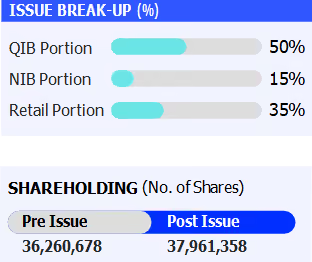
Rishabh Instruments Limited is a global energy efficiency solution company focused on electrical automation, metering and measurement, precision engineered products, et al. with diverse applications across industries including power, automotive and industrial sectors. The company supply a wide range of electrical measurement and process optimization equipment, and is engaged in designing, developing and manufacturing, and sale of devices significantly under their own brand across several sectors.
OBJECTS OF THE ISSUE
- Financing the cost towards the expansion of Nashik Manufacturing Facility I.
- General corporate purposes.

KEY MANAGERIAL PERSONNEL
Narendra Joharimal Goliya
Chairman and Managing Director of the Company. He is the founder and Promoter of the Company. He has been associated with the Company since its incorporation and accordingly has over four decades of experience in the manufacturing and electrical industry.
Dineshkumar Musalekar
Group CEO. He has been associated with Lumel since January 16, 2014. He holds a bachelor’s degree of engineering (electronics and communication) from the Karnatak University Dharwad and a master’s degree in human resources development management from Somaiya Institute of Management Studies and Research, University of Mumbai.
Nitinkumar Sudhir Deshpande
Head – Marketing, Business Development and Profit Centre Head of the Company. He has been associated with the Company since July 8, 2018. He holds a bachelor’s degree of engineering (electrical engineering) from the University of Mumbai. He was previously associated with ABB Limited, Siemens Limited and Schneider Electric India Pvt Limited.
Vishal Prabhakar Kulkarni
Chief Financial Officer of the Company.He has been associated with the Company since July 21, 2014. He holds a master’s degree in commerce from the University of Pune. He is an associate member of the Institute of Company Secretaries of India. He was previously associated with Techno Force (I) Pvt Ltd. and ThyssenKrupp Electrical Steel India Private Limited.
Ajinkya Joglekar
Company Secretary and Compliance Officer of the Company. He has been associated with the Company since August 8, 2022. He holds a bachelor’s degree in commerce from the Rashtrasant Tukadaji Maharaj Nagpur University. He is an associate member of the ICSI. He was previously associated with Galactico Corporate Services Limited.
COMPANY PROFILE
- Rishabh Instruments provides comprehensive solutions to their customers looking for cost-effective ways to measure, control, record, analyse and optimise energy and processes through their array of products.
- They also provide complete aluminium high pressure die casting solutions for customers requiring close tolerance fabrication, machining and finishing of precision components.
- Rishabh Instruments has 4 segments: (a) electrical automation devices; (b) metering, control, and protection devices; (c) portable test and measuring instruments; and (d) solar string inverters.
- The Company manufactures all the products in-house from their five manufacturing facilities – two in India, two in Poland and one in China.
- They primarily follow a business-to-business model which is purchase order based for all their segments except portable test and measuring instruments which is also sold on a merchant basis.
- The Company have an extensive network of 175 authorized distributors/stockists across 81 districts in India with direct sales conducted through eight sales and marketing offices.
COMPETITIVE STRENGTHS
- Ability to drive technology and innovation through advanced research and development. Global engineering solution provider operating in large addressable markets.
- Vertically integrated operations, backed by strong manufacturing capabilities. Diversified product portfolio & wide customer base.
- Track record of successful integration of acquired businesses or entities across geographies Well-established and recognised brand
- Committed Promoters, Board and management team.
KEY STRATEGIES
- Enhance product innovation, engineering and design competence while focussing on higher value addition .
- Expanding geographical footprint.
- Continue to pursue their strategy for inorganic growth.
- Target new customers and expand existing customer accounts . Explore opportunities to tap emerging products and services segments. Promote product localization.
KEY CONCERNS
- Failure to manage component and material purchasing and shortages in the supply of their major production inputs could adversely affect the operation.
- The Company faces risks associated with their international sales and multi-location operations in various geographies. Foreign exchange fluctuations related risk is also there.
- They export their products to various countries, on account of which they may be subject to significant import duties or restrictions.
- Most of Their customers do not commit to long term contracts.
- Dependence on their own Subsidiaries exposes them to significant operational and financial risk. Shortages in the supply of semiconductors have had, and may continue to have, a adverse effect on business.
COMPARISON WITH LISTED INDUSTRY PEERS (AS ON 31ST MARCH 2023)
As mentioned in Company's RHP, there are no comparable listed companies in India or globally that engage in a business similar to that of Rishabh Instruments Limited. Accordingly, it is not possible to provide an industry comparison in relation to this Company
FINANCIALS (RESTATED CONSOLIDATED)
.png)
OUTLOOK & VALUATION
Rishabh Instruments is a multinational company offering energy efficiency solutions. The company has a diverse product portfolio and a vertically integrated operation. The company is operating globally in a large, addressable market. Their brands ‘Rishabh’, ‘Lumel’, Sifam, and ‘Tinsley’ are well recognised in multiple countries. The financial position of the company is currently not very attractive, but it is stable.
However, multi-location operations and global sales raise concerns related to international exposure. Secondly, any kind of shortage in their production inputs, like semiconductors, could also impact their business. The IPO is coming at a P/E valuation of 34.34x. Though the company does not have any listed peers to compare, its valuation is looking high in general. We will recommend this IPO only for high-risk investors.
DISCLAIMER:
The information contained herein are strictly confidential and are meant solely for the information of the recipient and shall not be altered in any way, transmitted to, copied or distributed, in part or in whole, to any other person or to the media or reproduced in any form, without prior written permission of Swastika Investmart Ltd. (“SIL”). The contents of this document are for information purpose only. This document is not an investment advice and must not alone be taken as the basis for an investment decision. Before taking any decision to invest, the recipient of this document must read carefully the Red Herring Prospectus (“RHP”) issued to know the details of IPO and various risks and uncertainties associated with the investment in the IPO of the Company. All recipients of this document must before acting on the given information/details, make their own investigation and apply independent judgment based on their specific investment objectives and financial position. They can also seek appropriate professional advice from their own legal and tax consultants, advisors, etc. to understand the risks and investment considerations arising from such investment. The investor should possess appropriate resources to analyze such investment and the suitability of such investment to such investor’s particular circumstances before making any decisions on the investment. The Investor shall be solely responsible for any action taken based on this document. SIL shall not be liable for any direct or indirect losses arising from the use of the information contained in this document and accept no responsibility for statements made otherwise issued or any other source of information received by the investor and the investor would be doing so at his/her/its own risk. The information contained in this document should not be construed as forecast or promise or guarantee or assurance of any kind. The investors are not being offered any assurance or guaranteed or fixed returns on their investments. The users of this document must bear in mind that past performances if any, are not indicative of future results. The actual returns on investment may be materially different than the past. Investments in Securities market products and instruments including in the IPO of the Company are highly risky and they are generally not an appropriate avenue for someone with limited resources/ limited investment and low risk tolerance. Such Investments are subject to market risks including, without limitation, price, volatility and liquidity and capital risks. Therefore, the users of this document must carefully consider all the information given in the RHP including the risks factors before making any investment in the Equity Shares of the Company.
Swastika Investmart Ltd or its analysts did not receive any compensation or other benefits from the companies mentioned in the report or third party in connection with preparation of the research report. Accordingly, neither Swastika Investmart Ltd nor Research Analysts have any material conflict of interest at the time of publication of this report. Compensation of our Research Analysts is not based on any specific merchant banking, investment banking or brokerage service transactions. Swastika Investment Ltd may have issued other reports that are inconsistent with and reach different conclusion from the information presented in this report. Research entity has not been engaged in market making activity for the subject company. Research analyst has not served as an officer, director or employee of the subject company. We have not received any compensation/benefits from the Subject Company or third party in connection with the Research Report.
CORPORATE & ADMINISTRATIVE OFFICE - 48, Jaora Compound, M.Y.H. Road, Indore - 452 001 | Phone 0731 - 6644000
Compliance Officer: Ms. Sheetal Duraphe Email: compliance@swastika.co.inPhone: (0731) 6644 241
Swastika Investmart Limited, SEBI Reg. No. : NSE/BSE/MSEI: INZ000192732 Merchant Banking: INM000012102 Investment Adviser: INA000009843 MCX/NCDEX: INZ000072532 CDSL/NSDL: IN-DP-115-2015 RBI Reg. No.: B-03-00174 IRDA Reg. No.: 713.

कमजोर वैश्विक आकड़ो से सोने-चांदी में तेज़ी।
सोने और चांदी की कीमतों में पिछले सप्ताह कमजोर वैश्विक आकड़ो से तेज़ी दर्ज की गई है क्योकि अमेरिका और यूरोप से जारी होने वाले मैन्युफैक्चरिंग आंकड़े अनुमान से कमजोर दर्ज किये गए है। कमजोर मैन्युफैक्चरिंग आंकड़े, धीमी होती व्यापार गतिविधिओ की और संकेत कर रहे है जो फेड और यूरोपियन सेंट्रल बैंक को आगे ब्याज दर वृद्धि से रोक सकते है। जिससे कीमती धातुओं को राहत मिल रही है। इस बीच, सोने की कीमते चार महीने के निचले स्तरों पर रहने के कारण इसके भाव को सपोर्ट मिला है। हालांकि, रुपये में मजबूती रहने से सोने के भाव में तेज़ी सीमित रही लेकिन निवेशकों का भरोसा चांदी में बढ़ता दिखा। पिछले सप्ताह सोने की कीमतों में 0.75 प्रतिशत की तेज़ रही और ऑक्टूबर वायदा सोने के भाव 58800 रुपये प्रति दस ग्राम के स्तरों पर रहे। चांदी के भाव में पिछले सप्ताह 5 प्रतिशत की तेज़ी दर्ज की गई और इसके भाव 73500 रुपये प्रति किलो के स्तरों पर कारोबार करते दिखे। कमजोर मैन्युफैक्चरिंग पीएमआई के आकड़ो के कारण अमेरिकी डॉलर दो महीने की उचाई और बेंचमार्क अमेरिकी ट्रेज़री यील्ड कई दशकों की उचाई से पीछे हट गए है, जिससे कीमती धातुओं के भाव में पिछले सप्ताह तेज़ी देखने को मिली है। हालांकि, अमेरिका में उच्च ब्याज दरे लम्बी अवधि के लिए रहने का अनुमान है जो कीमती धातुओं में तेज़ी को सीमित कर सकता है। डॉलर के मुकाबले भारतीय मुद्रा को मजबूत करने के लिए भारतीय रिजर्व बैंक (आरबीआई) के संभावित हस्तक्षेप की अटकलें बाज़ार में चल रही हैं। इस तरह का हस्तक्षेप रुपये के मूल्य पर महत्वपूर्ण प्रभाव डाल सकता है, जिससे रुपये में मजबूती रह सकती है और सोने में तेज़ी सीमित रह सकती है।
तकनिकी विश्लेषण :
इस सप्ताह कीमती धातुओं के भाव सकारात्मक दायरे में रहने की सम्भावना है। एमसीएक्स अक्टूबर वायदा सोने में सपोर्ट 57500 रुपये पर है और रेजिस्टेंस 59500 रुपये पर है। दिसंबर वायदा चांदी में सपोर्ट 73000 रुपये पर है और रेजिस्टेंस 76500 रुपये पर है।

Concord Biotech IPO: Issue Details, Latest GMP, and Price

Concord Biotech Limited is an India-based biopharma company and one of the leading global developers and manufacturers of select fermentation-based APIs across immunosuppressants and oncology in terms of market share, based on volume in 2022, supplying to over 70 countries including regulated markets, such as the United States, Europe and Japan, and India. The Company manufacture (i) bio- pharmaceutical APIs through fermentation and semi-synthetic processes, across the therapeutic areas of immunosuppressants, oncology and anti-infectives; and (ii) formulations, which are used in the therapeutic areas of immunosuppressants, nephrology drugs and anti-infective drugs for critical care.

- In 2016, they launched their formulation business in India as well as emerging markets, including Nepal, Mexico, Indonesia, Thailand, Ecuador, Kenya, Singapore and Paraguay, and have further expanded to the United
- As of March 31, 2023, they had 23 API products. The Company had filed 128 Drug Master Files (“DMFs”) across several countries for their APIs, including 20, 65 and four, respectively, in the United States, Europe and Japan, as of June 30,
- They are amongst the few companies globally that have successfully and sustainably established and scaled up fermentation-based API manufacturing capabilities.
- As of March 31, 2023, the Company had three manufacturing facilities in the state of Gujarat, India, comprising API manufacturing facilities in Dholka and Limbasi and a formulation manufacturing facility in Valthera, which were commercialized in 2000, 2021 and 2016,
- They have established two DSIR-approved R&D units with 148 members as of March 31, 2023, including members having doctoral qualifications.
- Concord Biotech had over 200 customers in over 70 countries as of March 31, 2023, for their APIs and
KEY MANAGERIAL PERSONNEL
- Sudhir Vaid is one of the Promoters of the Company and the Chairman and Managing director of the Company Previously, he was associated with Ranbaxy Laboratories Limited, Lupin Chemicals Limited and as a part of M/s. Sudman Consultants acted as a consultant for companies such as Plus Chemicals S.A., Lek Pharmaceuticals & Chemicals Co. and Biocon India Limited.
- Ankur Vaid is one of the Promoters of the Company and the Joint Managing Director and the Chief Executive Officer of the company. He has been associated with the Company since 2009 and has more than 15 years of experience in the pharmaceutical industry.
- Lalit Sethi is the Chief Finance Officer of the company. He joined the Company on March 14, 2022. He is a chartered accountant and was previously associated with companies such as Tilaknagar Industries Limited, High Polymer Labs Limited, Dabur India Limited, British Health Products (India) Limited, East India Hotels Limited and American Express Bank Limited.
- Prakash Sajnani is the Company Secretary and Compliance Officer, and Assistant Vice President(Finance) of the Company. He has been associated with the Company since February 15, 2006. He has been associated with the Company for more than 18 years as a General Manager.
COMPETITIVE STRENGTHS
- Established presence across the complex fermentation value chain.
- Global leadership in immunosuppressant APIs along with a wide spectrum of complex fermentation-based APIs across multiple therapeutic areas.
- Scaled manufacturing facilities with a consistent regulatory compliance track record and supported by strong R&D capabilities.
- Diversified global customer base with long-standing relationships with key customers.
- Experienced Promoters, management team supported by marquee investor.
- Financial track record of rapid growth and consistent profitability
KEY STRATEGIES
- Continue to increase its API market share and further develop its portfolio.
- Increase the presence of their existing formulations and expand into new formulations.
- Improve cost management and operational efficiencies.
KEY CONCERNS
- Dependence on a limited number of customers for a substantial portion of its revenues.
- They have significant working capital requirements. If they experience insufficient cash flows to fund their working capital requirements, there may be an adverse effect on the business.
- Their international operations expose them to complex management, legal, tax and economic risks, which could adversely affect their business.
- They operate in a highly-regulated industry and various aspects of their operations are subject to extensive laws and regulations in India and internationally.
- The pharmaceutical industry in which they operate is highly competitive
COMPARISON WITH LISTED INDUSTRY PEERS (AS ON 31ST MARCH 2023)

FINANCIALS (RESTATED CONSOLIDATED)

OUTLOOK & VALUATION
Concord Biotech is a leading fermentation-based API company with a strong track record. The company has a diversified global customer base, strong R&D capabilities, and scaled manufacturing facilities. However, its international operations expose it to complex management, legal, tax, and economic risks. Additionally, the industry has been facing margin pressure in recent quarters. It is also worth noting that this IPO is purely an OFS, meaning that the company will not receive any proceeds from the offering. While the valuations may not appear overly attractive, this IPO could still deliver a moderate return, thus investors may apply for listing gain.
Disclaimer: The content provided above is for informational and educational purposes only. It does not constitute or imply a recommendation to engage in any securities transactions or investment strategies. We do not provide personalized advice or determine suitability for individuals' financial needs. Please conduct your own analysis and consider your personal circumstances before making any investment decisions.

Pyramid Technoplast Limited IPO Details
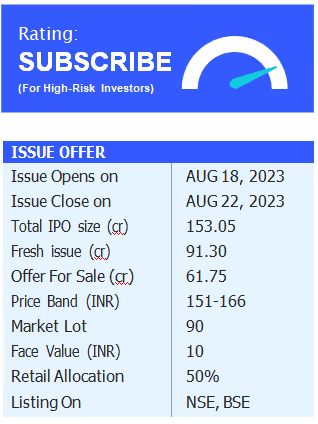
Pyramid Technoplast Limited is an industrial packaging company engaged in the business of manufacturing polymer based molded products (Polymer Drums) mainly used by chemical, agrochemical, speciality chemical and pharmaceutical companies for their packaging requirements. They are one of the leading manufacturers of rigid Intermediate Bulk Containers (IBC) in India manufacturing 1,000 litre capacity IBC. They also manufacture MS Drums made of mild steel (MS) used in the packaging and transport of chemicals, agrochemicals and speciality chemicals.
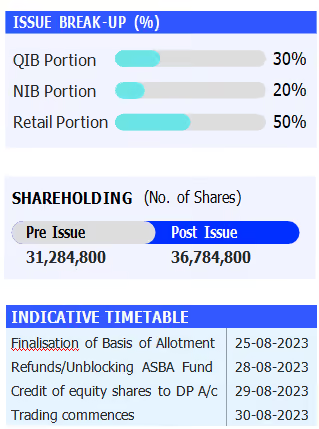
OBJECTS OF THE ISSUE
- Prepayment or repayment of certain outstanding borrowings.
- Funding working capital requirements of the company.
- General corporate purposes.
KEY MANAGERIAL PERSONNEL
1. Bijaykumar Agarwal
Managing Director & Chairman of the Company. He has been associated with the Company since 2002. He has over three decades of experience in packaging industry. He looks after various functions in the Company such as finance, raw material procurement, customer servicing, and business development.
2. Jaiprakash Agarwal
Whole-time Director & Chief Financial Officer of the Company. He has been associated with the Company since June 2003. He has over 19 years of experience in the packaging industry. He looks after various functions in the Company such as manufacturing, finance, accounts, sales & marketing and business development.
3. Madhu Agarwal
Whole-time Director of the Company. She holds a bachelor’s degree of commerce from the Calcutta University. She has been associated with the Company since May 2006. She has over sixteen (16) years of experience in human resource compliance and administration.
4. Chandrakant Joge
e Company Secretary and Compliance Officer of the Company. He looks after the overall corporate governance and secretarial matters of the Company. He has an experience of more than seven years.
COMPANY PROFILE
- The Company use blow molding technology to manufacture Polymer Drums and IBCs. Injection molding technology is used for manufacturing caps, closures, bungs, lids, handles, lugs, etc. for in-house use. Their products are marketed and sold under the brand name “Pyramid”.
- The company started commercial production in the year 1998 in Unit I. Presently, they have six strategically situated manufacturing units out of which four (4) are in Bharuch, GIDC, Gujarat and two (2) are situated at Silvassa, UT of Dadra and Nagar Haveli. The seventh (7) manufacturing unit is under construction at the Bharuch, GIDC, Gujarat adjacent to the existing six units.
- The total installed capacity of their Polymer Drum manufacturing units is 20,612 MTPA. The total installed capacity of their IBC manufacturing unit is 12,820 MTPA and the total installed capacity of MS Drums unit is 6,200 MTPA.
COMPETITIVE STRENGTHS
- Diverse customer base. Comprehensive product portfolio.
- Strategic location of their manufacturing units.
- Quality Standard Certifications & Quality Tests.
- Experienced Promoters and senior management team.
KEY STRATEGIES
- Continued focus on Intermediate Bulk Containers (IBC) by expanding their existing facilities.
- Continued focus on Polymer Drums and Mild Steel (MS) drums.
- Explore organic growth opportunities to increase capacity and business.
- Exploit industry opportunities arising out of the current geo-political situation and government policies.
KEY CONCERNS
- Unsecured loans of ₹ 205.39 lakhs taken by the Company from lenders can be recalled at any time. Polymer including polypropylene and polyethylene is the primary raw material consumed by the Company. Polymer is a derivative of crude oil and any substantial increase in price of crude oil or decrease in the supply of polymer could materially adversely affect the Company’s business.
- Their Business has substantial working capital requirements. They require significant amount of working capital for purchasing key raw materials which they procured from domestic and international suppliers.
- The company has experienced negative net cash flow from operating activities in the past . The company face competition from various domestic manufacturers and traders.
- Any ban on polymer based packaging by the Government of India may affect the business.
COMPARISON WITH LISTED INDUSTRY PEERS (AS ON 31ST MARCH 2023)

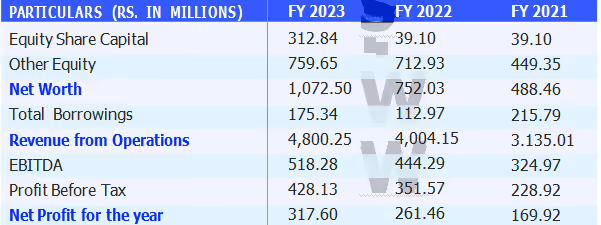
FINANCIALS (RESTATED CONSOLIDATED)
OUTLOOK & VALUATION
Pyramid Technoplast is a well-established player in the plastic packaging industry with a proven track record of financial performance. The company has a strong brand presence and a wide customer base, and it is also expanding its operations. It has strategic locations for its manufacturing units. However, the company faces some risks, such as competition from new entrants, fluctuations in the price of raw materials, and changes in government policies. Additionally, the company has experienced negative cash flow in the past. Nevertheless, the IPO is fairly priced at a P/E of around 16.24x. Thus, after considering all these factors, high-risk investors may apply for this IPO.
DISCLAIMER:
The information contained herein are strictly confidential and are meant solely for the information of the recipient and shall not be altered in any way, transmitted to, copied or distributed, in part or in whole, to any other person or to the media or reproduced in any form, without prior written permission of Swastika Investmart Ltd. (“SIL”). The contents of this document are for information purpose only. This document is not an investment advice and must not alone be taken as the basis for an investment decision. Before taking any decision to invest, the recipient of this document must read carefully the Red Herring Prospectus (“RHP”) issued to know the details of IPO and various risks and uncertainties associated with the investment in the IPO of the Company. All recipients of this document must before acting on the given information/details, make their own investigation and apply independent judgment based on their specific investment objectives and financial position. They can also seek appropriate professional advice from their own legal and tax consultants, advisors, etc. to understand the risks and investment considerations arising from such investment. The investor should possess appropriate resources to analyze such investment and the suitability of such investment to such investor’s particular circumstances before making any decisions on the investment. The Investor shall be solely responsible for any action taken based on this document. SIL shall not be liable for any direct or indirect losses arising from the use of the information contained in this document and accept no responsibility for statements made otherwise issued or any other source of information received by the investor and the investor would be doing so at his/her/its own risk. The information contained in this document should not be construed as forecast or promise or guarantee or assurance of any kind. The investors are not being offered any assurance or guaranteed or fixed returns on their investments. The users of this document must bear in mind that past performances if any, are not indicative of future results. The actual returns on investment may be materially different than the past. Investments in Securities market products and instruments including in the IPO of the Company are highly risky and they are generally not an appropriate avenue for someone with limited resources/ limited investment and low risk tolerance. Such Investments are subject to market risks including, without limitation, price, volatility and liquidity and capital risks. Therefore, the users of this document must carefully consider all the information given in the RHP including the risks factors before making any investment in the Equity Shares of the Company.Swastika Investmart Ltd or its analysts did not receive any compensation or other benefits from the companies mentioned in the report or third party in connection with preparation of the research report. Accordingly, neither Swastika Investmart Ltd nor Research Analysts have any material conflict of interest at the time of publication of this report. Compensation of our Research Analysts is not based on any specific merchant banking, investment banking or brokerage service transactions. Swastika Investment Ltd may have issued other reports that are inconsistent with and reach different conclusion from the information presented in this report. Research entity has not been engaged in market making activity for the subject company. Research analyst has not served as an officer, director or employee of the subject company. We have not received any compensation/benefits from the Subject Company or third party in connection with the Research Report.CORPORATE & ADMINISTRATIVE OFFICE - 48, Jaora Compound, M.Y.H. Road, Indore - 452 001 | Phone 0731 - 6644000Compliance Officer: Ms. Sheetal Duraphe Email: compliance@swastika.co.inPhone: (0731) 6644 241Swastika Investmart Limited, SEBI Reg. No. : NSE/BSE/MSEI: INZ000192732 Merchant Banking: INM000012102 Investment Adviser: INA000009843 MCX/NCDEX: INZ000072532 CDSL/NSDL: IN-DP-115-2015 RBI Reg. No.: B-03-00174 IRDA Reg. No.: 713.

SBFC Finance Limited IPO - Review,valuation, price and Grey Market Premium (GMP)
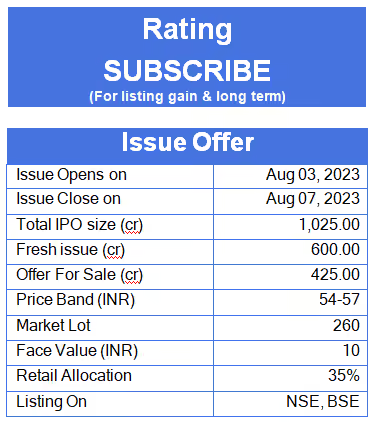
SBFC Finance Limited is a non-deposit taking non-banking finance company (“NBFC-ND-SI”) offering Secured MSME Loans and Loans against Gold, with a majority of its borrowers being entrepreneurs, small business owners, self-employed individuals, salaried and working-class individuals.
- Among MSME-focused NBFCs in India, SBFC has one of the highest assets under management (“AUM”) growth, at a CAGR of 44% in the period from Fiscal 2019 to Fiscal 2023.
- The company has a diversified pan-India presence, with an extensive network in its target customer segment. As of March 31, 2023, it has an expansive footprint in 120 cities, spanning 16 Indian states and two union territories, with 152 branches.
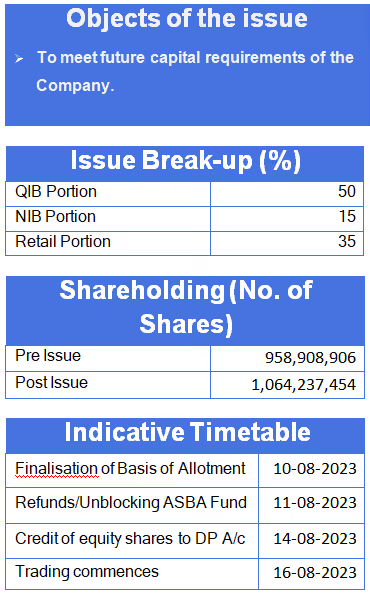
- The Company’s complete portfolio of loans has in-house origination and benefits from its risk management framework. Leveraging its significant operational experience, it has set up stringent credit quality checks and customised operating procedures that exist at each stage for comprehensive risk management.
- The company primarily focus on small enterprise borrowers, whose monthly income is up to ₹ 0.15 million, with a demonstrable track record of servicing loans such as gold loans, loans for two-wheeler vehicles and have a CIBIL score above 700 at the time of origination.
- SBFC source customers directly through its sales team of 1,911 employees as of March 31, 2023, and has adopted a direct sourcing model through branch-led local marketing efforts, repeat customers or through walk-ins, which has helped it to maintain contact with customers and establish strong relationships with them.
- The company has also created an onground collections infrastructure that is extensive, to ensure that it maintain a high asset quality.
KEY MANAGERIAL PERSONNEL
- Neeraj Swaroop is an Independent Director and Chairperson of the Board. He has been associated with the Company since November 21, 2017. Prior to joining this Company, he was associated with Pond’s (India) Limited, Bank of America, HDFC Bank Limited, Standard Chartered Bank and Singapore Exchange Limited
- Aseem Dhru is the Managing Director and Chief Executive Officer of the Company. He has over 25 years of experience in the banking industry and has been associated with the Company since September 28, 2017.
- Narayan Barasia, is the Chief Financial Officer of the Company. In his current role, he is responsible for financial management, accounts, tax, treasury, secretarial and legal matters. He has more than two decades of experience.
- Jay Mistry, is the Company Secretary and Compliance Officer of the Company. In his current role, he is responsible for secretarial and regulatory compliance of the Company. He has more than five years of experience in securities and corporate laws, and corporate compliances.
- Mahesh Dayani, is chief business officer of the company. He has over 22 years of experience across wholesale and retail banking.
- Saiprashant Menon is the chief collection officer of the company.He has more than 21 years of experience in collections.
COMPETITIVE STRENGTHS
- Diversified pan-India presence with an extensive network to cater the target customer segment.
- 100% in-house sourcing, leading to favourable business outcomes.
- Comprehensive credit assessment, underwriting and risk management framework.
- Extensive on-ground collections infrastructure leading to maintenance of asset quality.
- Healthy liability franchise with low cost of funds.
- Consistent financial performance backed by profitable growth
- Experienced, cycle-tested and professional management team
KEY STRATEGIES
- Leverage pan-India network to deepen its penetration in the target customer segment.
- Expand its product portfolio through offering affordable housing finance.
- Diversify its source of borrowings and improve operating leverage.
KEY CONCERNS
- It require substantial capital for its business and any disruption in its sources of capital could have an adverse effect on the business.
- Their business is particularly vulnerable to interest rate risk, and volatility in interest rates for both lending and treasury operations, could have an adverse effect on it.
- Inability to compete effectively in an increasingly competitive industry may adversely affect its net interest margins, income and market share.
- Any downgrade in its credit ratings could increase borrowing costs.
- Risk arising from collateral for its portfolio.
COMPARISON WITH LISTED INDUSTRY PEERS (AS ON 31ST MARCH 2023)
FINANCIALS (RESTATED CONSOLIDATED)


OUTLOOK & VALUATION:
SBFC is a well-established company with consistent financial performance and a stable asset quality; it is showing growing AUM and a decline in its NPAs. It has a diversified presence across India, and its access to diversified funding sources is a key contributor to its growth. However, there are a few risks as well. SBFC is dependent on a few key customers. Secondly, The company is also exposed to fluctuations in the price of securities it takes as collateral for loans. Additionally, an increase in interest rates could pose a challenge for the company. Nevertheless, the Issue looks fairly priced, and after considering all these factors, we believe that investors may consider to apply for this IPO.
Disclaimer: The content provided above is for informational and educational purposes only. It does not constitute or imply a recommendation to engage in any securities transactions or investment strategies. We do not provide personalized advice or determine suitability for individuals' financial needs. Please conduct your own analysis and consider your personal circumstances before making any investment decisions.

फेड के हॉकिश आउटलुक से टुटा सोना।
कीमती धातुओं में इस सप्ताह भी ब्याज दरों में बढ़ोतरी की सम्भावना के बीच, कीमतों में बिकवाली का दबाव देखा गया। दुनिया की सबसे बड़ी अर्थव्यवस्था में मजबूती और मुद्रास्फीति में बढ़ोतरी निवेशकों को वैश्विक ब्याज दरों के दायरे पर पुनःविचार करने के लिए बाध्य कर रहा है। ग्लोबल बॉन्ड मार्केट में बिकवाली के कारण अमेरिकी बेंचमार्क ट्रेज़री यील्ड 2007 के स्तरों के करीब जबकि यूके में बांड यील्ड 2008 के उच्च स्तरों के करीब पहुंच गई है। दरसल, पिछले सप्ताह फेड के मीटिंग मिनट्स जारी हुए जिसमे स्पष्ट हुआ है की फेड के ज़्यादातर सदस्य आगे भी ब्याज दर बढ़ोतरी के पक्ष में है, जिससे बांड यील्ड में बढ़ोतरी देखने को मिल रही और इसके सपोर्ट से अमेरिकी डॉलर इंडेक्स मजबूत हुआ है। मजबूत बांड यील्ड से डॉलर 83.1 रुपये हो गया है जिससे घरेलु बाज़ार में सोने में कॉमेक्स वायदा की तुलना में कम गिरावट रही।अमेरिकी डॉलर के मुकाबले रुपये के मूल्य में गिरावट के प्रमुख कारणों में से एक 10-वर्षीय भारत सरकार बांड और अमेरिकी सरकार बांड के बीच कम होती स्प्रेड है। भारत और अमेरिका में बॉन्ड यील्ड स्प्रेड 2007 के बाद न्यूनतम स्तरों पर है। एमसीएक्स सोने में लगातार तीसरे सप्ताह भी गिरावट रही है और अक्टूबर वायदा सोने में पिछले सप्ताह 0.90 प्रतिशत की गिरावट दर्ज की गई है और भाव 58375 रुपये प्रति दस ग्राम के स्तरों पर पहुंच गए है। हालांकि एमसीएक्स में सितम्बर वायदा चांदी में पिछले सप्ताह मामूली बढ़ोतरी दर्ज की गई है।
तकनिकी विश्लेषण : इस सप्ताह कीमती धातुओं के भाव दबाव में रहने की सम्भावना है। एमसीएक्स अक्टूबर वायदा सोने में सपोर्ट 57000 रुपये पर है और रेजिस्टेंस 59000 रुपये पर है। सितम्बर वायदा चांदी में सपोर्ट 68000 रुपये पर है और रेजिस्टेंस 71500 रुपये पर है।
Big Budget


Popular Articles





.avif)
.avif)

.avif)



START YOUR INVESTMENT JOURNEY
Get personalized advice from our experts
- Dedicated RM Support
- Smooth and Fast Trading App
