
Dollar To Rupee Exchange Rate: Opening Signals And Implications For Retail Investors



Key Takeaways
- Rupee Opens Higher At 95.33 Per USD, Signaling A Softer Dollar In Early Trade.
- Dollar Index Stays Below 101, Aiding EM Currencies Amid Mixed Asian Moves.
- Saudi Crude Price Cut To Asia Of $1.10 Per Barrel Eases Crude Pressure On The Rupee.
- Exporters May Sell Dollars Around 95.50 While Importers Hedge Near-Term Obligations.
Rupee opens higher to 95.33 per U.S. dollar in early July 7 trading as the dollar to rupee exchange rate softens and several Asian currencies firm. The market is weighing crude price directions, U.S. data, and policy cues across the region. The rupee rose from the previous close of 95.40, while the U.S. dollar index hovered below the 101 threshold, last quoted at 100.86 – a configuration that tends to support emerging-market currencies and add resilience to domestic markets.
Saudi Arabia announced a cut in its official selling price for crude oil exports to Asia by $1.10 per barrel, the steepest reduction in 26 years. This development could ease concerns around crude prices and provide a modest cushion for the rupee in the near term. Exporters could consider selling dollars around the 95.50 level, while importers may use any decline in the U.S. dollar to hedge near-term payment obligations. These two cues–crude price trajectory and dollar direction–help frame the day’s risk-reward in currency trading.
Dollar To Rupee Exchange Rate: Opening Moves And What Retail Investors Should Know
In the opening trade of the session the rupee was at 95.33 per U.S. dollar, improving from 95.40. This movement is part of a broader pattern where the dollar to rupee exchange rate is influenced by global currency flows and cross-asset dynamics. The dollar index remains below the 101 threshold, with the latest reading around 100.86, helping to support the rupee and other EM currencies as risk appetite recovers modestly. The rupee’s underlying momentum, while softer than some prior sessions, remains uplifted by favorable crude-price expectations and by cross-border liquidity conditions.
From a practical perspective, exporters may consider selling dollars around the 95.50 level, and importers could look to hedge near-term obligations on declines in the U.S. dollar. This is how traders translate macro signals into execution: sell dollars when you see a credible rupee rally and hedge near-term exposures when the dollar shows fresh weakness that could affect cash flows.
Rupee Opens Higher Amid Softer Dollar And Mixed Asian Currency Moves
Asian currencies showed a mixed picture in early trading. The Philippine peso led gains with a rise of 0.11%, followed by the Malaysian ringgit at 0.09% and the Singapore dollar at 0.03% higher. In contrast, the Chinese yuan drifted 0.20% lower, the Indonesian rupiah fell 0.18%, and the Thai baht declined 0.14%. The Taiwan dollar eased by 0.08%, while the South Korean won and the Japanese yen were largely unchanged, the won slipping 0.02% and the yen down 0.01%. This mixed regional environment often translates into cautious flows into Indian assets as global risk sentiment stabilizes.
Against this backdrop, the rupee maintains a constructive tone, with the potential for short-lived pullbacks as U.S. data evolve and investors reassess global growth expectations. The near-term setup remains a calculus of cross-currency dynamics and crude price movements, rather than a single directional bet. Traders should monitor the 95.50 level for USD sales and be mindful of any sharp moves in the dollar that may prompt hedges or rebalancing of FX exposures.
Dollar Index And Global Cues: Reading The Sub-101 Level
The U.S. dollar index stayed under pressure after softer-than-expected U.S. employment data tempered expectations of further rate hikes. The dollar index was last quoted at 100.86 in the session, while broad risk appetite saw several Asian currencies move in different directions. The Japanese yen remained under pressure, trading above the 162-per-dollar mark in early Asian dealings, and the currency hovered near its weakest level against the British pound since 2007. Such dynamics underscore how sensitive the rupee remains to both domestic fundamentals and external cues.
In this context, the rupee is likely to continue taking cues from global currency movements, crude price trajectories, and incoming U.S. economic data during the trading session. For retail investors, this means maintaining flexibility in exposure to USD-denominated assets and staying ready to adjust hedges as the macro picture evolves. A softening dollar and a trend toward stabilization in risk assets can provide temporary tailwinds for the rupee, but the path remains nuanced and dependent on cross-market signals. This is why the dollar to rupee exchange rate can be volatile as cross-currency dynamics shift.
Euro Rupee Exchange Rate Forecast: A Cross-Currency Perspective
While the current session centers on the dollar to rupee exchange rate, many traders also watch cross-currency flows for potential spillovers into the euro rupee exchange rate forecast. Cross-currency dynamics can shift as the euro strengthens or weakens relative to the dollar, depending on eurozone growth signals and global risk appetite. For Indian markets, a broader cross-currency lens can help explain episodes when the rupee strengthens despite a firmer dollar, as shifts in global liquidity and risk sentiment influence flows into EM currencies. Investors should consider a scenario-based approach, mapping how a stronger euro or a weaker dollar could interact with crude pricing and U.S. data releases to drive the rupee in the near term.
From a practical perspective, monitoring euro zone indicators and cross-currency momentum provides a more complete view of the dollar to rupee exchange rate journey. If the euro rupee exchange rate forecast begins to show strength alongside improving risk sentiment, the rupee stands to benefit from an environment of balanced cross-currency flows rather than a pure USD-specific move.
Rupee To Dollar Rate Today Live: Monitoring Real-Time Signals And Hedging Tactics
For real-time decision-making, traders and retail investors should watch the rupee to dollar rate today live movement in intraday sessions. While the day’s opening price remains a reference point, actual trades can swing around as U.S. data prints, oil price movements, and risk appetite shift. A practical approach is to pair any near-term USD funding needs with timely hedges, including options or forward contracts, to limit downside risk if the dollar suddenly strengthens. In addition, setting up alert levels around 95.50 for USD selling and 95.70 for USD buying can help create a structured plan rather than reacting to every tick.
As part of your ongoing workflow, consider consulting Swastika's Sarthi AI stock assistant for institutional-quality stock and index insights that complement currency analysis. This AI-driven resource can help you connect macro currency cues with stock-level research in a practical, decision-ready way.
Practical Hedging And Actionables For Retail Investors In The Dollar To Rupee Environment
Takeaways for retail investors center on disciplined risk management and clear levels. The rupee's 95.33 opening print and the potential for moves near the 95.50 mark create a window for hedging and selective USD selling, even as the rupee’s momentum remains subject to global cues. When the dollar softens and the rupee strengthens, exporters have incentive to realize gains on USD exposures at or around the 95.50 level, whereas importers may prefer to hedge near-term payments on declines. If the market experiences a renewed dollar rally, consider scaling hedges and maintaining a diversified exposure to foreign currency risk rather than chasing momentum.
In this context, a mental model like "risk-first hedging with predefined levels" can be more effective than chasing directional bets. The currency market is a system where cross-currency flows, crude price, and U.S. data interact; having a plan helps you protect capital while remaining nimble enough to take advantage of favorable moves. Remember to account for your own liquidity needs and risk tolerance before acting on the next signal.
Related Reads
- Dollar To Rupee Exchange Rate Signals Rupee Strength As Softer Dollar Boosts Sentiment
- RBI currency intervention And The Rupee Open: Navigating The 94.2-94.75 Band For Retail Investors
- Yes Bank Share Price And The Yen-Rupee Trade Pivot For Indian Investors
Frequently Asked Questions
What is the current rupee opening level against the U.S. dollar?
The rupee opened at 95.33 per U.S. dollar, improving from 95.40.
What factors influenced the rupee's movement on July 7, 2026?
The U.S. dollar index remained below 101, at 100.86, while gains in several Asian currencies supported the rupee. A Saudi crude price cut of $1.10 per barrel—the steepest in 26 years—could provide additional rupee support.
What actions can exporters and importers take in this environment?
Exporters could consider selling dollars around the 95.50 level, while importers may use any decline in the U.S. dollar to hedge near-term payment obligations.
What should retail investors watch next for the dollar to rupee exchange rate?
Investors should monitor global currency movements, crude price trajectories, and incoming U.S. economic data for fresh direction on the dollar to rupee exchange rate.
Where can I get deeper stock research and AI-driven insights for stock decisions?
Swastika's Sarthi AI stock assistant offers institutional-level research on stocks and indices for retail investors.
Conclusion
For retail investors, today’s rupee open underscores the delicate balance between global currency moves and commodity prices. The dollar to rupee exchange rate remains sensitive to the U.S. data stream, crude pricing, and cross-currency flows, meaning actionable decisions should be based on a framework that accounts for multiple moving parts rather than a single data point.
Next steps: monitor the 95.50 level for USD selling opportunities and use hedges to protect near-term payables. As you navigate this environment, consider using Swastika's Sarthi AI stock assistant to integrate currency cues with stock-level research and institutional-grade insights. This AI-powered resource can help you translate macro signals into practical investment decisions and smarter portfolio construction.
Latest Articles

Valiant Laboratories IPO Review - GMP, Price, Details


Valiant Laboratories Limited is an Active Pharmaceutical Ingredient (“API”) / Bulk Drug manufacturing company with having focus on the manufacturing of Paracetamol. The Company manufactures Paracetamol in various grades such as IP/BP/EP/USP, as per the pharmacopeia requirements of its customers.
OBJECTS OF THE ISSUE
- Investment in its wholly-owned subsidiary VASPL for its capital expenditure and working capital requirements.
- General corporate purposes.


Velji Karamshi Gogri
Chairman, Independent and Non- Executive Director of the Company. He has experience of more than 45 years in the Chemical Industry involved in setting up and operating bulk drugs intermediates and fine chemicals manufacturing units and handling different chemical processes and equipment.
Santosh Shantilal Vora
Managing Director of the Company. He has experience of over 7 years in the chemical industry. He is one of the founding members of the Company and looks after the day- to-day affairs of the Company. He handles the responsibility of looking after new product development, infusion and upgradation of technology in operations and production process of the Company.
Paresh Shashikant Shah
Executive Director and Chief Financial Officer of the Company. He has been associated with the Company since 1985. He has experience of over four decades in the chemical industry. He is also one of the founding members of the Company and a director on the Board since incorporation.
Saloni Mehta
The Company Secretary & Compliance Officer of the Company. She is a qualified Company Secretary and is an associate member of the Institute of Company Secretaries of India. She has over two years of experience in the field of company law and SEBI Listing Regulations related compliance. She has been associated with the Company since November 30, 2021
COMPANY PROFILE
- Valiant Laboratories Limited was originally formed in year 1980 as a partnership firm under the name and style of “M/s. Bharat Chemicals” and gradually, commenced manufacturing of Paracetamol by late 1982.
- Its manufacturing unit is located in Palghar, Maharashtra, spread over 2,000 sq. mts. of land with an aggregate annual installed capacity of 9,000 MT per annum.
- Within its Manufacturing Facility located at Tarapur Industrial Area, Palghar, Maharashtra it also has an in-house R&D infrastructure.
- The Company, through its wholly-owned subsidiary, Valiant Advanced Sciences Private Limited intends to establish a greenfield project at Saykha Industrial Area, Bharuch, Gujarat. which shall venture into the manufacture of specialty chemicals and assist it in the backward integration process.
COMPETITIVE STRENGTHS
- Experienced promoters and strong management team.
- Strong financial performance.
- Reducing dependence on import of raw materials.
- Strategically located Manufacturing Facility.
KEY STRATEGIES
- Diversification into new chemistries and industry. Increase in market share.
- Improve operational efficiencies through backward integration of the Proposed Facility. Increase its penetration into international markets including regulated markets.
KEY CONCERNS
- It is a single-product manufacturing company and any changes to the paracetamol API industry or its product demand will adversely affect its business.
- The Company operates out of a single Manufacturing Facility. Any significant social, political, or economic disruption natural calamities, or civil disruptions in this region may impact its business. Subject to strict quality requirements, regular inspections, and audits by our customers and any failure to comply with quality standards may lead to cancellation of existing and future orders. limited number of suppliers for its raw materials which are highly concentrated in the western region of India.
- Dependent on a few customers for a major part of its revenues. The pharmaceutical industry is intensely competitive.
COMPARISON WITH LISTED INDUSTRY PEERS (AS ON 31ST MARCH 2023)
.avif)
FINANCIALS (RESTATED CONSOLIDATED)
.avif)
OUTLOOK & VALUATION
Valiant Laboratories is a 40-year-old pharmaceutical ingredient manufacturing company with a main focus on paracetamol. Currently, it operates from its only manufacturing unit in Palgarh, Maharashtra; however, it is planning to establish a new project in Gujarat through its subsidiary. Its financial performance has been improving, and it has the benefit of experienced promoters.
But it is a single-product manufacturing company. Secondly, it is dependent on a limited number of suppliers as well as customers. Also, there is intense competition in this industry along with high regulations. The issue is coming at a P/E valuation of 15.7, which seems fair, but considering other risks and current market volatility, we will avoid this IPO.
DISCLAIMER:
The information contained herein are strictly confidential and are meant solely for the information of the recipient and shall not be altered in any way, transmitted to, copied or distributed, in part or in whole, to any other person or to the media or reproduced in any form, without prior written permission of Swastika Investmart Ltd. (“SIL”). The contents of this document are for information purpose only. This document is not an investment advice and must not alone be taken as the basis for an investment decision. Before taking any decision to invest, the recipient of this document must read carefully the Red Herring Prospectus (“RHP”) issued to know the details of IPO and various risks and uncertainties associated with the investment in the IPO of the Company. All recipients of this document must before acting on the given information/details, make their own investigation and apply independent judgment based on their specific investment objectives and financial position. They can also seek appropriate professional advice from their own legal and tax consultants, advisors, etc. to understand the risks and investment considerations arising from such investment. The investor should possess appropriate resources to analyze such investment and the suitability of such investment to such investor’s particular circumstances before making any decisions on the investment. The Investor shall be solely responsible for any action taken based on this document. SIL shall not be liable for any direct or indirect losses arising from the use of the information contained in this document and accept no responsibility for statements made otherwise issued or any other source of information received by the investor and the investor would be doing so at his/her/its own risk. The information contained in this document should not be construed as forecast or promise or guarantee or assurance of any kind. The investors are not being offered any assurance or guaranteed or fixed returns on their investments. The users of this document must bear in mind that past performances if any, are not indicative of future results. The actual returns on investment may be materially different than the past. Investments in Securities market products and instruments including in the IPO of the Company are highly risky and they are generally not an appropriate avenue for someone with limited resources/ limited investment and low risk tolerance. Such Investments are subject to market risks including, without limitation, price, volatility and liquidity and capital risks. Therefore, the users of this document must carefully consider all the information given in the RHP including the risks factors before making any investment in the Equity Shares of the Company.
Swastika Investmart Ltd or its analysts did not receive any compensation or other benefits from the companies mentioned in the report or third party in connection with preparation of the research report. Accordingly, neither Swastika Investmart Ltd nor Research Analysts have any material conflict of interest at the time of publication of this report. Compensation of our Research Analysts is not based on any specific merchant banking, investment banking or brokerage service transactions. Swastika Investment Ltd may have issued other reports that are inconsistent with and reach different conclusion from the information presented in this report. Research entity has not been engaged in market making activity for the subject company. Research analyst has not served as an officer, director or employee of the subject company. We have not received any compensation/benefits from the Subject Company or third party in connection with the Research Report.
CORPORATE & ADMINISTRATIVE OFFICE - 48, Jaora Compound, M.Y.H. Road, Indore - 452 001 | Phone 0731 - 6644000
Compliance Officer: Ms. Sheetal Duraphe Email: compliance@swastika.co.inPhone: (0731) 6644 241
Swastika Investmart Limited, SEBI Reg. No. : NSE/BSE/MSEI: INZ000192732 Merchant Banking: INM000012102 Investment Adviser: INA000009843 MCX/NCDEX: INZ000072532 CDSL/NSDL: IN-DP-115-2015 RBI Reg. No.: B-03-00174 IRDA Reg. No.: 713.

JSW Infrastructure IPO Details
JSW Infrastructure Limited provides maritime-related services including cargo handling, storage solutions and logistics services. The company develop and operates ports and port terminals under Port Concessions. JSW Infrastructure Limited is part of the JSW Group. JSW Infrastructure is the 2nd largest commercial port operator in the country in terms of cargo handling capacity in Fiscal 2022.
OBJECTS OF THE ISSUE
- Payment of borrowings.
- Financing capital expenditure requirements. General corporate purposes.
Sajjan Jindal
Chairman and Non-Executive Director of the Company. He is the vice chairman of the World Steel Association and is also on the board of directors of JSW Energy Limited. He has over 36 years of experience in the manufacturing and steel industry.
Nirmal Kumar Jain
Vice Chairman and Independent Director of the Company. He joined Jindal Iron & Steel Company Limited in 1992 as general manager – finance. He has over 21 years of experience in the financial services sector.
Arun Sitaram Maheshwari
Joint Managing Director and Chief Executive Officer. He has previously been associated with Jindal Strips Limited, Jindal Iron & Steel Company Limited and Jindal Vijaynagar Steel Limited. He has over 30 years of experience in the areas of marketing, import (raw materials), corporate strategy and infrastructure.
Lalit Chandanmal Singhvi
Whole Time Director and Chief Financial Officer of the Company.He has over 21 years of experience in management and finance. He has been associated with our Company since January 15, 2015 as senior vice president – finance and commercial.
Kantilal Narandas Patel
Non-Executive Director of the Company. He has over 28 years of experience in the financial services sector and the steel industry. He was previously associated with JSW Holdings Limited as joint managing director and chief executive officer.
COMPANY PROFILE
- JSW Infrastructure’s operations have expanded from one Port Concession at Mormugao, Goa which was acquired by the JSW Group in 2002 and commenced operations in 2004, to nine Port Concessions as of June 30, 2023 across India.
- It is the fastest-growing port-related infrastructure company in terms of growth in installed cargo handling capacity and cargo volumes handled from Fiscal 2021 to Fiscal 2023.
- The company has a diversified presence across India with Non-Major Ports located in Maharashtra and port terminals located at Major Ports across the industrial regions of Goa and Karnataka on the west coast, and Odisha and Tamil Nadu on the east coast. The company’s international presence includes 2 terminals at Fujairah and Dibba in the UAE
- The company’s ports and port terminals typically have long concession periods ranging between 30 to 50 years, providing long-term visibility of revenue streams.
COMPETITIVE STRENGTHS
- Fastest growing port-related infrastructure company and second largest commercial port operator in India.
- Strategically located assets at close proximity to JSW Group Customers (Related Parties) and industrial clusters supported by a multi-modal evacuation infrastructure.
- Strong financial metrics with a growing margin profile, return metrics, and growth. Diversified operations in terms of cargo profile, geography, and assets.
- Demonstrated project development, execution, and operational capabilities.
- Benefit from the strong corporate lineage of the JSW Group and a qualified and experienced management team.
KEY STRATEGIES
- Continue to pursue greenfield and brownfield expansions with a focus on Non-Major Ports Pursue acquisition opportunities in similar businesses.
- Increasing third-party customer base.
- Pursue opportunities in synergistic businesses to increase revenue diversification. Focus on building environment friendly and sustainable operations along with growth.
KEY CONCERNS
- A substantial portion of the volume of cargo handled by the company is dependent on a few types of cargo.
- It derives a substantial portion of its revenue from its top five customers Certain of its Subsidiaries have incurred losses in the past.
- It operates in a capital-intensive industry and its current and future expansion plans may require significant capital.
- The company's business operations are subject to a wide range of environmental and other regulations, and any changes to these regulations could increase the company's costs.
COMPARISON WITH LISTED INDUSTRY PEERS (AS ON 31ST MARCH 2023)
..%252C.avif)
FINANCIALS (RESTATED CONSOLIDATED)
%252C.avif)
OUTLOOK & VALUATION
As a division of the JSW Group, JSW Infrastructure offers logistical, cargo handling, and other maritime-related services. The second-largest commercial port operator in India, the corporation has the fastest rate of growth in the infrastructure associated with ports.
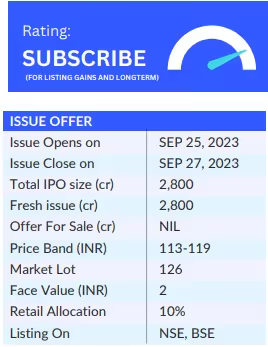
The business's financial performance is quite strong, and both its sales and net worth are increasing. The ratio of debt to equity is 0.54, which is quite favorable. The issue size is about 2800 crore, and the IPO is full of fresh issues. last but not least, coming to the IPO valuation the issue is priced at a P/E valuation of about 28x, and EV/EBITDA is 15.17 which looks reasonable.
We will therefore subscribe to this IPO for listing benefits and for long terms due to valuation and current market sentiments.
DISCLAIMER:
The information contained herein are strictly confidential and are meant solely for the information of the recipient and shall not be altered in any way, transmitted to, copied or distributed, in part or in whole, to any other person or to the media or reproduced in any form, without prior written permission of Swastika Investmart Ltd. (“SIL”). The contents of this document are for information purpose only. This document is not an investment advice and must not alone be taken as the basis for an investment decision. Before taking any decision to invest, the recipient of this document must read carefully the Red Herring Prospectus (“RHP”) issued to know the details of IPO and various risks and uncertainties associated with the investment in the IPO of the Company. All recipients of this document must before acting on the given information/details, make their own investigation and apply independent judgment based on their specific investment objectives and financial position. They can also seek appropriate professional advice from their own legal and tax consultants, advisors, etc. to understand the risks and investment considerations arising from such investment. The investor should possess appropriate resources to analyze such investment and the suitability of such investment to such investor’s particular circumstances before making any decisions on the investment. The Investor shall be solely responsible for any action taken based on this document. SIL shall not be liable for any direct or indirect losses arising from the use of the information contained in this document and accept no responsibility for statements made otherwise issued or any other source of information received by the investor and the investor would be doing so at his/her/its own risk. The information contained in this document should not be construed as forecast or promise or guarantee or assurance of any kind. The investors are not being offered any assurance or guaranteed or fixed returns on their investments. The users of this document must bear in mind that past performances if any, are not indicative of future results. The actual returns on investment may be materially different than the past. Investments in Securities market products and instruments including in the IPO of the Company are highly risky and they are generally not an appropriate avenue for someone with limited resources/ limited investment and low risk tolerance. Such Investments are subject to market risks including, without limitation, price, volatility and liquidity and capital risks. Therefore, the users of this document must carefully consider all the information given in the RHP including the risks factors before making any investment in the Equity Shares of the Company.
Swastika Investmart Ltd or its analysts did not receive any compensation or other benefits from the companies mentioned in the report or third party in connection with preparation of the research report. Accordingly, neither Swastika Investmart Ltd nor Research Analysts have any material conflict of interest at the time of publication of this report. Compensation of our Research Analysts is not based on any specific merchant banking, investment banking or brokerage service transactions. Swastika Investment Ltd may have issued other reports that are inconsistent with and reach different conclusion from the information presented in this report. Research entity has not been engaged in market making activity for the subject company. Research analyst has not served as an officer, director or employee of the subject company. We have not received any compensation/benefits from the Subject Company or third party in connection with the Research Report.
CORPORATE & ADMINISTRATIVE OFFICE - 48, Jaora Compound, M.Y.H. Road, Indore - 452 001 | Phone 0731 - 6644000
Compliance Officer: Ms. Sheetal Duraphe Email: compliance@swastika.co.inPhone: (0731) 6644 241
Swastika Investmart Limited, SEBI Reg. No. : NSE/BSE/MSEI: INZ000192732 Merchant Banking: INM000012102 Investment Adviser: INA000009843 MCX/NCDEX: INZ000072532 CDSL/NSDL: IN-DP-115-2015 RBI Reg. No.: B-03-00174 IRDA Reg. No.: 713.

Updater Services IPO Date, Price, GMP, Review, Details
Updater Services Limited is an integrated business services platform in India offering integrated facilities management (“IFM”) services and business support services (“BSS”) to its customers, with a pan-India presence.
OBJECTS OF THE ISSUE
- Payment of certain borrowings.
- Funding the working capital requirements. Pursuing inorganic initiatives.

.webp)
Raghunandana Tangirala
Promoter, Chairman and Managing Director of the Company. He is one of the founding directors of the Company and has been on the board since its incorporation. In the Company, he focuses primarily on corporate governance, organizational development, capital allocation and strategic growth of the Company. He has approximately 30 years of experience.
C. R. Saravanan
Director of business operations of the Company. He has been associated with the Company since October 3, 2016. In the Company, he handles the pan India business operations.
Balaji Swaminathan
Chief Financial Officer of the Company. He has been associated with the Company since December 11, 2019. He handles finance & accounts and compliances of the Company. He holds a bachelor’s degree in commerce from University of Madras. He is an associate member of the Institute of Chartered Accountants in India.
Ravishankar B
Company Secretary of the Company. He has been associated with the Company since March 6, 2023. In the Company, he is responsible for secretarial compliances. He holds a bachelor degree in commerce from the University of Madras. He is an associate member of the Institute of Chartered Accountants of India and an associate member of the Institute of Company Secretaries in India.
COMPANY PROFILE
- Updater Services Limited commenced operations in 1990 as a housekeeping and catering services company situated in Chennai, Tamil Nadu.
- Over the years, it has evolved into an integrated business services platform with a pan-India presence serving customers across industries and business service lines.
- In IFM other service segments include Production Support Services, Soft Services, Engineering Services, Washroom and feminine hygiene, Warehouse management, General Staffing, and more. In the BSS segment, the company offers Audit and Assurance services, employee background verification check services, airport ground handling services, sales enablement services, and more through its subsidiaries.
- All these services are B2B services which are primarily in the nature of annuity-based services whereby the customer, once acquired, generates revenue over an extended period of time.
- It served 2,797 customers across various sectors, including certain marquee global and Indian customers.
COMPETITIVE STRENGTHS
- Leading integrated business services platform, operating across diverse segments. Longstanding relationship with customers across diverse sectors leading to recurring business. Track record of successful acquisition and integration of high-margin business segments.
- Pan India presence with a large and efficient workforce. Technology at the forefront of its current and future business.
- Highly experienced Management team with support from PE Investors.
KEY STRATEGIES
- Retain, strengthen, and grow customer base. Grow market share in key segments.
- Introduce new products and services catering to existing and new customer segments. Pursue inorganic growth through strategic acquisitions.
- Continue to improve operating margins.
KEY CONCERNS
- The Company employs a large workforce of 65,627 employees as of June 30, 2023, thus it faces significant employee-related regulatory risks.
- Operational risks, as it provides services in different business environments.
- It witnessed a reduction in its profit in the Financial Year ending March 31, 2023. Any delay or default in receiving payments for services rendered by the Company.
- The Company is exposed to service-related claims and losses or employee disruptions that could have an adverse effect on its business.
- The industries in which it operates are intensely competitive.
- Certain of the services that it offer to its customers are subject to seasonal variations.
COMPARISON WITH LISTED INDUSTRY PEERS (AS ON 31ST MARCH 2023)
...avif)
FINANCIALS (RESTATED CONSOLIDATED)
..avif)
OUTLOOK & VALUATION
Updater Services Ltd. (UDS) is a leading business services platform that offers a diverse range of services to customers (B2B) across diverse sectors. The company has a pan-India presence and a large workforce.
The financial performance of the company has been mixed, with growing revenue but declining profit. The company faces certain regulatory and operational risks due to the nature of its business. It is also exposed to service-related claims and losses.
Lastly, the issue is priced at a P/E of 44.3x, which is significantly higher than its listed peers. Thus, considering all the factors, we will avoid this IPO.
DISCLAIMER:
The information contained herein are strictly confidential and are meant solely for the information of the recipient and shall not be altered in any way, transmitted to, copied or distributed, in part or in whole, to any other person or to the media or reproduced in any form, without prior written permission of Swastika Investmart Ltd. (“SIL”). The contents of this document are for information purpose only. This document is not an investment advice and must not alone be taken as the basis for an investment decision. Before taking any decision to invest, the recipient of this document must read carefully the Red Herring Prospectus (“RHP”) issued to know the details of IPO and various risks and uncertainties associated with the investment in the IPO of the Company. All recipients of this document must before acting on the given information/details, make their own investigation and apply independent judgment based on their specific investment objectives and financial position. They can also seek appropriate professional advice from their own legal and tax consultants, advisors, etc. to understand the risks and investment considerations arising from such investment. The investor should possess appropriate resources to analyze such investment and the suitability of such investment to such investor’s particular circumstances before making any decisions on the investment. The Investor shall be solely responsible for any action taken based on this document. SIL shall not be liable for any direct or indirect losses arising from the use of the information contained in this document and accept no responsibility for statements made otherwise issued or any other source of information received by the investor and the investor would be doing so at his/her/its own risk. The information contained in this document should not be construed as forecast or promise or guarantee or assurance of any kind. The investors are not being offered any assurance or guaranteed or fixed returns on their investments. The users of this document must bear in mind that past performances if any, are not indicative of future results. The actual returns on investment may be materially different than the past. Investments in Securities market products and instruments including in the IPO of the Company are highly risky and they are generally not an appropriate avenue for someone with limited resources/ limited investment and low risk tolerance. Such Investments are subject to market risks including, without limitation, price, volatility and liquidity and capital risks. Therefore, the users of this document must carefully consider all the information given in the RHP including the risks factors before making any investment in the Equity Shares of the Company.
Swastika Investmart Ltd or its analysts did not receive any compensation or other benefits from the companies mentioned in the report or third party in connection with preparation of the research report. Accordingly, neither Swastika Investmart Ltd nor Research Analysts have any material conflict of interest at the time of publication of this report. Compensation of our Research Analysts is not based on any specific merchant banking, investment banking or brokerage service transactions. Swastika Investment Ltd may have issued other reports that are inconsistent with and reach different conclusion from the information presented in this report. Research entity has not been engaged in market making activity for the subject company. Research analyst has not served as an officer, director or employee of the subject company. We have not received any compensation/benefits from the Subject Company or third party in connection with the Research Report.
CORPORATE & ADMINISTRATIVE OFFICE - 48, Jaora Compound, M.Y.H. Road, Indore - 452 001 | Phone 0731 - 6644000
Compliance Officer: Ms. Sheetal Duraphe Email: compliance@swastika.co.in Phone: (0731) 6644 241
Swastika Investmart Limited, SEBI Reg. No. : NSE/BSE/MSEI: INZ000192732 Merchant Banking: INM000012102 Investment Adviser: INA000009843 MCX/NCDEX: INZ000072532 CDSL/NSDL: IN-DP-115-2015 RBI Reg. No.: B-03-00174 IRDA Reg. No.: 713.

उच्च ब्याज दरों से दबाव में सोना।
फेड बैठक के बाद सोने की कीमते सप्ताह के निचले स्तरों पर आ गई, हालांकि कीमतों में गिरावट सीमित रही जबकि चांदी में 2 प्रतिशत की तेज़ी के बाद भाव 73600 रुपये प्रति किलो पर पहुंच गए। पिछले सप्ताह की बैठक में फेडरल रिजर्व ने तब तक दरें बढ़ाने के संकेत दिए है जब तक कि मुद्रास्फीति अपने वार्षिक लक्ष्य 2 प्रतिशत पर वापस नहीं आ जाती। जिसके कारण एमसीएक्स में सोना 0.20 की साप्ताहिक गिरावट के बाद 58800 रुपये प्रति दस ग्राम के स्तरों पर कारोबार करता दिखा। मौद्रिक नीति पर फेड के कड़े रुख के कारण स्पॉट गोल्ड 1950 डॉलर के महत्वपूर्ण स्तरों को पार नहीं कर पाया है जबकि यह महत्वपूर्ण सपोर्ट 1900 डॉलर के ऊपर बना हुआ है। बेंचमार्क अमेरिकी 10-वर्षीय ट्रेज़री यील्ड 4.5 प्रतिशत के शिखर पर पहुंचने के बाद सोने में दबाव बढ़ गया है, जो 2007 के बाद से सबसे अधिक है, और यह बांड बाजार में भारी बिकवाली को दर्शा रहा है। इस बीच, डॉलर इंडेक्स छह महीने के उच्चतम स्तर पर पहुंच गया, जिससे अन्य मुद्राओं के धारकों द्वारा डॉलर में कारोबार करने वाली वस्तुओं की खरीदारी सीमित कर दी है। पिछले सप्ताह फेड की नीति बैठक में सितंबर के लिए दरों को अपरिवर्तित छोड़ने के बावजूद, फेड द्वारा इस साल के अंत तक ब्याज दरों में एक और 0.25 प्रतिशत वृद्धि का अनुमान लगाया है। ब्याज दरों में बढ़ोतरी रोकने के बाद भी उच्च दरें लम्बी अवधि तक बने रहने के संकेत दिए है, जिससे सोने की कीमतों में दबाव बना रह सकता है जब तक की उच्च ब्याज़ दरों के कारण आर्थिक मंदी हावी नहीं हो जाती है।
तकनिकी विश्लेषण
इस सप्ताह कीमती धातुओं के भाव सिमित दायरे में रहने की सम्भावना है। एमसीएक्स अक्टूबर वायदा सोने में सपोर्ट 58000 रुपये पर है और रेजिस्टेंस 59500 रुपये पर है। दिसंबर वायदा चांदी में सपोर्ट 71000 रुपये पर है और रेजिस्टेंस 75000 रुपये पर है।

Manoj Vaibhav Gems 'N' Jewellers Ltd. IPO details
Manoj Vaibhav Gems 'N' Jewellers Limited is a hyperlocal jewelry retail chain with a presence in the micro markets of Andhra Pradesh and Telangana with 13 showrooms (inclusive of two franchisee showrooms) across 8 towns and 2 cities. It has dedicated branded showrooms and has a strong rural market focus and a dedicated urban focus.
OBJECTS OF THE ISSUE
- To Finance the Establishment of the proposed 8 new showrooms.
- General corporate purposes.


Bharata Mallika Ratna Kumari Grandhi
Chairperson and Managing Director of the Company. She has 23 years of experience in jewellery industry, having been associated with the Company since 2001. Her knowledge of jewellery industry has contributed to the growth of the Company.
Currently, she looks after the overall operations and gives strategic directions furthering the growth of the Company.
Grandhi Sai Keerthana
Whole-time Director and CFO of the Company. She has been involved in the areas of marketing, operations and product development of the Company.
Currently, she is involved in managing the finances of the Company.
Mr. Gontla Rakhal
Chief Operating Officer of the Company and is responsible for the operations of the Company. He joined the Company on April 01, 2022. He has an overall experience of approximately 9 years. Prior to joining the Company. he worked as an Assistant Manager-Business Development in Vijay Engifab Private Limited.
Mr Raghunath Jonnavithula
General Manager – Marketing of the Company. General Manager –Marketing of the company. He has an overall experience of approximately 37 years. Prior to joining this Company, he has worked with Cipla Limited and Rexcel Pharmaceuticals Limited.
Mr. Bandari Shiva Krishna
Company Secretary and the Compliance Officer of the Company. He has been associated with the Company since 2014. His primary responsibility is to look after the overall secretarial matters of the Company. He has an overall experience of approximately 13 years.
COMPANY PROFILE
- Vaibhav Jewellers started its jewelry business as a proprietorship concern in the year 1994 from its first retail showroom in Visakhapatnam, Andhra Pradesh.
- It has a market share of ~4% of the overall Andhra Pradesh and Telangana jewelry market and ~10% of the organized market in these two states in FY2023.
- The Company has positioned itself as a retailer focused on ‘Relationships, by Design’ where it focuses on offering designs, high quality, transparency, and customer service to its customers.
- 77% of its retail showrooms are in Tier 2 and Tier 3 cities catering to the semi-urban and rural demand of Andhra Pradesh and Telangana.
- It has designed and developed a website for its online sales in addition to other online marketplaces.
- It procures jewelry on an outright basis from its list of suppliers as well as it supply bullion to job workers for creating varied designs of jewelleries as per its specifications.
COMPETITIVE STRENGTHS
- A key leading home-grown regional brand built on hyperlocal retail strategy. Early mover advantage in the state of Andhra Pradesh.
- Its focus of fortifying its business through Rural Market focus.
- Through its operating ethos of ‘Relationships, by Design’ it offer diverse product designs at varied price range.
- Its go-to-market strategy is its key business enabler thereby providing wider market reach. Experienced promoter and professional senior management team.
KEY STRATEGIES
- Expand in the untapped sections of the micro markets of Andhra Pradesh and Telangana. Focus on further strengthening its rural focus and improving its sales from existing showrooms. Deepen its customer relationships by enhancing focus on its Go-to-Market strategy.
- Focus on augmenting its Brand strength.
- Invest to enhance its product portfolio by offering a wider spectrum of designs.
KEY CONCERNS
- The Company is subject to fluctuations in prices or any unavailability of the raw materials that it uses in its products.
- It has significant working capital requirements.
- It operates in a competitive market and faces competition from other jewelry retailers. The business may be subject to fraud, theft, employee negligence, or similar incidents.
- The current geographic concentration of its operations exposes it to risks related to local economies, and regional downturns.
- The Company does not register its jewelry designs under the Designs Act, 2000 and it may fail to protect its jewelry designs.
COMPARISON WITH LISTED INDUSTRY PEERS (AS ON 31ST MARCH 2023)
.avif)
FINANCIALS (RESTATED CONSOLIDATED)
.avif)
OUTLOOK & VALUATION
Vaibhav Jewellers is a South Indian-based jewelry retail chain. It has a focus on rural and urban markets, with 13 stores currently. It is also planning to expand with eight new stores. The company offers diverse product designs. and it has reported consistent financial performance.
However, this business is subject to price fluctuations for raw materials and requires high working capital as well.
Secondly, it operates in a very competitive market.
The issue is coming at a P/E valuation of 43.69x which seems fully priced. So considering all these factors and current market sentiments, we will avoid this IPO. One may consider other listed peers for better opportunities.
DISCLAIMER:
The information contained herein are strictly confidential and are meant solely for the information of the recipient and shall not be altered in any way, transmitted to, copied or distributed, in part or in whole, to any other person or to the media or reproduced in any form, without prior written permission of Swastika Investmart Ltd. (“SIL”). The contents of this document are for information purpose only. This document is not an investment advice and must not alone be taken as the basis for an investment decision. Before taking any decision to invest, the recipient of this document must read carefully the Red Herring Prospectus (“RHP”) issued to know the details of IPO and various risks and uncertainties associated with the investment in the IPO of the Company. All recipients of this document must before acting on the given information/details, make their own investigation and apply independent judgment based on their specific investment objectives and financial position. They can also seek appropriate professional advice from their own legal and tax consultants, advisors, etc. to understand the risks and investment considerations arising from such investment. The investor should possess appropriate resources to analyze such investment and the suitability of such investment to such investor’s particular circumstances before making any decisions on the investment. The Investor shall be solely responsible for any action taken based on this document. SIL shall not be liable for any direct or indirect losses arising from the use of the information contained in this document and accept no responsibility for statements made otherwise issued or any other source of information received by the investor and the investor would be doing so at his/her/its own risk. The information contained in this document should not be construed as forecast or promise or guarantee or assurance of any kind. The investors are not being offered any assurance or guaranteed or fixed returns on their investments. The users of this document must bear in mind that past performances if any, are not indicative of future results. The actual returns on investment may be materially different than the past. Investments in Securities market products and instruments including in the IPO of the Company are highly risky and they are generally not an appropriate avenue for someone with limited resources/ limited investment and low risk tolerance. Such Investments are subject to market risks including, without limitation, price, volatility and liquidity and capital risks. Therefore, the users of this document must carefully consider all the information given in the RHP including the risks factors before making any investment in the Equity Shares of the Company.
Swastika Investmart Ltd or its analysts did not receive any compensation or other benefits from the companies mentioned in the report or third party in connection with preparation of the research report. Accordingly, neither Swastika Investmart Ltd nor Research Analysts have any material conflict of interest at the time of publication of this report. Compensation of our Research Analysts is not based on any specific merchant banking, investment banking or brokerage service transactions. Swastika Investment Ltd may have issued other reports that are inconsistent with and reach different conclusion from the information presented in this report. Research entity has not been engaged in market making activity for the subject company. Research analyst has not served as an officer, director or employee of the subject company. We have not received any compensation/benefits from the Subject Company or third party in connection with the Research Report.
CORPORATE & ADMINISTRATIVE OFFICE - 48, Jaora Compound, M.Y.H. Road, Indore - 452 001 | Phone 0731 - 6644000
Compliance Officer: Ms. Sheetal Duraphe Email: compliance@swastika.co.inPhone: (0731) 6644 241
Swastika Investmart Limited, SEBI Reg. No. : NSE/BSE/MSEI: INZ000192732 Merchant Banking: INM000012102 Investment Adviser: INA000009843 MCX/NCDEX: INZ000072532 CDSL/NSDL: IN-DP-115-2015 RBI Reg. No.: B-03-00174 IRDA Reg. No.: 713.

Signatureglobal India IPO Date, Price, GMP, Review
Signatureglobal (India) Limited largest real estate development company in the National Capital Region of Delhi (“DelhiNCR”) in affordable and lower mid-segment housing. It has strategically focused on the Affordable Housing (“AH”) segment (below ₹ 4 million price category) and the Middle Income Housing (“MH”) segment (between ₹ 4 million to ₹2.5 million private-category) through GoI and state government policies.
OBJECTS OF THE ISSUE
- Payment of borrowings.
- Infusion of funds in certain of its Subsidiaries. Inorganic growth through land acquisitions.


Pradeep Kumar Aggarwal
Chairman and Whole time Director of the Company. He has over eight years of experience in real estate industry. He has been appointed as a director on the Board of the Company since November 2, 2017.
Lalit Kumar Aggarwal
Vice Chairman and Whole-time Director of the Company. He has an experience of over seven years in the real estate sector. He has been appointed as a director on the Board of the Company since February 15, 2022.
Ravi Aggarwal
Managing Direct of the Company. He is a fellow member of the Institute of Chartered Accountants of India. He has over nine years of experience in the real estate industry. He has been appointed as a director on the Board of the Company since November 5, 2015.
Meghraj Bothra
Company Secretary and Compliance Officer of the Company. He joined the Company on May 2, 2022.He has been admitted as a fellow at the Institute of Company Secretaries of India since November 13, 2011.
Manish Garg
Chief Financial Officer of the Company. He joined the Company on October 17, 2016. He holds a bachelor’s degree in commerce (honors) from the University of Delhi. He has been admitted as an associate member of the institute of chartered accountants of India.
Rajat Kathuria
Chief Executive Officer of the Company. He joined the Company on February 1, 2020. He holds a bachelor’s degree in commerce from the University of Delhi and has passed the final examination conducted by the institute of chartered accountants of India.
COMPANY PROFILE
- The Company commenced operations in 2014 through its Subsidiary, Signature Builders Private Limited, with the launch of its Solera project on 6.13 acres of land in Gurugram, Haryana.
- As of March 31, 2023, it had sold 27,965 residential and commercial units, all within the Delhi NCR region, with an aggregate Saleable Area of 18.90 million square feet.
- Most of its Completed Projects, Ongoing Projects, and Forthcoming Projects are located in Gurugram and Sohna in Haryana, with 88.49% of its Saleable Area located in this region as of March 31, 2023, and almost all of its projects have been, or are being, undertaken under the AHP or the DDJAY -APHP. It has adopted an integrated real estate development model, with in-house capabilities and resources to execute projects from inception to completion which enables it to offer its projects at competitive prices.
- The Company has an extensive distribution network focused on the customer segments it targets, with 593 channel partners and an in-house team of 41 employees engaged in direct sales and 100 employees for indirect sales, as of March 31, 2023.
COMPETITIVE STRENGTHS
- Largest affordable and lower-mid and mid-segment real estate developer in Delhi NCR.
- Well-established brand, strong distribution network, and digital marketing capabilities translate into faster sales.
- Fast growing with the ability to scale up rapidly.
- Ability to provide aspirational lifestyle and amenities at affordable pricing and strategic locations. Standardized product offerings, quick turnaround, and end-to-end in-house project execution expertise. Positive operating cash flows with low levels of debt.
KEY CONCERNS
- The Company has incurred a net loss and negative Net Worth in the past.
- Its business is significantly dependent on the performance of the real estate market in the Delhi- NCR region.
- Changes in government policies may adversely affect its business.
- Significant increases in prices or shortage of or delay or disruption in the supply of, construction materials, contract labor, and equipment could adversely affect its estimated construction cost. Competition from other renowned brands.
- The Company is required to obtain statutory and regulatory approvals and permits to operate its business. Any delay or failure in that may affect the business.
COMPARISON WITH LISTED INDUSTRYPEERS (AS ON 31ST MARCH 2023)
%252C.avif)
FINANCIALS (RESTATED CONSOLIDATED)
%252C.avif)
OUTLOOK & VALUATION
Signature Global is the largest real estate player in Delhi, NCR, operating in affordable and lower-mid-segment housing. It is a well-known brand with a strong distribution network. The company also has large projects on hand.
But it has been a loss-making business for the last few years. Secondly, its major business is focused on a limited region. Changing government policies may also impact its business adversely.
As it has been at a loss, we cannot define its P/E valuation; however, its discounted revenue multiple is 3.48x, which is lower than the industry average. However, due to its current financial condition and other risk factors, we will avoid this IPO.
DISCLAIMER:
The information contained herein are strictly confidential and are meant solely for the information of the recipient and shall not be altered in any way, transmitted to, copied or distributed, in part or in whole, to any other person or to the media or reproduced in any form, without prior written permission of Swastika Investmart Ltd. (“SIL”). The contents of this document are for information purpose only. This document is not an investment advice and must not alone be taken as the basis for an investment decision. Before taking any decision to invest, the recipient of this document must read carefully the Red Herring Prospectus (“RHP”) issued to know the details of IPO and various risks and uncertainties associated with the investment in the IPO of the Company. All recipients of this document must before acting on the given information/details, make their own investigation and apply independent judgment based on their specific investment objectives and financial position. They can also seek appropriate professional advice from their own legal and tax consultants, advisors, etc. to understand the risks and investment considerations arising from such investment. The investor should possess appropriate resources to analyze such investment and the suitability of such investment to such investor’s particular circumstances before making any decisions on the investment. The Investor shall be solely responsible for any action taken based on this document. SIL shall not be liable for any direct or indirect losses arising from the use of the information contained in this document and accept no responsibility for statements made otherwise issued or any other source of information received by the investor and the investor would be doing so at his/her/its own risk. The information contained in this document should not be construed as forecast or promise or guarantee or assurance of any kind. The investors are not being offered any assurance or guaranteed or fixed returns on their investments. The users of this document must bear in mind that past performances if any, are not indicative of future results. The actual returns on investment may be materially different than the past. Investments in Securities market products and instruments including in the IPO of the Company are highly risky and they are generally not an appropriate avenue for someone with limited resources/ limited investment and low risk tolerance. Such Investments are subject to market risks including, without limitation, price, volatility and liquidity and capital risks. Therefore, the users of this document must carefully consider all the information given in the RHP including the risks factors before making any investment in the Equity Shares of the Company.
Swastika Investmart Ltd or its analysts did not receive any compensation or other benefits from the companies mentioned in the report or third party in connection with preparation of the research report. Accordingly, neither Swastika Investmart Ltd nor Research Analysts have any material conflict of interest at the time of publication of this report. Compensation of our Research Analysts is not based on any specific merchant banking, investment banking or brokerage service transactions. Swastika Investment Ltd may have issued other reports that are inconsistent with and reach different conclusion from the information presented in this report. Research entity has not been engaged in market making activity for the subject company. Research analyst has not served as an officer, director or employee of the subject company. We have not received any compensation/benefits from the Subject Company or third party in connection with the Research Report.
CORPORATE & ADMINISTRATIVE OFFICE - 48, Jaora Compound, M.Y.H. Road, Indore - 452 001 | Phone 0731 - 6644000
Compliance Officer: Ms. Sheetal Duraphe Email: compliance@swastika.co.inPhone: (0731) 6644 241
Swastika Investmart Limited, SEBI Reg. No. : NSE/BSE/MSEI: INZ000192732 Merchant Banking: INM000012102 Investment Adviser: INA000009843 MCX/NCDEX: INZ000072532 CDSL/NSDL: IN-DP-115-2015 RBI Reg. No.: B-03-00174 IRDA Reg. No.: 713.
Big Budget


Popular Articles


.avif)
.avif)
.avif)



START YOUR INVESTMENT JOURNEY
Get personalized advice from our experts
- Dedicated RM Support
- Smooth and Fast Trading App