


Itr Filing Essentials For Indian Investors: Deadlines, AIS Reconciliation, And Tax Regimes




Key Takeaways
- Filing itr filing by July 31 avoids penalties, delays, and last-minute stress.
- Reconciling AIS and how to check 26as form early helps verify income, TDS, and avoid discrepancies in returns.
- An illustrative example shows old regime benefits can outweigh the new regime for certain deductions.
- Relying on July 31 extensions is risky; extensions are exceptional and not guaranteed.
What if a single decision about itr filing could save you penalties, speed up refunds, and unlock smarter tax planning? As July's end draws near, millions log into the income tax portal only during the final week of July, which is when mismatches in financial data surface. The real opportunity lies in starting early–not just to file, but to reconcile AIS and how to check 26as form and to compare how the old regime and the new regime could affect your bottom line.
Filing itr filing by July 31 avoids penalties, delayed refunds, and last-minute stress for taxpayers. The window to fix mismatches with banks before filing closes is crucial because data mismatches often surface late, requiring time to resolve with banks. Reviewing the Annual Information Statement (AIS) and Form 26AS well in advance ensures you verify income, TDS, and avoid discrepancies in returns. If a discrepancy appears close to the filing deadline, verifying and addressing it with your financial institution takes time, so the sooner you start the better. This early discipline forms the backbone of a smooth itr filing process, reducing last-minute scrambling and letting you claim every eligible credit on time.
Tax professionals emphasise reviewing AIS and Form 26AS well in advance. AIS is a comprehensive view of your financial information for the year, while Form 26AS tracks tax credits already paid or deducted, including TDS and TCS. For example, if a fixed deposit yielded Rs 45,000 in interest this year, that exact entry must appear, alongside the TDS deducted by the bank. If it is missing, it requires coordination with the bank before the return is submitted. Similar verification is necessary for salary TDS, mutual fund dividends, and capital gains. This meticulous early check helps you avoid surprises during itr filing and ensures you receive eligible tax credits without delays.
A mid-year financial decision such as initiating a new home loan EMI or purchasing a health insurance policy can completely alter which tax regime is more beneficial. The choice between regimes depends entirely on a taxpayer's actual income and deductions at the time of filing. For instance, an individual earning Rs 15 lakh a year pays minimal tax under the new regime due to standard deductions and rebates. Yet, if that same person is claiming Rs 2 lakh in home loan interest, Rs 1.5 lakh under Section 80C, and Rs 25,000 under Section 80D, the old regime becomes more cost-effective. Ultimately, evaluating both tax regimes with final numbers rather than early-year estimates ensures the lowest possible tax liability. This is a core reason why itr filing tips should include a regime comparison based on final figures, not estimates.
As the July 31 deadline nears, financial experts emphasise that reconciling data early remains the most reliable way to ensure an accurate, penalty-free filing process. Every July, a chunk of taxpayers delay their filings, often anticipating that the government will extend the Income Tax Return deadline. However, relying on the July 31 cutoff being extended is an approach that can lead to financial penalties, delayed refunds, and last-minute stress. Historically, deadline extensions have been exceptional measures, typically deployed only during widespread technical glitches on the e-filing portal or administrative constraints. Understanding this helps you avoid an unnecessary risk and plan your itr filing with confidence.
To deepen your research on stock opportunities and tax planning, explore Swastika's Sarthi AI stock assistant: Swastika's Sarthi AI stock assistant.
Itr Filing Deadline Strategy: Why Filing Early Reduces Stress And Penalties
The most immediate reason to start itr filing early is simple: penalties and delays become less likely. When you file early, you gain a crucial buffer to address any data gaps or mismatches you uncover in AIS or Form 26AS. This buffer is not just about avoiding financial penalties; it also ensures you receive tax credits in a timely manner, which speeds refunds and reduces the anxiety of last-minute filings. The July 31 deadline is a real date to plan around, not a vague target, and taking steps now can save you costly revisions later. The key actions in this phase include compiling all income sources, aligning TDS disclosures with your Form 26AS, and ensuring that any mismatches are resolved before you submit your itr filing.
One practical way to build this early discipline is to break the process into three clear steps: (1) verify AIS and Form 26AS for all income streams, (2) resolve any mismatches with banks or financial institutions, and (3) run a final regime check using your final numbers. The first two steps minimize the risk of post-filing corrections, while the third step helps you choose the regime that delivers the lowest tax liability based on your actual deductions and credits. This approach also aligns with the best practices recommended by tax professionals, who stress the importance of data reconciliation well ahead of the deadline rather than rushing at the last minute.
How To Check 26as Form For Accurate Itr Filing
Understanding how to check 26as form is a staple skill for any serious investor tackling itr filing. The 26AS is the consolidated tax credit statement that reflects TDS, TCS, and tax payments made on your behalf. A missing or incorrect entry can derail your filing, delay refunds, and cause you to miss out on eligible credits. The steps to verify this critical document are straightforward, but they require timely action: log into the income tax portal, navigate to Form 26AS, and compare each entry against your bank statements, salary slips, or investment statements. The goal is to ensure that every income component–salary, interest from bank accounts, mutual fund dividends, and capital gains–has a corresponding TDS entry and that the amounts match exactly.
Why is this so important for itr filing? Because a late discovery of a mismatch means you may need to coordinate with a bank to correct an entry, which takes time and can push your filing into the next window if not addressed promptly. This is why the article emphasizes reviewing AIS and Form 26AS well in advance. It gives you the time to correct any discrepancies and to ensure that when you submit your return, it reflects a true and complete picture of your income and tax credits. For many taxpayers, this early diligence pays off in the form of fewer amendments later and a smoother experience with the tax filing process.
Income Tax Portal Issues: How Early AIS Review Prevents Last-Minute Delays
The term income tax portal issues captures the stress that arises when the filing window clatters toward the deadline. When the system experiences glitches or investors rush to file at the last minute, the risk of data mismatches and processing delays increases. The best defense is proactive, not reactive: perform an AIS and 26AS review early so you catch issues when you have time to resolve them. AIS, the Annual Information Statement, consolidates information across banks, mutual funds, dividends, and other financial instruments. Early review allows you to confirm that each line item appears as expected and that no entry is missing from your returns. This preparation reduces stress on the portal and helps ensure your recuerdo goes through without hitch.
Additionally, a mid-year decision–such as taking out a new home loan EMI or purchasing medical insurance–can change which tax regime is most favorable. The choice between regimes is driven by your actual income and eligible deductions at filing time, so a careful, early review of both AIS data and your planned financial moves is essential. The goal is to avoid a situation where you discover that a key deduction would have been more advantageous under a different regime only after you have submitted your itr filing. By planning ahead, you can secure the regime that minimizes tax liabilities in the final assessment.
Comparison Of Old And New Tax Regime: When The Old Regime Benefits You
The decision between the old regime and the new regime hinges on your final numbers, not early-year estimates. A concrete example helps illustrate this point. Suppose you are an individual earning Rs 15 lakh a year. In this scenario, you may find that you pay minimal tax under the new regime due to standard deductions and rebates–but things can change with additional deductions. If that same person is claiming Rs 2 lakh in home loan interest, Rs 1.5 lakh under Section 80C, and Rs 25,000 under Section 80D, the old regime becomes more cost-effective. The takeaway is clear: always run a final, numbers-based comparison of the old regime versus the new regime before filing itr filing. The right choice depends on your actual deductions and credits rather than theoretical assumptions at the start of the year.
To help you visualize this, consider the following illustrative table. It contrasts a few common inputs and shows how the regime choice could influence the overall tax outcome. While the exact tax figures depend on current tax slabs and rebates, the principle remains consistent: a regime with more deductions can outperform a regime with fewer deductions when those deductions align with your personal financial situation.
| Parameter | Value | Old Regime Outcome | New Regime Outcome |
|---|---|---|---|
| Annual Income | Rs 15 Lakh | Tax liability potentially reduced by deductions | Tax liability may be lower due to lower slab rates but fewer deductions |
| Home Loan Interest (80C) | Rs 2 Lakh | Significant deduction under old regime | No equivalent deduction under new regime |
| 80C Deduction | Rs 1.5 Lakh | Helps lower taxable income | Not available in the same way |
| 80D Deduction | Rs 25,000 | Partial benefit in old regime | Typically not claimed in new regime |
| Net Take-Home Impact | Depends on final numbers | Old regime could be more cost-effective when deductions are sizable | New regime may win with fewer eligible deductions |
This table reinforces the core message: use a final-number approach when deciding between the old regime and the new regime. The takeaway from this section should be clear: when your deductions align more with the old regime, it can yield a lower overall tax liability even if the new regime initially looks simpler. The decision should be driven by actual incomes and deductions rather than predictive estimates, especially as you approach the itr filing deadline.
Itr Filing Tips For Tax Planning: Choosing Regimes Based On Final Numbers
Itr filing tips emphasize the practice of calculating both regimes with final numbers before you submit your return. This ensures you optimize tax liability while staying compliant. As your financial situation changes–such as a new home loan EMI or an additional health insurance policy–it's essential to recalculate to determine which regime yields the best after-tax result. The key is to avoid relying on approximate numbers early in the year; instead, conduct a rigorous regime comparison using actual figures at the time of filing. This approach minimizes the risk of leaving money on the table or paying more tax than necessary. Your final decision should be grounded in your real income, eligible deductions, and eligible tax credits that apply to the year in question.
In practice, you should complete three parallel checks before itr filing: (1) verify AIS and 26AS for every income component, (2) finalize all eligible deductions (home loan interest, investment under 80C, medical premiums under 80D, etc.), and (3) perform a bottom-line comparison between the old regime and the new regime using your final numbers. If the old regime proves advantageous, you should plan accordingly to claim the relevant deductions. If the new regime proves advantageous, you should ensure that you have considered all possible credits and that you have not inadvertently disqualified yourself from any beneficial deductions. This disciplined approach keeps you ahead of the curve and reduces taxation-related anxiety as the itr filing deadline approaches.
Old Regime Benefits: A Concrete Example With Rs 15 Lakh Income
The narrative surrounding old regime benefits becomes particularly relevant when you have meaningful deductions to claim. In the given example, an individual earning Rs 15 lakh per year may see the old regime become more cost-effective if they claim Rs 2 lakh in home loan interest, Rs 1.5 lakh under Section 80C, and Rs 25,000 under Section 80D. The old regime can deliver a more favorable outcome in this scenario, illustrating why it is essential to compute final numbers under both regimes rather than rely on general assumptions. The overarching lesson is simple: a mid-year shift in financial strategy–such as taking on a housing loan or optimizing insurance coverage–can materially impact which regime provides the best tax efficiency. When you go through itr filing with this mindset, you ensure that the final numbers reflect your best possible position, not just your expectations at the outset of the year.
In conclusion, the decision to adopt one regime over another should be grounded in precise calculations of your actual income and deductions. The old regime may deliver higher tax savings where large deductions exist, while the new regime could be preferable for taxpayers with fewer eligible deductions. The most important takeaway for retail investors is to perform a final numbers check before you file, rather than basing your decision on early-year estimates. This prudent approach minimizes surprises and maximizes your post-tax return, which is the ultimate goal of itr filing.
Frequently Asked Questions
Why Should You Rely On Filing itr filing By July 31?
Filing by July 31 avoids penalties, delayed refunds, and last-minute stress.
What Are AIS And Form 26AS And Why Review Them Early?
Reviewing the Annual Information Statement (AIS) and Form 26AS early helps verify income, TDS, and avoid discrepancies in returns. If a discrepancy appears close to the filing deadline, verifying and addressing it with your financial institution takes time.
What Happens If Data Mismatch Surfaces Near The Deadline?
When a discrepancy appears in your Form 26AS or AIS close to the filing deadline, verifying and addressing it with your financial institution takes time. Filing early gives taxpayers the crucial window needed to resolve these issues so they do not miss out on tax credits or face delays.
In Which Situation Is The Old Regime More Beneficial Than The New Regime?
For instance, an individual earning Rs 15 lakh a year pays minimal tax under the new regime due to standard deductions and rebates. Yet, if that same person is claiming Rs 2 lakh in home loan interest, Rs 1.5 lakh under Section 80C, and Rs 25,000 under Section 80D, the old regime becomes more cost-effective. The choice between regimes depends on your actual income and deductions at the time of filing.
Are Deadline Extensions A Reliable Way To Extend The ITR Filing Deadline?
Historically, deadline extensions have been exceptional measures, typically deployed only during widespread technical glitches on the e-filing portal or administrative constraints. Relying on extensions is risky as they are not guaranteed.
Conclusion
In today’s tax environment, starting your itr filing early is not just about meeting a deadline; it’s about safeguarding your refunds, avoiding penalties, and ensuring you don’t miss out on legitimate credits. By reconciling AIS and Form 26AS early, you create a clear path to a smooth filing experience and an accurate return. The most practical takeaway is to run a final, numbers-based comparison of the old regime and the new regime before submitting your itr filing. This approach empowers you to choose the regime that minimizes tax liability based on your actual deductions and income–even if mid-year decisions shift your financial picture.
Open your trading and demat account here
Reference :
1 : Ndtv
Latest Articles
.avif)
EPACK Durable Limited IPO - Date, Price, GMP, Review & Details


EPACK Durable Limited is the second largest room air conditioner original design manufacturer (“ODM”) in India in terms of number of units (indoor units + outdoor units) manufactured in Fiscal 2023. Its current product portfolio currently comprises i) Room air conditioners where it designs and manufactures complete RACs. ii) Small domestic appliances. and iii) Components.

OBJECTS OF THE ISSUE
- Funding capital expenditure for the expansion.
- Payment of certain outstanding loans of the company.
- General corporate purposes.
KEY MANAGERIAL PERSONNEL
Bajrang Bothra
Chairman and Whole-time Director on the Board of the Company. He oversees the business operations and management of the Company. He has a master’s degree in commerce from Shri Ram College of Commerce, University of Delhi, Delhi. He has approximately 27 years of experience in the electronics manufacturing sector.
Ajay DD Singhania
Managing Director and Chief Executive Officer of the Company. He has approximately 24 years of experience in the electronics manufacturing sector. He oversees the sales and marketing, production, supply chain management, and R&D departments of the Company.
Rajesh Kumar Mittal
Chief Financial Officer of the Company. He has been associated with the Company since June 8, 2020. He has approximately 25 years of post-qualification work experience in the finance and accounting.
Esha Gupta
Company Secretary and Compliance Officer of the Company. She has been associated with the Company since April 3, 2023. She has approximately 15 years of experience in the secretarial sector.
COMPANY PROFILE

- Since 2003, EPACK has been on a journey of evolution , where it initially started as an OEM for RAC brands.
- Driven by its focus on product development and innovation , it evolved into an ODM partner for RACs for its customers.
- The company also identified the opportunity to increase its value addition in its offerings to customers, and accordingly, started manufacturing various components such as sheet metal, injection moulded, cross-flow fans, and PCBA components.
- In parallel, it capitalized on its existing manufacturing infrastructure to strategically expand its operations in the small domestic appliances (“SDA”) market.
- The Company has dedicated R&D centers in Greater Noida, Bhiwandi, and Dehradun and it has 4 manufacturing facilities in Dehradun and two other facilities as Bhiwandi Manufacturing Facility and the Sri City Manufacturing Facility.
- Its top customers include Blue Star Limited, Daikin Air conditioning India Private Limited, Carrier Midea India Private Limited, Voltas Limited, Havells India Limited, Haier Appliances (India) Private Limited.
COMPETITIVE STRENGTHS
- Long-standing relationships with established customers.
- Among the key manufacturers in the fast-growing RAC and SDA manufacturing industries.
- Advanced vertically integrated manufacturing operations with a product portfolio aimed at capturing the full spectrum of the RAC and SDA value chain.
- Robust product development and design optimization capabilities.
- Experienced Promoters supported by the senior management team.
KEY STRATEGIES
- Expanding its existing product portfolio.
- Continue to drive operational efficiencies through expansion of its integrated manufacturing capabilities and continued investment in its R&D infrastructure.
- Increase wallet share with existing customers and continue to focus to expand its customer base. Further, explore initiatives to strengthen control over its supply chain.
KEY CONCERNS
- A significant portion of the company’s revenue is generated from its top 5 customers.
- The Company’s customers do not make long-term commitments to it and may cancel or change their sourcing requirements.
- Failure to maintain its quality accreditations and certifications may negatively impact its brand and reputation.
- The industry is competitive and company’s inability to compete effectively may adversely affect its business.
- Its RAC business is subject to seasonal variations and cyclicality.
COMPARISON WITH LISTED INDUSTRY PEERS (AS ON 31ST MARCH 2023)

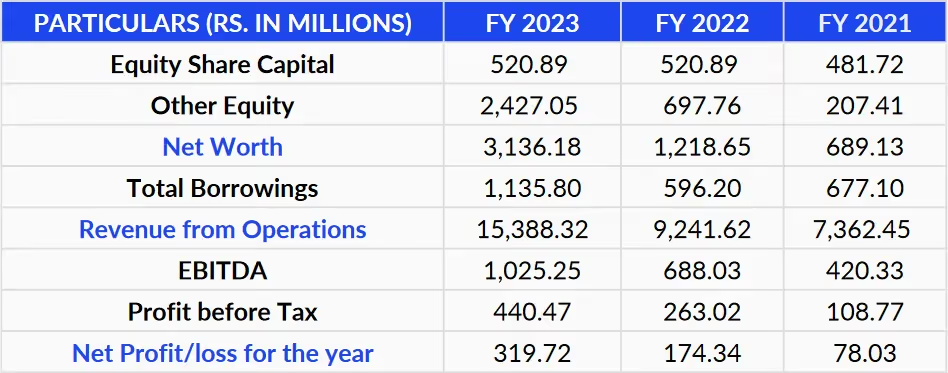
FINANCIALS (RESTATED CONSOLIDATED)
OUTLOOK & VALUATION
EPACK Durable is India's second-largest room air conditioner (RAC) ODM. The company boasts long-standing relationships with top customers, leverages advanced vertically integrated manufacturing and possesses robust product development capabilities. EPACK Durable prioritizes continuous product portfolio expansion. And its consistent financial performance demonstrates operational efficiency and growth potential.
However, some key risks warrant consideration. The company's dependence on a limited number of major customers. Additionally, the RAC industry is highly competitive, and the business experiences seasonal fluctuations.
The issue is fully priced at a P/E valuation of 56.4x; thus, considering all the factors ,we recommend that investors apply for this IPO with a mid- to long-term view. However, they should carefully evaluate their risk tolerance and current market sentiments.

इस सप्ताह फेड की अहम बैठक के अलावा दूसरे ग्लोबल फैक्टर महत्वपूर्ण होंगे
इस सप्ताह फेड की अहम बैठक के अलावा दूसरे ग्लोबल फैक्टर महत्वपूर्ण होंगे| भारतीय शेयर बाजार इस साल ग्लोबलमार्केट से बेहतर प्रदर्शनकर रहे हैं, लेकिन पिछला सप्ताह भारतीय शेयर बाजार के लिए एकशानदार सप्ताह रहा था, जहां निफ्टी और सेंसेक्स ने17,793 और 59,737 के अपने नएउच्चतम स्तर को छुआ, साथही बैंक निफ्टी भी अपने उच्चत्तमस्तर पर पहुंच गयाहै| टेलीकॉम क्षेत्र के लिए राहतपैकेज, बेड बैंक की घोषणा, एफआईआईद्वारा जोरदार खरीदारी, और बड़े पैमानेपर शॉर्ट-कवरिंग भारतीय शेयर बाजारों के बेहतर प्रदर्शनके प्रमुख कारण थे।
कैसा रहेगा यह सप्ताह?
बेहतरप्रदर्शन के बाद भारतीयबाजार के लिए अगलाहफ्ता महत्वपूर्ण होने जा रहा हैक्योंकि ग्लोबल बाजारों में कुछ कमजोरी है जहां 21-22 सितंबरको होने वाली एफओएमसी की बैठक कानतीजा एक महत्वपूर्ण फैक्टरहोगा। ऐसी संभावना है कि यूएसफेड बॉन्ड टेपरिंग की समय-सीमाके बारे में बात कर सकता हैजो नवंबर तक हो सकतीहै और इस वजहसे ग्लोबल इक्विटी बाजारों में सतर्कता देखने को मिल सकतीहै| चीन से मंदी केकुछ संकेत मिल रहे है जो भी चिंता का एक विषयहै, विशेष रूप से मेटल सेक्टरके लिए जहां अधिकांश मेटल शेयरों में पिछले सप्ताह से ही कमजोरी दिखाई देने लगी है। यूएस फेड के अलावा, बैंकऑफ जापान भी 22 सितंबर को अपनी मोनेटरी पॉलिसी जारी करेगा। अमेरिका और अन्य देशों में बढ़ते COVID-19 के मामले भी बाजार के मूड को बिगाड़ सकते हैं।
डॉलर इंडेक्स और अमेरिकी बांड यील्ड पर रहेगी नज़र
डॉलरइंडेक्स का उतार-चढ़ावऔर यूएस बॉन्ड यील्ड भारत जैसे उभरते बाजारों के चाल मेंअहम भूमिका निभाएंगे। डॉलर इंडेक्स 93.5 के महत्वपुर्ण रेसिस्टेन्सस्तर के आसपास कारोबारकर रहा है और अगरयह इस स्तर कोपार करने में सक्षम हो जाता हैतो हमे इसमे तेज उछाल की उम्मीद कर सकते हैं, इसके अलावा यूएस 10-ईयर बॉन्ड यील्ड भी निचले स्तरोसे उछाल के संकेत देरही हैं। यदि डॉलर इंडेक्स और बॉन्ड यील्ड में वृद्धि होगी तो एफआईआई की रणनीति को देखना महत्वपूर्ण होगा क्योंकि हमने पिछले कुछ दिनों में एफआईआई द्वारा बड़ी खरीदारी देखी है और इससेलार्ज-कैप शेयरों में अच्छी तेजी आई है।
टेक्निकलआउटलुक
हमएक मजबूत बुल मार्केट में हैं और हमारा माननाहै कि यह अगले2-3 वर्षों तक जारी रहसकता है, लेकिन लंबे समय के बाद, कुछ फैक्टर ऐसे हैं जो संकेत देते हैं कि बाजार मेंएक शार्ट टर्म करेक्शन देखने को मिल सकताहै| निफ्टी मिडकैप इंडेक्स 30500 के रेजिस्टेंस सेपलट रहा है और निफ्टीमें भी 17800-17850 रेजिस्टेंस जोन के पास कुछ बिकवाली का दबाव देखा गया|
निचे की ओर 17,430-17,250 एक महत्वपूर्ण सपोर्ट क्षेत्र है; इससे नीचे, हमें बाजार में कमजोरी देखने को मिल सकती है और निफ़्टी 16,700 के स्तर की ओर अग्रसर हो सकता है, जबकि अगर निफ्टी 17,800-17,850 क्षेत्र के ऊपर निकलने में कामयाब हो जाता है तो हम उम्मीद कर सकते हैं कि यह 18000 के लेवल तक जा सकता है|

भू-राजनीतिक तनाव के कारण कीमती धातुओं को समर्थन
मिडिल ईस्ट में तनाव बढ़ने के चलते सोने और चांदी के भाव को सपोर्ट मिला हुआ है और कीमते हल्के दबाव के साथ सीमित दायरे में बनी हुई है। अमेरिका से जारी मुद्रास्फीति के आंकड़े अनुमान से बेहतर दर्ज किये गए, लेकिन भू -राजनितिक तनाव के चलते बुलियन की कीमतों में गिरावट सीमित रही। हालांकि, सप्ताह के अंत में सोने की कीमतों में कुछ मजबूती देखी गई, लेकिन अमेरिकी ब्याज दरों को लेकर अनिश्चितता के बीच, कीमते 0.5 प्रतिशत की गिरावट के बाद 62250 रुपये प्रति दस ग्राम रही। चांदी की कीमते भी पिछले सप्ताह 1 प्रतिशत मंदी रहने के बाद 72000 रुपये प्रति किलो पर कारोबार करती रही। उपभोक्ता मूल्य सूचकांक आकड़ो ने पिछले गुरुवार को स्पष्ट किया कि अमेरिकी मुद्रास्फीति दिसंबर में उम्मीद से थोड़ी अधिक बढ़ी, जो श्रम बाजार में हालिया लचीलेपन के साथ मिलकर, फेडरल रिजर्व को ब्याज दरों में जल्दी कटौती शुरू करने के लिए कम प्रोत्साहित कर सकती है। जबकि कई फेड अधिकारियों ने यह भी स्पष्ट किया कि प्रारंभिक दर में कटौती पर दांव अत्यधिक आशावादी है। हालांकि केंद्रीय बैंक द्वारा इस साल के अंत तक ब्याज दरों में कटौती की उम्मीद की जा रही है, लेकिन इस कदम का समय मुद्रास्फीति में कमी और श्रम क्षेत्र में नरमी पर निर्भर करेगा। अमेरिकी मुद्रास्फीति आकड़ो के बाद डॉलर इंडेक्स को सपोर्ट मिला और सोने-चांदी के भाव में स्थिरता रही।
तकनिकी विश्लेषण
इस सप्ताह सोने और चांदी की कीमतों में उछाल देखने को मिल सकता है। एमसीएक्स फ़रवरी वायदा सोने में सपोर्ट 61000 रुपये पर है और रेजिस्टेंस 64000 रुपये पर है। मार्च वायदा चांदी में सपोर्ट 69000 रुपये पर है और रेजिस्टेंस 74000 रुपये पर है।

अमेरिकी डॉलर और ट्रेज़री यील्ड में तेज़ी से दबाव में कीमती धातुए
अमेरिकी डॉलर इंडेक्स में निचले स्तरों से उछाल आने के बाद सोने और चांदी की कीमतों में पिछले सप्ताह दबाव बना रहा। फेड के मीटिंग मिनट्स में सभी फेड सदस्यों की ब्याज दर कटौती को लेकर एकमत रहे, लेकिन ब्याज दर कटौती का समय स्पष्ट नहीं रहा, जिससे अमेरिकी डॉलर इंडेक्स और ट्रेज़री यील्ड में तेज़ी रही और कीमती धातुओं के भाव में गिरावट दर्ज की गई। हालांकि, 2023 के आखिरी कुछ दिनों में सोने में जोरदार तेजी देखी गई, इस आशावाद के बीच कि फेड मार्च 2024 की शुरुआत में दरों में कटौती शुरू कर सकता है। लेकिन नए साल की शुरुआत में कीमती धातुओं को कुछ मुनाफावसूली का सामना करना पड़ा, जबकि निवेशकों ने केंद्रीय बैंक से शुरुआती दरों में कटौती की उम्मीदों को भी कुछ हद तक कम कर दिया है। फेड मीटिंग के मिनट्स के बाद से ही सोने और चांदी में गिरावट देखि जा रही है, मिनट्स में कुछ संकेत दिए गए कि बैंक इस साल दरों में कटौती कब शुरू करेगा। जबकि अधिकांश फेड अधिकारियों ने 2024 में ब्याज दरों में 75 आधार अंकों तक की कटौती देखी, जबकि दर में कटौती के समय पर बहुत कम सहमति रही। 2024 की शुरुआत में सोने में कुछ कमजोरी देखी गई, फिर भी यह 2023 के 10 प्रतिशत से अधिक की बढ़त पर है। इस साल ब्याज दरों में कमी से कीमती धातुओं को लाभ होने की उम्मीद है, क्योकि उच्च दरें खरीदने की अवसर लागत को बढ़ा रही थी।
तकनिकी विश्लेषण
इस सप्ताह सोने और चांदी की कीमते दबाव में रह सकती है। एमसीएक्स फ़रवरी वायदा सोने में सपोर्ट 61000 रुपये पर है और रेजिस्टेंस 64000 रुपये पर है। मार्च वायदा चांदी में सपोर्ट 69000 रुपये पर है और रेजिस्टेंस 74000 रुपये पर है।

साल 2024 सोने-चांदी के लिए बेहतर रहने की सम्भावना।
2023 के मध्य के दौरान मौद्रिक नीति पर फेड का लहजा सख्त था, जिसने सोने में तेजी को सीमित कर दिया। हालांकि, 2023 के अंत में, फेड ने संकेत दिया कि उन्होंने दर वृद्धि पूरी कर ली है और 2024 में ब्याज दरों में कटौती शुरू कर देंगे, जिससे पिछले तीन सप्ताह से सोने की कीमतें बढ़ रही हैं। जब ब्याज दरें कम रहती हैं, तो मुद्रास्फीति बढ़ने लगती है, जिससे बाद में सोने की कीमतें बढ़ जाती हैं। 2024 में, फेड मौद्रिक नीति पर डोवीश रहेगा, जो सोने की तेजी के लिए अनुकूल स्थिति होगी। वर्तमान में सोना और इक्विटी दोनों रिकॉर्ड ऊंचाई पर चल रहे हैं, घटती ट्रेजरी यील्ड, अमेरिकी डॉलर में गिरावट और आगामी वर्ष में कम ब्याज दरों की उम्मीद के कारण सोने की कीमतों को समर्थन मिलता रह सकता है। साल 2023 के भू-राजनीतिक मुद्दे और क्षेत्रीय संघर्ष साल 2024 में भी जारी रह सकते है, जिससे सोने की कीमतें और भी ऊंचे स्तर पर पहुंच सकती हैं। साल 2023 में चांदी की कीमतें 70000 रुपये से 77000 रुपये के दायरे में रहीं, जो अगले वर्ष के लिए संचय का संकेत देते है। हालांकि, सोने-चांदी के अनुपात ने चांदी की धारणा को नुकसान पहुंचाया है। कम ब्याज दरें और भू-राजनीतिक कारक 2024 में चांदी की कीमतों का समर्थन कर सकते है। कम खदान उत्पादन, उच्च मांग की उम्मीद और मंदी की आशंका के बीच अर्थव्यवस्था की वृद्धि, चांदी की कीमतों का समर्थन कर सकती है। इस साल अर्थव्यवस्था में वृद्धि चांदी की कीमतों के लिए प्रमुख चालक हो सकती है। निवेशकों ने ब्याज दरों में बढ़ोतरी के दौरान मंदी का डर देखा है, लेकिन वह डर सच नहीं हुआ है। उच्च ब्याज दरों के बावजूद, अमेरिकी अर्थव्यवस्था अच्छा प्रदर्शन कर रही है, और फेड की नरम मौद्रिक नीति अर्थव्यवस्था को समर्थन देगी, जिससे आगामी वर्ष में चांदी की मांग बढ़ सकती है।
तकनिकी विश्लेषण
इस सप्ताह सोने और चांदी की कीमते सीमित दायरे में रह सकती है। एमसीएक्स फ़रवरी वायदा सोने में सपोर्ट 61500 रुपये पर है और रेजिस्टेंस 64000 रुपये पर है। मार्च वायदा चांदी में सपोर्ट 71000 रुपये पर है और रेजिस्टेंस 76000 रुपये पर है।

Azad Engineering IPO: Date, Price, GMP, Review, Details
Azad Engineering manufactures and supplies high-precision forged and machined components to global original equipment manufacturers (“OEMs”) in the energy, aerospace, defense, and oil and gas industries, manufacturing highly engineered, complex, and mission and life-critical components. The Company’s products include 3D rotating airfoil/ blade portions of turbine engines and other critical components.

OBJECTS OF THE ISSUE
- Funding capital expenditure of the Company.
- Payment of certain of the borrowings availed by the Company.
KEY MANAGERIAL PERSONNEL
Rakesh Chopdar
Chairman and CEO of the Company. He has completed his education until the 10th standard from Trinity Public School, Hyderabad, Telangana. He has been involved with the Company since 2003 and has more than two decades of experience in engineering and manufacturing activities.
Ronak Jajoo
Chief Financial Officer of the Company. He has previously worked with Pransa Financial Consultants Private Limited as vice president. He joined the Company on April 15, 2021.
Ful Kumar Gautam
Company Secretary and Compliance Officer of the Company. He has passed the examination in relation to bachelor’s degree in commerce (insurance) from Loyola Academy Degree & P.G. College and is an associate member of the Institute of Company Secretaries of India. He is also an associate member of the Insurance Institute of India.
COMPANY PROFILE
- Azad Engineering’s components have been supplied to countries such as the USA, China, Europe, the Middle East, and Japan since its inception.
- Its customers include global OEMs across the energy, aerospace, defense, and oil and gas industries such as General Electric, Honeywell International Inc., Mitsubishi Heavy Industries, Ltd., Siemens Energy, Eaton Aerospace, and MAN Energy Solutions SE.
- The demand for its precision, forged and machined components is driven by requirements relating to energy turbines (industrial, gas, nuclear, and coal), and aircraft (commercial and military), amongst others.
- In the energy industry, its Company produces high-precision rotating and stationary 3D airfoils/ blades, special machined parts, and combustion component assemblies.
- Its aerospace and defense products include airfoils/ blades and components for engines, auxiliary power units (“APUs”), hydraulics, actuating systems, flight controls, fuel, and inerting sections of commercial and defense aircraft and spacecraft.

COMPETITIVE STRENGTHS
- A preferred name in the manufacturing of highly engineered, complex, and mission and life-critical high- precision components for global OEMs.
- Supplying to OEMs with high global market penetration.
- Long-standing and deep customer relationships.
- Advanced manufacturing facilities with a diverse range of products and solutions.
- Consistent track record of financial performance.
- Experienced Promoter and management team backed by marquee investors.
KEY STRATEGIES
- Leverage its industry-leading capabilities by continuing to diversify its customer base.
- Augment its manufacturing capabilities, including by way of inorganic acquisitions.
- Strengthening its core capabilities across the focus industries.
- Further reduce operating costs, improve operating efficiencies, and deploy new technologies.
KEY CONCERNS
- Business is dependent on the sale of its products to key customers.
- The Company faces competition globally in its business against other manufacturers of high precision and mission-critical components manufacturing.
- The global nature of its operations exposes it to numerous risks that could materially adversely affect its business.
- There may be problems with the products it manufactures that could result in liability claims against it.
- It is subject to strict compliance with quality requirements which results in incurring significant expenses to maintain its product quality.
- The company had negative cash flows in prior periods and may continue to have negative cash flows in the future.
COMPARISON WITH LISTED INDUSTRY PEERS (AS ON 31ST MARCH 2023)

FINANCIALS (RESTATED CONSOLIDATED)

OUTLOOK & VALUATION
Azad Engineering stands as a prominent player within its segment, boasting strong, long-standing relationships with renowned global OEMs. Its diverse product offerings and technologically advanced manufacturing facilities position it for continued growth. Additionally, the company's consistent financial track record instills confidence.
However, investors should carefully consider potential risk factors. Stringent compliance and quality requirements inherent in the business, reliance on a limited number of key clients, and global market exposure all require careful monitoring.
Currently, the IPO is fully priced at a P/E ratio of around 50x. While this may appear fully priced, Azad Engineering's strong market position, promising future growth prospects, and current optimistic market sentiment could still present a potential opportunity for investors. Thus, we suggest Subscribe rating for this IPO.
Big Budget


Popular Articles





.avif)
.avif)

.avif)



START YOUR INVESTMENT JOURNEY
Get personalized advice from our experts
- Dedicated RM Support
- Smooth and Fast Trading App
