


Inside the IPO Filing Process from DRHP to Listing Day


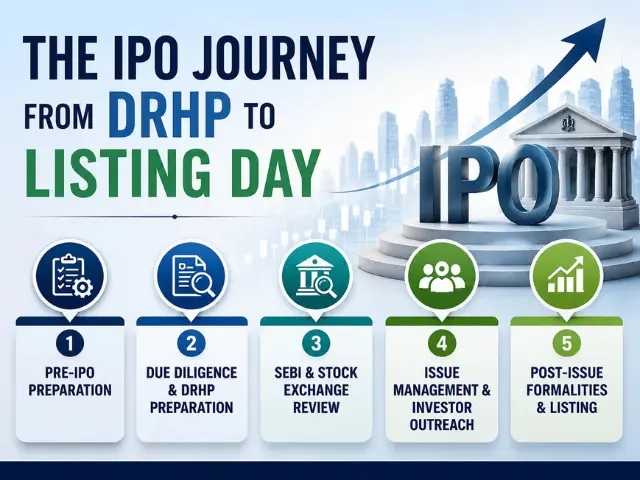

An IPO is often perceived as a single event. In reality, it is a tightly regulated capital markets transaction that tests a company’s governance, financial maturity and disclosure standards. Long before the stock lists, months of preparation go into drafting, verification, regulatory review and investor positioning.
Why the Filing Process Matters
The offer document is the backbone of the IPO. For SEBI, it is a legal disclosure document. For investors, it is the primary source of truth.For the company, it becomes a permanent public record. Gaps in statutory disclosures or inconsistencies in financial reporting may result in approval delays and affect investor confidence.
Phase I: Pre IPO Preparation
The IPO process begins well before drafting the prospectus. At this stage, the company prepares itself to operate as a listed entity. Key actions include finalising the issue structure, converting into a public limited company, updating constitutional documents, strengthening board and committee structures, appointing key managerial personnel and dematerialising shareholding.
Phase II: Due Diligence and DRHP Preparation
This is the most intensive stage of the IPO journey. The Merchant Banker conducts detailed financial, legal and business due diligence, followed by preparation of the Draft Red Herring Prospectus covering company profile, industry overview, risks, financials and utilisation of proceeds.
Phase III: SEBI and Stock Exchange Review
SEBI, along with the stock exchanges, reviews the DRHP to ensurefull and fair disclosures, eligibility, and governance compliance. All queries and observations are addressed before final In-Principal approval.
Phase IV: Issue Management and Investor Outreach
Post regulatory clearances, the Red Herring Prospectus is finalised and the issue pricing is decided. Merchant Bankers, working closely with syndication and underwriting teams, drive investor outreach and roadshows, while market makersplay a role in supporting orderly trading and liquidity (in case of SME-IPO), in line with applicable issue regulations.
Phase V: Post Issue Formalities and Listing
After the issue closes, the basis of allotment is finalised, funds are reconciled by the banker to the issue, and shares are credited to investors’ demat accounts. In cases of oversubscription, allotment is carried out as per category-wise allocation norms, with proportionate or lottery-based distribution and refunds/unblock of excess application amounts. The company then lists on the stock exchanges and enters the post-listing compliance framework. Syndication and underwriting teams continue to support investor engagement, while issuer-led marketing and investor interactions remain ongoing. Anchor investors participate up to one working day prior to the issue opening, helping establish early demand visibility and confidence in the offering.
Role of the Merchant Banker
The Merchant Banker anchors the IPO end-to-end, beginning with comprehensive due diligence and preparation of offer documentation. They act as the primary interface with SEBI and Stock Exchanges, provide valuation and structuring advice, and lead investor marketing efforts. In coordination with syndication and underwriting teams, the merchant banker supports book building, demand aggregation, and risk underwriting. Post listing, they also facilitate market-making arrangements and ensure regulatory and compliance requirements are met, enabling a smooth transition from a privately held company to the public markets.
Closing Thoughts
The IPO process shows how ready a company is to operate in public markets. With the right Merchant Banker guiding the company at every stage, the journey becomes well-planned and manageable, helping the business move smoothly into the listed space and build long-term, sustainable growth.
👉 To Connect with us today, please click here.
Latest Articles

Women's Day Exclusive: Top 10 Investment Picks for Indian Women


In today’s world, it is extremely important for a woman to achieve financial liberty and independence. For those with an impactful career and becoming an essential part of the workplace, financial empowerment is just as much an essential factor for a secured future; something that is applicable to the homemakers as well.
We believe that each and every woman must give thought to grow financially and secure their positions for the long term. This can be achieved by making the right investment decisions.
In fact, making investments related to market-linked instruments can serve as a constant income source like a simple job for ladies.
In India, there are plenty of investment options available that offer long-term benefits to long-term investors. However, everyone should understand how and where to invest their hard-earned money.
Investment options such as mutual funds and stocks help women in creating and incrementing and compounding liquid cash reserves. Financial instruments such as Fixed Deposit, PPF, and EPF can help in saving your money while saving one’s money.
Also, several investment options can be used to generate constant monthly income, by earning interest on the principal amount. Apart from this, investing in fixed assets can generate financial security over the years.
Here are the top 10 investment vehicles that can secure and empower Indian Women financially:
1. Public Provident Fund:
PPF is still considered one of the most popular investment plans in India. This scheme is available in post offices and banks.
This low investment scheme has a tenure of 15 years with an interest rate of 7.1% Also, the PPF scheme helps one to save a lot of tax. This is because an investment amount in PPF can be claimed for a tax deduction under Section 80c of the Income Tax Act.
The annual investment amount of the PPF scheme ranges from ₹500 to ₹1.5 Lakh.
The biggest benefit of investing in a PPF account is its flexibility. i.e once can withdraw 50% of the amount after completing 5 years in investing in the PPF scheme.
Furthermore, the accumulated interest amount and principal are also exempted from tax at the time of withdrawal.
2. National Pension Scheme:
NPS or National Pension Scheme is a long-term retired pension scheme that is movable across locations and jobs. That means you don’t require to change your fund while locating to another city or state.
The investment product is fully managed by the Pension Fund Regulatory and Development Authority (PFRDA). One of the prime benefits of having NPS is that you can generate returns from equity and debt.
While in PPF, you can only invest solely in interest-earning instruments.
The minimum annual contribution for an NPS tier I to remain active has been reduced to ₹1000 from ₹6000.
NPS is a mix of fixed deposits, corporate bonds, equities, corporate bonds, liquid funds, government funds and more.
3. Direct Equity:
Investing in stocks might not be everyone’s cup of tea but it is considered one of the most attractive options due to huge returns. In fact, a stock’s investment carries higher risk as it can generate higher returns.
Also, you can generate a yearly return of 15% - 18% from the stocks you invest in. For better investment, it is suggested to invest in the right stocks at the right time.
4. Employees’ Provident Fund
Employees’ provident fund is one of the best investment options for working women as with the help of schemes they can easily avail of tax benefits and gather tax-free savings.
According to the Government of India, new women employees are required to contribute only 8% instead of 10% for the first three years. This will certainly increase their take-home pay.
Under Section 80C of the Income Tax Act, the annual contribution up to ₹1.5 Lakh which you make towards the EPF account is free from tax.
5. Equity Linked Savings Scheme
Equity-linked savings schemes allow you to generate a higher rate of return about 15% to 18%. If we talk about the lock-in period, ELSS allows you to store away for just 3 years.
Any earnings that exceed ₹1 lakh are taxable. For better returns, one should keep in mind that ELSS can provide you with long term capital gains and taxed at 10%.
6. Bank Fixed Deposits
Bank Fixed deposits are another good investment for women that is available with both public and private sector banks. The investment amount and tenure are decided by the investor.
However, the interest rate of these deposits varies from bank to bank. As the investments have no maximum limits, fixed deposits can be broken and the amount can be withdrawn before the maturity date.
However, if one breaks the deposit before the completion of its tenure then it will affect the interest rate which is earned on the principal amount.
7. Mutual Funds
Mutual funds are also considered a good investment option, especially for women. Here, the investment amount is managed by the fund experts.
With SIP investment, you can earn subsequent wealth over a period of time, which reduces losses and maximizes ROI.
In mutual funds, investors can select the top funds offered by banks and numerous financial institutions. Also, it gives investors an opportunity to make choices from the products according to their requirements.
Mutual funds work on a strategy called a systematic investment plan or SIP wherein a specific amount is invested every month.
The key benefit of using SIP is to avoid huge losses.
8. Unit Linked Insurance Plan
Unit Linked Insurance Plan is the best way to create wealth with an addition to a life cover. The premiums that one pays for ULIP are eligible for deductions under section 80C.
Also, the return on maturity is exempted under section 10 10 (D). The returns generated from ULIP vary from the types of funds selected whether one opts for hybrid, debt or debt funds. Returns generated through ULIP are tax-free and could be quite impressive if the stock market performs well.
9. Gold
Buying gold is often considered a good investment option for Indian women. Although Gold prices are dynamic in nature, they can be considered as the safest instruments to invest in the long run.
Investment in gold requires no fixed quantity, which means as little as 5-gram gold coin in a year. Investing in gold gives you liquidity as when the price increases in the future, these coins can be exchanged either for cash or jewellery depends on the requirement.
10. Post Office Monthly Savings Scheme
Post office monthly income scheme aka Post office fixed deposit scheme is backed by the Government of India. This scheme holds a tenure of 5 years and the interest rate that is earned on this scheme is 6.9% per annum.
The minimum amount that can be deposited in the scheme is ₹1000 and the maximum amount that can be deposited is ₹1, 50, 000 per year.
Women spend 90 percent of their income on their families, and economically empowered women boost demand, have healthier and better-educated children, and raise human development levels.
On this women’s day, we firmly believe it is our moral obligation to empower women, to empower our Nation.

सोने की कीमतें 10 माह के निचले स्तरों पर पहुंची।
कीमती धातुओं के भाव मे मध्यवर्ती ट्रेंड की गिरावट जारी है। घरेलु वायदा मे सोने के भाव पिछले सप्ताह 1500 रुपय प्रति दस ग्राम तक टूट कर 44200 रुपय के निचले स्तरों को छू गए है।
चाँदी के भाव पिछले सप्ताह 3000 रुपय प्रति किलो तक टूट कर 65500 रुपय के स्तरों पर पहुंच चुके है। कॉमेक्स वायदा सोना और चाँदी मे पिछले सप्ताह क्रमशः 2.5 प्रतिशत तथा 4 प्रतिशत की गिरावट देखि गई है। डॉलर की तुलना मे रुपया 1.5 प्रतिशत तक सप्ताह मे मजबूत हुआ है।
कीमती धातुओं मे गिरावट का कारण
अमेरिकी बॉन्ड यील्ड मे लगातार चार महीनों से तेज़ी जारी है। पिछले सप्ताह 10 वर्षो की बॉन्ड यील्ड 1.58 प्रतिशत के ऊपरी स्तरों को छू गई है। सोने के विपरीत दिशा मे चलने वाला डॉलर इंडेक्स सप्ताह मे 1.5 प्रतिशत मजबूत हो कर चार महीने की उचाई पर पहुंच गया है। केंद्रीय बैंक का ध्यान अब मुद्रास्फीति पर शिफ्ट होने लगा है। लेकिन, बढ़ती दरे और अर्थव्यवस्था मे सुधार सोने पर दबाव बना रही है।
इसी समय कोविड-19 टीकों के बड़े पैमाने पर लगने से वैश्विक सुधार की उम्मीद बढ़ी है जिससे निवेशकों को पारंपरिक सुरक्षित मांग से अन्य संपत्तियों में निवेश करने के लिए प्रेरित किया है। कुछ निवेशक स्पष्ट रूप से बिटकॉइन और डिजिटल संपत्ति को सोने मे निवेश के विकल्प के रूप में देख रहे है।
फ़ेडरल रिज़र्व के प्रमुख जेरोम पॉवेल के बयान के बाद कीमती धातुओं मे गिरावट बढ़ गई, पॉवेल ने लंबी अवधि की यील्ड बढ़त पर किसी तरह का जोर नहीं दिया जिससे, इनमे बढ़त कायम रही। उन्होंने कहा कि वह वित्तीय स्थितियों की निगरानी कर रहे हैं और बाजारों की अव्यवस्थित चाल पर विचार कर रहे है।
सोने की घरेलु मांग बढ़ी:
भारतीय गहनों की मांग दो दशक के निचले स्तरों से बढ़ना शुरू हुई है, जिसमें सोने की कीमतें मनोवैज्ञानिक रूप से महत्वपूर्ण स्तर 50,000 रुपये प्रति 10 ग्राम से नीचे आ गई है, जिसने पिछले साल भारत मे खरीदारों को सोने से दूर रखा था। सोने के भाव सस्ते होने से, चीन में सोना अब लंदन की कीमतों से प्रीमियम पर है, जो मांग में सुधार का एक और संकेत है। विकासशील देशो की बढ़ती आय और सोने की खदानों मे घटता उत्पादन लंबी अवधि मे मांग बढ़ा सकता है।
साप्ताहिक तकनीकी विश्लेषण
इस सप्ताह कीमती धातुओं के भाव मे बिकवाली का दबाव रह सकता है। सोने मे 43800 रुपय के निचले स्तरों पर सपोर्ट है तथा 45000 रुपय पर प्रतिरोध है। चाँदी के भाव मे भी मंदी रह सकती है। इसमें 64500 रुपय पर सपोर्ट और 67500 रुपय पर प्रतिरोध है।
REDINGTON (INDIA) LIMITED
From a “Broadline Distributor” to a “Value Added Distributor” to a “Services & Solutions Company”
Redington is a leading distributor of technology & communication products and provider of services and solutions across 37 emerging markets, Redington will get a positive push government is preparing to unveil another incentive to drive local manufacturing of IT products including tablets, laptops and servers, three sources closely involved in the drafting of the plan told Reuters.
The new performance-linked incentive (PLI) scheme, which offers cash-back to manufacturers for exports, will have a budget of up to 70 billion rupees ($964.5 million) over five years. It's expected to be launched by the end of February.
REDINGTON INDIA -
- 1 Technology distributor in Middle East Asia and No.2 in India
- An Emerging Markets player with an in-country presence
- Expanding the reach & coverage for over 230+ brands
- Portfolio of Marquee brands
- The rich product portfolio consists of diversified Brands and diversified product categories under the same brand.
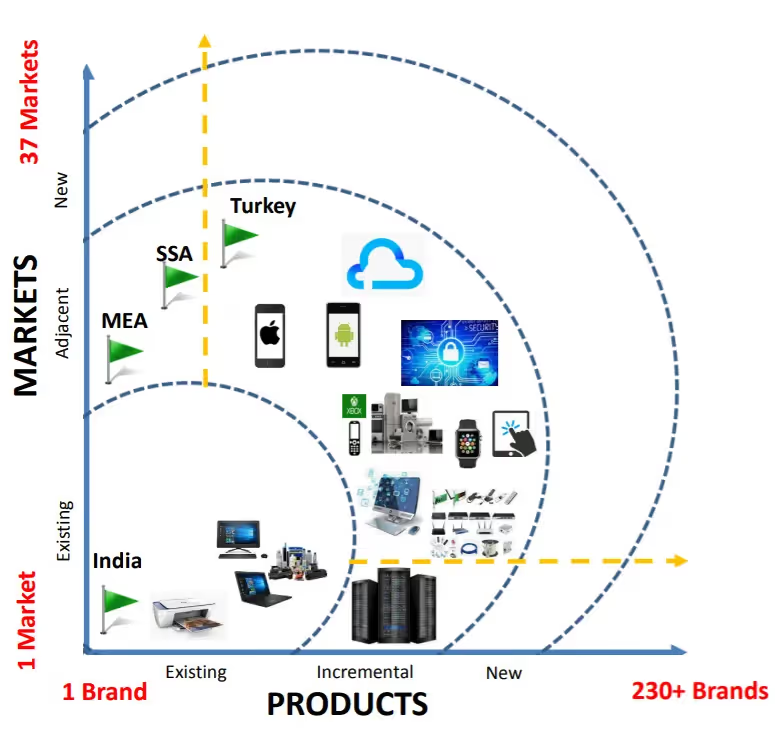
- Strong and seamless partnerships through 38,230+ partners - Their strong and seamless partnerships and dynamic business model ensure that we stay relevant in the everchanging technological environment.
- Entering into new lines of business - Foraying into new lines of businesses, leading to incremental growth as well as diversification of risk
- Multiple overseas and Indian Subsidiaries- Presence in multiple markets ensures diversification of risk as well as ensuring Kaizen’s continuous improvement.
IT Consumer Business -
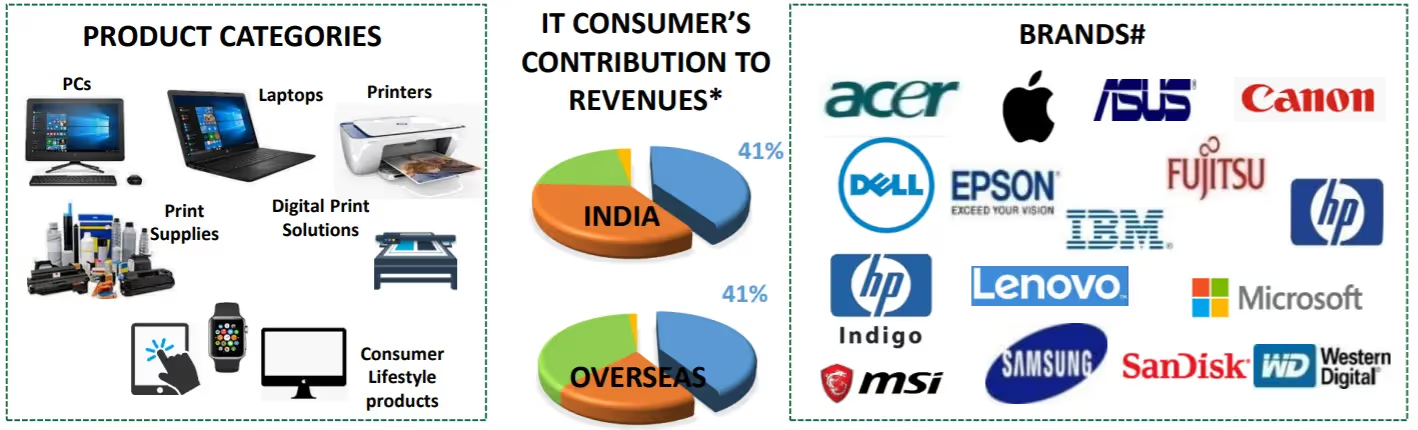
IT Enterprise Business -
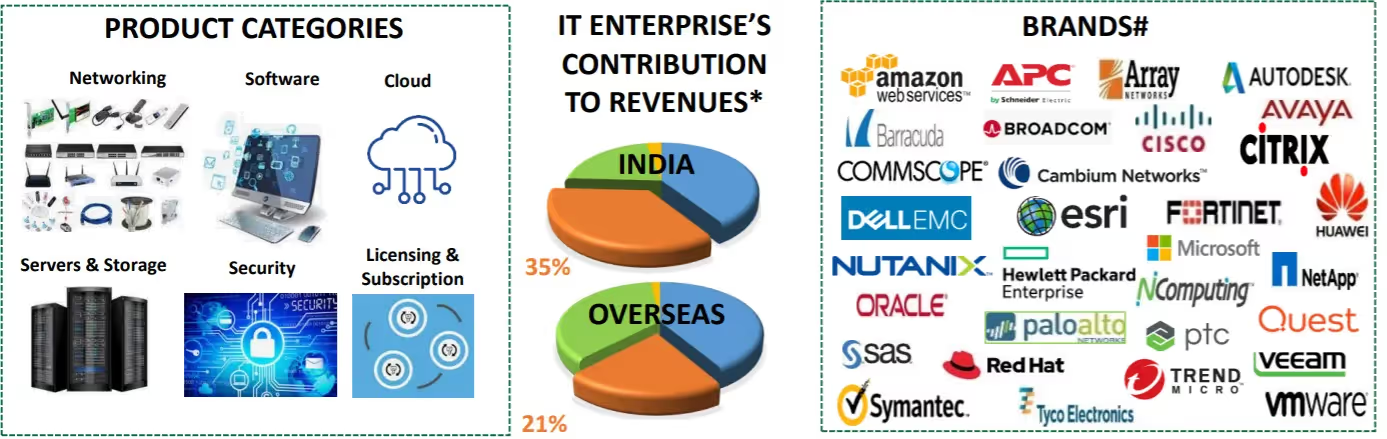
- Redington Cloud Business - Unified Digital Cloud Platform, Investments in Manpower, Redington Managed Cloud Solutions, Redington Cloud Academy

Services Business
ProConnect India -
- Wholly Owned Subsidiary of Redington
- Integrated Third Party Logistics partner
- PAN India presence
- 160+ Warehouses
- 20+ Customers across 12+ Industries
MTAR Technologies Limited IPO
Incorporated in 1999, MTAR Technologies is a leading national player in the precision engineering industry. The company is primarily engaged in the manufacturing of mission-critical precision components with close tolerance and in critical assemblies through its precision machining, assembly, specialized fabrication, testing, and quality control processes.
Since its inception, MTAR Technologies has significantly expanded its product portfolio including critical assemblies i.e. Liquid propulsion engines to GSLV Mark III, Base Shroud Assembly & Airframes for Agni Programs, Actuators for LCA, power units for fuel cells, Fuel machining head, Bridge & Column, Drive Mechanisms, Thimble Package, etc. A wide range of complex product portfolios meets the varied requirements of the Indian nuclear, Defense, and Space sector. ISRO, NPCIL, DRDO, Bloom Energy, Rafael, Elbit, etc. are some of the esteem clients.
Currently, the firm has 7 state-of-the-art manufacturing facilities in Hyderabad, Telangana that undertake precision machining, assembly, specialized fabrication, brazing and heat treatment, testing and quality control, and other specialized processes.
Product Portfolio:
Nuclear sector
- Fuel machining head: Used for loading and unloading of fuel bundles in nuclear reactors
- Bridge and column
- Grid plate
- Sealing plug, shielding plug, liner tubes and end fittings
- Drive Mechanisms
Customer Sector
- Ball screws and water-lubricated bearings
- Base shroud assembly and airframes
- Various missile parts
- Valves
- Cryogenic engines (turbopumps, booster pumps, gas generators and injector heads for such engines)
- Ball screws and water-lubricated bearings
Strength of the company:
- Wide range of product portfolio.
- 7 Modern technology manufacturing units.
- Diversified supplier base.
- Strong financial track record.
- Experienced and qualified management.
Risks Relating to Industry
- Company depend on a limited number of customers for a significant portion of their revenue. The loss of one or more of their significant customers or a significant reduction in demand for their products from such significant customers.
- The company depend significantly on orders from the NPCIL, ISRO and DRDO. A decline or re-prioritization of funding in the Indian budget towards the respective departments of the Government of India under which these customers operate or delays in the budget process could adversely affect their ability to grow or maintain our sales, earnings, and cash flow.
- The company primarily rely on purchase orders to govern the volume and other terms of the sales of their products. The company do not have long-term supply agreements with its customers.
- The company are subject to strict quality standards. Any failure to comply with such quality standards may lead to the cancellation of existing and future orders which may adversely affect their reputation, financial conditions, cash flows and results of operations.
- The company could make investments and acquisitions in the future that involve considerable integration costs. The company may be unable to sustain, manage or realize the expected benefits of such growth or may not be able to fund that growth.
- Company may face claims and incur additional rectification costs for delays and/or defects in respect of their precision components and equipment
IPO Details:
IPO Date Mar 3, 2021 to Mar 5, 2021Issue Type Book Built Issue IPO Issue Size Equity Shares of Rs.10 totaling up to Rs. 596.41 Crore Fresh Issue Equity Shares of Rs.10 totaling up to Rs. 123.52croreOffer for Sale Equity Shares of Rs.10 totaling up to Rs.472.89 crore Face Value Rs.10 per equity share IPO Price Per Equity Share: Rs. 574-575 Min Order Quantity 26 Listing At BSE, NSE
IPO Objective :
The company proposes to utilize the Net Proceeds from the Fresh Issue towards funding the following objects:
- Repayment/prepayment in full or in part, of borrowings availed by our Company
- Funding working capital requirements; and
- General Corporate Purposes
Financial Performance:
Particulars For the year/period ended (₹ in million)31-Dec-2031-Mar-2031-Mar-1931-Mar-18 Total Assets3,819.143,462.713,051.582,810.32Total Revenue1,779.912,181.421,859.101,605.45Profit After Tax280.69313.18391.9954.23
Tentative Time Table:
IPO Opening Date: 3rd March 2021IPO Closing Date: 5th March 2021Finalisation of Basis of Allotment: 10th March 2021Initiation of refunds: 12th March 2021Transfer of shares to Demat account: 15th March 2021Listing Date: 16th March 2021
Outlook:
Hyderabad-based MTAR Technologies is a leading player in the precision-engineering industry develops and manufactures equipment for the defense, aerospace, clean energy, and nuclear energy sectors.
The company has long-standing relationships of over three to four decades with customers such as the Indian Space Research Organization (“ISRO”) and the Defense Research and Development Organization (“DRDO”), and have been able to supply specialized products to the Indian space programmes and the Indian missile programme, respectively.
The company’s aggregate Order Book as of November 30, 2020, was Rs.356 crores, comprising Order Book in the nuclear, space and defence, and clean energy sectors of Rs.93 crores, Rs.172 crores and Rs.86 crores respectively. These numbers signify the strength of the company. When it comes to Clean energy which is a boom these days, accounts for 64.34% of its revenues in FY2020 which also depicts its strong hold in the Clean energy sector.
The company is also focusing on its expansion plans and for the same, it is establishing an additional manufacturing facility at Adibatlaand in Hyderabad which is expected to become operational in Fiscal 2022.MTAR Technologies owns a large range of equipment, resulting in increased fixed costs.
When it comes to the financial performance of MTAR Technologies over the last three years highlights significant growth. The total revenue of the company showed a 3-year CAGR growth of 16.57%. Further, between 2018 and 2020, the profit after tax grew at a staggering CAGR of 14.39%. Also, the company’s total assets grew at a CAGR of 11%. The company’s Earnings Per Share is 11.11 and the Price to Earnings ratio stands at 51.75. As a niche player, the company is expected to gain fancy after the listing as it will be the first company to list in this segment.

Easy Trip Planners Limited IPO
Easy Trip Planners is the company behind the online travel booking portal EaseMyTrip.com. The company offers a comprehensive range of travel-related products and services for end-to-end travel solutions, including airline tickets, hotels and holiday packages, rail tickets, bus tickets and taxis as well as ancillary value-added services such as travel insurance, visa processing and tickets for activities and attractions.
As of 30 November 2019, it provided customers with access to more than 400 international and domestic airlines, more than 1,096,400 hotels in India and in international jurisdictions, almost all the railway stations in India as well as bus tickets to and taxi rentals for major cities in India.
The company is among the leading online travel agencies in India in terms of gross booking revenues and had a market share of approximately 3.8%, and 4.5% to 5% in terms of gross booking revenues and gross booking revenues for the airline ticketing segment in India during FY2019.
The company focuses on the B2B2C (business to business to customer), B2C (business to customer), and B2E (business to enterprise) distribution channels.
Product Portfolio:
The company’s products and services are organized primarily in the following segments:
Airline tickets, which consist of the sale of airline tickets as well as airline tickets sold as part of the holiday packages; Hotels and holiday packages, which consist of standalone sales of hotel rooms as well as travel packages (which may include hotel rooms, cruises, travel insurance, and visa processing); and Other services, which consist of rail tickets, bus tickets, taxi rentals and ancillary value-added services such as travel insurance, visa processing and tickets for activities and attractions.
Strengths of the Company
- One of the leading online travel agencies in India.
- Strong brand name and distribution network.
- In-house advanced technology infrastructure.
- Consistent financial track record and operational performance.
RISKS RELATING TO BUSINESS
- Any impact on airline bookings can adversely impact the revenue of the company.
- Any reduction in the commission of GDS and API service providers can affect the company’s business and growth.
- Any disruption to the supply of air, train, and bus tickets could adversely affect operations, turnover, and profitability.
- Any failure to maintain the quality of customer service and deal with complaints could adversely affect its business and operating results.
IPO Details:
IPO Date March 8th, 2021 to March 10th, 2021 Issue Type Book Built Issue IPO Issue Size Eq Shares of ₹2(aggregating up to ₹510.00 Cr) Fresh Issue NIL Offer for Sale Eq Shares of ₹2(aggregating up to ₹510.00 Cr)Face ValueRs.2 per equity share IPO Price Rs.186 to Rs.187per equity share Min Order Quantity 80 Listing At BSE, NSE
IPO Objective:
- To achieve the benefits of listing the equity shares on the stock exchange
- To execute the sale of up to 2,72,72,727equity shares by the promoter selling shareholders aggregating up to Rs.510 Cr
Financial Performance:
Easy Trip Planners’ financial performance (in INR crore)FY2018FY2019FY20209M FY2021Revenue113.6151.1179.781.6Expenses103109.9132.239.7Net income02434.631.1Net margin (%)015.919.338.1
Tentative Time Table:
- Price Band announced on 3 March 2021
- Ease My Trip IPO Anchor List on 7 March 2021
- Ease My Trip IPO Opens on 8 March 2021
- Ease My Trip IPO Closes on 10 March 2021
- Ease My Trip IPO Allotment on 16 March 2021
- Unblocking of ASBA 17 March 2021
- Credit to Demat Accounts 18 March 2021
- Ease My Trip IPO Listing on 19 March 2021
Outlook :
Easy Trip Planners is the second largest online travel agency in India in terms of volume and 3rd largest in terms of revenues. Easy Trip Planners has the lowest sales and marketing expense as a percentage of its gross booking revenues in 2020 as per a report by CRISIL.
The Indian travel industry is expected to grow at a CAGR of 2% from Fiscal 2020 to Fiscal 2023. As people have slowly started resuming air travel after the COVID-19, the air ticketing segment is expected to grow at a CAGR of 1.5% by Fiscal 2023.
Increasing penetration of the internet and smartphones is expected to continue aiding the growth in this segment, the impact of the pandemic might take some time to wear off.
Easy Trip Planners have stable revenue growth over the last 3 years and it is generating consistent and improved margins. Over FY17-20, Company saw a 31.7% CAGR rise in the gross booking revenue which is led by a 52.4% CAGR growth in the gross booking volume. PAT from operations increased by 23.6% CAGR over FY17-20.
At an EPS of 3.19 and at an upper price band of 187, the PE ratio would be 58.62, however as per the RHP company does not have any peers thus it is ascertained whether the issue price is underpriced or overpriced. The company’s net profit margin in FY2020 is 19.3%.
The company is further claiming to be using sophisticated technology which will help in improving the margins growing further. Thus, the fundamentals of the company would also be improving.

The New Definition of MSME
Indian economy fundamentally relies upon two areas, agriculture and manufacturing. While the first has generally stayed unorganized since the start, the last also has not been so till now. The MSME area has gradually come into the spotlight, with expanded concentration from the public authority and other government organizations, corporate bodies and banks.
Strategy based changes; interests in the area; globalization and India's powerful monetary development have started up a few inactive business openings for this area.
MSME represents Micro, Small, and Medium Enterprises. As per the Micro, Small, and Medium Enterprises Development (MSMED) Act in 2006, the ventures are arranged into two divisions.
- Manufacturing enterprises occupied with the assembling or creation of products in any industry
- Service enterprises providing or rendering services
In the modified definition, both the manufacturing and the service sector are grouped together.
Micro:
Manufacturing and Service Industries – Investment ought to be under 1 Crore and Turnover ought to be under 5 Crore.
Small:
Manufacturing and Service Industries – Investment ought to be more than 1 Crore and under 10 Crore. Though, Turnover ought to be more than 5 Crore and under 50 Crore.
Medium:
Manufacturing and Service Industries – Investment ought to be more prominent than 10 Crore and under 20 Crore. Though, Turnover ought to be more than 50 Crore and under 100 Crore.
Some Important Points of MSME
1. Collateral Free Loans
Collateral free loans for organizations has been arranged including MSMEs and emergency credit line to organizations/MSMEs from banks and NBFCs up to 20 per cent of whole extraordinary credit.
2. Equity imbuement of Rs. 50,000 crores for MSMEs via a Fund of Funds
The Government has additionally declared the proposed foundation of a Fund of Funds is proposed to be set up with a corpus of Rs. 10,000 crores and will be worked through a 'Mother Fund' and a couple of daughter funds, through which it expects to use Rs. 50,000 crores of assets. That will straightforwardly put resources into MSMEs and urge them to list on the Indian stock trades.
3. Interest subvention
An interest subvention will be reached out to every one of those brief payees who are making normal installments for a year. Has likewise been declared under Mudra Scheme's Shishu Cover whereby a 2 per cent interest to aid will be permitted on credits up to INR 50,000.
4. Postponement of registration and completion date of real estate projects under RERA
During the underlying days of the lockdown, the Ministry of Finance had assigned the COVID-19 pandemic as a power Majeure occasion under RERA and consequently extended the project completion cutoff times by a time of a half-year.
5. Rs 20 crore subordinated debt for MSMEs
MSMEs ministry has introduced the Credit Guarantee Scheme for Subordinate Debt (CGSSD) which is called 'Distressed Assets Fund–Subordinate Debt for MSMEs'
(i) Promoters of MSMEs will be given credit equivalent to 15% of their stake (e+d) or Rs. 75 lakhs, whichever is lower.
(ii) A moratorium of 7 years on principal payment while maximum extreme tenure for repayment will be 10 years.
(iii) 90% assurance cover for this subordinate debt will be given under the plan/trust and 10% would come from the concerned advertisers.
6. Directions to Public Sector Undertakings to make timely payments
Bearings have been given by the Cabinet Secretary, Expenditure Secretary and Secretary, MSME to all PSUs to take care of remarkable obligations to MSMEs within the time span of 45 days.
7. Extension of the due date for ITR for FY’19-20 to November 30, 2020
As declared by the public authority in a question and answer session, the due date for all income tax returns (ITR) for FY 2019-20 has been stretched out from July 31, 2020, and October 31, 2020, to November 30, 2020, and for the tax audit from September 30, 2020, to October 31 2020
8. ECLG scheme
The ECLG Scheme would apply to all advances authorized or made accessible to MSMEs between 23 May 2020 and 31 October 2020 and the Government has as of now put a general cap of Rs. 3 lakh crores for all credits dispensed under the ECLG Scheme.
9. Measures identifying with the Insolvency and Bankruptcy Code
This alteration will probably profit MSMEs that are under monetary misery because of the financial emergency brought about by COVID-19. The Government on 24 March 2020 expanded the base edge for default from Rs.1 lakh to Rs.1 crore to start the corporate insolvency resolution process under the Insolvency and Bankruptcy Code, 2016 (IBC).
10. Import protection
In a line towards confident India or backing make in India and will likewise assist MSMEs with extending their business. For this, worldwide tenders have been refused in Government acquirement tenders up to INR 200 crore because Indian MSMEs and different organizations have regularly confronted unjustifiable rivalry from foreign organizations.
Big Budget


Popular Articles



.avif)
.avif)

.avif)



START YOUR INVESTMENT JOURNEY
Get personalized advice from our experts
- Dedicated RM Support
- Smooth and Fast Trading App
