


Inside the IPO Filing Process from DRHP to Listing Day


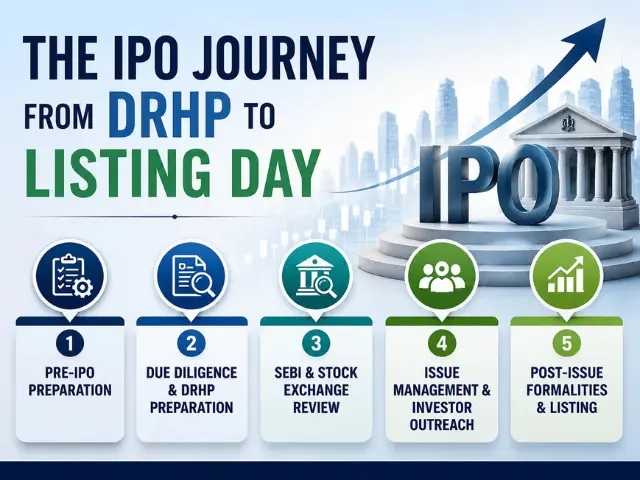

An IPO is often perceived as a single event. In reality, it is a tightly regulated capital markets transaction that tests a company’s governance, financial maturity and disclosure standards. Long before the stock lists, months of preparation go into drafting, verification, regulatory review and investor positioning.
Why the Filing Process Matters
The offer document is the backbone of the IPO. For SEBI, it is a legal disclosure document. For investors, it is the primary source of truth.For the company, it becomes a permanent public record. Gaps in statutory disclosures or inconsistencies in financial reporting may result in approval delays and affect investor confidence.
Phase I: Pre IPO Preparation
The IPO process begins well before drafting the prospectus. At this stage, the company prepares itself to operate as a listed entity. Key actions include finalising the issue structure, converting into a public limited company, updating constitutional documents, strengthening board and committee structures, appointing key managerial personnel and dematerialising shareholding.
Phase II: Due Diligence and DRHP Preparation
This is the most intensive stage of the IPO journey. The Merchant Banker conducts detailed financial, legal and business due diligence, followed by preparation of the Draft Red Herring Prospectus covering company profile, industry overview, risks, financials and utilisation of proceeds.
Phase III: SEBI and Stock Exchange Review
SEBI, along with the stock exchanges, reviews the DRHP to ensurefull and fair disclosures, eligibility, and governance compliance. All queries and observations are addressed before final In-Principal approval.
Phase IV: Issue Management and Investor Outreach
Post regulatory clearances, the Red Herring Prospectus is finalised and the issue pricing is decided. Merchant Bankers, working closely with syndication and underwriting teams, drive investor outreach and roadshows, while market makersplay a role in supporting orderly trading and liquidity (in case of SME-IPO), in line with applicable issue regulations.
Phase V: Post Issue Formalities and Listing
After the issue closes, the basis of allotment is finalised, funds are reconciled by the banker to the issue, and shares are credited to investors’ demat accounts. In cases of oversubscription, allotment is carried out as per category-wise allocation norms, with proportionate or lottery-based distribution and refunds/unblock of excess application amounts. The company then lists on the stock exchanges and enters the post-listing compliance framework. Syndication and underwriting teams continue to support investor engagement, while issuer-led marketing and investor interactions remain ongoing. Anchor investors participate up to one working day prior to the issue opening, helping establish early demand visibility and confidence in the offering.
Role of the Merchant Banker
The Merchant Banker anchors the IPO end-to-end, beginning with comprehensive due diligence and preparation of offer documentation. They act as the primary interface with SEBI and Stock Exchanges, provide valuation and structuring advice, and lead investor marketing efforts. In coordination with syndication and underwriting teams, the merchant banker supports book building, demand aggregation, and risk underwriting. Post listing, they also facilitate market-making arrangements and ensure regulatory and compliance requirements are met, enabling a smooth transition from a privately held company to the public markets.
Closing Thoughts
The IPO process shows how ready a company is to operate in public markets. With the right Merchant Banker guiding the company at every stage, the journey becomes well-planned and manageable, helping the business move smoothly into the listed space and build long-term, sustainable growth.
👉 To Connect with us today, please click here.
Latest Articles

ओपेक देशों की बैठक से कच्चे तेल की कीमतों को नई दिशा मिलेगी।


ब्रेंट कच्चे तेल की कीमतें 65 डॉलर प्रति बैरल के ऊपर पहुंच गई है लेकिन 68 डॉलर के महत्वपूर्ण प्रतिरोध स्तरों पर है। इस सप्ताह गुरुवार को, पेट्रोलियम निर्यातक देशों और सहयोगियों (ओपेक) की बैठक पर निवेशको की नज़र रहेगी जिसके पहले अन्य बाज़ारो पर दबाव देखा गया है।
कच्चे तेल की कीमतों मे लगातार सुधार होने के कारण, ओपेक और सहयोगी देशो के निर्णय पर बाज़ारों की निगाहें होगी। अधिक आपूर्ति होने से सऊदी अरब ने पिछली बैठक मे अतिरिक्त उत्पादन कटौती पर समझौता किया था। जबकि अन्य तेल निर्यातक देशो ने आपूर्ति को स्थिर रखने पर जोर दिया था। वही रूस उत्पादन मे वृद्धि के पक्ष मे रहा है।
अमेरिकी प्रान्त टेक्सास और आसपास के क्षेत्रों में पिछले सप्ताह की ठंड के कारण 40 लाख बैरल प्रति दिन कच्चे तेल की आपूर्ति बाधित हुई है। जिससे कच्चे तेल की कीमतों में मजबूती है और इस महीने मे ब्रेंट तथा अमेरिकी कच्चे तेल मे 20 प्रतिशत की बढ़त दर्ज की गई है। वैश्विक तेल स्टॉक मे लगातार कमी दर्ज की गई है लेकिन, मौसम के कारण बाधित होने वाले कच्चे तेल उत्पादन में लाखों बैरल की कमी धीरे-धीरे पूरी हो रही है। बांड बाजार टूटने से डॉलर मे तेज़ी होने की सम्भावना है और ऐसा होने पर कच्चे तेल की आपूर्ति बढ़ सकती है।
तकनीकी लेवल
इस सप्ताह कच्चे तेल की कीमतों मे अस्थिरता रहने की सम्भावना है।घरेलु वायदा कच्चे तेल के भाव मे 4700 रुपय पर प्रतिरोध और 4200 रुपय पर सपोर्ट है। ब्रेंट वायदा कच्चे तेल मे 67 डॉलर पर प्रतिरोध तथा 62 डॉलर पर सपोर्ट है।

Effect on Stock Market After Rising COVID 19 Cases: Government Moves and Vaccine Rollout
As the COVID 19 cases had marked a considerable decline in the past few months, the active cases have been on the rise again and with Feb 21, registering new cases of 14,199. However, the cases had seen a sudden decline on Feb 16 with 9,121.
The spectacular fall in the COVID 19 cases for nearly five months, in the states that has shown a resurgence now, had led to a belief that the infection levels in the country had probably reached a new level where the effects of herd immunity had started to play out.
On Monday, the ministry reported 83 deaths with a total tally of over 1.56 lakh. This accounts for 1.42% of more than 1.1 crore coronavirus cases detected in India. Some states including Maharashtra, Kerala have been advised by the centre to increase the proportion of RT-PCR tests and regularly monitor mutant strains.
Maharashtra's government has announced renewed curbs in Pune and Amravati because fresh cases rose nearly up to 5000 per day in the country's worst-hit state.
After the sudden rise of COVID 19 cases, the restrictions have forced the stock market to go down, and with the BSE Sensex which was a little above 1,145 points (2.25 per cent) to close below 50,000 at 49, 744 on Feb 22. The Nifty settled below 14,700 level at close on the same day.
Although the testing rate had not dropped significantly, lockdown restrictions had been eased, festivals, elections had seen people coming out in multiple numbers, political activities had restarted, a farmers’ protest had been going on.
As the active cases of COVID 19 cases rose by 4,421, registering a three per cent increase in the active caseload back to the 1.5 lakh mark. However, the sheer rise has been marked since the beginning of November where there was an increment of 3.85 per cent in the COVID cases. The latest spike has come in Feb where the cases have been continuously rising in Maharashtra, Kerala, Punjab, Chhattisgarh, Madhya Pradesh.
Restrictions are Back
Due to rising cases of COVID 19, the Central government and state government put restrictions in order to minimize the cases in the bud. In Maharashtra, the government has been putting a ban on social gatherings, night curfew in Amravati. Also, surveillance has been increased in the states (Maharashtra, Kerala) where the COVID cases are still rising.
In the last five days, the Sensex lost 2,400 points and there are certain factors responsible for the COVID 19 cases including the rise in the US, domestic bonds, yields, consequent fear of inflation and the rise in crude oil prices.
Recently, the petrol prices are still high i.e. Rs 100 per liter which in turn has triggered fears that the prices of other commodities may rise.
Although the COVID-19 cases and other factors may heavily impact the stock market, analysts attribute the current correction to the valuations. In the recent past, where the market has performed well despite having COVID-19 issues, the recent budget focused on triggering economic growth and the Capex cycle and an aggressive fiscal deficit of 9.5% for FY21 and 6.8% for FY22.
FIIs continue to be Bullish
Foreign Institutional Investors continue to be bullish and have been net buyers worth Rs 23,875 crore till the Feb end. As per provisional data from NSE, the FIIs had turned net sellers offloading over Rs 893 crore.
According to Credit Suisse, a brokerage India has seen a net portfolio investment of $5.2 billion in January. The firm has upgraded its Indian equity market stance overnight from the earlier market weight and said the country was in good condition as compared to other economies in the world.
Bond Yields and RBI’s possible moves
In India, the ten-year-old bond yield has risen for four straight sessions and closed at over 6 per cent on Monday. Now, all the analysts and trader’s eyeing RBI’s special open market operation worth Rs 10,000 crore where it will buy and sell simultaneously. Therefore, any RBI intervention to keep bond yield at or below 6% will be welcomed by equity markets.
Seeking the Bright Side
As India announced its first-ever vaccine against COVID 19, India’s rate has been 3 lakh vaccinations per day but it is only a quarter of the 1.3 million vaccinations target per day. India had proved 11.8 million vaccinations nationwide as of February 22, the beginning of the drive.
Keeping this in mind, the central government has decided to increase the current rate to 5 million vaccines nearly in a day over the next month. It will be a welcoming move in controlling the fear of the second move.
The central government has further decided to involve the private sector in India’s vaccination efforts which in turn bring back the positive sentiments in the stock market. As per the sources of NITI aayog, the details of private privatization in the vaccine drive will be made available soon to buoy the market.
According to the experts, the rise in COVID 19 cases is not a uniform spread in the whole country as it can be the outcome of different testing protocols across the country. Also, it's not clear whether the rising cases of COVID 19 is the beginning of a second wave or not.
A Flitch reporting report has said the decline in the economic activities in the UK and France during the fourth quarter of 2020, were quite less, even though there were lockdowns there. India’s economy and the Indian’s stock market can take an idea from this report.
Conclusion
Even after the COVID 19, the stock market is likely to react positively and bounce back from Monday’s close on the back of private sector involvement in vaccinations, better containment of cases and other major factors such as sustained FII inflows, central bank interventions and more.

Best Ways to Overcome Fear and Greed in Stock Trading
Stock trading can be both exciting and intimidating. For many, the thought of putting hard-earned money into the stock market brings up fears—fear of losing money, fear of making the wrong decisions, and fear of the unknown. However, overcoming these fears is crucial for anyone looking to succeed in trading. Sometimes even experienced investors can become scared of putting their money in the stock market. Their bad decisions regarding stock trading, emotions and inconsistency are some of the situations that go out of their control.
The most reliable solution to conquer fear is “exposure”. For instance, when someone is afraid of swimming, the best possible way to overcome that fear is to face them. Exposure lets you achieve the goal that once you were scared of. Although it is not as easy as it seems to be, it’s worth trying.
Here’s a simple guide to help you manage and overcome fear in stock trading.
1. Educate Yourself
Knowledge is power. One of the main reasons people fear stock trading is because they don't fully understand how it works. By educating yourself about the basics of the stock market, how different types of stocks work, and the factors that influence stock prices, you can gain the confidence needed to make educated decisions.
- Start with the basics: Learn what stocks are, how the stock market operates, and the different types of investment strategies.
- Understand risks: Knowing the potential risks and rewards associated with stock trading helps in setting realistic expectations.
2. Start Small
It's normal to feel anxious about trading when large sums of money are at stake. To reduce this, start with a small investment. By investing a smaller amount, you reduce the pressure and potential stress.
- Practice with a demo account: Many trading platforms offer demo accounts where you can practice trading without using real money. This helps in building confidence.
- Gradually increase your investment: As you become more comfortable, you can slowly increase the amount you invest.
3. Develop a Trading Plan
A well-thought-out trading plan can be your best friend in the stock market. It helps you stay focused and avoid making impulsive decisions driven by fear.
- Set clear goals: Know what you want to achieve with your investments. Are you looking for short-term gains or long-term growth?
- Determine entry and exit points: Decide in advance when you will buy and sell stocks based on your research and analysis.
- Stick to your plan: Having a plan gives you direction and prevents you from making decisions based on emotions.
4. Diversify Your Portfolio
Diversification means spreading your investments across different types of assets to reduce risk. This strategy can help ease the fear of losing everything if one stock performs poorly.
- Invest in various sectors: Don’t put all your money in one industry. By investing in different sectors, you reduce the impact of a downturn in any one area.
- Include different asset types: Consider adding bonds, mutual funds, or other investment vehicles to balance your portfolio.
5. Manage Your Emotions
Fear is a natural emotion, but it can lead to poor decision-making in trading. Learning to manage your emotions is key to overcoming fear.
- Practice mindfulness: Techniques like deep breathing, meditation, or yoga can help calm your mind and reduce anxiety.
- Avoid trading when emotional: If you’re feeling overly stressed or emotional, it’s best to take a break from trading until you can think clearly.
6. Accept Losses as Part of Trading
No trader wins all the time. Losses are a natural part of the stock trading journey, and accepting this fact can help you manage fear.
- Learn from your mistakes: Instead of fearing losses, see them as learning opportunities. Analyze what went wrong and use that knowledge to improve future trades.
- Don’t dwell on losses: After a loss, it’s important to move on. Dwelling on a bad trade can cloud your judgment and lead to more mistakes.
7. Stay Updated, But Don’t Overload
Keeping up with market news is important, but too much information can lead to confusion and fear.
- Follow credible sources: Stick to a few reliable news outlets and avoid chasing every headline.
- Avoid information overload: Too much information can lead to analysis paralysis, where you’re unable to make decisions because you’re overwhelmed with data.
8. Set Realistic Expectations
It’s important to set realistic expectations for your trading activities. Expecting to become a millionaire overnight is unrealistic and can lead to unnecessary stress.
- Understand market fluctuations: The stock market is volatile, and prices can go up and down quickly. Don’t panic at every small dip.
- Focus on long-term goals: Instead of obsessing over daily fluctuations, keep your eyes on your long-term financial goals.
9. Seek Professional Advice
If you’re still feeling unsure, seeking advice from a financial advisor or a mentor who has experience in stock trading can be beneficial.
- Hire a financial advisor: A professional can help you create a tailored trading plan and provide guidance on your investment decisions.
- Join a trading community: Being part of a group of traders allows you to share experiences, learn from others, and gain support.
10. Keep a Trading Journal
Maintaining a trading journal where you record your trades, the reasons behind them, and your emotions at the time can be incredibly helpful.
- Review your trades: Regularly reviewing your journal helps you understand your strengths and weaknesses, allowing you to improve over time.
- Track your progress: Seeing how far you’ve come can boost your confidence and reduce fear.
Conclusion
Overcoming fear in stock trading is a journey, but with the right strategies, you can turn that fear into confidence. By educating yourself, starting small, having a plan, diversifying your portfolio, managing emotions, accepting losses, staying updated, setting realistic expectations, seeking professional advice, and keeping a trading journal, you can approach the stock market with a calm and focused mindset. Remember, fear is natural, but it doesn’t have to control your trading decisions.

Open Demat Account with Swastika in Easy Steps
How to Open a Demat Account? Easy Steps
Opening an online trading account is the first step towards becoming a successful investor. Before we begin, decide whether you want to open an account with Swastika through their website or with Swastika via their mobile app. Both options offer user-friendly interfaces and convenient features to make the account opening process seamless.
Via Website (Swastika):
- Visit Swastika's website & click “Open an Account”: Go to Swastika's website and find the option to open an account. It's usually a button or link that says something like "Open an Account."
- Enter mobile no. & email: Fill in your mobile number and email address.
- Enter Aadhaar no. & PIN into Digilocker to fetch PAN: You'll need your Aadhaar number and PIN to access your PAN card details from Digilocker.
- Fill in basic details: Provide basic information like your name, address, and date of birth. This helps Swastika create your account.
- Select plan & segment: Choose the type of account you want to open and the investment segment you're interested in, like stocks or mutual funds.
- Upload required documents: Scan or take pictures of the documents Swastika asks for, like your PAN card, Aadhaar card, and proof of address. Upload these documents to their website.
- E-sign: Use your Aadhaar number to electronically sign the documents. This is like signing your name on paper but done digitally.
Once you've completed all the steps and everything is verified, your account is officially opened! You'll receive confirmation and can start using your Swastika account to trade.
Via Mobile App (Swastika):
- Download Swastika: Find and download the Swastika app from the app store on your mobile phone.
- Enter mobile no. & email: You'll need to provide your mobile number and email address.
- Enter Aadhaar no. & PIN into Digilocker to fetch PAN: Use your Aadhaar number and PIN to access your PAN card details from Digilocker.
- Fill in basic details: Enter your personal information, like your name, address, and date of birth.
- Select plan & segment: Choose the type of account and investment segment you're interested in.
- Upload required documents: Take photos of your documents using your phone's camera and upload them directly to the app.
Although many people prefer to invest in mutual funds as they find it is one of the finest ways to achieve high returns with minimum risks, only a few investors among them show their courage to invest in equities and stocks.
Needless to say, the stock market is full of volatility, unpredictability and therefore many investors unable to put their money in the stock market. Still, many investors invest in equities and get outstanding returns from stock market trading.
What is a Demat Account?
A Demat account is simply a dematerialized account in which you hold a variety of investment securities such as shares, bonds, government securities, equity shares and more. The account is known as dematerialized because all the securities are placed in a dematerialized form.
Opening a Demat account is a must if you want to trade in securities in the stock market. This is because Demat accounts allow you to hold, buy and sell securities within a single account.
Importance of Demat Account
Opening a Demat account is important as it provides a digitally secure and convenient way of holding securities and shares instead of a physical one.
Also, it removes theft, loss and damage of physical certificates. Before the 90's when there were no Demat accounts, shares were traded in a physical form. And needless to say, physical shares were difficult to store and maintain. There was always a risk of being misplaced, damaged or stolen.
You can’t trade if you don't have a Demat account. Since everything is done electronically, having a Demat account allows investors to hold the paperless securities without a flick of a switch.
Why Open Demat Account with Swastika?
Swastika is a renowned stock broker that offers trustworthy yet quality stock brokers services in India. We are a SEBI registered stock broker and corporate member with NSE and BSE. We provide smooth trading platforms for the biggest stock exchanges such as NSE and BSE.
Here are the noteworthy reasons for opening a Demat account with Swastika:
- Easy to Carry: Since the stocks are placed in electronic form, there are zero risks involved. This is because the Demat account allows investors to hold securities most easily. Therefore, opening a Demat account is the easiest form of holding shares in one place.
- Common Depository: With a common depository, investors can hold all the investments in a single account. It also operates for other instruments and government securities like mutual funds, NCD and more.
- Automatic Updates : The investors do not have to provide their details every time a transaction is carried out through the DP. The account linked to the investors with their unique id represents the investors and has all the things listed out. Hence, every transaction is automatically updated with specifics.
Benefits of opening a Demat account with Swastika:
- Transparent Services: Swastika is known for providing transparent services for its clients without hiding any details from them. You will get all the information regarding your money such as where your money goes.
- Multiple Services under one Roof: At Swastika, you will get all the financial services under one roof such as stock trading, commodities, currencies and more.
- Real-Time Monitoring: Swastika’s trading account allows you to track and monitor stock price movements as they happen.
- Secure Trades: With Swastika, you can perform safe and convenient transactions. No matter whether you are trading through a laptop or mobile phone, buying and selling is a seamless and quick process.
India sets Ambitious Privatization Program that May Uplift the Country’s Capital Market
The recent updates in the budget 2021-22 have brought the spotlight back on the government's privatization plans.
In the budgetary speech which was held on Feb 1, 2021, India’s finance minister Nirmala Sitaraman announced to sell its whole stake in IDBI bank - of 46.5% of the bank’s capital - to private retail and institutional investors through a stock exchange.
Also, the government is planning to sell a part of its holdings in Life Insurance Corp, India, with an initial public offering for the fiscal year starting on April 1, said Tuhin Kanta Pandey, Secretory for Disinvestment. According to livemint, this will require specific legislative action. LIC is 100% state-owned.
LIC’s Size:
According to a report, LIC comes with a size of USD 434 billion, holding more than all Indian mutual funds combined.
Currently, LIC has a market share of 76.28% of policies and 71% in first-year premiums according to Business Insider.
The market reacted positively to the budgetary announcement and due to that, the shares of public sector banks rose to 3 per cent while Nifty PSU Bank Index went up by 3 per cent. On the same day, the BSE PSU Index rose 4.5% making it its best performance for the last 10 days post-budget announcement.
The government has also notified its intentions of holding a minimum number of PSUs in sectors. The announcement also includes a much-awaited IPO which would be brought in the current FY 2021-22. Here, the primary objective of the government is to gain Rs 90,000 Crore from LIC listing with the dilution of stakes in IDBI bank.
Finance Minister Nirmala Sitaraman also highlighted the importance of having a Public sector enterprise policy and said that the policy would be divided into two major areas: strategies and non-strategic. The government also has mentioned that the new PSE policy does not apply to the PSEs which are non-profit or related to development.
Primary government departments such as the Airport Authority of India, key port trusts and posts cannot be considered as a part of PSU privatization. Other major sectors such as space, defence, atomic energy, petroleum, transport and telecom, power, coal, minerals, financial services are some of the sectors that will be considered for privatization.
As a result, the government has started to lower the number of PSEs in India to 25 from 300 plus.
How does Privatization affect the Stock Market?
BSE Sensex is all set to mark a presence of 55000 towards the end of 2021, Morgan Stanly analysts said. The primary reason behind the scaling of Sensex points is the government's plan of divestment of some PSB, privatization and LIC IPO.
The analysts further said, if all the procedures of privatization are implemented well, then there is a strong chance for India to recover its domestic equity flows and prosper its earnings growth. The announcement will also help India’s equity trading to reach a new height and catch up with emerging markets via the stock market’s performance.
The increment of current liquidity in the stock market will encourage the government's plan of divesting its stake in certain firms. As more PSUs get divestment push, the value of these firms will be unlocked. Keeping in mind, the RBI monetary policy has ensured that the low-interest rates are maintained yet the liquidity levels remain high.
Divestment, Privatization and Foreign Investment
Foreign Institutional Investment is currently keeping an eye on India and FIIs bought shares worth Rs 1.7 lakh crore in 2020 and raised stake quarter in over 400 companies in December, according to the news reports.
Ever since the budget was announced, FIIs have turned to net buyers in the equity markets. Between Feb 1 to Feb 5, FIIs have invested a net of Rs 10,793 crore in equities which has ensured that the markets have been buoyant.
Nowadays the government seems to attract more overseas buyers which in turn makes more privatization of the firms. This means that these firms can attract foreign investment. The stock market trading will only encourage the opportunities that disinvestment will bring, as it helps in expanding a broadened capital market with upgraded listings and market size.
India’s Privatization Plans
India’s overall privatization goals for 2020/2021 will get doubled to INR 2.1 trillion. This has made the government fail to meet its overall deficit goals.
According to the news reports, before privatization, the previous targets have not been met. In the current fiscal year, only one-quarter of the target was raised.
In the reports shared by ET, the 2019-20 financial year deficit is projected at 3.8% of GDP versus 3.3% previously projected, before falling to 3.5% in fiscal 2021.
Conclusion
Government divest their stakes in PSUs so that it can raise funds for infrastructure projects reducing debts or narrowing fiscal deficits. Infrastructure projects such as roads or ports will not only boost economic activities but also enhance the productivity and transparency of said enterprises by bringing in private interest.

RBI Monetary Policy 2021
The Reserve Bank of India’s (RBI) monetary policy left the repo rate unchanged at 4% in its monetary policy committee while maintaining an accommodative stance, RBI governor Shaktikanta Das announced-on Friday. The governor further decided to maintain the repo rate amid a sticky rate of inflation. The reverse repo rate also remained unchanged at 3.35%.
The repo rate has remained at 4% since August 2020 during the MPC meeting. RBI governor Mr Shaktikanta Das announced-on Friday that the decision was taken unanimously in favor of him. The MPC meeting was conducted between 3 to 5 Feb where the panel was headed by Mr Shaktikanta Das along with the other members Dr Ashima Goyal, Dr Shashank Bhide, Prof. Jayant R. Verma, Dr Michael Debabrata Patra and Dr Mridul K. Saggar.
The repo rate has remained unchanged while maintaining an accommodative stance for this FY to next FY as long as necessary, RBI governor Shaktikanta Das announced-on Friday.
In late March 2020, the central bank had slashed the repo rate by 115 basis points to support growth. This is the 4 time in a row that the MPC decided to keep the policy rate unchanged as the RBI had revised its policy rate on May 22 to increase the demand by minimizing the interest rate to a historic low.
This is the first MPC meeting after the arrival of Union Budget 2021-2022.
What is meant by Accommodative Stance?
An accommodative stance means there is room for reducing the interest rates in the future to revive economic growth. That’s why MPC has decided to continue with the stance from the current FY 2021 to next FY 2022 to revive growth to minimize the impact of COVID 19 on the economy.
Even if the central government and central bank worked together to uplift the economy by providing financial support, the economy still has to take a long time from the Covid 19 impact with rising cases.
Therefore, RBI decided to minimize the interest rate and await inflationary pressure to ease before the economy grows.
What Does This Mean for You?
The Monetary Policy Committee kept its repo rate unchanged at 4% which means the rate at which banks borrow money from RBI remains as is. Normally, when RBI reduces the repo rate, commercial banks also have to reduce the interest rate and therefore they offer fewer interest rates on loans given to you.
Interest rates have congruence with rising inflation.
Key Terms to Ponder
Repo Rate:
Repo rate is the rate at which commercial banks borrow money from the apex bank (RBI) by selling their securities to the central bank of our country. RBI uses it as the main tool to keep inflation under control.
Reverse Repo Rate:
Reverse Repo Rate is the rate at which RBI borrows money from other commercial banks. It is a mechanism to absorb the liquidity in the market, whenever there is excess liquidity in the market.
Marginal Standing Facility
MSF is the rate at which banks borrow overnight funds from the RBI. MSF has been created only in case of emergency when interbank liquidity goes down and overnight interest rates are volatile. Here, the rate is higher than the repo rate.
Bank Rate
The bank rate is the rate at which banks lend money to commercial banks that too without any security.
MPC’s Outlook on Growth and Inflation
Inflation:
In December 2020, for the first time in 1 year, the inflation rate had fallen below the RBI mandate band of 2-6%. It is expected that the vegetable prices will remain soft in the near term, while the pressure may continue to persist in many food items, said the MPC.
While the MPC’s outlook on food prices remains favorable, its outlook on core inflation causes depression.
What is Core Inflation?
Core inflation excludes unstable factors such as fuel and petrol prices.
Fuel Prices:
The RBI acknowledged the rise in fuel prices. The further increase of fuel price added with huge indirect taxes on the product by both centre and state always remain a cause of concern. This depicts the concerted policy action by both governments to control cost-push pressures.
Considering all the above factors, RBI expects inflation at 5.2% for January to March of the current fiscal year, 5.2-5% between April to September 2021and 4.3% for the third quarter of the next financial year.
What is Real GDP?
Real GDP is a measure of a country’s gross domestic product which has been adjusted for inflation.
Retail Investor Online Access to Gilt Securities
The RBI has numerous measures to extend the scope of financial markets. RBI plans to provide retail investors online access to the government financial securities, including primary and secondary directly through Reserve Bank (‘Retail Direct’).
Big Budget


Popular Articles



.avif)
.avif)

.avif)



START YOUR INVESTMENT JOURNEY
Get personalized advice from our experts
- Dedicated RM Support
- Smooth and Fast Trading App
