


Nifty 50 Morning: 03 Aug 2026 Market Summary




Key Takeaways
- Nifty 50 pivot levels (from the previous session's close): Pivot 24687.92; R1 24860.68; R2 24947.07; S1 24601.53; S2 24428.77.
- Top gainers: AARTISURF 400.85 -> 481.0 (+20.00%), ALPHAGEO 220.13 -> 264.15 (+20.00%), IITL 127.68 -> 153.21 (+20.00%), UEL 153.73 -> 184.47 (+20.00%), VINDHYATEL 1985.9 -> 2383.0 (+20.00%).
- Top losers: INDOTHAI 213.43 -> 170.75 (-20.00%), ZEEL 114.55 -> 98.14 (-14.33%), XPROINDIA 1500.4 -> 1302.8 (-13.17%), NITTAGELA 1922.5 -> 1729.2 (-10.05%), EPACKPEB 267.31 -> 243.95 (-8.74%).
- PCR: Not available for this session.
Nifty 50 Support And Resistance Levels For 03 Aug 2026
Pivot levels are reference points derived from the previous session's close. They are not live intraday data. For Nifty 50: Pivot 24687.92; R1 24860.68; R2 24947.07; S1 24601.53; S2 24428.77.
A pivot is a central reference point. If the price trades above this pivot, the first resistance above it is R1 and then R2; if below, S1 is the first support and S2 is the second.
Nifty Bank Support And Resistance Levels For 03 Aug 2026
Pivot: 57987.28; R1: 58508.62; R2: 58769.28; S1: 57726.62; S2: 57205.28.
The central Pivot is the reference for Bank Nifty; use above/below to gauge intraday direction; R1 and R2 above, S1 and S2 below.


Top 5 Gainers On 03 Aug 2026
| Stock | From | To | Change |
|---|---|---|---|
| AARTISURF | 400.85 | 481.0 | +20.00% |
| ALPHAGEO | 220.13 | 264.15 | +20.00% |
| IITL | 127.68 | 153.21 | +20.00% |
| UEL | 153.73 | 184.47 | +20.00% |
| VINDHYATEL | 1985.9 | 2383.0 | +20.00% |
Top 5 Losers On 03 Aug 2026
| Stock | From | To | Change |
|---|---|---|---|
| INDOTHAI | 213.43 | 170.75 | -20.00% |
| ZEEL | 114.55 | 98.14 | -14.33% |
| XPROINDIA | 1500.4 | 1302.8 | -13.17% |
| NITTAGELA | 1922.5 | 1729.2 | -10.05% |
| EPACKPEB | 267.31 | 243.95 | -8.74% |
Market-Wide Index Options PCR
Market-wide Index Options PCR: Not available for this session.
Frequently Asked Questions
What are the Nifty 50 pivot levels for 03 Aug 2026?
Pivot: 24687.92; R1: 24860.68; R2: 24947.07; S1: 24601.53; S2: 24428.77.
What are the Nifty Bank pivot levels for 03 Aug 2026?
Pivot: 57987.28; R1: 58508.62; R2: 58769.28; S1: 57726.62; S2: 57205.28.
Who were the top gainers on 03 Aug 2026?
AARTISURF: 400.85 -> 481.0 (+20.00%), ALPHAGEO: 220.13 -> 264.15 (+20.00%), IITL: 127.68 -> 153.21 (+20.00%), UEL: 153.73 -> 184.47 (+20.00%), VINDHYATEL: 1985.9 -> 2383.0 (+20.00%).
Who were the top losers on 03 Aug 2026?
INDOTHAI: 213.43 -> 170.75 (-20.00%), ZEEL: 114.55 -> 98.14 (-14.33%), XPROINDIA: 1500.4 -> 1302.8 (-13.17%), NITTAGELA: 1922.5 -> 1729.2 (-10.05%), EPACKPEB: 267.31 -> 243.95 (-8.74%).
Is Market-wide Index Options PCR available for 03 Aug 2026?
Market-wide Index Options PCR: Not available for this session.
Conclusion
These levels are PREVIOUS SESSION closing levels used as reference points for today's trading, not live intraday data. The Nifty 50 pivot is 24687.92 with resistance at 24860.68 and 24947.07 and support at 24601.53 and 24428.77. The Bank Nifty pivot is 57987.28 with resistance at 58508.62 and 58769.28 and support at 57726.62 and 57205.28.
Watch price action around these pivot levels at the open, particularly near S1 24601.53 and R1 24860.68, and consider the five gainers and five losers from yesterday as a guide to sector momentum. For deeper stock-level insights, try Swastika's Sarthi AI stock assistant.
Open your trading and demat account here
Reference :
1 : Nseindia
Latest Articles

Understanding the differences between Investment Banks and Commercial Banks


The distinction between investment banking and commercial banking is a common query among those seeking clarity about the banking system.
In India, banking is integral across all levels of society, from high-profile businessmen to middle-class families and even those in poverty. Bank accounts are essential for everyday financial transactions, including deposits and withdrawals.
Commercial Banking:
Commercial banking, often referred to as retail banking, involves providing financial services to individuals and businesses. These services include accepting deposits, offering savings and checking accounts, providing loans and mortgages, and offering other basic financial products. Commercial banks generate revenue primarily through the interest they earn on loans and the fees they charge for their services.
Key Functions of Commercial Banking
- Accepting Deposits: Commercial banks offer various deposit accounts, such as savings accounts, current accounts, and fixed deposits. These accounts provide a safe place for individuals and businesses to store their money while earning interest.
- Providing Loans: Banks lend money to individuals (for housing loans, car loans, and personal loans) and businesses (for working capital, term loans, and project financing). The interest charged on these loans is a significant source of revenue for banks.
- Payment Services: Banks facilitate transactions through services like electronic funds transfers (EFT), credit and debit cards, and online banking.
- Wealth Management: Some commercial banks offer investment products and advisory services to help clients manage their wealth.
- Safeguarding Valuables: Banks provide safe deposit lockers and vaults for securing valuable items and documents.
Regulatory Framework
Commercial banks are regulated by the Reserve Bank of India (RBI) under the Banking Regulation Act, 1949. The RBI ensures the safety and soundness of the banking system through measures like capital adequacy norms, asset classification and provisioning standards, and corporate governance requirements. Commercial banks in India are regulated by the Reserve Bank of India (RBI) under the Banking Regulation Act, 1949. The RBI ensures the safety and soundness of the banking system through measures like capital adequacy norms, asset classification and provisioning standards, and corporate governance requirements.
Investment Banking:
Investment banking, on the other hand, differs significantly from commercial banking. They specialize in helping organizations raise capital and provide financial advisory services. Investment banks act as intermediaries between entities seeking capital (such as corporations and SMEs) and those looking to invest (HNIs and institutional investors).
Key Functions of Investment Banking
- Underwriting: Investment banks assist companies in raising capital by underwriting and distributing new securities (stocks, bonds). They play a crucial role in initial public offerings (IPOs) and other equity and debt offerings.
- Mergers and Acquisitions (M&A): Investment banks advise clients on mergers, acquisitions, divestitures, and other strategic transactions. They help negotiate deals, perform due diligence, and provide valuation services.
- Initial Public Offerings (IPOs): Investment banks manage the process of bringing a company to the public stock market for the first time. This includes creating and managing prospectuses, setting stock prices, and navigating legal and compliance issues to attract investors.
- Bond Offerings: Similar to IPOs, investment banks facilitate bond offerings where the primary consideration is the interest rate offered.
- Wealth Management: Investment banks compete with commercial banks and specialized firms in managing institutional investors' substantial assets.
- Research: Investment banks provide research and analysis on markets, industries, and companies to help clients make smart investment decisions.
Regulatory Framework
Investment banks operate under a different regulatory framework compared to commercial banks. The Securities and Exchange Board of India (SEBI) regulates investment banking activities under the SEBI Act, 1992, and the various regulations issued thereunder. Additionally, the RBI oversees certain aspects of investment banking operations, especially for banks engaged in these activities.
Key Differences between Investment Banking and Commercial Banking
Clientele: Commercial banks serve the general public and businesses, whereas investment banks cater to large corporations, governments, and institutional investors.
Services Provided: Commercial banks focus on deposit-taking, lending, and basic financial services, while investment banks specialize in complex financial transactions like underwriting, M&A advisory, launching IPOs, valuations of companies, and trading.
Revenue Sources: Commercial banks earn revenue from interest on loans and service fees, while investment banks generate income through fees from underwriting, advisory services, trading profits, asset management fees, and fund raising fees.
Regulation: Commercial banks are regulated by the RBI to ensure stability and protect depositors, with a focus on capital adequacy and risk management. SEBI regulates investment banks to ensure market integrity and protect investors, with a focus on transparency and reducing systemic risk.
Risk Exposure: Commercial banks face credit risk from loan defaults and interest rate risk. Investment banks face market risk, liquidity risk, and operational risk due to their involvement in trading and complex financial activities.
Conclusion
While both investment banking and commercial banking are essential components of the financial system in India, they serve different purposes and operate in distinct ways. Commercial banks are the backbone of everyday financial transactions and credit provision for individuals and businesses. In contrast, investment banks are the architects of capital markets, enabling large-scale funding and facilitating major corporate transactions. Understanding these differences is crucial for anyone looking to engage with the financial sector in India, whether for personal finance, corporate finance, or investment purposes.
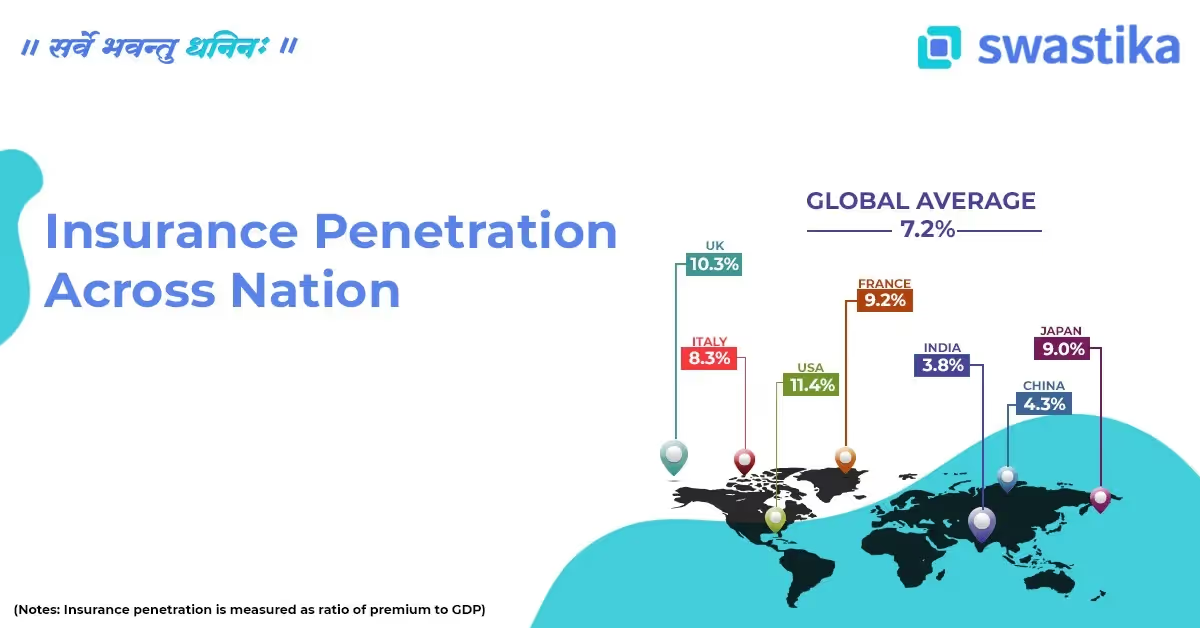
INSURANCE PENETRATION ACROSS NATION
The insurance industry is a key factor of the economic system with the aid of using distinctive features of the number of premiums it collects, the size of its funding and, fundamentally, it plays a crucial social and economic function as it helps in overlaying private and commercial enterprise risks.
The below details encompass Insurance penetration throughout distinctive nations. The insurance penetration for your information is measured as the ratio of premium to GDP.
USA – 11.4%
It's far ranked as in the top 10 nations of the world for its insurance penetration. The premium of the U.S. is the most important at the global level.
The insurance density which is the premium in line with capita is ranked lower because of the huge population of the United States. At the same time, the rating of the insurance penetration (premium/GDP) is even lower because of the excessive economic improvement level.
UK – 10.3%
Many developed nations together with Japan, U.K., France and Germany share similar traits as that of the U.S.A. The United Kingdom generated margins above 10 percent. The claims ratio within side the UK’s medical health insurance zone has been solid historically, which has helped to keep the boost in the insurance market.
FRANCE – 9.2%
The largest markets in medical health insurance, together with France, Germany, and the Netherlands, had a net earnings margin of approximately 2 per cent on average within the 2015–16 time frame, however, it's far on a declining trend, because of excessive opposition that drives pricing and margin downwards. In rising markets, personal medical health insurance premiums are a small per cent of general health expenditure and are drastically lower than the extra classes of expenses.
JAPAN – 9.0%
In financial 2017, life insurance businesses in Japan had earnings of ¥33.7 trillion from insurance premiums. Although this amount was developing steadily in view that financial 2002, it has declined during the last years in a row.
Changes in household composition have reduced the want for huge death benefits aimed toward heads of households. Meanwhile, the need for 0.33 per cent of insurance together with clinical and nursing care merchandise is increasing.
ITALY – 8.3%
The Changes in household composition because of the declining birthrate, ageing population, and overdue marriage have helped the Italy insurance market get more attention through people.
GLOBAL AVERAGE – 7.2%
Global distribution tendencies range with the aid of using product and vicinity. In life coverage, whilst banc assurance dominates the distribution area in lots of Asian and European geographies, however, we see a speedy boom within the reputation of direct distribution modes in lots of geographies.
Analyses of the overall performance of direct players, in a few geographies, additionally screen that they're capable of outperforming their markets.
CHINA – 4.3%
As is discovered from these numbers, even though the premium of China is amongst the most important within the global market, the ranking of China's insurance density commonly known as the premium in line with capita has gone to drastically lower levels because of the very huge population. The insurance penetration is rated much better than the insurance density because of the especially low economic improvement level.
INDIA – 3.8%
The penetration for life coverage in India is 2.82%, and the penetration for non-life insurance has gone lower and now stands at 0.94%. Globally, coverage penetration turned into 3.35% for the life insurance section and 3.88% for the non-life insurance section.
Companies searching for the top market have gained an increase in possibilities within the international insurance markets. maximum providers may even want to go looking farther afield.
Looking ahead, on the geographic level, Latin America and the Middle East are anticipated to be the fastest-growing nearby markets, the top line of the insurance market is anticipated to develop health insurance as its fastest-growing section.

फेड के मौद्रिक निति पर शांत विचारो से तेज़ हुआ सोना।
सोने- चांदी के भाव पिछले सप्ताह जैक्सन होल सिम्पोसियम के होने के कारण एक सीमित दायरे में ही रहे और कीमती धातुओं में कारोबार का दायरा सकारात्मक रहा। अमेरिका की 10 साल बांड उपज बढ़कर 1.34 प्रतिशत हो गई है।
डॉलर की तुलना में रूपया पिछले सप्ताह में 0.37 प्रतिशत मजबूत हुआ है जबकि डॉलर इंडेक्स जो सोने की विपरीत दिशा में चलता है, 0.82 प्रतिशत की गिरावट दर्ज की गई है। अमेरिका से जारी बेरोज़गारी के दावे और प्रिलिम जीडीपी के आंकड़े अनुमान से कमजोर दर्ज किये गए।
दूसरी ओर, अफगानिस्तान में बदतर होती परिस्थिति के कारण निवेशकों का भरोसा सोने में बना हुआ है। कच्चे तेल के भाव में 300 रुपये प्रति बैरल की तेज़ी पिछले सप्ताह में देखि गई है जिससे सोने के भाव को सपोर्ट मिला है।
शुक्रवार को हुए जैक्सन होल सिम्पोजियम के भाषण मे पॉवेल के मुताबिक इस बात पर विश्वास करने का कोई कारण नहीं है कि मूलभूत अवस्फीति के कारण अचानक बदल गए हैं, और मुद्रास्फीति लगातार घटने की संभावना है।
श्रम बाजार में पर्याप्त सुस्ती और महामारी जारी रहने के साथ, गलत समय पर नीतिगत कदम विशेष रूप से हानिकारक हो सकता है। संपत्ति खरीद कार्यक्रम इस साल के अंत तक घटाया जा सकता है लेकिन सीधे तोर पर ब्याज दर वृद्धि के संकेत नहीं है।
फेड प्रमुख जेरोम पॉवेल के बयां के बाद कीमती धातुओं में निचले स्तरों से उछाल देखा गया। और अक्टूबर वायदा सोना निचले स्तरों से 400 रुपये मजबूत होकर 47200 रुपये प्रति दस ग्राम पर रहा।
तकनिकी विश्लेषण
इस सप्ताह कीमती धातुओं में तेज़ी रह सकती है। सोने में 46700 रुपये पर सपोर्ट है और 48000 रुपये पर प्रतिरोध है। दिसंबर वायदा चांदी में 62500 रुपये पर सपोर्ट और 64500 रुपये पर प्रतिरोध है।

How to Invest in US Treasury Bonds from India with Bond ETFs
Treasury bonds can turn out to be a good investment for the ones who seek stable returns or for those who are close to retirement. Are treasury bonds a good investment choice?
Investors consider several factors before applying for a bond: these factors include the type of bond, the amount the interest the bond pays, and the time duration their investment will be tied up.
Apart from these factors, there are other things also which can bear risk tolerance with a bond’s risk of default. These bonds are guaranteed by the US government.
US Treasury bonds are also a type of fixed income type that help investors to get guaranteed returns.
What is Fixed Income Securities?
Fixed income refers to those investment securities that pay a fixed sum of interest or dividend payments till their maturity date. Government and fixed income bonds are considered as one of the safest fixed income instruments in the world.
A bond is a debt security issued by an investor to a borrower. Here, the investors are: governments and organizations where they raise funds by issuing bonds and borrowers are the ones who purchase these securities and in turn achieve a significant amount of interest from the government.
It may be noted that the government pays you the principal amount on the date of maturity.
If you want to diversify your portfolio with the purpose of equity, you need to consider bonds as an asset class. Just like the equity trading market where investing comes with profits and loss, investing in bonds also has its good or bad.
Here are some of the pros and cons:
Pros
- With bonds, you receive a regular income through interest payments.
- Hold the bond to maturity to get the principal back.
- Capital gains if you sell the bond at a much higher price.
- Government and investment bonds are considered low-risk assets.
- Low correlation to equities that provide portfolio diversification.
Cons
- Bonds offer low returns as compared to equity.
- The market price of the bond is directly proportional to volatility and can fall.
- The borrower can default on the bonds and here the risk.
Before taking a deep dive into bonds, let’s take a look at the terminologies:
Face Value
The amount of bond will be worth only at its maturity. It is the reference amount that the issuer issues while calculating the interest payments. For instance, if someone purchased a bond worth $1K, that becomes the face value of that bond.
Coupon Rate
The rate of interest issuers will pay on the face value of the bond. A coupon rate of 5% will mean the bondholder will receive 5% every year on the $1K invested.
Coupon Dates
Dates on which the bond issuer will pay interest. The coupon date can be monthly, quarterly, annually.
Maturity Date
The date at which the bond will mature and the bond issuer will return the face value of the bond.
Expense Ratio
An expense ratio is an annual fee a fund charges to cover its expenses. For instance, if an ETF has an expense ratio of 1%, it means the fund uses 1% of the assets to cover the expenses.
Bond Ratings
Bonds are classified through their credit ratings of which the highest quality of bonds are classified as investment grade.
Under this category, bonds are issued by the US government and stable blue-chip companies. Different bonds are available and therefore it is up to you which bond you want to invest in. Bonds that have poor credit ratings have a higher risk of default.
High rated bonds are rated as AAA while D means default. Bonds that come with a longer maturity date usually have a higher rate of interest. This is because such bonds have bondholders to default risk that can be extended for a longer period.
Agencies like S&P, Moody’s, and CRISIL have the authority to give credit ratings to bonds.
US government bonds are generally issued by the federal government for a specific duration. These bonds are considered as less defaulter and therefore they carry the lowest rate of default. The bonds that the US Treasury issues are known as T-bills or treasury bills.
Different Types of US Treasury
Treasury Bills
Treasury bills are a type of government bond at which the maturities start from a few days to 52 weeks. These short term government bonds are sold at a discount from their face value.
Treasury Bonds
These bonds have a tenor of 20 or 30 years as these bonds pay interest every six months.
Treasury Notes
Government securities are issued with maturities of two, three, five, seven and ten hours.
Treasury Inflation-Protected Securities
There are securities that are issued with maturities of five, 10 and 30 years. These securities pay interest every six months. The only difference from the bonds is that the issuer adjusts the principal of such securities based on the Consumer Price Index (Consumer Price Index).
Floating Rate Notes
FRNs are issued for a two years term and pay interest to their shareholders on a quarterly basis. The interest rates rise and fall which is based on discount rates for 13-week Treasury bills.
Series I Savings Bond
These are low-risk savings products that not only earn interest but also protect you from inflation fluctuations.
Series EE Savings Bond
These are savings products that pay interest based on current market rates until 30 years or you cash them.
Ways to Invest in US Treasury Bonds from India
ETFs are the easiest way to invest US treasuries and corporate bonds as these are very lost cost securities than other securities. These types of investments are made under the Liberalized Remittance Scheme of the RBI.
Below is a list of some ETFs of different tenors that you can consider for investing in US Treasuries.
iShares 1-3 Year Treasury Bond ETF
This ETF tracks treasury bonds with short term maturities ranging from 1-3 years. The fund carries an expense ratio of 0.15%. It has total assets worth $19.5 2B and a dividend yield of 0.46%.
Vanguard Intermediate-Term Treasury ETF
The fund offers exposure which has a tenure of three to 10 years. The fund has the lowest expense ratio at 0.05%. This ETF has assets worth $7.62B under management.
SPDR Portfolio Long Term Treasury ETF
This ETF records an index that offers exposure to US treasuries having a maturity of 10 years and more. It carries minimal credit risk but a significant amount of risk associated with it. The fund has an expense ratio of 0.06% and has an AUM of $3.56.
Takeaway
Bonds can be considered as the safest yet most trusted investment security irrespective of age. This is because bonds can provide income, safety, and help to minimize the risk in an investment portfolio.
%2520(2).avif)
Understanding How Investment Banking Can Help Startups in India
Starting a business is challenging, similar to navigating a ship through turbulent seas. In today's technology-driven world, innovative ideas have the potential to create significant impact, with thousands of startups emerging each year, promising to revolutionize various sectors. However, many of these startups fail within two to three years despite their promising beginnings. Understanding why this happens, the steps necessary for success, and how investment bankers can support these ventures is crucial for any entrepreneur.
What is an Investment Bank?
An investment bank primarily helps companies, including startups, access capital markets to raise money for growth and other business needs. Unlike commercial banks that offer loans at fixed interest rates and are subject to regulatory limits on lending, investment banks offer a broader range of financial services and are not as restricted by lending limits. This makes them particularly valuable for startups needing substantial funding.
Key Services Provided by Investment Banks
- Raising Equity Capital: Investment banks help startups raise equity by underwriting and issuing shares. This is often done through Initial Public Offerings (IPOs) or private placements.
- Raising Debt Capital: They assist in issuing debt securities, such as bonds, to raise capital.
- Underwriting Bonds: Investment banks can insure and launch new bond issues, ensuring that the startup secures the necessary funding.
- Mergers and Acquisitions (M&A): They provide advisory services for mergers, acquisitions, and other strategic transactions, helping startups grow through consolidation or strategic partnerships.
- SME IPO Launching: Specialized services for launching IPOs for Small and Medium Enterprises (SMEs), which often include startups.
Beyond fundraising, investment banks conduct thorough research, analyze company valuations, and provide accurate data for business expansion. They also help startups determine how much capital is required and map out their financial structure.
How Investment Banking Works for Startups
Investment banks are crucial for startups as they provide the necessary capital and strategic advice to help these new ventures grow and succeed. Here's how they work:
Detailed Due Diligence
Before partnering with a startup, investment bankers conduct extensive research and due diligence. This involves reviewing the startup's business model, financial projections, market potential, and competitive landscape. This ensures that the startups they present to potential investors are robust and have a high likelihood of success.
Fundraising Strategies
Investment bankers are adept at crafting fundraising strategies that meet the specific needs of a startup. They identify the best sources of capital, whether through equity, debt, or hybrid instruments, and structure the deals to maximize the startup's financial health and growth potential.
Building Investor Relationships
Investment bankers have extensive networks of potential investors, including venture capitalists, private equity firms, and institutional investors. They leverage these relationships to connect startups with suitable investors, facilitating deals that might not have been possible otherwise.
Advisory Services
Beyond raising capital, investment bankers provide valuable advisory services. They help startups with financial planning, corporate restructuring, and strategic decision-making, ensuring that the business is well-positioned for long-term success.
Why Should Startups Engage with Investment Bankers?
Engaging with investment bankers can provide startups with several advantages:
- Access to Capital: Investment bankers can secure large amounts of funding that are typically beyond the reach of commercial banks.
- Expert Advice: They offer strategic advice on growth, mergers, acquisitions, and market positioning.
- Network Connections: Investment bankers have connections with a wide range of investors and can facilitate introductions and negotiations.
- Market Insights: They have deep insights into market trends and investor expectations, which can be invaluable for startups planning their growth strategies.
Case Studies: Investment Banking Success Stories in India
To illustrate the impact of investment banking on startups, let's look at a few success stories in India:
Flipkart
Flipkart, one of India's largest e-commerce platforms, benefited significantly from investment banking services. Early on, Flipkart raised substantial funds through multiple rounds of equity financing, facilitated by investment banks. These funds allowed Flipkart to scale rapidly, expand its product offerings, and improve its logistics and supply chain management.
Paytm
Paytm, a leading digital payment platform in India, also leveraged investment banking services to fuel its growth. Investment banks helped Paytm raise billions of dollars in capital from prominent investors, enabling it to diversify its services, enter new markets, and compete with global giants like Google Pay and Amazon Pay.
Ola Cabs
Ola, a popular ride-hailing service in India, used investment banking to secure funding from international investors. This capital infusion allowed Ola to expand its fleet, enhance its technology platform, and extend its services to smaller cities and towns, solidifying its market position.
Potential Challenges and Considerations
While engaging with investment bankers can provide significant advantages, startups should also be aware of potential challenges:
1. Cost: Investment banking services can be expensive, with fees based on the capital raised or the complexity of the transaction. Startups need to weigh these costs against the benefits.
2. Dilution of Ownership: Raising equity capital often involves issuing new shares, which can dilute the ownership of existing shareholders. Startups need to carefully consider the implications of this dilution.
3. Regulatory Compliance: Navigating the regulatory landscape can be complex, especially for startups unfamiliar with the requirements. Investment bankers can help ensure compliance, but startups must still be diligent in understanding their obligations.
4. Alignment of Interests: It's crucial for startups to find investment bankers whose interests align with their own. Misalignment can lead to conflicts and suboptimal outcomes.
Conclusion
Investment banking can be a powerful tool for startups in India, providing access to capital, strategic advice, and valuable networking opportunities. By understanding the services offered by investment banks and how they can support growth, startups can better navigate the challenging landscape of entrepreneurship. Engaging with investment bankers requires careful consideration of costs, regulatory requirements, and the alignment of interests, but the potential benefits can far outweigh the challenges. As illustrated by success stories like Flipkart, Paytm, and Ola, the right partnership with an investment bank can propel a startup to new heights, turning innovative ideas into successful, sustainable businesses.

10 Tried and Tested Trading Strategies to Always Stay in Profit
Stock trading can be very profitable, especially if you stick with it for a long time. To be successful, it's important to understand things like a company's financial health and its real value.
Trading has been around for a long time, starting with the barter system where people traded goods directly with each other. This old form of trading laid the groundwork for the modern stock market.
The stock market is a place where people buy and sell shares of companies. These shares represent part ownership in the business. The first modern stock exchange started in Amsterdam in 1602, where people traded shares of the Dutch East India Company.
Derivatives, which are contracts based on the value of an asset, were first traded in 1607 by a single company. Dividends, or profits shared with stockholders, were given out a few years later. Amsterdam was also the birthplace of futures and options trading.
Today, more and more people are getting interested in the stock market, even those who don’t have much experience. Many see trading as a good way to grow their wealth.
Staying consistently profitable in trading is the goal of every trader, but the journey isn’t always smooth. However, by following some proven strategies, you can increase your chances of staying in the green. Here are ten tried and tested trading strategies to help you stay in profit, explained in simple language.
1. Set Clear Goals and Stick to a Plan
The foundation of successful trading is having a clear goal and a solid plan. Before you even make your first trade, know what you want to achieve.
- Define your trading objectives: Are you looking for short-term gains, or is long-term growth your goal?
- Create a plan: Outline your entry and exit points, how much you’re willing to risk, and how you’ll respond to market changes.
- Stick to the plan: It’s easy to get swayed by emotions, but staying disciplined is key to long-term profitability.
2. Use Stop-Loss Orders
A stop-loss order is a tool that automatically sells your stock if it drops to a certain price, preventing further losses.
- Set your stop-loss: Determine the maximum loss you’re willing to take on a trade and set your stop-loss accordingly.
- Protect your capital: By using stop-loss orders, you can prevent a small loss from turning into a big one.
3. Diversify Your Portfolio
Diversification means spreading your investments across different assets or sectors to reduce risk.
- Avoid putting all your eggs in one basket: Invest in various sectors like technology, healthcare, and consumer goods. If one sector performs poorly, others might do well, balancing your overall returns.
- Include different asset types: Consider adding bonds, ETFs, or mutual funds to your portfolio for added stability.
4. Follow Market Trends
Trend trading is a strategy where you make decisions based on the direction of the market.
- Identify the trend: Use technical analysis tools like moving averages to determine whether the market is trending up, down, or sideways.
- Trade with the trend: If the market is going up, focus on buying (going long). If it’s going down, you might consider selling (going short).
5. Practice Risk Management
Risk management involves controlling the amount of money you expose to potential loss on any given trade.
- Use the 1% rule: Don’t risk more than 1% of your trading capital on a single trade. This way, even if a trade doesn’t go as planned, it won’t significantly impact your overall portfolio.
- Balance risk and reward: Always aim for a higher potential reward compared to the risk. For example, risking ₹10,000 to make ₹30,000 ensures that even if you lose occasionally, you’ll still come out ahead.
6. Keep Emotions in Check
Emotions like fear and greed can cloud your judgment and lead to poor trading decisions.
- Stay calm: Don’t let short-term market fluctuations affect your trading decisions. Stick to your plan and avoid making impulsive trades.
- Avoid emotional trading: If you feel overly stressed or emotional, it might be best to take a break from trading until you can approach it with a clear mind.
7. Regularly Review and Adjust Your Strategy
Markets are constantly changing, so it’s important to review your trading strategy regularly.
- Analyze past trades: Look at what worked and what didn’t. Learn from your mistakes and successes.
- Adjust your strategy: If market conditions change or you notice a pattern in your trading performance, don’t hesitate to tweak your strategy to better align with your goals.
8. Learn to Identify and Trade Support and Resistance Levels
Support and resistance levels are key concepts in technical analysis that can help you make better trading decisions.
- Support level: This is the price level where a stock tends to find support as it falls. Think of it as a floor that the price has trouble falling below.
- Resistance level: This is the price level where a stock often faces selling pressure as it rises, acting like a ceiling.
- Trade near these levels: Buy near support and sell near resistance for better profit potential.
9. Use Technical Indicators
Technical indicators like moving averages, Relative Strength Index (RSI), and MACD can provide insights into market trends and potential entry and exit points.
- Moving Averages: These smooth out price data to create a trend-following indicator.
- RSI: Helps identify whether a stock is overbought or oversold, which can indicate a potential reversal.
- MACD: Shows the relationship between two moving averages and can help signal buying or selling opportunities.
10. Stay Informed and Adapt to Market Conditions
The financial markets are influenced by various factors, including economic data, geopolitical events, and market sentiment. Staying informed helps you anticipate potential changes.
- Follow market news: Keep up with the latest financial news, earnings reports, and economic data releases.
- Be adaptable: Markets can change quickly. Be ready to adjust your strategy or portfolio if necessary to align with new market conditions.
Conclusion
Trading for profit requires discipline, knowledge, and the right strategies. By setting clear goals, managing risk, following trends, and staying updated, you can increase your chances of consistent profitability. Remember, no strategy guarantees success, but these ten tried and tested methods can significantly enhance your trading outcomes.
Big Budget


Popular Articles





.avif)
.avif)

.avif)



START YOUR INVESTMENT JOURNEY
Get personalized advice from our experts
- Dedicated RM Support
- Smooth and Fast Trading App
