


Inside the IPO Filing Process from DRHP to Listing Day


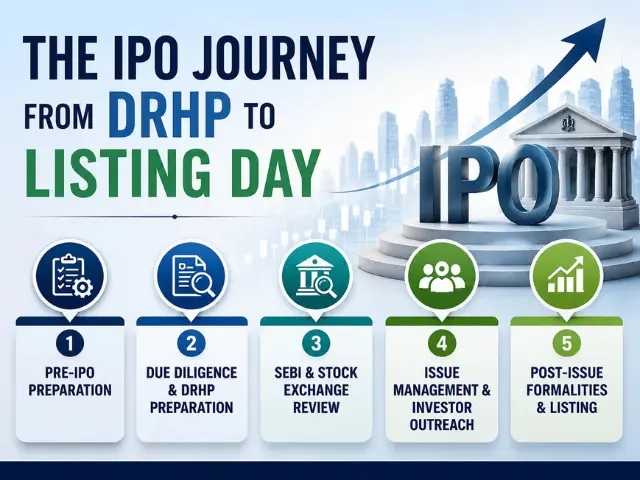

An IPO is often perceived as a single event. In reality, it is a tightly regulated capital markets transaction that tests a company’s governance, financial maturity and disclosure standards. Long before the stock lists, months of preparation go into drafting, verification, regulatory review and investor positioning.
Why the Filing Process Matters
The offer document is the backbone of the IPO. For SEBI, it is a legal disclosure document. For investors, it is the primary source of truth.For the company, it becomes a permanent public record. Gaps in statutory disclosures or inconsistencies in financial reporting may result in approval delays and affect investor confidence.
Phase I: Pre IPO Preparation
The IPO process begins well before drafting the prospectus. At this stage, the company prepares itself to operate as a listed entity. Key actions include finalising the issue structure, converting into a public limited company, updating constitutional documents, strengthening board and committee structures, appointing key managerial personnel and dematerialising shareholding.
Phase II: Due Diligence and DRHP Preparation
This is the most intensive stage of the IPO journey. The Merchant Banker conducts detailed financial, legal and business due diligence, followed by preparation of the Draft Red Herring Prospectus covering company profile, industry overview, risks, financials and utilisation of proceeds.
Phase III: SEBI and Stock Exchange Review
SEBI, along with the stock exchanges, reviews the DRHP to ensurefull and fair disclosures, eligibility, and governance compliance. All queries and observations are addressed before final In-Principal approval.
Phase IV: Issue Management and Investor Outreach
Post regulatory clearances, the Red Herring Prospectus is finalised and the issue pricing is decided. Merchant Bankers, working closely with syndication and underwriting teams, drive investor outreach and roadshows, while market makersplay a role in supporting orderly trading and liquidity (in case of SME-IPO), in line with applicable issue regulations.
Phase V: Post Issue Formalities and Listing
After the issue closes, the basis of allotment is finalised, funds are reconciled by the banker to the issue, and shares are credited to investors’ demat accounts. In cases of oversubscription, allotment is carried out as per category-wise allocation norms, with proportionate or lottery-based distribution and refunds/unblock of excess application amounts. The company then lists on the stock exchanges and enters the post-listing compliance framework. Syndication and underwriting teams continue to support investor engagement, while issuer-led marketing and investor interactions remain ongoing. Anchor investors participate up to one working day prior to the issue opening, helping establish early demand visibility and confidence in the offering.
Role of the Merchant Banker
The Merchant Banker anchors the IPO end-to-end, beginning with comprehensive due diligence and preparation of offer documentation. They act as the primary interface with SEBI and Stock Exchanges, provide valuation and structuring advice, and lead investor marketing efforts. In coordination with syndication and underwriting teams, the merchant banker supports book building, demand aggregation, and risk underwriting. Post listing, they also facilitate market-making arrangements and ensure regulatory and compliance requirements are met, enabling a smooth transition from a privately held company to the public markets.
Closing Thoughts
The IPO process shows how ready a company is to operate in public markets. With the right Merchant Banker guiding the company at every stage, the journey becomes well-planned and manageable, helping the business move smoothly into the listed space and build long-term, sustainable growth.
👉 To Connect with us today, please click here.
Latest Articles

India Planning for 20% Foreign Investment in LIC IPO


India is planning a proposal to let foreign investors buy up to 20 percent stakes in the upcoming LIC IPO. The whole information was provided by a person with knowledge of the matter, that would allow them to participate in the nation’s biggest IPO i.e LIC.
The listing of LIC as an IPO is the government’s biggest move towards public offering as the government is expecting to raise 900 billion rupees from its stakes sale.
Also, the government is planning to amend its FDI rules so that the investors will purchase shares without the government’s approval. According to the act of parliament of India, LIC is a special Indian entity, and hence not all have an opportunity to buy its stakes.
Besides, GOI, the RBI, and IRDAI also regulate foreign investment in the Indian insurance sector.
As of now, the FII’s are allowed to hold up to 74% of private insurance companies and 20% up to state-owned banks, however, they have no right to buy shares in LIC.
The amendment in FDI rules would allow foreign pension funds, mutual funds, insurance companies to participate in LIC IPO i.e India’s biggest life insurer.
Before the year ends, the government is all set to complete its listing procedures and hence selected 10 merchant banks out of 16 that had bid to manage LIC IPO.
10 Out of 16 Merchant Bankers Are Selected to Manage LIC IPO
The government has selected the top 10 global and Indian merchant bankers to manage the mega-IPO of the country’s largest insurer LIC.
According to the department of investment and public asset management, GOI has appointed Goldman Sachs, Nomura Financial Advisory and Securities, Citigroup, JP Morgan Chase, Bank of America Securities, JM Financial, SBI Capital Market, Axis Capital, ICICI Securities and Kotak Mahindra Capital to manage the mega initial public offering of LIC.
Furthermore, the Government of India also selected Kfintech as the registrar, share transfer agent and concept communications as the advertising agency before launching the LIC IPO.
According to DIPAM (Department of Investment and Public Asset Management) secretary Tuhin Kanta Pandey, the government has finalized the book-running led managers and other advisors for LIC IPO.
Also, on July 15, 2021, the disinvestment department received several applications for the appointment of merchant bankers. As a result, 10 out of 16 bankers have been selected. After this, 16 merchant bankers had prepared presentations for managing the listing and disinvestment of LIC.
Looking actively at the whole matter, DIPAM had already appointed a legal advisor for the stake sale and the last date for placing bids for the same was 16 September.
The government also allows foreign investors to buy stakes in LIC IPO. However, as per the LIC Act, there was no provision for foreign investment earlier, the GOI along with SEBI has come with proposed norms regarding FII’s participation as a result of which they are allowed to purchase up to 20 per cent in this IPO.
If you look at the size of the IPO, then it is expected to be far larger than any other IPOs that have launched in the primary market.
The public listing of LIC will give bountiful benefits to the Indian government as its disinvestment target will be Rs 1.75 Lakh Crore in FY 2021-22.
This financial year, Rs 8,368 Crore has been mopped up through minority stake sale in PSU and sale of specified undertaking of the unit trust of India stake in Axis Bank.
LIC to Draft IPO Papers with Sebi Next Month
After selecting the best merchant bankers for managing the LIC IPO, the fresh move that will be taken by LIC is to draft DRHP next month. As per the finance ministry official, the plan is to bring the IPO within this fiscal, and we have set fixed timelines in regards to the IPO.
The DRHP would be filed in November 2021, i.e next month. Once the Draft Red Herring Prospectus is filed, the merchant bankers will open domestic and global roadshows for investors all over the world.
The government has appointed Cyril Amarchand Mangaldas as a legal advisor for the IPO.
The government’s objective then is to list the insurance behemoth within the current financial year ending in March 2022. The ministry is in the process of getting the embedded value of the LIC and once that is done, the ministerial panel will decide the government stake that will be divested in the IPO.
The listing of LIC is important as through it, the government will get a benefit of Rs 1.75 Lakh Crore.
Basic Details of LIC-IPO
As per the economic time’s report, three companies including national fertilizers limited, Mishra Dhatu Nigam and Rashtriya Chemicals and Fertilisers Limited are likely to get divested through an offer for sale before LIC IPO launching.
It is estimated that 10% of stake sale of LIC would give a big amount of Rs 1 Crore to 1.5 Crore.
The price band of LIC IPO is estimated at Rs 400-600 shares taking into account total capital and valuation. The paid-up capital is reported is Rs 25000 Crore while the total valuation of the IPO would be between 10-15 Lakh Crore.
Strength of LIC IPO
The renowned company offers numerous life insurance plans, money back plans, term life insurance plans and more.
LIC covered a market share of 69% in the life insurance space.
LIC also offers other businesses such as LIC Housing Finance, LIC Pension Fund, LIC Mutual Fund, LIC Card Services.
The Bottom Line
As per the new norms, foreign investors’ participation is allowed in the LIC IPO.

वैश्विक आपूर्ति संकट से तेज़ सोना-चांदी के भाव।
सोने और चांदी की कीमतों में तेज़ी पिछले सप्ताह भी जारो रही। घरेलु वायदा बाजार में सोना पिछले सप्ताह 400 रुपये तेज़ हो कर 47600 रुपये प्रति दस ग्राम के स्तरों पर कारोबार किया। जबकि चांदी के भाव 2300 रुपये तेज़ हुए जिससे कीमते 65500 रुपये प्रति किलो पर पहुंच गई।
विश्व बैंक ने गुरुवार को अपने नवीनतम कमोडिटी मार्केट आउटलुक में कहा कि ऊर्जा संसाधनों की कीमतें 2021 में 80 प्रतिशत से अधिक बढ़ी जिसके कारण कई विकासशील देशों में निकट अवधि के लिए वैश्विक मुद्रास्फीति का जोखिम बढ़ गया है।
बहुपक्षीय विकास बैंक के अनुमान के मुताबिक साल 2022 की दूसरी छमाही में ऊर्जा की कीमतों में गिरावट शुरू हो सकती है क्योंकि आपूर्ति संकट कम हो जायेगा, साथ ही कृषि और औद्योगिक धातुओं की कीमतों में भी गिरावट होगी जिनकी कीमते 2021 में काफी उचे स्तरों पर पहुंच चुकी है।
उच्च खाद्य कीमतें भी खाद्य-मूल्य मुद्रास्फीति को बढ़ा रही है और कई विकासशील देशों में खाद्य सुरक्षा के बारे में सवाल उठने लगे है। जिससे कीमती धातुए जो मुद्रास्फीति से सुरक्षा का बेहतर विकल्प है, की मांग मजबूत है।
दुनिया की प्रमुख केंद्रीय बैंको द्वारा कोवीड -19 का असर कम होने पर एसेट टेपरिंग पर विचार शुरू कर दिया है लेकिन, आपूर्ति में बाधा रहने से औद्योगिक उत्पादन घटने लगा है जिससे डॉलर जो सोने के विपरीत दिशा में चलता है, में पिछले सप्ताह गिरावट रही है और सोने के भाव में तेज़ी है। खुदरा मांग मजबूत रहने से भी कीमती धातुओं के भाव में तेज़ी है।
तकनीकी विश्लेषण
घरेलु सराफा बाज़ारो में दिवाली के पहले सोने और चांदी की खुदरा मांग बढ़ने की सम्भावना है जिससे इनके भाव में तेज़ी रह सकती है। घरेलु वायदा सोने में 47200 रुपये पर सपोर्ट है और 48000 रुपये पर प्रतिरोध है। चांदी वायदा में 63700 रुपये पर सपोर्ट और 66000 रुपये पर प्रतिरोध है।

Understanding Contingent Liabilities
Introduction
Welcome! Today, we’re going to delve into the concept of contingent liabilities—a key aspect of financial reporting that often confuses many. Contingent liabilities are potential obligations that may arise depending on the outcome of uncertain future events. Let’s break down what they are, why they matter, and how they are reported.
What are Contingent Liabilities?
Contingent liabilities are potential financial obligations that depend on the occurrence of uncertain future events. They are not guaranteed to occur but represent possible future liabilities that could affect a company’s financial position.
Types of Contingent Liabilities
- Possible Liabilities: These are obligations that may arise based on the outcome of an uncertain future event. For example, if a company is involved in a lawsuit, the potential damages awarded could be a possible liability.
- Probable Liabilities: These are obligations that are likely to occur based on current information. If a company is almost certain to lose a lawsuit, the potential loss is considered a probable liability.
- Remote Liabilities: These are obligations that are unlikely to occur. For example, if the likelihood of a company facing a significant lawsuit is very low, the associated liability is considered remote.
How are Contingent Liabilities Reported?
- Disclosure: Companies must disclose contingent liabilities in the notes to their financial statements. This disclosure includes details about the nature of the contingency, the potential financial impact, and any relevant uncertainties.
- Recognition: If a contingent liability is probable and can be reasonably estimated, it should be recorded in the financial statements as a liability. For example, if a company anticipates paying a specific amount in a lawsuit, this amount should be recognized as a liability.
- Assessment: The assessment of contingent liabilities involves evaluating the likelihood of the event occurring and estimating the potential financial impact. This assessment helps determine whether the liability should be disclosed or recognized.
Examples of Contingent Liabilities
- Legal Claims: If a company is involved in a legal dispute and the outcome is uncertain, the potential damages awarded are considered a contingent liability. For instance, a company facing a lawsuit for patent infringement might disclose a potential liability in its financial statements.
- Warranties and Guarantees: Companies often provide warranties on their products. If a significant number of products are expected to require repairs or replacements, the estimated cost of these warranties is a contingent liability.
Risks and Considerations
- Financial Impact: Contingent liabilities can impact a company’s financial health if they materialize. Companies must carefully assess and disclose these liabilities to provide an accurate picture of their financial position.
- Regulatory Compliance: Proper reporting and disclosure of contingent liabilities are required by accounting standards and regulations. Non-compliance can lead to legal issues and impact investor confidence.
- Estimation Challenges: Estimating the financial impact of contingent liabilities can be challenging, especially when the outcome of the underlying event is uncertain.
Conclusion
Contingent liabilities are an important aspect of financial reporting that help stakeholders understand potential future obligations. Proper disclosure and assessment of these liabilities provide valuable insights into a company’s financial position and risk exposure. Always stay updated about how contingent liabilities are reported and their potential impact on financial statements.

DSP Mutual Fund Launches India’s First ETF Based on Equal Weight Strategy
DSP Investment managers announced the launch of DSP Nifty 50 Equal Weight ETF on the very first Monday of this week. The ETF is India’s first exchange-traded fund which is based on the Nifty 50 Equal Weightage Index.
The new fund offer NFO opens for subscription on October 18th and closes on October 29th, after which it could be bought and sold on the major stock exchanges, the company said.
Before taking a deep dive into the Nifty 50 Equal Weight Index lets take a quick glance at ETF:
What Exactly is ETF?
An ETF is a basket of securities whose shares are sold on the stock exchanges i.e. NSE and BSE. They offer similar features and potential benefits like mutual funds, stocks and bonds.
ETFs are similar to stocks as they provide investors with a facility to trade throughout the day at prices that change based on supply and demand.
Like stocks, ETFs also possess some features of mutual funds as ETF stocks represent partial ownership of a portfolio built by professional managers.
Different Types of ETFs
There are different types of ETFs, each with a different investment focus.
Here are some of the most common ETFs.
1. Diversified Passive Equity ETFs
The returns of Diversified Passive Equity ETFs are completely dependent on the performance of widely used equity market benchmarks such as the S&P 500, the Dow Jones Industrial Averages and more.
2. Niche Passive Equity ETFs
Niche passive equity ETFs, are those whose returns are based on the performance of S&P 500 industry subgroups or Russell 2000 small companies.
These ETFs provide investors with focused exposure to help them fine-tune their portfolio strategies.
As with passive diversified funds, these niche portfolio funds are generally made up of the same stocks that are used to calculate their benchmarks.
3. Active Equity ETFs
Active Equity ETFs allow their managers to use their own judgment when choosing investments rather than being rigidly tied to a benchmark index.
Active ETFs can have the potential to outperform a market benchmark, but they can also carry higher risk and higher costs. 4,444 bond ETFs focus more on bonds than stocks.
4. Large Fixed Income ETFs
Large fixed-income ETFs are those that actively traded on the stock market but provide low returns or steady returns to the investors. In other words, the returns generated from large fixed income are not very high yielding.
5. Equal Weight Index ETF
In an equal weight index, each stock present in it receives equal weight. For instance, if the method is applied to the index Nifty 50, then the equal weightage index will own the same 50 companies of Nifty 50 and will have 2% weight of each company.
This method is not like the current stock market cap design where some stocks hold a large weight such as 9-10% and many stocks in the lower tail will get only 0.3%.
This provides all the companies with a fair chance to contribute equal returns than completely dependent on the top 10 company stocks.
Difference Between Nifty 50 and Nifty 50 Equal Weight
In Nifty 50, the stock weights are decided on the basis of market capitalization and weightage changes based on the movement of the stock market. Hence, the returns generated from the market are slanting towards the stocks that possess the highest weight.
In the Nifty 50 Equal Weight Index, equal weights are assigned to each company’s stocks and the weight of each stock is reset to equal weight every quarter. Here, they provide equal opportunity for every stock to perform.
The DSP Equal Nifty 50 ETF operates on the two fundamental investment principles that invest in industry leaders who can navigate the cycles of the stock market with better diversification between companies and sectors with equal share weights, offering low specific risks and low industry concentration compared to Nifty.
Aside from a lower-cost diversified portfolio, the Nifty 50 ETF has the same weighting benefits of ease of purchase and real-time stock trading.
The equal index is reweighted quarterly. Because of this quarterly rebalancing, an equally weighted portfolio has a built-in profit mechanism that buys the underperforming at low prices and sells the best performing at high prices.
The new fund offering opens for subscription on October 18 and ends on October 19, after which it can be bought and sold on the stock exchanges.
Kalpen Parekh, Dr MD and CEO of DSP Investment managers has said that when we explore this concept of equally-weighted indices around the world, we find that the same weights tend to produce better returns than market capitalization-weighted indices over long periods of time.
This is done because all companies have the opportunity to participate, not just a few. Such a strategy has its underperforming phase when the benefits of the economy polarize on selected companies, as they have been for the past five years.
However, since good companies in all industries grow and create long-term value, a balancing strategy gives each company significant weight in the index.
The same weighting also ensures that the sector with the most ownership is at risk at all times, ”Parekh said.
Anil Ghelani, CFA, Director of Investments and Passive Products, DSP Investment Managers, emphasized that equally weighted strategies exploit certain market inefficiencies due to behavioral distortions.
Since the strategy is not controlled by an excess of optimism in specific actions, the same weighting takes the benefits of certain stock market inefficiencies caused by behavioral biases.
These inefficiencies have contributed to the balanced index strategy eclipsing traditional index strategies based on market capitalization, ”says Ghelani.

साहसी बूल्स निफ़्टी को 18500 के स्तर की ओर बढ़ा रहे हैं
हम एक अनोखा बुल रन देख रहे हैं, जहां महंगाई और बढ़ती बॉन्ड यील्ड की सभी चिंताओं को नजरअंदाज करते हुए बूल्स 18500 के स्तर की ओर बढ़ रहे हैं, वही हमने लंबे समय से कोई बड़ी गिरावट नहीं देखी है।
इस बुल रन का सबसे दिलचस्प हिस्सा यह है कि यह संस्थागत निवेशकों के प्रवाह की परवाह नहीं कर रहा है जहा पिछले सप्ताह नेट संस्थागत निवेश नेगेटिव रहा वही निफ्टी ने पिछले सप्ताह के प्रत्येक कारोबारी सत्र में अपनी नई ऊंचाई को छुआ तथा 2.5% की साप्ताहिक बढ़त के साथ अपने उच्चतम स्तर पर समाप्त हुआ।
FII ने केवल 1037 करोड़ रुपये की बाजार में खरीददारी की जबकि DII ने 3296 करोड़ की बिकवाली की, इसलिए संसस्थागत निवेशकों द्वारा नेट 2259 करोड़ रुपये की बिक्री हुई। बाजारों में परिस्थिति बदल रही है और हम रिटेल निवेशकों की ताकत देख रहे हैं क्योंकि एसआईपी मार्ग के साथ-साथ डायरेक्ट इक्विटी मार्ग के माध्यम से रिकॉर्ड इनफ्लो हो रहा है।
ये इनफ्लो पिछले बुल रनों की तुलना में ज़्यादा मज़बूत दिख रहा हैं क्योंकि इन निवेशकों का दीर्घकालिक दृष्टिकोण है और हर गिरावट पर खरीदारी के रुख के साथ शार्ट टर्म अस्थिरता से निपटने के लिए तैयार हैं, हालांकि इन निवेशकों के स्वभाव की वास्तविक परीक्षा थोड़े बड़े करेक्शन में होगी क्योंकि अभी तक नए निवेशकों ने बाजार में कोई बड़ी मुनाफावसूली नहीं देखी है।
क्या कहता है डेरीवेटिव डेटा?
अगर हम डेरिवेटिव डेटा के बारे में बात करे तो इंडेक्स फ्यूचर में FII का लॉन्ग एक्सपोजर 67% है, जबकि पीसीआर 1.53 मार्क पर है, जो बाजार में कम्फर्टेबले लेवल का संकेत देता है, हालांकि 21 अक्टूबर की एक्सपायरी के लिए ओपन इंटरेस्ट पोजीशन बिखरी हुई है, जहां पर कॉल ऑप्शन में OI 18500-19000 की रेंज में है जबकि पुट ऑप्शन के लिए यह 18300-18000 जोन है।
टेक्निकल आउटलुक
टेक्निकल चार्ट पर 18500 एक तत्काल और मनोवैज्ञानिक रेजिस्टेंस है, जबकि 18700 एक अपस्लोपिंग ट्रेंडलाइन रेजिस्टेंस होगा। वही दूसरी तरफ, 18250 एक तत्काल सपोर्ट स्तर है जबकि 18000 -17950 किसी भी मुनाफावसूली पर महत्वपूर्ण सपोर्ट जोन होगा।
निफ़्टी के मुकाबले बैंकनिफ्टी बेहतर प्रदर्शन कर रहा है और 40000 के महत्वपूर्ण रेजिस्टेंस को टेस्ट कर सकता है और 39000-38800 का क्षेत्र तत्काल और मजबूत सपोर्ट क्षेत्र बन गया है जबकि 38100-37900 महत्वपूर्ण सपोर्ट क्षेत्र होगा।
सेक्टर परफॉरमेंस
IT सेक्टर अंडरपरफॉर्म कर सकता है क्योंकि यह लोअर हाई और लोअर लो फॉर्मेशन बना रहा है जबकि मेटल सेक्टर नए हाई के तरफ बढ़ सकता है । पीएसयू बैंक भी आने वाले दिनों में अपनी मजबूती जारी रख सकते हैं।
अगले सप्ताह के संकेत
अगर अगले सप्ताह के संकेतों की बात करें तो सितम्बर के तिमाही नतीजे बाजार पर हावी रहेगी जहां बाजार सोमवार को एचडीएफसी बैंक और एवेन्यू सुपरमार्ट्स (डी-मार्ट) की कमाई पर बाजार रियेक्ट करेंगे , साथ ही अल्ट्राटेक सीमेंट, एसीसी, एचयूएल, नेस्ले, एशियन पेंट्स, जेएसडब्ल्यू स्टील, एचडीएफसी लाइफ, और रिलायंस इंडस्ट्रीज सप्ताह के दौरान अपने तिमाही नतीजे घोषित करेगी ।
तिमाही नतीजे के अलावा अन्य ग्लोबल संकेत महत्वपूर्ण होंगे जहां ग्लोबल बाजारों ने एक करेक्शन के बाद अच्छा प्रदर्शन करना शुरू किया है। कमोडिटी की बढ़ती कीमतें अभी भी चिंता का विषय हैं लेकिन बाजार फिलहाल इस तथ्य पर विचार नहीं कर रहा है। डॉलर इंडेक्स और यूएस बॉन्ड यील्ड थोड़ी ठंडी हुई लेकिन आने वाले दिनों में बाजार की नजर इस पर होगी।

Knowledge Byte: Market Share of Top 10 AMCs
A financial service firm (AMC) is one that offers a large variety of mutual fund investment strategies.
In India as of now, there are 44 asset management companies (February 2017). The private sector includes 35 such AMCs. Association of Mutual Funds in India (AMFI) India includes all asset management companies (AMFI). In 1995, AMFI was established in all registered AMCs in India as a non-profit association.
SBI AMC
The SBI Mutual Fund was launched in 1987 and has been active for over 30 years in the Indian Mutual Fund sector. The fund administers approximately 5.4 million investment mandates. It's one of India's oldest and best-known AMCs. SBI Mutual Fund offers systems in different categories to meet different requirements of individuals.
HDFC AMC
Housing Development Finance Corporation Limited (HDFC) is a firm that is located in Mumbai, India. it is an Indian Financial Services organization. Through its subsidiary HDFC Asset Management Company Limited, HDFC provides mutual fund services. This is India's second-largest AMC.
ICICI Prudential Asset Management Company Ltd.
The AMC works along with Prudential of the United Kingdom and ICICI Bank of India, one of India's largest banks. Prudential Plc. is a major player in the financial services sector in Great Britain. Founded in Mumbai on 13 October 1993, this AMC has an asset basis of about Rs 2,93,338, with more than 1,400 supplies. The AMC provides a wide array and high marked service choices.
Aditya Birla Sun Life Mutual Fund
AUM, which distributes over 600+ schemes, is presently managing over Rs 2,41,107 crore. The AMC was established by Aditya Birla Group of India and Sun Life Financial Inc. of Canada in 1994 as a joint venture.
From broad equity trading plans to industry-specific plans, the Birla Sun Life mutual fund delivers a variety of mutual fund programmes. There are also debt-mutual funds, hybrid schemes, fund schemes, monthly income plans and offshore funds. It has a large range of investments and a strong financial base.
Kotak AMC
Since 1988, Kotak's huge client base with investor lakhs has already been created. AMC provides a variety of solutions, catering with new goods to a variety of clients. With minimal SIP commitment of 1000 and 500, Kotak Equity Opportunities Fund, Standard Multicap funds have improved growth.
Nippon India AMC
Founded by the late Dhirubhai Ambani, Nippon India AMC (formerly known as Reliance Asset Management Limited) is one of the most prominent Indian AMCs. It was then partnered with the Japanese Nippon Life Insurance. In 2019, the Insurance company Nippon Life held a 75% interest in the mutual fund, which allowed Anil Ambani to exit the Mutual fund industry. It was then called Nippon India Asset Management Company
Axis AMC
Axis Mutual Fund is India's fifth-biggest asset-size mutual fund company. For the quarter ending June 2020, the Fund House would handle assets of Rs 1.34 lakh crore. The fund house's asset size fell by 2,90% from the quarterly number in March 2020. For over 11 years the fund house has existed. Axis Bank Limited controls 74.99% of the funds, while Schroder Singapore Assets Private Limited retains the remaining 25% of the holdings.
UTI AMC
Founded in 1963, UTI is one of India's leading asset management firms. As the first mutual fund provider to offer, UTI promises certain reliable returns, Easy and accessible investment in UTI at any time of year. UTI mutual funds schemes are handled by the most acute financial institutions and hence their returns are trustworthy and in accordance with their goals for capital appreciation. The AMC manages 1,53,364 crore rs in AUM with around 1400 products and offers funds in different categories.
IDFC AMC
The IDFC Mutual Fund is India's ninth-largest asset house. For the quarter ending June 2020, the investment firm manages assets (AUM) worth Rs 1.01 lakh crore. For almost 20 years, the fund house has been around. It enables investors to make quality investments through rigorous research and creation of the product mix while taking the risk profile of their investors into account to support the fund house. In the approximately 46 cities and 280 towns in the nation, the IDFC Mutual Fund holds more than 1 million investors' accounts.
DSP AMC
DSP BlackRock Mutual Fund is the world's largest investment management company. It has a record of more than 20 years of investing excellence. An investment host of equities, debt, hybrids, the Fund of Funds, international FoFs etc. which can be used by the investors. The AMC has a highly skilled investing staff.
Big Budget


Popular Articles



.avif)
.avif)

.avif)



START YOUR INVESTMENT JOURNEY
Get personalized advice from our experts
- Dedicated RM Support
- Smooth and Fast Trading App
