

The Power of Compounding – Why Starting Early Matters




Introduction
Albert Einstein reportedly called compound interest the "eighth wonder of the world." Whether or not he actually said it, the math is undeniable. Compounding is the process where your investment returns begin earning their own returns — and over time, this snowball effect becomes truly extraordinary.
The catch? Compounding needs one essential ingredient: time.
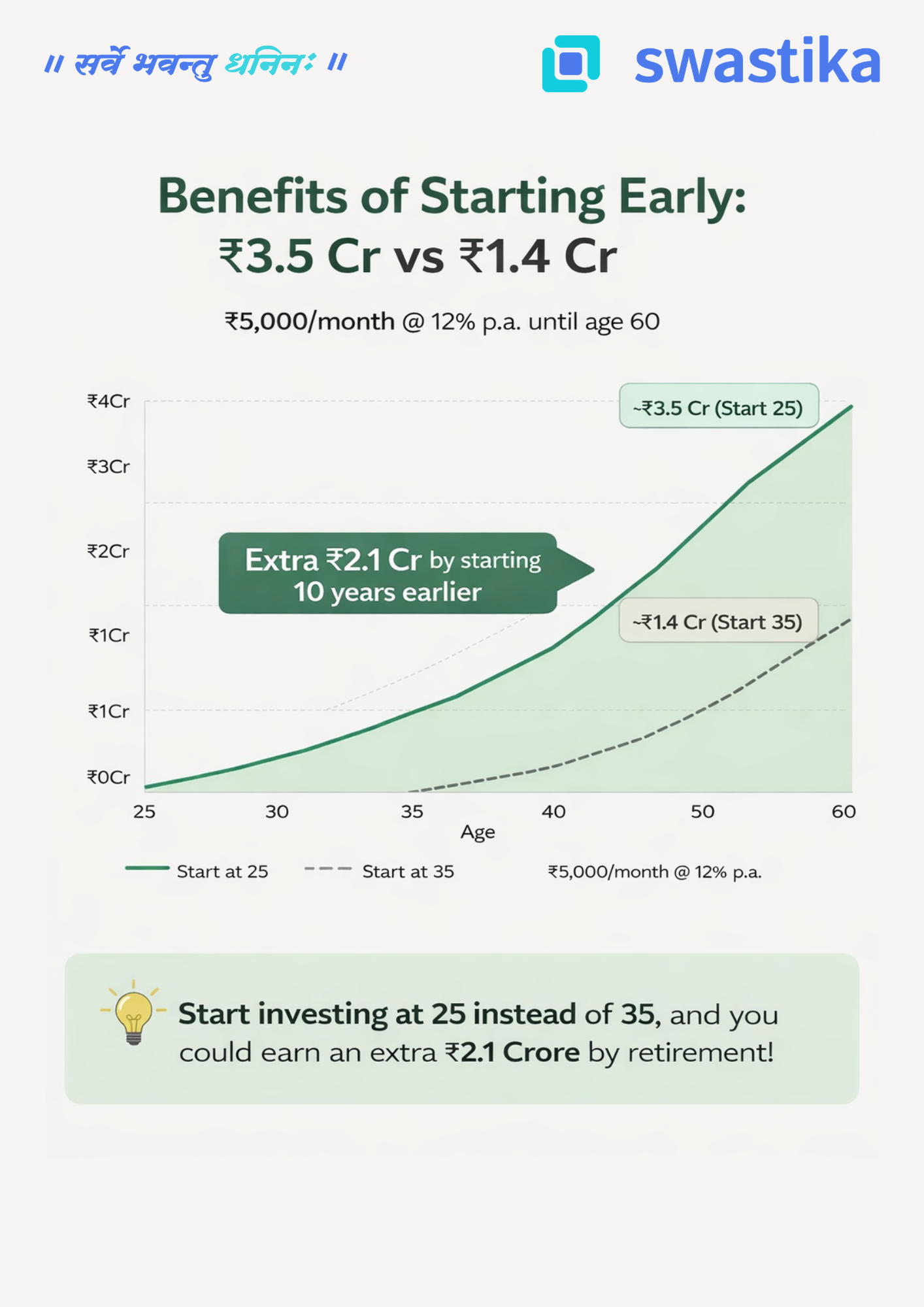
The more years you give your money to grow, the more dramatic — and life-changing — the results become. This is exactly why starting your investment journey early, even with a modest amount, can make a difference of crores by the time you retire.
A Tale of Two Investors: Arjun vs Priya
Let's bring this concept to life with a simple, real-world example.
Meet Arjun and Priya. Both are sensible, disciplined investors. Both invest ₹5,000 every month through a SIP (Systematic Investment Plan) in equity mutual funds, earning an average annual return of 12%. Both stop investing at age 60.
The only difference? Arjun starts at 25. Priya starts at 35.
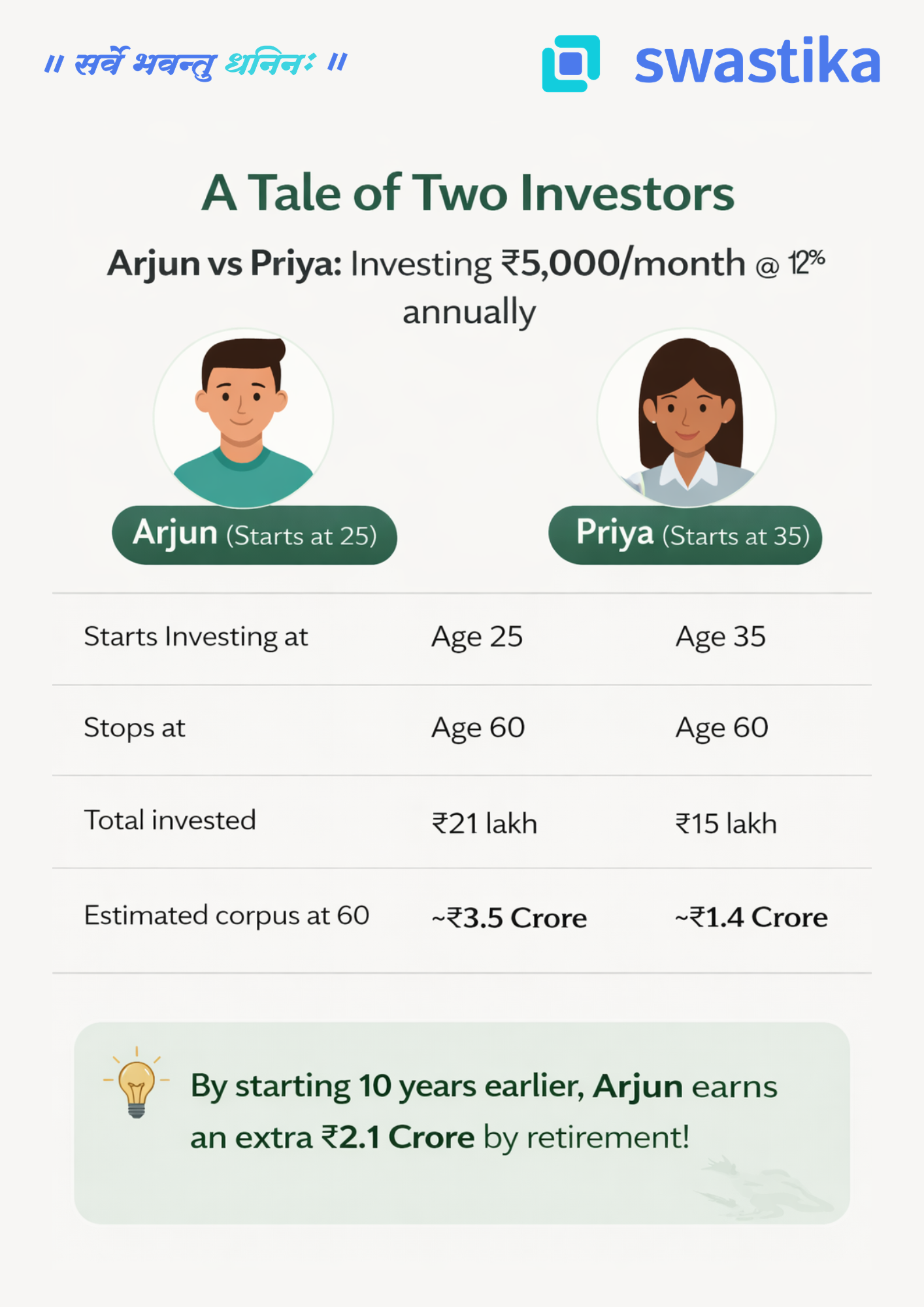
The numbers are striking. Arjun invests just ₹6 lakh more than Priya in absolute terms — yet walks away with ₹2.1 Crore more at retirement.
That extra ₹2.1 Crore didn't come from investing more aggressively or taking bigger risks. It came purely from starting 10 years earlier.
Why Does Time Make Such a Huge Difference?
This is where the magic of compounding reveals itself.
In the early years of investing, growth looks modest and almost unimpressive. But as the years pass, your corpus grows not just on your original investment, but on all the accumulated returns from previous years. The curve goes from almost flat to steeply exponential — and that steep climb happens in the later years.
When Arjun starts at 25, his money has 35 years to ride that exponential curve. Priya's money, starting at 35, only catches the last 25 years — and critically, it misses the steepest part of the climb in the final decade.
Think of it this way: the last 10 years of compounding are worth more than the first 20. That is the counterintuitive truth at the heart of long-term investing.
The Real Cost of Waiting
Many young earners tell themselves, "I'll start investing once I'm more settled — once the salary improves, once the EMI is paid off, once life is a bit easier."
But the numbers show that every year of delay is extraordinarily expensive — far more expensive than any EMI or lifestyle expense. Priya didn't invest carelessly. She invested faithfully for 25 years. Yet she ends up with less than half of what Arjun accumulated — not because she did anything wrong, but simply because she started a decade late.
The cost of waiting 10 years wasn't ₹6 lakh in additional contributions. The cost was ₹2.1 Crore in lost wealth.
Three Principles to Remember
1. Start now, not later.The best time to start investing was yesterday. The second best time is today. Even a SIP of ₹1,000–₹2,000 per month in your 20s is infinitely better than waiting for the "right time."
2. Consistency beats intensity.You don't need to invest large sums all at once. A small, steady, monthly commitment — maintained without interruption — is what unlocks the full power of compounding over decades.
3. Stay invested through market cycles.Compounding works only if you let it work. Exiting during market corrections or stopping your SIP in tough months breaks the chain. Time in the market, not timing the market, is what builds wealth.
The Bottom Line
If you are in your 20s or early 30s, you hold an asset that no amount of money can buy later: time. Use it. Start a SIP today — even a small one. Let compounding do its slow, steady, powerful work.
Because the difference between starting at 25 and starting at 35 is not just 10 years. As Arjun and Priya's story shows, that difference is ₹2.1 Crore.
Big Budget









.webp)
.webp)
.webp)
.webp)
.webp)
















.webp)
.webp)
.webp)
.webp)
Latest Articles
%20(3).webp)
Stock Market Closed Today March 31, 2026: Equity, Derivatives, Currency & Commodity Shut for Mahavir Jayanti


If you were planning to make last-minute trades or adjustments today, here’s an important update — the Indian stock market is closed today, March 31, 2026, on account of Mahavir Jayanti.
Both the National Stock Exchange of India (NSE) and the Bombay Stock Exchange (BSE) have suspended trading across all segments for the day.
This closure comes at a crucial moment, as today marks the last day of the financial year, when investors typically finalize tax-saving moves and rebalance portfolios.
🚨 What’s Closed Today?
- Equity Markets – No buying or selling of stocks
- Derivatives (F&O) – Futures and options trading paused
- Currency Derivatives – Trading unavailable
- SLB Segment – Securities lending & borrowing halted
👉 In short, no trading activity is happening today across NSE & BSE.
⚠️ Important Exceptions
- Commodity exchanges like MCX are open in the evening session
- Timings can vary — always confirm with your broker
📉 Why Today Matters So Much
March 31 isn’t just any holiday it’s the financial year-end, making it critical for:
1. Tax Planning Deadline
Strategies like tax loss harvesting cannot be executed today due to market closure.
2. Portfolio Rebalancing
Any pending portfolio changes should have been completed by March 30, 2026.
3. Settlement Impact
Because of the holiday, the T+1 settlement cycle gets delayed, affecting fund and stock credits.
🌍 What Happens While India Is Closed?
Even though Indian markets are shut:
- Global markets remain active
- Major international developments can impact Indian markets when they reopen
🧠 What Smart Investors Do Today
Instead of trading, experienced investors use today to:
- Review portfolio performance
- Analyze market trends and sectors
- Study upcoming earnings and macro signals
- Plan next financial year strategies
🏛️ Regulatory Note
Market holidays are scheduled as per guidelines from the Securities and Exchange Board of India (SEBI).
Banking and settlement processes are also influenced by the Reserve Bank of India (RBI), especially around financial year-end.
❓ FAQs
Is the stock market closed today (March 31, 2026)?
Yes, NSE and BSE are fully closed for Mahavir Jayanti.
Can I place orders today?
Yes, but they will only execute when markets reopen.
Will settlements be delayed?
Yes, due to the holiday, settlement timelines will shift.
Are commodity markets open today?
Yes commodity markets are open today for evening session.
.png)
Last Trading Day of FY 2025–26: What Investors Should Do on March 30, 2026
As the last trading day of FY 2025–26 arrives on March 30, 2026, investors have a final window to optimize taxes, rebalance portfolios, and ensure compliance before the financial year closes. Whether you are a seasoned trader or a long-term investor, the decisions you make today can directly impact your tax outgo and future returns.
This is not just another trading session. It is your last opportunity to take strategic actions aligned with your financial goals.
Key Takeaways
- Review your portfolio and book losses to reduce tax liability
- Ensure all trades are settled before year-end cutoffs
- Rebalance asset allocation based on performance and goals
- Verify capital gains statements and tax reports
- Avoid last-minute emotional or impulsive trades
Why March 30, 2026 Matters for Investors
The Indian stock market follows a T+1 settlement cycle, meaning trades executed on March 30 will typically settle by March 31, marking them within the current financial year. Since March 31, 2026 is a market holiday due to Mahavir Jayanti, March 30 becomes the effective last trading day.
This makes it crucial for investors to complete all tax-related and portfolio adjustments before market close.
Tax Loss Harvesting: A Smart Move Before Year-End
One of the most effective strategies on the last trading day is tax loss harvesting. This involves selling underperforming stocks or mutual funds to offset capital gains earned during the year.
For example, if you made a profit of ₹1 lakh in one stock and have a loss of ₹40,000 in another, booking that loss can reduce your taxable gains to ₹60,000.
Under current regulations by the Securities and Exchange Board of India, short-term capital gains are taxed at 15 percent, while long-term gains above ₹1 lakh are taxed at 10 percent without indexation. Proper loss booking can significantly reduce this burden.
Review Your Capital Gains and Statements
Before the financial year closes, it is essential to reconcile your capital gains statements with broker reports. Many investors overlook discrepancies, which can lead to errors during income tax filing.
Check the following:
- Realized gains and losses
- Dividend income
- Securities transaction tax records
- Broker ledger and contract notes
Using a reliable platform like Swastika Investmart can simplify this process, as it offers consolidated reports and easy tracking tools.
Rebalance Your Portfolio for Better Alignment
Market movements over the year may have altered your asset allocation. A portfolio that was initially balanced could now be overweight in equities or underexposed to certain sectors.
Rebalancing helps you:
- Maintain your risk profile
- Lock in profits from outperforming assets
- Reinvest in undervalued opportunities
For instance, if banking stocks have surged while IT stocks lagged, you may consider partial profit booking and reallocating funds strategically.
Avoid Last-Minute Panic Trades
The final trading day often sees heightened volatility due to institutional adjustments and retail activity. It is easy to get caught in the noise and make impulsive decisions.
Instead:
- Stick to your predefined strategy
- Avoid chasing momentum stocks
- Focus on long-term goals rather than short-term market swings
Disciplined investing tends to outperform reactive trading over time.
Check Compliance and Documentation
Ensure all your financial records are in order before the year ends. This includes:
- PAN and Aadhaar linkage
- Updated KYC details
- Bank account verification
- Nominee details
Regulatory bodies like the Reserve Bank of India and SEBI emphasize proper documentation for seamless investing and compliance.
How Swastika Investmart Can Help
Swastika Investmart stands out as a SEBI-registered broker offering a comprehensive investing ecosystem. From advanced research tools to user-friendly trading platforms, it supports investors in making informed decisions.
Key advantages include:
- Expert research and advisory insights
- Tech-enabled trading platform with real-time data
- Dedicated customer support
- Strong focus on investor education
These features can be particularly useful during critical periods like the financial year-end when timely action is essential.
Frequently Asked Questions
Is March 30, 2026 the last trading day for FY 2025–26?
Yes, since March 31 is a market holiday, March 30 is the final trading session for the financial year.
Can I still do tax loss harvesting after March 30?
No, only trades executed and settled within the financial year will count for tax purposes.
What happens if I miss reviewing my portfolio before year-end?
You may miss opportunities to reduce tax liability or rebalance your investments effectively.
Are intraday trades relevant for tax planning?
Intraday trades are treated as business income and do not qualify for capital gains tax adjustments.
Do I need to file reports immediately after March 30?
No, but maintaining accurate records now will make tax filing easier later.
Final Thoughts
The last trading day of FY 2025–26 is more than a routine market session. It is a strategic checkpoint for every investor. From tax planning to portfolio alignment, the actions you take today can shape your financial outcomes for the next year.
Take a few moments to review your investments, make informed decisions, and ensure everything is in order.
If you are looking for a reliable partner to navigate the markets with confidence, you can explore the tools and insights offered by Swastika Investmart here:
Stock Market Closed Tomorrow on March 31, 2026: Equity, Derivatives, Currency & Commodity Shut for Mahavir Jayanti
If you're planning your trades at the financial year-end, here’s an important update. The Indian stock market will remain closed on March 31, 2026, on account of Mahavir Jayanti. Both National Stock Exchange of India and Bombay Stock Exchange will suspend trading across all segments for the day.
This closure comes at a crucial time when many investors actively rebalance portfolios and utilize tax-saving strategies before the financial year ends.
Key Highlights
- Indian stock markets will remain closed on March 31, 2026
- Closure applies to NSE and BSE across equity, derivatives, and SLB segments
- Commodity markets may have partial trading sessions
- Settlement cycles will be impacted due to the holiday
- Investors should plan trades in advance to avoid last-minute issues
Why the Stock Market Is Closed on March 31, 2026
March 31, 2026, marks Mahavir Jayanti, a significant religious festival celebrated across India. As per the official holiday calendar issued by exchanges, trading remains suspended on this day.
Both NSE and BSE follow a predefined list of trading holidays approved in alignment with regulatory guidelines and industry practices. These holidays ensure uniformity across the financial ecosystem and allow market participants to plan accordingly.
What Segments Are Affected
The holiday impacts multiple trading segments:
Equity Segment
No buying or selling of shares will take place on either exchange.
Derivatives Segment
Futures and options trading will remain closed for the day.
Securities Lending and Borrowing
SLB transactions will also be paused.
Currency Markets
Currency derivatives trading will not be available.
Commodity Market Exception
While equity markets remain closed, commodity exchanges such as MCX may operate in the evening session. However, traders should confirm timings with their broker.
Impact on Traders and Investors
1. Settlement Cycle Changes
Stock market holidays affect the T+1 settlement cycle. Trades executed before March 31 may see a delay in settlement due to the intervening holiday.
2. Financial Year-End Planning
March 31 is the last day of the financial year, making it crucial for tax planning strategies such as tax loss harvesting. Since markets are closed, investors must execute such strategies before the holiday.
3. Portfolio Rebalancing Delays
Any last-minute portfolio adjustments will need to be completed before March 30, 2026.
4. Global Market Influence
Even though Indian markets are closed, global markets will remain active. Significant global developments may impact Indian markets when they reopen.
Regulatory Perspective and Compliance
Market holidays in India are regulated under the broader framework governed by Securities and Exchange Board of India. Exchanges publish annual holiday calendars in advance to ensure transparency.
Additionally, banking operations, guided by the Reserve Bank of India, may also influence settlement timelines, especially during consecutive holidays.
Practical Tips for Investors
- Plan trades at least one day in advance to avoid liquidity issues
- Check settlement obligations if you have open positions
- Avoid last-day tax planning decisions without proper research
- Stay updated on global cues during the market closure
- Use the holiday to review your investment strategy
How Smart Investors Use Market Holidays
Experienced investors often use market holidays as an opportunity rather than a limitation. With no trading noise, it becomes easier to:
- Analyze portfolio performance
- Study upcoming market trends
- Review research reports and earnings outlooks
- Align investments with long-term financial goals
Platforms like Swastika Investmart offer robust research tools and insights that can help investors make informed decisions even when markets are closed. As a SEBI-registered broker, it emphasizes investor education, reliable support, and technology-driven investing, making it easier to stay ahead in dynamic market conditions.
Frequently Asked Questions
Is the stock market completely closed on March 31, 2026
Yes, both NSE and BSE will remain fully closed across all trading segments.
Will commodity markets also remain closed
Commodity markets may operate partially, especially in the evening session. It is best to confirm with your broker.
How does this holiday affect settlement
Settlement timelines may be delayed by one day due to the market closure.
Can I place orders on this day
You can place orders, but they will be executed only when markets reopen.
Why is March 31 important for investors
It marks the end of the financial year, making it crucial for tax planning and portfolio adjustments.
Conclusion
The stock market holiday on March 31, 2026, for Mahavir Jayanti comes at a critical time for investors. With trading suspended on both NSE and BSE, it is essential to plan your trades, settlements, and tax strategies in advance.
A well-prepared investor uses such pauses to reflect, analyze, and refine their approach. If you are looking to make smarter investment decisions backed by expert research and a reliable platform, you can explore opportunities with Swastika Investmart.
Indian Stock Market Fall Today 30 March 2026 : What Triggered the Sharp Sell-Off?
The Indian stock market fall today has caught investors’ attention as benchmark indices closed deep in the red on the last trading day of the financial year. With the Sensex and Nifty witnessing sharp declines, market sentiment turned cautious amid global and domestic triggers.
This blog breaks down the reasons behind the fall, sectoral impact, and what it means for investors moving forward.
Key Takeaways
- Indian markets dropped sharply due to global tensions and crude oil surge
- Banking and financial stocks led the decline
- FIIs continued selling pressure ahead of fiscal year-end
- Volatility may persist in the short term, but long-term outlook remains stable
Why Did the Indian Stock Market Fall Today?
Global Geopolitical Tensions
One of the primary triggers behind the Indian stock market fall today is rising geopolitical tensions in the Middle East. Such developments often create uncertainty in global markets, pushing investors toward safer assets like gold and US treasuries.
Surge in Crude Oil Prices
Crude oil prices surged above $115 per barrel, which is a concern for India, a major oil importer. Higher oil prices can:
- Increase inflation
- Widen the current account deficit
- Put pressure on the Indian Rupee
This directly impacts market sentiment, especially for sectors like aviation, paints, and logistics.
Year-End Profit Booking
The last trading day of the financial year often sees investors booking profits to rebalance portfolios and optimize tax liabilities. This phenomenon, combined with tax-loss harvesting strategies, adds to selling pressure.
FII Selling Pressure
Foreign Institutional Investors continued to offload Indian equities. Rising US bond yields and a stronger dollar make emerging markets less attractive, leading to capital outflows.
Sector-Wise Impact
Banking and Financial Stocks
Banking stocks were among the worst hit. Major players like SBI, Axis Bank, and Bajaj Finance saw sharp declines. Since financial stocks have a heavy weight in indices, they pulled the market down significantly.
IT Sector
The IT sector showed relative resilience but still ended lower. Concerns about global slowdown and reduced tech spending continue to weigh on IT stocks.
FMCG and Pharma
Defensive sectors like FMCG and pharma showed limited downside. These sectors tend to perform better during uncertain times due to stable demand.
What Does This Mean for Investors?
Short-Term Volatility is Likely
Market volatility may continue due to:
- Global uncertainties
- Interest rate concerns
- Ongoing FII activity
Investors should avoid panic selling and stay cautious with short-term trades.
Long-Term Investors Can Stay Invested
Despite the Indian stock market fall today, India’s long-term growth story remains intact. Factors supporting growth include:
- Strong domestic consumption
- Government infrastructure spending
- Digital and manufacturing push
Use Corrections as Opportunities
Market corrections often present opportunities to accumulate fundamentally strong stocks at better valuations.
Regulatory Perspective
The Securities and Exchange Board of India plays a crucial role in maintaining market stability. Measures like circuit breakers and strict compliance norms ensure that extreme volatility is managed effectively.
Additionally, the Reserve Bank of India monitors inflation and liquidity conditions, which indirectly influence equity markets.
Smart Investing Approach in Volatile Markets
Here are a few strategies investors can consider:
- Diversify across sectors and asset classes
- Focus on fundamentally strong companies
- Avoid leveraging in volatile conditions
- Continue SIP investments to average costs
Platforms like Swastika Investmart, a SEBI-registered broker, provide investors with strong research tools, expert advisory, and a reliable tech-driven platform to navigate such market phases confidently.
Their focus on investor education and customer support helps both beginners and experienced investors make informed decisions.
Frequently Asked Questions
Why did the Indian stock market fall today?
The fall was driven by global geopolitical tensions, rising crude oil prices, year-end profit booking, and FII selling.
Which sectors were most affected?
Banking and financial stocks were the biggest losers, followed by IT, while FMCG and pharma showed relative resilience.
Is this a good time to invest?
For long-term investors, market corrections can offer good buying opportunities in fundamentally strong stocks.
How do crude oil prices affect the stock market?
Higher crude prices increase inflation and import costs, negatively impacting corporate earnings and investor sentiment.
Should I sell my stocks now?
Panic selling is not advisable. Investors should review their portfolio and focus on long-term goals.
Final Thoughts
The Indian stock market fall today reflects a mix of global and domestic factors rather than a structural weakness in the economy. While short-term volatility may persist, disciplined investing and a long-term perspective remain key to wealth creation.
If you are looking to navigate market fluctuations with expert guidance and reliable tools, you can explore trading and investing with Swastika Investmart.

How to Claim HRA, LTA & Other Allowances in Income Tax
Key Takeaways
- HRA, LTA and allowances can significantly reduce your taxable income
- Proper documentation like rent receipts and travel proofs is essential
- Old tax regime allows these benefits, new regime has limited scope
- Smart planning can legally lower your tax liability
How to Claim HRA, LTA & Other Allowances in Income Tax
Tax planning is not just about saving money at the end of the year. It is about understanding your salary structure and making the most of the exemptions available under the Income Tax Act.
Many salaried individuals miss out on benefits like House Rent Allowance, Leave Travel Allowance, and other reimbursements simply because they are not aware of the rules or fail to maintain proper documentation.
Let us break it down in a simple and practical way.
Understanding Salary Structure and Taxable Income
Your salary is divided into multiple components:
- Basic salary
- Allowances such as HRA and LTA
- Special allowances
- Perquisites
Not all components are fully taxable. Some are either partially exempt or fully exempt if certain conditions are met.
This is where proper tax planning makes a big difference.
How to Claim HRA in Income Tax
House Rent Allowance is one of the most commonly claimed exemptions.
Who can claim HRA?
- Salaried individuals receiving HRA as part of salary
- Must be living in a rented house
- Must pay actual rent
HRA exemption calculation
The exemption is the minimum of the following:
- Actual HRA received
- 50 percent of salary for metro cities or 40 percent for non-metro
- Rent paid minus 10 percent of salary
Example
Rahul lives in Indore and earns:
- Basic salary: ₹40,000 per month
- HRA: ₹20,000 per month
- Rent paid: ₹18,000 per month
His exemption will be calculated based on the least of the three values. This ensures only a realistic portion is exempted.
Documents required
- Rent receipts
- PAN of landlord if rent exceeds ₹1 lakh annually
- Rental agreement if available
How to Claim LTA in Income Tax
Leave Travel Allowance helps you save tax on travel expenses during vacations.
Key conditions
- Applicable only for domestic travel within India
- Covers travel cost, not hotel or food expenses
- Can be claimed for two journeys in a block of four years
Example
If you travel from Mumbai to Delhi with your family and spend ₹25,000 on flight tickets, this amount can be claimed as LTA exemption if it falls within the allowed rules.
Important tips
- Keep travel tickets and boarding passes
- Claim within the correct block period
- Ensure it is part of your salary structure
Other Allowances You Can Claim
Apart from HRA and LTA, several other allowances can reduce your tax burden.
1. Standard Deduction
Currently ₹50,000 is allowed for salaried individuals without any conditions.
2. Conveyance Allowance
Reimbursement for official travel expenses.
3. Medical Reimbursement
If structured properly, certain medical benefits may be tax-efficient.
4. Food Coupons or Meal Benefits
Partially tax-exempt if provided by employer.
Old vs New Tax Regime: What Should You Choose?
This is one of the most important decisions while filing taxes.
Old regime
- Allows HRA, LTA, and multiple deductions
- Suitable for individuals with higher exemptions
New regime
- Lower tax rates
- Most exemptions are not allowed
Practical insight
If you pay high rent and claim multiple deductions, the old regime often works better. If your salary structure is simple, the new regime may be beneficial.
Common Mistakes to Avoid
Even experienced taxpayers make errors while claiming allowances.
1. Not keeping proper documents
Without proof, your claims can be rejected.
2. Claiming incorrect HRA
Overestimating exemption can lead to notices.
3. Ignoring regime selection
Choosing the wrong regime can increase tax liability.
4. Last-minute planning
Tax planning should be done at the beginning of the financial year.
Real-World Scenario
Consider two employees with the same salary of ₹10 lakh.
- One plans taxes, claims HRA, LTA, and deductions
- The other does not
The difference in tax outgo can easily be ₹50,000 to ₹1 lakh annually.
That is the power of informed tax planning.
Impact on Financial Planning and Investments
Tax savings directly increase your disposable income. This extra amount can be invested in:
- Mutual funds
- Equity markets
- Retirement planning
Platforms like Swastika Investmart help investors make the most of these savings by offering:
- SEBI-registered services
- Advanced research tools
- Tech-enabled investing platforms
- Strong customer support and investor education
FAQs
1. Can I claim HRA without paying rent?
No, you must actually pay rent to claim HRA exemption.
2. Is LTA applicable for international travel?
No, LTA is only valid for travel within India.
3. Can I claim both HRA and home loan benefits?
Yes, if you meet the conditions, both can be claimed.
4. Which tax regime is better for salaried employees?
It depends on your deductions. The old regime is better if you claim multiple exemptions.
5. Is documentation necessary for all claims?
Yes, proper documents are essential to support your claims.
Conclusion
Understanding how to claim HRA, LTA, and other allowances can significantly reduce your tax burden. It is not about avoiding taxes but about using the provisions available under the law wisely.
A little planning, proper documentation, and awareness can go a long way in improving your financial health.
If you want to make the most of your tax savings by investing smartly, consider getting started with Swastika Investmart. With strong research support, advanced tools, and a trusted platform, it helps you turn savings into long-term wealth.

94,000 Tonnes of LPG En Route: Is India Safe from a Supply Shock?
Key Takeaways
- 94,000 tonnes of LPG successfully heading to India via Strait of Hormuz
- Global tensions have disrupted shipping routes but supplies continue
- India depends heavily on LPG imports from the Middle East
- Short-term supply stable, but risks remain if tensions escalate
LPG Supply to India: Stability Amid Global Uncertainty
At a time when global geopolitical tensions are rising, especially around the Strait of Hormuz, India has received some relief. Two LPG carriers, BW Tyr and BW Elm, carrying nearly 94,000 tonnes of liquefied petroleum gas, have successfully crossed this critical chokepoint and are on their way to Indian ports.
This development raises an important question: Is India safe from a potential LPG supply shock, or is this just temporary relief?
Why the Strait of Hormuz Matters So Much
The Strait of Hormuz is one of the most important energy transit routes in the world.
Key facts:
- A significant portion of global oil and gas passes through this route
- Any disruption can impact energy prices worldwide
- India relies heavily on Middle Eastern energy imports
With ongoing geopolitical tensions, shipping through this region has become risky. Even a temporary halt can trigger panic in global energy markets.
India’s LPG Dependency: A Structural Reality
India is one of the world’s largest consumers of LPG, widely used for cooking fuel in households.
The numbers tell the story:
- Annual consumption exceeds 30 million tonnes
- Around 60 percent of demand is met through imports
- Nearly 90 percent of imports come from the Middle East
This dependency makes India vulnerable to supply disruptions and price shocks.
What Does the Arrival of 94,000 Tonnes Mean?
The successful transit of LPG shipments is a positive signal, but it needs to be viewed in context.
Short-term impact:
- Ensures immediate supply continuity
- Prevents panic buying or shortages
- Supports stable domestic distribution
But is it enough?
Not really. India’s daily LPG consumption is massive, and such shipments only cover a small portion of demand. The real concern lies in sustained supply over the coming weeks.
Real-World Scenario: How It Affects You
Imagine a situation where LPG supply is disrupted for even a few weeks.
- Cylinder prices could rise sharply
- Delivery delays may increase
- Government may need to increase subsidies
For a middle-class household, this directly impacts monthly expenses. For businesses like restaurants or small manufacturers, it affects operating costs.
Impact on Indian Markets
Energy disruptions do not just affect households, they have a broader market impact.
1. Oil Marketing Companies
Companies like Indian Oil Corporation, Bharat Petroleum Corporation Limited, and Hindustan Petroleum Corporation Limited are directly impacted.
- Higher import costs can दबाव margins
- Government intervention may limit price hikes
2. Inflation
Rising LPG prices can push inflation higher, especially in rural areas where LPG usage has increased under government schemes.
3. Currency Pressure
Higher energy imports increase demand for dollars, putting pressure on the rupee.
Government and Regulatory Readiness
The Indian government and regulators are closely monitoring the situation.
Key measures:
- Strategic reserves and diversified sourcing
- Coordination with shipping and port authorities
- Monitoring of supply chains
India has improved its energy resilience over the years, but complete insulation from global shocks is still not possible.
Can India Avoid a Supply Shock?
Reasons for optimism:
- Multiple shipments successfully crossing the route
- Strong coordination with global suppliers
- Stable port operations within India
Risks that remain:
- Escalation of geopolitical tensions
- Prolonged disruption in shipping lanes
- Sudden spike in crude oil and gas prices
In simple terms, India is safe for now, but the situation needs continuous monitoring.
Investor Perspective: What Should You Watch?
For investors, energy disruptions often create both risks and opportunities.
Key sectors to track:
- Oil marketing companies
- Gas distribution companies
- Logistics and shipping
Short-term volatility is likely, but long-term investors should focus on fundamentals and policy direction.
Having access to reliable research and insights is crucial during such uncertain times.
Swastika Investmart offers:
- SEBI-registered platform
- Advanced research tools
- Tech-enabled investing experience
- Strong customer support and investor education
FAQs
1. Why is the Strait of Hormuz important for India?
It is a key route for oil and LPG imports from the Middle East, making it critical for India’s energy security.
2. Is India facing an LPG shortage right now?
No, current supplies are stable, but risks remain due to global tensions.
3. How much LPG does India import?
India imports around 60 percent of its LPG needs, mostly from the Middle East.
4. Will LPG prices increase?
Prices may rise if global supply disruptions continue or oil prices remain high.
5. Which sectors are affected the most?
Oil marketing companies, gas distributors, and sectors sensitive to fuel costs are most impacted.
Conclusion
The arrival of 94,000 tonnes of LPG offers short-term relief, but it does not eliminate the broader risks tied to global energy supply chains. India’s dependence on imports, especially from the Middle East, means that geopolitical developments will continue to play a key role.
For investors and consumers alike, staying informed is essential. Market movements, policy decisions, and global events are closely interconnected.
If you want to navigate such market developments with confidence, backed by expert research and smart tools, consider starting your journey with Swastika Investmart.


.webp)
.webp)

.webp)






START YOUR INVESTMENT JOURNEY
Get personalized advice from our experts
- Dedicated RM Support
- Smooth and Fast Trading App
