The Power of Compounding – Why Starting Early Matters




Introduction
Albert Einstein reportedly called compound interest the "eighth wonder of the world." Whether or not he actually said it, the math is undeniable. Compounding is the process where your investment returns begin earning their own returns — and over time, this snowball effect becomes truly extraordinary.
The catch? Compounding needs one essential ingredient: time.
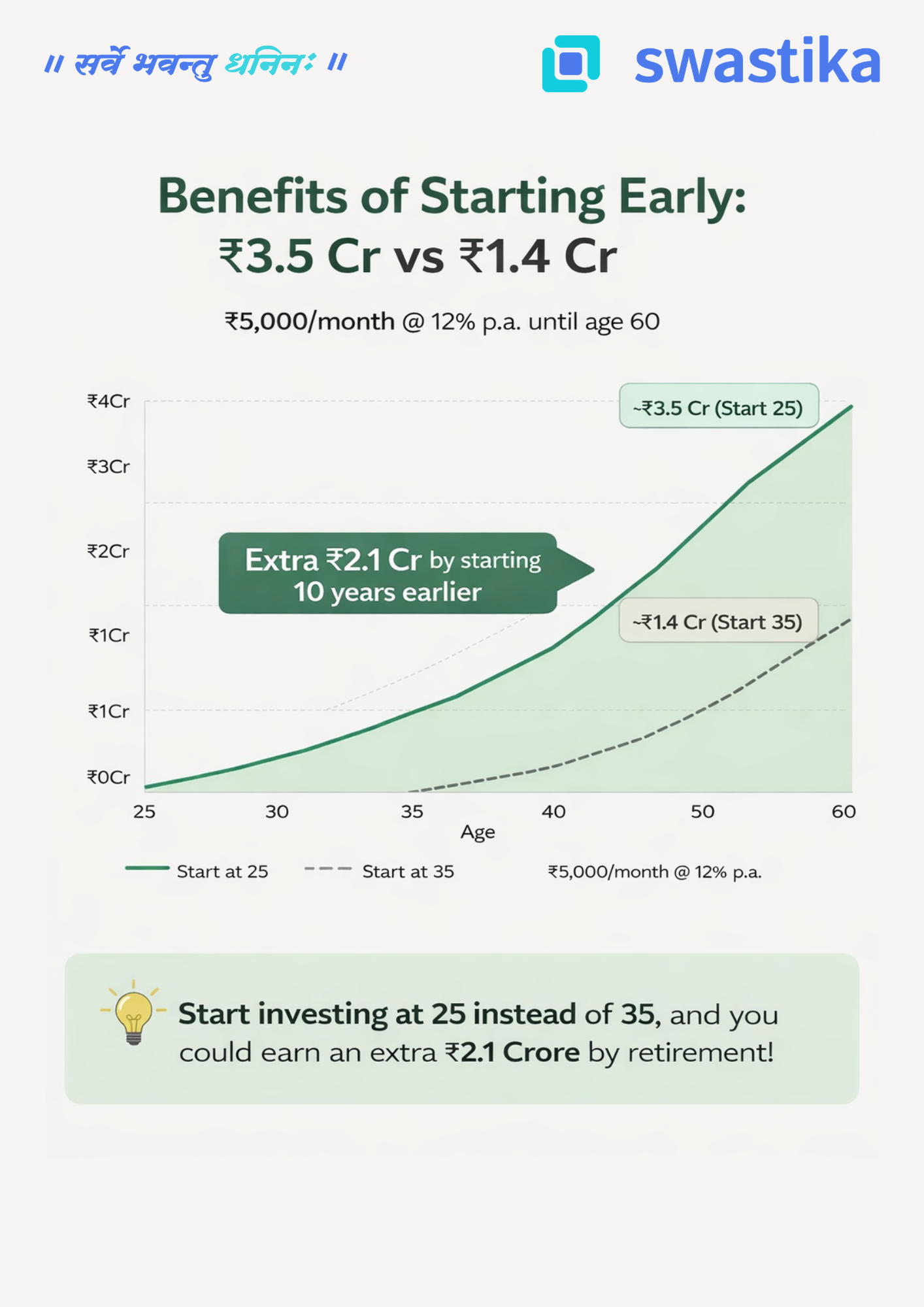
The more years you give your money to grow, the more dramatic — and life-changing — the results become. This is exactly why starting your investment journey early, even with a modest amount, can make a difference of crores by the time you retire.
A Tale of Two Investors: Arjun vs Priya
Let's bring this concept to life with a simple, real-world example.
Meet Arjun and Priya. Both are sensible, disciplined investors. Both invest ₹5,000 every month through a SIP (Systematic Investment Plan) in equity mutual funds, earning an average annual return of 12%. Both stop investing at age 60.
The only difference? Arjun starts at 25. Priya starts at 35.
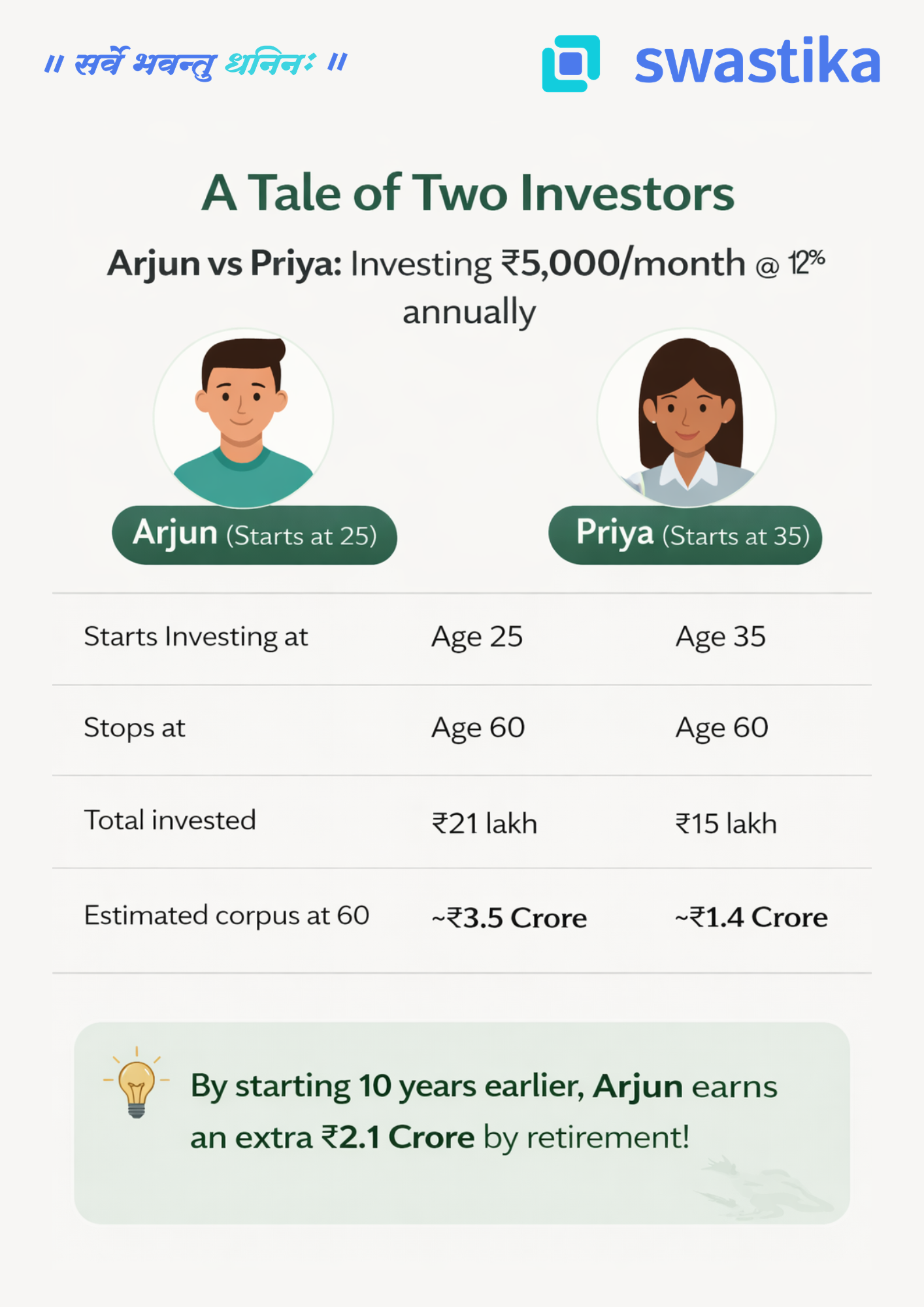
The numbers are striking. Arjun invests just ₹6 lakh more than Priya in absolute terms — yet walks away with ₹2.1 Crore more at retirement.
That extra ₹2.1 Crore didn't come from investing more aggressively or taking bigger risks. It came purely from starting 10 years earlier.
Why Does Time Make Such a Huge Difference?
This is where the magic of compounding reveals itself.
In the early years of investing, growth looks modest and almost unimpressive. But as the years pass, your corpus grows not just on your original investment, but on all the accumulated returns from previous years. The curve goes from almost flat to steeply exponential — and that steep climb happens in the later years.
When Arjun starts at 25, his money has 35 years to ride that exponential curve. Priya's money, starting at 35, only catches the last 25 years — and critically, it misses the steepest part of the climb in the final decade.
Think of it this way: the last 10 years of compounding are worth more than the first 20. That is the counterintuitive truth at the heart of long-term investing.
The Real Cost of Waiting
Many young earners tell themselves, "I'll start investing once I'm more settled — once the salary improves, once the EMI is paid off, once life is a bit easier."
But the numbers show that every year of delay is extraordinarily expensive — far more expensive than any EMI or lifestyle expense. Priya didn't invest carelessly. She invested faithfully for 25 years. Yet she ends up with less than half of what Arjun accumulated — not because she did anything wrong, but simply because she started a decade late.
The cost of waiting 10 years wasn't ₹6 lakh in additional contributions. The cost was ₹2.1 Crore in lost wealth.
Three Principles to Remember
1. Start now, not later.The best time to start investing was yesterday. The second best time is today. Even a SIP of ₹1,000–₹2,000 per month in your 20s is infinitely better than waiting for the "right time."
2. Consistency beats intensity.You don't need to invest large sums all at once. A small, steady, monthly commitment — maintained without interruption — is what unlocks the full power of compounding over decades.
3. Stay invested through market cycles.Compounding works only if you let it work. Exiting during market corrections or stopping your SIP in tough months breaks the chain. Time in the market, not timing the market, is what builds wealth.
The Bottom Line
If you are in your 20s or early 30s, you hold an asset that no amount of money can buy later: time. Use it. Start a SIP today — even a small one. Let compounding do its slow, steady, powerful work.
Because the difference between starting at 25 and starting at 35 is not just 10 years. As Arjun and Priya's story shows, that difference is ₹2.1 Crore.
Big Budget









.webp)
.webp)
.webp)
.webp)
.webp)














.webp)
.webp)
.webp)
.webp)
Latest Articles

Unlisted Gems: How India’s Private Market is Creating the Next Wave of Billion-Dollar Companies


Unlisted Gems: How India’s Private Market is Creating the Next Wave of Billion-Dollar Companies
Quick Highlights
- India’s unlisted space is buzzing with high-growth companies preparing for IPOs.
- Sectors like fintech, retail, and renewable energy are driving investor interest.
- Unlisted shares offer early access but come with liquidity and regulatory risks.
- Strong research, SEBI-registered advisors, and tech tools make investing smarter.
- Swastika Investmart empowers investors with expert insights and safe investing platforms.
India’s Unlisted Market: The Quiet Revolution
When most investors think about wealth creation, they picture stock exchanges like NSE or BSE. But some of India’s most exciting stories are unfolding outside the listed markets. Companies like Reliance Retail, HDB Financial Services (HDFC Bank’s arm), and Ola Electric are making headlines long before their IPOs.
This growing market of unlisted shares has caught the eye of high-net-worth individuals, family offices, and savvy retail investors. The appeal is simple: early access to potential unicorns and future multibaggers.
Why Are Unlisted Companies in Demand?
Early-Stage Growth Opportunities
Investors can buy into businesses before they go public, often at valuations that may look attractive compared to post-IPO prices. For example, Ola Electric was trading actively in the unlisted space before announcing its IPO roadmap.
Sectoral Tailwinds
- Fintech: HDB Financial and One97 (Paytm, pre-IPO days) showed how fintech reshapes banking.
- Retail: Reliance Retail continues to expand aggressively, attracting private market interest.
- Energy Transition: Companies in renewable energy and EV sectors are getting strong traction.
Limited Public Access
Since these shares aren’t listed on exchanges, only informed and well-connected investors get access. That exclusivity adds to the demand.
Risks Investors Should Not Ignore
While the rewards can be high, unlisted shares carry risks:
- Liquidity Constraints: Unlike listed stocks, selling unlisted shares is not easy.
- Valuation Uncertainty: Prices are based on private transactions, making fair valuation tricky.
- Regulatory Oversight: SEBI governs unlisted space, but disclosures are not as transparent as listed companies.
This makes research and guidance critical before making any move.
Real-World Examples from India
- Reliance Retail – With a valuation crossing $100 billion in private markets, it’s among the most valuable unlisted entities globally.
- OYO Rooms – Despite delays in its IPO, OYO has remained one of the most traded unlisted shares.
- HDB Financial Services – Expected to list in the coming years, it is already considered a “blue-chip” in the unlisted space.
These examples highlight how the private market is building the billion-dollar companies of tomorrow.
The Impact on Indian Capital Markets
Unlisted activity is reshaping investor strategies:
- Pre-IPO Participation: Investors seek allocations before companies list to benefit from potential IPO premiums.
- Diversification: Portfolio managers use unlisted shares to diversify away from traditional equities.
- Market Depth: A growing private market shows the maturity of India’s financial ecosystem, aligning with SEBI’s efforts to deepen capital markets.
How Investors Can Participate Safely
For retail investors, entering the unlisted space requires trusted partners who provide:
- SEBI-registered advisory services for compliance and credibility.
- Research-based recommendations instead of speculation.
- Transparent pricing and execution through tech-enabled platforms.
This is where Swastika Investmart Pvt. Ltd. stands out. With its SEBI registration, robust research desk, investor education initiatives, and customer-first approach, Swastika ensures that investors don’t just access opportunities but also understand the risks.
👉 Open your account with Swastika Investmart and explore a smarter way to invest in both listed and unlisted opportunities.
FAQs
1. What are unlisted shares?
Unlisted shares are equity shares of companies not listed on stock exchanges like NSE or BSE. They trade in the private market.
2. How can investors buy unlisted shares in India?
Through SEBI-registered brokers and research firms like Swastika Investmart, which ensure compliance and transparency.
3. Are unlisted shares riskier than listed ones?
Yes, mainly due to liquidity issues, limited disclosures, and valuation uncertainty. However, they can deliver strong returns if chosen wisely.
4. Do all unlisted companies eventually go for an IPO?
Not necessarily. Some remain private, while others may take years before listing.
5. What is the minimum investment required?
It varies by company and broker, but typically starts from a few thousand to a few lakhs, depending on the share price and lot size.
Conclusion
The Indian private market is quietly minting the next set of billion-dollar companies. For investors, this is both an opportunity and a challenge—early access to growth stories, but with risks that demand careful evaluation.
With the right partner like Swastika Investmart, investors get access to trusted research, compliance-driven execution, and strong customer support, making the journey into unlisted shares more secure and rewarding.
👉 Open your account today with Swastika Investmart and take the first step towards discovering India’s next unlisted gems.
.webp)
AI in Futures Trading – How Algorithms Predict Market Moves
Quick Highlights
- Swastika Investmart offers smart research & AI-backed insights for retail traders.
- AI-driven futures trading uses machine learning & predictive analytics to spot price trends.
- Algorithms analyze big data, news, and technical indicators faster than humans.
- Predictive models in futures trading improve risk management and execution.
Introduction: The Rise of AI in Futures Trading
The Indian futures & derivatives market has grown rapidly, with rising participation from retail traders, institutions, and global players. In 2025, Artificial Intelligence (AI) is reshaping how traders approach futures trading.
From predicting Nifty and Bank Nifty moves to identifying trends in commodities like gold, crude oil, and silver, AI-driven trading models are bringing speed, accuracy, and discipline to markets.
How AI Predicts Futures Market Moves
1. Pattern Recognition & Technical Analysis
AI systems scan years of historical price data to detect candlestick patterns, support/resistance zones, and breakouts.
- Example: Spotting early signals of a Nifty futures rally before retail traders notice.
2. Sentiment Analysis from News & Social Media
AI-powered NLP (Natural Language Processing) algorithms analyze news, Twitter feeds, and global market updates.
- Example: Detecting a sudden bearish trend in crude oil futures due to OPEC decisions.
3. High-Frequency Trading (HFT)
AI executes trades in milliseconds, exploiting micro price movements.
- Example: Algorithmic scalping in Bank Nifty futures during volatile RBI policy days.
4. Risk Management with Predictive Models
AI models calculate probabilities of price levels being breached and suggest stop-loss & take-profit levels.
5. Backtesting & Simulation
AI systems backtest strategies across multiple years and market conditions, helping traders choose the most reliable setups.
Benefits of AI in Futures Trading
✅ Faster decision-making than manual trading
✅ Better accuracy in identifying short-term & long-term trends
✅ Reduced emotional bias in trades
✅ Ability to process real-time global data
✅ Improved risk-reward ratio for retail and institutional traders
Challenges of AI in Futures Trading
⚠️ Overfitting – algorithms may fail in unexpected events (e.g., geopolitical shocks)
⚠️ High costs of infrastructure for HFT systems
⚠️ Retail investors may face a technology gap compared to institutions
Example – AI in Nifty Futures (Case Study)
Suppose AI models detect:
- Rising call option open interest
- Positive social sentiment for IT stocks
- Historical trend of Nifty gaining after Fed rate cuts
The AI may predict a short-term bullish rally in Nifty Futures and suggest entry points with stop-loss levels.
Why Swastika Investmart?
Retail investors often can’t build costly AI systems, but Swastika Investmart bridges the gap with:
- AI-assisted Research Reports: Actionable futures & options strategies.
- Expert Advisory: Human + AI insights for risk management.
- User-Friendly Platforms: Trade seamlessly in Nifty, Bank Nifty, and commodities.
- SEBI-Compliant Safety: Trusted by lakhs of investors across India.
✅ Start AI-Backed Futures Trading with Swastika
📲 Download the Swastika App – Android | iOS
FAQs
Q1. Can AI guarantee profits in futures trading?
No, AI improves probabilities but cannot eliminate risks. Market shocks can still impact trades.
Q2. Is AI-based trading only for institutions?
While HFT is dominated by institutions, retail traders now access AI-powered tools via brokers like Swastika.
Q3. How can beginners benefit from AI in trading?
By using AI-assisted research and avoiding emotional trading mistakes.
Q4. Does SEBI regulate AI-based trading?
Yes, SEBI monitors algo-trading to ensure fair access and transparency in Indian markets.
Conclusion
AI is no longer futuristic—it is actively shaping futures trading in India. From predictive analytics to algorithmic execution, AI helps traders manage risk and capture opportunities in fast-moving markets.
With Swastika Investmart, retail traders can leverage AI-driven research and expert insights to trade smarter, not harder.
✅ Start AI-Backed Futures Trading with Swastika
📲 Download the Swastika App – Android | iOS
%20(1)%20(2).webp)
IPO Watch 2025: Urban Company, Dev Accelerator & Shringar House of Mangalsutra – Full Analysis
IPO Watch 2025: Urban Company, Dev Accelerator & Shringar House of Mangalsutra – Full Analysis
Quick Highlights
- Three major IPOs—Urban Company, Dev Accelerator, and Shringar House of Mangalsutra—are opening in September 2025.
- Urban Company IPO is Neutral rated, with strong revenue growth but high valuations.
- Dev Accelerator IPO is rated Avoid due to steep pricing and high competition in flexible workspace.
- Shringar House of Mangalsutra IPO is rated Subscribe, driven by niche demand and strong financial ratios.
- Investor participation should be guided by valuation comfort, sector outlook, and risk appetite.
Introduction
The IPO market in India continues to attract strong investor attention in 2025. With Dalal Street buzzing over fresh listings, three diverse companies—Urban Company Limited, Dev Accelerator Limited, and Shringar House of Mangalsutra Limited—are set to hit the primary market.
These IPOs span across technology-driven services, flexible workspace solutions, and traditional jewelry manufacturing, giving investors a wide range of choices. But should you subscribe? Let’s decode each offering.
Urban Company IPO – Neutral Outlook
Urban Company, India’s leading tech-driven home and beauty services marketplace, is coming with an IPO worth ₹1,900 crore.
- Price Band: ₹98–₹103
- Issue Size: ₹1,900 crore (with OFS component of ₹472 crore)
- Financials: FY25 revenue stood at ₹1,260.68 crore, EBITDA margin at 10.66%, and net profit of ₹135.82 crore.
Strengths
- Market leadership in online home and beauty services.
- Growing digital adoption across Indian households.
- Strong network of service professionals.
Concerns
- High P/E of 59.71x, signaling aggressive valuation.
- Regulatory risks on labor and compliance front.
- Heavy reliance on urban-centric demand.
Investor View: A neutral call is advised. Risk-taking investors may apply for listing gains, while conservative investors may prefer to wait for better valuations.
Dev Accelerator IPO – Avoid
Dev Accelerator (DevX), a flexible workspace provider, is launching a ₹143.35 crore IPO.
- Price Band: ₹56–₹61
- Financials: FY25 revenue stood at ₹178.89 crore with EBITDA margins of 36.65%, but profit after tax is just ₹1.74 crore.
Strengths
- Expanding presence across Tier-I and Tier-II cities.
- High occupancy rates in major business hubs.
Concerns
- Valuation is extremely stretched with P/E at 233.25x.
- Competitive and fragmented co-working sector.
- Low profitability despite rising revenue.
Investor View: Given its steep pricing and weak earnings, analysts advise investors to avoid this IPO.
Shringar House of Mangalsutra IPO – Subscribe
Shringar House of Mangalsutra, a jewelry brand specializing in mangalsutra and related ornaments, is bringing an IPO worth ₹400.95 crore.
- Price Band: ₹155–₹165
- Financials: FY25 revenue stood at ₹1,430.12 crore with net profit of ₹61.11 crore.
- Ratios: ROCE of 32.43%, P/E of 19.47x, making it attractively valued compared to sector peers.
Strengths
- Strong presence in culturally significant jewelry segment.
- Steady financial growth with robust return ratios.
- Rising consumer demand for premium and designer jewelry.
Concerns
- Dependent on gold and precious stone price fluctuations.
- Faces competition from established jewelry houses.
Investor View: With attractive valuations and niche positioning, Shringar House of Mangalsutra’s IPO is a Subscribe for long-term investors.
Broader Market Impact
The diversity of these IPOs—tech-driven Urban Co., asset-heavy Dev Accelerator, and culturally niche Shringar—shows the evolving Indian capital market. While Urban Co. highlights India’s digital adoption, Dev Accelerator reflects challenges in the workspace economy, and Shringar taps into India’s deep-rooted jewelry culture.
Strong participation in such IPOs often signals healthy market sentiment, which in turn boosts secondary market activity and liquidity.
FAQs
Q1: Which IPO looks the most attractive among the three?
A: Shringar House of Mangalsutra IPO, rated Subscribe, stands out due to strong fundamentals and reasonable valuation.
Q2: Is Urban Company IPO worth applying for?
A: It may attract listing gains, but valuations look stretched. Conservative investors may avoid.
Q3: Why is Dev Accelerator IPO rated Avoid?
A: Despite revenue growth, its profits are weak, and valuations are unjustifiably high.
Q4: How do IPO ratings help investors?
A: Ratings provide a quick guide on company fundamentals, sector outlook, and valuation comfort.
Q5: Where can I open a Demat account to apply for these IPOs?
A: You can open an account with Swastika Investmart, a SEBI-registered broker with strong research, investor education, and tech-enabled platforms.
Conclusion
The upcoming IPO season offers something for every type of investor—from high-growth tech stories to traditional cultural businesses. However, careful selection is crucial.
- Shringar House of Mangalsutra IPO: Subscribe for long-term gains.
- Urban Company IPO: Neutral; only for risk-takers.
- Dev Accelerator IPO: Avoid due to weak fundamentals.
For a seamless IPO investing experience, research-backed recommendations, and expert guidance, consider opening your account with Swastika Investmart.
.webp)
How FIIs Use Options to Move the Indian Stock Market
Key Takeaways
- FIIs (Foreign Institutional Investors) are among the largest participants in Indian derivatives markets.
- Their options strategies—like buying puts, writing calls, or hedging—often move Nifty & Bank Nifty intraday.
- Options activity by FIIs sets short-term sentiment for retail traders & DIIs.
- Swastika Investmart provides research-backed insights for retail investors to track FII moves effectively.
How FIIs Use Options Strategically
1. Hedging Equity Positions
FIIs often hedge their cash market positions using options.
- Example: If they hold heavy long positions in Indian equities, they may buy put options on Nifty to protect against sudden downside risks.
2. Speculating on Market Moves
With deep pockets and access to global cues, FIIs use options to speculate on short-term volatility.
- A surge in Index Call Option buying usually reflects bullish bets.
- Heavy Put Option writing shows confidence that markets won’t fall below a level.
3. Driving Intraday Volatility
FIIs’ massive trades in options create sharp intraday moves, especially in Bank Nifty and Nifty. Retail investors often follow these flows, leading to chain reactions.
4. Impact on India VIX
FII activity in options also impacts the India VIX (Volatility Index). When FIIs aggressively buy options, implied volatility spikes, signaling uncertain or sharp expected moves.
FII Options Strategies & Market Impact
Why FIIs’ Options Moves Affect Retail Investors
FIIs trade in huge volumes, which:
- Creates liquidity in options contracts
- Influences price discovery
- Sets the tone for intraday momentum
Retail investors often follow FII trends without risk management, which can be dangerous. Instead, tracking open interest data, FII reports, and SEBI disclosures provides better clarity.
Role of SEBI & Transparency
SEBI ensures FIIs disclose their trades and maintains a fair derivatives market. Retail investors can access FII derivatives data daily on the NSE website—helping them align strategies without blindly following the “big money.”
Why Choose Swastika Investmart
While FIIs move markets, retail investors can still win with the right guidance. This is where Swastika Investmart helps:
- Expert Research: Daily insights into FII/DII activities.
- Trusted Advisory: Blending AI + human analysis for better clarity.
- Beginner-Friendly Support: Regional language help for new traders.
- Technology-Driven Platform: SEBI-compliant, NSDL/CDSL-backed safety.
✅ Open Your Account with Swastika Investmart Today
📲 Download the Swastika App – Android | iOS
FAQs
Q1. Why do FIIs prefer options over stocks?
Options allow FIIs to hedge, speculate, and move markets with lower capital compared to equities.
Q2. How can retail investors track FII activity?
NSE publishes daily FII derivative positions. Brokers like Swastika also provide research reports.
Q3. Do FIIs always dictate market direction?
Not always. Domestic Institutional Investors (DIIs) often counterbalance FIIs, especially during sell-offs.
Q4. Can retail traders profit by following FIIs?
Yes, but blindly copying FII moves is risky. Use them as signals, not as trade confirmations.
Conclusion
FIIs use options not just to hedge but to drive intraday and short-term market sentiment in India. Their trades in Nifty and Bank Nifty options often set the tone for retail and DIIs.
For retail investors, the key is to track, not mimic FIIs. With expert research and SEBI-backed safety, platforms like Swastika Investmart empower investors to make smarter decisions.
✅ Open Your Account with Swastika Investmart Today
📲 Download the Swastika App – Android | iOS

AI in Online Trading – How Artificial Intelligence is Changing Stock Markets
Key Takeaways
- Swastika Investmart is empowering investors with research-backed, AI-assisted and a trusted tech stack.
- AI is revolutionizing stock markets with faster execution, predictive analytics, and reduced human bias.
- From robo-advisors to algorithmic trading, AI is now accessible to retail investors.
- Global investors & FIIs are increasingly relying on AI-driven insights for Indian markets.
Introduction: Why AI in Trading Matters
Artificial Intelligence (AI) is no longer just a buzzword—it’s a game-changer in stock markets. From Wall Street to Dalal Street, AI is transforming the way trades are executed, risks are managed, and investment strategies are designed.
For Indian retail investors, the rise of AI-driven trading platforms means access to smarter insights, faster decision-making, and reduced errors. With SEBI-regulated brokers integrating AI into their systems, trading is becoming safer and more efficient than ever before.
How AI is Changing Stock Markets
1. Predictive Analytics & Market Forecasting
AI algorithms analyze historical stock data, price patterns, and global cues to predict possible market movements. For example, AI can spot trends in Nifty 50, Bank Nifty, or commodities before human traders react.
2. Algorithmic & High-Frequency Trading (HFT)
AI enables automated trading where thousands of orders are executed within milliseconds. While institutional investors already use this, retail investors can now access simplified AI tools via apps.
3. Robo-Advisors for Beginners
Platforms like Groww and Zerodha Varsity are incorporating AI-driven learning modules, while brokers like Swastika Investmart blend AI with human assistance—helping beginners make data-backed decisions.
4. Fraud Detection & Risk Management
AI-powered systems track unusual patterns in transactions, preventing fraud and protecting investors. With NSDL/CDSL-backed DEMAT accounts, SEBI ensures AI adoption enhances compliance and safety.
5. Sentiment Analysis & News Trading
AI can scan thousands of news sources, social media posts, and analyst reports in seconds, helping traders react faster to RBI policies, FIIs flows, or global events.
Table – AI vs. Traditional Trading
Role of AI in Indian Context
India’s stock markets are seeing massive retail participation. According to SEBI, over 11 crore DEMAT accounts are active as of 2025. With this surge, AI ensures:
- Beginners get guided entry through robo-advisory & model portfolios.
- Experienced traders gain an edge with algorithmic execution.
- Regulators like SEBI use AI for surveillance, ensuring fair play.
Why Swastika Investmart Stands Out
While many platforms offer AI-driven tools, Swastika Investmart brings a unique blend of trust + technology.
- Advisory + AI: Instead of leaving beginners entirely to bots, Swastika combines expert human advisory with AI-driven insights.
- Regional Support: Available in multiple Indian languages, making trading accessible beyond metros.
- Trusted Legacy: A SEBI-regulated broker with decades of customer trust.
- Research Reports: AI-assisted research helps clients identify opportunities in equities, commodities, and derivatives.
📲 Download Swastika App – Android | iOS
👉 Open Your Trading Account with Swastika Today
FAQs
Q1. Is AI trading safe for beginners?
Yes. With SEBI-regulated brokers, AI trading is safe. Beginners should start small and use AI-assisted advisory platforms like Swastika.
Q2. Can AI guarantee profits in stock markets?
No system can guarantee profits. AI reduces human bias and improves probability but risk remains inherent in markets.
Q3. Do I need coding skills for AI-based trading?
Not anymore. Most brokers provide ready-to-use AI tools integrated within apps.
Q4. Which Indian brokers use AI?
Zerodha, Upstox, Groww, Angel One, and Swastika Investmart all integrate AI in different capacities.
Conclusion
Artificial Intelligence is no longer optional—it’s the future of trading in India. From enhancing market predictions to preventing fraud, AI is reshaping how both beginners and professionals participate in stock markets.
For investors seeking trust, research-backed advisory, and AI-powered tools, Swastika Investmart is a strong choice. It combines the safety of SEBI regulations with modern technology, ensuring investors stay ahead in 2025 and beyond.
✅ Open Your Trading Account with Swastika Today
📲 Download the Swastika App – Android | iOS

Navigating a Hopeful September: Market Outlook and Key Triggers
Key Takeaways
- Indian markets were volatile in August due to U.S. tariffs and FII selling, despite strong Q1 FY26 GDP growth.
- Key triggers for September include the GST tax overhaul, the U.S. Federal Reserve meeting, and U.S.-India trade tensions.
- Sectors like consumption, IT, and metals are expected to be in focus this month.
- Top stock picks for September from Swastika include NALCO, Aadhar Housing Finance, and Subros.
- Several IPOs, both mainline and SME, are expected to hit the market in September.
Navigating a Hopeful September: Indian Market Outlook and Key Triggers
After a challenging August, the Indian equity markets are looking toward September with a sense of cautious optimism. The previous month was marked by a continuation of the downtrend from July, creating a "tug-of-war" between robust domestic indicators and global headwinds. This market decline was primarily triggered by new U.S. tariffs on Indian exports, which sparked uncertainty and led to significant selling by Foreign Institutional Investors (FIIs). In fact, FIIs experienced their highest monthly outflow in seven months , with a net outflow of ₹46,902.92 crore.
This negative market sentiment occurred despite strong domestic performance, including a 7.8% GDP growth in the first quarter of fiscal year 2026 and cooling inflation. The resilience of Domestic Institutional Investors (DIIs) with a buying of ₹94,828.55 crore provided crucial support to the market.
Key Triggers for September: What to Watch 📈
The market's direction in September will be shaped by a blend of important domestic and global factors. Investors will be keeping a close eye on these key events:
- U.S. Federal Reserve Meeting: A key global event to watch is the upcoming U.S. Federal Reserve meeting. There's an expectation of a potential interest rate cut, which could weaken the U.S. dollar and attract FII inflows back into the Indian markets.
- U.S.-India Trade Tensions: The ongoing trade dispute over new U.S. tariffs on Indian exports continues to be a major headwind. Any positive developments or de-escalation of these tensions could significantly improve market sentiment and encourage foreign investment.
- Global Economic Data: Key economic indicators from major global economies like the U.S. and China, such as labor market reports and manufacturing data, will also influence foreign investor sentiment toward India.
- GST Tax Overhaul: The GST Council's decision to move to a simplified two-slab tax system (5% and 18%) is a big positive for the market. This change is expected to make many household goods and consumer durables cheaper, which could boost consumption in key sectors like auto and consumer goods. *
Sectors and Stocks to Watch 🔭
Based on these triggers, some sectors are expected to be in the spotlight this month.
- Consumption: The consumption theme will be a key focus due to the GST tax cut and the upcoming festive season.
- IT: The IT sector will be watched closely ahead of the U.S. Federal Open Market Committee (FOMC) meeting.
- Metal Stocks: Indian metal stocks may perform well amid China's Anti-Involution campaign.
- Export-related stocks: These stocks will remain in focus due to the ongoing trade tensions between the U.S. and India.
As for specific stock picks, here are a few recommended by Swastika for September:
- NALCO (National Aluminium Company Limited): The recommendation is to buy at a current market price (CMP) of ₹212, with a target (TGT) of ₹238 and a stop-loss (SL) of ₹199.
- Aadhar Housing Finance Ltd: The recommendation is to buy at a CMP of ₹514, with a TGT of ₹555 and an SL of ₹488.
- Subros: The recommendation is to buy at a CMP of ₹954, with a TGT of ₹1100 and an SL of ₹880.
IPOs: August Performance and September Expectations 💰
August saw mixed results from IPOs. Some, like Highway Infrastructure Ltd, had a strong listing gain of 64.29%. However, others like BlueStone Jewellery Ltd had a negative listing gain of -1.35%. A few of the expected IPOs in September 2025 include:
Mainline IPOs:
- Nilachal Carbo Metalicks
- Krupalu Metals
- Taurian MPS
- Karbonsteel Engineering
- Jay Ambe Supermarkets
- Airfloa Rail Technology
SME IPOs:
- Shringar House of Mangalsutra
- Dev Accelerator
- Urban Company (Urban Co.)
Frequently Asked Questions
Q1. What caused the market volatility in August 2025?
The volatility in August was primarily caused by a significant outflow of funds from Foreign Institutional Investors (FIIs) in response to new U.S. tariffs on Indian exports.
Q2. What is the "tug-of-war" mentioned in the report?
The "tug-of-war" refers to the market being pulled in two different directions: negative global factors like U.S. tariffs and positive domestic factors such as robust GDP growth and cooling inflation.
Q3. Why are FIIs and DIIs important?
Foreign Institutional Investors (FIIs) and Domestic Institutional Investors (DIIs) are key market participants whose buying and selling activity significantly influence market direction. In August, DIIs' buying of ₹94,828.55 crore helped support the market against FIIs' selling.
Q4. What is the GST tax overhaul and how will it affect the market?
The GST tax overhaul is the GST Council's decision to shift to a two-slab system (5% and 18%). This is expected to make many products more affordable, which could boost consumption and benefit sectors like consumer goods and autos.
Conclusion
Your Partner in Informed InvestingThe Indian market is dynamic, with global and domestic factors constantly shaping its direction. While August was a reminder of this volatility, September offers renewed hope based on promising domestic triggers and potential global shifts.Navigating these market cycles requires a blend of timely information, expert analysis, and a robust trading platform. At Swastika Investmart, a SEBI-registered member of major exchanges, we provide all of this and more. From comprehensive research to tech-enabled trading and dedicated customer support, we are here to help you make informed decisions.Open an account today and take the first step towards smarter investing.


.webp)
.webp)

.webp)






START YOUR INVESTMENT JOURNEY
Get personalized advice from our experts
- Dedicated RM Support
- Smooth and Fast Trading App