

The Power of Compounding – Why Starting Early Matters




Introduction
Albert Einstein reportedly called compound interest the "eighth wonder of the world." Whether or not he actually said it, the math is undeniable. Compounding is the process where your investment returns begin earning their own returns — and over time, this snowball effect becomes truly extraordinary.
The catch? Compounding needs one essential ingredient: time.
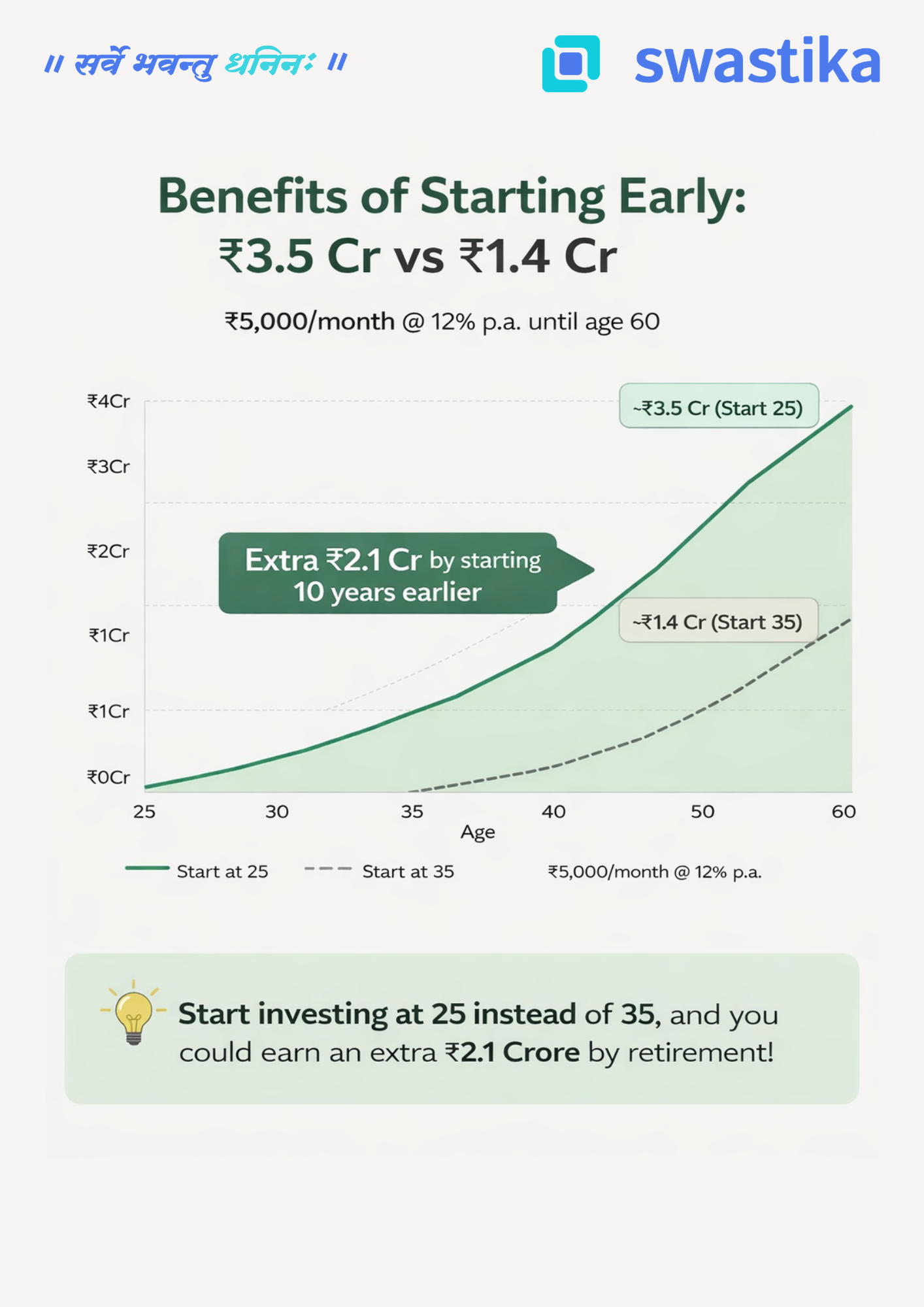
The more years you give your money to grow, the more dramatic — and life-changing — the results become. This is exactly why starting your investment journey early, even with a modest amount, can make a difference of crores by the time you retire.
A Tale of Two Investors: Arjun vs Priya
Let's bring this concept to life with a simple, real-world example.
Meet Arjun and Priya. Both are sensible, disciplined investors. Both invest ₹5,000 every month through a SIP (Systematic Investment Plan) in equity mutual funds, earning an average annual return of 12%. Both stop investing at age 60.
The only difference? Arjun starts at 25. Priya starts at 35.
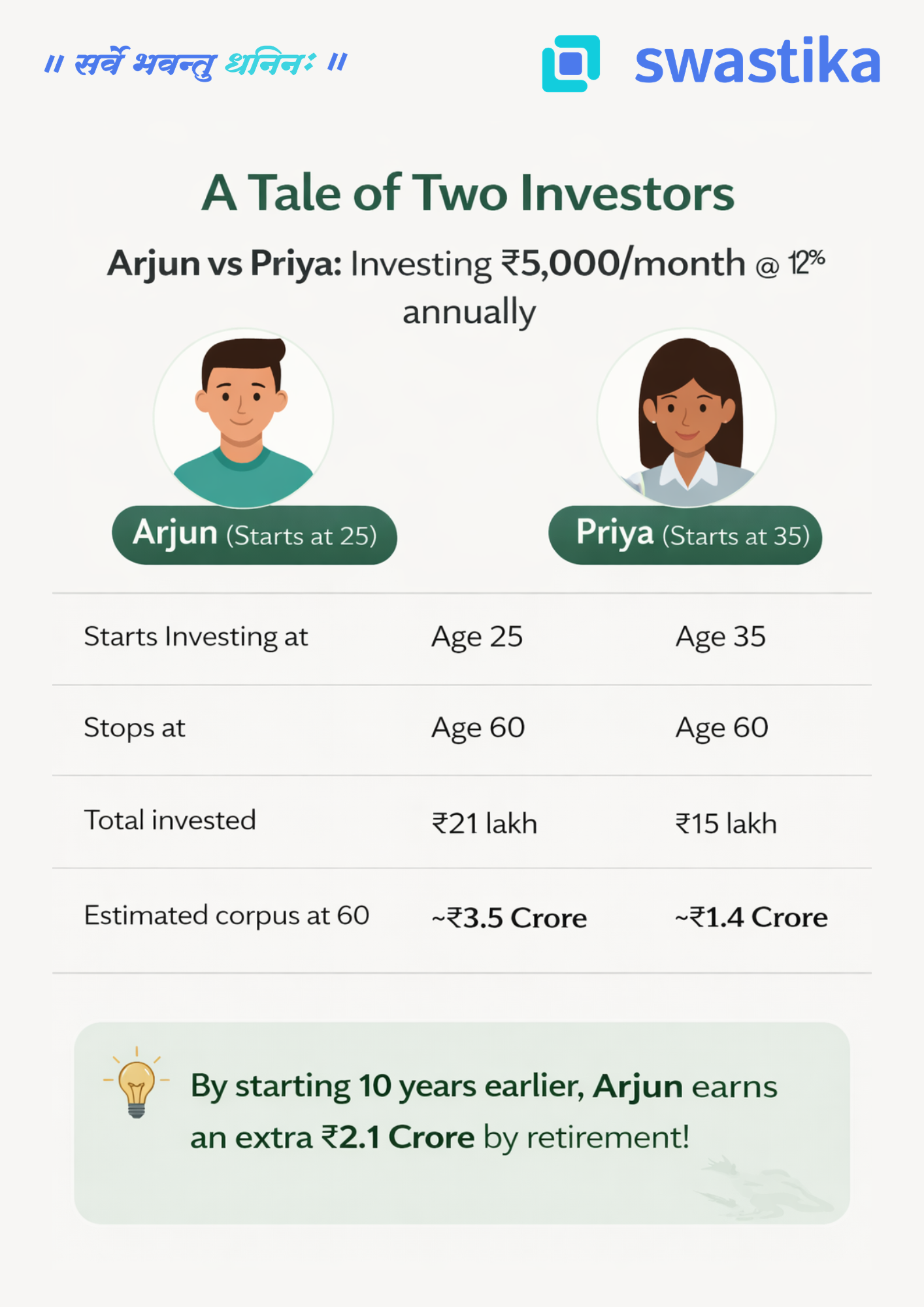
The numbers are striking. Arjun invests just ₹6 lakh more than Priya in absolute terms — yet walks away with ₹2.1 Crore more at retirement.
That extra ₹2.1 Crore didn't come from investing more aggressively or taking bigger risks. It came purely from starting 10 years earlier.
Why Does Time Make Such a Huge Difference?
This is where the magic of compounding reveals itself.
In the early years of investing, growth looks modest and almost unimpressive. But as the years pass, your corpus grows not just on your original investment, but on all the accumulated returns from previous years. The curve goes from almost flat to steeply exponential — and that steep climb happens in the later years.
When Arjun starts at 25, his money has 35 years to ride that exponential curve. Priya's money, starting at 35, only catches the last 25 years — and critically, it misses the steepest part of the climb in the final decade.
Think of it this way: the last 10 years of compounding are worth more than the first 20. That is the counterintuitive truth at the heart of long-term investing.
The Real Cost of Waiting
Many young earners tell themselves, "I'll start investing once I'm more settled — once the salary improves, once the EMI is paid off, once life is a bit easier."
But the numbers show that every year of delay is extraordinarily expensive — far more expensive than any EMI or lifestyle expense. Priya didn't invest carelessly. She invested faithfully for 25 years. Yet she ends up with less than half of what Arjun accumulated — not because she did anything wrong, but simply because she started a decade late.
The cost of waiting 10 years wasn't ₹6 lakh in additional contributions. The cost was ₹2.1 Crore in lost wealth.
Three Principles to Remember
1. Start now, not later.The best time to start investing was yesterday. The second best time is today. Even a SIP of ₹1,000–₹2,000 per month in your 20s is infinitely better than waiting for the "right time."
2. Consistency beats intensity.You don't need to invest large sums all at once. A small, steady, monthly commitment — maintained without interruption — is what unlocks the full power of compounding over decades.
3. Stay invested through market cycles.Compounding works only if you let it work. Exiting during market corrections or stopping your SIP in tough months breaks the chain. Time in the market, not timing the market, is what builds wealth.
The Bottom Line
If you are in your 20s or early 30s, you hold an asset that no amount of money can buy later: time. Use it. Start a SIP today — even a small one. Let compounding do its slow, steady, powerful work.
Because the difference between starting at 25 and starting at 35 is not just 10 years. As Arjun and Priya's story shows, that difference is ₹2.1 Crore.
Big Budget








.webp)
.webp)
.webp)
.webp)
.webp)














.webp)
.webp)
.webp)
.webp)
Latest Articles
.webp)
Next-Gen GST Reform 2025: How Tax Cuts Could Fuel India’s Consumption & Stock Market Rally


Key Takeaways
- India is preparing for a Next-Gen GST reform in 2025 with potential tax cuts.
- Lower GST rates may increase household spending and drive consumption growth.
- Key sectors like FMCG, auto, and consumer durables may benefit the most.
- Stock market sentiment could improve, mirroring past tax-driven rallies.
- Investors can leverage Swastika Investmart’s research and tech tools to stay ahead.
Introduction
India’s Goods and Services Tax (GST), introduced in 2017, was one of the most significant tax reforms in independent India. Fast forward to 2025, the government is considering next-gen GST reforms aimed at simplifying the structure and potentially cutting rates to boost consumption.
If implemented, these reforms could change the way households spend, businesses operate, and investors allocate their portfolios. More importantly, they may trigger a stock market rally, similar to the momentum witnessed after the corporate tax cut in 2019.
Let’s decode how this reform could shape India’s consumption story and what it means for the stock market.
Why GST Reform in 2025 Matters
GST has streamlined indirect taxation, but challenges remain: multiple slabs, compliance complexities, and sector-specific anomalies. By 2025, policymakers are focusing on:
- Simplifying slabs – moving closer to a two-rate structure (e.g., 8% and 18%).
- Boosting consumption – cutting GST on mass-consumption items like packaged foods, white goods, and two-wheelers.
- Enhancing compliance – leveraging digital tax infrastructure and AI-driven monitoring.
A simpler GST can lower prices, increase demand, and strengthen India’s consumption-driven economy, which contributes nearly 60% to GDP.
How Tax Cuts Could Fuel Consumption
Imagine a family planning to buy a two-wheeler. If GST drops from 28% to 18%, the cost decreases by nearly ₹10,000. That saving either goes back into discretionary purchases (like electronics or travel) or adds to household savings.
Some key areas that may benefit:
- FMCG and Packaged Foods: Even a small cut can make everyday essentials cheaper, boosting rural and urban consumption.
- Automobiles: Two-wheelers and entry-level cars could see strong demand recovery.
- Consumer Durables: GST reduction on ACs, refrigerators, and washing machines can push middle-class spending.
This ripple effect supports higher sales, better corporate earnings, and eventually stronger stock performance.
Impact on the Stock Market
History shows that tax reforms can act as a sentiment booster:
- In 2019, when corporate tax was slashed from 30% to 22%, Nifty 50 surged nearly 8% in two trading sessions.
- A GST cut in 2025 could similarly lift sectors linked to discretionary demand and consumption.
Likely market beneficiaries:
- FMCG majors – HUL, Nestle, Dabur could see higher rural volume growth.
- Auto manufacturers – Hero MotoCorp, Maruti Suzuki may benefit from increased affordability.
- Consumer durables – Companies like Voltas, Whirlpool may enjoy stronger sales momentum.
- Banking & NBFCs – Higher consumption could boost credit demand.
However, investors must also consider fiscal implications. A steep tax cut may reduce government revenues, impacting fiscal deficit management. The balance between growth and fiscal prudence will be critical.
Global Context: Learning from Others
Globally, governments have used indirect tax cuts as a stimulus tool:
- Japan temporarily cut VAT to revive demand post-recession.
- UK reduced VAT during the 2008 global financial crisis, which helped stabilize consumption.
India’s 2025 GST reform could echo these moves, signaling a pro-growth policy stance that encourages private investment and boosts investor confidence.
What Investors Should Do
Investors need to watch sectoral cues and policy announcements closely. A well-diversified strategy can help capture opportunities while managing risks.
At Swastika Investmart, investors gain:
- SEBI-registered advisory services ensuring compliance and trust.
- Strong research tools providing sector insights and market analysis.
- Tech-enabled investing platforms for seamless trading.
- Investor education initiatives to guide both new and seasoned investors.
👉 Open Your Account Today with Swastika Investmart to explore investment opportunities around India’s consumption boom.
Frequently Asked Questions
Q1. What is the Next-Gen GST Reform 2025?
It refers to proposed changes in India’s GST system, focusing on simplification and possible tax cuts to boost consumption and growth.
Q2. Which sectors will benefit most from a GST cut?
FMCG, automobiles, consumer durables, and financial services are likely to benefit as reduced taxes spur demand.
Q3. How can GST cuts impact the stock market?
They improve corporate earnings and consumer sentiment, which can trigger rallies in consumption-driven stocks.
Q4. Will tax cuts hurt government revenues?
In the short term, yes. However, higher consumption and better compliance may balance the fiscal impact over time.
Q5. How can investors prepare for this reform?
By tracking government announcements, focusing on consumption-driven sectors, and leveraging expert research through platforms like Swastika Investmart.
Conclusion
The Next-Gen GST Reform 2025 has the potential to act as a game-changer for India’s economy. By cutting taxes and simplifying slabs, the government can stimulate consumption, strengthen corporate earnings, and fuel a stock market rally.
For investors, this is both an opportunity and a challenge—requiring informed strategies and timely execution. Swastika Investmart, with its research expertise, SEBI registration, and customer-first approach, is well-positioned to help you navigate this evolving landscape.
👉Open Your Account Today with Swastika Investmart and be ready for India’s next growth wave.
.webp)
How to Close or Transfer a DEMAT Account in India – A Step-by-Step Guide
Key Takeaways
- Swastika Investmart offers seamless account closure/transfer support with strong regional assistance.
- Closing or transferring a Demat account requires filling a closure form with your broker.
- All dues, charges, and holdings must be cleared before closure.
- Transfer of securities is done via Delivery Instruction Slip (DIS) to another Demat account.
- Both NSDL and CDSL follow SEBI’s investor-protection framework.
Introduction
Opening a Demat account is the first step for any Indian investor. But situations often arise where one might want to close or transfer their account. Whether you are shifting to a new broker, consolidating holdings, or simply exiting the markets, understanding the right SEBI-compliant process ensures your money and securities remain safe.
This guide explains the step-by-step process of closing or transferring your Demat account in India, with practical insights for retail investors.
Why Do Investors Close or Transfer Their Demat Accounts?
- Moving to a broker with better technology or research support.
- Consolidating multiple Demat accounts into one for easier management.
- Unsatisfactory service or lack of regional support.
- Exiting the stock market completely.
Process of Closing a Demat Account
Process of Transferring Securities to Another Demat Account
Investor Protection: What SEBI Mandates
- No mandatory charges for account closure.
- Securities must be transferred safely via NSDL/CDSL systems.
- Brokers cannot delay closure once dues are cleared.
- Investors should always keep copies of submitted forms for record.
Why Swastika Investmart?
While brokers like Zerodha, Groww, Upstox, Angel One, and ICICI Direct are popular, Swastika Investmart stands out for its:
- Trusted 30+ years legacy in Indian markets.
- Regional offices and personal assistance for closure/transfer.
- SEBI-compliant practices ensuring investor protection.
- Smooth tech integration for account management.
- Dedicated advisory & handholding for beginners.
FAQs
Q1. Can I close my Demat account online?
Some brokers allow partial digital closure, but most require a physical signed form as per SEBI rules.
Q2. How long does it take to close a Demat account?
Typically 7–10 working days, depending on pending verifications.
Q3. Can I keep multiple Demat accounts?
Yes, SEBI allows multiple Demat accounts under the same PAN with different brokers.
Q4. What happens if I don’t use my Demat account?
Inactive accounts may attract AMC charges. It’s better to close unused accounts.
Q5. What happens if I don’t use my Demat account?
Inactive accounts may attract AMC charges. It’s better to close unused accounts.
Conclusion
Closing or transferring a Demat account in India is straightforward if you follow SEBI’s prescribed steps. Always clear dues, verify holdings, and ensure paperwork is submitted correctly.
For beginners and seasoned investors alike, choosing a reliable broker makes all the difference. With its strong regional support, advisory services, and SEBI-compliant systems, Swastika Investmart ensures your Demat journey is smooth from start to finish.
👉 Ready to experience hassle-free investing?
Open your Demat Account with Swastika Investmart
📱 Download the Swastika App:
.webp)
Why China’s Anti-Involution Policy Matters for Indian Equities?
Key Takeaways
- China’s anti-involution policy aims to end destructive price wars and overcapacity.
- It impacts global commodities, trade flows, and investor sentiment.
- Indian equities may gain from reduced dumping and stronger domestic demand.
- Sectors like EVs, renewables, and metals in India could see tailwinds.
- Investors must stay informed and rely on expert research to make sound decisions.
Investor’s Take: Why China’s Anti-Involution Policy Matters for Indian Equities
China’s economy has long influenced global markets, and recent policy shifts are no exception. The anti-involution policy, launched in 2025, is Beijing’s attempt to tackle cut-throat price wars, overcapacity, and profitless competition in industries such as electric vehicles, solar panels, and steel. While this may sound like a domestic issue, its ripple effects could shape Indian equities in more ways than one.
What Is China’s Anti-Involution Policy?
“Involution” became a buzzword in China to describe a cycle of diminishing returns caused by endless competition—companies slashing prices just to survive, often destroying margins. To counter this, the government rolled out an anti-involution framework focused on:
- Ending destructive price wars in industries like EVs, cement, and solar panels.
- Reducing overcapacity by encouraging consolidation and production cuts.
- Redirecting capital toward sustainable, innovation-driven sectors.
- Strengthening fair competition to stabilize the economy.
For instance, in mid-2025, Chinese solar glass producers agreed to cut output by nearly 30% to restore balance in the industry. Similarly, the government warned EV makers against reckless price cutting that was eroding profitability.
Why Should Indian Investors Care?
While China’s policy appears inward-looking, its global consequences are far-reaching. India, as an emerging market and trade partner, is directly exposed to shifts in commodity prices, competitive pressures, and investor sentiment.
1. Commodity Market Impact
China’s role as the world’s largest consumer of steel, cement, and energy means that production curbs can ease global supply gluts. For Indian metal companies like Tata Steel and JSW Steel, reduced Chinese dumping could stabilize international prices and improve margins.
2. EV & Renewable Energy Sector
India’s EV and solar ambitions often face competition from cheaper Chinese imports. If Chinese firms scale back aggressive discounting, Indian manufacturers—such as Tata Motors in EVs and Adani Green Energy in renewables—may benefit from more sustainable pricing in the global market.
3. Investor Sentiment & FII Flows
Foreign Institutional Investors (FIIs) often treat India and China as part of the same “emerging markets basket.” When China stabilizes its economy through anti-involution measures, FIIs may regain confidence in emerging markets overall—potentially benefiting Indian equities.
4. Regulatory Lessons for India
India has faced its own “involution-like” moments, such as telecom price wars triggered by Jio’s entry, or overcapacity in cement. SEBI and sectoral regulators can draw lessons from China’s approach, emphasizing long-term sustainability over short-term competition.
Which Indian Sectors Could Gain?
- Metals & Mining: Reduced Chinese oversupply can support global steel and aluminum prices.
- Renewables: Indian solar and wind companies gain breathing space if Chinese exports stabilize.
- EV Ecosystem: Domestic players may thrive without aggressive Chinese price competition.
- Banks & Financials: Improved margins in cyclical sectors reduce NPA risks, strengthening financial institutions.
Risks to Watch Out For
Of course, not everything is rosy. Investors should remain cautious about:
- Execution risk in China: Local governments may resist production cuts, undermining the policy.
- Short-term volatility: Global markets may react sharply to news of production halts or policy tweaks.
- Commodity dependency: While higher global prices help Indian firms, they can also raise input costs for industries like auto, construction, and infrastructure.
Real-World Example: Steel Sector Parallel
In 2015–2016, Chinese overcapacity in steel created global price crashes, hurting Indian producers. However, in 2025, as China enforces anti-involution in steel and cement, Indian firms are likely to enjoy healthier pricing. This could mirror the rally Indian steel stocks witnessed in 2021 when global prices surged due to supply-side discipline.
FAQs
Q1: What does anti-involution mean in simple terms?
It means stopping destructive competition where companies keep cutting prices or overproducing without making profits.
Q2: How will it affect Indian retail investors?
It may bring stability to Indian commodity and EV-related stocks, improving investment opportunities.
Q3: Can Indian regulators adopt similar policies?
Yes, lessons can be applied in telecom, cement, and even fintech to ensure long-term sustainable growth.
Q4: Will FIIs increase investments in India due to this policy?
If China’s reforms stabilize emerging markets, FIIs may allocate more funds to India as part of a broader strategy.
Q5: Which Indian sectors could benefit the most?
Metals, EVs, renewables, and banks supporting these sectors are likely beneficiaries.
Conclusion
China’s anti-involution policy might sound distant, but its impact on Indian equities is undeniable. From supporting commodity prices to reshaping investor sentiment, the ripple effects are already visible. For Indian investors, the key is to stay informed, diversify portfolios, and align with trusted advisors.
At Swastika Investmart (SEBI Regd.), we combine strong research capabilities, tech-enabled investing platforms, and investor education to help you navigate such global shifts confidently.
👉 Open Your Account with Swastika Investmart Today and stay ahead of the curve.

Gold Crosses ₹1 Lakh: What It Means for Commodity Traders in India
Key Takeaways
- Gold crossing ₹1 Lakh marks a historic milestone in India’s commodity market.
- Traders must prepare for higher margin requirements & volatility.
- Strong FIIs/DIIs flows, inflation trends, and USD-INR will influence gold’s direction.
- Hedging with futures, options, and ETFs is vital for risk management.
- Swastika Investmart offers trusted platforms, SEBI compliance, and expert advisory for commodity traders.
Gold has officially crossed the ₹1 lakh per 10 grams mark in India—a historic level that has sent shockwaves through the commodity market. For traders, investors, and even everyday buyers, this milestone is more than just a number; it’s a reflection of global macroeconomic factors, inflationary pressures, currency movements, and investor sentiment. But what does this really mean for commodity traders in India in 2025?
Why Did Gold Cross ₹1 Lakh?
Several factors have contributed to gold breaching this psychological level:
Impact on Commodity Traders
For traders in MCX (Multi Commodity Exchange), gold at ₹1 lakh brings both opportunities and risks.
- Volatility Surge – Expect sharp intraday swings.
- Margin Requirements – Higher price = higher capital needed for futures contracts.
- Options Hedging – Growing importance of options to reduce downside risks.
- Liquidity – While retail demand may soften, trading volumes in MCX gold futures are expected to rise.
How Should Traders Adapt?
Commodity traders need to be agile and strategic in this new high-price environment.
- Use Technical Levels – Pivot points, support/resistance, and Fibonacci retracements are crucial.
- Diversify Holdings – Include gold ETFs and sovereign gold bonds for balanced exposure.
- Watch USD-INR – Currency fluctuations will heavily influence gold’s momentum.
- Adopt Hedging Strategies – Use gold mini contracts to manage risk.
Role of Brokers & Platforms
With such a volatile market, choosing the right trading partner matters more than ever. Popular brokers like Zerodha, Groww, Angel One, Upstox, and ICICI Direct provide gold trading access.
However, Swastika Investmart stands out for:
- SEBI-registered compliance ensuring security and transparency.
- Robust advisory & research reports tailored for commodity markets.
- Regional support & trust built over decades across India.
- Advanced technology platforms with mobile access for real-time trading.
FAQs
Q1. Will gold remain above ₹1 lakh?
It depends on global inflation, US Fed policies, and rupee-dollar movement. Consolidation is possible.
Q2. Is gold still a safe investment at these levels?
Yes, but risk management is crucial. Traders should hedge using futures & options.
Q3. Should beginners enter commodity trading now?
Beginners should start small with gold ETFs or mini contracts instead of large positions.
Q4. Should beginners enter commodity trading now?
For traders, digital forms like ETFs and MCX futures are more liquid and easier to trade.
Conclusion
The ₹1 lakh milestone for gold is historic, but it’s also a reminder of the volatility and opportunities in India’s commodity market. Traders must adapt with smarter strategies, risk management, and trusted platforms. With Swastika Investmart’s strong research base, SEBI compliance, and reliable support, traders can confidently navigate this golden era.
👉 Start Trading Gold with Swastika Investmart Today
📱 Download the App for Smarter Trading:
.webp)
India GDP Data: What It Means for Stock Market Investors in 2025
Key Takeaways
- India’s GDP growth remains resilient amid global trade pressures.
- Key sectors like manufacturing, IT, and banking benefit from strong demand.
- Tariffs and FII outflows remain short-term risks for investors.
- Stock market investors must align strategies with India’s macroeconomic outlook.
- Swastika Investmart offers research-driven insights to navigate opportunities.
Introduction
India’s GDP data for FY26 Q1 has sparked fresh debates in financial circles. At a time when global markets are battling trade wars and economic uncertainty, India posted a robust GDP growth of 7.8%. While this reflects resilience, investors are asking an important question: What does this mean for the Indian stock market in 2025?
In this blog, we decode the GDP data, its implications on equities, sector-wise opportunities, and how investors can make informed decisions with the right research support.
Understanding India’s 2025 GDP Data
India’s economic performance continues to stand out globally. Despite challenges such as U.S. tariffs on Indian exports and FII outflows, the economy expanded at one of the fastest rates among major nations.
- Manufacturing and Construction: Both sectors posted growth above 7%, highlighting strong domestic demand and government-led infrastructure push.
- Services: IT, finance, and trade contributed nearly 9% growth, reinforcing India’s services-led economy.
- Agriculture: Growth was modest, reflecting seasonal challenges, but still stable enough to support rural demand.
This data underlines that India’s growth story remains broad-based, though external pressures could test sustainability.
Impact on the Stock Market
The connection between GDP and stock market performance is direct but nuanced. A higher GDP growth rate generally means better earnings potential for companies, but investors must also track liquidity flows and global cues.
Positive Triggers for Markets
- Corporate Earnings Growth: A strong GDP figure indicates rising consumer demand, boosting earnings across FMCG, banking, and auto sectors.
- Investor Sentiment: Markets often rally on positive GDP surprises, as seen in the recent rebound where Nifty crossed 24,500 levels.
- Policy Push: The government’s focus on GST reforms and tax rationalization could further enhance growth visibility.
Risks to Watch
- Tariff Wars: U.S. import tariffs may weigh on export-heavy sectors like textiles and IT.
- Capital Outflows: FIIs sold over ₹35,000 crore worth of equities in August, showing caution despite positive GDP data.
- Inflation and Rates: If growth stokes inflation, RBI may need to adjust rates, impacting borrowing costs.
Sector-Wise Outlook
Banking & Financials
GDP growth translates into credit expansion. Banks benefit from higher loan demand, while NBFCs may see improved collections. However, global liquidity trends could impact capital flows.
Infrastructure & Construction
With GDP showing strong momentum in this segment, infra and real estate stocks remain attractive. Government capex continues to be a key growth driver.
IT & Services
While GDP growth in services is robust, U.S. tariffs and global demand softness pose medium-term risks. Still, India’s digital transformation keeps IT in focus for long-term investors.
FMCG & Consumption
Rising GDP means higher disposable incomes. FMCG companies and consumer discretionary plays (like retail, autos) are likely to ride this wave.
What Investors Should Do
- Stay Diversified: Balance growth sectors like IT and infra with defensives like FMCG.
- Track Global Risks: Keep an eye on tariff negotiations and FII activity.
- Use Research Tools: Leverage institutional research to align portfolio with macro trends.
At Swastika Investmart (SEBI Registered), we combine strong research tools, customer-focused support, and tech-enabled investing platforms to help clients navigate these market cycles effectively.
👉 Open a Free Demat & Trading Account with Swastika Investmart
FAQs
Q1. Why is GDP important for stock market investors?
GDP reflects the health of the economy. Strong GDP growth usually supports higher corporate earnings, leading to bullish equity markets.
Q2. Does high GDP growth always mean stock market gains?
Not necessarily. While GDP supports long-term growth, factors like FII flows, inflation, and global events can create short-term volatility.
Q3. Which sectors benefit the most from India’s GDP growth?
Banking, FMCG, infrastructure, and IT services are usually the first to benefit from rising GDP and consumer demand.
Q4. How should retail investors react to the latest GDP data?
Instead of chasing short-term rallies, investors should build diversified portfolios aligned with long-term growth sectors.
Conclusion
India’s 2025 GDP performance highlights the economy’s resilience in a challenging global environment. For stock market investors, the message is clear: strong domestic demand, government reforms, and robust services growth provide opportunities, but risks like tariffs and capital outflows must be managed.
With Swastika Investmart’s expert research and investor education initiatives, you can stay ahead of market trends and make informed decisions.
👉 Open a Free Demat & Trading Account with Swastika Investmart
.webp)
Intraday Market Movers: The Role of FIIs and DIIs in Shaping Stock Price Trends in India
Key Takeaways
- FIIs and DIIs are key drivers of intraday volatility in Indian stock markets.
- FIIs bring foreign capital, DIIs provide domestic stability.
- Sudden buy/sell actions by institutions can move indices like Nifty & Bank Nifty sharply.
- Monitoring daily FII/DII activity helps retail traders make informed intraday decisions.
- Tools like Swastika Investmart’s app provide real-time updates.
How FIIs & DIIs Influence Intraday Stock Moves in India 📊
The Indian stock market is heavily influenced by institutional investors. While Foreign Institutional Investors (FIIs) bring global capital, Domestic Institutional Investors (DIIs) act as a balancing force. Their daily trades often decide the direction of Nifty, Bank Nifty, and sectoral indices—especially during intraday trading.
Who Are FIIs and DIIs?
- FIIs (Foreign Institutional Investors): Large overseas funds (mutual funds, hedge funds, pension funds) that invest in Indian equities. Their inflows/outflows are sensitive to global factors like USD strength, interest rates, and oil prices.
- DIIs (Domestic Institutional Investors): Indian mutual funds, insurance companies, banks, and pension funds investing in local equities. They typically act as stabilizers against volatile FII movements.
How FIIs Influence Intraday Moves 🚀
- Heavy Buying = Market Rally: When FIIs pump capital, large-cap stocks (HDFC Bank, Infosys, Reliance) surge, pulling indices up.
- Massive Selling = Sharp Falls: Sudden withdrawals create panic selling, dragging the market lower intraday.
- Sector Rotation: FIIs often move between IT, banks, and energy, creating sector-specific intraday swings.
👉 Example: An FII net buy of ₹3,000 crore in banking stocks can push Bank Nifty up by 2–3% in a single session.
How DIIs Influence Intraday Moves 🏦
- Counterbalancing FIIs: DIIs often buy when FIIs sell, preventing steep falls.
- Retail Protection: Their buying during dips cushions retail portfolios.
- Event-Based Activity: DIIs step in during Budget announcements, RBI policies, or geopolitical tensions.
👉 Example: If FIIs sell ₹5,000 crore, DIIs may buy ₹4,000 crore to stabilize markets, reducing intraday damage.
Why Should Intraday Traders Track FII/DII Data?
📌 Pro Tip: Always check daily FII/DII activity before planning your intraday trades.
How to Track FII & DII Flows in Real-Time
- NSE & BSE Disclosures – Official end-of-day data.
- Business News Channels – Quick updates but delayed intraday clarity.
- Broker Research Apps – Real-time updates + advisory.
- Swastika Investmart App – Easy access to daily FII/DII data + expert recommendations.
👉 Download Swastika App for Real-Time FII/DII Data
Swastika Investmart Advantage 🌟
- Real-time FII/DII activity tracker
- Intraday advisory & calls from research experts
- Smart portfolio tools to balance against volatility
- User-friendly mobile apps for fast execution
📲 Start trading smarter with Swastika:
FAQs
Q1. Do FIIs always control Indian markets?
Not always. DIIs and retail investors also balance markets, especially in volatile times.
Q2. Why do FIIs sell heavily sometimes?
Global factors like Fed rate hikes, rising USD, or geopolitical risks trigger exits.
Q3. Can DIIs fully offset FII selling?
Not fully, but they reduce extreme intraday falls by absorbing liquidity.
Q4. Should retail intraday traders blindly follow FII/DII moves?
No. Use FII/DII data as a sentiment indicator along with technical analysis.
Conclusion
FIIs and DIIs are the powerhouses of Indian stock market moves, especially intraday. While FIIs bring in global volatility, DIIs provide domestic strength. Tracking their activity is crucial for every trader who wants to stay ahead.


.webp)
.webp)

.webp)






START YOUR INVESTMENT JOURNEY
Get personalized advice from our experts
- Dedicated RM Support
- Smooth and Fast Trading App
