

The Power of Compounding – Why Starting Early Matters




Introduction
Albert Einstein reportedly called compound interest the "eighth wonder of the world." Whether or not he actually said it, the math is undeniable. Compounding is the process where your investment returns begin earning their own returns — and over time, this snowball effect becomes truly extraordinary.
The catch? Compounding needs one essential ingredient: time.
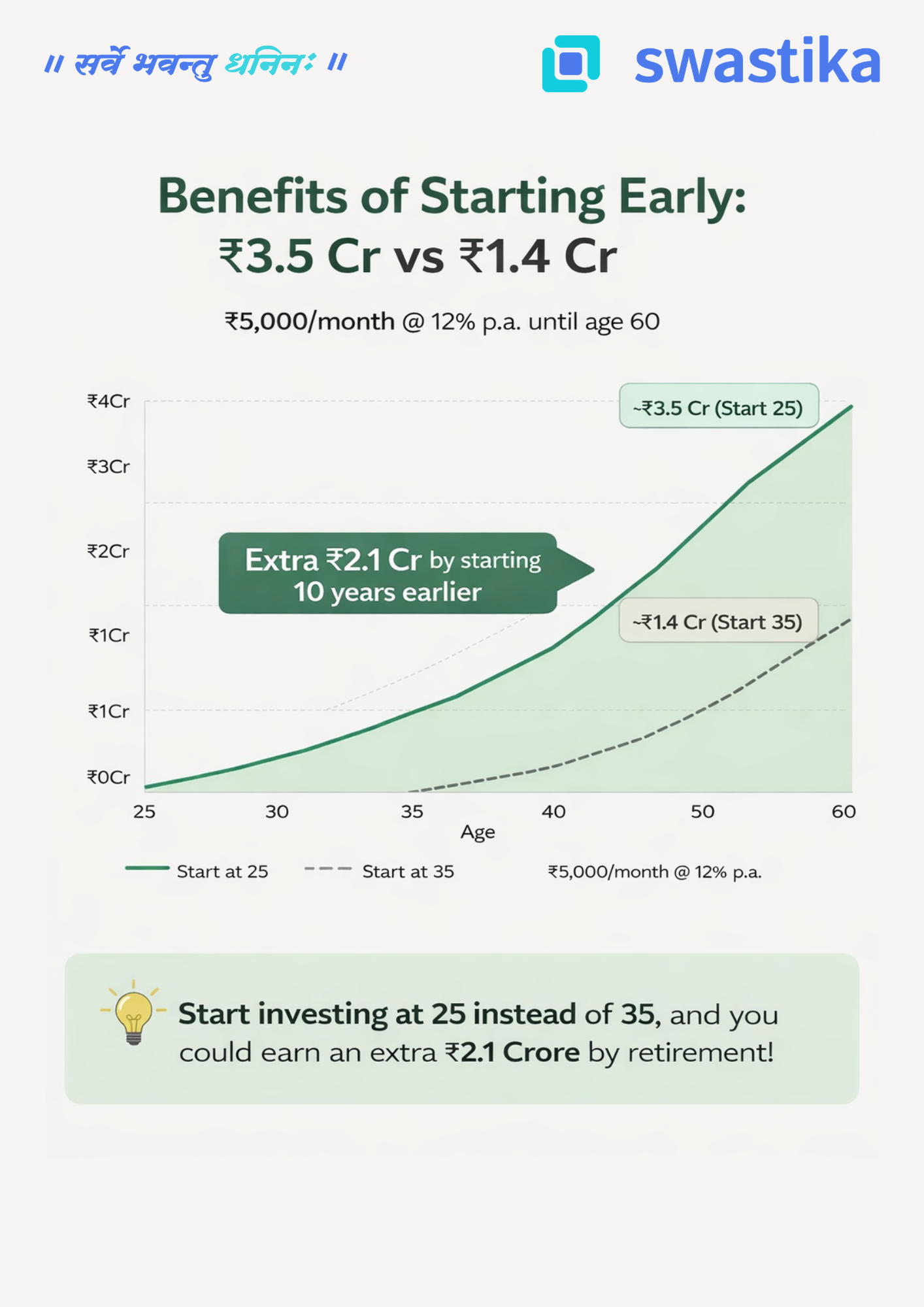
The more years you give your money to grow, the more dramatic — and life-changing — the results become. This is exactly why starting your investment journey early, even with a modest amount, can make a difference of crores by the time you retire.
A Tale of Two Investors: Arjun vs Priya
Let's bring this concept to life with a simple, real-world example.
Meet Arjun and Priya. Both are sensible, disciplined investors. Both invest ₹5,000 every month through a SIP (Systematic Investment Plan) in equity mutual funds, earning an average annual return of 12%. Both stop investing at age 60.
The only difference? Arjun starts at 25. Priya starts at 35.
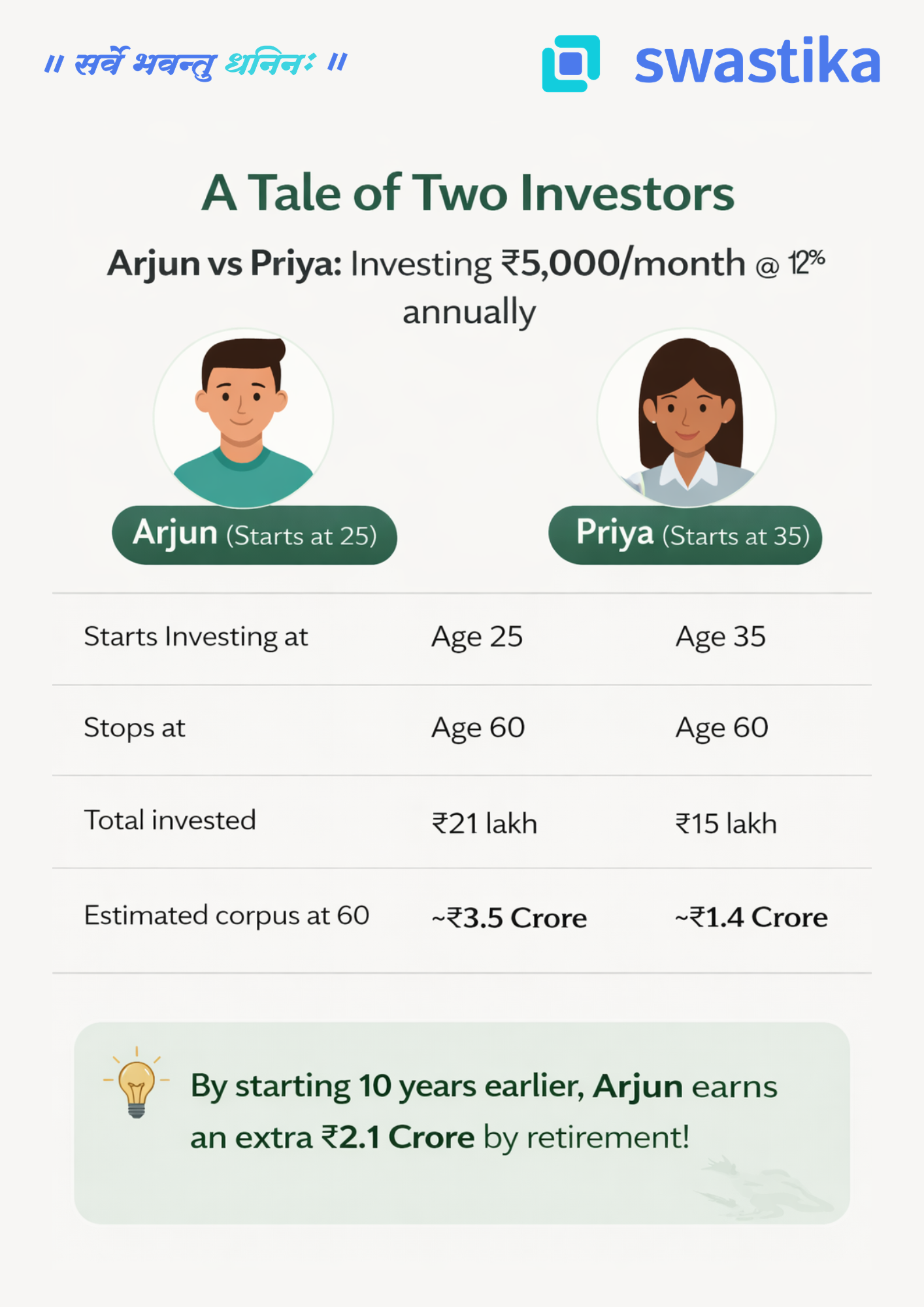
The numbers are striking. Arjun invests just ₹6 lakh more than Priya in absolute terms — yet walks away with ₹2.1 Crore more at retirement.
That extra ₹2.1 Crore didn't come from investing more aggressively or taking bigger risks. It came purely from starting 10 years earlier.
Why Does Time Make Such a Huge Difference?
This is where the magic of compounding reveals itself.
In the early years of investing, growth looks modest and almost unimpressive. But as the years pass, your corpus grows not just on your original investment, but on all the accumulated returns from previous years. The curve goes from almost flat to steeply exponential — and that steep climb happens in the later years.
When Arjun starts at 25, his money has 35 years to ride that exponential curve. Priya's money, starting at 35, only catches the last 25 years — and critically, it misses the steepest part of the climb in the final decade.
Think of it this way: the last 10 years of compounding are worth more than the first 20. That is the counterintuitive truth at the heart of long-term investing.
The Real Cost of Waiting
Many young earners tell themselves, "I'll start investing once I'm more settled — once the salary improves, once the EMI is paid off, once life is a bit easier."
But the numbers show that every year of delay is extraordinarily expensive — far more expensive than any EMI or lifestyle expense. Priya didn't invest carelessly. She invested faithfully for 25 years. Yet she ends up with less than half of what Arjun accumulated — not because she did anything wrong, but simply because she started a decade late.
The cost of waiting 10 years wasn't ₹6 lakh in additional contributions. The cost was ₹2.1 Crore in lost wealth.
Three Principles to Remember
1. Start now, not later.The best time to start investing was yesterday. The second best time is today. Even a SIP of ₹1,000–₹2,000 per month in your 20s is infinitely better than waiting for the "right time."
2. Consistency beats intensity.You don't need to invest large sums all at once. A small, steady, monthly commitment — maintained without interruption — is what unlocks the full power of compounding over decades.
3. Stay invested through market cycles.Compounding works only if you let it work. Exiting during market corrections or stopping your SIP in tough months breaks the chain. Time in the market, not timing the market, is what builds wealth.
The Bottom Line
If you are in your 20s or early 30s, you hold an asset that no amount of money can buy later: time. Use it. Start a SIP today — even a small one. Let compounding do its slow, steady, powerful work.
Because the difference between starting at 25 and starting at 35 is not just 10 years. As Arjun and Priya's story shows, that difference is ₹2.1 Crore.
Big Budget




.webp)
.webp)
.webp)
.webp)
.webp)






.webp)
.webp)
.webp)
.webp)
Latest Articles
Vodafone Idea's Survival Saga: Can a Massive Fundraising Push Outweigh Government's Firm Stand on Dues?


Key Takeaways
- Vodafone Idea plans to raise ₹45,000 crore to revive operations and repay debt.
- Government remains firm on Adjusted Gross Revenue (AGR) dues.
- Telco’s survival is key to India’s telecom competition and infrastructure.
- Shareholders bet on fresh funds, but regulatory risks persist.
- Investors must track this saga for potential market ripple effects.
Vodafone Idea's Survival Saga: Can a Massive Fundraising Push Outweigh Government's Firm Stand on Dues?
India's telecom landscape is at a critical juncture, and right in the eye of the storm is Vodafone Idea (Vi)—once a telecom behemoth, now grappling with debt, regulatory liabilities, and survival itself. As the company races against time to stay afloat, a massive fundraising drive has sparked renewed optimism. But can even ₹45,000 crore in fresh capital neutralize the looming shadow of the government’s unyielding stance on AGR dues?
Let’s break down the battle between financial hope and legal obligation—and what it means for the broader Indian market.
Vodafone Idea: The Rise, the Fall, and the Survival Plan
Vodafone Idea was formed in 2018 through the merger of Vodafone India and Idea Cellular, aiming to challenge Reliance Jio's dominance. However, intense competition, subscriber loss, and regulatory liabilities quickly eroded its financial stability. Today, the telco has over ₹2.1 lakh crore in debt, of which over ₹63,000 crore is owed to the government as part of Adjusted Gross Revenue (AGR) dues, following a Supreme Court ruling.
In a bid to regain its footing, the company has announced a fundraising plan of ₹45,000 crore—one of the largest in India’s telecom sector. Of this, ₹20,000 crore is through equity and the remaining via debt.
This capital will be channeled into 5G rollout, network expansion, and debt repayment. But is this enough?
Government’s AGR Stand: A Stubborn Wall
The core of Vi’s financial struggle lies in the AGR dues, a long-standing dispute over revenue calculation between telcos and the Department of Telecommunications (DoT). In 2019, the Supreme Court sided with the government, demanding immediate clearance of dues.
While the government has allowed staggered payments over 10 years, there’s been no relaxation or waiver—even as Vodafone Idea pleaded for relief. The Ministry of Finance and DoT continue to insist that payments be made as scheduled, placing enormous pressure on Vi’s cash flow.
This non-negotiable position from the government underscores a broader message: financial discipline trumps corporate distress, even for critical infrastructure sectors.
Market Perspective: Why Vodafone Idea’s Fate Matters
A weakened or collapsed Vodafone Idea would transform India’s telecom sector into a duopoly—between Reliance Jio and Bharti Airtel. This would affect:
- Consumer pricing power, leading to potential tariff hikes
- Tower companies and vendors with outstanding dues from Vi
- Banks and mutual funds exposed to Vodafone Idea’s debt
- Employment and indirect jobs across telecom-linked industries
Hence, even as the government maintains its dues stance, the market and policymakers understand the systemic risk involved in Vi’s potential collapse.
This is where the fundraising plan becomes crucial.
Can Fundraising Revive Vi?
The ₹45,000 crore infusion is designed to:
- Upgrade infrastructure for 4G and 5G services
- Stem subscriber losses
- Improve average revenue per user (ARPU)
- Reduce debt pressure
Real example: After the fund infusion news, Vodafone Idea’s stock rallied nearly 20% over a few trading sessions. Market sentiment turned optimistic, particularly after strategic investors including Aditya Birla Group and government-backed entities like LIC showed confidence.
However, investors must remain cautious. A large capital raise does not eliminate the AGR burden, nor does it guarantee positive cash flow. Network capex and pricing war with Jio and Airtel could burn cash quickly.
Investor Takeaways: What You Should Watch
The Vodafone Idea situation offers several key insights for investors:
- Regulatory clarity is vital in long-term investing. AGR dues were a known but underestimated risk.
- Fundamentals matter: Raising capital without improving business operations only delays the problem.
- Competitive positioning: Vi must now catch up on 5G rollout and regain lost market share.
- Risk management: Investors with exposure through mutual funds or telecom ETFs should reassess their risk appetite.
At Swastika Investmart, we prioritize risk-adjusted analysis and equip investors with real-time insights and personalized portfolio strategies.
FAQs
Q1: What are AGR dues and why are they critical for Vodafone Idea?
AGR dues are payments owed by telcos to the government, based on revenue calculations that include non-core income. For Vi, this amounts to over ₹63,000 crore, forming a major part of its liabilities.
Q2: Has the government shown any intent to waive these dues?
No. The Supreme Court has ruled firmly in favour of the government, and the DoT has reiterated its stance that no waivers or concessions will be provided.
Q3: What happens if Vodafone Idea fails to survive?
A collapse could disrupt telecom services, increase tariffs, cause job losses, and lead to NPAs in banks. It would significantly alter India’s telecom landscape.
Q4: Is Vodafone Idea a good stock to invest in now?
It remains a high-risk, high-reward bet. While fundraising provides temporary relief, execution and regulatory headwinds persist. Consider your risk appetite and consult a registered advisor.
Q5: How can investors stay updated on such developments?
Platforms like Swastika Investmart offer research-backed insights, SEBI-registered advisory, and tech-enabled investing tools to help you stay ahead of the curve.
Conclusion: A Balancing Act Between Hope and Hurdles
Vodafone Idea’s fundraising push is undeniably ambitious and possibly transformative. But the telecom major still faces an uphill battle—with government dues, market competition, and execution risk all converging.
For investors, this saga is more than a corporate turnaround story—it’s a lesson in regulatory risk, sectoral dynamics, and financial discipline.
At Swastika Investmart, we believe in empowering investors through data-backed research, SEBI-registered advisory, and simplified investing platforms. Whether you’re a retail investor or seasoned trader, our tools and experts can help you navigate volatile markets like these.
👉 Open your trading account with Swastika Investmart now to stay informed and invest smartly in India’s changing financial landscape.

Why Commodity Trading Is Gaining Momentum in India in 2025
Key Takeaways
- Commodity trading in India is surging thanks to better technology, SEBI regulation, and diverse online platforms.
- Broader retail participation is driven by user-friendly apps like Zerodha, Groww, Upstox, and Swastika Investmart.
- Sectors like gold, crude oil, and agri-products see higher interest due to price volatility and inflation hedging.
- Robust compliance via SEBI, NSDL/CDSL, and improved risk management elevate investor trust.
Commodity trading is no longer niche—it’s rapidly becoming a mainstream investment avenue in India. As 2025 unfolds, more investors are turning to commodity markets with interest than ever before. Whether you’re eyeing gold futures, crude oil contracts, or agri-products like chana and soybean, the market dynamics have never been more favorable.
Here’s why:
Digital Platforms Are Empowering Traders
Platforms like Zerodha, Groww, Upstox, Angel One, and ICICI Direct now offer seamless access to commodity segments. But Swastika Investmart takes it further with:
- Regional support in tier-2 and tier-3 cities
- Personalized research and advisory insights
- A SEBI-compliant and intuitive trading ecosystem
This combination lowers barriers for new retail investors and builds confidence in the commodity space.
Regulatory Safeguards Boost Confidence
SEBI's oversight of MCX (Multi-Commodity Exchange) and NCDEX (National Commodity & Derivatives Exchange), along with enforced use of NSDL/CDSL, ensures safe custody and settlement. Frequent investor alerts, mandatory KYC, and transparent margin norms reduce risk and build trust—especially vital for first-time participants.
Diversification in a Volatile Market
Equity markets’ volatility has investors seeking alternative avenues. Commodities—particularly gold (for inflation hedging), crude oil (tied to global trends), and agri-products (linked to climate)—offer a portfolio hedge. Emerging themes such as food inflation and geopolitical shifts are further drawing attention.
Rising Retail Interest & Awareness
Thanks to rising financial literacy and media coverage, retail investors are more aware of commodity opportunities. This urban-and-rural diffusion is backed by growing DEMAT account openings and mobile investing culture. Learning resources—from webinars to newsletters—added by brokers like Swastika Investmart are educating more people on the how-tos of commodities.
Momentum Snapshot: Why India Loves Commodities in 2025
Example in Action
Take the rising interest in soybean futures due to monsoon variability. Data shows a surge in active contracts traded, especially among small-town investors—a trend mirrored by the sharp rise in sign-ups for commodity access on cash-light platforms like Swastika Investmart.
Why Are More Indians Choosing Commodity Trading?
- Portfolio Diversification: Adding commodities reduces equity risk.
- Hedge Against Inflation: Gold, silver, and crude oil safeguard wealth.
- Global Exposure: Commodities reflect international demand-supply shifts.
- Leverage Opportunities: Futures & options provide margin benefits (with risk).
- Technology Access: Mobile apps make commodity trading as simple as stock investing.
👉 Ready to explore this growing market? Open a Commodity Account with Swastika Investmart today.
Swastika Investmart Advantage in Commodity Trading 🌟
While many brokers provide commodity access, Swastika Investmart focuses on:
- SEBI-compliant practices ensuring investor protection.
- Strong research desk offering actionable trading insights.
- Regional & vernacular support for Tier-2 & Tier-3 investors.
- Technology-first approach with robust web & app platforms.
- Trusted brand legacy with decades of market presence.
📲 Start trading commodities with Swastika Investmart:
FAQs
Q1. Why is commodity trading becoming popular in India now?
Rising digital access, volatile prices, and inflation-driven demand are key contributors.
Q2. Can beginners invest in commodities easily?
Yes—platforms like Swastika Investmart guide them with intuitive tools and regional support.
Q3. What commodity is best to start with?
Gold and crude oil are among the most liquid, making them good starting points.
Q4. Are commodity markets risky for retail traders?
They can be volatile, but disciplined trading and robust platforms mitigate most risks.
Q5. How does SEBI protect commodity traders?
Through regulatory oversight, transaction transparency, and enforced clearing procedures via NSDL/CDSL.
Conclusion
In 2025, commodity trading isn’t just another option—it’s a strategic avenue for diversification, hedging, and portfolio growth. With modern trading apps, strong regulatory frameworks, and growing investor confidence, the Indian commodity market truly stands at an inflection point.
If you're ready to get started, Swastika Investmart offers a seamless, trusted, and insightful platform to explore your commodity trading journey.
.webp)
Why IPOs Are Booming in 2025
Key Takeaways
- India is witnessing a record number of IPOs in 2025.
- A Demat account is mandatory to apply for IPOs as per SEBI guidelines.
- Leading brokers like Swastika Investmart, Zerodha, Groww, Angel One, Upstox, ICICI Direct offer easy onboarding.
- Swastika Investmart stands out for its trust, research-backed advisory, and regional support.
- Early account setup ensures you don’t miss upcoming IPO opportunities.
Introduction
The year 2025 has kickstarted one of the strongest IPO waves in India’s market history. From startups to large conglomerates, companies are lining up to raise capital via Initial Public Offerings (IPOs). With SEBI making IPO processes faster and digital applications simpler, retail participation is at an all-time high.
But here’s the catch – you cannot apply for or hold IPO shares without a DEMAT account. If you are serious about wealth creation through the upcoming IPO boom, now is the right time to get started.
Factors fueling this surge in IPO activity:
Why You Need a DEMAT Account for IPOs
Here’s why a DEMAT account is non-negotiable for IPO investments:
- Mandatory Requirement – As per SEBI rules, IPO shares are allotted only in DEMAT form.
- Safe & Paperless – No risk of losing share certificates.
- Faster Refunds – Non-allotted funds are unblocked instantly via UPI.
- Ease of Selling – Shares get credited directly to your DEMAT and can be sold anytime post listing.
- Access to Multiple IPOs – Apply seamlessly via brokers or banking apps linked to DEMAT.
Benefits of Applying for IPOs via DEMAT
What’s Fueling the IPO Boom in 2025?
The Indian stock market has matured significantly in the last few years. Backed by favorable SEBI regulations, strong retail participation, and India’s status as the fastest-growing major economy, more companies are choosing to go public.In fact, experts estimate that IPO fundraising in 2025 could surpass all previous records, covering diverse sectors like fintech, renewable energy, digital commerce, and infrastructure.
How to Get Started Today
- Open a DEMAT + Trading Account – Choose a SEBI-registered broker like Swastika Investmart, Zerodha, Upstox, or Angel One.
- Complete e-KYC – Submit Aadhaar, PAN, and bank details.
- Link UPI ID – For IPO applications.
- Apply for IPOs – Directly through broker platforms or net banking (ASBA).
- Monitor Allotments & Listings – Shares get credited automatically into your DEMAT.
Why Choose Swastika Investmart?
<p>While many discount brokers focus on speed, <strong>Swastika Investmart</strong> has built its reputation on **trust, SEBI compliance, and deep research-based advisory**. With its strong technology stack and regional support network across India, Swastika empowers both beginners and experienced investors to participate confidently in IPOs.</p> <p>What sets Swastika apart is its investor-first approach, ensuring that new entrants into the stock market are guided properly and not just left with trading tools. From IPO recommendations to post-listing strategies, Swastika helps investors at every step.</p>
👉 Open a Demat Account with Swastika Today
📱 iOS: Download Here
📱 Android: Download Here
FAQs
Q1. Can I apply for an IPO without a DEMAT account?
No. IPO allotments are only made in DEMAT form as per SEBI guidelines.
Q2. How much money do I need to start investing in IPOs?
Retail IPO applications usually start from ₹15,000–₹20,000 per lot.
Q3. Are IPOs always profitable?
Not always. While some deliver strong listing gains, others may underperform. Research is essential.
Q4. Which IPOs are expected in 2025?
Several companies in fintech, EV, renewable energy, and healthcare are expected to go public this year.
Conclusion:
The IPO boom of 2025 is a once in a decade opportunity for Indian investors. With leading companies tapping into public markets, retail investors have a golden chance to grow wealth. But without a Demat account, you’ll be left out of the action. If you’re serious about making the most of the IPO wave, now is the right time to open a Demat account. Whether you prefer app-based brokers or value-added services, ensure your account is ready before the next big IPO hits the market. And with Swastika Investmart, you get not just access but also trusted guidance to navigate India’s exciting IPO journey in 2025 🚀
%20(4).webp)
Tariff Turmoil: How U.S. Duties Are Reshaping India’s Export Strategy.
Key Takeaways
- Rising U.S. tariffs are pushing India to diversify export markets.
- Key sectors like textiles, steel, and pharma are directly impacted.
- India is boosting trade ties with EU, ASEAN, and Africa.
- Exporters are exploring value-addition and supply chain resilience.
- Investors must watch policy moves, sectoral shifts, and global demand.
The Changing Landscape of Global Trade
The year 2025 has been marked by intensifying tariff disputes between the U.S. and several trading partners. India, being a significant exporter of textiles, pharmaceuticals, steel, IT services, and chemicals, is directly feeling the impact. With the U.S. imposing higher duties on steel and certain manufactured goods, Indian companies are rethinking their export strategy and market diversification.
Trade has always been one of India’s strongest growth levers. In FY24, India’s exports of goods and services crossed $775 billion, but the U.S. tariffs are creating headwinds. While India continues to be a trusted global partner, changing tariff structures require businesses to reimagine pricing, supply chains, and long-term competitiveness.
Why U.S. Tariffs Matter for India
The U.S. remains India’s largest export destination, accounting for nearly 17% of total exports. From IT services to engineering goods, India’s dependency on U.S. markets is significant.
- Steel & Aluminum: Duties are making Indian exports less competitive compared to local U.S. suppliers.
- Textiles & Apparel: One of India’s strongest export categories faces margin pressure as tariffs raise landed costs.
- Pharmaceuticals: While essential medicines often get exemptions, higher compliance costs and trade uncertainties are slowing shipments.
For example, a textile exporter from Tiruppur exporting cotton apparel to the U.S. now faces a 10–15% cost disadvantage compared to competitors from tariff-free countries.
India’s Strategic Response
Market Diversification
India is accelerating trade agreements with EU, ASEAN, and African nations. The India-EFTA Trade Deal, signed in early 2025, is expected to boost textile and engineering exports by providing duty-free access to European markets.
Moving Up the Value Chain
Instead of relying on low-margin exports, Indian companies are shifting toward value-added products. For example, in the chemical sector, rather than exporting bulk chemicals, firms are focusing on specialty chemicals with higher margins and lower tariff sensitivity.
Government Initiatives
- PLI Schemes (Production-Linked Incentives) are encouraging domestic manufacturing and export competitiveness.
- Remission of Duties and Taxes on Exported Products (RoDTEP) continues to provide relief for exporters facing higher overseas costs.
- Digital Trade Missions are connecting Indian SMEs with alternative markets in Southeast Asia and Africa.
Impact on Indian Markets and Investors
The stock market often reacts quickly to global tariff announcements. Sectors like metal stocks, textiles, and export-heavy IT firms witness volatility. For instance, after the latest tariff announcement in July 2025, several steel companies in India saw a 2–3% dip in share value due to expected demand slowdown.
However, long-term opportunities remain strong. Companies with diversified export bases, robust domestic demand, and strong R&D (such as specialty chemicals and pharma) are expected to emerge stronger.
For investors, this means a shift in focus toward:
- Export-resilient companies with global presence.
- Domestic demand-driven sectors less dependent on U.S. markets.
- Renewable energy and green exports, which are gaining global preference.
Case Study: How Indian Pharma Is Navigating Tariffs
The Indian pharmaceutical sector, a global supplier of generics, initially faced hurdles due to U.S. duties on certain APIs (Active Pharmaceutical Ingredients). To counter this, companies are strengthening backward integration, reducing dependency on imports from China, and exploring new export markets in Latin America and Africa.
This adaptability showcases India’s resilience and long-term growth potential, even in a turbulent trade environment.
FAQs
1. Why are U.S. tariffs affecting Indian exports so much?
Because the U.S. is India’s largest export market, higher duties directly raise costs for Indian exporters, making them less competitive.
2. Which sectors are most impacted?
Steel, textiles, and certain chemical exports face the highest tariff pressure, while IT and pharma are moderately affected.
3. What steps is the Indian government taking?
Through FTAs, PLI schemes, and RoDTEP incentives, the government is ensuring exporters stay competitive globally.
4. Should investors avoid export-heavy companies?
Not necessarily. Investors should focus on firms with diversified markets, innovation, and strong domestic demand.
5. Can this tariff turmoil benefit India in the long run?
Yes. It encourages diversification, strengthens local manufacturing, and pushes companies to innovate in higher-value exports.
Conclusion
While U.S. tariffs are creating near-term challenges for India’s exporters, they are also driving innovation, diversification, and resilience in the long run. For investors, this is a reminder that global trade risks and domestic opportunities must both be factored into investment strategies.
At Swastika Investmart, our SEBI-registered research team provides in-depth insights, strong research tools, and investor education to help you make informed decisions in such dynamic times.
👉 Open Your Account with Swastika Investmart and navigate global market shifts with confidence.
.webp)
Anlon Healthcare & Vikran Engineering IPOs: What Investors Need to Know in August 2025
Key Takeaways
- Anlon Healthcare IPO (₹121 cr, ₹86–91/share, 164 lot): Strong fundamentals, expansion focus, but valuation seems full and there are risks like falling FY 24 revenue, high debt, client concentration, and single‑facility dependency—so it may be safer to skip this round.
- Vikran Engineering IPO (₹772 cr, ₹92–97/share, 148 lot): Well‑valued with solid growth, order book, and diversified project portfolio in essential infrastructure—I staying open to both listing gain and long‑term possibilities.
- Indian investors should weigh expansion potential versus execution and execution risks—policy‑sensitive nature is key for Vikran.
- Swastika Investmart is a reliable SEBI‑registered platform offering research tools, tech‑based investing, customer support, and investor education to help navigate IPO decisions.
Anlon Healthcare and Vikran Engineering IPO Review: Investor Perspective
Anlon Healthcare Limited – API and Pharmaceutical Intermediates
Anlon Healthcare, based in Rajkot, has carved a niche in manufacturing high‑purity pharmaceutical intermediates and APIs used in medications, personal care, nutraceuticals, and animal health—critical raw materials in drug production. Its IPO is a fully fresh issue of around ₹121 crore at ₹86–91 per share, with a lot size of 164 shares. Proceeds are earmarked for capacity expansion (₹30.7 crore), working capital (₹43 crore), debt reduction, and general corporate use MoneycontrolIPO Watch.
Pros Under the Hood:
- Profits climbed from ₹5.82 crore in FY 23 to ₹9.65 crore in FY 24, even though revenue dropped sharply from ₹112.9 crore to ₹66.6 crore Business StandardMoneycontrol.
- The company meets pharmacopoeia standards (IP, BP, EP, JP, USP) and holds international approvals for key APIs, boosting credibility Business Standard.
Caveats to Consider:
- Revenue decline in FY 24 raises concerns about sustainability—one‐off recovery possible but uncertain.
- Financial leverage appears elevated, and competition in API space is fierce—pricing power may be limited.
- Heavy reliance on a single facility in Rajkot and 78% revenue concentration from top 10 clients poses operational and client‑diversification risks.
- Current valuations appear full—little room for upside unless growth trajectory rapidly improves.
Verdict: With expansion plans and stronger margins in sight, Anlon Healthcare shows promise—but given the high valuation, past revenue dip, location dependency, debt, and narrow client base—cautious investors may prefer to sit this one out.
Vikran Engineering Limited – Key EPC Player
Vikran Engineering, headquartered in Thane (Maharashtra), is a fast‑growing EPC firm focused on core sectors like power transmission (EHV substations, smart metering), water infrastructure, railway electrification, and solar projects. The IPO totals ₹772 crore, comprising ₹721 crore fresh issue and ₹51 crore via offer for sale, at ₹92–97 per share, with a lot size of 148 shares. The net proceeds largely support working capital and corporate needs SharescartUpstox - Online Stock and Share TradingFortune India.
Strengths That Stand Out:
- FY 25 revenue jumped ~16–17% to ₹922–923 crore from ~₹786 crore, while PAT rose ~4% to ₹78 crore Fortune IndiaIPO Watch.
- A robust order book: ₹2,442 crore as of mid‑2025, backed by 45 completed and 44 ongoing projects across 14–16 states Upstox - Online Stock and Share TradingFortune India.
- Diversified across essential infrastructure sectors, reducing dependency on any single vertical.
Risks to Note:
- EPC is highly execution‑dependent; delays—especially on tightly bid government projects—can pressure earnings.
- Heavy reliance on government contracts (around 62% by order book) makes it vulnerable to policy shifts or funding changes.
- Working capital intensity and receivables could strain liquidity if project receipts lag.
Verdict: A fundamentally sound candidate with solid growth, diverse project mix, and strong credibility. Investors could consider participating for potential listing gains and long‑term growth, while remaining watchful on execution and policy risks.
Why Swastika Investmart stands out:
- SEBI‑registered broker with transparency and regulatory rigor.
- Sophisticated yet intuitive IPO analytics and comparison dashboards.
- Dedicated customer support to clarify IPO terms, allotment, and demat credit.
- Tech‑forward platform enabling quick bidding, tracking, and alerts.
- Investor education resources—webinars, blogs, FAQs—empowering decision-making.
Frequently Asked Questions
Q1. When do these IPOs open and list?
Both IPOs—Anlon and Vikran—open on August 26, 2025, and close on August 29. Allotment is expected by September 1, with refunds and demat credit on September 2, and listing on September 3 on BSE and NSE IPO Watch+1Sharescart.
Q2. What is the minimum investment for retail investors?
- Anlon Healthcare: 164 shares (~₹14,924 at upper band) IPO WatchBusiness Standard.
- Vikran Engineering: 148 shares (~₹13,616 at upper band) Business StandardFortune India.
Q3. What share quotas are allocated among investor categories?
- Anlon: 75% QIB, 10% retail, 15% NII IPO Watch.
- Vikran: Up to 50% QIB, at least 35% retail, at least 15% NII IPO WatchUpstox - Online Stock and Share Trading.
Q4. What does the grey market premium (GMP) suggest?
Vikran shows a strong grey market premium (~17–23%), indicating investor enthusiasm and possible listing upside The Economic TimesMoneycontrol. Anlon currently has no visible GMP activity The Economic Times.
Q5. Should a risk‑aware investor subscribe to both?
Anlon’s full valuation, FY 24 revenue slump, and operational concentration suggest prudence—this one could be avoided for now. Vikran, however, offers a well-balanced risk‑reward profile; investors may consider applying for potential gains and long-term infrastructure exposure.
Conclusion
The Anlon Healthcare IPO tells a story of niche manufacturing with potential—but shadowed by recent revenue decline, high valuation, and reliance on a single facility and a few clients. In contrast, Vikran Engineering stands out with healthy financials, diversified order book in vital sectors, and encouraging market sentiment.
For investors seeking support, clarity, and confidence in navigating these IPOs, Swastika Investmart delivers with its SEBI‑registered platform, powerful research tools, supportive customer care, and educational edge.
To explore these IPOs or your next investment opportunity with ease and authority:
%20(3).webp)
Online Gaming Bill Passed: What It Means for Investors and Markets
Key Takeaways
- India’s Online Gaming Bill 2025 bans all real money online gaming nationwide, reshaping the digital gaming sector.
- The Bill aims to protect users from addiction, fraud, and security threats, but has sparked concern over job losses and startup closures.
- Investors may face losses as gaming platforms suspend operations and shift away from real-money segments.
- Indian markets are witnessing portfolio rebalancing, with opportunities emerging in tech innovation and investor education for safer sectors.
- Swastika Investmart offers SEBI-registered, tech-driven investing and customer-centric support to help you adapt confidently.
India’s Online Gaming Bill Passed: How Will It Shape Investments and Markets?
India’s rapidly growing digital economy is undergoing a dramatic policy shift. The passage of the Promotion and Regulation of Online Gaming Bill, 2025 by both houses of Parliament has triggered intense debate, concern, and strategic repositioning—particularly for investors and market participants. The Bill, which awaits presidential assent (largely seen as a formality), brings sweeping changes to India’s online gaming landscape, especially targeting real-money games. But what does this mean for your investments and the broader financial markets?
Understanding the New Online Gaming Bill
India boasted over 568 million online gamers in 2025—one in five globally. The real-money gaming (RMG) segment, comprised of fantasy sports, rummy, and poker, contributed to 85% of industry revenue last year, embedding itself deep into India’s startup ecosystem and attracting massive foreign and domestic investments.
Key Provisions of the 2025 Bill:
- A total ban on all real-money online games and gambling platforms.
- Strict penalties: Platform operators could face up to three years' imprisonment or a ₹1 crore fine. Promoting celebrities and financial facilitators are also liable.
- No distinction between games of skill and chance. Even fantasy sports and rummy are included, leaving little room for legal recourse.
- Financial clampdown: Banks and payment gateways are now prohibited from processing transactions related to banned games.
- Focus on e-sports and casual gaming: Sectors that don’t involve monetary stakes are encouraged and regulated.
Why Did the Government Intervene?
Policymakers argue the ban was necessary for national security and public health:
- Curbing addiction and financial ruin: Tamil Nadu alone reported 47 suicides linked to gaming addiction in the last five years.
- Busting illicit activities: Real-money games have reportedly enabled money laundering and even terror financing.
- Protecting families: On average, Indians lose nearly ₹20,000 crore annually in these games, eroding household savings and trust.
Real-World Market Impact: Investors, Startups & Markets React
The passage of the Bill has sent shockwaves across India’s startup and investment communities:
- Immediate shutdowns: Industry leaders like Dream Sports, MPL, PokerBaazi, and Zupee have already begun winding down their real-money operations.
- Potential job losses and capital erosion: The industry fears over two lakh job losses and the closure of 400+ startups, with investors left stranded.
- Valuation nosedive: Venture-backed platforms, once valued in billions, are rapidly reassessing models. Some are pivoting to free-to-play or e-sports—but revenue and growth projections have changed drastically.
- Stock market ripple effects: Investor portfolios linked to gaming, interactive entertainment, and fintech are witnessing rebalancing, with the tech sector closely watched for further regulatory clarity.
Example:
Amit, an angel investor, had allocated 10% of his portfolio to emerging fantasy gaming startups. Overnight, the Bill rendered these investments non-viable. Forced to reassess his positions, Amit is now redirecting capital towards SEBI-regulated fintech and tech stocks with robust compliance records.
What’s Next? Navigating Opportunities in Tech and Investor Safety
The Online Gaming Bill is more than just a ban—it’s a call for responsible digital development, innovation, and investor protection. The focus now shifts to:
- Growth of regulated e-sports & social gaming: Platforms emphasizing community, skill-building, and non-monetary rewards are gaining traction.
- Enhanced investor education: SEBI and market leaders are rolling out awareness campaigns around digital fraud, regulatory risks, and safe investing.
- Tech-driven platforms: Brokers offering advanced research tools, real-time analytics, and customer transparency are attracting former gaming investors.
Why Swastika Investmart Stands Out For Investors
As Indian markets evolve, the need for a trusted, SEBI-registered, and technologically advanced broker is paramount. Swastika Investmart ticks every box:
- Full SEBI registration and 30+ years of legacy instill trust and safety.
- Real-time research tools, screeners, and investment alerts designed for proactive, smart investing.
- Unmatched support: Advisory, investor education, and regional language features for new and seasoned investors.
- Data privacy matters: ISO-certification and bank-grade encryption for peace of mind.
Example:
Ravi, after facing losses with a gaming app, opened an account with Swastika Investmart. He used Swastika’s research screeners to diversify into energy and banking stocks, accessed regional support for clarity, and benefitted from timely educational webinars.
FAQs
Q1. Does the new Online Gaming Bill completely ban all online games?
No, it bans only real-money gaming. E-sports, educational, and social (non-monetary) games are still encouraged and regulated.
Q2. How will this affect my investments as an individual investor?
Expect volatility in gaming and fintech stocks. Diversify and favor SEBI-regulated sectors and brokers for safer, research-backed investing.
Q3. Can Indian startups challenge the Bill?
Some gaming companies are exploring legal challenges, but the Bill’s provisions are sweeping and its passage by Parliament signals strong government intent.
Q4. Where can investors look for the next growth opportunity?
E-sports, fintech, AI, green energy, and regulated tech platforms with strong compliance and user support are emerging as new avenues.
Q5. Is Swastika Investmart safe for online investing after these regulatory changes?
Absolutely. The platform is SEBI-registered, ISO-certified, and follows stringent privacy and compliance protocols.
Conclusion: Invest Smarter with Swastika Investmart
The passage of the Online Gaming Bill signals a careful regulatory tone in India’s digital economy. While it brings challenges for a thriving sector, it also unlocks safer, more transparent, and innovative investing opportunities. For investors seeking stability, advanced market research, and trusted compliance, Swastika Investmart is your ideal partner.
Take charge of your financial future—Open an Account today with Swastika Investmart.
(Open Account CTA: https://trade.swastika.co.in/?UTMsrc=OnlineGamingBillPassed)


.webp)
.webp)

.webp)





START YOUR INVESTMENT JOURNEY
Get personalized advice from our experts
- Dedicated RM Support
- Smooth and Fast Trading App
