JSW Steel & POSCO JV: A Mega Step Towards India’s Steel Expansion


Key Takeaways
- JSW Steel and POSCO have formed a 50:50 joint venture
- The project aims to build a 6 MTPA integrated steel plant in Odisha
- The partnership combines global technology with local execution
- India’s steel demand growth supports long-term potential
- Execution and capital intensity remain key risks
A Landmark Partnership in India’s Steel Sector
The collaboration between JSW Steel and POSCO Group marks a significant milestone in India’s industrial growth story.
The two companies have entered into a joint venture agreement to set up a 6 million tonnes per annum integrated steel plant in Odisha. This is not just another capacity expansion. It reflects a strategic alignment between one of India’s largest steel producers and a global leader in steel technology.
At a time when India is positioning itself as a manufacturing hub, such partnerships can play a critical role in strengthening the country’s industrial base.
Why This JV Matters for India
Rising Steel Demand
India’s infrastructure push is driving strong demand for steel. From highways and railways to housing and renewable energy projects, steel consumption is expected to grow steadily over the next decade.
Government initiatives focused on infrastructure development and urbanization are further accelerating this demand.
Odisha as a Strategic Location
Odisha has emerged as a key industrial hub due to its rich mineral resources and improving infrastructure. Setting up a steel plant in this region provides logistical advantages and access to raw materials.
This makes the project more viable in the long run.
Understanding the Integrated Steel Plant
What Is an Integrated Steel Plant
An integrated steel plant handles the entire production process, from raw material processing to finished steel products.
This includes:
- Iron ore processing
- Steelmaking
- Rolling and finishing
Such plants offer better control over costs and quality, making them more competitive.
Capacity Significance
A 6 MTPA plant is a large-scale project. It can significantly contribute to domestic steel production and reduce dependence on imports in certain categories.
What JSW Steel Gains
For JSW Steel, this joint venture strengthens its expansion strategy.
Scale Expansion
The new plant adds to JSW’s existing capacity, helping it maintain its leadership position in the Indian steel market.
Technology Advantage
Partnering with POSCO allows access to advanced steelmaking technologies, which can improve efficiency and product quality.
Global Positioning
The collaboration enhances JSW’s global competitiveness by aligning with an international player.
What POSCO Brings to the Table
POSCO Group is known for its technological expertise and operational excellence.
Through this JV, POSCO gains:
- Entry into one of the fastest-growing steel markets
- Access to India’s resource base
- Opportunity to expand its global footprint
Impact on Investors
Growth Visibility
Large-scale capacity expansion signals confidence in future demand. Investors often view such projects as indicators of long-term growth.
Capital Intensity
Steel projects require significant investment. While they offer growth potential, they also increase financial commitments.
Execution Timeline
Such projects take years to complete. Investors need to track progress and execution efficiency.
Real-World Context
India aims to become a global manufacturing hub. Steel plays a crucial role in this vision.
Consider sectors like:
- Infrastructure development
- Automobile manufacturing
- Renewable energy projects
All these sectors depend heavily on steel. As demand grows, companies with strong capacity and technology will be better positioned.
Risks to Watch
Commodity Price Cycles
Steel prices are influenced by global demand and supply dynamics. Any slowdown can impact profitability.
Project Execution
Delays in construction or cost overruns can affect returns.
Regulatory Environment
Large industrial projects require multiple approvals. Changes in regulations can impact timelines.
Oversight by bodies like the Securities and Exchange Board of India ensures transparency for investors, but operational challenges remain.
Competitive Landscape
The steel sector in India is competitive, with multiple players expanding capacity.
However, partnerships like this create a strong competitive advantage by combining:
- Local market understanding
- Global technology
- Large-scale production capability
Why Research Matters for Investors
Evaluating large industrial projects requires careful analysis of multiple factors.
Swastika Investmart provides:
- SEBI-registered research insights
- Advanced tools for market analysis
- Dedicated support for investors
- Strong focus on financial education
Such support helps investors make informed decisions rather than reacting to market noise.
Frequently Asked Questions
What is the JSW Steel and POSCO joint venture?
It is a 50:50 partnership to set up a 6 MTPA integrated steel plant in Odisha.
Why is this project important for India?
It supports growing steel demand and strengthens India’s manufacturing capabilities.
How will this impact JSW Steel’s growth?
The project can increase capacity, improve efficiency, and enhance long-term growth prospects.
What are the risks involved in this JV?
Key risks include project delays, high capital investment, and steel price volatility.
Is the steel sector a good investment opportunity?
The sector has growth potential, but it is cyclical and depends on economic conditions.
Conclusion
The JSW Steel and POSCO joint venture is a significant step toward strengthening India’s steel ecosystem. It reflects confidence in the country’s long-term growth story and the rising demand for core materials.
For investors, this development offers a mix of opportunity and caution. While the growth potential is strong, success will depend on execution and market conditions.
If you want to explore such opportunities with research-backed insights and smart tools, you can start here:
Big Budget





.avif)
.avif)
.avif)
.avif)
.avif)













.avif)
.avif)
.avif)
.avif)
Latest Articles
.avif)
FII/DII Futures Activity: What Retail Traders Must Know


Quick Takeaways
- FIIs (Foreign Institutional Investors) and DIIs (Domestic Institutional Investors) drive liquidity in India’s futures market.
- Their activity often sets the short-term market direction.
- Retail traders can track FII/DII data to align trades with institutional flows.
- Futures data helps gauge market sentiment (bullish, bearish, or neutral).
- Swastika Investmart provides research and tools to simplify tracking and execution.
Why FII/DII Activity Matters
The Indian futures and derivatives market is heavily influenced by large institutional players.
- FIIs bring global capital flows, often reacting to interest rates, U.S. dollar trends, and geopolitical shifts.
- DIIs — such as mutual funds, insurance companies, and pension funds — provide domestic stability by countering excessive volatility.
Retail traders alone may not move markets, but by understanding institutional positioning, they can trade with the trend instead of against it.
How FIIs Use Futures
Foreign investors frequently use futures contracts to hedge and speculate:
- Index Futures (Nifty, Bank Nifty):
FIIs buy when bullish and short-sell when cautious. Example: If FIIs have net long positions of 80,000 contracts in Nifty futures, it signals bullish sentiment. - Stock Futures:
FIIs may build long positions in sector leaders (Infosys, HDFC Bank, Reliance) when they expect growth, or short when bearish on specific industries. - Hedging Spot Positions:
If FIIs buy equity shares worth ₹5,000 crore, they may simultaneously short futures to protect against market downturns.
How DIIs Use Futures
DIIs generally adopt a risk management role:
- Mutual funds may hedge equity portfolios during volatile phases.
- Insurance companies may use index futures to maintain portfolio balance.
- Unlike FIIs, DIIs focus more on long-term stability rather than short-term speculation.
Example: When FIIs aggressively sell futures, DIIs often step in through spot buying or limited hedging, helping cushion the market.
Reading FII/DII Data for Retail Traders
Retail traders can monitor daily FII/DII futures activity via NSE reports and broker research.
Key indicators to track:
- Net Long vs. Short Contracts – Shows whether institutions expect markets to rise or fall.
- Index Options Positioning (Put/Call Ratio) – Reveals hedging strategies.
- Monthly Expiry Trends – Indicates rollover bias (bullish, bearish, neutral).
Example:
- If FIIs turn net buyers of 10,000 Nifty futures contracts after weeks of selling, it could mean a trend reversal.
- A rising Put/Call ratio often signals excessive bearish bets, sometimes leading to short-covering rallies.
How Retail Traders Can Benefit
- Follow the Flow, Don’t Fight It
Align trades with institutional positioning. If FIIs are net long, intraday and swing traders can look for buying opportunities. - Use Futures Data for Confirmation
Combine technical charts with FII/DII futures data for stronger conviction. - Sector Rotation Insights
If FIIs build positions in IT futures and reduce metals exposure, retail traders can adjust portfolios accordingly. - Risk Management
Institutions hedge consistently — retail traders should adopt similar discipline with stop-losses and defined risk per trade.
Real-World Example
In August 2025, FIIs recorded heavy selling in Nifty futures, creating downward pressure. However, DIIs supported the market with strong cash equity buying. Retail traders who observed this could have:
- Avoided aggressive long positions in futures.
- Shifted towards safer swing trades in defensive sectors like FMCG and Pharma.
- Prepared for a potential bounce when DII support began outweighing FII selling.
FAQs
Q1. Where can I track FII/DII futures activity?
You can check NSE’s derivative reports, daily FII/DII statistics, or broker research portals like Swastika Investmart.
Q2. Do FIIs always influence market direction?
Not always, but their flows set the tone for short-term sentiment. DIIs often counterbalance them.
Q3. Can retail traders directly copy FII moves?
Blindly copying isn’t advisable. Instead, use their activity as a sentiment guide along with technical and fundamental analysis.
Q4. Are FIIs more active in index futures or stock futures?
FIIs trade both, but index futures (Nifty, Bank Nifty) see the most action due to high liquidity.
Q5. How does expiry affect FII/DII activity?
Near monthly expiry, institutions roll over positions or square them off, leading to high volatility.
Conclusion
For retail traders in India, tracking FII/DII activity in futures can provide valuable clues about market direction and sentiment. Instead of trading in isolation, aligning with institutional flows improves odds of success.
With Swastika Investmart’s tech-enabled platforms, SEBI-registered trust, advanced derivatives research, and investor education, retail traders can confidently navigate futures trading.
👉 Open a Demat & Trading Account with Swastika Investmart and make informed trading decisions today.
.avif)
4 IPOs Hitting the Market! Which One is Best for You? | Anand Rathi, Seshaasai & More!
Quick Highlights
- Four IPOs open this week: Anand Rathi Share & Stock Brokers, Seshaasai Technologies, Jaro Institute, and Solarworld Energy.
- Anand Rathi: strong brand in stockbroking with long-term growth potential.
- Seshaasai: tech-driven BFSI solutions, riding on digital transformation.
- Jaro Institute: online education player, faces stiff competition.
- Solarworld Energy: renewable push, strong margins, but niche sector risks.
Introduction
Indian markets continue to witness a surge of Initial Public Offerings (IPOs) in 2025. For investors, this week is buzzing with four new IPOs, each from different sectors — stockbroking, BFSI technology, edtech, and renewable energy.
Choosing the right IPO can be overwhelming, especially with mixed market sentiments and sector-specific opportunities. Let’s decode the four upcoming issues and analyze which one fits different investor profiles.
Anand Rathi Share & Stock Brokers Ltd – A Veteran in Broking
Founded in 1991, Anand Rathi is a well-established full-service brokerage house with over three decades of experience. It operates across equity, derivatives, commodities, mutual funds, and financial product distribution.
- With a legacy of over 30 years, the company stands as a well-established full-service brokerage firm in India.
- It operates within a highly competitive and fragmented market landscape.
- Over the reported periods, the company has consistently delivered growth in both revenue and profitability.
- Its performance has surpassed that of industry peers, positioning it for accelerated future expansion.
- For long-term oriented and informed investors, the stock offers a promising investment opportunity.
Seshaasai Technologies Ltd – Riding the BFSI Digital Wave
Seshaasai Technologies is a multi-location, technology-driven solutions provider catering to BFSI and government projects. It specializes in payment solutions, smart cards, and fulfillment services.
- The company is a leading partner for multi-location solutions in the BFSI sector.
- It holds several industry firsts in technology and fulfilment innovations.
- Its bottom line has shown consistent growth over the reported periods.
- However, FY25 saw a slight decline in revenue due to lower activity in the card business.
- Investors may consider this stock for listing gains and medium to long-term investment.
Jaro Institute of Technology Management & Research Ltd – Edtech Play
Jaro Institute (Jaro Education) is an online higher education and upskilling platform. It partners with universities and institutions to provide certification and degree programs.
- The company holds a prominent position in India's online higher education and upskilling market.
- Its business model is built on collaborations with 36 well-regarded universities and institutions.
- The IPO price is quite high For investors.
- The edtech / upskilling sector is crowded. Both from online platforms, global players, universities.
- Investors may avoid this ipo for now.
Solarworld Energy Solutions Ltd – Betting on Renewables
Established in 2013, Solarworld Energy Solutions focuses on EPC services for solar power projects. It offers project execution, procurement, and commissioning solutions.
- The company's core business is providing end-to-end solar power solutions, with a specialization in EPC services for solar projects.
- It has consistently delivered growth in both its revenue and profit margins over the past few years.
- The company operates within a highly competitive and fragmented industry, which poses a significant business risk.
- Based on current financials, the IPO's pricing seems to be fully valued, suggesting a premium.
- The stock may be suitable for minor listing gains with a long-term investment horizon.
Market Context – Why These IPOs Matter
- India’s IPO market has remained buoyant despite global headwinds.
- Sectors like financial services and renewables are attracting strong institutional interest.
- SEBI’s stricter norms for IPO disclosures ensure greater transparency, adding confidence for retail investors.
Frequently Asked Questions
Q1. Which IPO is the safest among these four?
Anand Rathi Share & Stock Brokers is the most stable, given its strong brand and consistent financial performance.
Q2. Are these IPOs suitable for listing gains?
Seshaasai Technologies and Solarworld Energy may offer better listing gains due to sectoral buzz.
Q3. What risks should retail investors watch out for?
Market volatility, sector-specific risks, and overvaluation are key factors to consider.
Q4. How does SEBI protect IPO investors?
SEBI mandates detailed disclosures, strict compliance norms, and fair allotment processes to safeguard investor interests.
Conclusion
The four IPOs present varied opportunities — from the safety of financial services to the growth potential of renewables and digital solutions. Investors should align their choices with financial goals and risk tolerance.
If you’re exploring IPO investments, a trusted partner like Swastika Investmart (SEBI-registered) can guide you with expert research, powerful trading tools, and investor education resources.
👉 Open Your Account with Swastika Investmart
Upcoming IPOs Sep 22–24: Atlanta Electricals or Ganesh Consumer – Best Bet for Investors?
Quick Highlights
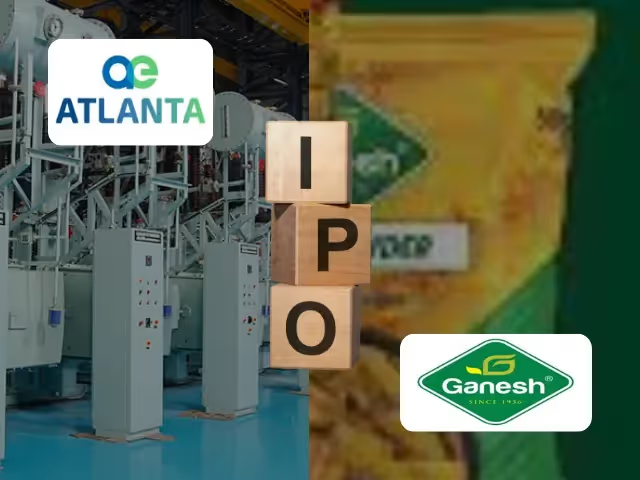
- Two IPOs are hitting Dalal Street between Sep 22–24, 2025: Atlanta Electricals and Ganesh Consumer Products.
- Atlanta Electricals focuses on manufacturing electrical equipment, with strong B2B demand.
- Ganesh Consumer is tapping into the fast-growing FMCG & packaged foods space.
- Both IPOs come amid positive secondary market sentiment post-SEBI’s recent regulatory clarity.
- Choosing the right IPO depends on sector preference, valuations, and long-term growth visibility.
Introduction
Indian stock markets continue to witness a flurry of IPO activity in 2025. Between September 22–24, two companies – Atlanta Electricals Ltd. and Ganesh Consumer Products Ltd. – are set to launch their public offerings. For investors, this raises an important question: Which IPO holds stronger potential?
This blog dives into the details of both offerings, comparing business models, financials, growth outlook, and sectoral trends to help investors make informed decisions.
Atlanta Electricals IPO – Powering the Infrastructure Boom
Atlanta Electricals is a manufacturer of transformers, switchgears, and power distribution equipment, catering primarily to state electricity boards, renewable energy projects, and large industrial clients.
Key Highlights:
- Sector Demand: With India’s ambitious power infrastructure and renewable energy push, demand for reliable electrical equipment is set to rise.
- Government Focus: Schemes like Revamped Distribution Sector Scheme (RDSS) and Green Energy Corridor are driving investments in this space.
- Financials: The company reported steady revenue growth over the last 3 years, with margins improving due to raw material cost optimization.
- Risks: The business is capital-intensive and faces raw material price volatility (especially copper and aluminum).
👉 Example: The ongoing electrification of rural India and rising EV charging infra could provide Atlanta Electricals with strong order inflows in the coming years.
Ganesh Consumer IPO – Riding India’s FMCG Wave
Ganesh Consumer Products is in the packaged foods and consumer staples segment, offering products such as ready-to-eat snacks, beverages, and household essentials.
Key Highlights:
- Sector Demand: India’s FMCG market is expected to grow at 10–12% CAGR, driven by rising incomes, urbanization, and premiumization of packaged foods.
- Consumer Behavior: Post-pandemic, health-conscious and convenience-driven products are in demand – an area Ganesh Consumer is actively targeting.
- Financials: The company has posted strong topline growth, though margins remain under pressure due to competition from established FMCG giants.
- Risks: High competition, heavy marketing spends, and changing consumer preferences could impact profitability.
👉 Example: With rural FMCG demand rebounding and modern trade channels expanding, Ganesh Consumer may benefit from a wider retail reach.
Introduction
Indian stock markets continue to witness a flurry of IPO activity in 2025. Between September 22–24, two companies – Atlanta Electricals Ltd. and Ganesh Consumer Products Ltd. – are set to launch their public offerings. For investors, this raises an important question: Which IPO holds stronger potential?
This blog dives into the details of both offerings, comparing business models, financials, growth outlook, and sectoral trends to help investors make informed decisions.
Atlanta Electricals IPO – Powering the Infrastructure Boom
Atlanta Electricals is a manufacturer of transformers, switchgears, and power distribution equipment, catering primarily to state electricity boards, renewable energy projects, and large industrial clients.
Key Highlights:
- Sector Demand: With India’s ambitious power infrastructure and renewable energy push, demand for reliable electrical equipment is set to rise.
- Government Focus: Schemes like Revamped Distribution Sector Scheme (RDSS) and Green Energy Corridor are driving investments in this space.
- Financials: The company reported steady revenue growth over the last 3 years, with margins improving due to raw material cost optimization.
- Risks: The business is capital-intensive and faces raw material price volatility (especially copper and aluminum).
👉 Example: The ongoing electrification of rural India and rising EV charging infra could provide Atlanta Electricals with strong order inflows in the coming years.
Outlook & Valuation
- The company ranks among the prominent manufacturers of power, auto, and inverter-duty transformers in India.
- With its recent acquisition and capacity expansion, it is well-positioned to capture the growing demand in the sector.
- As of March 31, 2025, it holds a strong order book of ₹1,642.96 crore.
- While the valuation is a point of caution, the company's strong fundamentals, proven track record of profitability
- Aggressive Investors with a long-term perspective may consider allocating. funds.
Ganesh Consumer IPO – Riding India’s FMCG Wave
Ganesh Consumer Products is in the packaged foods and consumer staples segment, offering products such as ready-to-eat snacks, beverages, and household essentials.
Key Highlights:
- Sector Demand: India’s FMCG market is expected to grow at 10–12% CAGR, driven by rising incomes, urbanization, and premiumization of packaged foods.
- Consumer Behavior: Post-pandemic, health-conscious and convenience-driven products are in demand – an area Ganesh Consumer is actively targeting.
- Financials: The company has posted strong topline growth, though margins remain under pressure due to competition from established FMCG giants.
- Risks: High competition, heavy marketing spends, and changing consumer preferences could impact profitability.
👉 Example: With rural FMCG demand rebounding and modern trade channels expanding, Ganesh Consumer may benefit from a wider retail reach.
Outlook & Valuation
- The company has a strong presence in the eastern region and holds the position of the third-largest brand in packaged wheat products.
- Its revenue has shown consistent growth over the reported years.
- While profits remained flat in FY23 and FY24, earnings picked up in FY25.
- It operates within a highly fragmented and competitive FMCG market.
- Looking at recent financial performance, the valuation of the issue seems on the higher side.
- The business is driven by high volumes but works on thin margins.
- Agrressive investor may apply for long term.
Market Sentiment & Timing
The timing of these IPOs is crucial. With SEBI tightening disclosure norms and ensuring greater transparency, investor trust in new listings has improved. Additionally, strong secondary market performance in 2025 has boosted retail participation.
For instance, recent IPOs in the power and FMCG sectors have seen oversubscription, indicating strong appetite among both institutional and retail investors.
Why Choose Swastika Investmart for IPO Investing?
While evaluating IPOs, having the right research tools, guidance, and seamless investing experience is essential. Swastika Investmart offers:
- SEBI-registered brokerage ensuring compliance and trust.
- Strong research-backed insights to analyze IPOs better.
- Technology-enabled trading platforms for a smooth application process.
- Investor education resources to help both beginners and experienced investors.
- Dedicated customer support for query resolution.
👉 Open your account now with Swastika Investmart and apply for IPOs seamlessly: Open Account
Frequently Asked Questions
1. Which IPO is better – Atlanta Electricals or Ganesh Consumer?
It depends on your investment preference. Atlanta Electricals suits long-term infra believers, while Ganesh Consumer appeals to those favoring FMCG-led growth.
2. What is the subscription period for these IPOs?
Both IPOs are open between September 22–24, 2025.
3. Can I apply for both IPOs simultaneously?
Yes, investors can apply for both IPOs provided they have sufficient funds in their demat and trading account.
4. Are these IPOs suitable for long-term holding?
Atlanta Electricals may offer long-term compounding linked to infrastructure, while Ganesh Consumer’s growth depends on maintaining market share in FMCG.
5. How can I apply for these IPOs online?
You can apply via UPI through your broker’s platform. With Swastika Investmart, the process is tech-enabled, simple, and quick.
Conclusion
Both Atlanta Electricals and Ganesh Consumer present unique opportunities for investors during Sep 22–24, 2025. One taps into India’s infrastructure and power growth story, while the other benefits from the consumption-driven FMCG wave.
The right choice ultimately depends on your risk profile, sector preference, and investment horizon.
For a research-backed investing journey with seamless IPO applications, explore Swastika Investmart today: Open Account
Scalping vs Swing vs Intraday – What’s the Difference?
Quick Highlights
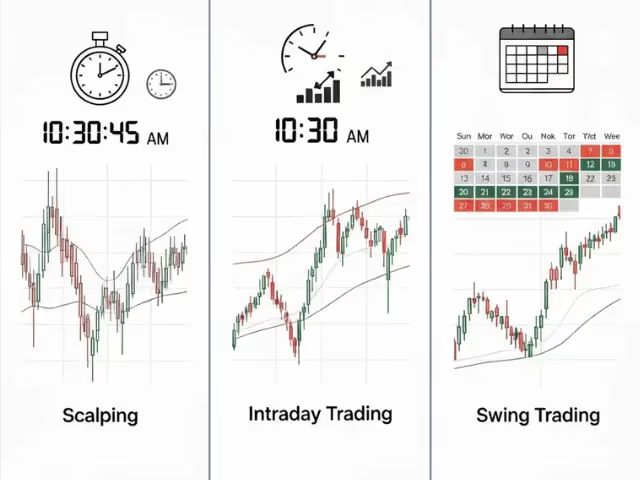
- Scalping: Ultra-short trades lasting seconds to minutes, aiming for small profits on high volumes.
- Intraday Trading: Buying and selling within the same trading session, no overnight positions.
- Swing Trading: Trades held for days to weeks, riding medium-term price trends.
- The choice depends on risk tolerance, time commitment, and capital availability.
- Swastika Investmart offers research, tools, and support for all trading styles.
Why Trading Styles Matter
Trading in the stock market isn’t one-size-fits-all. Every trader has a different:
- Risk appetite
- Capital base
- Time horizon
- Market knowledge
This is why strategies like scalping, intraday, and swing trading exist. While all involve speculation on price movements, the key differences lie in timeframe, frequency, and risk-reward profile.
Scalping – The Fastest of All
Scalping is about making multiple quick trades during the day, sometimes lasting only seconds.
- Goal: Capture tiny price movements.
- Volume: High — profits depend on frequency and quantity of trades.
- Tools Required: Advanced trading platforms, low brokerage costs, real-time charting.
- Risk: Extremely high due to transaction costs and speed.
Example: A scalper may buy Reliance shares at ₹2,750 and sell at ₹2,752 within 2 minutes, repeating this process 20–30 times daily.
Scalping is not suited for beginners — it demands discipline, lightning-fast execution, and constant screen time.
Intraday Trading – Same Day Entry & Exit
Intraday trading refers to buying and selling stocks on the same day before market close. No positions are carried overnight.
- Goal: Capture intraday volatility.
- Timeframe: Minutes to hours.
- Leverage: Often used to amplify returns.
- Risk: Moderate to high — depending on market volatility.
Example: A trader buys Infosys at ₹1,650 in the morning and exits at ₹1,700 by afternoon, booking profits within a single session.
Intraday trading is popular in India because of high liquidity in Nifty 50, Bank Nifty, and large-cap stocks.
Swing Trading – Riding the Trend
Swing trading is about holding positions for a few days to weeks to ride medium-term price movements.
- Goal: Capture larger moves than intraday.
- Timeframe: Days to weeks.
- Tools: Technical + fundamental analysis (trend lines, earnings reports, sector news).
- Risk: Lower than intraday, but exposed to overnight/global risks.
Example: Buying Tata Motors ahead of quarterly results and holding for 2 weeks to ride a bullish breakout.
Swing trading is suitable for those who can’t monitor markets full-time but still want to benefit from short-term trends.
Scalping vs Swing vs Intraday – Key Differences
Which Trading Style Is Right for You?
- Choose Scalping if you have high capital, advanced tools, and can monitor markets full-time.
- Choose Intraday if you want daily opportunities, high liquidity, and short-term profits.
- Choose Swing if you prefer less stress, can hold for days/weeks, and rely on trend analysis.
👉 For beginners, swing trading or simple intraday trades may be safer than scalping.
Swastika’s Role in Your Trading Journey
Whether you’re a scalper, intraday trader, or swing trader, success depends on the right tools and research. With Swastika Investmart, you get:
- SEBI-registered trust and compliance
- Tech-enabled platforms with advanced charting tools
- AI-driven research and market calls
- Dedicated support and investor education
👉 Open Demat & Trading account with Swastika Investmart today and trade with confidence.
FAQs
Q1. Is scalping legal in India?
Yes, scalping is legal but requires a registered broker and compliance with SEBI norms.
Q2. Which trading style is best for beginners?
Swing trading is generally considered safer for beginners as it requires less screen time and avoids intraday volatility.
Q3. Can I use leverage in intraday trading?
Yes, brokers allow leverage, but it increases both potential profits and risks.
Q4. Do FIIs or big institutions use scalping?
Yes, institutions use algorithmic scalping strategies, but retail traders should be cautious due to high risks.
Q5. Which sectors are best for intraday trading in India?
Highly liquid sectors like Banking, IT, and Energy (Nifty 50 and Bank Nifty stocks) are ideal for intraday trades.
Conclusion
Each trading style — scalping, intraday, or swing — comes with its unique risk-reward profile. Choosing the right one depends on your capital, time availability, and risk appetite.
For Indian investors, a blend of swing and intraday trading often works best, while scalping is more suited to professionals.
👉 Ready to explore your trading style? Start your journey with Swastika Investmart and get access to expert-backed research, tech platforms, and reliable support.
.avif)
Adani Group Gets Clean Chit from SEBI – Impact on Stock Market Sentiment
Quick Highlights
- SEBI has given Adani Group a clean chit, easing regulatory concerns.
- Market confidence in Adani stocks has improved, boosting investor sentiment.
- The development may trigger higher inflows from domestic and foreign investors.
- Competitive landscape remains strong; due diligence is still vital.
- Investors can explore opportunities through trusted brokers like Swastika Investmart.
A Turning Point for Adani Group
The Securities and Exchange Board of India (SEBI), India’s capital markets regulator, has cleared the Adani Group of allegations that had been clouding its reputation and weighing on investor sentiment. This regulatory relief is not just a corporate milestone for the Adani conglomerate, but also a moment that reverberates across the Indian stock market.
For months, questions over regulatory scrutiny kept many investors cautious. With the SEBI clean chit, the Adani Group can now focus fully on its expansion strategy in infrastructure, energy, ports, and airports—sectors that are vital to India’s economic growth story.
Why SEBI’s Clean Chit Matters
Restoring Investor Confidence
Regulatory clarity is often a key factor in boosting market sentiment. When an influential corporate group like Adani receives a clean regulatory report, investors see it as a green signal that reduces perceived risks.
In real terms, this could translate into:
- Renewed interest from Foreign Institutional Investors (FIIs), who had earlier pulled back.
- Increased participation from domestic retail investors, encouraged by stability.
- A positive rub-off effect on indices like Nifty 50 and sectoral benchmarks that have Adani Group companies as constituents.
Boost to Market Stability
Stock markets thrive on confidence. When large groups face prolonged uncertainty, volatility tends to rise. SEBI’s move helps reduce such uncertainty, creating a stable environment not just for Adani investors, but for the broader Indian equity market.
Impact on Adani Group Stocks
Already, market watchers have observed that Adani Enterprises, Adani Ports, and Adani Green Energy registered improved trading volumes post the SEBI announcement. While prices remain subject to global cues and sectoral dynamics, the regulatory clarity has provided a short-term lift in valuation multiples.
For example, Adani Ports—a bellwether for India’s logistics and trade infrastructure—saw heightened interest among both institutional and retail investors. Analysts believe the company is positioned to benefit from India’s rising export competitiveness and infrastructure push.
The Bigger Picture: Indian Market Sentiment
This development doesn’t just impact Adani stocks; it signals a broader theme of regulatory transparency in Indian markets. Investors, both domestic and global, now see:
- Stronger governance framework in capital markets.
- Increased accountability, which strengthens India’s case as a preferred investment destination.
- Renewed optimism in infrastructure, renewable energy, and logistics—sectors where the Adani Group plays a major role.
Such shifts matter at a macro level. India is currently one of the fastest-growing large economies. With clear regulations and reduced uncertainty, global funds are more likely to allocate capital to Indian equities.
What Should Investors Do Now?
While the SEBI clean chit is undeniably positive, it doesn’t remove all risks. Adani Group companies still operate in highly leveraged and competitive sectors. Investors should:
- Diversify portfolios instead of chasing momentum in a single group.
- Analyze valuations, as certain stocks may already be pricing in optimistic growth.
- Focus on fundamentals like earnings growth, debt management, and sectoral trends.
Here’s where a trusted partner like Swastika Investmart adds value. With its SEBI registration, in-house research tools, and technology-enabled trading platforms, Swastika helps investors make well-informed decisions. Its focus on investor education and customer support ensures that even retail participants can navigate complex markets with confidence.
👉 Open a Swastika Investmart Account to explore opportunities today.
FAQs
Q1: What did SEBI say about the Adani Group?
SEBI cleared the Adani Group of allegations, effectively giving the conglomerate a clean chit, which eased investor concerns.
Q2: How does this impact the Indian stock market?
It reduces uncertainty, boosts confidence in Indian markets, and may increase both foreign and domestic investor participation.
Q3: Should I invest in Adani stocks now?
While sentiment is positive, investors should review fundamentals, valuations, and their own risk profile before investing.
Q4: What sectors benefit the most from this development?
Infrastructure, renewable energy, ports, and logistics—sectors where Adani Group has a major presence—stand to gain.
Q5: How can Swastika Investmart help investors?
Swastika offers SEBI-regulated brokerage services, strong research insights, and customer support to help investors make informed decisions.
Conclusion
SEBI’s clean chit to the Adani Group is more than just a regulatory development—it’s a confidence booster for the entire Indian stock market. While the news strengthens investor sentiment, prudent investing remains essential. Diversification, valuation analysis, and informed decision-making are key.
With Swastika Investmart’s research-driven approach and tech-enabled platforms, investors gain the tools and guidance they need to navigate opportunities in an evolving market landscape.
👉 Open Your Account with Swastika Investmart and start investing with confidence.
.avif)
How FIIs Use Commodities to Hedge Risks in Indian Markets: A Complete Guide
Quick Highlights
- FIIs hedge equity risk in India by trading in commodities like gold, crude oil, and metals.
- Commodity derivatives on MCX and NCDEX provide efficient hedging tools.
- Hedging protects FIIs from currency fluctuations, inflation, and global volatility.
- FIIs’ strategies directly influence market liquidity and retail participation.
- Swastika Investmart offers research-driven insights and seamless commodity trading.
Why FIIs Matter in Indian Markets
Foreign Institutional Investors (FIIs) play a pivotal role in India’s capital markets. Their inflows and outflows often decide the short-term direction of indices like Nifty and Sensex. However, investing in an emerging economy like India also exposes FIIs to risks such as:
- Currency volatility (INR vs USD)
- Commodity-driven inflation (crude oil, metals, agri-commodities)
- Global macro shocks (Fed rate decisions, geopolitical tensions)
To manage these risks, FIIs actively use commodities as a hedging tool.
How Commodities Work as a Hedge for FIIs
1. Gold – The Classic Safe Haven
When FIIs expect volatility in equities, they often take positions in gold futures on MCX.
- Example: During the Russia-Ukraine conflict, FIIs increased exposure to gold to offset equity risks.
- Impact: Higher demand for gold derivatives boosts volumes on Indian exchanges.
2. Crude Oil – Hedging Against Inflation
India imports over 80% of its crude requirements. Rising crude prices mean inflationary pressures, which hurt equity markets. FIIs hedge this by:
- Going long in crude oil futures to offset inflation risks.
- Using Brent-linked contracts to manage global exposure.
3. Base Metals – Linked to Industrial Demand
Metals like copper, aluminium, and zinc are highly cyclical.
- FIIs hedge equity bets in industrial and infrastructure stocks by balancing exposure through base metals.
- For instance, in 2023–24, rising Chinese demand concerns saw FIIs turn defensive in equities while using copper futures as a hedge.
4. Agricultural Commodities – Inflation Hedge
Though not as liquid as metals or energy, agri-commodities on NCDEX provide FIIs a tool to manage inflation-linked risks. Rising food inflation can hurt consumer companies, so FIIs hedge through contracts in commodities like soybean or chana.
Tools FIIs Use in India
FIIs use regulated platforms like:
- MCX (Multi Commodity Exchange) – India’s largest commodity derivatives exchange.
- NCDEX (National Commodity & Derivatives Exchange) – Focused on agri-commodities.
With SEBI oversight, these platforms ensure transparency and liquidity for hedging activities.
Real-World Impact on Indian Markets
When FIIs hedge via commodities:
- Liquidity in commodity derivatives increases, benefitting Indian retail traders.
- Price discovery improves, as global players bring in sophisticated trading strategies.
- Market correlation rises – sudden moves in crude or gold often reflect in equity trends.
For example, in August 2025, FII outflows of nearly ₹47,000 crore from equities coincided with higher participation in gold and crude futures, showing how hedging balances exposure.
Benefits of Commodity Hedging for FIIs
- Currency Risk Management – INR depreciation against USD can be offset with crude and gold exposure.
- Diversification – Commodities often move inversely to equities.
- Inflation Protection – Rising commodity prices can hurt equity margins, but hedges balance the risk.
- Liquidity Play – Commodity derivatives offer intraday and positional opportunities.
Swastika’s Edge in Commodity Trading
While FIIs use sophisticated hedging models, retail and HNI investors can also benefit from commodity diversification. With Swastika Investmart, you get:
- SEBI-registered broker trust
- Access to MCX & NCDEX trading
- Research-backed commodity strategies
- AI-enabled platforms for real-time updates
- Investor education to simplify hedging for individuals
👉 Open your commodity enabled Demat & Trading account with Swastika Investmart today.
FAQs
Q1. Why do FIIs use commodities for hedging in India?
To balance risks from currency fluctuations, inflation, and global volatility while maintaining equity exposure.
Q2. Which commodities are most preferred by FIIs?
Gold, crude oil, and base metals like copper and aluminium are most widely used.
Q3. Do FIIs trade directly on Indian commodity exchanges?
Yes, through SEBI-regulated platforms like MCX and NCDEX, often via sub-accounts or participatory notes.
Q4. How does FII hedging impact retail investors?
It improves market liquidity, price discovery, and offers new opportunities for retail traders.
Q5. Can Indian investors also use commodities for hedging?
Yes, investors can diversify portfolios using commodities to reduce equity-linked risks.
Conclusion
FIIs are not just equity players—they are active risk managers who use commodities to stabilize their India exposure. By trading in gold, crude, metals, and agri-commodities, they hedge against inflation, currency moves, and global shocks, ensuring long-term portfolio balance.
For Indian investors, understanding these FII strategies can unlock smarter ways to invest.
👉 Experience AI-powered commodity trading with Swastika Investmart and step into the future of diversified investing.


.avif)
.avif)

.avif)




START YOUR INVESTMENT JOURNEY
Get personalized advice from our experts
- Dedicated RM Support
- Smooth and Fast Trading App